
Application Virtualization Market Size, Share & Trends by 2034
Coverage: by Organization Size (SMEs, Large enterprises); Type (Security Virtualization, Content Management System, Others); End Users (Retail and Consumer Goods, Healthcare, Industrial, IT and Telecom, Manufacturing, Others), and Geography (North America, Europe, Asia Pacific, and South and Central America)
- Status : Data Released
- Report Code : TIPRE00003638
- Category : Technology, Media and Telecommunications
- No. of Pages : 150
- Available Report Formats :


- Last update date : August 28, 2026


2025 Market Size
US$ 4.54 Bn
Base year value
2034 Forecast
US$ 8.61 Bn
Projected by 2034
CAGR 2026-2034
7.37 %
Growth rate
Addressable Market
US$ 59.29 Bn
(2026-2034)
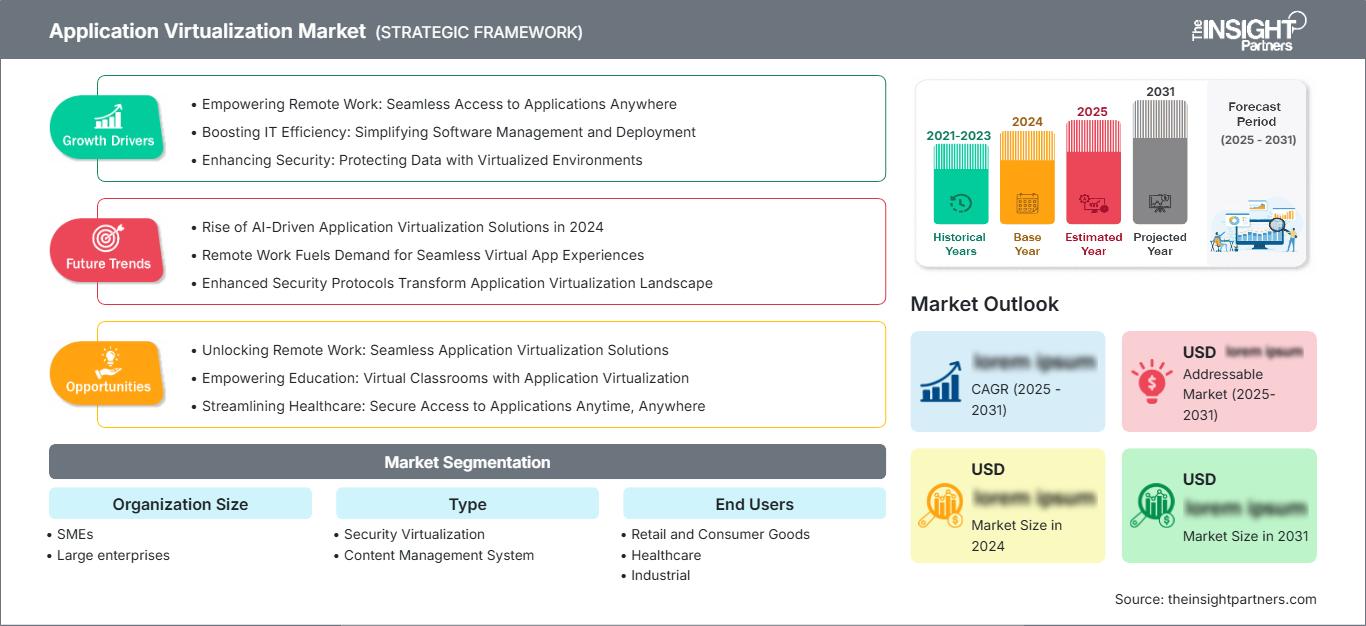
The global Application Virtualization market was valued at US$ 4.54 billion in 2025 and is expected to reach US$ 8.61 billion by 2034; it is estimated to record a CAGR of 7.37% during 2026-2034.
Application Virtualization Market Assessment and Insights
- North America: The region accounted for an estimated 36–39% share in 2025 and is expected to grow at a CAGR of 7.8–8.6% during 2026–2034, supported by hybrid work, cloud migration, and regulated-sector adoption.
- US: The US represented an estimated 78–82% of North America revenue in 2025 and is projected to expand at a CAGR of 7.9–8.7% during 2026–2034.
- Europe: Europe held an estimated 24–27% share in 2025 and is likely to grow at a CAGR of 7.2–8.0% through 2034, led by the UK, Germany, France, and the Nordic countries.
- Asia Pacific: APAC accounted for an estimated 22–25% share in 2025 and is forecast to grow at a CAGR of 8.8–9.7% during 2026–2034, led by China, India, Japan, South Korea, and Australia.
- Largest Segment: Large enterprises held an estimated 63–67% market share in 2025 and are expected to grow at a CAGR of 7.6–8.3% during 2026–2034.
- High Growth Segment: SMEs held an estimated 33–37% share in 2025 and are projected to grow at a CAGR of 8.9–9.8% during 2026–2034.
- Key companies analyzed in detail: Citrix Systems, Inc., Dell Technologies Inc., Google LLC, Microsoft Corporation, OpenText Corporation, NComputing Co., Ltd., Oracle Corporation, Red Hat, Inc., Broadcom Inc., and Gen Digital Inc.
Source: The Insight Partners' analysis based on proprietary research, government publications, company annual reports, investor presentations, industry databases, and expert interviews.
Enterprise application delivery has shifted from device-centric installation to centralized, policy-led access. The application virtualization market growth is increasingly shaped by cloud-hosted desktops, secure browser access, app streaming, and containerized delivery models that reduce compatibility risks. The focus for IT departments is on environments where applications can be maintained once, centrally managed, and then used across multiple endpoints without re-engineering each endpoint device.
Where secure access is required without adding to the complexity of endpoints, forward-looking needs will have the greatest strength. Government workloads, healthcare apps, retail, manufacturing execution systems, and IT help desks are forecasted to lead the market. The investments are also being made in identity-enabled delivery, observability, and automation.
Application Virtualization Market Report Scope
| Report Attribute | Details |
|---|---|
| Market size in 2025 | US$ 4.54 Billion |
| Market Size by 2034 | US$ 8.61 Billion |
| Global CAGR (2026 - 2034) | 7.37% |
| Historical Data | 2021-2024 |
| Forecast period | 2026-2034 |
Application Virtualization Market Analysis
The application virtualization market growth is driven by hybrid work normalization, rising endpoint diversity, and the need to manage legacy and cloud-native applications together. Virtualization technology is being deployed by enterprises to decouple applications from operating systems, facilitate patching, and minimize the time required for deployment. The need for virtualization is greatest wherever application availability, compliance, and experience need to be maintained consistently across corporate laptops, thin clients, unmanaged endpoints, and remote access points.
Another area that has witnessed improvement is ecosystem maturity. The integration between cloud platforms, identity providers, endpoint management solutions, and secure access service edge architecture with the virtualization stack makes it possible for IT departments to implement conditional access, reduce data transfer to endpoints, and increase application availability without creating virtual desktop environments for each workload.
Application virtualization market analysis shows a competitive landscape led by secure workspace, cloud infrastructure, and enterprise software vendors. Citrix Systems, Microsoft Corporation, Broadcom Inc., Dell Technologies, Oracle Corporation, Red Hat, Google LLC, OpenText Corporation, NComputing, and Gen Digital focus on integration, identification, endpoint security, and hybrid cloud support rather than stand-alone delivery platforms.
Positioning has become increasingly influenced by integration capabilities. Customers want to work with systems that have connections with Microsoft Entra ID, Azure Virtual Desktop, Chrome Enterprise, Kubernetes-based environments, content management, and zero-trust principles. Companies offering application delivery, analytics, automation, and security governance have greater advantages.
● REPORT CUSTOMIZATION
Tailor This Report To Align With Your Specific Business Requirements
This report can be customized to align precisely with your business objectives, scope, and target markets. Customization options include tailored segmentation, geography, competitive analysis, and strategic insights to support informed decision-making.
Customize This Report →WHAT YOU CAN ADJUST
- ● Segmentations
- ● Geography
- ● Competitive Analysis
- ● Language Preferences
Application Virtualization Market: Strategic Insights
Regional Insights
North America application virtualization market
North America's application virtualization market share is estimated at 36–39% in 2025, with growth expected at a CAGR of 7.8–8.6% through 2034. Adoption is reinforced by mature cloud infrastructure, cybersecurity spending, and distributed workforce models across healthcare, financial services, government, retail, and technology enterprises.
The US dominates regional demand, while Canada contributes through public-sector modernization and managed services adoption. Enterprises are consolidating application access through secure workspaces, reducing local installations, and integrating identity controls into virtualized environments. Vendor concentration also supports rapid adoption of new delivery and compliance features.
U.S. application virtualization Market
The US accounted for an estimated 78–82% of the North America application virtualization market revenue in 2025 and is projected to grow at a CAGR of 7.9–8.7% during 2026–2034. Demand comes from healthcare networks, retailers, technology firms, and regulated enterprises requiring secure delivery of business applications across hybrid workforces.
Company presence is a major accelerator. Microsoft Corporation, Citrix Systems, Oracle Corporation, Dell Technologies, Google LLC, Red Hat, and Broadcom support enterprise deployments through cloud services, virtualization platforms, and secure access tools. Adoption is shifting toward identity-based access, app isolation, and managed desktop alternatives.
Europe application virtualization Market
Europe held an estimated 24–27% share in 2025 and is projected to grow at a CAGR of 7.2–8.0% through 2034. The UK and Germany lead adoption due to enterprise cloud migration, digital workplace programs, and strong compliance requirements under data-protection frameworks.
France, Italy, and Spain are growing steadily as midmarket firms modernize legacy applications and reduce endpoint support costs. Public services, manufacturing, banking, and telecom buyers are adopting centralized application delivery to improve security, manage software versions, and support workforce flexibility across multiple countries.
APAC application virtualization Market
APAC represented an estimated 22–25% share in 2025 and is expected to grow at a CAGR of 8.8–9.7% during 2026–2034. China, India, Japan, South Korea, and Australia are leading the adoption as enterprises expand cloud infrastructure, digitize operations, and support mobile workforces.
Industrial modernization, policy-led digital transformation, and growth in IT services are increasing the demand for secure application delivery. India and China present strong volume opportunities, while Japan, South Korea, and Australia emphasize security, managed endpoints, and compliance-ready application access.
Middle East & Africa application virtualization Market
The Application Virtualization Market Report indicates that the Middle East & Africa is expected to grow at a CAGR of 7.4–8.2% during 2026–2034. Saudi Arabia and the UAE lead regional uptake as digital government, energy, aviation, and financial services organizations modernize application access for distributed teams and contractors.
South Africa remains the largest African contributor, supported by banking, telecom, and business services demand. Across the region, cloud adoption and infrastructure investment are creating opportunities for managed application virtualization, especially where organizations need secure access without large endpoint refresh cycles.
Segmentation Analysis
Organization Size
Organization Size is expected to grow at a CAGR of 8.1–8.8% during 2026–2034. The application virtualization market scope across enterprises and SMEs is widening as buyers prioritize flexible licensing, centralized administration, and secure remote delivery. Larger organizations retain the dominant revenue base, while SMEs are moving faster as cloud-hosted options reduce implementation complexity.
- SMEs: SMEs are adopting virtualized applications to access enterprise-grade software delivery without extensive infrastructure. Subscription models, managed services, and simplified administration make deployment practical for resource-constrained IT teams.
- Large enterprises: Large enterprises use virtualization to standardize application access across regions, departments, contractors, and regulated workflows. Adoption is driven by compliance, scale, distributed endpoints, and complex application estates.
Type
Type is projected to grow at a CAGR of 8.0–8.7% through 2034. Security virtualization remains strategically important because application isolation, access policy enforcement, and reduced endpoint exposure are central buying criteria. Content management system virtualization supports controlled access to enterprise content and workflows without requiring local installations.
- Security Virtualization: Security virtualization supports application isolation, controlled execution, and safer remote access. It is relevant in regulated industries where endpoint compromise, unauthorized access, and data leakage risks must be minimized.
- Content Management System: Content management system virtualization helps organizations deliver document, workflow, and collaboration applications centrally. It supports version control, access governance, and reduced dependency on device-specific software installations.
End Users
End Users are expected to grow at a CAGR of 8.2–9.0% during 2026–2034. IT and telecom remain the largest adopting verticals, while healthcare and manufacturing are accelerating due to secure access, operational continuity, and application modernization requirements across distributed environments.
- Retail and Consumer Goods: Retailers use application virtualization for point-of-sale support, workforce scheduling, inventory tools, and secure access across stores. Centralized delivery reduces downtime during seasonal demand and software updates.
- Healthcare: Healthcare providers adopt virtualized applications to support secure access to clinical systems, administrative workflows, and remote care operations while managing compliance and endpoint diversity across facilities.
- Industrial: Industrial users rely on virtualized applications to support engineering, field service, and plant management systems. Adoption improves access consistency while reducing disruption from device or operating system changes.
- IT and Telecom: IT and telecom companies use virtualization to support service delivery, internal operations, development environments, and customer support platforms. High application density makes centralized management strategically valuable.
- Manufacturing: Manufacturers deploy virtualized applications for production planning, maintenance, quality workflows, and supplier collaboration. The model helps modernize legacy applications without replacing every endpoint across plants.
Opportunity Snapshot
| End Users | Revenue Contribution | Trend Tag | Adoption Stage |
| Retail and Consumer Goods | Medium | Store Access | Scaling |
| Healthcare | High | Clinical Access | Scaling |
| Industrial | Medium | Plant Apps | Emerging |
| IT and Telecom | High | Service Desk | Mature |
| Manufacturing | Medium | Factory Systems | Scaling |
Application Virtualization Market Growth Drivers and Impact Analysis
Hybrid Workforces Require Secure Application Access
Hybrid work has made application delivery an IT strategic function instead of simply being a deployment process. Enterprises need their employees, contractors, and partners to be able to securely access their business applications from different places and different devices. Virtualization minimizes the dependency on local installations, minimizes the risk of exposing any information to endpoints, and allows central policy enforcement. It increases the resiliency of businesses in regulated industries or those with higher turnovers and geographically dispersed workforces. This effect is most prominent in the healthcare industry, retail, finance, government organizations, and IT services.
Legacy Application Modernization Without Full Replacement
Many businesses continue to rely on outdated applications that are too costly to convert or challenging to move directly into cloud-based architectures. The concept of application virtualization ensures that such programs are provided in a managed environment, thus minimizing problems with their compatibility with current operating systems and devices. The technology increases application lifespan, decreases migration risks, and offers a method for step-by-step modernization. Moreover, it facilitates acquisitions, branch expansion, and outsourcing when there is a need for users to have quick access to uniform tools.
Centralized Security and Software Lifecycle Control
There is a rising preference for centralizing application control due to the potential security holes created by having decentralized installations. Application virtualization allows updates to be performed centrally, with applications being separated from the local system and controlled via identity and access management. This ensures that there will not be a large attack surface and facilitates the demonstration of consistent policy when auditing for compliance. IT departments also gain benefits from the elimination of problems at the endpoints, easy rollback, and better monitoring of how an application is being used.
Application Virtualization Market Future Trends
Identity-Centric Virtual Workspaces
Application virtualization market trends are moving toward identity-centric workspaces where access decisions are based on user context, device posture, location, and risk signals. As opposed to just considering virtualization as a delivery platform, organizations are now linking it up with passwordless authentication, conditional access, multi-factor policies, and zero trust governance. The end result will be applications that can adapt to changes and that will become more secure as well, particularly in regulated industries. Companies whose products link up well with identity ecosystems will be preferred since buyers do not want policy silos.
Cloud-Native and Containerized Application Delivery
Future application virtualization initiatives will leverage an increasing integration of application virtualization with cloud-native infrastructure, container orchestration, and intelligent workload placement. This approach will enable organizations to deploy their applications closer to end users and enable the dynamic scaling of capacity with reduced reliance on physical data center infrastructures. Container-based deployment strategies will also increase the portability of applications among public cloud, private cloud, and edge computing environments. Increasingly, virtualization platforms will become less about publishing and more about orchestrating applications within hybrid infrastructures.
Application Virtualization Market Opportunities
Managed Application Delivery for SMEs
Application virtualization market Forecasts point to expanding SME opportunities as cloud-based and managed delivery models remove barriers related to infrastructure ownership and specialist staffing. Service providers have the option to bundle together secure access, management, backup, and support services within predictable subscription models. This is ideal for small health care facilities, retail companies, professional service firms, and regional manufacturers who require enterprise-level security but find it difficult to implement. Companies that can make the process of transitioning and licensing easy will be able to fill an untapped market need.
Vertical-Specific Secure Application Platforms
Industry-specific platforms offer an obvious opportunity due to the variation of application demands within different industries. The healthcare industry requires access control within its clinical settings, the retail industry requires continuity at the level of each store, the manufacturing industry requires integration with production and engineering applications, and the telecom industry requires robust service operations. The solution vendors can leverage their ability to create templates, policies, compliance checks, and integrations specific to each type of workflow.
Frequently Asked Questions

- Comprehensive Market Sizing and Forecast Analysis
- Detailed Segmentation Analysis
- In-Depth Market Dynamics Assessment
- Regional and Country-Level Insights
- Competitive Landscape and Company Benchmarking
- Strategic Business Intelligence
Recent Reports
Testimonials

The Insight Partners' SCADA System Market report is comprehensive, with valuable insights on current trends and future forecasts. The team was highly professional, responsive, and supportive throughout. We are very satisfied and highly recommend their services.
RAN KEDEM Partner, Reali Technologies LTDs
I requested a report on a very specific software market and the team produced the report in a few days. The information was very relevant and well presented. I then requested some changes and additions to the report. The team was again very responsive and I got the final report in less than a week.
JEAN-HERVE JENN Chairman, Future Analytica
We worked with The Insight Partners for an important market study and forecast. They gave us clear insights into opportunities and risks, which helped shape our plans. Their research was easy to use and based on solid data. It helped us make smart, confident decisions. We highly recommend them.
PIYUSH NAGPAL Sr. Vice President, High Beam Global
The Insight Partners delivered insightful, well-structured market research with strong domain expertise. Their team was professional and responsive throughout. The user-friendly website made accessing industry reports seamless. We highly recommend them for reliable, high-quality research services
YUKIHIKO ADACHI CEO, Deep Blue, LLC.
This is the first time I have purchased a market report from The Insight Partners.While I was unsure at first, I visited their web site and felt more comfortable to take the risk and purchase a market report.I am completely satisfied with the quality of the report and customer service. I had several questions and comments with the initial report, but after a couple of dialogs over email with their analyst I believe I have a report that I can use as input to our strategic planning process.Thank you so much for taking the extra time and making this a positive experience.I will definitely recommend your service to others and you will be my first call when we need further market data.
JOHN SUZUKI President and Chief Executive Officer, Board Director, BK Technologies
I wish to appreciate your support and the professionalism you displayed in the course of attending to my request for information regarding to infectious disease IVD market in Nigeria. I appreciate your patience, your guidance, and the fact that you were willing to offer a discount, which eventually made it possible for us to close a deal. I look forward to engaging The Insight Partners in the future, all thanks to the impression you have created in me as a result of this first encounter.
DR CHIJIOKE ONYIA MANAGING DIRECTOR, PineCrest Healthcare Ltd.Reason to Buy
- Informed Decision-Making
- Understanding Market Dynamics
- Competitive Analysis
- Identifying Emerging Markets
- Customer Insights
- Market Forecasts
- Risk Mitigation
- Boosting Operational Efficiency
- Strategic Planning
- Investment Justification
- Tracking Industry Innovations
- Aligning with Regulatory Trends





 Get Free Sample for