
AR Content Management System Market Share, Growth & Forecast by 2034
Coverage: By Deployment (Cloud, On Premise); Industry (Healthcare, Retail, Media and Entertainment, Manufacturing, Education, Others) , and Geography (North America, Europe, Asia Pacific, and South and Central America)
- Status : Data Released
- Report Code : TIPRE00023887
- Category : Technology, Media and Telecommunications
- No. of Pages : 150
- Available Report Formats :


- Last update date : August 28, 2026


2025 Market Size
US$ 1.41 Bn
Base year value
2034 Forecast
US$ 5.37 Bn
Projected by 2034
CAGR 2026-2034
15.98 %
Growth rate
Addressable Market
US$ 28.62 Bn
(2026-2034)
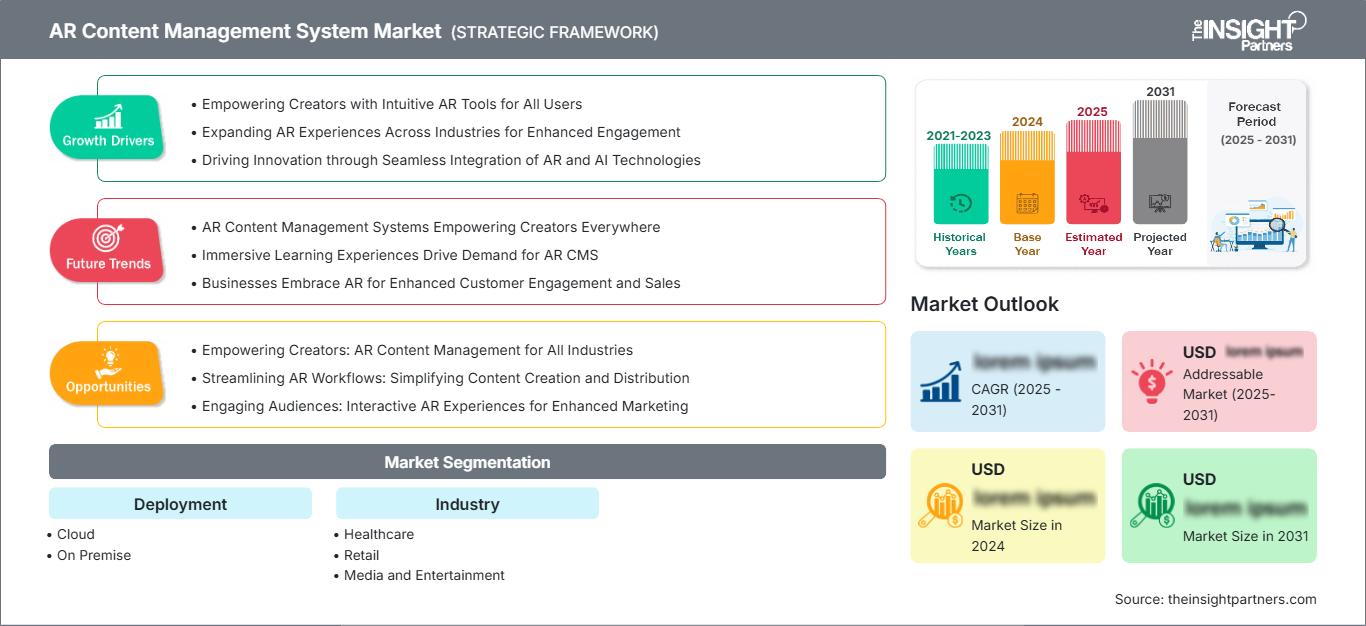
The AR content management system market was valued at US$ 1.41 Billion in 2025 and is projected to reach US$ 5.37 Billion by 2034; it is expected to register a CAGR of 15.98% from 2026 to 2034. Growth is being shaped by enterprise demand for scalable augmented reality publishing, reusable 3D content workflows, and secure content orchestration across training, retail, healthcare, manufacturing, education, and media environments.
Across North America, enterprise buyers are expected to adopt platforms at a modeled CAGR range of 14.7–16.2% during 2026–2034, supported by cloud migration and stronger digital experience budgets. The AR content management system market size in the region benefits from structured procurement in healthcare, retail, and manufacturing, where AR content libraries reduce repeat development costs and improve field deployment consistency.
AR Content Management System Market Assessment and Insights
- North America accounted for 34–37% share in 2025 and is expected to grow at a CAGR of 14.7–16.2% during 2026–2034, led by enterprise cloud adoption, workflow digitization, and strong AR use in training.
- US represented 78–82% of North America in 2025 and is expected to expand at a CAGR of 14.8–16.3% during 2026–2034, driven by retail, defense, healthcare, and industrial pilots.
- Europe held 24–27% share in 2025 and is projected to grow at a CAGR of 13.8–15.4% during 2026–2034, with the UK, Germany, and France leading adoption.
- Asia Pacific held 25–28% share in 2025 and is expected to grow at a CAGR of 17.3–19.2% during 2026–2034, led by China, Japan, South Korea, India, and Australia.
- Largest Segment: Cloud held 68–72% market share in 2025 and is projected to register a CAGR of 16.4–18.1% during 2026–2034.
- High Growth Segment: Healthcare held 16–19% market share in 2025 and is likely to grow at a CAGR of 18.1–20.3% during 2026–2034.
- Key companies analyzed in detail: Zappar Ltd., BUNDLAR, LLC, itSilesia Sp. z o.o., Vertebrae Inc., Cosmic, PAPER.plus, KOALAR GmbH, Plattar Pty Ltd, AugRay LLC, VNTANA Inc.
Source: The Insight Partners' analysis based on proprietary research, government publications, company annual reports, investor presentations, industry databases, and expert interviews.
The development of the platform is moving away from campaign-oriented AR creation and toward governed content platforms connecting 3D assets, access controls, analytics, and publishing systems. The vendors are developing no-code creation capabilities, WebAR delivery, asset optimization, and automated workflow processes, thus reducing their reliance on specialized developers. In addition, the production process itself will change as corporations leverage their CAD data, packaging data, training, and product data for many AR experiences rather than creating new applications for each campaign and each department separately.
As far as the future goes, the investment in Asia Pacific manufacturing, European retail transformation, and North American healthcare training will increase. The regulatory forces pushing toward more accessible experiences, clearer product information, and increased safety in workplaces will contribute to the controlled publication of AR. In addition, public sector transformation, educational technology purchases, and cloud-based asset management will further help the adoption.
AR Content Management System Market Report Scope
| Report Attribute | Details |
|---|---|
| Market size in 2025 | US$ 1.41 Billion |
| Market Size by 2034 | US$ 5.37 Billion |
| Global CAGR (2026 - 2034) | 15.98% |
| Historical Data | 2021-2024 |
| Forecast period | 2026-2034 |
AR Content Management System Market Analysis
The AR content management system market growth is tied to a practical enterprise problem: immersive content must be created, updated, approved, distributed, and measured without rebuilding every experience. Retailers leverage AR CMS solutions for their product visualization libraries, manufacturers link digital work instructions to on-site equipment, and healthcare establishments implement scenario-based training modules. The demand arises wherever the need exists for frequently updated, localized, and approved content.
The ecosystem consists of 3D artists, software providers, cloud infrastructure providers, device providers, content agencies, and enterprise IT. Improvements in the supply environment exist due to the advent of WebAR, cloud rendering, and reusable templates that decrease complexity in projects. Nevertheless, the lack of skills in 3D optimization and spatial design hinders the growth and presents an opportunity for platforms that facilitate publishing while providing security and analytics.
Competitive positioning is fragmented, and the AR content management system market analysis shows a clear split between specialist AR CMS vendors and broader 3D asset management providers. The companies that operate through platform depth include Zappar Ltd., BUNDLAR, LLC, VNTANA Inc., and Plattar Pty Ltd. The companies that focus on use-case specialization include Cosmic and PAPER.plus, KOALAR GmbH, and AugRay LLC. Investments are being made in integration-focused solutions and not in novel solutions for AR experiences. BUNDLAR is focusing on enterprise and defense applications, VNTANA Inc. is focusing on 3D asset pipeline development, and Zappar Ltd. is focusing on WebXR and accessibility.
● REPORT CUSTOMIZATION
Tailor This Report To Align With Your Specific Business Requirements
This report can be customized to align precisely with your business objectives, scope, and target markets. Customization options include tailored segmentation, geography, competitive analysis, and strategic insights to support informed decision-making.
Customize This Report →WHAT YOU CAN ADJUST
- ● Segmentations
- ● Geography
- ● Competitive Analysis
- ● Language Preferences
AR Content Management System Market: Strategic Insights
Regional Insights
North America AR content management system market
North America accounted for 34–37% share in 2025 and is projected to grow at a CAGR of 14.7–16.2% during 2026–2034. The region’s AR content management system market share is supported by enterprise cloud maturity, strong digital commerce infrastructure, and sustained investment in immersive training. Healthcare, retail, and manufacturing buyers favor platforms that integrate with learning systems, product data repositories, and compliance workflows.
Adoption is also reinforced by defense modernization and field-service digitization. Organizations in the US and Canada increasingly require AR content that can be updated centrally, deployed across mobile and wearable devices, and tracked through analytics dashboards. This favors cloud-based vendors with security controls, modular templates, and support for both WebAR and app-based experiences.
U.S. AR Content Management System Market
The US represented 78–82% of North America AR Content Management System Market in 2025 and is expected to expand at a CAGR of 14.8–16.3% during 2026–2034. Repeatable AR content workflows for healthcare simulation, maintenance training, retail visualization, and defense readiness are being favored by enterprise customers. Enterprise customers show the greatest strength of company presence in platform vendors, creative studios, and 3D workflows vendors catering to large companies.
Applications for AR include a shift away from one-off branding experiences to a managed library of immersive content. US retailers make use of 3D product models to lower uncertainty in online purchases, while manufacturers use AR instructions for technicians. AR content in healthcare establishments is being explored for training purposes.
Europe AR Content Management System Market
Europe held 24–27% share of the AR Content Management System Market in 2025 and is projected to grow at a CAGR of 13.8–15.4% during 2026–2034. The United Kingdom leads the pack with support from creative technology consultancies, retail testing programs, and media immersion applications. The demand for AR in the UK is highest in areas of brand engagement, easy packaging, education, and eCommerce, with WebAR minimizing barriers to adoption within consumer-facing applications.
Germany adds its value with use cases in manufacturing and industry training. Automotive, machinery, and technical education companies are implementing AR content management systems (CMS) to visualize product information and instructions. France, Italy, and Spain are emerging nations with AR applications in retail, media, educational, and packaging use cases.
APAC AR Content Management System Market
APAC accounted for 25–28% share of the AR Content Management System Market in 2025 and is forecast to register a CAGR of 17.3–19.2% during 2026–2034. China leads due to large-scale retail digitization, manufacturing automation, and mobile-first consumer engagement. Japan and South Korea support enterprise XR innovation through electronics, gaming, education, and advanced manufacturing ecosystems.
India and Australia are entering a scaling phase, with demand from education technology, e-commerce, workforce training, and property visualization. Policy support for digital learning, smart manufacturing, and Industry 4.0 programs enhances adoption. Platforms with localization, mobile compatibility, and cost-efficient cloud deployment are positioned to gain faster traction across diverse APAC markets.
Middle East & Africa AR Content Management System Market
The Middle East & Africa AR Content Management System Market is expected to grow at a CAGR of 12.9–14.6% during 2026–2034. Saudi Arabia and the UAE lead adoption through infrastructure, tourism, education, and smart-city initiatives. AR CMS platforms are being evaluated for visitor engagement, technical training, retail activations, and asset visualization in large development programs.
South Africa and the Rest of MEA show earlier-stage adoption, mainly in education, mobile commerce, and enterprise training. Energy and infrastructure companies create demand for guided maintenance and safety content, but budget cycles and skills availability slow deployment. Cloud delivery and template-based authoring are likely to improve accessibility for mid-sized organizations.
Segmentation Analysis
Deployment
The deployment segment is expected to grow at a CAGR of 15.6–17.4% during 2026–2034. The AR content management system market scope in deployment is defined by enterprise preference for flexible publishing, security, uptime, and integration with content operations. Cloud dominates because it enables distributed teams to create, approve, update, and analyze AR experiences across regions, while on-premises remains relevant for defense, regulated healthcare, and restricted industrial environments.
- Cloud platforms hold the strongest position because they support rapid content updates, device-independent access, analytics, and integration with digital asset systems across retail, media, healthcare, and education workflows.
- On Premise deployments remain strategically important for organizations requiring strict data residency, offline operation, classified content control, or integration with protected internal systems in defense and manufacturing.
Industry
The industry segment of the AR Content Management System Market is projected to grow at a CAGR of 15.2–17.1% during 2026–2034. Adoption differs by content intensity, compliance exposure, and the measurable value of immersive guidance. Retail and media use AR CMS platforms to increase engagement and conversion, while healthcare and manufacturing emphasize repeatable training, safer procedures, and knowledge transfer. Education is expanding as institutions seek immersive learning tools with manageable authoring costs.
- Healthcare is a high-growth industry, driven by procedural training, patient education, equipment familiarization, and demand for governed immersive content that can be reviewed, updated, and reused.
- Retail uses AR CMS platforms for product visualization, packaging engagement, virtual try-on workflows, and campaign localization, making content reuse and analytics central to commercial value.
- Media and Entertainment demand is linked to interactive storytelling, fan engagement, location-based experiences, and branded WebAR campaigns that require fast publishing across mobile channels.
- Manufacturing adoption is shaped by maintenance guidance, assembly support, safety procedures, and technical training, especially where AR content can reduce dependence on expert travel.
- Education is moving from experimental AR lessons toward platform-managed immersive modules, allowing teachers and content teams to update experiences without advanced development skills.
Opportunity Snapshot
| Industry | Revenue Contribution | Trend Tag | Adoption Stage |
| Healthcare | High | Clinical Training | Scaling |
| Retail | High | Product Visualization | Mature |
| Media and Entertainment | Medium | Fan Engagement | Scaling |
| Manufacturing | High | Work Instructions | Scaling |
| Education | Medium | Immersive Learning | Emerging |
AR Content Management System Market Growth Drivers and Impact Analysis
Enterprise Need for Reusable Immersive Content
Businesses are transitioning away from sporadic AR promotions due to the inability to make constant updates to their products and to customize them according to regional differences. A CMS solution will allow the teams to work with 3D models, triggers, templates, permissions, and analytics within a single platform. This is even more true in the retail, healthcare, and manufacturing industries where the same product or procedure might need different experiences to be designed for sales, training, service, and education. The change in the market is reflected in changing buyer priorities from innovation to efficiency. This is why AR vendors offering reuse of assets, permissions, and content integration will fare better.
Cloud-Based Publishing and WebAR Accessibility
This trend of cloud-based deployments has been increasing its pace of adoption due to low burden of infrastructure and the ability to facilitate distributed teams working on the content creation. WebAR is improving this approach even more by offering users an opportunity to consume experiences via their browsers and QR codes rather than downloading the applications. For enterprises, this will reduce friction in use cases such as packaging, retail, education, and visitor engagement. At the same time, the consequence of such technology adoption will be higher participation of marketing, training, and product teams, who used to rely only on developers for updates.
Workforce Training and Field Support Digitization
A lack of skills and an increase in the complexity of equipment are contributing to greater demands for visuals, guidance, and repeatable training content. Manufacturers, medical facilities, military units, and energy companies require a way to distribute expert knowledge to the employees on the front lines without depending solely on the classroom or documentation. AR CMS systems allow teams to deliver step-by-step instructions, safety recommendations, and contextual overlays that are centrally managed. The effects are most apparent in cases when mistakes result in downtime, danger, and non-compliance issues. Purchasers do not treat AR as a device but concentrate on managing their content.
AR Content Management System Market Future Trends
AI-Assisted Spatial Content Operations
The next phase of AR content management system market trends will center on AI-assisted conversion, tagging, localization, and optimization of 3D and AR assets. Enterprises hold large volumes of CAD, product photography, manuals, and learning content that are not immediately usable in immersive formats. AI can shorten preparation cycles by recommending spatial layouts, compressing assets, generating metadata, and adapting content for different devices. This will not eliminate designers, but it will reduce repetitive production work and improve consistency. Vendors that combine AI with review controls, audit trails, and human approval will become more relevant to regulated and brand-sensitive industries.
Convergence of AR CMS, 3D DAM, and Digital Twins
AR content management is likely to converge with 3D digital asset management and digital twin workflows. Manufacturers, retailers, and infrastructure operators increasingly want one governed source for product models, training overlays, simulation assets, and customer-facing visualization. This trend will push platforms to support richer metadata, version control, engineering file conversion, and multi-channel publishing. The strategic implication is that AR CMS may become part of broader spatial data infrastructure rather than a standalone marketing tool. Buyers will evaluate vendors based on interoperability with PLM, DAM, LMS, CRM, and analytics systems.
AR Content Management System Market Opportunities
Verticalized Platforms for Healthcare and Manufacturing
Healthcare and manufacturing offer strong opportunities for vendors that build industry-specific workflows rather than generic authoring tools. Buyers in these sectors need content permissions, validation steps, safety documentation, multilingual support, and measurable training outcomes. The AR content management system market Forecasts point to rising demand for platforms that package templates for clinical equipment training, assembly guidance, inspection procedures, and field support. Vendors can improve adoption by offering preconfigured integrations with learning management systems, quality management tools, and enterprise identity systems. The opportunity is not only software licensing but recurring services around content migration, workflow design, and performance analytics.
AR-Enabled Product Commerce and Packaging Experiences
Retailers and consumer brands are looking for ways to make digital product discovery more informative without adding friction to the buyer journey. AR CMS platforms can help manage virtual product views, packaging-linked instructions, sustainability information, and post-purchase support from a single content layer. This creates opportunities in furniture, apparel, consumer electronics, food packaging, and beauty products. Platforms that combine QR activation, WebAR delivery, 3D asset optimization, and engagement analytics can support both conversion and customer education. As product information regulations and accessibility expectations increase, managed AR content could become a practical extension of digital shelf strategy.
Frequently Asked Questions

- Comprehensive Market Sizing and Forecast Analysis
- Detailed Segmentation Analysis
- In-Depth Market Dynamics Assessment
- Regional and Country-Level Insights
- Competitive Landscape and Company Benchmarking
- Strategic Business Intelligence
Recent Reports
Testimonials

The Insight Partners' SCADA System Market report is comprehensive, with valuable insights on current trends and future forecasts. The team was highly professional, responsive, and supportive throughout. We are very satisfied and highly recommend their services.
RAN KEDEM Partner, Reali Technologies LTDs
I requested a report on a very specific software market and the team produced the report in a few days. The information was very relevant and well presented. I then requested some changes and additions to the report. The team was again very responsive and I got the final report in less than a week.
JEAN-HERVE JENN Chairman, Future Analytica
We worked with The Insight Partners for an important market study and forecast. They gave us clear insights into opportunities and risks, which helped shape our plans. Their research was easy to use and based on solid data. It helped us make smart, confident decisions. We highly recommend them.
PIYUSH NAGPAL Sr. Vice President, High Beam Global
The Insight Partners delivered insightful, well-structured market research with strong domain expertise. Their team was professional and responsive throughout. The user-friendly website made accessing industry reports seamless. We highly recommend them for reliable, high-quality research services
YUKIHIKO ADACHI CEO, Deep Blue, LLC.
This is the first time I have purchased a market report from The Insight Partners.While I was unsure at first, I visited their web site and felt more comfortable to take the risk and purchase a market report.I am completely satisfied with the quality of the report and customer service. I had several questions and comments with the initial report, but after a couple of dialogs over email with their analyst I believe I have a report that I can use as input to our strategic planning process.Thank you so much for taking the extra time and making this a positive experience.I will definitely recommend your service to others and you will be my first call when we need further market data.
JOHN SUZUKI President and Chief Executive Officer, Board Director, BK Technologies
I wish to appreciate your support and the professionalism you displayed in the course of attending to my request for information regarding to infectious disease IVD market in Nigeria. I appreciate your patience, your guidance, and the fact that you were willing to offer a discount, which eventually made it possible for us to close a deal. I look forward to engaging The Insight Partners in the future, all thanks to the impression you have created in me as a result of this first encounter.
DR CHIJIOKE ONYIA MANAGING DIRECTOR, PineCrest Healthcare Ltd.Reason to Buy
- Informed Decision-Making
- Understanding Market Dynamics
- Competitive Analysis
- Identifying Emerging Markets
- Customer Insights
- Market Forecasts
- Risk Mitigation
- Boosting Operational Efficiency
- Strategic Planning
- Investment Justification
- Tracking Industry Innovations
- Aligning with Regulatory Trends





 Get Free Sample for