
AR SDK Software Market Size, Growth & Trends by 2034
Coverage: by Platform (Mac, Windows, Android, IOS); Application (Shopping, Education, Gaming, Medical, Others) , and Geography (North America, Europe, Asia Pacific, and South and Central America)
- Status : Data Released
- Report Code : TIPRE00012428
- Category : Technology, Media and Telecommunications
- No. of Pages : 150
- Available Report Formats :


- Last update date : August 28, 2026


2025 Market Size
US$ 4.02 Bn
Base year value
2034 Forecast
US$ 8.88 Bn
Projected by 2034
CAGR 2026-2034
9.21 %
Growth rate
Addressable Market
US$ 57.67 Bn
(2026-2034)
The global AR SDK Software market was valued at US$ 4.02 billion in 2025 and is expected to reach US$ 8.88 billion by 2034; it is estimated to record a CAGR of 9.21% during 2026-2034.
AR SDK Software Market Assessment and Insights
- North America accounted for 35–39% share in 2025 and is projected to grow at a CAGR between 2026–2034 of 9.8–10.8%, driven by cloud-native development ecosystems, enterprise XR pilots, and mature Android and iOS developer bases.
- US represented 76–80% of North America in 2025 and is expected to grow at a CAGR between 2026–2034 of 9.7–10.7%, supported by platform providers, gaming studios, retailers, and healthcare innovation hubs.
- Europe held 24–28% share in 2025 and is projected to grow at a CAGR between 2026–2034 of 9.0–10.0%, with the UK, Germany, and France leading demand in industrial visualization, training, and consumer engagement.
- Asia Pacific captured 25–29% share in 2025 and is forecast to expand at a CAGR between 2026–2034 of 11.2–12.2%, led by China, Japan, South Korea, and India across gaming, shopping, and education adoption.
- Largest Segment: Android held 44–48% market share in 2025 and is forecast to grow at a CAGR between 2026–2034 of 10.6–11.6%, favored by device scale and developer accessibility.
- High Growth Segment: Medical accounted for 12–16% market share in 2025 and is projected to grow at a CAGR between 2026–2034 of 12.5–13.5%, supported by simulation, procedure planning, and training.
- Key companies analyzed in detail: Amazon Web Services, Inc., Google LLC, Seerslab Inc., realityBLU Inc., VisionStar Information Technology (Shanghai) Co., Ltd., MAXST Co., Ltd., PTC Inc., Wikitude GmbH, XLsoft Corporation, Zappar Ltd.
Source: The Insight Partners' analysis based on proprietary research, government publications, company annual reports, investor presentations, industry databases, and expert interviews.
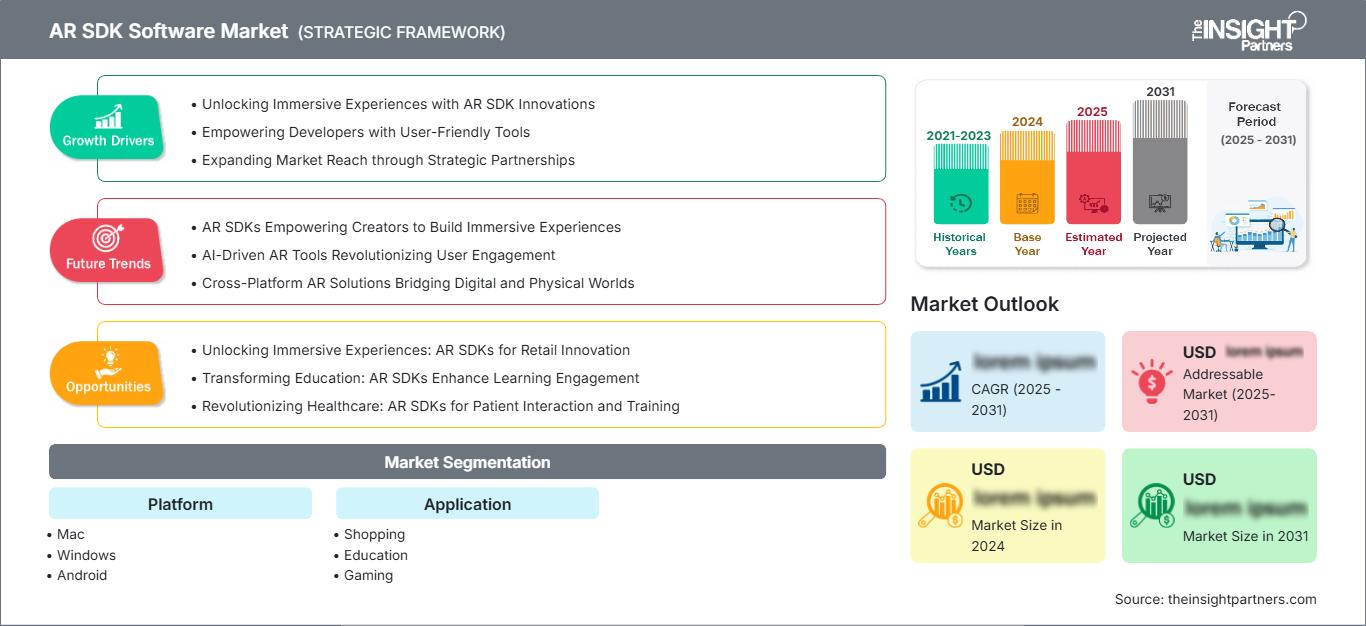
From marker-based overlays and app-based visualization solutions, the technology moved to spatially aware software development kits (SDKs) supporting such features as depth estimation, plane detection, object recognition, cloud anchors, and cross-device rendering. Development has become less about custom engineering and more about reusable modules, saving the development time of companies focused on commerce, gaming, education, and healthcare. In terms of vendors, accuracy of tracking, integration with workflows based on Unity, cloud computing, privacy, and low latency are key competitive advantages.
In the future, usage of the technology will increase in emerging markets due to increased smartphone penetration, 5G coverage, and investments in digital learning, providing a growing pool of developers. In addition, positive regulatory factors related to remote care, digital training, and safer industrial operations are driving enterprises' spending. Investments will be oriented toward SDKs with spatial mapping capabilities, AI-driven recognition, and safe deployment approaches.
AR SDK Software Market Report Scope
| Report Attribute | Details |
|---|---|
| Market size in 2025 | US$ 4.02 Billion |
| Market Size by 2034 | US$ 8.88 Billion |
| Global CAGR (2026 - 2034) | 9.21% |
| Historical Data | 2021-2024 |
| Forecast period | 2026-2034 |
AR SDK Software Market Analysis
Demand is expanding as enterprises seek measurable productivity and customer engagement gains from immersive experiences. AR SDK software market growth is being supported by cloud rendering, mobile computer vision, and device-level sensors that make AR deployment more reliable. SDKs help in placing products virtually for retailers, create interactive content for educators and test simulations in health care before using the hardware-intensive immersive system.
It consists of SDK developers, cloud service providers, hardware manufacturers, game engines, application developers and system integrators. The supply is affected by OS upgrades, camera ability, chip ability and developer documentation quality. The SDKs that reduce integration difficulty and give good support to the Android, iOS, Windows and Mac environments have an advantage of capturing ongoing development work and renewal of licenses.
Competitive intensity remains high because platform leaders and specialist SDK developers address different buying criteria. Google LLC strengthens mobile reach through ARCore, Amazon Web Services, Inc. supports spatial computing infrastructure, while PTC Inc. emphasizes enterprise object recognition and industrial deployment. Seerslab Inc., MAXST Co., Ltd., Wikitude GmbH, Zappar Ltd., and realityBLU Inc. compete through verticalized use cases and developer-focused tooling.
Investment patterns indicate a shift from novelty applications toward commercial workflows requiring reliability, security, and measurable return. The AR SDK software market analysis shows that buyers increasingly evaluate SDKs by tracking quality, integration depth, documentation, cloud functions, and regulatory readiness. VisionStar Information Technology (Shanghai) Co., Ltd. and XLsoft Corporation remain relevant for regional developer communities and distribution-led adoption.
● REPORT CUSTOMIZATION
Tailor This Report To Align With Your Specific Business Requirements
This report can be customized to align precisely with your business objectives, scope, and target markets. Customization options include tailored segmentation, geography, competitive analysis, and strategic insights to support informed decision-making.
Customize This Report →WHAT YOU CAN ADJUST
- ● Segmentations
- ● Geography
- ● Competitive Analysis
- ● Language Preferences
AR SDK Software Market: Strategic Insights
Regional Insights
North America AR SDK software market
North America held 35–39% share in 2025 and is projected to grow at a CAGR of 9.8–10.8% through 2034. The region benefits from concentrated cloud infrastructure, strong app development ecosystems, and early enterprise adoption across retail, medical training, and industrial visualization. The AR SDK software market share is also supported by high spending on immersive content production and mature integration with mobile operating systems.
Enterprise buyers in the region are moving from pilot applications toward repeatable deployment frameworks. Retailers use AR for product visualization, education providers apply immersive modules to improve participation, and healthcare organizations test simulation-based training. Vendor proximity, developer communities, and cloud availability improve deployment speed, making North America a stable revenue base even as faster growth emerges elsewhere.
U.S. AR SDK Software Market
The U.S. represented 76–80% of the North America AR SDK Software Market in 2025 and is projected to grow at a CAGR of 9.7–10.7% during 2026–2034. Influence on the domestic market from Google LLC, Amazon Web Services Inc., PTC Inc., and other application developers, agencies, and system integrators. The country is the leader in regional penetration in areas of retailing, gaming, education, and medical education processes.
The trends in applications are going more and more towards the "try before you buy" retail model, simulation-based medical education, and digital instructions for industrial purposes. Gaming remains an important testing ground since it tests the tracking quality and user experience. Enterprises in the U.S. seem ready to pay for analytics, cloud services, privacy, and SDK support features.
Europe AR SDK Software Market
Europe accounted for 24–28% share of the AR SDK Software Market in 2025 and is expected to grow at a CAGR of 9.0–10.0% through 2034. The United Kingdom leads the market, aided by creative technology houses, retail technology, gaming capabilities, and education technology. Local buyers are keen on SDKs that can cater to both consumer and enterprise software needs.
Manufacturing capabilities, engineering training, and industrial visualization influence the German market. Businesses make use of AR SDKs for assembly guidance, maintenance instructions, and demonstrations. The market is cautious and focused on integration, prioritizing reliability and security rather than standalone immersive products.
Luxury retail, tourism, medicine education, and creative media come from France, Italy, and Spain. The French market is showing progress in brand retailing and cultural activities; Italy, in design visualization; and Spain, in education and interactive media. Growth in these regions continues to be slow due to procurement cycles and data privacy considerations.
APAC AR SDK Software Market
APAC held 25–29% share of the AR SDK Software Market in 2025 and is forecast to grow at a CAGR of 11.2–12.2% through 2034, making it the fastest expanding regional market. China has the lead by virtue of mobile commerce volume, gaming groups, and ecosystems of device manufacturing. The contribution of Japan and South Korea comes from gaming, consumer electronics, and sophisticated content production.
India and Australia are increasing adoption via edtech, healthcare training, and enterprise digitization. Policy support for digital infrastructure and modernization increases prospects. Use cases are broadening from large enterprises to mid-sized enterprises, training programs, and local language content development.
Middle East & Africa AR SDK Software Market
The Middle East & Africa AR SDK Software Market is forecast to grow at a CAGR of 8.4–9.4% during 2026–2034, with the UAE leading adoption through smart city programs, retail innovation, tourism, and digital learning. Saudi Arabia is expanding immersive demand through infrastructure, healthcare modernization, and workforce training investments tied to economic diversification.
South Africa anchors demand in education, retail engagement, and enterprise training, while the rest of MEA remains at an earlier stage. Energy and infrastructure projects create practical use cases for remote assistance, asset visualization, and safety training. Growth is constrained by device affordability and specialist developer availability, but cloud access and public digital programs improve long-term potential.
Segmentation Analysis
Platform
The Platform segment is projected to grow at a CAGR of 10.1–11.1% during 2026–2034 as developers prioritize deployment flexibility across mobile and desktop environments. The AR SDK software market scope is increasingly defined by SDKs that offer stable APIs, strong documentation, and cross-platform rendering. Platform choice strongly influences target users, device reach, monetization models, and enterprise support requirements.
- Mac supports creative studios, education publishers, and enterprise prototyping teams that require high-performance content preparation, testing, and visualization before mobile or headset deployment.
- Windows maintains strategic importance in enterprise training, simulation, and industrial settings where workstations, engineering files, and controlled deployment environments remain central to AR production workflows.
- Android is the largest platform due to global device scale, affordability, and broad developer access, especially in gaming, shopping, education, and emerging-market deployments.
- IOS attracts premium retail, medical, education, and branded experiences because device standardization, camera quality, and user spending support polished AR applications.
Application
The Application segment of the AR SDK Software Market is projected to grow at a CAGR of 10.7–11.7% through 2034 as AR moves from experimental engagement toward measurable workflow value. Shoppers and games provide consumer reach, and education and medicine applications ensure institutional demand over time. More and more, vendors are bundling SDK capabilities to address verticals through things such as object tracking, placement, collaboration, and analytics.
- Shopping uses AR to reduce product uncertainty, support virtual try-ons, and improve online conversion by letting consumers evaluate scale, fit, and style before purchase.
- Education benefits from interactive visualization in science, anatomy, engineering, and vocational training, especially where spatial understanding improves learner engagement and concept retention.
- Gaming remains a core demand generator because it pushes SDK performance, multiplayer interaction, spatial persistence, and real-time responsiveness across diverse mobile devices.
- Medical is the high-growth application as hospitals, universities, and device makers evaluate AR for anatomy instruction, procedural simulation, rehabilitation, and clinical workflow training.
Opportunity Snapshot
| Application | Revenue Contribution | Trend Tag | Adoption Stage |
| Shopping | High | Virtual Try-On | Scaling |
| Education | Medium | Immersive Learning | Scaling |
| Gaming | High | Spatial Play | Mature |
| Medical | Medium | Clinical Simulation | Emerging |
AR SDK Software Market Growth Drivers and Impact Analysis
Expansion of Mobile AR Development Ecosystems
The AR SDK Software Market is significantly influenced by mobile-first development, which remains the most important demand driver because Android and iOS devices give AR applications immediate distribution scale without requiring dedicated headsets. The providers of SDKs have been making improvements in motion tracking, light estimation, depth sensing, and cloud anchors, which allow developers to come up with more stable apps in the areas of shopping, education, gaming, and healthcare. These improvements can be seen in the market through reduced time spent in the development process, increased experimentation among agencies and organizations, and increased transition from concepts to commercial apps. In this regard, as smartphones come with enhanced cameras and spatial sensors, there are improvements in the performance of the SDKs without the need to upgrade the infrastructure of the buyer.
Enterprise Need for Visual Training and Remote Assistance
The use of AR SDKs is gaining popularity because of simplifying processes, standardizing workflows, and facilitating the transfer of information within distributed teams. AR applications in the industrial, healthcare, and education sectors will have interactive layers illustrating instructions, anatomy, assembly, and maintenance procedures in the context of the respective process. Thus, AR becomes not a technology aimed at marketing but a support process. Object recognition and spatial mapping, as well as offline and on-premise features offered by the SDK, will be highly relevant in cases when sensitive information about the products or clinical data cannot be uploaded. The business impact will include increased enterprise purchases, extended subscriptions, and the integration of the technology with the content management, analytics, identities, and cloud systems.
Growth of Immersive Commerce and Product Visualization
AR SDKs are now being used by retailers and brands to decrease the uncertainty associated with making purchases online for goods such as furniture, fashion accessories, beauty products, home renovation, and consumer electronics. Consumers will be able to check how the products look in their actual surroundings, compare the sizes of various objects, and make personal selections even before finalizing their purchase. Engagement will increase through AR integration as it may also help reduce the hassle associated with returns because of misalignment of the visual expectations. The need for AR SDK increases due to the fact that brands need reusable platforms instead of building campaigns from scratch.
AR SDK Software Market Future Trends
AI-Assisted Spatial Understanding Becomes Standard
AI will increasingly define AR SDK software market trends as vendors embed scene interpretation, object recognition, semantic mapping, and automated content placement into development workflows. Rather than setting up each interaction layer individually, developers will leverage SDK capabilities that allow them to sense surfaces, categorize objects, and adapt their overlays based on the physical world situation. This will enhance usability in healthcare, educational, and commercial apps, where precision is required. The transition will also reduce skill requirements for small studios and enterprise development groups. Eventually, the ability to differentiate an SDK will evolve from basic tracking to spatial awareness, private modeling, and adaptation to environment and task complexity.
Cross-Platform Spatial Content Pipelines Mature
AR production is headed toward reusable content pipelines for smartphones, tablets, computers, and new spatial computing devices from a common asset base. In doing so, there is less redundancy on the part of the developer and simplification for enterprise procurement because the same content strategy will work across multiple deployment platforms. SDKs will require enhanced import features, cloud-based synchronization capabilities, device testing frameworks, and compatibility with 3D game engines. The best platforms will provide solutions for managing assets, permissions, analytics, and updates by region. As immersive content goes beyond experimentation and into operations, buyers will value platforms that fit within IT governance yet remain agile.
AR SDK Software Market Opportunities
Vertical SDK Packages for Healthcare and Education
Vendors can capture higher-value opportunities by building vertical packages for medical training, anatomy education, vocational learning, and institutional content delivery. These packages should combine tracking tools, template libraries, collaboration functions, privacy controls, and analytics dashboards for instructors or training managers. AR SDK software market Forecasts indicate that demand will favor solutions that reduce implementation risk and demonstrate clear learning or operational outcomes. Healthcare and education buyers often lack large immersive engineering teams, so packaged SDK accelerators can shorten procurement and deployment cycles. Partnerships with universities, hospitals, publishers, and simulation labs can create recurring revenue while improving validation and user feedback loops.
Cloud-Integrated Developer Services for Enterprise Scale
A huge opportunity can be found in cloud-based SDKs that help organizations to manage their spatial assets, deployment versions, permission models, and monitoring of performance across multiple sites. Big companies require not just tracking modules but tools for operations that include governance, audibility, and integration with internal systems. Those suppliers that will provide SDK functionality along with storage, content management, and analytics will get a chance to rise up the value chain. This applies particularly to retail networks, healthcare facilities, manufacturers, and global education companies. It’s an action-oriented opportunity, and suppliers should prepare connectors, APIs, compliance documentation, and implementation guides to make AR more acceptable for IT teams.
Frequently Asked Questions

- Comprehensive Market Sizing and Forecast Analysis
- Detailed Segmentation Analysis
- In-Depth Market Dynamics Assessment
- Regional and Country-Level Insights
- Competitive Landscape and Company Benchmarking
- Strategic Business Intelligence
Recent Reports
Testimonials

The Insight Partners provided valuable market intelligence that supported our global go-to-market strategy. Their team was professional, responsive, and attentive to our feedback, providing thoughtful analysis and helpful methodological clarifications throughout the project.
Junmo Kim Chief Financial Officer (CFO), Enertech Co., Ltd.
The Insight Partners' SCADA System Market report is comprehensive, with valuable insights on current trends and future forecasts. The team was highly professional, responsive, and supportive throughout. We are very satisfied and highly recommend their services.
RAN KEDEM Partner, Reali Technologies LTDs
I requested a report on a very specific software market and the team produced the report in a few days. The information was very relevant and well presented. I then requested some changes and additions to the report. The team was again very responsive and I got the final report in less than a week.
JEAN-HERVE JENN Chairman, Future Analytica
We worked with The Insight Partners for an important market study and forecast. They gave us clear insights into opportunities and risks, which helped shape our plans. Their research was easy to use and based on solid data. It helped us make smart, confident decisions. We highly recommend them.
PIYUSH NAGPAL Sr. Vice President, High Beam Global
The Insight Partners delivered insightful, well-structured market research with strong domain expertise. Their team was professional and responsive throughout. The user-friendly website made accessing industry reports seamless. We highly recommend them for reliable, high-quality research services
YUKIHIKO ADACHI CEO, Deep Blue, LLC.
This is the first time I have purchased a market report from The Insight Partners.While I was unsure at first, I visited their web site and felt more comfortable to take the risk and purchase a market report.I am completely satisfied with the quality of the report and customer service. I had several questions and comments with the initial report, but after a couple of dialogs over email with their analyst I believe I have a report that I can use as input to our strategic planning process.Thank you so much for taking the extra time and making this a positive experience.I will definitely recommend your service to others and you will be my first call when we need further market data.
JOHN SUZUKI President and Chief Executive Officer, Board Director, BK Technologies
I wish to appreciate your support and the professionalism you displayed in the course of attending to my request for information regarding to infectious disease IVD market in Nigeria. I appreciate your patience, your guidance, and the fact that you were willing to offer a discount, which eventually made it possible for us to close a deal. I look forward to engaging The Insight Partners in the future, all thanks to the impression you have created in me as a result of this first encounter.
DR CHIJIOKE ONYIA MANAGING DIRECTOR, PineCrest Healthcare Ltd.Reason to Buy
- Informed Decision-Making
- Understanding Market Dynamics
- Competitive Analysis
- Identifying Emerging Markets
- Customer Insights
- Market Forecasts
- Risk Mitigation
- Boosting Operational Efficiency
- Strategic Planning
- Investment Justification
- Tracking Industry Innovations
- Aligning with Regulatory Trends





 Get Free Sample for