
AR VR Software Market Size, Share & Forecast by 2034
AR VR Software Market Size and Forecasts (2021–2034), Global and Regional Share, Trends, and Growth Opportunity Analysis Report Coverage : By Technology Type (AR Software and VR Software), Software Type (Software Development Kit, Game Engine), Vertical (Media & Entertainment, Retail & eCommerce, Manufacturing, Healthcare)
- Status : Data Released
- Report Code : TIPRE00039727
- Category : Technology, Media and Telecommunications
- No. of Pages : 150
- Available Report Formats :


- Last update date : August 28, 2026


2025 Market Size
US$ 44.21 Bn
Base year value
2034 Forecast
US$ 170.31 Bn
Projected by 2034
CAGR 2026-2034
16.17 %
Growth rate
Addressable Market
US$ 906.30 Bn
(2026-2034)
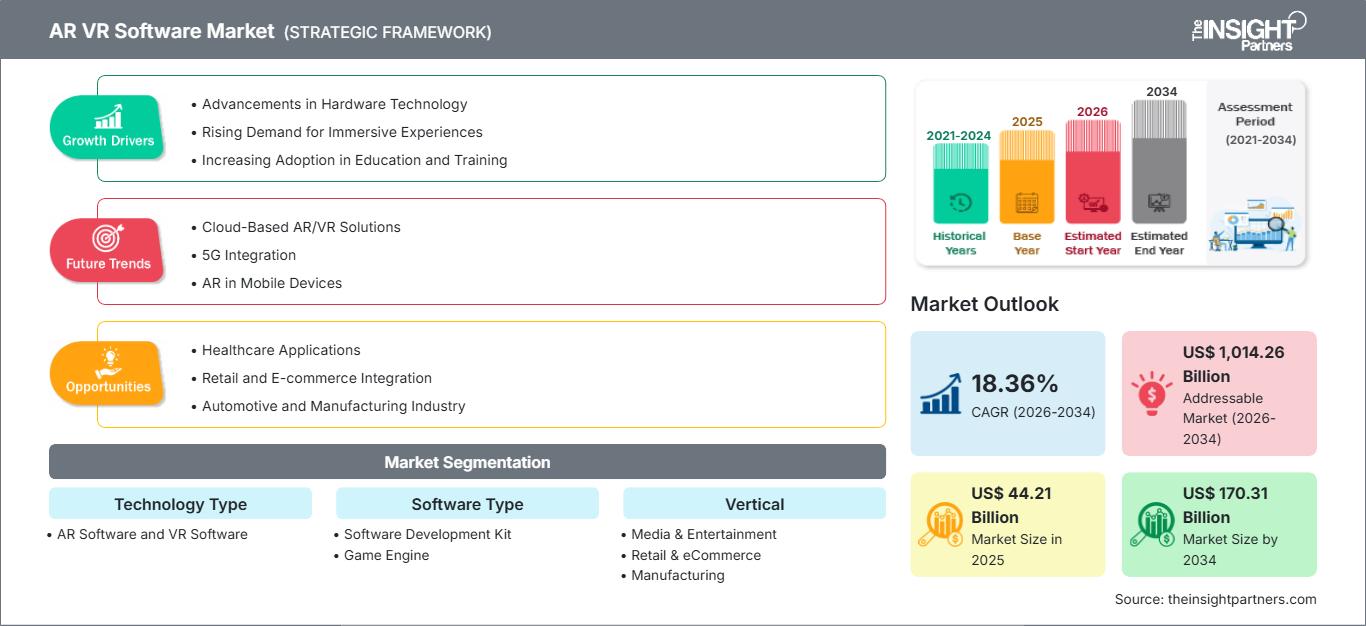
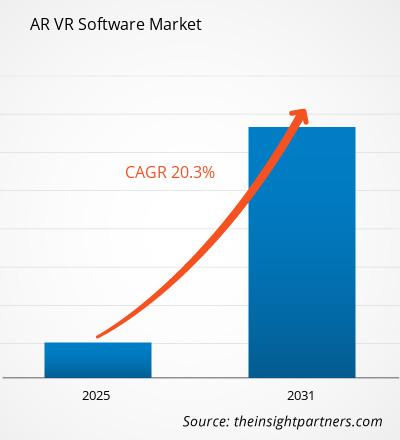
The AR VR Software market was valued at US$ 44.21 billion in 2025 and is expected to reach US$ 170.31 billion by 2034; it is estimated to record a CAGR of 16.17% during 2026-2034.
AR VR Software Market Assessment and Insights
- North America held a 34–38% share in 2025 and is expected to grow at a CAGR of 16.8–18.4% during 2026–2034, led by enterprise XR pilots, cloud-based rendering, and mature developer ecosystems.
- US represented 78–82% of North America in 2025 and is projected to expand at a CAGR of 16.9–18.6% during 2026–2034, reflecting strong platform, gaming, and healthcare simulation demand.
- Europe accounted for 21–25% in 2025 and is forecast to grow at a CAGR of 15.6–17.2% during 2026–2034, with Germany, the UK, France, and Spain leading industrial and retail adoption.
- Asia Pacific captured 27–31% in 2025 and is anticipated to grow at a CAGR of 20.4–22.0% during 2026–2034, driven by China, Japan, South Korea, India, and Australia.
- Largest Segment: VR Software held a market share of 56–60% in 2025 and is expected to record a CAGR of 17.4–18.8% during 2026–2034, anchored in gaming, simulation, and training.
- High Growth Segment: AR Software held a market share of 40–44% in 2025 and is projected to grow at a CAGR of 19.4–21.0% during 2026–2034, supported by mobile, industrial, and retail overlays.
- Key companies analyzed in detail: Microsoft Corporation, Google LLC, Unity Software Inc., Adobe Inc., Autodesk, Inc., Meta Platforms, Inc., PTC Inc., TeamViewer SE, NVIDIA Corporation, Advanced Micro Devices, Inc., Qualcomm Incorporated, and Zoho Corporation Pvt. Ltd.
Source: The Insight Partners' analysis based on proprietary research, government publications, company annual reports, investor presentations, industry databases, and expert interviews.
Software evolution is shifting the AR VR software market from standalone experiences to interoperable spatial ecosystems. Earlier demand was driven by gaming engines and applications for headsets, while modern production processes focus on reusable SDKs, real-time 3D assets, cloud streaming, content generation via AI, and OpenXR portability. Companies seek software that will help decrease development time, work across many devices, and connect immersive content with products lifecycle, training and customer engagement platforms.
Geographically, demand is becoming increasingly balanced as Asia-Pacific grows Android XR development and Europe drives manufacturing-centric spatial flows. Government initiatives to finance digitalization, privacy-by-design, medical training needs, and industry regulations on safety are driving demand outside the entertainment realm. Funding is also shifting towards vertical software libraries, spatial analytics, and collaborative content creation software capable of demonstrating ROI before the deployment of hardware.
AR VR Software Market Report Scope
| Report Attribute | Details |
|---|---|
| Market size in 2025 | US$ 44.21 Billion |
| Market Size by 2034 | US$ 170.31 Billion |
| Global CAGR (2026 - 2034) | 16.17% |
| Historical Data | 2021-2024 |
| Forecast period | 2026-2034 |
AR VR Software Market Analysis
The AR VR software market growth is being driven by the convergence of AI, 5G, cloud GPUs, and real-time 3D development. The highest demand exists where immersive software decreases the cost of physical prototyping, increases training effectiveness, or allows digital business to include the visualization of products in space. The supply chain is made up of chipmakers, device platforms, game engines, 3D content creation software, cloud services, systems integration firms, and vertical applications.
The supply landscape is becoming more favorable as standards such as OpenXR and WebXR, Unity and Unreal workflow compatibility, and mobile AR solutions ease platform lock-in. But the enterprise customer remains hamstrung by constraints in content creation, security assessment, device management, and ROI expectations.
The AR VR software market analysis shows a competitive setting shaped by platform control, developer reach, and enterprise integration. Microsoft Corporation, Google LLC, and Meta Platforms, Inc. steer the ecosystem, whereas Unity Software Inc., Adobe Inc., Autodesk, Inc., and PTC Inc. enhance the authoring and industrial scenarios.
Positioning increasingly revolves around the use of AI in creating products, interoperable digital twins, and multi-device deployment. NVIDIA Corporation, Advanced Micro Devices, Inc., and Qualcomm Incorporated offer the performance layer support, and TeamViewer SE and Zoho Corporation Pvt. Ltd. bring immersive workflows into remote service, support, and business scenarios.
● REPORT CUSTOMIZATION
Tailor This Report To Align With Your Specific Business Requirements
This report can be customized to align precisely with your business objectives, scope, and target markets. Customization options include tailored segmentation, geography, competitive analysis, and strategic insights to support informed decision-making.
Customize This Report →WHAT YOU CAN ADJUST
- ● Segmentations
- ● Geography
- ● Competitive Analysis
- ● Language Preferences
AR VR Software Market: Strategic Insights
Regional Insights
North America AR VR Software market
North America represented 34–38% of the global market in 2025, with the AR VR software market share supported by enterprise software budgets, cloud rendering access, and early XR experimentation across healthcare, defense, manufacturing, and entertainment. The region is forecast to expand at a CAGR of 16.8–18.4% during 2026–2034 as immersive collaboration moves from pilots into repeatable training and product visualization processes.
Growth is reinforced by strong developer communities, large game engine adoption, and the presence of Microsoft Corporation, Google LLC, Meta Platforms, Inc., NVIDIA Corporation, AMD, and Qualcomm Incorporated. Adoption is broadening from gaming to clinical simulation, connected worker tools, retail try-on, and design review, although procurement committees increasingly require security, integration, and productivity evidence before scale deployment.
U.S. AR VR Software Market
The U.S. accounted for 78–82% of the North America AR VR Software Market in 2025 and is projected to grow at a CAGR of 16.9–18.6% during 2026–2034. Demand is concentrated in entertainment studios, defense training, healthcare simulation, industrial design, and enterprise collaboration. The country benefits from deep software engineering talent, cloud infrastructure, venture-backed spatial computing companies, and large platform owners shaping developer standards.
Company presence is a decisive advantage. Microsoft Corporation, Google LLC, Unity Software Inc., Adobe Inc., Autodesk, Inc., Meta Platforms, Inc., NVIDIA Corporation, AMD, and Qualcomm Incorporated maintain major development, partner, or ecosystem operations in the U.S. Application trends include AI-generated 3D assets, immersive product configurators, surgery rehearsal software, and remote-assist overlays for field technicians.
Europe AR VR Software Market
Europe held 21–25% of the AR VR Software Market in 2025 and is expected to expand at a CAGR of 15.6–17.2% during 2026–2034. Leading countries are Germany, thanks to automotive engineering, discrete manufacturing, and digital twins; the UK through gaming, creative productions, edutech, and digital health pilots; and France, Italy, and Spain through luxury retail, aerospace, medical education, tourism, and manufacturing modernization. The leading industry for each country is defined by specific requirements that buyers have for their products and services.
London, Manchester, and local studios in the regions provide content creation and immersive media in the UK. Enterprise adoption in the UK focuses on employee training, retail visualization, and innovation programs for the government. Buyers from other regions show caution when adopting technologies, as they focus on information governance, stability of the vendor, and integration into the current enterprise platform.
In France, immersive designs and experiences, in Italy, industrial visualization and fashion commerce, and in Spain, employee training and media and customer engagement define the leading industries.
APAC AR VR Software Market
Asia Pacific accounted for 27–31% of the AR VR Software Market in 2025 and is projected to grow at a CAGR of 20.4–22.0% during 2026–2034, making it the fastest-expanding region. China is the leading country, supported by electronics manufacturing, mobile AR ecosystems, gaming, and government-backed digital industry initiatives.
Japan, South Korea, India, and Australia add momentum through robotics, education, healthcare training, smart factories, and media production. Android XR development, 5G networks, and lower-cost device ecosystems are expanding the reachable developer base. Industrial and policy drivers favor localized content, workforce upskilling, and spatial interfaces for engineering and public services.
Middle East & Africa AR VR Software Market
The Middle East & Africa AR VR Software Market is expected to grow at a CAGR of 17.0–18.6% during 2026–2034, supported by smart city programs, energy infrastructure, aviation training, and tourism experiences. Saudi Arabia is the leading country, using immersive software for mega-project visualization, workforce development, and digital public services.
The UAE is advancing immersive retail, education, real estate, and aviation use cases, while South Africa shows gradual adoption in mining safety, healthcare education, and enterprise training. The rest of MEA demand is at an earlier stage, but oil and gas, construction, and infrastructure operators are evaluating AR support tools to reduce downtime and improve field productivity.
Segmentation Analysis
Technology Type
Technology Type is projected to grow at a CAGR of 18.0–19.4% during 2026–2034 as enterprises combine fully immersive VR environments with AR overlays for operational workflows. The AR VR software market scope within this segment is widening because buyers increasingly want interoperable tools that support training, visualization, collaboration, and real-time decision support across multiple devices.
- AR Software is gaining strategic importance as mobile devices, smart glasses, and connected worker platforms bring contextual overlays into retail, service, manufacturing, and healthcare workflows without requiring full environmental immersion.
- VR Software remains the largest sub-segment, supported by gaming, simulation, design review, and behavioral training applications where controlled digital environments deliver repeatable experiences and measurable learning outcomes.
Software Type
Software Type is expected to register a CAGR of 17.8–19.2% during 2026–2034 as developer productivity becomes central to the AR VR software market. SDKs and engines influence how enterprises can deploy spatial content, integrate data sources, manage assets, and publish applications across headsets, mobile devices, and web-enabled immersive environments.
- Software Development Kit demand is rising as developers need APIs for tracking, gesture input, object recognition, spatial anchors, security, analytics, and cross-platform deployment across consumer and enterprise XR devices.
- Game Engine platforms remain strategically important because they provide real-time rendering, physics, asset pipelines, and collaborative production environments for entertainment, industrial simulation, product visualization, and training applications.
Vertical
Vertical is forecast to grow at a CAGR of 18.2–19.8% during 2026–2034 as AR VR software market adoption spreads from consumer entertainment into operational enterprise use. Media and retail create visible demand, while manufacturing and healthcare increasingly justify investment through reduced travel, fewer errors, faster training, and safer simulation-based learning environments.
- Media & Entertainment generates strong content demand through immersive games, spatial video, virtual concerts, interactive storytelling, and branded experiences seeking higher engagement and repeat monetization.
- Retail & eCommerce uses AR try-on, 3D product configurators, virtual stores, and guided shopping experiences to reduce purchase uncertainty and improve conversion for high-consideration products.
- Manufacturing adopts immersive software for design validation, work instruction overlays, factory layout planning, safety training, and remote maintenance support across distributed production environments.
- Healthcare relies on VR simulation, anatomical visualization, rehabilitation tools, therapy environments, and clinician training modules where repeatability, risk reduction, and measurable competency are critical.
Opportunity Snapshot
| Vertical | Revenue Contribution | Trend Tag (MAX 2 words, specific) | Adoption Stage |
|---|---|---|---|
| Media & Entertainment | High | Spatial Media | Mature |
| Retail & eCommerce | Medium | Virtual Try-on | Scaling |
| Manufacturing | High | Connected Worker | Scaling |
| Healthcare | Medium | Clinical Simulation | Scaling |
AR VR Software Market Growth Drivers and Impact Analysis
Expansion of Real-time 3D Content Pipelines
Real-time 3D content is emerging as the base for immersive software deployment since it helps organizations reuse their digital assets through training, marketing, design, and service processes. The emergence of game engines, 3D asset libraries, generative AI tools, and collaboration platforms based in the cloud is cutting down the effort required to build interactive experiences. This trend is relevant commercially since the production of content is one of the main obstacles that enterprises have faced when adopting XR technologies. Buyers will be able to address different needs through a single software purchase as the management of reusable assets becomes simpler. The driver works best in industries like manufacturing, media, and retail since a single product model can be used for design review, customer visualization, and technician training.
Growing Need for Safer and Repeatable Workforce Training
Businesses are employing immersive software applications to standardize training in difficult and dangerous tasks or those that are costly to perform practically. VR applications help workers, doctors, or technicians perform tasks repeatedly without disrupting their workflow, whereas AR applications help them perform tasks with guidance in real life. The impact of the market can be seen in the simulation training in the healthcare industry, safety training in the manufacturing sector, aviation procedure training, and energy sector maintenance. The training professionals prefer software that records the performance of the learners and works in collaboration with learning management systems and allows updating scenarios without redoing the whole content again.
Integration of Spatial Computing with Enterprise Platforms
Adoption of the technology is accelerated by connecting immersive software to traditional enterprise systems such as PLM, CAD, CRM, Field Service, and collaboration software. Integration transforms AR and VR from mere demos to actual workflow tools that have the potential to make an impact on productivity, compliance, and decision-making. Vendors offering solutions that include APIs, identity management, device management, and data security capabilities will have an advantage in the purchasing process. The effect goes beyond big corporations since cloud deployment reduces the initial implementation complexity of mid-size enterprises. Since immersion becomes another interface layer in digital operations, investments go from innovation budgets to application modernization budgets.
AR VR Software Market Future Trends
AI-Native Spatial Interfaces
AI-native interaction will reshape AR VR software market trends by allowing users to create, modify, and navigate spatial environments through voice, gesture, image recognition, and contextual prompts. Instead of manually building every scene, developers will use AI to generate 3D assets, automate environment testing, personalize training paths, and summarize user behavior. This trend will improve productivity for small development teams and lower the threshold for non-technical business users. Over the forecast period, platforms that combine spatial mapping, generative content, and enterprise-grade governance will gain preference. The strategic impact will be a faster shift from custom one-off applications to configurable immersive software suites for specific business functions.
Open Ecosystems and Cross-device Deployment
The next generation of immersive software is going to see a preference for open architectures where applications can be executed on various devices such as headsets, smart glasses, mobile devices, and even browsers for spatial computing. There is more reluctance from developers to use single-device execution due to diverse hardware stacks employed by corporate buyers and longer life cycles of their applications. OpenXR, WebXR, Android XR, and engine-level portability will see increased usage within procurement parameters. This development is also going to impact pricing, as customers will prefer software that can be scaled to different geographies and does not need to be re-developed. Eventually, cross-device functionality will enable wider access to educational, medical, and industrial customers with varied hardware capabilities.
AR VR Software Market Opportunities
Verticalized Immersive Software Libraries
A strong opportunity exists in prebuilt immersive software libraries tailored to industries with repeatable workflows. AR VR software market Forecasts indicate that scalable revenue will come from packaged modules rather than fully custom projects alone. Manufacturing could use libraries for machine maintenance, safety drills, and assembly training, while healthcare could use anatomy, therapy, and procedure simulation modules. Retailers could license configurable try-on, showroom, and product demonstration templates. Investors and vendors should prioritize libraries that can be localized, updated, and integrated with analytics dashboards. This approach reduces implementation time, improves margin consistency, and helps customers move from pilot projects to department-wide deployment with clearer cost expectations.
Spatial Commerce and Product Visualization
Spatial commerce presents itself as an actionable route for investment, in that it integrates immersive technology with customer conversion, return prevention, and product education. Businesses can employ technologies such as augmented reality product placements, virtual showrooms, and interactive configurators to enable customers to visualize size, fit, materials, and functionality prior to purchase. This is particularly true for businesses involving furniture, fashion, automobiles, consumer electronics, and luxury products, in which case visualization will play a huge role in the decision to convert or not. Businesses should concentrate on lightweight implementation, integration with e-commerce systems, management of 3D assets, and performance on mobile devices.
Frequently Asked Questions

- Comprehensive Market Sizing and Forecast Analysis
- Detailed Segmentation Analysis
- In-Depth Market Dynamics Assessment
- Regional and Country-Level Insights
- Competitive Landscape and Company Benchmarking
- Strategic Business Intelligence
Recent Reports
Testimonials

The Insight Partners provided valuable market intelligence that supported our global go-to-market strategy. Their team was professional, responsive, and attentive to our feedback, providing thoughtful analysis and helpful methodological clarifications throughout the project.
Junmo Kim Chief Financial Officer (CFO), Enertech Co., Ltd.
The Insight Partners' SCADA System Market report is comprehensive, with valuable insights on current trends and future forecasts. The team was highly professional, responsive, and supportive throughout. We are very satisfied and highly recommend their services.
RAN KEDEM Partner, Reali Technologies LTDs
I requested a report on a very specific software market and the team produced the report in a few days. The information was very relevant and well presented. I then requested some changes and additions to the report. The team was again very responsive and I got the final report in less than a week.
JEAN-HERVE JENN Chairman, Future Analytica
We worked with The Insight Partners for an important market study and forecast. They gave us clear insights into opportunities and risks, which helped shape our plans. Their research was easy to use and based on solid data. It helped us make smart, confident decisions. We highly recommend them.
PIYUSH NAGPAL Sr. Vice President, High Beam Global
The Insight Partners delivered insightful, well-structured market research with strong domain expertise. Their team was professional and responsive throughout. The user-friendly website made accessing industry reports seamless. We highly recommend them for reliable, high-quality research services
YUKIHIKO ADACHI CEO, Deep Blue, LLC.
This is the first time I have purchased a market report from The Insight Partners.While I was unsure at first, I visited their web site and felt more comfortable to take the risk and purchase a market report.I am completely satisfied with the quality of the report and customer service. I had several questions and comments with the initial report, but after a couple of dialogs over email with their analyst I believe I have a report that I can use as input to our strategic planning process.Thank you so much for taking the extra time and making this a positive experience.I will definitely recommend your service to others and you will be my first call when we need further market data.
JOHN SUZUKI President and Chief Executive Officer, Board Director, BK Technologies
I wish to appreciate your support and the professionalism you displayed in the course of attending to my request for information regarding to infectious disease IVD market in Nigeria. I appreciate your patience, your guidance, and the fact that you were willing to offer a discount, which eventually made it possible for us to close a deal. I look forward to engaging The Insight Partners in the future, all thanks to the impression you have created in me as a result of this first encounter.
DR CHIJIOKE ONYIA MANAGING DIRECTOR, PineCrest Healthcare Ltd.Reason to Buy
- Informed Decision-Making
- Understanding Market Dynamics
- Competitive Analysis
- Identifying Emerging Markets
- Customer Insights
- Market Forecasts
- Risk Mitigation
- Boosting Operational Efficiency
- Strategic Planning
- Investment Justification
- Tracking Industry Innovations
- Aligning with Regulatory Trends





 Get Free Sample for