
Archiving Software Market Size, Share & Forecast by 2034
Coverage: By Product Type (On-Premises, Cloud); Application (IT and Telecommunication, BFSI, Government, Healthcare, Manufacturing, Others); Enterprise Size (Small and Medium Enterprises (SMEs), Large Enterprises) , and Geography (North America, Europe, Asia Pacific, and South and Central America)
- Status : Data Released
- Report Code : TIPRE00017038
- Category : Technology, Media and Telecommunications
- No. of Pages : 150
- Available Report Formats :


- Last update date : August 28, 2026


2025 Market Size
US$ 6.53 Bn
Base year value
2034 Forecast
US$ 23.88 Bn
Projected by 2034
CAGR 2026-2034
15.49 %
Growth rate
Addressable Market
US$ 129.27 Bn
(2026-2034)
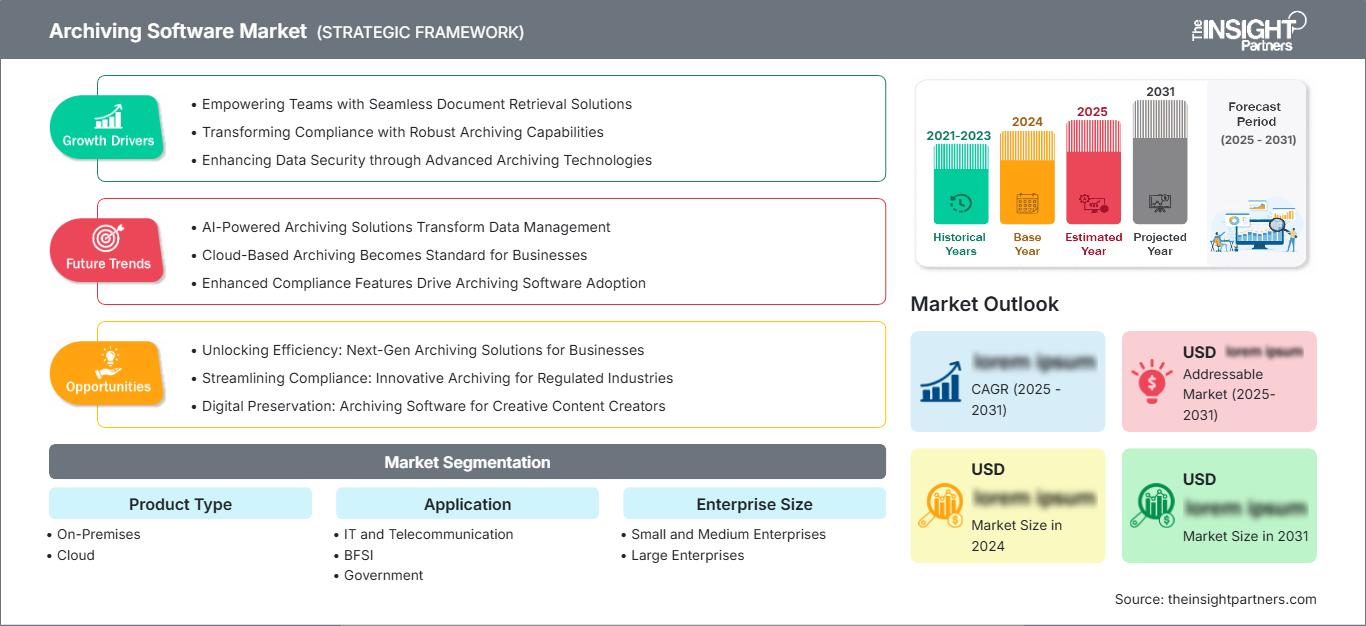
The archiving software market was valued at US$ 6.53 Billion in 2025 and is projected to reach US$ 23.88 Billion by 2034; it is expected to register a CAGR of 15.49% during 2026–2034. Growth is supported by rising enterprise data volumes, audit-readiness requirements, litigation preparedness, and the shift from passive storage to searchable, policy-based information governance across regulated and data-intensive industries.
Across North America, the archiving software market size is supported by mature compliance programs, strong cloud adoption, and high spending on cybersecurity resilience. The region is estimated to grow at a CAGR range of 14.6–15.4% during 2026–2034, with demand concentrated in financial services, healthcare, public sector agencies, and telecom operators managing retention, eDiscovery, and immutable archival workflows.
Archiving Software Market Assessment and Insights
- North America held a 37–40% share in 2025 and is expected to grow at a CAGR of 14.6–15.4% between 2026–2034, supported by SEC cyber-disclosure rules, HIPAA modernization pressure, and enterprise cloud migration.
- US accounted for 78–82% of North America in 2025 and is projected to grow at a CAGR of 14.8–15.6% between 2026–2034, driven by BFSI, government, and healthcare archives.
- Europe represented 24–27% share in 2025 and is forecast to grow at a CAGR of 13.8–14.6% between 2026–2034, led by the UK, Germany, France, Italy, and Spain.
- Asia Pacific captured 20–23% share in 2025 and is projected to expand at a CAGR of 16.8–17.6% between 2026–2034, led by China, Japan, South Korea, India, and Australia.
- Largest Segment: Cloud held a market share of 58–62% in 2025 and is expected to grow at a CAGR of 16.4–17.2% between 2026–2034 as enterprises shift to scalable retention platforms.
- High Growth Segment: Healthcare held a market share of 14–17% in 2025 and is expected to grow at a CAGR of 17.2–18.0% between 2026–2034 due to ePHI, imaging, and audit retention.
- Key companies analyzed in detail: ASG Technologies Group, Inc., Archive Power Systems Inc. (DocuXplorer Software), Commvault Systems, Inc., GFI Software Ltd., Iron Mountain Incorporated, Jatheon Technologies Inc., NTP Software, Inc., QStar Technologies, Inc., Quantum Corporation, ShareArchiver LLC, and Waterford Technologies Ltd.
Source: The Insight Partners' analysis based on proprietary research, government publications, company annual reports, investor presentations, industry databases, and expert interviews.
Enterprise archiving is no longer about static repository management but intelligent retention, classification, and retrieval. Dynamic production has shifted preferences to cloud-native designs, connector-packed implementations, automated metadata, and legally sound retention policies. Enterprise vendors are focused on delivering policy engines, role-based access control, immutable repositories, and Microsoft 365, Google Workspace, collaboration apps, enterprise content management, and object storage integrations to minimize governance manual labor.
Growing future demand will expand to new digital economies where cloud regulations, government modernization efforts, and increasing cyber insurance needs drive changes in buying priorities. More money is going to AI-capable archive tiers, data sovereignty, and hybrid implementations. The regulatory tailwind from cybersecurity reporting requirements, healthcare security upgrades, and cross-border data management regulations will continue to fuel enterprise interest even when compliance is not an issue.
Archiving Software Market Report Scope
| Report Attribute | Details |
|---|---|
| Market size in 2025 | US$ 6.53 Billion |
| Market Size by 2034 | US$ 23.88 Billion |
| Global CAGR (2026 - 2034) | 15.49% |
| Historical Data | 2021-2024 |
| Forecast period | 2026-2034 |
Archiving Software Market Analysis
Rising data retention complexity is a central driver of archiving software market growth, as enterprises need searchable, indexed, tamper-resistant repositories instead of fragmented backups. The value chain consists of content producers, collaboration tools, archiving software providers, cloud providers, managed service providers, lawyers, compliance professionals, and auditors. The demand will be highest in places where retention policies need to factor in cost, access time, confidentiality, and chain of custody proof.
New supply factors are moving towards subscription-based licenses, API integration capabilities, and cloud storage optimization. Providers who cater for more specific retention policies, automated legal holds, encryption, role-based security, and audit capabilities have an advantage when dealing with regulated organizations. More emphasis is being placed on ingestion time, storage costs, and integration capabilities apart from archiving space.
The competitive landscape for archiving software market analysis is moderately fragmented, with global resilience platforms, information management providers, and specialist archive vendors competing across deployment models. CommVault Systems, Inc., Iron Mountain Incorporated, and Quantum Corporation are geared towards more general data resilience and storage solutions, whereas Jatheon Technologies Inc., ShareArchiver LLC, Waterford Technologies Ltd., and Archive Power Systems Inc. offer more specific email, document, and compliance archiving capabilities.
Investments show that cloud archive solutions, intelligent classification based on artificial intelligence, and resilient storage systems will continue to be funded. In cases where enterprises seek more selective technology capabilities, legacy workload management capabilities, file governance solutions, or tape-based archiving, companies like ASG Technologies Group, Inc., GFI Software Ltd., NTP Software, Inc., and QStar Technologies, Inc. still have an important role to play.
● REPORT CUSTOMIZATION
Tailor This Report To Align With Your Specific Business Requirements
This report can be customized to align precisely with your business objectives, scope, and target markets. Customization options include tailored segmentation, geography, competitive analysis, and strategic insights to support informed decision-making.
Customize This Report →WHAT YOU CAN ADJUST
- ● Segmentations
- ● Geography
- ● Competitive Analysis
- ● Language Preferences
Archiving Software Market: Strategic Insights
Regional Insights
North America Archiving Software Market
North America accounted for 37–40% of global revenue in 2025 and is projected to record a CAGR of 14.6–15.4% during 2026–2034. The archiving software market share in the region reflects its early adoption of cloud productivity suites, stringent legal discovery obligations, and a large installed base of regulated enterprises.
Demand is strongest across BFSI, healthcare, government, telecom, and manufacturing organizations, retaining communications, records, log data, and collaboration content. The U.S. SEC’s four-business-day cybersecurity incident disclosure requirement and proposed HIPAA security updates are strengthening archive governance expectations. Canada adds demand through privacy, public-sector digitization, and cross-border data retention needs.
U.S. Archiving Software Market
The U.S. represented 78–82% of North America Archiving Software Market in 2025 and is expected to grow at a CAGR of 14.8–15.6% during 2026–2034. Adoption is concentrated among banks, insurers, hospitals, federal agencies, legal services firms, telecom operators, and technology companies seeking defensible retention with rapid search and export.
Company presence is broad, with Commvault Systems, Inc., Iron Mountain Incorporated, Quantum Corporation, GFI Software Ltd., and NTP Software, Inc. serving enterprise, public-sector, and data-intensive workloads. Key application trends include cloud email archiving, Microsoft 365 retention oversight, immutable compliance storage, ransomware recovery alignment, and litigation-ready eDiscovery workflows.
Europe Archiving Software Market
Europe held 24–27% share of the Archiving Software Market in 2025 and is projected to grow at a CAGR of 13.8–14.6% during 2026–2034. UK continues to be a dominant region in terms of financial conduct logging, public sector transformation, and widespread use of cloud collaboration solutions in professional services and regulated communication.
Germany has a stable demand from manufacturing, automotive, health care, and industrial sectors that need control over retention, metadata management, and data localization. In buyer assessment, privacy by design, auditability, integration with enterprise content repositories, and hybrid infrastructure are usually key considerations.
France, Italy, and Spain have been growing through public sector modernization, health care transformation, and improvements in financial compliance. European Union data governance efforts, data space creation, and accountability from GDPR make the archival discipline more important. European buyers value solutions that include retention policies, privacy, localization, and export capability.
APAC Archiving Software Market
APAC captured 20–23% share of the Archiving Software Market in 2025 and is expected to expand at a CAGR of 16.8–17.6% during 2026–2034. China dominates in terms of influence, but Japan, South Korea, India, and Australia play their role by using digital government, financial compliance, and cloud enterprise transformation.
Demand for scalable archival solutions is driven by industrial development, expansion of telecom data, healthcare data digitalization, and data localization regulations. India's banking and IT industry, Australia’s public sector, and Japan's enterprise modernization initiatives have spurred the adoption of platforms.
Middle East & Africa Archiving Software Market
The Middle East & Africa Archiving Software Market is projected to grow at a CAGR of 15.0–15.8% during 2026–2034. Saudi Arabia is the leading country, supported by large-scale digital government programs, energy-sector documentation, and sovereign cloud investment. The UAE follows through with financial services, healthcare, aviation, and smart-city records demand.
South Africa shows adoption across banking, telecom, and public agencies, while the Rest of MEA remains earlier-stage but improving. Energy, infrastructure, and public-sector projects create long-retention records, making archive searchability, secure access, and low-cost storage increasingly important for regional buyers.
Segmentation Analysis
Product Type
Product Type is expected to grow at a CAGR of 15.2–16.0% during 2026–2034, supported by the continued replacement of fragmented storage tools with policy-based archive platforms. The archiving software market scope across this segment includes deployment flexibility, retention automation, search, security, and compliance workflows, allowing enterprises to align archival design with infrastructure maturity and regulatory exposure.
- On-Premises remains strategically important for government, defense, banking, and highly regulated enterprises that require direct infrastructure control, internal security governance, and tighter oversight of sensitive historical records.
- Cloud leads adoption as enterprises prioritize elastic storage, fast deployment, lower infrastructure maintenance, global access, and integration with SaaS collaboration suites and cloud object storage.
Application
Archiving Software Market application is projected to grow at a CAGR of 15.5–16.3% during 2026–2034 as archive use cases expand from email retention to enterprise-wide governance. Demand varies by industry, with regulated sectors requiring legal hold, audit exports, privacy controls, security event retention, and standardized records classification across multiple content sources.
- IT and Telecommunication uses archives for service records, operational logs, customer communications, and compliance evidence, with demand rising as network complexity and cloud service delivery expand.
- BFSI remains a major adopter because banks and insurers must retain communications, transaction records, advisory documents, and audit trails for regulatory reviews and dispute resolution.
- Government requires long-term preservation of public records, case files, citizen communications, and administrative data, making trusted access, retention schedules, and data sovereignty central procurement factors.
- Healthcare is a high-growth application as providers and payers manage electronic health information, medical images, claims records, and cybersecurity documentation under stricter privacy expectations.
- Manufacturing uses archives for quality records, engineering documentation, supplier communications, compliance certificates, and production history, especially in automotive, aerospace, electronics, and industrial equipment.
Enterprise Size
Archiving Software Market enterprise size is expected to grow at a CAGR of 14.9–15.7% during 2026–2034 as both large organizations and SMEs formalize retention governance. Buying behavior differs by budget, IT staffing, and compliance exposure, but both groups increasingly require intuitive search, automated policies, cloud deployment, and predictable cost models.
- Small and Medium Enterprises are adopting cloud-based archives to reduce IT burden, meet customer compliance expectations, and protect business communications without building specialized records management teams.
- Large Enterprises drive complex deployments involving multi-region data governance, legal holds, enterprise content connectors, user role segmentation, and integration with security, compliance, and analytics platforms.
Opportunity Snapshot
| Application | Revenue Contribution | Trend Tag | Adoption Stage |
| IT and Telecommunication | High | Log Retention | Scaling |
| BFSI | High | Legal Hold | Mature |
| Government | Medium | Public Records | Scaling |
| Healthcare | High | ePHI Governance | Scaling |
| Manufacturing | Medium | Quality Archives | Emerging |
Archiving Software Market Growth Drivers and Impact Analysis
Regulatory Pressure is Expanding Defensible Retention Requirements
Businesses find themselves being asked more and more often to demonstrate that data held in reserve is both complete, accessible, secured and can be accessed within stipulated timeframes. Financial organizations, health care facilities, government organizations, and publicly held organizations have become increasingly interested in treating their archives as evidence management systems rather than passive repositories. Cybersecurity reporting mandates, privacy checks, discovery proceedings, and regulatory record-keeping requirements are putting pressure on organizations to ensure that they are retaining data immutably, maintaining control over metadata, and keeping track of who accesses what. Such pressures affect platform vendors the most insofar as they are able to offer tools for automated retention policies and exportable audit logs.
Cloud Collaboration Growth is Creating New Archive Workloads
The adoption of cloud collaboration tools has increased the number of data sources that should be governed and retained. Email is not the only data source that is worth archiving anymore – companies now have to manage chat logs, shared documents, artifacts from meetings, and workflow data. The implications of that include new technical challenges of connecting, indexing, deduplicating, and enforcing consistent policies on rapidly changing SaaS platforms. The practical consequences of that include a wider pool of potential customers for cloud-based and hybrid archive solutions. Companies are also utilizing archives to decrease costs related to primary storage and to retain access to information.
Cyber Resilience is Reframing Archives as Recovery Assets
The emergence of ransomware attacks and cyber attacks of a destructive nature is altering the value being placed on data that is archived. Immutable archives, storage tiers with isolation capabilities, and validated copies of retained data may be used to enable investigation, business continuity, and recovery after a compromise of production systems. This need creates a requirement for integrated systems for backup, protection, identity, and incident response operations. The effect of this driver is seen in the purchasing decisions made on the basis of encryption, access controls, monitoring, recovery guarantees, tamper evidence, and search capabilities. This driver affects vendors dealing with healthcare, BFSI, the public sector, and heavy industries.
Archiving Software Market Future Trends
AI-Assisted Classification Will Reshape Retention Governance
AI-assisted classification is expected to become one of the defining archiving software market trends as enterprises seek to reduce manual records tagging and improve retention accuracy. The future systems will make use of machine learning algorithms to classify the sensitive content, suggest the appropriate retention classes, detect duplicates, and find the relevance for a legal hold. This move will not necessarily do away with human classification; however, it will enhance the consistency in large content repositories. In any case, the buyers will always want to see explainable models, control by administrators, and log audits that will demonstrate the reason for classification.
Sovereign and Hybrid Archives Will Gain Strategic Importance
Sovereign and hybrid archive architectures will be increasingly valuable in the coming years as governments and regulated industries raise the bar for data location, accessibility, and control. Multinational corporations with business across multiple geographies will require architecture flexibility that combines the scalability of cloud computing with the ability to store data locally. This will lead to an increased demand for customizable storage tiers, region-specific encryption management, local management, and portable export. The companies that can offer multinational retention strategies without imposing a specific infrastructure strategy on their customers will have the upper hand. Hybrid solutions will particularly continue to have relevance in government, banking, healthcare, defense manufacturing, and energy sectors.
Archiving Software Market Opportunities
Verticalized Compliance Packages Can Accelerate Enterprise Buying
Vendors have a strong opportunity to package archive capabilities around vertical workflows rather than generic retention features. BFSI buyers need communications surveillance, legal hold, and transaction record preservation, while healthcare organizations need ePHI governance and secure access logs. Government users require public record schedules, export transparency, and long-term preservation controls. Packaging these capabilities into preconfigured templates can shorten procurement cycles and reduce implementation risk. The opportunity is especially valuable for mid-market enterprises that lack specialized compliance teams. Archiving software market Forecasts suggest that vendors with verticalized onboarding, policy libraries, and partner-led implementation models can capture faster subscription growth.
AI-Ready Long-Term Data Lakes Offer New Monetization Paths
Firms are starting to look at their historical archives as sources of input for analysis, AI training, fraud detection, customer intelligence, and benchmarking. It provides an opportunity for providers of archive services to enrich metadata, retrieve selectively, apply privacy filters, and provide integration into the data lake. The best business case exists in situations when firms have decades worth of archives containing documentation, call recordings, emails, images, engineering drawings, or regulatory documentation. Instead of being viewed as a cost center, archive buyers can enable governed re-use while preserving their retention integrity.
Frequently Asked Questions

- Comprehensive Market Sizing and Forecast Analysis
- Detailed Segmentation Analysis
- In-Depth Market Dynamics Assessment
- Regional and Country-Level Insights
- Competitive Landscape and Company Benchmarking
- Strategic Business Intelligence
Recent Reports
Testimonials

The Insight Partners' SCADA System Market report is comprehensive, with valuable insights on current trends and future forecasts. The team was highly professional, responsive, and supportive throughout. We are very satisfied and highly recommend their services.
RAN KEDEM Partner, Reali Technologies LTDs
I requested a report on a very specific software market and the team produced the report in a few days. The information was very relevant and well presented. I then requested some changes and additions to the report. The team was again very responsive and I got the final report in less than a week.
JEAN-HERVE JENN Chairman, Future Analytica
We worked with The Insight Partners for an important market study and forecast. They gave us clear insights into opportunities and risks, which helped shape our plans. Their research was easy to use and based on solid data. It helped us make smart, confident decisions. We highly recommend them.
PIYUSH NAGPAL Sr. Vice President, High Beam Global
The Insight Partners delivered insightful, well-structured market research with strong domain expertise. Their team was professional and responsive throughout. The user-friendly website made accessing industry reports seamless. We highly recommend them for reliable, high-quality research services
YUKIHIKO ADACHI CEO, Deep Blue, LLC.
This is the first time I have purchased a market report from The Insight Partners.While I was unsure at first, I visited their web site and felt more comfortable to take the risk and purchase a market report.I am completely satisfied with the quality of the report and customer service. I had several questions and comments with the initial report, but after a couple of dialogs over email with their analyst I believe I have a report that I can use as input to our strategic planning process.Thank you so much for taking the extra time and making this a positive experience.I will definitely recommend your service to others and you will be my first call when we need further market data.
JOHN SUZUKI President and Chief Executive Officer, Board Director, BK Technologies
I wish to appreciate your support and the professionalism you displayed in the course of attending to my request for information regarding to infectious disease IVD market in Nigeria. I appreciate your patience, your guidance, and the fact that you were willing to offer a discount, which eventually made it possible for us to close a deal. I look forward to engaging The Insight Partners in the future, all thanks to the impression you have created in me as a result of this first encounter.
DR CHIJIOKE ONYIA MANAGING DIRECTOR, PineCrest Healthcare Ltd.Reason to Buy
- Informed Decision-Making
- Understanding Market Dynamics
- Competitive Analysis
- Identifying Emerging Markets
- Customer Insights
- Market Forecasts
- Risk Mitigation
- Boosting Operational Efficiency
- Strategic Planning
- Investment Justification
- Tracking Industry Innovations
- Aligning with Regulatory Trends





 Get Free Sample for