
ASIC Chip Market Growth and Forecast by 2034
Coverage: By Type (Semi-Based Custom, Programmable Logic Device, and Full Custom), Application (Data Processing System, Consumer Electronics, Telecommunication System, Medical Instrumentation, and Others), and Geography
- Status : Data Released
- Report Code : TIPRE00008259
- Category : Electronics and Semiconductor
- No. of Pages : 150
- Available Report Formats :


- Last update date : July 17, 2026


2025 Market Size
US$ 18.04 Bn
Base year value
2034 Forecast
US$ 31.27 Bn
Projected by 2034
CAGR 2025-2034
7.1 %
Growth rate
Addressable Market
US$ 232.39 Bn
(2025-2034)
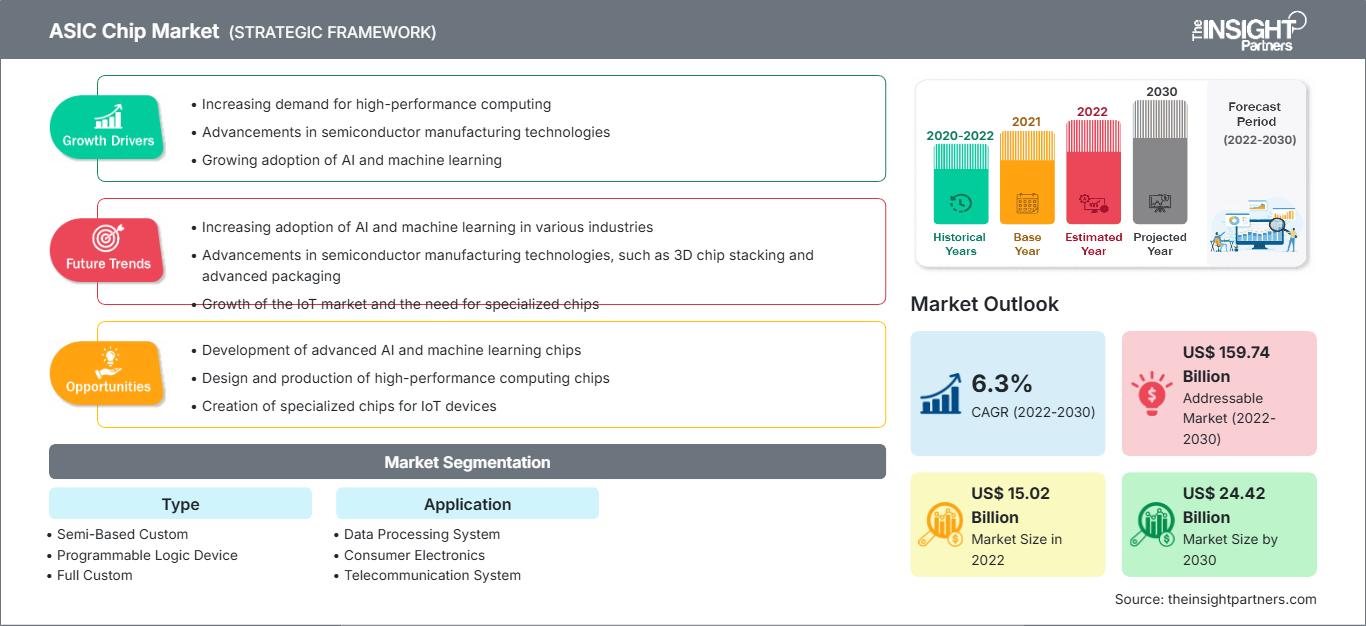
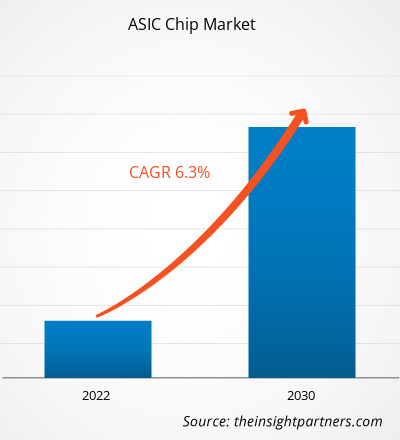
The ASIC Chip Market size is projected to grow from US$ 18.04 Billion in 2025 to US$ 31.27 Billion by 2034; it is expected to register a CAGR of 7.1% during 2026–2034. Demand will be driven by application-specific processing requirements within data processing systems, consumer electronics, telecommunication systems, and medical instruments, whereby custom-designed silicon chips increase performance, energy efficiency, and economics.
The North America region is projected to experience a 5.8% - 6.4% CAGR over the period between 2026 and 2034 due to artificial intelligence investments in data centers, electronic upgrades in the defense sector, and semiconductor design innovations. This region is aided by cloud infrastructure concentration, fabless design ecosystem, and public funds that promote local chip packaging, verification, and fabrication capabilities.
ASIC Chip Market Assessment and Insights
- North America: The region accounted for 29–32% share in 2025 and is forecast to grow at a CAGR of 5.8–6.4% during 2026–2034, led by AI infrastructure, aerospace electronics, and telecom modernization.
- US: The US represented 78–82% of North America share in 2025 and is projected to expand at a 5.9–6.5% CAGR as hyperscalers, defense contractors, and chip designers increase custom silicon programs.
- Europe: Europe held 18–21% share in 2025 and may grow at a 5.1–5.8% CAGR, with Germany, France, the UK, Italy, and Spain supporting demand through automotive electronics and industrial automation.
- Asia Pacific: Asia Pacific captured 38–42% share in 2025 and is expected to grow at a 6.8–7.5% CAGR, led by China, Taiwan, South Korea, Japan, and India across foundry, consumer device, and telecom ecosystems.
- Largest Segment: Semi-Based Custom held 45–49% market share in 2025 and is projected to grow at a 6.1–6.7% CAGR because it balances customization, cost, and design-cycle efficiency.
- High Growth Segment: Data Processing System accounted for 30–34% market share in 2025 and is anticipated to record a 7.0–7.8% CAGR, supported by AI acceleration, storage, and cloud workloads.
- Key companies analyzed in detail: Texas Instruments Incorporated, Bitmain Technologies Holding Company, Infineon Technologies AG, Advanced Micro Devices, Inc., NVIDIA Corporation, Taiwan Semiconductor Manufacturing Company Limited, Samsung Electronics Co., Ltd., ON Semiconductor Corporation, Intel Corporation, Broadcom Inc.
Source: The Insight Partners' analysis based on proprietary research, government publications, company annual reports, investor presentations, industry databases, and expert interviews.
ASIC architectures have progressed from narrow-function logic to highly integrated systems incorporating computing, memory interface, security, and sensor management functionalities. Advanced packaging, chiplet architecture, and artificial intelligence-enabled electronic design automation are influencing manufacturing economics through reduced cycle times for verification and yield learning. Foundry consolidation is relevant but outsourced assembly, substrate capacity, and design are now driving ASIC Chip Market timelines.
For the period up to 2034, the dynamics will focus on the convergence of markets that leverage digital infrastructure expansion along with the localization of industrial electronics. India, Southeast Asia, and the Gulf countries are building investments in data centers, telecommunications infrastructure, and semiconductor industry policies, while Europe prioritizes secure supply chain sourcing. Growth prospects in the market thus reflect capital deployment in design IP, wafer starts, advanced packaging, and application testing.
ASIC Chip Market Report Scope
| Report Attribute | Details |
|---|---|
| Market size in 2025 | US$ 18.04 Billion |
| Market Size by 2034 | US$ 31.27 Billion |
| Global CAGR (2026 - 2034) | 7.1% |
| Historical Data | 2021-2024 |
| Forecast period | 2025-2034 |
ASIC Chip Market Analysis
Demand is growing as equipment manufacturers seek customized processors for specific workloads instead of general processors. For data processing platforms, ASICs help in lowering latencies and power for operations, whereas consumer electronic devices have requirements for dense, low-power designs. Telecommunication systems rely on specialty silicon for packet processing, beamforming and baseband processing capabilities, whereas medical instruments rely on robust signal acquisition and reliable lifecycle support.
The value chain includes IP licensing, architecture design and verification, wafer manufacturing, packaging, testing and system integration. Supply dynamics work in favor of firms that obtain early access to foundry capacity and advanced substrates amid competition for leadership node by AI and networking chips. ASIC Chip Market trends also reflect increased co-design between software teams, chip architects, and end-product manufacturers.
Competitive environment comprises integrated device manufacturers, fabless semiconductor design firms, foundries, and ASIC services companies. High-performance computing requirements are affected by NVIDIA Corporation, Advanced Micro Devices, Inc., Broadcom Inc., and Intel Corporation, whereas Taiwan Semiconductor Manufacturing Company Limited and Samsung Electronics Co., Ltd. affect manufacturing capabilities. Texas Instruments Incorporated and Infineon Technologies AG assist in the embedded and industrial application sectors.
Capital expenditure is shifting towards design automation, packaging, and regional diversification of the supply chain. Bitmain Technologies Holding Company still plays a role in application-specific mining silicon, and ON Semiconductor Corporation will gain from power-efficient embedded systems. Successful strategic positioning is now determined by market analysis, which associates architectural decisions with total ownership costs, performance per watt, qualification cycle times, and geopolitical sourcing risks.
● REPORT CUSTOMIZATION
Tailor This Report To Align With Your Specific Business Requirements
This report can be customized to align precisely with your business objectives, scope, and target markets. Customization options include tailored segmentation, geography, competitive analysis, and strategic insights to support informed decision-making.
Customize This Report →WHAT YOU CAN ADJUST
- ● Segmentations
- ● Geography
- ● Competitive Analysis
- ● Language Preferences
ASIC Chip Market: Strategic Insights
Regional Insights
North America ASIC Chip Market
North America represented 29–32% of the global share in 2025 and is expected to post a 5.8–6.4% CAGR during 2026–2034. Cloud data centers, AI inference deployment, defense electronics, and fast networking are the key structural enablers. Support for semiconductor policies is increasing the strength of design, packaging, and manufacturing capabilities.
ASIC Chip Market share in the region is largely dominated by the United States due to the presence of prominent hyperscalers, EDA companies, and IC designers. Canada offers contributions through AI studies, photonics, and telecommunications testing, while Mexico offers contributions for electronics assembly. The region’s procurement focuses on security, performance, and availability.
U.S. ASIC Chip Market Market
The US accounted for 78–82% of North America share in 2025 and is projected to grow at a 5.9–6.5% CAGR through 2034. The demand will be dominated by AI data centers, accelerators, 5G network infrastructure, aerospace applications, and special medical electronics that need validation and low-power processors.
Presence in the market is widespread, with NVIDIA Corporation, Advanced Micro Devices, Inc., Intel Corporation, Broadcom Inc., Texas Instruments Incorporated, and ON Semiconductor Corporation playing significant roles in the areas of architecture, embedded controls, and efficient power. Some application trends are AI inference, network silicon, image processing, wearable health devices, and edge computing.
Europe ASIC Chip Market Market
Europe accounted for 18-21% market share in 2025 and is forecasted to grow at a CAGR of 5.1–5.8%. Germany leads the region on account of the presence of ecosystems in automotive electronics, industrial automation and robotics, and power semiconductors. There is high demand for ASICs with safety, reliability, and a long qualification cycle.
The United Kingdom contributes to chip design, defense electronics, and communications segments where secure processing and low-latency connections are key factors. France is involved in aerospace, medical instrumentation, and national digital infrastructure projects, which can be leveraged by semi-custom ASIC designs in accordance with European supply chain security goals.
Italy and Spain contribute through industrial machinery, energy management, and telecommunication projects. Infineon Technologies AG continues to play an important role in Europe’s power and automotive semiconductor industry, while regional design houses contribute to expanding the scope of the market.
APAC ASIC Chip Market Market
APAC had a share of 38%-42% in 2025 and is expected to witness a CAGR of 6.8%-7.5%, being the biggest regional hub. The leading market in the APAC region in terms of consumption is China because of the use of consumer electronics, telecommunication systems, and domestic cloud infrastructure, whereas Taiwan is the key player in terms of advanced foundries.
Japan and South Korea are responsible for ASIC design by way of automotive electronics, imaging systems, memory integration, and high-end device fabrication. Samsung Electronics Co., Ltd., and Taiwan Semiconductor Manufacturing Company Limited are involved in wafer availability, package technology, and node shifting for customized chips.
India and Australia are developing countries through data centers, telecoms, research initiatives, and semiconductor investments. The ASIC Chip Market forecast is supported by industrial policy, electronics localization, and rising design talent, making APAC central to growth beyond consumer device demand.
Middle East & Africa ASIC Chip Market Market
ME and Africa will experience a CAGR of 4.9% to 5.6% during 2026–2034. Saudi Arabia will spearhead the demand regionally by driving digital infrastructure, AI programs, energy automation, and smart city projects that need edge processing.
The UAE has been focusing on investments in data centers, telecommunications infrastructure, and sovereignty in AI platforms, thereby increasing the use of ASICs for networking and accelerated computing. In South Africa, the demand comes from mining automation, medical devices, and telecommunications network expansion.
RoW (Rest of ME and Africa) is contributing less to the market, but with better results with the increasing energy infrastructure, logistics infrastructure digitization, and broadband investment. According to the ASIC Chip Market report, the region’s growth depends on imported systems, local assembly ambitions, and partnerships with global semiconductor and cloud infrastructure providers.
Segmentation Analysis
Type
The Type segment is estimated to register a growth rate of 5.9% to 6.6% CAGR from 2026-2034 as manufacturers weigh the need to maintain flexibility, cost of masks, power targets, and volume of manufacture. Semi-custom architectures rule the roost because they reduce the time to market, whereas full-custom architectures play an essential role in higher volumes.
- Semi-Based Custom is a good solution due to the opportunity to have custom logic without incurring significant NRE costs, thus it is well-suited for consumer electronics, telecommunications equipment, and medium-volume industrial systems.
- The value of PLD is high when flexibility of design, ability to perform updates in the field, and shorter time-to-market are required, in prototyping, defense electronics, medical electronics, and special communication equipment.
- Full Custom meets the requirements of products with high performance, small chip size, and low power consumption, in premium products, AI accelerators, and platforms with high production volumes.
Application
The Application Market is projected to grow at a CAGR of 6.4-7.1% over 2026-2034, owing to workloads becoming specialized in computing, connectivity, communication, and health care electronics sectors. The demand for data processing applications is increasing owing to requirements in AI inferencing, storage acceleration, and cloud network processing.
- Data Processing System is highly valued strategically due to the increasing need for workload-specific accelerators that will enhance compute densities, conserve energy, and provide real-time processing capabilities on the part of cloud vendors and businesses.
- Consumer Electronics is characterized by large volumes of demand with ASICs used in compact designs, efficient batteries, image processing, sensor integration, and enhanced user experience within interconnected devices.
- Telecommunication System utilizes ASICs in packet switching, radio access, optical networking, and 5G technologies, with low latency and deterministic behavior being key operational characteristics of the system.
- Medical Instrumentation utilizes ASICs in sensing, signal processing, imaging, and diagnostic devices that are adopted based on reliability and the lengthy lifetimes of the products.
Opportunity Snapshot
| Application | Revenue Contribution | Trend Tag | Adoption Stage |
| Data Processing System | High | AI Acceleration | Scaling |
| Consumer Electronics | High | Device Integration | Mature |
| Telecommunication System | Medium | 5G Processing | Scaling |
| Medical Instrumentation | Medium | Precision Sensing | Emerging |
ASIC Chip Market Growth Drivers and Impact Analysis
AI Workloads Push Custom Silicon Adoption
Training of AI, inference, search rankings, recommendations, and data compression continue to create a steady need for processor design that can handle particular compute workloads. Although general processors continue to be relevant, there are improvements in efficiency per unit of power when the workload is known and runs at scale. This directly impacts hyperscale procurement, data center design in the enterprise, and edge computing in telecommunications. Since power cost takes up a greater proportion of the cost structure of digital infrastructure, customers are looking at silicon in terms of throughput per joule and not maximum throughput alone.
Advanced Packaging Improves System Economics
The advent of chiplets, high bandwidth memory, and advanced substrates is leading to an evolution in the way that ASIC program evaluations take place. Rather than trying to integrate everything onto one monolithic device, it is possible to use combinations of logic, memory, analog interface, and connectivity chips in efficient package formats. This decreases the chances of yield failure with complex devices and speeds up innovation cycles. The effect on the market is particularly pronounced in AI accelerators, telecom networking, and premium consumer electronics, which have bandwidth and thermal management constraints.
Connected Devices Require Lower Power Processing
There is a growing requirement for small-sized chips that increase battery efficiency and perform data processing locally. An application-specific integrated circuit removes redundant instruction overhead and allows the inclusion of analog, digital, and security functionalities into an effective chip. This enables the development of smaller devices, faster responses, and reduced network traffic. Moreover, the driver increases potential beyond high-end computing applications because customization of processing is now possible in areas like wearable devices, diagnostics, smart meters, and home appliances. It is vital for manufacturers to provide lifecycle support and application knowledge.
ASIC Chip Market Future Trends
Domain-Specific AI Inference at the Edge
Future ASIC design would focus on the implementation of AI inference in closer proximity to where the data is collected, for example, in factories, hospitals, telecom sites, cars, and consumer products. The reasoning is due to limitations on latency, privacy, bandwidth, and power, which can be overcome using cloud computing solutions in some cases. The edge ASICs would focus on compact neural processing, security in memory accesses, and deterministic behavior under thermal constraints. The trend expands the scope of the ASIC Chip Market, as customers would need application-specific models and a software stack.
Greater Use of AI in Chip Design Flows
In electronic design automation, there will be more use of artificial intelligence-based placement, routing, verification, and optimization processes within the forecast period. Such a phenomenon can help solve engineering bottlenecks, optimize power-performance-area trade-offs, and cut down time-to-market for complex ASIC projects. Even small teams that do not have enough people in their verification departments can benefit from this development. Probably the most obvious effect will be on semi-custom ICs, where the use of reusable IP modules and automatic design exploration can reduce risks of development.
ASIC Chip Market Opportunities
Localized Design Services for Emerging Semiconductor Hubs
As emerging semiconductor centers mature in their capabilities, they will need services such as chip design, verification, integration of IP, and packaging support prior to achieving full-scale manufacturing capability. Countries like India, Southeast Asia, and the Middle East are building their digital infrastructure and semiconductor strategy; however, a majority of their customers need assistance in converting their system requirements into an ASIC solution. Service providers can create value through the provision of reference designs, secure IP solutions, and application engineering in telecom, medical, industrial, and data center applications. This business proposition is investment-focused since it does not necessitate ownership of leading-edge foundries.
Medical and Industrial Reliability-Focused ASICs
The other niche area for the development of ASICs would be for those that target the medical device industry and automation in industries owing to their long shelf life, traceability, and capability to operate in severe conditions. They might lack the volume that the consumer electronics market boasts, but they will look for reliable products, regulatory requirements, and low energy consumption. They can integrate sensing, signal processing, encryption, and diagnosis within small spaces. Those companies that combine the expertise of applications with manufacturing partners can develop defense niches, especially when customers prefer custom products over microcontrollers.
Recent Developments
- May 2026: MICROIP (TPEx: 7796), a specialist in AI software and ASIC design services, will introduce its "AI Vehicle System Business Group" at COMPUTEX 2026 (Booth A1215a, TWTC Hall 1, June 2–5). Aligned with the "AI Together" theme, the showcase highlights edge AI, smart mobility, and cross-platform applications.
- April 2026: Alchip Technologies, Ltd., the high-performance AI and HPC ASIC leader, will showcase its latest technology advancements at the Partner Pavilion of the TSMC 2026 Technology Symposium in North America. The company will highlight its continued progress at advanced nodes, including 3nm designs in production and a robust 2nm ecosystem supporting next-generation AI processors. It will also present its complete, proven 3DIC design platform and ongoing development programs.
- May 2026: Ardentec's Longtan plant is scheduled to begin accepting AI ASIC wafer probing orders in the third quarter of 2026. The semiconductor testing company is expanding its capabilities to capture increasing AI ASIC testing demand and benefit from spillover business generated by its foundry strategic partners.
Frequently Asked Questions

- Comprehensive Market Sizing and Forecast Analysis
- Detailed Segmentation Analysis
- In-Depth Market Dynamics Assessment
- Regional and Country-Level Insights
- Competitive Landscape and Company Benchmarking
- Strategic Business Intelligence
Recent Reports
Testimonials

The Insight Partners' SCADA System Market report is comprehensive, with valuable insights on current trends and future forecasts. The team was highly professional, responsive, and supportive throughout. We are very satisfied and highly recommend their services.
RAN KEDEM Partner, Reali Technologies LTDs
I requested a report on a very specific software market and the team produced the report in a few days. The information was very relevant and well presented. I then requested some changes and additions to the report. The team was again very responsive and I got the final report in less than a week.
JEAN-HERVE JENN Chairman, Future Analytica
We worked with The Insight Partners for an important market study and forecast. They gave us clear insights into opportunities and risks, which helped shape our plans. Their research was easy to use and based on solid data. It helped us make smart, confident decisions. We highly recommend them.
PIYUSH NAGPAL Sr. Vice President, High Beam Global
The Insight Partners delivered insightful, well-structured market research with strong domain expertise. Their team was professional and responsive throughout. The user-friendly website made accessing industry reports seamless. We highly recommend them for reliable, high-quality research services
YUKIHIKO ADACHI CEO, Deep Blue, LLC.
This is the first time I have purchased a market report from The Insight Partners.While I was unsure at first, I visited their web site and felt more comfortable to take the risk and purchase a market report.I am completely satisfied with the quality of the report and customer service. I had several questions and comments with the initial report, but after a couple of dialogs over email with their analyst I believe I have a report that I can use as input to our strategic planning process.Thank you so much for taking the extra time and making this a positive experience.I will definitely recommend your service to others and you will be my first call when we need further market data.
JOHN SUZUKI President and Chief Executive Officer, Board Director, BK Technologies
I wish to appreciate your support and the professionalism you displayed in the course of attending to my request for information regarding to infectious disease IVD market in Nigeria. I appreciate your patience, your guidance, and the fact that you were willing to offer a discount, which eventually made it possible for us to close a deal. I look forward to engaging The Insight Partners in the future, all thanks to the impression you have created in me as a result of this first encounter.
DR CHIJIOKE ONYIA MANAGING DIRECTOR, PineCrest Healthcare Ltd.Reason to Buy
- Informed Decision-Making
- Understanding Market Dynamics
- Competitive Analysis
- Identifying Emerging Markets
- Customer Insights
- Market Forecasts
- Risk Mitigation
- Boosting Operational Efficiency
- Strategic Planning
- Investment Justification
- Tracking Industry Innovations
- Aligning with Regulatory Trends





 Get Free Sample for