
Audio Editing Software Market Share, Growth & Demand by 2034
Coverage: by Editing Type (Destructive Editing, Real-time Editing); End-user (Individual, Commercial) , and Geography (North America, Europe, Asia Pacific, and South and Central America)
- Status : Data Released
- Report Code : TIPRE00012060
- Category : Technology, Media and Telecommunications
- No. of Pages : 150
- Available Report Formats :


- Last update date : August 28, 2026


2025 Market Size
US$ 5.13 Bn
Base year value
2034 Forecast
US$ 8.08 Bn
Projected by 2034
CAGR 2026-2034
5.84 %
Growth rate
Addressable Market
US$ 61.98 Bn
(2026-2034)
The audio editing software market was valued at US$ 5.13 Billion in 2025 and is projected to reach US$ 8.08 Billion by 2034, growing at a CAGR of 5.84% during 2026–2034. Demand is expanding as creators, broadcasters, musicians, educators, and enterprises rely on digital tools to record, clean, mix, restore, master, and distribute professional-quality sound across multiple content channels.
North America continues to anchor commercial adoption as podcasting, streaming media, music production, and post-production workflows mature across studios and independent creator networks. The audio editing software market size is supported by subscription software, cloud collaboration, digital audio workstation integration, and AI-assisted noise reduction, with the region expected to grow at a 4.9–6.2% CAGR during 2026–2034.
Audio Editing Software Market Assessment and Insights
- North America: North America held 36–39% share in 2025 and is expected to grow at 4.9–6.2% CAGR during 2026–2034, supported by creator economy monetization, podcast networks, studio software renewals, and post-production activity.
- US: The US represented 78–82% of North American revenue in 2025 and is projected to grow at 5.0–6.1% CAGR, driven by commercial studios, individual creators, and software subscriptions.
- Europe: Europe accounted for 26–29% share in 2025 and is expected to grow at 4.6–5.8% CAGR, with the UK, Germany, France, Italy, and Spain leading adoption.
- Asia Pacific: Asia Pacific held 22–25% share in 2025 and is expected to grow at 6.4–8.0% CAGR, supported by mobile-first creators, online education, gaming, and music production growth.
- Largest Segment: Real-time editing led with 58–62% share in 2025 and is expected to grow at 5.7–6.8% CAGR because live workflows need instant processing, monitoring, and mix decisions.
- High Growth Segment: Commercial end users held 54–58% share in 2025 and are projected to grow at 6.2–7.6% CAGR as studios, agencies, broadcasters, and enterprises increase audio output.
- Key companies analyzed in detail: Acon AS, Adobe Inc., Avid Technology, Inc., Cockos Incorporated, CyberLink Corp., Image-Line Software, MAGIX Software GmbH, NCH Software, n-Track Software, and Steinberg Media Technologies GmbH.
Source: The Insight Partners' analysis based on proprietary research, government publications, company annual reports, investor presentations, industry databases, and expert interviews.
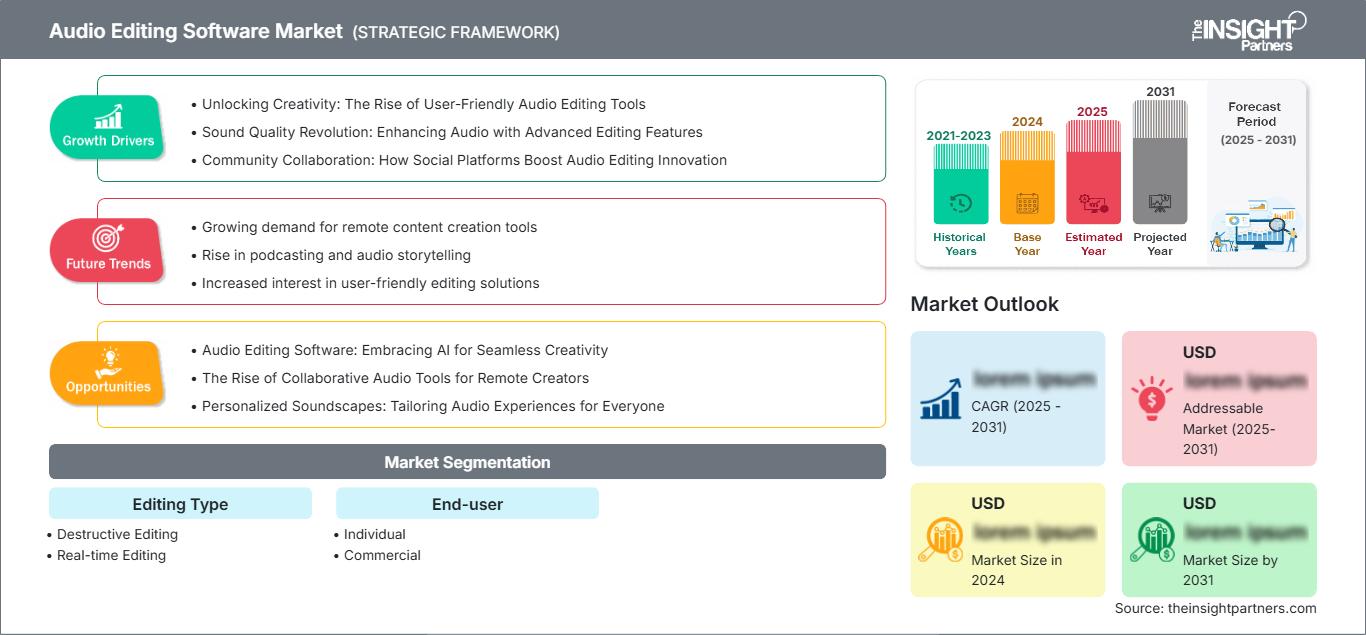
Audio productions have moved away from studio-only environments to more distributed creators through affordable digital audio workstations, plugins, mobile editing tools, and cloud-based file sharing. The market for audio editing software is now targeting musicians, podcasters, video production teams, educators, and marketing teams who need fast cleaning, multitrack editing, and uniform loudness specifications. Real-time editing and AI-based audio restoration have improved efficiency without sacrificing artistic control.
In terms of future demand, the factors that will play into this include new creators in Asia Pacific, remote working, immersive audio formats, and the greater application of audio in learning and business communication. Providers will target subscriptions, workflow automation, and cross-platform capabilities. Policy supporting digital literacy, media export, and creator-based businesses in this region will encourage adoption, but piracy and cost-sensitivity will ensure that they listen to licensing needs.
Audio Editing Software Market Report Scope
| Report Attribute | Details |
|---|---|
| Market size in 2025 | US$ 5.13 Billion |
| Market Size by 2034 | US$ 8.08 Billion |
| Global CAGR (2026 - 2034) | 5.84% |
| Historical Data | 2021-2024 |
| Forecast period | 2026-2034 |
Audio Editing Software Market Analysis
The audio editing software market growth is tied to the expansion of podcasts, short-form video, music streaming, audiobooks, games, and branded content. Users need tools that remove noise, balance dialogue, edit waveforms, and manage multitrack projects without extended post-production delays. Demand is strongest where speed, audio clarity, and repeatable publishing workflows affect audience retention and commercial output.
The audio editing software market analysis shows a value chain spanning software vendors, plug-in developers, hardware interfaces, content platforms, training communities, and enterprise IT teams. Factors that affect the supply side include subscription model, package deals of creative applications, ecosystem of digital audio workstations and free models. Compatibility on different operating systems, files, and collaboration software becomes increasingly important due to the growing number of remote workers.
The competitive arena highlights professional DAWs, compact editors, restoration systems and creative solutions. Adobe Inc. holds its position due to its Creative Cloud ecosystem, while Avid Technology Inc. retains its competitiveness in the professional post-production industry. Steinberg Media Technologies GmbH provides Cubase and WaveLab ecosystems for music and broadcasting professionals.
Acon AS, Cockos Incorporated, MAGIX Software GmbH, NCH Software, n-Track Software, CyberLink Corporation, and Image-Line Software compete due to their affordability, special focus on certain workflows, mobility and producer communities. Investments are made into AI-assisted cleaning and editing, immersive mixing, improved rendering and subscription business models. Usability becomes an important factor in strategic positioning besides advanced features.
● REPORT CUSTOMIZATION
Tailor This Report To Align With Your Specific Business Requirements
This report can be customized to align precisely with your business objectives, scope, and target markets. Customization options include tailored segmentation, geography, competitive analysis, and strategic insights to support informed decision-making.
Customize This Report →WHAT YOU CAN ADJUST
- ● Segmentations
- ● Geography
- ● Competitive Analysis
- ● Language Preferences
Audio Editing Software Market: Strategic Insights
Regional Insights
North America Audio Editing Software Market
North America generated 36–39% share in 2025 and is forecast to expand at 4.9–6.2% CAGR. High creator monetization, mature podcast advertising, enterprise media teams, and strong professional studio spending sustain demand. The audio editing software market share remains highest in this region because users already operate paid creative suites and established DAW workflows.
It is becoming increasingly necessary to provide real-time editing, automatic cleaning and collaboration tools from afar for production houses, educational institutions, broadcast networks, and independents in the US and Canada. Moreover, there is an added advantage for software companies due to the widespread presence of broadband access and devices and an upgrade from free to paid subscriptions by individual users.
U.S. Audio Editing Software Market
The US accounted for 78–82% of North American revenue in 2025 and is expected to grow at 5.0–6.1% CAGR. Strong music, media, film, podcast, gaming, and corporate communications activity gives vendors a large base of professional and individual users.
Adobe Inc., Avid Technology, Inc., Cockos Incorporated, MAGIX Software GmbH, NCH Software, and Image-Line Software support diverse workflows ranging from podcast cleanup to immersive audio post-production. Demand is strongest where audio is monetized through streaming, advertising, learning platforms, brand campaigns, and professional media delivery.
Europe Audio Editing Software Market
Europe represented 26–29% share in 2025 and is projected to grow at 4.6–5.8% CAGR. Podcasting, broadcasting, music recording, and post-production services are among the UK's strengths, whereas Germany is ahead in professional audio engineering, software lineage, and creation training. These countries also offer reliable commercial licenses.
France, Italy, and Spain have increasing adoption, with more creators, academic institutions, marketing firms, and streaming companies creating audio material. Buyers in Europe focus on data privacy, multilingual support, accessibility, and pricing clarity. Growth is steady due to mature creation markets utilizing professional technology, yet adopting AI clean-up and cloud collaboration.
APAC Audio Editing Software Market
APAC held 22–25% share in 2025 and is expected to grow at 6.4–8.0% CAGR. China, Japan, South Korea, India, and Australia support adoption through online video, music education, gaming, anime, creator platforms, and mobile-first production.
India and Southeast Asia create upside because entry-level creators are moving from free applications toward low-cost paid tools. Japan and South Korea provide advanced media and music production demand. Localized interfaces, affordable subscriptions, cloud libraries, and mobile compatibility will influence regional conversion rates.
Middle East & Africa Audio Editing Software Market
The Middle East & Africa market is expected to grow at 3.9–5.4% CAGR during 2026–2034. Adoption is highest in the UAE and Saudi Arabia through media districts, entertainment investments, education, and content from creators.
The strongest African market is South Africa, thanks to the influence of broadcasting, music, online education, and the podcast community. The remainder of MEA is selective but growing, as broadband, smartphones, and digital media spending increase there. Licensing and lightweight editors matter for adoption.
Segmentation Analysis
Editing Type
Editing Type is expected to grow at 5.2–6.5% CAGR during 2026–2034. The audio editing software market scope covers destructive editing and real-time editing, with demand shaped by workflow speed, quality control, reversibility, collaboration needs, and whether users are producing live, iterative, or archival audio projects.
- Destructive Editing: Destructive editing remains relevant for final corrections, restoration, file repair, and compact workflows where permanent processing is acceptable and users need fast, direct waveform modification.
- Real-time Editing: Real-time editing dominates because creators and professionals need instant monitoring, non-destructive effects, flexible revisions, and faster approval cycles across music, podcasting, broadcast, and video workflows.
End-user
End-user is expected to grow at 5.5–6.9% CAGR during 2026–2034. Individual creators drive volume adoption, while commercial users generate higher recurring spending through multi-seat licenses, support requirements, compliance needs, project volume, and integration with video, music, and enterprise content workflows.
- Individual: Individual users adopt software for podcasts, music demos, social videos, online courses, and home studios, often beginning with low-cost tools before upgrading as output quality expectations rise.
- Commercial: Commercial users include studios, broadcasters, agencies, media companies, educators, and enterprises that require collaboration, reliability, support, licensing control, templates, and repeatable sound quality across teams.
Opportunity Snapshot
| End-user | Revenue Contribution | Trend Tag | Adoption Stage |
| Individual | Medium | Creator Tools | Scaling |
| Commercial | High | Studio Workflow | Mature |
Audio Editing Software Market Growth Drivers and Impact Analysis
Expansion of Creator-Led Audio and Video Content
Podcasts, video tutorials, short clips, audio files, live streams, and branded audio are being released by independent producers and production teams with increasing frequency. There is a need for technology that would help with the cleaning of the speech, reduction of noise in the background, normalization of sound levels, correction of errors and fast editing. This would have an effect on software being used not only by professional studios but also by other people who need professional-quality results and don’t have to hire professional engineers.
Growth of Remote Production and Cloud Collaboration
The process of audio production is getting more decentralized among editors, musicians, speakers, agencies, and clients who may not be located in the same place. In case of remote production, there are needs for file compatibility, exchange, versioning, and fast feedback. The cloud-based editing, together with collaboration, makes it possible to eliminate the gaps between these stages of the process and helps business teams cope with the deadline management of various projects at once.
Improvement in AI-Assisted Editing and Restoration
AI-driven technologies are saving time on tasks related to repetitive audio editing, including noise reduction, speech improvement, silence cutting, and mastering recommendations. Such features are helpful for those without expertise as they lower the level of complexity, and professionals use them in order to speed up their initial audio editing process. As for the effect on the market, there will be greater efficiency and wider usage by educators, marketers, podcasters, and businesspeople.
Audio Editing Software Market Future Trends
AI-Guided Workflows with Human Creative Control
Audio editing software market trends are moving toward AI-guided workflows that suggest cleanup, loudness, timing, and mix improvements while leaving final choices to users. This will reshape product design because creators want automation without losing creative identity. Future tools are likely to include explainable presets, editable recommendations, and content-aware routing. Vendors that balance speed, transparency, and professional control will attract both entry-level users and commercial teams managing repeatable output standards.
Immersive and Cross-Platform Audio Production
The spatial content required for music, gaming, movies, virtual reality, automobiles, and high-end streaming sites will encourage the editor to opt for immersive media and cross-platform monitoring. The audio tools will require enhanced capabilities like object-based mixing, binaural playback, multichannel deliverable, and exporting compatibility. This shift adds greater value for commercial production houses since one single project requires several iterations in different formats like headphones, loudspeakers, video sites, and even live performance venues.
Audio Editing Software Market Opportunities
Affordable Subscriptions for Emerging Creator Markets
Emerging markets offer significant opportunities as creators monetize regional language podcasts, music, education, and social video. Audio editing software market Forecasts indicate that flexible pricing can widen paid adoption where perpetual licenses are too expensive. Vendors can combine mobile support, localized tutorials, cloud backup, and creator templates to reduce onboarding friction. Partnerships with creator academies, telecom providers, and online learning platforms can improve reach while helping users progress from basic cleanup to more advanced multitrack production.
Enterprise Audio Workflows for Learning and Communications
Enterprises are using audio more in their training programs, customer education, internal communication, webinars, and branded podcasts. This opens up opportunities in terms of team licensing, workflow approval, templating, and security. Business buyers want quality that is consistent across the organization rather than point creative applications. Product differentiation could come from the combination of audio cleaning into video suites, CMS, and learning software. The reason why the opportunity is good is that enterprises offer repeat business and multi-departmental sales.
Frequently Asked Questions

- Comprehensive Market Sizing and Forecast Analysis
- Detailed Segmentation Analysis
- In-Depth Market Dynamics Assessment
- Regional and Country-Level Insights
- Competitive Landscape and Company Benchmarking
- Strategic Business Intelligence
Recent Reports
Testimonials

The Insight Partners' SCADA System Market report is comprehensive, with valuable insights on current trends and future forecasts. The team was highly professional, responsive, and supportive throughout. We are very satisfied and highly recommend their services.
RAN KEDEM Partner, Reali Technologies LTDs
I requested a report on a very specific software market and the team produced the report in a few days. The information was very relevant and well presented. I then requested some changes and additions to the report. The team was again very responsive and I got the final report in less than a week.
JEAN-HERVE JENN Chairman, Future Analytica
We worked with The Insight Partners for an important market study and forecast. They gave us clear insights into opportunities and risks, which helped shape our plans. Their research was easy to use and based on solid data. It helped us make smart, confident decisions. We highly recommend them.
PIYUSH NAGPAL Sr. Vice President, High Beam Global
The Insight Partners delivered insightful, well-structured market research with strong domain expertise. Their team was professional and responsive throughout. The user-friendly website made accessing industry reports seamless. We highly recommend them for reliable, high-quality research services
YUKIHIKO ADACHI CEO, Deep Blue, LLC.
This is the first time I have purchased a market report from The Insight Partners.While I was unsure at first, I visited their web site and felt more comfortable to take the risk and purchase a market report.I am completely satisfied with the quality of the report and customer service. I had several questions and comments with the initial report, but after a couple of dialogs over email with their analyst I believe I have a report that I can use as input to our strategic planning process.Thank you so much for taking the extra time and making this a positive experience.I will definitely recommend your service to others and you will be my first call when we need further market data.
JOHN SUZUKI President and Chief Executive Officer, Board Director, BK Technologies
I wish to appreciate your support and the professionalism you displayed in the course of attending to my request for information regarding to infectious disease IVD market in Nigeria. I appreciate your patience, your guidance, and the fact that you were willing to offer a discount, which eventually made it possible for us to close a deal. I look forward to engaging The Insight Partners in the future, all thanks to the impression you have created in me as a result of this first encounter.
DR CHIJIOKE ONYIA MANAGING DIRECTOR, PineCrest Healthcare Ltd.Reason to Buy
- Informed Decision-Making
- Understanding Market Dynamics
- Competitive Analysis
- Identifying Emerging Markets
- Customer Insights
- Market Forecasts
- Risk Mitigation
- Boosting Operational Efficiency
- Strategic Planning
- Investment Justification
- Tracking Industry Innovations
- Aligning with Regulatory Trends





 Get Free Sample for