
Augmented Reality and Virtual Reality in Sports and Entertainment Market Share, Demand & Growth by 2034
Coverage: by Software Type (Augmented Reality Software, Virtual Reality Content Creation); Device (Augmented Reality Head-Mounted Device, Virtual Reality Head-Mounted Device) , and Geography (North America, Europe, Asia Pacific, and South and Central America)
- Status : Data Released
- Report Code : TIPRE00006628
- Category : Technology, Media and Telecommunications
- No. of Pages : 150
- Available Report Formats :


- Last update date : August 19, 2026


2025 Market Size
US$ 968.57 Mn
Base year value
2034 Forecast
US$ 6,044.97 Mn
Projected by 2034
CAGR 2026-2034
22.56 %
Growth rate
Addressable Market
US$ 27,568.77 Mn
(2026-2034)
The global Augmented Reality and Virtual Reality in Sports and Entertainment market was valued at US$ 968.57 million in 2025 and is expected to reach US$ 6044.97 million by 2034; it is estimated to record a CAGR of 22.56% during 2026-2034.
Augmented Reality and Virtual Reality in Sports and Entertainment Market Assessment and Insights
- North America: Accounted for 36–40% share in 2025 and is projected to register a 24.5–26.5% CAGR during 2026–2034, supported by strong investments from professional sports organizations, streaming platforms, immersive entertainment providers, and advanced digital infrastructure.
- US: Represented approximately 72–76% of the North American market in 2025 and is expected to grow at a 24–26% CAGR through 2034, driven by leading technology companies, professional leagues, and widespread adoption of immersive fan experiences.
- Europe: Held an estimated 24–28% share in 2025 and is forecast to expand at a 24–26% CAGR, with the UK, Germany, and France leading investments in immersive broadcasting, live entertainment, and digital sports engagement.
- Asia Pacific: Captured approximately 26–30% share in 2025 and is anticipated to record the fastest regional expansion with a 27–29% CAGR, led by China, Japan, South Korea, and India through investments in esports, gaming, and smart entertainment ecosystems.
- Largest Segment: Software Type (Virtual Reality Content Creation): Accounted for approximately 54–58% market share in 2025 and is expected to grow at a 25–27% CAGR, supported by increasing production of immersive sports broadcasts and interactive entertainment experiences.
- High Growth Segment: Device (Augmented Reality Head-Mounted Device): Represented 42–46% market share in 2025 while expanding at a 27–30% CAGR, driven by lightweight wearable innovations, live venue experiences, and enterprise-supported immersive applications.
- Key companies analyzed in detail: Artoolworks, Inc., Blippar Ltd., EON Reality, Inc., Google LLC, HTC Corporation, Microsoft Corporation, Meta Platforms, Inc. (Oculus VR), Samsung Electronics Co., Ltd., Sony Group Corporation, Zugara, Inc.
Source: The Insight Partners' analysis based on proprietary research, government publications, company annual reports, investor presentations, industry databases, and expert interviews.
The market has changed from visualization techniques that were experimental in nature to digital engagement solutions that offer immersive viewing, athlete analytics, merchandising, and virtual participation. The improvements in graphics processing, cloud rendering, artificial intelligence integration, and wearables have greatly improved the experience of the end users by reducing latency in real-time solutions in sports arenas and entertainment venues.
Future prospects show that there will be an increase in investments in digital economies where telecom networks, smart venues, and broadcasting will continue to evolve. Governments promoting digital innovations, growth of esports, creation economy, and cooperation between technology firms and sports organizations will drive commercialization opportunities through the forecast period.
Augmented Reality and Virtual Reality in Sports and Entertainment Market Report Scope
| Report Attribute | Details |
|---|---|
| Market size in 2025 | US$ 968.57 Million |
| Market Size by 2034 | US$ 6,044.97 Million |
| Global CAGR (2026 - 2034) | 22.56% |
| Historical Data | 2021-2024 |
| Forecast period | 2026-2034 |
Augmented Reality and Virtual Reality in Sports and Entertainment Market Analysis
Growing consumer demand for immersive digital experiences continues to accelerate augmented reality and virtual reality in the sports and entertainment market growth across professional sports, esports, concerts, museums, and live entertainment. It is becoming increasingly common for organizations to utilize extended reality solutions to offer personalized experiences for fans, virtual ticketing, visualization of athletic performances, and improved sponsorship deals. The constant advancements in software development platforms, AI-enabled content creation, and cloud streaming solutions have enabled better value creation and scalable deployment of such applications, both for premium and mass markets.
There is also significant progress on the supply side, which is made possible by collaborations between semiconductor firms, optics firms, software developers, telecom operators, and cloud infrastructure providers to increase platform compatibility. Falling prices of hardware, more XR development kits being available in the market, and edge computing improving connectivity further help in the efficient deployment and adoption of these solutions.
The competitive landscape within the augmented reality and virtual reality in sports and entertainment market analysis is characterized by continuous innovation, strategic alliances, and ecosystem expansion among technology providers, hardware manufacturers, and software developers. Microsoft Corporation, Google LLC, HTC Corporation, Sony Group Corporation, Samsung Electronics Co., Ltd., Meta Platforms, Inc. (Oculus VR), Blippar Ltd., EON Reality, Inc., Zugara, Inc., and Artoolworks, Inc. continue to improve their competitive edge through platform improvements, integration with cloud, immersive experiences enhanced by artificial intelligence, and collaborations with sports leagues, media channels, and entertainment companies.
Venture investment continues to grow as organizations work on increasing immersive content libraries, working on spatial computing apps and forming collaborative ecosystems together with telecommunications companies and venue operators. Venture capital helps start-ups that work on immersive fan experience solutions, digital collectibles, interactive broadcasting, and tools for mixed reality production. Strategic acquisitions, software platform upgrades, and cloud-based deployment strategies will likely speed up the commercialization process while providing scalable solutions to meet the changing consumer demands in the sports and entertainment industries.
● REPORT CUSTOMIZATION
Tailor This Report To Align With Your Specific Business Requirements
This report can be customized to align precisely with your business objectives, scope, and target markets. Customization options include tailored segmentation, geography, competitive analysis, and strategic insights to support informed decision-making.
Customize This Report →WHAT YOU CAN ADJUST
- ● Segmentations
- ● Geography
- ● Competitive Analysis
- ● Language Preferences
Augmented Reality and Virtual Reality in Sports and Entertainment Market: Strategic Insights
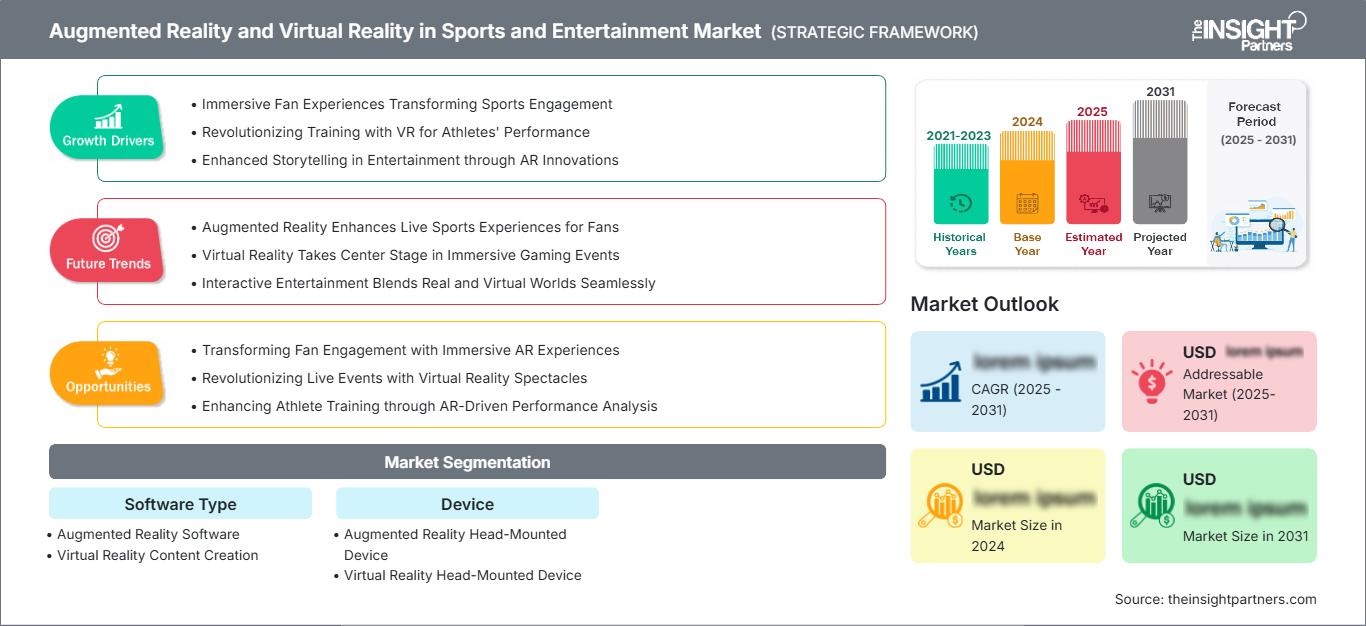
Regional Insights
North America Augmented Reality and Virtual Reality in Sports and Entertainment Market
North America accounted for an estimated 36–40% of the Augmented Reality and Virtual Reality in Sports and Entertainment Market share of the global market in 2025 and is projected to register a CAGR of 24.5–26.5% during 2026–2034. Strong technology investments, high consumer acceptance of immersive digital experiences, and widespread deployment of advanced communication infrastructure continue to position the region as the leading revenue contributor. AR and VR are currently being integrated into live broadcasts, player performance analysis, fans' experience, and management of venues through sports leagues, entertainment entities, and technology vendors.
The area also takes advantage of an advanced ecosystem consisting of cloud services vendors, semiconductor manufacturers, software developers, and extended reality platforms vendors. Partnerships of sports franchises with media and technology companies will drive further commercialization in stadiums, esports events, virtual concerts, and interactive entertainment. Ongoing investments in artificial intelligence-based content creation and spatial computing will facilitate further growth of the market.
U.S. Augmented Reality and Virtual Reality in Sports and Entertainment Market
The United States represented approximately 72–76% of the North American market in 2025 and is anticipated to expand at a CAGR of 24–26% through 2034. The leadership of the country is made possible through major investments in technological products by technology firms, professional sports firms, entertainment firms, and streaming media in order to deliver engaging experiences through digital technologies. Advanced broadband network infrastructures coupled with high uptake of connected devices contribute to growth in the market.
Leading technology developers keep releasing immersive software applications as well as next-generation head-mounted devices for various applications such as sports broadcasting, training, interactive gaming, and entertainment. Leading professional sports organizations leverage the use of augmented reality and virtual reality technologies in sports performance monitoring, training simulations, and fan engagement.
Europe Augmented Reality and Virtual Reality in Sports and Entertainment Market
Europe accounted for approximately 24–28% of the global market in 2025 and is forecast to grow at a 24–26% CAGR through 2034. The region benefits from increasing digital transformation across media organizations, professional sports clubs, cultural institutions, and entertainment venues. Government initiatives promoting digital innovation and expanding investments in immersive technologies further support adoption across multiple commercial applications.
The United Kingdom continues to lead regional deployment through investments in sports broadcasting, esports development, immersive theater, and virtual entertainment experiences. Strong technology partnerships between broadcasters, football clubs, and software developers continue to expand commercial opportunities across live event engagement and interactive media.
Germany remains a significant contributor owing to its advanced industrial technology base and increasing use of AR and VR solutions across sports training, simulation platforms, and entertainment production. Technology companies and research institutions actively collaborate to commercialize innovative immersive applications supporting consumer engagement.
France, Italy, and Spain collectively contribute substantial demand through expanding digital entertainment industries, growing esports communities, and the modernization of sports venues. Cultural events, tourism experiences, and interactive media production continue supporting adoption while encouraging partnerships among software developers, broadcasters, and event organizers.
APAC Augmented Reality and Virtual Reality in Sports and Entertainment Market
Asia Pacific captured an estimated 26–30% share in 2025 and is expected to record the highest regional expansion with a 27–29% CAGR during the forecast period. China leads the regional market through large-scale investments in esports, gaming, digital media, and smart entertainment infrastructure, while Japan and South Korea continue advancing immersive consumer electronics and XR innovation.
India and Australia are increasingly adopting AR and VR technologies across professional sports, education, gaming, and live entertainment. Expanding 5G networks, favorable digital economy initiatives, rising smartphone penetration, and increasing investments in immersive content development continue to strengthen regional market growth.
Middle East & Africa Augmented Reality and Virtual Reality in Sports and Entertainment Market
The Middle East & Africa market is anticipated to expand at a 23–25% CAGR through 2034, supported by growing investments in digital tourism, smart stadiums, esports, and entertainment diversification initiatives. Saudi Arabia leads regional adoption through major sporting events and large-scale investments in digital entertainment infrastructure.
The UAE continues expanding immersive technology deployment across tourism attractions, exhibitions, and premium entertainment venues, while South Africa demonstrates growing adoption in gaming, sports broadcasting, and educational entertainment. Ongoing digital infrastructure development and increasing collaboration between technology providers and event organizers are expected to create sustainable regional growth opportunities.
Segmentation Analysis
Software Type
The Software Type segment is expected to register a CAGR of 25–27% during 2026–2034, supported by continuous innovation in immersive content development, cloud rendering, artificial intelligence integration, and spatial computing platforms. The augmented reality and virtual reality in sports and entertainment market scope continues to expand as software solutions enable personalized fan engagement, athlete performance analytics, immersive broadcasting, and interactive digital experiences across professional sports and entertainment ecosystems.
- Augmented Reality Software: Enables real-time digital overlays for live sporting events, venue navigation, athlete statistics visualization, interactive advertising, and fan engagement applications, making it an essential component for enhancing audience participation and commercial value.
- Virtual Reality Content Creation: Supports production of immersive sporting events, virtual concerts, esports experiences, interactive storytelling, and digital simulations, allowing broadcasters and entertainment providers to deliver highly engaging premium content across multiple digital platforms.
Device
The Device segment is projected to grow at a CAGR of 27–29% during the forecast period as wearable technologies become lighter, more powerful, and increasingly affordable. Continuous advancements in display technologies, battery efficiency, sensors, and processing capabilities encourage wider deployment across professional sports training, live event broadcasting, immersive entertainment, and location-based experiences.
- Augmented Reality Head-Mounted Device: Provides hands-free visualization for coaches, athletes, broadcasters, and spectators by integrating digital information into real-world environments, supporting training simulations, venue experiences, and interactive entertainment applications.
- Virtual Reality Head-Mounted Device: Delivers fully immersive digital environments for esports competitions, virtual sporting events, entertainment venues, athlete simulations, and cinematic experiences while benefiting from improvements in display quality, motion tracking, and user comfort.
Opportunity Snapshot
| Segment Name | Revenue Contribution | Trend Tag | Adoption Stage |
| Augmented Reality Software | High | Live Analytics | Scaling |
| Virtual Reality Content Creation | High | Immersive Broadcast | Mature |
Augmented Reality and Virtual Reality in Sports and Entertainment Market Growth Drivers and Impact Analysis
Growing Consumer Demand for Immersive Live Sports Experiences
Sporting organizations as well as entertainment companies are turning to augmented and virtual reality technology in order to offer immersive experiences to fans that go beyond mere broadcasting. The ability to offer virtual courtside experience, interactive player stats, mixed reality replays and personal digital content has been identified as one of the major selling points for broadcasters and sports franchises to boost viewership. Premium streaming platform commercialization, growth in subscription digital content and increased expectations by consumers from their experiences are continuing to drive investment into the industry. For leagues, concert promoters and esports venues looking to grab the attention of fans, immersive technologies are becoming strategic tools.
Expansion of 5G Networks and Cloud-Based XR Infrastructure
The use of fast 5G connections together with cloud computing infrastructure has made the business case for immersive apps much stronger. Latency-free communication has allowed the delivery of augmented reality or virtual reality experiences in a seamless manner at sporting events, concerts, or interactive entertainment sessions. Rendering of content in the cloud eliminates the need for high-end computers, which makes immersive apps accessible through various devices such as smartphones, wearables, and connected screens. The collaboration of telecommunications companies, cloud service providers, and software vendors continues towards refining real-time streaming and multiplayer interaction.
Increasing Enterprise Adoption Across Sports Organizations
Increasingly, professional sports clubs, event producers, media organizations, and entertainment firms are making use of immersive technologies for purposes of coaching, training, planning, venue management, and audience analytics. Coaching is done via simulation, and players get benefits in the form of performance analysis as well as injury rehabilitation in immersive environments. In entertainment, immersive visualization technologies are being used in planning production, designing the stage, and interacting with audiences. Artificial intelligence, spatial computing, digital twins, and analytics make it possible for these organizations to make better decisions and maximize profits from both physical and virtual events.
Augmented Reality and Virtual Reality in Sports and Entertainment Market Future Trends
AI-Driven Spatial Content and Personalized Fan Experiences
Artificial intelligence is increasingly being integrated with spatial computing platforms to create personalized and adaptive immersive experiences for sports fans and entertainment audiences. Augmented reality and virtual reality in sports and entertainment market trends indicate that AI-powered content recommendation engines, automated highlight generation, multilingual virtual commentators, and contextual digital overlays will become mainstream across live events. Advanced computer vision, real-time player tracking, and generative AI are expected to simplify immersive content production while reducing operational costs. As personalization becomes a competitive differentiator, organizations will increasingly deploy intelligent XR platforms capable of delivering individualized viewing experiences across multiple connected devices.
Convergence of Mixed Reality with Smart Venues
In the future, all stadiums for sports and music concerts, as well as entertainment centers, will be designed with mixed reality capabilities in mind and incorporated into the digital architecture. Such capabilities as smart seating, interactive navigation, immersive shopping, contactless solutions, and location services will be common due to wearable technologies and edge computing. Venue managers will use IoT devices, digital twins, and XR platforms on the cloud to optimize crowd control as well as improve the experience of the visitors. This way, new revenue streams will emerge from digital sponsorship, immersive offerings, and interactive commerce.
Augmented Reality and Virtual Reality in Sports and Entertainment Market Opportunities
Commercial Expansion Across Emerging Sports Markets
Rapid digital transformation in Asia Pacific, Latin America, and the Middle East presents significant investment opportunities for immersive technology providers. Augmented reality and virtual reality in sports and entertainment market Forecasts indicate increasing adoption as governments invest in smart cities, esports ecosystems, sports tourism, and advanced entertainment infrastructure. Technology vendors can establish long-term partnerships with broadcasters, stadium developers, and sports organizations to deploy scalable XR solutions tailored to regional audiences. Localized content creation, cloud-native deployment models, and affordable wearable devices will further improve commercial accessibility, enabling sustained market penetration while supporting new digital revenue streams for ecosystem participants.
Enterprise Platforms for Immersive Sports Training and Broadcasting
Demand is growing for enterprise-grade XR platforms capable of supporting athlete development, tactical simulations, production planning, and remote collaboration across sports organizations and media companies. Technology providers have opportunities to deliver integrated software ecosystems combining artificial intelligence, cloud rendering, analytics, and digital twins into unified operational platforms. These solutions can improve coaching efficiency, broadcasting quality, venue operations, and sponsorship activation while enabling data-driven decision-making. Continued investment in interoperable enterprise platforms is expected to strengthen long-term commercial relationships between software developers, professional sports organizations, broadcasters, and global entertainment companies.
Frequently Asked Questions

- Comprehensive Market Sizing and Forecast Analysis
- Detailed Segmentation Analysis
- In-Depth Market Dynamics Assessment
- Regional and Country-Level Insights
- Competitive Landscape and Company Benchmarking
- Strategic Business Intelligence
Recent Reports
Testimonials

The Insight Partners' SCADA System Market report is comprehensive, with valuable insights on current trends and future forecasts. The team was highly professional, responsive, and supportive throughout. We are very satisfied and highly recommend their services.
RAN KEDEM Partner, Reali Technologies LTDs
I requested a report on a very specific software market and the team produced the report in a few days. The information was very relevant and well presented. I then requested some changes and additions to the report. The team was again very responsive and I got the final report in less than a week.
JEAN-HERVE JENN Chairman, Future Analytica
We worked with The Insight Partners for an important market study and forecast. They gave us clear insights into opportunities and risks, which helped shape our plans. Their research was easy to use and based on solid data. It helped us make smart, confident decisions. We highly recommend them.
PIYUSH NAGPAL Sr. Vice President, High Beam Global
The Insight Partners delivered insightful, well-structured market research with strong domain expertise. Their team was professional and responsive throughout. The user-friendly website made accessing industry reports seamless. We highly recommend them for reliable, high-quality research services
YUKIHIKO ADACHI CEO, Deep Blue, LLC.
This is the first time I have purchased a market report from The Insight Partners.While I was unsure at first, I visited their web site and felt more comfortable to take the risk and purchase a market report.I am completely satisfied with the quality of the report and customer service. I had several questions and comments with the initial report, but after a couple of dialogs over email with their analyst I believe I have a report that I can use as input to our strategic planning process.Thank you so much for taking the extra time and making this a positive experience.I will definitely recommend your service to others and you will be my first call when we need further market data.
JOHN SUZUKI President and Chief Executive Officer, Board Director, BK Technologies
I wish to appreciate your support and the professionalism you displayed in the course of attending to my request for information regarding to infectious disease IVD market in Nigeria. I appreciate your patience, your guidance, and the fact that you were willing to offer a discount, which eventually made it possible for us to close a deal. I look forward to engaging The Insight Partners in the future, all thanks to the impression you have created in me as a result of this first encounter.
DR CHIJIOKE ONYIA MANAGING DIRECTOR, PineCrest Healthcare Ltd.Reason to Buy
- Informed Decision-Making
- Understanding Market Dynamics
- Competitive Analysis
- Identifying Emerging Markets
- Customer Insights
- Market Forecasts
- Risk Mitigation
- Boosting Operational Efficiency
- Strategic Planning
- Investment Justification
- Tracking Industry Innovations
- Aligning with Regulatory Trends





 Get Free Sample for