
Augmented Reality Software Market Share, Growth & Forecast by 2034
Coverage: By Function (Remote Collaboration, Workflow Optimization, Documentation, Visualization, 3D Modelling, Navigation, Others); End User (Automotive, Medical, Aerospace and Defense, Mining, Telecom and IT, Others) , and Geography (North America, Europe, Asia Pacific, and South and Central America)
- Status : Data Released
- Report Code : TIPRE00008784
- Category : Technology, Media and Telecommunications
- No. of Pages : 150
- Available Report Formats :


- Last update date : August 24, 2026


2025 Market Size
US$ 20.32 Bn
Base year value
2034 Forecast
US$ 255.62 Bn
Projected by 2034
CAGR 2026-2034
32.49 %
Growth rate
Addressable Market
US$ 959.47 Bn
(2026-2034)
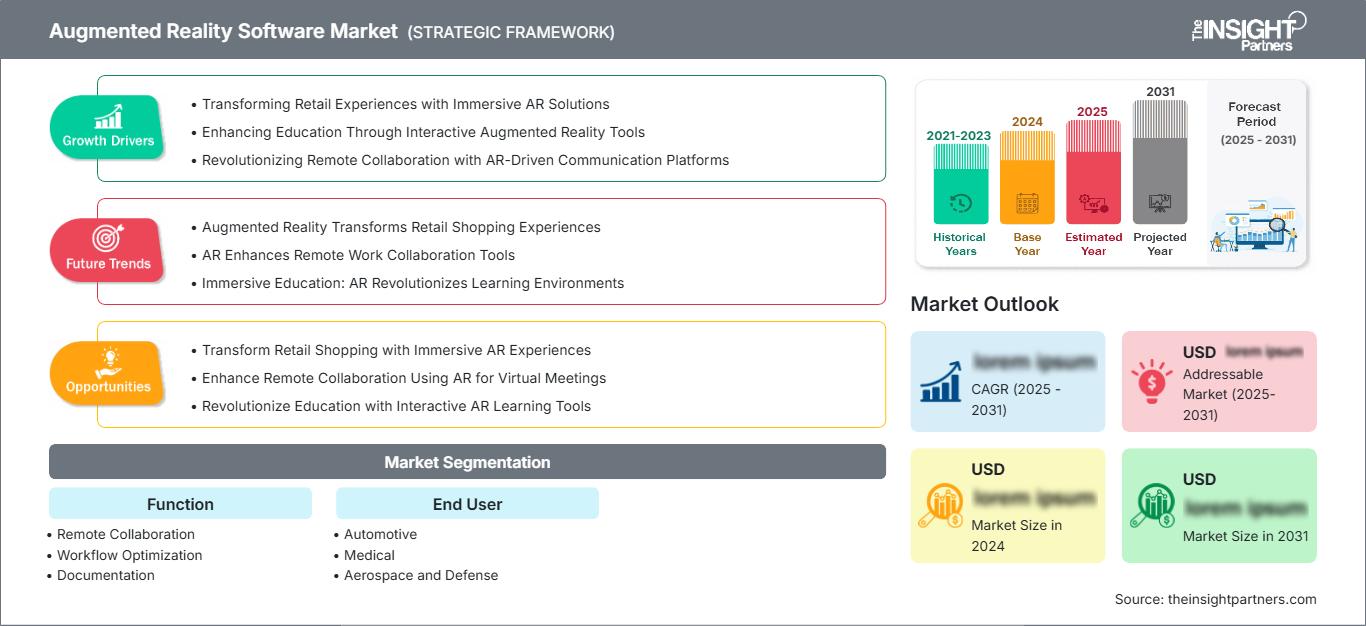
The Augmented reality software market is experiencing rapid expansion as enterprises and consumers increasingly integrate immersive digital experiences into operational workflows and customer engagement strategies. The market was valued at US$ 20.32 Billion in 2025 and is projected to reach US$ 255.62 Billion by 2034, registering a CAGR of 32.49% during 2026–2034. Accelerating adoption across manufacturing, healthcare, retail, aerospace, and education continues to strengthen demand for scalable augmented reality software platforms and cloud-enabled deployment models.
Across North America, technology investments, advanced enterprise digitalization programs, and expanding adoption of Industry 4.0 initiatives continue to strengthen the augmented reality software market size. The regional market is anticipated to expand at an estimated CAGR of 30.5–33.5% through 2034, supported by widespread cloud infrastructure, mature developer ecosystems, and increasing enterprise spending on remote collaboration, digital maintenance, and immersive workforce training solutions.
Augmented Reality Software Market Assessment and Insights
- North America: Accounted for 36–40% share in 2025 and is expected to register a CAGR of 30.5–33.5% during 2026–2034, supported by widespread enterprise software deployment, AI integration, and strong investments in industrial digital transformation.
- US: Represented nearly 74–78% of the North American market in 2025 and is projected to grow at a CAGR of 30–33% owing to rapid adoption across manufacturing, healthcare, aerospace, logistics, and enterprise collaboration platforms.
- Europe: Held approximately 25–29% share in 2025 while advancing at a CAGR of 29–32%. Germany, the UK, and France continue leading regional adoption through industrial automation, automotive innovation, and digital manufacturing initiatives.
- Asia Pacific: Captured 24–28% share in 2025 and is forecast to record the fastest regional expansion with a CAGR of 34–37%, driven by investments across China, Japan, South Korea, and India in smart factories and enterprise digitalization.
- Largest Segment: End User – Manufacturing accounted for approximately 26–30% market share in 2025 and is projected to grow at a CAGR of 33–35%, supported by predictive maintenance, worker guidance, and industrial visualization applications.
- High Growth Segment: Function – Remote Collaboration represented nearly 18–22% market share in 2025 and is expected to register a CAGR of 35–38%, fueled by hybrid workforce models and increasing enterprise collaboration requirements.
- Key companies analyzed in detail: Amazon Web Services, Inc.; Catchoom Technologies S.L.; EON Reality, Inc.; HP Reveal; Kentico Software; PTC Inc.; Ubimax GmbH; Upskill; Wikitude GmbH; Zappar Ltd.
Source: The Insight Partners' analysis based on proprietary research, government publications, company annual reports, investor presentations, industry databases, and expert interviews.
The evolution of the market has shifted from visualization tools to enterprise-grade software systems, which can cater to cloud computing, artificial intelligence, computer vision, digital twins, and spatial computing use cases. The continuous development of mobile processors, wearable displays, edge computing technology, and software development kits has increased the efficiency of real-time rendering processes while making it less complex to deploy immersive enterprise solutions.
The investment trend is anticipated to pick up in emerging economies as governments promote industrial and technological transformations. Increasing 5G network access, analytics using artificial intelligence, enterprise-grade cloud computing, and software interoperability will enable the creation of an ecosystem that is conducive to commercialization. The focus on cybersecurity and workforce safety, as well as enterprise data security, is anticipated to bolster software adoption.
Augmented Reality Software Market Report Scope
| Report Attribute | Details |
|---|---|
| Market size in 2025 | US$ 20.32 Billion |
| Market Size by 2034 | US$ 255.62 Billion |
| Global CAGR (2026 - 2034) | 32.49% |
| Historical Data | 2021-2024 |
| Forecast period | 2026-2034 |
Augmented Reality Software Market Analysis
Growing enterprise digital transformation programs continue to accelerate augmented reality software market growth across industrial, healthcare, logistics, and service sectors. In addition to that, organizations increasingly employ immersive software platforms as a means of boosting efficiency, cutting training expenses, decreasing machine downtime, and increasing the productivity of employees. The value chain has become much broader than just visualization software by including cloud platform providers, hardware producers, artificial intelligence vendors, enterprise software providers, and systems integrators, who can offer scalable AR solutions for particular industries.
Supply dynamics keep changing owing to increased availability of software-as-a-service solutions, interoperability, and AI-assisted content creation. Better software development frameworks allow for quicker implementation while decreasing the complexity of the implementation process for enterprises. Growing partnerships between semiconductor makers, cloud infrastructure providers, and enterprise software providers keep boosting the scalability of solutions and accelerating their adoption in various industries.
Competitive differentiation within the augmented reality software market analysis increasingly depends on software interoperability, AI integration, enterprise scalability, cybersecurity capabilities, and vertical-specific application development. Amazon Web Services, Inc., PTC Inc., TeamViewer-acquired Ubimax GmbH, EON Reality, Inc., and Wikitude GmbH have been making more investments in cloud native architecture, integration of digital twin, and advanced computer vision technology.
There is an increasing emphasis on investments in AI content generation, licensing through subscriptions, cloud-native technology, low-code environments, and edge computing, reflecting broader Augmented Reality Software Market trends toward scalable and enterprise-ready deployment models. Companies like Catchoom Technologies S.L., Zappar Ltd., Kentico Software, Upskill, HP Reveal, and EON Reality have continued to develop relationships with industrial automation firms and enterprise software providers to enhance customer retention and commercialization in developing economies.
● REPORT CUSTOMIZATION
Tailor This Report To Align With Your Specific Business Requirements
This report can be customized to align precisely with your business objectives, scope, and target markets. Customization options include tailored segmentation, geography, competitive analysis, and strategic insights to support informed decision-making.
Customize This Report →WHAT YOU CAN ADJUST
- ● Segmentations
- ● Geography
- ● Competitive Analysis
- ● Language Preferences
Augmented Reality Software Market: Strategic Insights
Regional Insights
North America Augmented Reality Software Market
North America accounted for an estimated 36–40% share of the global augmented reality software market in 2025 and is projected to expand at a CAGR of 31.5–33.5% through 2034. The region benefits from mature digital infrastructure, substantial enterprise software investments, and widespread adoption of cloud computing, artificial intelligence, and industrial automation technologies. Strong participation from technology providers, software developers, and research institutions accelerates commercialization across manufacturing, healthcare, aerospace, retail, and logistics applications. The augmented reality software market share remains the highest globally due to continuous innovation and robust enterprise spending.
The USA and Canada keep investing heavily in the Industry 4.0 concept, digital twin solutions, and connected workforce. Government spending on manufacturing, defense upgrades, and smart infrastructure projects drives enterprise adoption even more. Businesses focus on remote maintenance capabilities, employee training through virtual reality, and collaborative engineering systems to increase efficiency. Consistent venture capital funding and close cooperation of software vendors with cloud providers contribute to North America's domination during the forecast period.
U.S. Augmented Reality Software Market
The U.S. represented approximately 82–86% of the North American market in 2025 and is anticipated to record a CAGR of 31.8–33.8% between 2026 and 2034. The country's leadership is supported by a concentration of global technology companies, cloud infrastructure providers, enterprise software developers, and innovation-focused startups. High investment in artificial intelligence, mixed reality, and industrial digitalization continues driving enterprise demand across numerous vertical industries.
The manufacturing, military, healthcare, retail, and logistics sectors remain the top users of enterprise AR applications in the United States. Cloud deployments and subscription licensing continue to be adopted by many organizations to replace the on-premise deployments of the technology. Research efforts, venture capital funding, and collaborations between software vendors and industries make the United States the biggest revenue generator in North America.
Europe Augmented Reality Software Market
Europe captured approximately 26–30% of the global market in 2025 and is forecast to expand at a CAGR of 30.2–32.2% through 2034. Germany remains the regional leader due to advanced manufacturing capabilities and widespread Industry 4.0 implementation. The United Kingdom maintains strong adoption across retail, healthcare, and financial services, while France, Italy, and Spain increasingly integrate AR software into industrial training, engineering, and smart manufacturing operations.
The UK enjoys the presence of a thriving software development community, heavy investment in immersive technology, and growing applications in healthcare education, retail visualization, and enterprise collaboration. Germany continues to be a leader in terms of industrial applications by leveraging AR software in conjunction with automation and robotics in their factories. France, Italy, and Spain combine efforts in digital transformation, smart manufacturing, and modernization efforts in their industries.
APAC Augmented Reality Software Market
Asia Pacific accounted for an estimated 24–28% market share in 2025 and is expected to achieve the fastest regional expansion with a CAGR of 33.5–35.5% through 2034. China leads regional adoption through significant investments in digital manufacturing, smart factories, and artificial intelligence, while Japan and South Korea continue advancing industrial automation and enterprise visualization technologies.
India and Australia are experiencing increasing enterprise adoption supported by expanding cloud infrastructure, digital transformation initiatives, and government-backed innovation programs. Rising investments in manufacturing modernization, telecommunications, healthcare digitization, and retail technology continue strengthening regional demand while encouraging software localization and ecosystem partnerships.
Middle East & Africa Augmented Reality Software Market
The Middle East & Africa market is projected to register a CAGR of 29.0–31.0% during the forecast period. Saudi Arabia leads regional adoption through Vision 2030 initiatives supporting digital transformation, industrial diversification, and smart city development. The United Arab Emirates continues investing in immersive technologies across healthcare, education, aviation, and public services.
South Africa maintains gradual enterprise adoption across mining, manufacturing, and telecommunications, while the Rest of MEA benefits from increasing investments in digital infrastructure and cloud computing. Expanding industrial modernization projects, infrastructure development, and technology partnerships are expected to support sustained regional market expansion over the coming years.
Segmentation Analysis
Function
The Function segment is projected to grow at a CAGR of 33.0–35.0% during 2026–2034. The expanding deployment of enterprise visualization platforms, AI-powered collaboration tools, and immersive workforce applications continues to diversify software capabilities across industries. The augmented reality software market scope continues expanding as organizations increasingly integrate specialized functions into digital transformation strategies, improving productivity, operational visibility, and remote decision-making across manufacturing, healthcare, logistics, aerospace, and industrial maintenance.
- Remote Collaboration – This sub-segment supports virtual expert assistance, real-time maintenance guidance, and collaborative troubleshooting across geographically distributed teams. Growing hybrid work environments and industrial service optimization continue strengthening enterprise demand for remote collaboration software capabilities.
- Workflow Optimization – Organizations increasingly implement workflow optimization solutions to streamline inspection, maintenance scheduling, production monitoring, and quality assurance. These applications improve operational efficiency through contextual digital instructions and real-time process visualization while reducing human errors.
- Documentation – Documentation software enables automated capture of maintenance records, inspection reports, compliance documentation, and operational procedures using augmented reality interfaces. Enterprises benefit from standardized reporting, improved traceability, regulatory compliance, and faster knowledge transfer across distributed operations.
- Visualization – Visualization applications facilitate interactive product demonstrations, engineering simulations, design validation, and digital twin integration. High-quality three-dimensional rendering improves stakeholder collaboration while supporting faster product development, architectural planning, and manufacturing optimization initiatives.
- 3D Modelling – Three-dimensional modeling software enhances product prototyping, engineering validation, and design collaboration by allowing users to manipulate digital assets in immersive environments. Growing industrial digitalization continues to increase enterprise adoption across automotive, aerospace, and manufacturing sectors.
- Navigation – Navigation solutions deliver location-aware guidance for warehouses, industrial facilities, airports, hospitals, and logistics centers. Indoor positioning technologies combined with augmented overlays improve operational efficiency, worker safety, inventory management, and facility maintenance activities.
End User
The End User segment is anticipated to expand at a CAGR of 31.8–33.8% throughout the forecast period. Rising enterprise investments in digital transformation, workforce training, predictive maintenance, and customer engagement continue accelerating software deployment across multiple industries. Increasing interoperability with cloud platforms, artificial intelligence, and industrial IoT systems enables organizations to deploy scalable augmented reality software solutions that improve operational performance and business decision-making.
- Automotive – Automotive companies utilize AR software for assembly guidance, vehicle design validation, technician training, maintenance support, and quality inspections. Digital visualization tools improve manufacturing precision while reducing development cycles and operational costs.
- Medical – Healthcare providers increasingly deploy augmented reality software for surgical planning, medical education, patient visualization, rehabilitation, and remote consultation. Growing emphasis on precision medicine and advanced clinical training continues to strengthen adoption across hospitals and healthcare institutions.
- Aerospace and Defense – Aerospace and defense organizations integrate AR software into maintenance operations, equipment inspections, pilot training, assembly guidance, and mission planning. Immersive visualization significantly enhances operational efficiency while supporting stringent quality and safety requirements.
- Mining – Mining enterprises implement augmented reality software to improve equipment maintenance, workforce safety, geological visualization, and operational planning. Remote assistance capabilities reduce equipment downtime while improving productivity in hazardous operating environments.
- Telecom and IT – Telecommunications and IT companies leverage AR software for infrastructure maintenance, network visualization, customer support, technician training, and field service optimization. Expanding digital infrastructure investments continue to increase enterprise software deployment across the sector.
Opportunity Snapshot
| Segment Name | Revenue Contribution | Trend Tag | Adoption Stage |
| Automotive | High | Smart Manufacturing | Mature |
| Medical | High | Surgical Planning | Scaling |
| Aerospace and Defense | Medium | Digital Maintenance | Scaling |
| Mining | Medium | Remote Inspection | Emerging |
| Telecom and IT | High | Edge Computing | Scaling |
Augmented Reality Software Market Growth Drivers and Impact Analysis
Growing Enterprise Digital Transformation Across Industrial Sectors
Organizations keep focusing on digital transformation projects that enhance the productivity, efficiency, and reliability of their assets with the help of immersion technology. With the help of augmented reality software, technicians and engineers can access digital data related to their job tasks, such as maintenance, inspection, assembly, and quality assurance. Manufacturers are more likely to implement AR technology along with the industrial Internet of Things and artificial intelligence in order to reduce downtime and make decisions more efficiently. Enterprise augmented reality software becomes more and more valuable for organizations utilizing digital twins and predictive maintenance. It is possible to standardize training and onboarding of employees and avoid mistakes.
Expansion of Cloud Computing and Artificial Intelligence Integration
Cloud-native software architectures combined with AI make augmented reality apps scalable and intelligent. Image recognition, object tracking, NLP, and computer vision through AI help software provide real-time instructions, document generation, and recommendation engines. The cloud makes it possible to have centralized content management, deploy software remotely, update software, and collaborate at an enterprise level while reducing costs for infrastructure. With organizations moving their business operations into the cloud, AR software providers continue making their software platforms compatible with enterprise resource planning systems, CRM software, and industrial automation software.
Increasing Adoption of Remote Workforce Collaboration Solutions
The use of remote collaboration technology is becoming more prevalent among global corporations to facilitate the geographical distribution of workforces and complicated industrial processes. Through the use of augmented reality software, field engineers are able to collaborate remotely by engaging in live video guidance, annotations, and collaboration that helps cut down the cost associated with machine downtime and travel expenses. Such sectors as utility companies, telecommunication companies, manufacturers, aerospace industries, and healthcare companies are using remote assistance tools in increasing numbers. With an increased adoption of the hybrid workplace model and connected worker initiatives, firms are looking to adopt remote collaboration software that can enhance their communication needs.
Augmented Reality Software Market Future Trends
Artificial Intelligence Enhancing Immersive Enterprise Experiences
AI technology is continuing to revolutionize enterprise AR applications through automatic scene understanding, intelligent object recognition, analysis, and personalized experiences for users. The use of advanced computer vision technologies increases the precision of interactions and simplifies implementation processes in an industrial setting. Emerging trends in AR software are centered around offering autonomous assistance, predictive navigation, and smart workflow suggestions in enterprise software ecosystems. Enterprise software vendors are incorporating more AI functionalities using machine learning models and real-time analytics to increase efficiency in operations and offer more adaptable immersive experiences.
Expansion of Spatial Computing Ecosystems
The development of spatial computing platforms is giving rise to increased possibilities in terms of integrating enterprise AR software in various digital ecosystems. More and more organizations are integrating AR with digital twins, IoT sensors, robots, and cloud computing in order to increase transparency and decision-making. Software companies keep working on interoperable platforms capable of running on different operating systems and various wearable technologies, as well as smartphones and hardware designed specifically for industry applications. The increasing investment in future computing environments promotes development standards that ease enterprise adoption and open up new opportunities.
Augmented Reality Software Market Opportunities
Expansion Across Healthcare and Clinical Training Platforms
The providers of healthcare have increased their interest in the use of augmented technology for better surgical planning, medical training, and clinical collaboration through remote interaction with patients. The hospitals, diagnostic facilities, and medical institutions are continuously incorporating AR technology into imaging systems, electronic health records, and AI to enhance treatment accuracy and training. The forecast is positive due to the high investment potential of the ongoing digitalization of healthcare systems and simulation-based learning approaches. Companies able to offer software that meets the requirements of compliance, security, and interoperability will take advantage of the increased procurement within developed and emerging markets for healthcare.
Industrial Metaverse and Digital Twin Integration
Industrial enterprises are increasingly adopting digital twins, smart factories, and connected operational environments that rely on immersive visualization platforms. Augmented reality software vendors have significant opportunities to integrate with enterprise resource planning, industrial IoT, robotics, and predictive maintenance ecosystems to provide comprehensive operational intelligence. As manufacturers modernize production facilities and supply chains, scalable cloud-based AR software capable of supporting remote inspections, digital documentation, engineering collaboration, and workforce assistance will experience increasing demand. Investments in industrial metaverse platforms, edge computing, and spatial computing infrastructure are expected to generate new revenue opportunities while encouraging long-term partnerships between software developers, industrial equipment manufacturers, and enterprise technology providers.
Frequently Asked Questions

- Comprehensive Market Sizing and Forecast Analysis
- Detailed Segmentation Analysis
- In-Depth Market Dynamics Assessment
- Regional and Country-Level Insights
- Competitive Landscape and Company Benchmarking
- Strategic Business Intelligence
Recent Reports
Testimonials

The Insight Partners' SCADA System Market report is comprehensive, with valuable insights on current trends and future forecasts. The team was highly professional, responsive, and supportive throughout. We are very satisfied and highly recommend their services.
RAN KEDEM Partner, Reali Technologies LTDs
I requested a report on a very specific software market and the team produced the report in a few days. The information was very relevant and well presented. I then requested some changes and additions to the report. The team was again very responsive and I got the final report in less than a week.
JEAN-HERVE JENN Chairman, Future Analytica
We worked with The Insight Partners for an important market study and forecast. They gave us clear insights into opportunities and risks, which helped shape our plans. Their research was easy to use and based on solid data. It helped us make smart, confident decisions. We highly recommend them.
PIYUSH NAGPAL Sr. Vice President, High Beam Global
The Insight Partners delivered insightful, well-structured market research with strong domain expertise. Their team was professional and responsive throughout. The user-friendly website made accessing industry reports seamless. We highly recommend them for reliable, high-quality research services
YUKIHIKO ADACHI CEO, Deep Blue, LLC.
This is the first time I have purchased a market report from The Insight Partners.While I was unsure at first, I visited their web site and felt more comfortable to take the risk and purchase a market report.I am completely satisfied with the quality of the report and customer service. I had several questions and comments with the initial report, but after a couple of dialogs over email with their analyst I believe I have a report that I can use as input to our strategic planning process.Thank you so much for taking the extra time and making this a positive experience.I will definitely recommend your service to others and you will be my first call when we need further market data.
JOHN SUZUKI President and Chief Executive Officer, Board Director, BK Technologies
I wish to appreciate your support and the professionalism you displayed in the course of attending to my request for information regarding to infectious disease IVD market in Nigeria. I appreciate your patience, your guidance, and the fact that you were willing to offer a discount, which eventually made it possible for us to close a deal. I look forward to engaging The Insight Partners in the future, all thanks to the impression you have created in me as a result of this first encounter.
DR CHIJIOKE ONYIA MANAGING DIRECTOR, PineCrest Healthcare Ltd.Reason to Buy
- Informed Decision-Making
- Understanding Market Dynamics
- Competitive Analysis
- Identifying Emerging Markets
- Customer Insights
- Market Forecasts
- Risk Mitigation
- Boosting Operational Efficiency
- Strategic Planning
- Investment Justification
- Tracking Industry Innovations
- Aligning with Regulatory Trends





 Get Free Sample for