
Automated Guided Vehicles (AGV) Software Market Size, Share & Trends by 2034
Coverage: by Offering (In-Built Vehicle Software and Integrated Software); Industry (Automotive, Manufacturing, Food & Beverages, Aerospace, Healthcare, Logistics, and Retail), and Geography (North America, Europe, Asia Pacific, and South and Central America)
- Status : Data Released
- Report Code : TIPTE00002653
- Category : Technology, Media and Telecommunications
- No. of Pages : 150
- Available Report Formats :


- Last update date : August 19, 2026


2025 Market Size
US$ 3.36 Bn
Base year value
2034 Forecast
US$ 5.43 Bn
Projected by 2034
CAGR 2026-2034
5.49 %
Growth rate
Addressable Market
US$ 39.88 Bn
(2026-2034)
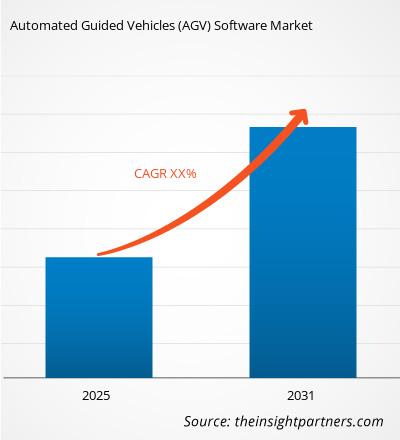
The automated guided vehicles software market is valued at US$ 3.36 Billion in 2025 and is projected to reach US$ 5.43 Billion by 2034, expanding at a CAGR of 5.49% during 2026–2034. Adoption is being shaped by warehouse modernization, industrial automation, and the need for coordinated fleet control across material handling environments where accuracy, throughput, and safety are operational priorities.
Across North America, the automated guided vehicles software market size is supported by e-commerce fulfillment, automotive electrification programs, and higher investment in warehouse management integration. The region is estimated to grow at a CAGR of 5.1–5.6% during 2026–2034 as operators prioritize software that improves route planning, traffic control, battery management, and real-time visibility.
Automated Guided Vehicles (AGV) Software Market Assessment and Insights
- North America accounted for 31–34% share in 2025 and is expected to grow at a CAGR of 5.1–5.6% during 2026–2034, supported by advanced logistics automation, labor optimization, and strong integration of AGV fleets with WMS and MES platforms.
- US represented 76–79% of North America share in 2025 and is projected to grow at a CAGR of 5.2–5.7% through 2034, driven by fulfillment centers and automotive plants.
- Europe held 27–30% share in 2025 and is forecast to grow at a CAGR of 4.8–5.3%, led by Germany, France, Italy, and the UK, where smart manufacturing programs support software-enabled intralogistics.
- Asia Pacific captured 30–33% share in 2025 and is expected to grow at a CAGR of 5.8–6.4%, with China, Japan, South Korea, and India expanding automated material handling in manufacturing and logistics.
- Largest Segment: Integrated Software held 57–60% market share in 2025 and is expected to grow at a CAGR of 5.3–5.8%, reflecting demand for centralized fleet orchestration.
- High Growth Segment: Logistics held 20–23% market share in 2025 and is forecast to grow at a CAGR of 6.1–6.8%, supported by fulfillment automation and route optimization.
- Key companies analyzed in detail: Dematic, KION GROUP AG, Toyota Industries Corporation, JBT Corporation, Murata Machinery, Ltd., Oceaneering International, Inc., BA Systèmes, Addverb Technologies Limited, Kollmorgen Corporation, Konecranes Plc, and Götting KG.
Source: The Insight Partners' analysis based on proprietary research, government publications, company annual reports, investor presentations, industry databases, and expert interviews.
The role that software plays in AGVs has moved from being a control plane to an intelligence that makes the implementation of these machines possible. The early software could only work with predefined fixed routes, while modern software is capable of controlling issues like navigation, fleet management, traffic management, preventive maintenance, and corporate data management.
Future needs will be determined by the need for coordination of multiple robots, cloud connectivity, and standardization to avoid vendor lock-in. New markets may want scalable solutions due to the growing shortage of manpower and increased need for deliveries. Legislation aimed at protecting workers and increasing traceability may further stimulate the adoption of AGV software since it can be used in tracking the movement and reducing the risks involved with manual movement.
Automated Guided Vehicles (AGV) Software Market Report Scope
| Report Attribute | Details |
|---|---|
| Market size in 2025 | US$ 3.36 Billion |
| Market Size by 2034 | US$ 5.43 Billion |
| Global CAGR (2026 - 2034) | 5.49% |
| Historical Data | 2021-2024 |
| Forecast period | 2026-2034 |
Automated Guided Vehicles (AGV) Software Market Analysis
Demand for automated guided vehicles software market growth is linked to the broader move toward connected factories and responsive distribution networks. The facilities will start using software that helps to assign transportation orders, prevent bottlenecks, and coordinate the activities of the AGVs with the conveyor, warehouse, and production system. The supply chain will consist of vehicle manufacturers, suppliers of navigation software, fleet management software, system integrators, and end-users who seek to achieve clear benefits in terms of performance.
The supply chain becomes more specialized as the suppliers manage to increase their compatibility with different sensors, warehouses, and manufacturing execution systems. The onboard vehicle software becomes essential in terms of safe navigation and movement, and the integrated software is gaining its strategic importance due to the need for one layer of control.
The market analysis reveals a combination of global intralogistics suppliers and software-enabled automation vendors. Dematic, KION GROUP AG, Toyota Industries Corporation, Murata Machinery, Ltd., and JBT Corporation have been competing based on their material handling ecosystem offerings, whereas Kollmorgen Corporation, Addverb Technologies Limited, BA Systèmes, Oceaneering International, Inc., Konecranes Plc, and Götting KG are building their niche capabilities in controls, navigation, and mobility.
There is a clear trend towards interoperability, cloud-based supervision, artificial intelligence-driven traffic control, and lifecycle service delivery. Suppliers that will be able to minimize the complexity of implementation and offer gradual upgrades are well-positioned, in particular among logistics and manufacturing enterprises, which are trying to reconcile capital constraints with requirements for automation.
● REPORT CUSTOMIZATION
Tailor This Report To Align With Your Specific Business Requirements
This report can be customized to align precisely with your business objectives, scope, and target markets. Customization options include tailored segmentation, geography, competitive analysis, and strategic insights to support informed decision-making.
Customize This Report →WHAT YOU CAN ADJUST
- ● Segmentations
- ● Geography
- ● Competitive Analysis
- ● Language Preferences
Automated Guided Vehicles (AGV) Software Market: Strategic Insights
Regional Insights
North America automated guided vehicles software market
North America's automated guided vehicles software market share is estimated at 31–34% in 2025, with a CAGR of 5.1–5.6% during 2026–2034. Growth is supported by high warehouse automation spending, dense fulfillment networks, and adoption of fleet management software that reduces vehicle idle time while improving picking, replenishment, and dock-to-storage movements.
Manufacturers and logistics providers in the region are prioritizing software that links AGVs to ERP, WMS, and maintenance systems. Automotive electrification, food distribution, and healthcare logistics also create demand for repeatable, traceable, and safer internal transport. These factors make the region a mature but still expanding market for advanced orchestration tools.
U.S. automated guided vehicles software Market
The U.S. represented 76–79% of North America share in 2025 and is projected to grow at a CAGR of 5.2–5.7% during 2026–2034. Strong demand comes from e-commerce fulfillment, automotive assembly, third-party logistics, and high-volume manufacturing facilities that require reliable task assignment and real-time fleet supervision.
Company presence is reinforced by intralogistics suppliers, robotics developers, and system integrators serving large distribution centers. Application trends include dynamic route optimization, battery management, predictive maintenance, and integration with labor planning systems. These software capabilities are becoming essential as operators seek stable throughput despite labor availability and peak-season variability.
Europe automated guided vehicles software Market
Europe held 27–30% share in 2025 and is expected to grow at a CAGR of 4.8–5.3% during 2026–2034. Germany remains the leading country due to its automotive base, advanced manufacturing infrastructure, and focus on standardized automation interfaces that support multi-vendor fleets.
The UK is expanding AGV software adoption in retail distribution, food logistics, and parcel networks, where high service expectations require predictable internal movement. Germany’s demand is more manufacturing-led, with software used to connect automated vehicles to production sequencing and parts delivery. France, Italy, and Spain are scaling adoption in food and beverage, aerospace, and general manufacturing as facilities modernize material handling while controlling labor and safety risks.
APAC automated guided vehicles software Market
APAC accounted for 30–33% share in 2025 and is forecast to grow at a CAGR of 5.8–6.4% through 2034. China is the leading country, supported by large manufacturing capacity, logistics automation, and policy support for intelligent factories. Japan and South Korea contribute through robotics maturity and precision manufacturing demand.
India and Australia are expanding deployments in warehousing, retail distribution, and industrial campuses. Regional growth is supported by rising e-commerce volumes, electronics manufacturing, automotive production, and the need for software that coordinates AGVs with storage, sorting, and production systems.
Middle East & Africa automated guided vehicles software Market
The Middle East & Africa market is projected to grow at a CAGR of 4.6–5.1% during 2026–2034. Saudi Arabia and the UAE lead adoption through logistics parks, airport cargo facilities, healthcare infrastructure, and industrial diversification programs that require automated internal movement.
South Africa and the Rest of MEA show more selective adoption, mainly in mining support, manufacturing, retail distribution, and port-linked logistics. Growth depends on integration capability, service availability, and the ability to justify automation through safety, utilization, and throughput improvements.
Segmentation Analysis
Offering
Offering is segmented into in-built vehicle software and integrated software. The automated guided vehicles software market report indicates that the market scope is strongest where both layers work together, with vehicle-level control ensuring safe movement and integrated platforms coordinating fleet-wide operations. Offering-level CAGR is estimated at 5.2–5.8% during 2026–2034.
- In-Built Vehicle Software manages navigation, safety logic, obstacle response, and vehicle-level execution. It remains critical for reliable movement in controlled routes and supports core autonomy inside each AGV.
- Integrated Software connects multiple AGVs with warehouse, manufacturing, and maintenance systems. It holds the largest segment share because operators increasingly require centralized visibility and coordinated task allocation.
Industry
Industry demand is projected to grow at a CAGR of 5.5–6.1% during 2026–2034 as end users expand automation from repetitive transport to connected material flow. Logistics is a high-growth industry, while automotive and manufacturing remain foundational users due to structured production environments and high movement frequency.
- Automotive uses AGV software for line feeding, parts sequencing, and battery component movement, where route reliability and production synchronization are essential to avoid downtime.
- Manufacturing applies fleet software to move raw materials, work-in-process goods, and finished products between cells, improving consistency across complex plant layouts.
- Food & Beverages requires traceable and hygienic material movement, making software valuable for pallet transfer, packaging areas, and cold-chain distribution workflows.
- Aerospace uses AGV platforms for large-part movement, tool delivery, and controlled production logistics where precision, safety, and documentation are central.
- Healthcare adoption focuses on hospital logistics, pharmaceuticals, and clean environments, where automated transport can reduce manual handling and support secure material flows.
- Logistics is the fastest-growing industry because fulfillment centers need scalable transport automation, dynamic task assignment, and reliable integration with order management systems.
- Retail uses AGV software in distribution centers, back-end replenishment, and high-volume inventory movement as omnichannel fulfillment increases operational complexity.
Opportunity Snapshot
| Industry | Revenue Contribution | Trend Tag | Adoption Stage |
| Automotive | High | Line Feeding | Mature |
| Manufacturing | High | Plant Flow | Scaling |
| Food & Beverages | Medium | Cold Chain | Scaling |
| Aerospace | Medium | Precision Moves | Emerging |
| Healthcare | Medium | Secure Transport | Emerging |
| Logistics | High | Fulfillment Flow | Scaling |
| Retail | Medium | Omnichannel Stock | Scaling |
Automated Guided Vehicles (AGV) Software Market Growth Drivers and Impact Analysis
Warehouse Automation and Labor Optimization
The use of AGV software by warehouses allows the stabilization of their throughput while minimizing dependency on repetitive manual operations. The AGV software controls the mission, vehicle traffic, and real-time exception management. This enhances the efficiency of the vehicles in the receiving, storage, picking, and shipping areas. Due to the shortage of labor force and peak periods that affect the distribution centers, software-driven AGVs provide a predictable motion without the need for fixed conveyors in all processes. The driver of change is most influential in logistics and retail.
Integration with Smart Manufacturing Systems
AGV software has been embraced by manufacturers due to the need for the logistics process within the organization to be integrated with the production schedule, quality management system, and maintenance system. Integration of the software with MES, ERP, and warehouse systems helps ensure that the material reaches the workstation in time without buffer storage near production lines. This is particularly true in car manufacturing, aerospace manufacturing, and electronics manufacturing, where any downtime is expensive and route accuracy is important.
Shift Toward Flexible Navigation and Fleet Orchestration
The facilities are shifting from the fixed transportation layout towards the mobility defined by software, which can dynamically change its routes depending on traffic, obstacles and vehicle types. Such advanced software for AGVs allows for controlling the traffic, managing battery charging schedules, reacting to obstacles and prioritizing missions for several vehicles. Such an ability allows reducing the restrictions related to implementation and enables the gradual expansion of the automation processes within the facilities. The role of the driver becomes especially relevant for the development of warehouses and factories.
Automated Guided Vehicles (AGV) Software Market Future Trends
Cloud-Based Fleet Intelligence
The Automated guided vehicles software market trends point toward cloud-connected fleet intelligence that improves monitoring, analytics, and multi-site performance benchmarking. The dashboard will be expected to provide operators with information on vehicle utilization, routing efficiency, charging performance, and maintenance performance relative to other facilities. Cloud-based solutions can make updating the software and remote diagnostics much simpler, minimizing downtime in the case of a distributed warehouse/manufacturing network. With improved connectivity and security, cloud solutions can enable companies to deploy their AGV programs at a regional level.
Interoperable Multi-Vendor Control
Interoperability is likely to be the emerging trend of choice as companies try to minimize dependency on the fleet from a single vendor. Using standards for communication and neutral orchestration software will enable organizations to control AGVs, AMRs, conveyors, and storage systems through unified control platforms. The trend will be useful to large-scale manufacturing and logistics enterprises that buy automation gradually. Improved interoperability will lower costs of integration, decrease time required for implementation, and increase resilience through the utilization of mixed fleets for task sharing.
Automated Guided Vehicles (AGV) Software Market Opportunities
Software Upgrades for Installed AGV Fleets
A major opportunity lies in upgrading installed AGV fleets with smarter orchestration, analytics, and integration layers. Many facilities already operate vehicle automation but lack advanced traffic control, predictive maintenance, or real-time enterprise connectivity. Vendors can address this gap by offering modular software that extends fleet performance without forcing full hardware replacement. Automated guided vehicles software market Forecasts indicate that upgrade-led revenue can become attractive as operators seek faster payback, lower disruption, and improved visibility from existing automation assets.
Industry-Specific Workflow Templates
The vendors can derive value by providing specific workflows for the auto, food and beverage, healthcare, logistics, and retail industries. Such workflows could cut down the configuration time by pre-defining the route logic, safety requirements, exceptions, and reporting mechanisms. From the perspective of the buyer, the pre-defined workflows help in decreasing the risk of implementing the solution and enable the quick realization of value. From the perspective of the supplier, the pre-defined workflows help in developing repeatable deployment models that increase margins and differentiation.
Frequently Asked Questions

- Comprehensive Market Sizing and Forecast Analysis
- Detailed Segmentation Analysis
- In-Depth Market Dynamics Assessment
- Regional and Country-Level Insights
- Competitive Landscape and Company Benchmarking
- Strategic Business Intelligence
Recent Reports
Testimonials

The Insight Partners' SCADA System Market report is comprehensive, with valuable insights on current trends and future forecasts. The team was highly professional, responsive, and supportive throughout. We are very satisfied and highly recommend their services.
RAN KEDEM Partner, Reali Technologies LTDs
I requested a report on a very specific software market and the team produced the report in a few days. The information was very relevant and well presented. I then requested some changes and additions to the report. The team was again very responsive and I got the final report in less than a week.
JEAN-HERVE JENN Chairman, Future Analytica
We worked with The Insight Partners for an important market study and forecast. They gave us clear insights into opportunities and risks, which helped shape our plans. Their research was easy to use and based on solid data. It helped us make smart, confident decisions. We highly recommend them.
PIYUSH NAGPAL Sr. Vice President, High Beam Global
The Insight Partners delivered insightful, well-structured market research with strong domain expertise. Their team was professional and responsive throughout. The user-friendly website made accessing industry reports seamless. We highly recommend them for reliable, high-quality research services
YUKIHIKO ADACHI CEO, Deep Blue, LLC.
This is the first time I have purchased a market report from The Insight Partners.While I was unsure at first, I visited their web site and felt more comfortable to take the risk and purchase a market report.I am completely satisfied with the quality of the report and customer service. I had several questions and comments with the initial report, but after a couple of dialogs over email with their analyst I believe I have a report that I can use as input to our strategic planning process.Thank you so much for taking the extra time and making this a positive experience.I will definitely recommend your service to others and you will be my first call when we need further market data.
JOHN SUZUKI President and Chief Executive Officer, Board Director, BK Technologies
I wish to appreciate your support and the professionalism you displayed in the course of attending to my request for information regarding to infectious disease IVD market in Nigeria. I appreciate your patience, your guidance, and the fact that you were willing to offer a discount, which eventually made it possible for us to close a deal. I look forward to engaging The Insight Partners in the future, all thanks to the impression you have created in me as a result of this first encounter.
DR CHIJIOKE ONYIA MANAGING DIRECTOR, PineCrest Healthcare Ltd.Reason to Buy
- Informed Decision-Making
- Understanding Market Dynamics
- Competitive Analysis
- Identifying Emerging Markets
- Customer Insights
- Market Forecasts
- Risk Mitigation
- Boosting Operational Efficiency
- Strategic Planning
- Investment Justification
- Tracking Industry Innovations
- Aligning with Regulatory Trends





 Get Free Sample for