
Automotive Actuator Market Size, Share & Growth by 2034
Coverage: By Type (Hydraulic Actuator, Electric Actuator, Pneumatic Actuator); Application (Throttle, Fuel Injection, Brake, Others), and Geography
- Status : Data Released
- Report Code : TIPAT00002106
- Category : Automotive and Transportation
- No. of Pages : 150
- Available Report Formats :


- Last update date : August 26, 2026


2025 Market Size
US$ 30.25 Bn
Base year value
2034 Forecast
US$ 63.19 Bn
Projected by 2034
CAGR 2026-2034
8.53 %
Growth rate
Addressable Market
US$ 419.15 Bn
(2026-2034)
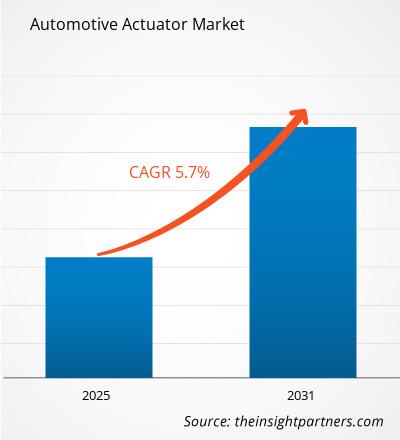
The automotive actuator market is experiencing sustained expansion as vehicle manufacturers integrate electronically controlled systems to improve fuel efficiency, safety, emissions compliance, and driving comfort. The automotive actuator market was valued at US$ 30.25 Billion in 2025 and is projected to reach US$ 63.19 Billion by 2034, registering a CAGR of 8.53% during 2026–2034. Rising vehicle electrification, increasing electronic content per vehicle, and continuous advancements in intelligent motion control technologies continue to strengthen global market demand.
Across North America, demand for advanced automotive actuators continues to increase because of rapid electric vehicle production, stringent vehicle emission standards, and expanding adoption of advanced driver assistance systems. Automotive manufacturers are investing in intelligent electromechanical technologies that improve vehicle efficiency and reliability while reducing maintenance requirements. The expanding automotive actuator market size is further supported by increasing deployment of electric actuators in passenger vehicles and next-generation commercial mobility platforms.
Automotive Actuator Market Assessment and Insights
- North America: Accounted for 29–33% of the global market in 2025, supported by advanced automotive manufacturing, increasing electric vehicle production, and widespread adoption of electronically controlled vehicle systems. The regional market is projected to expand at a CAGR of 7.9–8.4% during 2026–2034.
- U.S.: Represented 80–84% of North American demand in 2025, driven by strong automotive production, rapid vehicle electrification, and increasing integration of intelligent actuator technologies. The market is expected to register a CAGR of 8.0–8.5% through 2034.
- Europe: Held 24–28% of the global market in 2025, with Germany, France, Italy, and the United Kingdom leading adoption through premium vehicle manufacturing and stringent emission regulations. The region is anticipated to grow at a CAGR of 7.8–8.3% during 2026–2034.
- Asia Pacific: Captured 36–40% of the global market in 2025, led by China, Japan, South Korea, and India, owing to expanding automotive production and rapid electric vehicle adoption. The regional market is forecast to grow at a CAGR of 9.2–9.8% during 2026–2034.
- Largest Segment: Electric Actuator accounted for 47–51% of market demand in 2025 and is projected to register a CAGR of 9.3–9.8% during 2026–2034 as vehicle electrification accelerates globally.
- High Growth Segment: Throttle applications are expected to witness the strongest expansion with a CAGR of 9.5–10.0% during 2026–2034 because of increasing electronic throttle control adoption.
- Key companies analyzed in detail: Cebi Group, EFI Automotive, Continental AG, DENSO CORPORATION, HELLA GmbH & Co. KGaA, Johnson Electric Holdings Limited, Mitsubishi Electric Corporation, NIDEC CORPORATION, Rheinmetall AG, Robert Bosch GmbH.
Source: The Insight Partners' analysis based on proprietary research, government publications, company annual reports, investor presentations, industry databases, and expert interviews.
Advancements in vehicle electrification, intelligent motion control, and integrated electronic architectures have significantly transformed the automotive actuator market over recent years. Electric actuators are increasingly used in many braking systems, throttles, fuel injection systems, and body control systems to increase accuracy and simplify mechanical designs, as well as enhance the performance of the automobile. In addition, increased production of electric and hybrid automobiles has increased investments in small-sized, lightweight, and efficient actuator technologies that are able to facilitate advanced control systems in the automobile industry.
In the future, the market is likely to receive gains as a result of increased investments in software-defined vehicles, self-driving technologies, and smart manufacturing technologies. Increased production of automobiles in Asia-Pacific, favorable policies by governments on vehicle electrification and innovations in intelligent electromechanical technologies are likely to boost the long-term demand. Collaboration between the original equipment manufacturer and component manufacturers will be necessary.
Automotive Actuator Market Report Scope
| Report Attribute | Details |
|---|---|
| Market size in 2025 | US$ 30.25 Billion |
| Market Size by 2034 | US$ 63.19 Billion |
| Global CAGR (2026 - 2034) | 8.53% |
| Historical Data | 2021-2024 |
| Forecast period | 2026-2034 |
Automotive Actuator Market Analysis
Growing vehicle electrification, increasing integration of advanced electronic systems, and evolving safety regulations continue to drive market growth worldwide. Automotive manufacturers increasingly replace hydraulic and mechanical systems with electronically controlled actuators that improve responsiveness, reduce energy consumption, and enhance overall vehicle efficiency. Continuous advancements in sensor integration, semiconductor technologies, and intelligent control algorithms further support product innovation while enabling greater functionality across passenger vehicles and commercial vehicles.
The market ecosystem includes raw material suppliers, actuator manufacturers, semiconductor providers, automotive OEMs, system integrators, and aftermarket service providers. Strong collaboration throughout this value chain enables rapid product development, manufacturing optimization, and localized production capabilities. Increasing investment in intelligent manufacturing, digital quality monitoring, and supply chain resilience continues to support stable production while addressing growing global demand for advanced automotive actuator solutions.
Competitive intensity within the market analysis continues to increase as leading suppliers expand product portfolios through innovation, strategic partnerships, and manufacturing modernization. Companies including Robert Bosch GmbH, Continental AG, DENSO CORPORATION, Mitsubishi Electric Corporation, NIDEC CORPORATION, Johnson Electric Holdings Limited, HELLA GmbH & Co. KGaA, EFI Automotive, Cebi Group, and Rheinmetall AG continue developing advanced actuator technologies supporting electrification, automated driving, and connected vehicle platforms while strengthening long-term relationships with global automotive manufacturers.
Investment priorities increasingly focus on compact electric actuators, intelligent control electronics, high-efficiency motor technologies, and automated manufacturing systems. Companies are expanding production capacity in high-growth automotive regions while investing in research and development to improve product durability, energy efficiency, and functional integration. These strategic initiatives are expected to strengthen competitive positioning and support sustained market expansion throughout the forecast period.
● REPORT CUSTOMIZATION
Tailor This Report To Align With Your Specific Business Requirements
This report can be customized to align precisely with your business objectives, scope, and target markets. Customization options include tailored segmentation, geography, competitive analysis, and strategic insights to support informed decision-making.
Customize This Report →WHAT YOU CAN ADJUST
- ● Segmentations
- ● Geography
- ● Competitive Analysis
- ● Language Preferences
Automotive Actuator Market: Strategic Insights
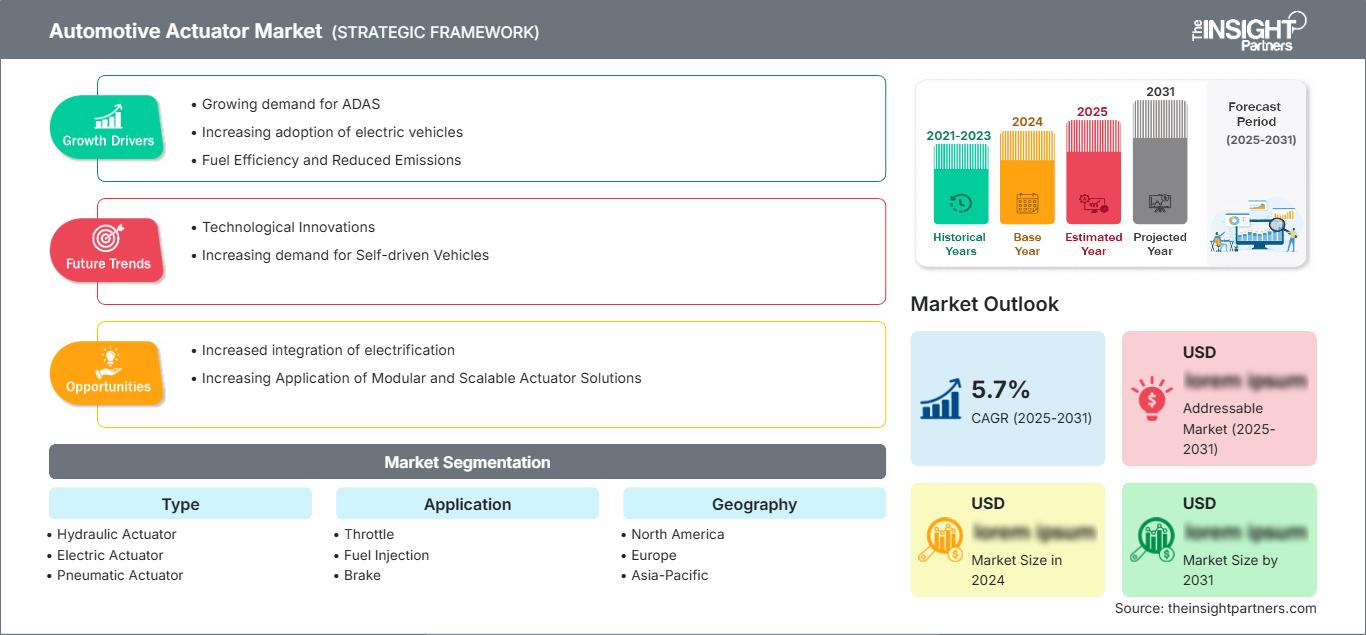
Regional Insights
North America Automotive Actuator Market
North America accounted for 29–33% of the global market in 2025 and is projected to expand at a CAGR of 7.9–8.4% during 2026–2034. Demand is supported by rapid vehicle electrification, stringent fuel economy standards, and widespread integration of advanced driver assistance systems. Automotive OEMs continue increasing the deployment of electric actuators in powertrain, braking, thermal management, and body control systems to improve efficiency, safety, and vehicle performance. The region also benefits from a mature automotive supply chain, advanced semiconductor capabilities, and strong investments in software-defined vehicle architectures.
The automotive actuator market share in North America continues to strengthen through increasing investments in intelligent manufacturing, localized component production, and research focused on high-performance electromechanical systems. Growing collaboration between actuator manufacturers and vehicle OEMs supports the rapid commercialization of compact, lightweight, and energy-efficient technologies. Continued expansion of electric vehicle manufacturing facilities and greater adoption of autonomous driving features are expected to reinforce regional demand throughout the forecast period.
U.S. Automotive Actuator Market
The United States represented 80–84% of North American demand in 2025 and is anticipated to register a CAGR of 8.0–8.5% through 2034. Increasing production of electric vehicles, rising electronic content per vehicle, and strong investment in intelligent mobility continue to support market expansion. Automotive manufacturers are integrating advanced actuator technologies into throttle control, braking systems, fuel injection, and thermal management applications to improve operational precision and energy efficiency.
Leading suppliers, including Robert Bosch GmbH, Continental AG, DENSO CORPORATION, Johnson Electric Holdings Limited, Mitsubishi Electric Corporation, and NIDEC CORPORATION, maintain extensive engineering, production, and customer support operations serving U.S. automotive manufacturers. Growing adoption of electronically controlled vehicle systems and continuous investment in next-generation mobility technologies are expected to sustain long-term demand for advanced automotive actuators across passenger and commercial vehicle platforms.
Europe Automotive Actuator Market
Europe captured 24–28% of the global market in 2025 and is forecast to expand at a CAGR of 7.8–8.3% during 2026–2034. Germany remains the regional leader because of its premium automotive manufacturing base, technological expertise, and early adoption of intelligent vehicle electronics. Stringent European Union emissions regulations and expanding electric vehicle production continue to support demand for sophisticated actuator systems across multiple automotive applications.
The United Kingdom continues investing in electric vehicle manufacturing and automotive innovation, encouraging increased deployment of intelligent actuator technologies. Germany benefits from close collaboration among component suppliers, engineering companies, and leading vehicle manufacturers, accelerating the development of highly integrated electronic vehicle architectures.
France, Italy, and Spain collectively contribute significantly through diversified automotive production and expanding investment in sustainable mobility. France continues strengthening electric vehicle manufacturing capacity, Italy emphasizes premium vehicle engineering and advanced component integration, while Spain expands export-oriented automotive manufacturing supported by modern production facilities. These developments continue to reinforce demand for advanced automotive actuators throughout the European automotive industry.
APAC Automotive Actuator Market
Asia Pacific accounted for 36–40% of the global market in 2025 and is projected to register the fastest regional growth at a CAGR of 9.2–9.8% during 2026–2034. China leads regional demand through large-scale automotive manufacturing, semiconductor investments, and the rapid expansion of electric vehicle production.
Japan and South Korea continue driving innovation in intelligent automotive electronics, while India benefits from expanding domestic vehicle manufacturing and supportive industrial policies. Australia contributes through specialized automotive engineering activities, strengthening the region's long-term competitive position in advanced automotive technologies.
Middle East & Africa Automotive Actuator Market
The Middle East & Africa market is expected to grow steadily at a CAGR of 6.7–7.2% during the forecast period. Saudi Arabia leads regional development through industrial diversification and automotive manufacturing initiatives, while the United Arab Emirates continues investing in advanced mobility infrastructure and intelligent transportation technologies.
South Africa remains an important automotive production hub with established export-oriented manufacturing capabilities. The Rest of the Middle East & Africa continues to adopt advanced vehicle technologies as industrial development, transportation infrastructure, and automotive assembly activities expand, creating new opportunities for actuator manufacturers.
Segmentation Analysis
Type
The Type segment forms the technological foundation of the market as manufacturers increasingly transition toward electronically controlled systems that improve efficiency, precision, and reliability. The market scope continues expanding with the growing replacement of hydraulic and pneumatic technologies by electric actuators in next-generation vehicles. The segment is projected to expand at a CAGR of 8.8–9.3% during 2026–2034.
- Hydraulic Actuator: Continues serving high-force automotive applications requiring durability and reliable performance, particularly in heavy-duty vehicles and specialized braking or suspension systems where significant mechanical force remains essential.
- Electric Actuator: Represents the largest product category owing to superior energy efficiency, precise electronic control, compact design, and compatibility with electric vehicles and advanced driver assistance systems.
- Pneumatic Actuator: Maintains relevance in selected commercial vehicle and industrial automotive applications where compressed air systems provide cost-effective and dependable actuation performance.
Application
Application diversity continues increasing as automotive manufacturers integrate advanced actuator technologies into multiple vehicle systems supporting performance, efficiency, emissions compliance, and safety. The growing adoption of software-controlled vehicle architectures continues to accelerate demand across critical automotive functions. The Application segment is expected to register a CAGR of 8.9–9.4% during 2026–2034.
- Throttle: Electronic throttle control systems continue gaining widespread adoption because they improve engine responsiveness, fuel efficiency, emissions control, and integration with advanced vehicle safety technologies.
- Fuel Injection: Precision actuators enhance fuel delivery accuracy, optimize combustion efficiency, reduce emissions, and improve engine performance across gasoline, diesel, and hybrid vehicle platforms.
- Brake: Intelligent braking actuators support electronic braking systems, stability control, regenerative braking, and autonomous driving functions, making them increasingly important across modern vehicle architectures.
Opportunity Snapshot
| Segment Name | Revenue Contribution | Trend Tag | Adoption Stage |
|---|---|---|---|
| Throttle | High | Electronic Control | Mature |
| Fuel Injection | High | Precision Fueling | Mature |
| Brake | High | Brake-by-Wire | Scaling |
| Others | Medium | Smart Motion | Emerging |
Automotive Actuator Market Growth Drivers and Impact Analysis
Expansion of Vehicle Electrification and Electronic Control Systems
Electrification of vehicles in terms of both passenger and commercial transport keeps escalating the need for sophisticated actuator systems that can provide effective electronic controls. The need for increased electronics in electric vehicles is higher compared to that of traditional vehicles, resulting in the application of actuators in thermal management, braking, battery management, and powertrains. Government policies promoting reduced carbon footprints in terms of lower emissions and energy efficiency have been aiding the efforts of original equipment manufacturers toward electronic control systems. Innovations in the field of compact motors, sensors, and embedded software have led to enhanced performance in terms of decreased size and lower power consumption.
Growing Adoption of Advanced Driver Assistance Systems
Automated driving support technologies become more reliant on rapid and accurate actuators to perform their tasks. For instance, adaptive cruise control, emergency braking, electronic steering, parking and lane keeping assist rely on well-coordinated performance of actuators coupled with cameras, radar and vehicle control systems. Vehicle safety rules in various jurisdictions keep pushing towards the implementation of such technologies in more models. In response, automotive companies begin to focus on highly responsive electric actuators able to provide decision-making and control systems capabilities. Such trends ensure further growth of demand and motivate suppliers to deliver more reliable and safe products.
Increasing Production of Intelligent and Connected Vehicles
The movement towards interconnected and software-defined cars is continuing to change the demands on actuators in current automotive systems. In order to be classified as an interconnected car, one requires many components that can work in harmony with the central control units in the car and any cloud-based diagnostic system that may exist for the car. Increasingly, automakers are focusing on developing modular actuators that will be able to take care of predictive maintenance, remote software updates, and health monitoring of the vehicle. Availability of semiconductors and advancements in digital manufacturing are helping manufacturers produce such actuators.
Automotive Actuator Market Future Trends
Software-Defined Vehicle Platforms Driving Intelligent Motion Control
Software-defined vehicle development is reshaping the automotive actuator market trends by increasing reliance on centralized electronic architectures capable of managing multiple actuator functions simultaneously. Future actuator platforms will increasingly integrate embedded intelligence, advanced diagnostics, over-the-air software updates, and predictive maintenance capabilities. Manufacturers are prioritizing scalable actuator technologies that support autonomous driving, vehicle connectivity, and electrified mobility while reducing wiring complexity, improving functional safety, and enabling continuous software enhancements throughout vehicle operating life.
Miniaturization and Lightweight Actuator Technologies
Car makers remain keen on lightweight car structures to increase energy efficiency and the distance covered by electric vehicles. The result is a rapid rise in demand for small actuators that incorporate highly efficient motors, composites, and accurate gears, as well as electronic control systems. Future products are set to be characterized by high torque density, good heat dissipation capacity, low energy usage, long service life, and reduced space requirements for mounting. Innovation in materials science and manufacturing techniques will drive large-scale adoption.
Automotive Actuator Market Opportunities
Expansion of Localized Manufacturing Across Emerging Automotive Hubs
Growing investments in automotive manufacturing across India, Southeast Asia, Eastern Europe, Mexico, and selected Middle Eastern countries create attractive expansion opportunities for actuator suppliers. Increasing localization of vehicle production encourages manufacturers to establish regional engineering centers, component manufacturing facilities, and strategic supplier partnerships that improve delivery efficiency and reduce supply chain risks. Long-term automotive actuator market Forecasts indicate sustained investment in localized production capabilities as governments continue supporting domestic automotive manufacturing through industrial incentives, infrastructure development, and electric mobility initiatives. Suppliers capable of combining regional manufacturing with advanced engineering expertise are expected to strengthen their competitive position over the coming decade.
Development of High-Performance Actuators for Autonomous Mobility
Autonomous driving technologies require increasingly sophisticated actuator systems capable of delivering precise, redundant, and fail-safe operation across steering, braking, thermal management, and powertrain applications. Automotive suppliers investing in intelligent motion control, integrated electronics, cybersecurity, and functional safety certification will benefit from expanding OEM demand. Collaboration between semiconductor companies, software developers, and actuator manufacturers is expected to accelerate the commercialization of highly integrated products supporting future autonomous vehicle platforms while creating new long-term revenue opportunities across premium and mass-market vehicle segments.
Frequently Asked Questions

- Comprehensive Market Sizing and Forecast Analysis
- Detailed Segmentation Analysis
- In-Depth Market Dynamics Assessment
- Regional and Country-Level Insights
- Competitive Landscape and Company Benchmarking
- Strategic Business Intelligence
Recent Reports
Testimonials

The Insight Partners' SCADA System Market report is comprehensive, with valuable insights on current trends and future forecasts. The team was highly professional, responsive, and supportive throughout. We are very satisfied and highly recommend their services.
RAN KEDEM Partner, Reali Technologies LTDs
I requested a report on a very specific software market and the team produced the report in a few days. The information was very relevant and well presented. I then requested some changes and additions to the report. The team was again very responsive and I got the final report in less than a week.
JEAN-HERVE JENN Chairman, Future Analytica
We worked with The Insight Partners for an important market study and forecast. They gave us clear insights into opportunities and risks, which helped shape our plans. Their research was easy to use and based on solid data. It helped us make smart, confident decisions. We highly recommend them.
PIYUSH NAGPAL Sr. Vice President, High Beam Global
The Insight Partners delivered insightful, well-structured market research with strong domain expertise. Their team was professional and responsive throughout. The user-friendly website made accessing industry reports seamless. We highly recommend them for reliable, high-quality research services
YUKIHIKO ADACHI CEO, Deep Blue, LLC.
This is the first time I have purchased a market report from The Insight Partners.While I was unsure at first, I visited their web site and felt more comfortable to take the risk and purchase a market report.I am completely satisfied with the quality of the report and customer service. I had several questions and comments with the initial report, but after a couple of dialogs over email with their analyst I believe I have a report that I can use as input to our strategic planning process.Thank you so much for taking the extra time and making this a positive experience.I will definitely recommend your service to others and you will be my first call when we need further market data.
JOHN SUZUKI President and Chief Executive Officer, Board Director, BK Technologies
I wish to appreciate your support and the professionalism you displayed in the course of attending to my request for information regarding to infectious disease IVD market in Nigeria. I appreciate your patience, your guidance, and the fact that you were willing to offer a discount, which eventually made it possible for us to close a deal. I look forward to engaging The Insight Partners in the future, all thanks to the impression you have created in me as a result of this first encounter.
DR CHIJIOKE ONYIA MANAGING DIRECTOR, PineCrest Healthcare Ltd.Reason to Buy
- Informed Decision-Making
- Understanding Market Dynamics
- Competitive Analysis
- Identifying Emerging Markets
- Customer Insights
- Market Forecasts
- Risk Mitigation
- Boosting Operational Efficiency
- Strategic Planning
- Investment Justification
- Tracking Industry Innovations
- Aligning with Regulatory Trends





 Get Free Sample for