
Automotive Alternators Market Trends, Size & Forecast by 2034
Coverage: By Alternator Type (Salient Pole, Cylindrical Rotor); Vehicle Type (Passenger Cars, Light Commercial Vehicles, Medium and Heavy Commercial Vehicles) , and Geography (North America, Europe, Asia Pacific, and South and Central America)
- Status : Data Released
- Report Code : TIPRE00005570
- Category : Automotive and Transportation
- No. of Pages : 150
- Available Report Formats :


- Last update date : August 27, 2026


2025 Market Size
US$ 29.40 Bn
Base year value
2034 Forecast
US$ 50.07 Bn
Projected by 2034
CAGR 2026-2034
6.10 %
Growth rate
Addressable Market
US$ 359.94 Bn
(2026-2034)
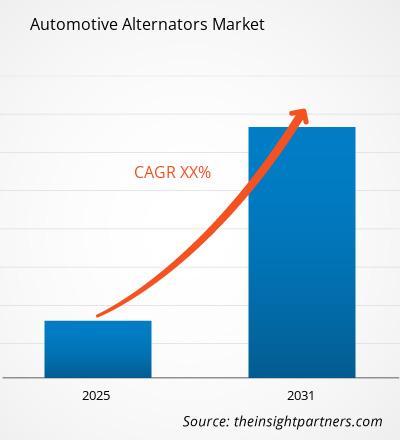
The automotive alternators market was valued at US$ 29.40 Billion in 2025 and is projected to reach US$ 50.07 Billion by 2034, registering a CAGR of 6.10% during 2026–2034. Demand is supported by vehicle production recovery, expanding electrical loads, higher use of infotainment and safety electronics, and the need for efficient charging systems across passenger cars, light commercial vehicles, and medium and heavy commercial vehicles.
North America automotive alternators market size is expected to expand at a CAGR range of 5.5–5.9% during 2026–2034, supported by replacement demand, high pickup and SUV penetration, and demand for high-output alternators in fleet and emergency vehicles. Electrified accessories, smart charging, and aftermarket remanufacturing also strengthen regional consumption.
Automotive Alternators Market Assessment and Insights
- North America accounted for 23–26% share in 2025 and is expected to grow at a CAGR of 5.5–5.9% during 2026–2034, supported by aftermarket replacement and high electrical accessory loads.
- US represented 76–80% of North America demand in 2025 and is projected to grow at a CAGR of 5.6–6.0% through 2034.
- Europe held 20–23% share in 2025 and is likely to expand at a CAGR of 5.2–5.6%, led by Germany, the UK, France, Italy, and Spain.
- Asia Pacific captured 42–46% share in 2025 and is projected to grow at a CAGR of 6.5–7.0%, led by China, India, Japan, South Korea, and Australia.
- Largest Segment: Salient pole alternators held 63–67% market share in 2025 and are expected to grow at a CAGR of 5.8–6.2% because of broad use in conventional vehicles.
- High Growth Segment: Light commercial vehicles held 19–22% share in 2025 and are projected to grow at a CAGR of 6.7–7.2% due to e-commerce and service fleet expansion.
- Key companies analyzed in detail: DENSO Corporation, FORVIA HELLA GmbH, Hitachi Astemo, Ltd., Lucas Industries Limited, Mitsubishi Electric Corporation, Motorcar Parts of America, Inc., Prestolite Electric Incorporated, Remy International, Inc., Robert Bosch GmbH, and Valeo SE.
Source: The Insight Partners' analysis based on proprietary research, government publications, company annual reports, investor presentations, industry databases, and expert interviews.
Alternators are evolving from simple current-generating devices to smaller, more efficient, and electronically-controlled alternators. Advanced voltage regulation, lightweight materials, better rectifiers, and the development of starter generators are altering production priorities. Manufacturers are trying to meet demands for alternators as well as the requirements of 48V mild hybrids that use belt starter generators.
Forward demand will be shaped by emerging vehicle production centers, regulatory pressure for fuel economy, and continued investment in aftermarket remanufacturing. The automotive alternators market outlook remains positive because internal combustion and hybrid vehicles still require robust charging architecture. Suppliers with OEM relationships, efficient thermal design, and regional rebuilding networks are positioned to protect margins as electrification changes product mix.
Automotive Alternators Market Report Scope
| Report Attribute | Details |
|---|---|
| Market size in 2025 | US$ 29.40 Billion |
| Market Size by 2034 | US$ 50.07 Billion |
| Global CAGR (2026 - 2034) | 6.10% |
| Historical Data | 2021-2024 |
| Forecast period | 2026-2034 |
Automotive Alternators Market Analysis
Automotive alternators market growth is driven by rising onboard power requirements from lighting, ADAS sensors, infotainment, electronic pumps, heated seats, and connectivity modules. The value chain includes rotor and stator manufacturers, semiconductor suppliers, voltage regulator producers, casting specialists, OEM assembly lines, and aftermarket remanufacturers. Supply dynamics depend on copper, steel, magnets, bearings, diodes, and electronics availability.
Vehicle makers increasingly request alternators that reduce parasitic losses and improve battery charging efficiency. Passenger cars create high-volume demand, while commercial fleets require durable output under stop-start routes, refrigeration loads, and auxiliary equipment. Aftermarket replacement remains important because alternator wear, bearing failure, diode damage, and regulator malfunction create predictable service needs in aging vehicle fleets.
The automotive alternator market analysis consists of competitors such as global electrical system suppliers with scale advantages, OEM certifications and remanufacturing capabilities. Competitors include DENSO Corporation, Valeo SE, Robert Bosch GmbH, Mitsubishi Electric Corporation, Hitachi Astemo, Ltd., FORVIA HELLA GmbH, Motorcar Parts of America, Inc., Prestolite Electric Incorporated, Remy International, Inc., and Lucas Industries Limited, among others, competing on efficiency, packaging, reliability and distribution channels.
Investment areas include 48V belt starter generators, efficient rectification processes, lightweight cases and predictive diagnostic technology. Existing suppliers are developing product lineups in accordance with the uptake of mild hybrids while servicing the replacement needs of 12V alternators. Positioning requires striking a balance between OEM electrification initiatives and parts that make money from the aftermarket, especially in North America, Europe, India and Southeast Asia.
● REPORT CUSTOMIZATION
Tailor This Report To Align With Your Specific Business Requirements
This report can be customized to align precisely with your business objectives, scope, and target markets. Customization options include tailored segmentation, geography, competitive analysis, and strategic insights to support informed decision-making.
Customize This Report →WHAT YOU CAN ADJUST
- ● Segmentations
- ● Geography
- ● Competitive Analysis
- ● Language Preferences
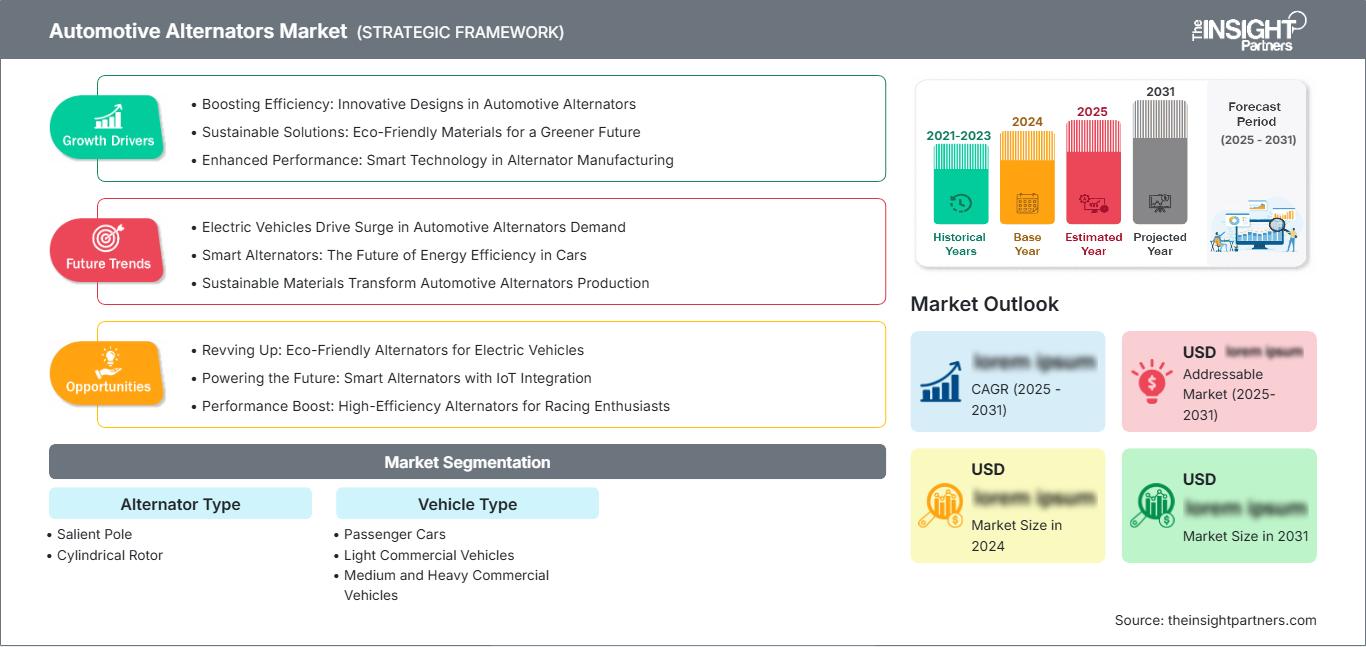
Automotive Alternators Market: Strategic Insights
Regional Insights
North America automotive alternators market
North America held 23–26% automotive alternators market share in 2025 and is projected to grow at a CAGR of 5.5–5.9% during 2026–2034. Demand is supported by a large installed vehicle base, high pickup ownership, long-distance driving, and strong replacement channels.
Fleet operators use high-output alternators for refrigeration, lighting, worksite tools, emergency equipment, and telematics. Remanufactured units remain common because they reduce service costs while maintaining availability across older vehicles. OEM demand is more moderate than APAC, but aftermarket intensity keeps regional revenue stable.
U.S. automotive alternators Market
According to the Automotive Alternators Market report, the U.S. accounted for 76–80% of North American demand in 2025 and is expected to grow at a CAGR of 5.6–6.0% through 2034. Vehicle age, extensive service networks, and a well-developed automotive aftermarket continue to sustain replacement demand. Strong parts retailing infrastructure, high vehicle ownership levels, and ongoing maintenance requirements further support consistent alternator replacement volumes across passenger and commercial vehicle segments. Company presence is significant through DENSO Corporation, Robert Bosch GmbH, Valeo SE, Motorcar Parts of America, Inc., and Remy International, Inc. Passenger cars and light trucks dominate applications, while commercial vans and emergency vehicles create demand for higher-output designs that support auxiliary electrical loads.
Europe automotive alternators Market
Europe accounted for 20–23% share in 2025 and is expected to grow at a CAGR of 5.2–5.6% during 2026–2034. Germany leads through premium vehicle engineering, supplier concentration, and advanced 48V mild-hybrid adoption.
The UK supports aftermarket replacement and light commercial fleet demand. France, Italy, and Spain contribute through passenger car production, service networks, and emission-driven efficiency requirements. Regional growth is moderated by battery electric vehicle penetration, but hybrids and internal combustion vehicles keep alternator and starter-generator demand relevant.
APAC automotive alternators Market
APAC held 42–46% share in 2025 and is projected to grow at a CAGR of 6.5–7.0% through 2034. China leads because of vehicle production scale, supplier localization, and rising electrical content in mass-market cars.
India, Japan, South Korea, and Australia add demand through passenger cars, light commercial vehicles, and replacement channels. Industrial policy, localization, export manufacturing, and hybrid technology adoption support regional leadership, while cost-sensitive buyers preserve demand for conventional salient pole alternators.
Middle East & Africa automotive alternators Market
The Middle East & Africa market is projected to grow at a CAGR of 4.8–5.3% during 2026–2034, supported by heat-intensive operations, construction fleets, logistics activity, and replacement demand. Saudi Arabia and the UAE favor reliable charging systems for premium and commercial vehicles.
South Africa contributes through passenger vehicle service networks and mining-related fleets, while the rest of MEA remains fragmented. High temperatures, dust exposure, and long operating hours increase alternator stress, supporting demand for durable components and remanufactured replacements.
Segmentation Analysis
Alternator Type
Alternator Type defines the automotive alternators market scope because rotor architecture influences output stability, cost, packaging, and suitability for different vehicle electrical loads. The segment is expected to grow at a CAGR of 5.9–6.3% during 2026–2034 as OEMs optimize designs for efficiency and durability.
- Salient Pole alternators remain dominant because they suit mass-market vehicles, offer cost efficiency, and provide reliable low-speed charging performance for urban driving, stop-start usage, and conventional powertrain layouts.
- Cylindrical Rotor alternators serve applications requiring smoother high-speed operation, compact packaging, and improved mechanical balance, making them relevant in higher-performance vehicles and selected commercial duty cycles.
Vehicle Type
Vehicle Type is projected to grow at a CAGR of 6.0–6.4% during 2026–2034 as charging demand differs by passenger comfort features, commercial uptime needs, payload duty, and auxiliary equipment intensity.
- Passenger Cars generate the largest volume because infotainment, lighting, climate systems, safety electronics, and connected features require dependable charging across compact, mid-size, SUV, and premium models.
- Light Commercial Vehicles show faster adoption because delivery vans, service fleets, and small logistics vehicles use telematics, refrigeration, lighting, and frequent stop-start operation, which increases electrical load.
- Medium and Heavy Commercial Vehicles require durable alternators for long duty cycles, high vibration exposure, cab electronics, auxiliary systems, and fleet uptime priorities in logistics, construction, mining, and municipal applications.
Opportunity Snapshot
| Vehicle Type | Revenue Contribution | Trend Tag | Adoption Stage |
|---|---|---|---|
| Passenger Cars | High | Smart Charging | Mature |
| Light Commercial Vehicles | Medium | Fleet Power | Scaling |
| Medium and Heavy Commercial Vehicles | Medium | High Output | Scaling |
Automotive Alternators Market Growth Drivers and Impact Analysis
Rising Electrical Loads in Modern Vehicles
Modern vehicles consume more electrical energy than their predecessors because comfort, safety, communication, lighting, and assistance functions work non-stop while the vehicle is operational. An alternator has to charge a battery and provide power to sensors, displays, heating units, pumps, and telematics devices. It leads to an increased need for higher performance and efficiency with lower mechanical loss. The effect is most pronounced for passenger cars and light commercial vehicles as their buyers require connectivity without failures while being able to recharge a battery.
Aftermarket Replacement Across Aging Vehicle Fleets
Alternators suffer wear and tear both mechanically and electrically due to heat, vibrations, bearing load, belt tension, diode damage, and regulator deterioration. This, therefore, implies that old cars continue to present the need for alternators irrespective of whether there is demand for new car production or not. This driver benefits part manufacturers, remanufacturing firms, distributors, and mechanics in regions like North America, Europe, India, and Latin America. Remanufactured products are advantageous in that they minimize costs and increase the availability of products for older models. The market effect is constant as opposed to being cyclical.
Mild-Hybrid Adoption and 48V Charging Architectures
Car manufacturers have embraced 48V mild hybridization solutions in order to increase efficiency and decrease carbon footprint without resorting to hybridization that would add to the costs. Belt starter generators could serve as a substitute for a standard alternator or be integrated into a more sophisticated electrical system to offer such features as regenerative braking, torque boost, and improved start-stop behavior. It has a dual effect since the need for the traditional 12V alternator decreases in some models, whereas the starter generator offers higher value and opens additional sales channels.
Automotive Alternators Market Future Trends
Smart Alternators Linked to Energy Management Software
Automotive alternators market trends will increasingly center on smart charging systems that communicate with engine control units, batteries, and vehicle energy management software. In contrast to units that generate constant power, these ones regulate the charge according to the level of acceleration, deceleration, the condition of the battery, and the needs of the accessories. Such an approach increases the fuel economy and decreases the unnecessary engine workload. It will become more popular because the OEMs will be looking for cheap ways to increase the efficiency of ICE and hybrids.
Greater Use of Remanufacturing and Circular Parts Programs
Remanufacturing will become a much more strategic approach since there is an effort to keep the cost of repair low on both the consumer side and the fleet side, as well as due to the effort by automobile manufacturers to achieve circular economy goals. Alternators are ideal candidates for remanufacturing since it is possible to salvage their housings, cores, as well as some mechanical parts, check and restore them. With better test equipment and consistent quality control standards, the remanufactured alternators will become more popular among professionals.
Automotive Alternators Market Opportunities
High-Output Alternators for Fleet and Specialty Vehicles
Automotive alternators market Forecasts point to growing opportunities in vehicles that carry heavy electrical accessories, including ambulances, refrigerated vans, police vehicles, buses, utility trucks, and construction fleets. These types of applications require consistent output under idle conditions, thermal stability, and the ability to interface with auxiliary systems. Manufacturers can realize their profits from designing solutions for specific applications, installation kits, and working together with fleet owners through maintenance. The market is very lucrative since customers care more about efficiency than price.
Localized Production for Emerging Automotive Hubs
Emerging manufacturing hubs in India, Southeast Asia, Mexico, and parts of Eastern Europe create opportunities for localized alternator production and rebuilding. OEMs prefer nearby suppliers to reduce logistics cost, currency exposure, and inventory risk. Aftermarket buyers also value fast availability for popular vehicle models. Companies can gain share by combining regional assembly, local sourcing, and quality systems aligned with global platforms. This approach supports cost competitiveness while meeting country-specific vehicle mix, climate, and service expectations.
Frequently Asked Questions

- Comprehensive Market Sizing and Forecast Analysis
- Detailed Segmentation Analysis
- In-Depth Market Dynamics Assessment
- Regional and Country-Level Insights
- Competitive Landscape and Company Benchmarking
- Strategic Business Intelligence
Recent Reports
Testimonials

The Insight Partners provided valuable market intelligence that supported our global go-to-market strategy. Their team was professional, responsive, and attentive to our feedback, providing thoughtful analysis and helpful methodological clarifications throughout the project.
Junmo Kim Chief Financial Officer (CFO), Enertech Co., Ltd.
The Insight Partners' SCADA System Market report is comprehensive, with valuable insights on current trends and future forecasts. The team was highly professional, responsive, and supportive throughout. We are very satisfied and highly recommend their services.
RAN KEDEM Partner, Reali Technologies LTDs
I requested a report on a very specific software market and the team produced the report in a few days. The information was very relevant and well presented. I then requested some changes and additions to the report. The team was again very responsive and I got the final report in less than a week.
JEAN-HERVE JENN Chairman, Future Analytica
We worked with The Insight Partners for an important market study and forecast. They gave us clear insights into opportunities and risks, which helped shape our plans. Their research was easy to use and based on solid data. It helped us make smart, confident decisions. We highly recommend them.
PIYUSH NAGPAL Sr. Vice President, High Beam Global
The Insight Partners delivered insightful, well-structured market research with strong domain expertise. Their team was professional and responsive throughout. The user-friendly website made accessing industry reports seamless. We highly recommend them for reliable, high-quality research services
YUKIHIKO ADACHI CEO, Deep Blue, LLC.
This is the first time I have purchased a market report from The Insight Partners.While I was unsure at first, I visited their web site and felt more comfortable to take the risk and purchase a market report.I am completely satisfied with the quality of the report and customer service. I had several questions and comments with the initial report, but after a couple of dialogs over email with their analyst I believe I have a report that I can use as input to our strategic planning process.Thank you so much for taking the extra time and making this a positive experience.I will definitely recommend your service to others and you will be my first call when we need further market data.
JOHN SUZUKI President and Chief Executive Officer, Board Director, BK Technologies
I wish to appreciate your support and the professionalism you displayed in the course of attending to my request for information regarding to infectious disease IVD market in Nigeria. I appreciate your patience, your guidance, and the fact that you were willing to offer a discount, which eventually made it possible for us to close a deal. I look forward to engaging The Insight Partners in the future, all thanks to the impression you have created in me as a result of this first encounter.
DR CHIJIOKE ONYIA MANAGING DIRECTOR, PineCrest Healthcare Ltd.Reason to Buy
- Informed Decision-Making
- Understanding Market Dynamics
- Competitive Analysis
- Identifying Emerging Markets
- Customer Insights
- Market Forecasts
- Risk Mitigation
- Boosting Operational Efficiency
- Strategic Planning
- Investment Justification
- Tracking Industry Innovations
- Aligning with Regulatory Trends





 Get Free Sample for