
Automotive Augmented Reality Market Demand, Trends & Forecast by 2034
Coverage: By Function (AR HUD With Navigation, AR HUD With Adaptive Cruise Control (ACC), AR HUD With Standard Functions, AR HUD With Lane Departure Warning (LDW), Advanced AR HUD); Sensor Technology (LiDAR, Radar, Sensor Fusion, CCD/CMOS Image Sensors); Display Technology (TFT-LCD, Other Advanced Technologies); Level of Autonomous Driving (Fully Autonomous, Semi-Autonomous) , and Geography (North America, Europe, Asia Pacific, and South and Central America)
- Status : Data Released
- Report Code : TIPRE00003703
- Category : Technology, Media and Telecommunications
- No. of Pages : 150
- Available Report Formats :


- Last update date : August 12, 2026


2025 Market Size
US$ 6.30 Bn
Base year value
2034 Forecast
US$ 31.50 Bn
Projected by 2034
CAGR 2026-2034
19.59 %
Growth rate
Addressable Market
US$ 153.96 Bn
(2026-2034)
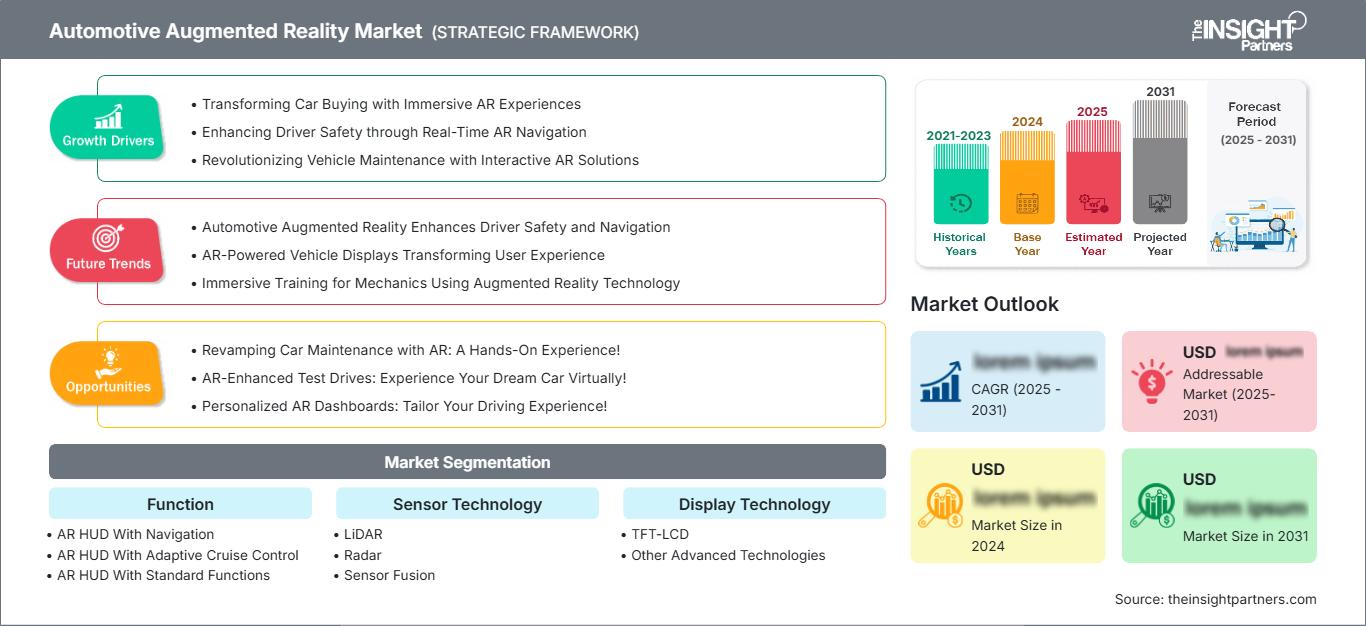
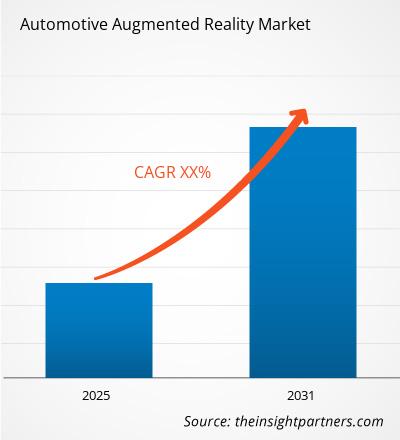
The automotive augmented reality market was valued at US$ 6.30 Billion in 2025 and is projected to reach US$ 31.50 Billion by 2034, registering a CAGR of 19.59 % during 2026–2034. Adoption is expanding as automakers integrate AR head-up displays, sensor fusion, advanced navigation overlays, and driver-assistance visualization into software-defined vehicle platforms.
North America remains a major commercialization hub as premium vehicle demand, connected cockpit investment, and advanced driver assistance adoption support the automotive augmented reality market size. The region is expected to expand at a CAGR of 18.6–20.1% during 2026–2034, supported by strong supplier presence, EV penetration, and early deployment of AR HUD systems in higher-trim passenger vehicles.
Automotive Augmented Reality Market Assessment and Insights
- North America: Held 33–36% share in 2025 and is expected to grow at a CAGR of 18.6–20.1% during 2026–2034, supported by premium cockpit programs and AR HUD integration.
- US: Accounted for 77–81% of North America in 2025 and is forecast to grow at a CAGR of 18.3–19.8%, led by connected vehicle platforms and ADAS visualization.
- Europe represented 25–28% share in 2025 and is projected to grow at a CAGR of 17.8–19.3%, led by Germany, the UK, France, Italy, and Spain.
- Asia Pacific: Captured 30–33% share in 2025 and is expected to grow at a CAGR of 20.4–22.2%, with China, Japan, South Korea, India, and Australia driving adoption.
- Largest Segment: AR HUD With Navigation held 42–46% market share in 2025 and is projected to grow at a CAGR of 18.9–20.5% during 2026–2034.
- High Growth Segment: Advanced AR HUD held 16–20% share in 2025 and is expected to grow at a CAGR of 22.1–24.0% as windshield-scale visualization improves.
- Key companies analyzed in detail: Apostera GmbH, Robert Bosch GmbH, Continental AG, Garmin Ltd., MicroVision, Inc., NVIDIA Corporation, Pioneer Corporation, Texas Instruments Incorporated, Visteon Corporation, Panasonic Holdings Corporation.
Source: The Insight Partners' analysis based on proprietary research, government publications, company annual reports, investor presentations, industry databases, and expert interviews.
Vehicle display architecture is moving from dashboard-centered information delivery toward contextual projection inside the driver’s forward field of view. The automotive augmented reality market growth is supported by better optical engines, improved image sensors, radar integration, and software stacks that align navigation, hazard warnings, and driver-assistance signals with road geometry.
Future adoption will depend on cost reduction, safety validation, and OEM confidence in large-field-of-view projection. Semi-autonomous vehicles will create near-term demand, while fully autonomous programs will use AR interfaces to communicate vehicle intent. Regulatory pressure to reduce distraction will also support investment in intuitive cockpit visualization.
Automotive Augmented Reality Market Report Scope
| Report Attribute | Details |
|---|---|
| Market size in 2025 | US$ 6.30 Billion |
| Market Size by 2034 | US$ 31.50 Billion |
| Global CAGR (2026 - 2034) | 19.59% |
| Historical Data | 2021-2024 |
| Forecast period | 2026-2034 |
Automotive Augmented Reality Market Analysis
Rising ADAS penetration, premium cockpit differentiation, and consumer preference for safer navigation interfaces are driving the automotive augmented reality market growth. Automakers are using AR overlays to show lane guidance, adaptive cruise control status, collision warnings, and route prompts without forcing drivers to shift attention from the road.
Supply dynamics are shaped by optics, display panels, sensors, embedded processors, and calibration software. Sensor fusion is becoming essential because AR content must align accurately with real-world objects. Suppliers with expertise in radar, LiDAR, CCD/CMOS image sensors, and low-latency projection can command stronger integration roles.
Competitive landscape of the automotive augmented reality market includes players in the sectors of automotive electronics, display solutions, navigation, semiconductor devices and cockpit software. Key participants that enable various segments of the value chain include Robert Bosch GmbH, Continental AG, Panasonic Holdings Corporation, Visteon Corporation, Garmin Ltd., MicroVision, Inc., NVIDIA Corporation, Texas Instruments Incorporated, Pioneer Corporation and Apostera GmbH.
Focus areas for investment in automotive augmented reality include windshield projection, holographic optics, AI-powered perception capabilities and software-defined cockpit platform scalability. Proper positioning is contingent upon readiness for mass manufacturing, thermoelectric efficiency, optical performance and capability to interface with the ADAS domain controller as well as participate in OEM programs.
● REPORT CUSTOMIZATION
Tailor This Report To Align With Your Specific Business Requirements
This report can be customized to align precisely with your business objectives, scope, and target markets. Customization options include tailored segmentation, geography, competitive analysis, and strategic insights to support informed decision-making.
Customize This Report →WHAT YOU CAN ADJUST
- ● Segmentations
- ● Geography
- ● Competitive Analysis
- ● Language Preferences
Automotive Augmented Reality Market: Strategic Insights
Regional Insights
North America automotive augmented reality market
North America held 33–36% automotive augmented reality market share in 2025 and is expected to grow at a CAGR of 18.6–20.1% during 2026–2034. Growth is supported by premium vehicle demand, EV adoption, advanced driver assistance penetration, and strong supplier engagement in digital cockpit technologies.
The region benefits from software-defined vehicle development, semiconductor availability, and active AR HUD integration in higher-trim passenger vehicles. OEMs are prioritizing navigation overlays, adaptive cruise visualization, and collision warning projection to reduce distraction and improve driver confidence during complex urban and highway driving.
U.S. automotive augmented reality Market
The US accounted for 77–81% of North America in 2025 and is expected to grow at a CAGR of 18.3–19.8%. Demand is concentrated in premium SUVs, electric vehicles, and connected cockpit platforms that combine ADAS status, route guidance, and hazard alerts.
Company presence is strong across semiconductors, display processors, software, and automotive electronics. NVIDIA Corporation, Texas Instruments Incorporated, Visteon Corporation, Garmin Ltd., and MicroVision, Inc. strengthen the ecosystem through compute, navigation, projection, and embedded systems capabilities that support AR cockpit commercialization.
Europe automotive augmented reality Market
Europe represented 25–28% share in 2025 and is projected to grow at a CAGR of 17.8–19.3%. Germany leads adoption due to premium OEM engineering, safety-focused cockpit development, and supplier strength from Robert Bosch GmbH and Continental AG.
The UK supports software, testing, and connected mobility programs, while France, Italy, and Spain contribute through vehicle production and gradual ADAS adoption. European demand is shaped by safety regulations, high consumer expectations, and the integration of windshield-based information systems.
APAC automotive augmented reality Market
APAC held 30–33% share in 2025 and is expected to grow at a CAGR of 20.4–22.2%. China leads regional demand through EV scale and smart cockpit adoption, while Japan and South Korea contribute optics, electronics, and advanced display manufacturing expertise.
India and Australia add growth through connected vehicle adoption, safety awareness, and premium vehicle upgrades. Regional suppliers and OEMs are prioritizing TFT-LCD, sensor fusion, and advanced display technologies to make AR HUD functions more affordable across wider vehicle classes.
Middle East & Africa automotive augmented reality Market
The Middle East and Africa market is forecast to grow at a CAGR of 15.8–17.5% during 2026–2034. Leaders in the use of this technology are Saudi Arabia and the UAE due to their premium car demands, smart mobility initiatives, and modernization of infrastructure.
The other countries in the MEA region include South Africa, where slow adoption of AR HUDs takes place because of fleet safety, luxury imports, and connected mobility solutions. Initial demand will be limited to basic AR HUD features, including navigation and warnings.
Segmentation Analysis
Function
Function is projected to grow at a CAGR of 19.1–20.7% during 2026–2034. The automotive augmented reality market scope is widening as OEMs move from basic speed projection toward contextual overlays for navigation, adaptive cruise control, lane departure warnings, and advanced AR HUD interfaces.
- AR HUD With Navigation holds the strongest demand because route arrows, junction guidance, and lane-level prompts directly improve driver awareness and reduce dependence on center displays.
- AR HUD With Adaptive Cruise Control supports safer distance perception by visualizing set speed, target vehicles, and following gaps in the driver’s forward view.
- AR HUD With Standard Functions remains important for speed, alerts, and basic information delivery, especially in mid-range vehicles adopting cost-efficient display platforms.
- AR HUD with Lane Departure Warning benefits from safety regulation and ADAS growth by projecting lane boundaries and warning cues in real time.
- Advanced AR HUD is gaining traction as wide-field projection, holographic optics, and high-brightness displays improve spatial accuracy and premium cockpit differentiation.
Sensor Technology
Sensor Technology is expected to grow at a CAGR of 18.8–20.6% as AR overlays require real-time environmental awareness and stable object positioning. Accurate sensor inputs determine whether virtual guidance aligns with lanes, vehicles, pedestrians, and hazards under varied weather and lighting conditions.
- LiDAR supports precise depth mapping and object localization, making it valuable for advanced overlays in premium and semi-autonomous vehicles.
- Radar remains critical for adaptive cruise control and collision warning because it performs reliably in poor visibility and supports distance estimation.
- Sensor Fusion combines radar, cameras, and LiDAR to improve accuracy, redundancy, and confidence in displayed AR guidance.
- CCD/CMOS Image Sensors enable lane detection, traffic sign recognition, and visual context capture for navigation and warning projections.
Display Technology
Display Technology is projected to grow at a CAGR of 19.0–20.8% as automakers seek brighter, wider, and lower-latency projection systems. TFT-LCD remains widely used, while advanced display technologies are improving contrast, field of view, and suitability for electric and premium vehicles.
- TFT-LCD remains a practical display option due to established manufacturing scale, predictable performance, and compatibility with current HUD architectures.
- Other Advanced Technologies include waveguides, holographic, micro-LED, and laser-based systems that support larger virtual images and more immersive AR visualization.
Level of Autonomous Driving
Level of Autonomous Driving is expected to grow at a CAGR of 19.4–21.2% as AR interfaces become communication tools between vehicles and drivers. Semi-autonomous platforms currently lead adoption, while fully autonomous vehicles may use AR to explain system intent and improve trust.
- Fully Autonomous vehicles can use AR visualization to communicate planned maneuvers, route logic, and surrounding object awareness to passengers and safety operators.
- Semi-Autonomous vehicles generate stronger near-term demand because drivers still need clear, real-time cues for lane keeping, cruise control, and hazard response.
Opportunity Snapshot
| Function | Revenue Contribution | Trend Tag | Adoption Stage |
| AR HUD With Navigation | High | Route Overlay | Mature |
| AR HUD With Adaptive Cruise Control | Medium | Cruise Assist | Scaling |
| AR HUD With Standard Functions | Medium | Core Display | Mature |
| AR HUD With Lane Departure Warning | Medium | Lane Safety | Scaling |
| Advanced AR HUD | High | Wide Projection | Emerging |
Automotive Augmented Reality Market Growth Drivers and Impact Analysis
Rising Demand for Safer Driver Information Interfaces
The need for guidance, speed, and warning information without having to look at anything other than the road has become an expectation of drivers. It is fulfilled by AR HUD systems by providing all such information in front of the driver's view. The driving force behind this innovation is the penetration of ADAS, the insurance industry's interest in safety technologies, and customer acceptance for higher-value cockpit technologies. This is particularly applicable in the case of passenger cars and electric vehicles, where the manufacturers use AR visualization to differentiate their interior cabins and improve safety perception.
Expansion of Sensor Fusion and ADAS Platforms
Functions of AR rely upon the precision of information captured through camera feeds, radar technology, LiDAR, and vehicle controls. With the rising use of ADAS platforms, the same information captured from sensors can be used for visual overlays that will help in providing adaptive cruise control, lane departure warning, collision avoidance warnings, and navigation guidance. Such a step will minimize additional cost for implementation because OEMs can take advantage of existing perception and control information sources. It will widen the addressable market for cockpit software, processors, projectors, and calibration solutions.
Premium Cockpit Differentiation in Electric Vehicles
For consumers interested in electric cars, it is common for such people to look forward to a highly advanced digital interface, and hence, the implementation of AR HUD becomes important to set the brand apart. Electric cars are also flexible in their electronic structure design, which allows central computing power as well as display management. For automakers, it is now possible to add layers through AR to indicate charging paths, range guidance, efficiency information, and driver assistance state. The driver is applicable to both the luxury and upper mid-segment categories since cockpit experience now matters when buying a car.
Automotive Augmented Reality Market Future Trends
Windshield-Scale Spatial Visualization
The automotive augmented reality market trends are moving toward larger virtual image areas that can display route, hazard, and lane data with stronger spatial alignment. A greater field-of-view would allow AR assistance to be more like an augmentation of the dashboard than an extension of the dashboard. This will demand advancements in optics, calibration, eye-boxing, and thermal management. With a reduction in cost, these premium features could eventually find their way into mass-market cars, especially in EVs, where software-defined cockpits have a cleaner dashboard interface.
AI-Calibrated AR Display Systems
In the future, AI would be used in order to adapt the information presented depending on the speed, road conditions, weather conditions, driver attention, and reliability of the sensors. The system will not present any static graphical information but will rather choose the information that is most important at the given moment of time, thus reducing the problem of information overload and increasing trust in the user interface.
Automotive Augmented Reality Market Opportunities
Scalable AR HUD Platforms for Mid-Range Vehicles
Cost-effective AR HUD platforms create a major opportunity as automakers move advanced display features beyond luxury models. Suppliers can target modular projection units, standardized software, and sensor-compatible calibration tools that reduce integration cost. The automotive augmented reality market Forecasts point to growing demand from mid-range EVs, SUVs, and connected passenger vehicles, where buyers want premium safety features without luxury pricing. Vendors that balance affordability, brightness, and road-aligned accuracy can win higher-volume programs and longer production contracts.
AR Interfaces for Semi-Autonomous Driving Trust
Semi-autonomous cars will need their drivers to know what is being seen and what the car plans to do with its environment. An AR display would be able to depict target lanes, detected cars, following distances, and warning zones in such a way that would build trust when the control transfers hands. This opens up possibilities for software developers, sensor engineers, and screen manufacturers to create human-machine interface modules built on transparency and trust. OEMs utilizing AR to explain automation would lower the uncertainties of their drivers.
Frequently Asked Questions

- Comprehensive Market Sizing and Forecast Analysis
- Detailed Segmentation Analysis
- In-Depth Market Dynamics Assessment
- Regional and Country-Level Insights
- Competitive Landscape and Company Benchmarking
- Strategic Business Intelligence
Recent Reports
Testimonials

The Insight Partners' SCADA System Market report is comprehensive, with valuable insights on current trends and future forecasts. The team was highly professional, responsive, and supportive throughout. We are very satisfied and highly recommend their services.
RAN KEDEM Partner, Reali Technologies LTDs
I requested a report on a very specific software market and the team produced the report in a few days. The information was very relevant and well presented. I then requested some changes and additions to the report. The team was again very responsive and I got the final report in less than a week.
JEAN-HERVE JENN Chairman, Future Analytica
We worked with The Insight Partners for an important market study and forecast. They gave us clear insights into opportunities and risks, which helped shape our plans. Their research was easy to use and based on solid data. It helped us make smart, confident decisions. We highly recommend them.
PIYUSH NAGPAL Sr. Vice President, High Beam Global
The Insight Partners delivered insightful, well-structured market research with strong domain expertise. Their team was professional and responsive throughout. The user-friendly website made accessing industry reports seamless. We highly recommend them for reliable, high-quality research services
YUKIHIKO ADACHI CEO, Deep Blue, LLC.
This is the first time I have purchased a market report from The Insight Partners.While I was unsure at first, I visited their web site and felt more comfortable to take the risk and purchase a market report.I am completely satisfied with the quality of the report and customer service. I had several questions and comments with the initial report, but after a couple of dialogs over email with their analyst I believe I have a report that I can use as input to our strategic planning process.Thank you so much for taking the extra time and making this a positive experience.I will definitely recommend your service to others and you will be my first call when we need further market data.
JOHN SUZUKI President and Chief Executive Officer, Board Director, BK Technologies
I wish to appreciate your support and the professionalism you displayed in the course of attending to my request for information regarding to infectious disease IVD market in Nigeria. I appreciate your patience, your guidance, and the fact that you were willing to offer a discount, which eventually made it possible for us to close a deal. I look forward to engaging The Insight Partners in the future, all thanks to the impression you have created in me as a result of this first encounter.
DR CHIJIOKE ONYIA MANAGING DIRECTOR, PineCrest Healthcare Ltd.Reason to Buy
- Informed Decision-Making
- Understanding Market Dynamics
- Competitive Analysis
- Identifying Emerging Markets
- Customer Insights
- Market Forecasts
- Risk Mitigation
- Boosting Operational Efficiency
- Strategic Planning
- Investment Justification
- Tracking Industry Innovations
- Aligning with Regulatory Trends





 Get Free Sample for