
Automotive Gears Market Share, Demand & Growth by 2034
Coverage: By Product Type (Spur Gears, Bevel Gears, Helical Gears, Worm Gears, Rack and Pinion Gears, Planetary Gears, Hypoid Gears, Others); Material Type (Metallic Gears, Non-Metallic Gears); Application (Transmission System, Steering System, Differential System, Others) , and Geography (North America, Europe, Asia Pacific, and South and Central America)
- Status : Data Released
- Report Code : TIPRE00006797
- Category : Automotive and Transportation
- No. of Pages : 150
- Available Report Formats :


- Last update date : August 04, 2026


2025 Market Size
US$ 45.54 Bn
Base year value
2034 Forecast
US$ 58.25 Bn
Projected by 2034
CAGR 2026-2034
2.77 %
Growth rate
Addressable Market
US$ 471.03 Bn
(2026-2034)
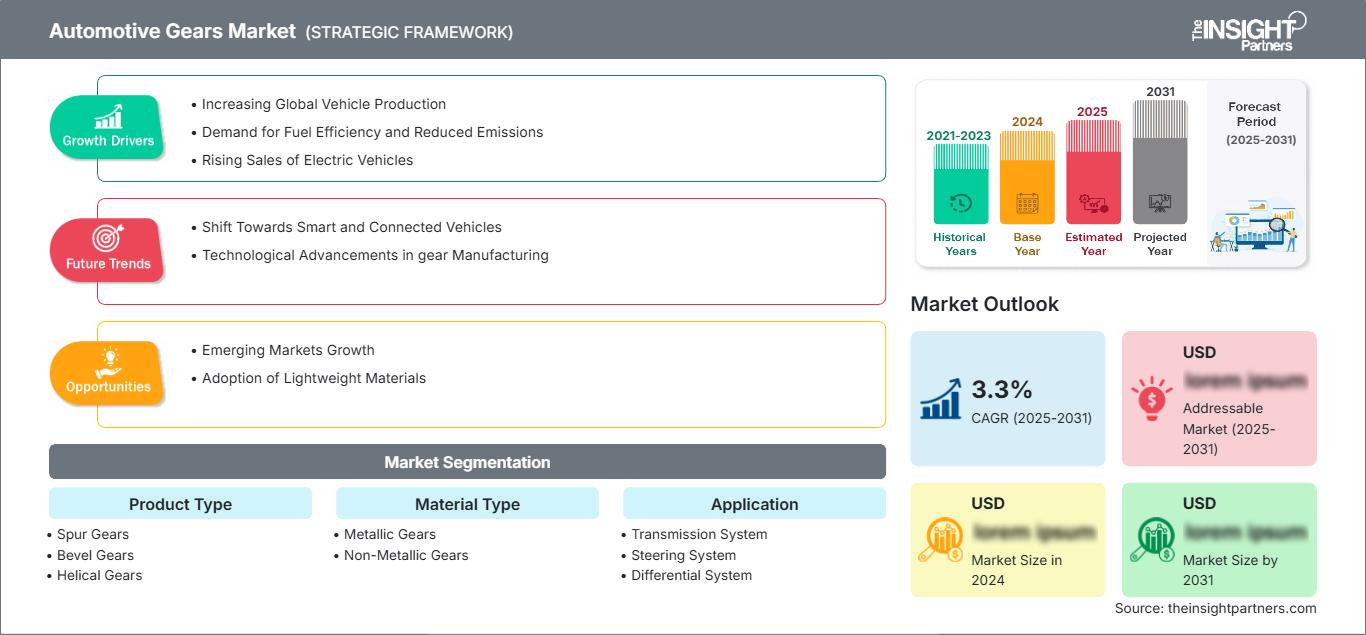
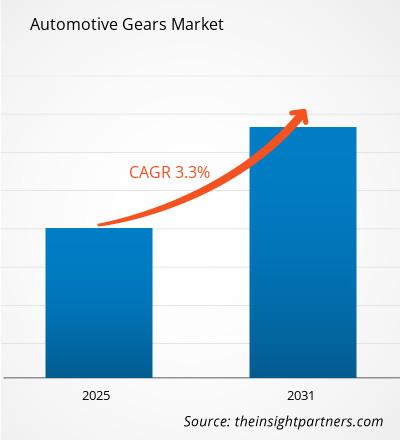
The Automotive Gears Market is projected to grow from US$ 45.54 Billion in 2025 to US$ 58.25 Billion by 2034, registering a CAGR of 2.77% during 2026–2034. Demand is supported by vehicle production, efficiency-focused drivetrain design, transmission refinement, and the continued need for reliable torque conversion in passenger cars, light commercial vehicles, and heavy commercial vehicles.
North America remains a mature manufacturing and replacement market, with the Automotive Gears Market size supported by automatic transmission penetration, pickup and SUV production, commercial fleet renewal, and precision-machined component demand. The region is expected to grow at a CAGR of 2.4–2.9% during 2026–2034 as OEMs prioritize durability, noise reduction, and lighter drivetrain assemblies.
Automotive Gears Market Assessment and Insights
- North America: North America held 23–26% share in 2025 and is projected to grow at a CAGR of 2.4–2.9% during 2026–2034, supported by transmission upgrades and replacement demand.
- US: The US accounted for 78–82% of North American demand in 2025 and is expected to grow at a CAGR of 2.3–2.8% through 2034.
- Europe: Europe represented 22–25% share in 2025 and is forecast to grow at a CAGR of 2.1–2.6%, led by Germany, France, the UK, Italy, and Spain.
- Asia Pacific: Asia Pacific accounted for 41–44% share in 2025 and is expected to grow at a CAGR of 3.0–3.6%, led by China, Japan, South Korea, and India.
- Largest Segment: Transmission System held 46–49% market share in 2025 and is projected to grow at a CAGR of 2.6–3.1% during 2026–2034.
- High Growth Segment: Planetary Gears held 12–15% market share in 2025 and is projected to grow at a CAGR of 3.3–3.9% during 2026–2034.
- Key companies analyzed in detail: American Axle & Manufacturing Holdings, Inc., AmTech International, Bharat Gears Limited, Eaton Corporation plc, GKN Automotive Limited, IMS Gear SE & Co. KGaA, Jiangsu Pacific Precision Forging Co., Ltd., RSB Transmissions (I) Ltd., Hitachi Astemo, Ltd., and Univance Corporation.
Source: The Insight Partners' analysis based on proprietary research, government publications, company annual reports, investor presentations, industry databases, and expert interviews.
Market evolution has shifted from conventional machined gears toward precision-engineered components designed for quieter operation, reduced friction, and compatibility with hybrid and electric driveline systems. The Automotive Gears Market is influenced by advances in tooth geometry, heat treatment, forging accuracy, and lightweight materials. Production dynamics are also changing as OEMs localize gear sourcing near transmission, steering, and differential assembly sites to reduce cost and improve supply reliability.
Forward demand will be shaped by emerging manufacturing hubs, tighter efficiency regulations, and investment in automated machining. Asia Pacific is expected to remain the largest volume base, while North America and Europe add value through premium vehicle platforms and commercial applications. Suppliers with forging, powder metallurgy, precision cutting, and integrated driveline expertise are positioned to support evolving vehicle architectures.
Automotive Gears Market Report Scope
| Report Attribute | Details |
|---|---|
| Market size in 2025 | US$ 45.54 Billion |
| Market Size by 2034 | US$ 58.25 Billion |
| Global CAGR (2026 - 2034) | 2.77% |
| Historical Data | 2021-2024 |
| Forecast period | 2026-2034 |
Automotive Gears Market Analysis
Demand drivers include fuel-efficiency requirements, higher torque density, and the need for smooth power transfer in modern vehicles. Automotive Gears Market growth is supported by transmission upgrades, differential durability, and steering system refinement across internal combustion, hybrid, and electric platforms. Gear manufacturers are balancing cost, metallurgy, precision finishing, and noise vibration harshness performance as OEMs seek compact components that improve efficiency without reducing service life.
The value chain combines steel and alloy suppliers, forging specialists, machining operations, heat treatment providers, and tier-one driveline integrators. Supply dynamics remain sensitive to energy costs, skilled labor availability, and quality certification because gear tolerances directly affect transmission noise, durability, and safety. Electrified vehicles reduce some gear counts but increase requirements for quiet, high-speed reduction gears.
Automotive Gears Market analysis indicates a moderately fragmented supplier ecosystem where global driveline companies compete with regional precision specialists. American Axle & Manufacturing Holdings, Inc., GKN Automotive Limited, Eaton Corporation plc, and Hitachi Astemo, Ltd. serve broad drivetrain applications, while Bharat Gears Limited, AmTech International, IMS Gear SE & Co. KGaA, Jiangsu Pacific Precision Forging Co., Ltd., RSB Transmissions (I) Ltd., and Univance Corporation strengthen cost-effective and application-specific supply.
Investment trends favor automated gear cutting, digital inspection, low-carbon production processes, and materials that reduce weight while preserving tooth strength. Strategic positioning depends on platform awards, regional capacity, quality consistency, and the ability to supply gears for transmission, steering, and differential systems. Suppliers that combine precision manufacturing with EV-ready reduction gear capability are expected to gain resilience.
● REPORT CUSTOMIZATION
Tailor This Report To Align With Your Specific Business Requirements
This report can be customized to align precisely with your business objectives, scope, and target markets. Customization options include tailored segmentation, geography, competitive analysis, and strategic insights to support informed decision-making.
Customize This Report →WHAT YOU CAN ADJUST
- ● Segmentations
- ● Geography
- ● Competitive Analysis
- ● Language Preferences
Automotive Gears Market: Strategic Insights
Regional Insights
North America Automotive Gears Market
North America accounted for 23–26% Automotive Gears Market share in 2025 and is expected to grow at a CAGR of 2.4–2.9% during 2026–2034. Demand is tied to pickup trucks, SUVs, automatic transmissions, and commercial vehicle replacement cycles, where gears require high load capacity, reliable heat treatment, and long service life.
Regional buyers increasingly prioritize low-noise gears, durable differential components, and steering assemblies that support advanced chassis performance. Localized production in the US and Mexico helps reduce logistics risk for transmission and axle programs. Hybrid powertrain launches add selective demand for precision planetary sets and reduction gears, although full EV platforms limit total gear count.
U.S. Automotive Gears Market
The US represented 78–82% of North American demand in 2025 and is projected to expand at a CAGR of 2.3–2.8% through 2034. Demand is led by pickups, SUVs, delivery fleets, off-highway vehicles, and performance applications that use heavy-duty transmission and differential components.
Company presence is supported by American Axle & Manufacturing Holdings, Inc., Eaton Corporation plc, AmTech International, and global suppliers with engineering and machining networks. Application trends favor stronger bevel, helical, and planetary gears for towing, axle durability, hybrid transmissions, and electric reduction units where quiet operation is essential.
Europe Automotive Gears Market
Europe held 22–25% share in 2025 and is expected to grow at a CAGR of 2.1–2.6% during 2026–2034. Germany leads through premium vehicle platforms, transmission engineering, and supplier specialization. The UK supports specialist vehicle and performance applications, while France emphasizes compact vehicles and hybrid driveline development.
Italy and Spain contribute through component manufacturing, small vehicle production, and light commercial vehicle demand. European OEMs focus on reduced friction, lower noise, and strict dimensional control to meet efficiency and comfort expectations. Suppliers with precision machining, powder metallurgy, and low-emission manufacturing capability are well placed for regional sourcing programs.
APAC Automotive Gears Market
APAC accounted for 41–44% share in 2025 and is forecast to grow at 3.0–3.6% through 2034. China leads through vehicle production scale and EV component localization, while Japan and South Korea support high-precision gears for automatic, hybrid, and steering systems.
India adds volume through passenger vehicles, two-wheelers, commercial vehicles, and growing domestic forging capacity. Australia remains smaller but supports replacement and import-linked demand. Policy support for localized automotive manufacturing and electrified mobility strengthens regional investment in precision gear production.
Middle East & Africa Automotive Gears Market
The Middle East & Africa market is expected to grow at a CAGR of 2.0–2.5% during 2026–2034. Saudi Arabia and the UAE lead through SUV imports, fleet modernization, and infrastructure-linked vehicle usage, while South Africa contributes through assembly and aftermarket channels.
Demand is concentrated in durable transmission, steering, and differential parts that can withstand heat, dust, and heavy-load conditions. Rest of MEA remains price-sensitive, but replacement demand and logistics activity support steady consumption of metallic gears.
Segmentation Analysis
Product Type
Product Type defines Automotive Gears Market scope because each gear design serves a different torque, speed, packaging, and load requirement. The segment is expected to grow at a CAGR of 2.8–3.4% during 2026–2034 as OEMs balance mature spur and bevel demand with higher precision helical, planetary, and hypoid applications in advanced drivelines.
- Spur Gears: Spur gears remain widely used where simple geometry, cost-efficient manufacturing, and direct power transfer are priorities in auxiliary systems, manual assemblies, and lower-load automotive mechanisms.
- Bevel Gears: Bevel gears support angular power transmission in differential and axle systems, where torque redirection, durability, and accurate tooth contact are critical for smooth vehicle operation.
- Helical Gears: Helical gears are preferred in transmissions because angled teeth reduce noise, improve load sharing, and support smoother engagement in passenger and commercial vehicles.
- Worm Gears: Worm gears serve steering, seat adjustment, and compact actuation applications where high reduction ratios, controlled movement, and space-efficient mechanical design are required.
- Rack and Pinion Gears: Rack and pinion gears remain essential in steering systems, converting rotational input into linear movement with precision, responsiveness, and predictable driver control.
- Planetary Gears: Planetary gears gain importance in automatic transmissions, hybrid systems, and electric reduction units because they provide compact torque multiplication and multiple ratio possibilities.
- Hypoid Gears: Hypoid gears are used in rear axles and differentials where offset shaft alignment, high torque transfer, and quieter operation are important for driveline performance.
Material Type
Material Type is expected to grow at a CAGR of 2.5–3.0% during 2026–2034 as automakers evaluate strength, weight, cost, heat resistance, and noise performance. Metallic gears dominate demanding load-bearing applications, while non-metallic gears are gaining selective use in low-load actuators and cabin-related systems.
- Metallic Gears: Metallic gears dominate transmission, differential, and heavy-load applications because steel and alloy materials offer strength, fatigue resistance, heat tolerance, and proven service reliability.
- Non-Metallic Gears: Non-metallic gears are used in lower-load automotive mechanisms where weight reduction, corrosion resistance, noise control, and cost-effective molding provide design advantages.
Application
Application is expected to grow at a CAGR of 2.6–3.2% during 2026–2034 as gears remain central to power transfer, steering response, and axle performance. Transmission systems generate the largest revenue contribution, while steering and differential systems support stable demand through safety, handling, and durability requirements.
- Transmission System: Transmission systems account for the largest gear demand because they require multiple gear types to manage speed, torque, efficiency, and smooth power delivery.
- Steering System: Steering systems use gears to deliver precise directional control, especially in rack and pinion layouts that support predictable response and compact packaging.
- Differential System: Differential systems depend on bevel, hypoid, and related gear designs to distribute torque between wheels while enabling stable cornering and axle durability.
Opportunity Snapshot
| Application | Revenue Contribution | Trend Tag | Adoption Stage |
| Transmission System | High | Quiet Torque | Mature |
| Steering System | Medium | Precision Control | Scaling |
| Differential System | Medium | Axle Durability | Mature |
Automotive Gears Market Growth Drivers and Impact Analysis
Efficiency Pressure in Transmissions and Differentials
Fuel economy and emission requirements are pushing OEMs to reduce mechanical losses in transmission and differential assemblies. Accurate gearing with an optimal profile, better heat treatment, and reduced friction finish contribute to minimizing energy loss without compromising on torque capability. This effect is most pronounced in passenger cars and light commercial vehicles, since efficiency requirements have to be met without compromising drivability. The suppliers offering quiet, lightweight, and robust gears are becoming increasingly relevant in platform selection.
Hybrid and Electric Driveline Redesign
Hybrid and electric vehicles change gear requirements rather than eliminating them. Reducing EV torque will be dependent on gears that can operate quietly at very high speeds and handle the torque from the motors. Hybrids, on the other hand, have smaller planetary and helical gear assemblies that can harmonize the engine and motor torque. As a result, there is a demand for better surface finishes, tighter tolerances, and better lubrication. I support my suppliers in these aspects.
Commercial Vehicle Durability Requirements
Commercial vehicles create stable demand because transmission, differential, and steering gears directly affect uptime and operating cost. Vans, buses, construction vehicles, and long-distance carriers need to use gears that can withstand high temperatures, the pressure of cargo, frequent starting, and have service intervals. Fleet operators would favor parts that perform in maintenance consistently and reduce failures. This driver favors gears made of metals, forged parts, and companies with heavy duty validation capabilities for regional vehicles.
Automotive Gears Market Future Trends
Precision Gear Manufacturing Automation
Automotive Gears Market trends will increasingly center on automation, digital inspection, and process control. The companies that manufacture gears have started using CNC machining, automatic grinding, coordinate measuring, and inline flaw detection to ensure repeatability. These technologies help in reducing scrap, maintaining consistency in the tooth profiles, and enable manufacturers to fulfill OEM requirements. Automatic manufacturing also enables gear suppliers to overcome labor shortages as well as quality standards in different regions.
Low-Noise Gears for Electrified Vehicles
Electrified vehicles make gear noise more noticeable because electric motors operate quietly compared with combustion engines. This is forcing suppliers to develop fine-tooth geometries, advanced grinding, surface coatings, and increased lubrication compatibility. For future needs, the need for gears which can handle high-speed rotations without producing whine and vibration within the cabin will be required. Suppliers who have capabilities in acoustics testing, simulation, and electric vehicle reduction gear will be more suited for future programs.
Automotive Gears Market Opportunities
Localized Precision Gear Supply in Asia Pacific
Automotive Gears Market Forecasts indicate that Asia Pacific offers the strongest opportunity for localized precision supply because China, India, Japan, and South Korea combine vehicle volume with expanding electrified driveline production. Suppliers can gain from having their forging, machining, and finishing operations close to OEM assembly locations. This will allow for lower lead times, better cost management, and support regional purchasing strategies. Suppliers that have a flexible quality system and product portfolio stand to gain transmission, steering, and differential programs.
Aftermarket and Fleet Replacement Channels
Replacement demand offers a practical opportunity in regions with aging fleets, high vehicle utilization, and harsh operating conditions. Transmission and differentials are susceptible to wear because of the heat, loads, lubrication, and terrain. Certified spare parts, distributors, and specific applications are ways that suppliers can increase their margins. This market is very pertinent in North America, India, the Middle East, and Africa, where commercial fleets need high uptime.
Frequently Asked Questions

- Comprehensive Market Sizing and Forecast Analysis
- Detailed Segmentation Analysis
- In-Depth Market Dynamics Assessment
- Regional and Country-Level Insights
- Competitive Landscape and Company Benchmarking
- Strategic Business Intelligence
Recent Reports
Testimonials

The Insight Partners' SCADA System Market report is comprehensive, with valuable insights on current trends and future forecasts. The team was highly professional, responsive, and supportive throughout. We are very satisfied and highly recommend their services.
RAN KEDEM Partner, Reali Technologies LTDs
I requested a report on a very specific software market and the team produced the report in a few days. The information was very relevant and well presented. I then requested some changes and additions to the report. The team was again very responsive and I got the final report in less than a week.
JEAN-HERVE JENN Chairman, Future Analytica
We worked with The Insight Partners for an important market study and forecast. They gave us clear insights into opportunities and risks, which helped shape our plans. Their research was easy to use and based on solid data. It helped us make smart, confident decisions. We highly recommend them.
PIYUSH NAGPAL Sr. Vice President, High Beam Global
The Insight Partners delivered insightful, well-structured market research with strong domain expertise. Their team was professional and responsive throughout. The user-friendly website made accessing industry reports seamless. We highly recommend them for reliable, high-quality research services
YUKIHIKO ADACHI CEO, Deep Blue, LLC.
This is the first time I have purchased a market report from The Insight Partners.While I was unsure at first, I visited their web site and felt more comfortable to take the risk and purchase a market report.I am completely satisfied with the quality of the report and customer service. I had several questions and comments with the initial report, but after a couple of dialogs over email with their analyst I believe I have a report that I can use as input to our strategic planning process.Thank you so much for taking the extra time and making this a positive experience.I will definitely recommend your service to others and you will be my first call when we need further market data.
JOHN SUZUKI President and Chief Executive Officer, Board Director, BK Technologies
I wish to appreciate your support and the professionalism you displayed in the course of attending to my request for information regarding to infectious disease IVD market in Nigeria. I appreciate your patience, your guidance, and the fact that you were willing to offer a discount, which eventually made it possible for us to close a deal. I look forward to engaging The Insight Partners in the future, all thanks to the impression you have created in me as a result of this first encounter.
DR CHIJIOKE ONYIA MANAGING DIRECTOR, PineCrest Healthcare Ltd.Reason to Buy
- Informed Decision-Making
- Understanding Market Dynamics
- Competitive Analysis
- Identifying Emerging Markets
- Customer Insights
- Market Forecasts
- Risk Mitigation
- Boosting Operational Efficiency
- Strategic Planning
- Investment Justification
- Tracking Industry Innovations
- Aligning with Regulatory Trends





 Get Free Sample for