
B2B Food Marketplace Platform Market Size, Share, Trends & Forecast 2034
Coverage: By Offering (Chilled & Dairy, Grocery, Beverages, and Others) and Enterprise Size (Small and Medium Enterprises and Large Enterprises)
- Status : Data Released
- Report Code : TIPRE00015838
- Category : Technology, Media and Telecommunications
- No. of Pages : 150
- Available Report Formats :


- Last update date : July 31, 2026


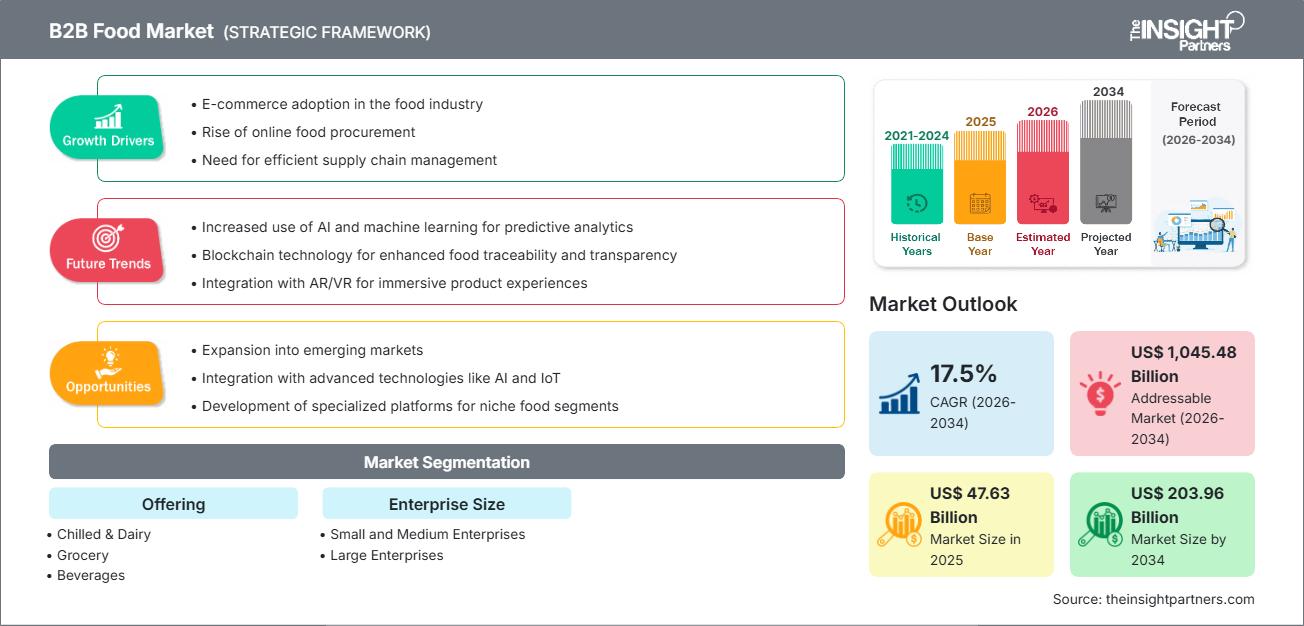
2025 Market Size
US$ 47.63 Bn
Base year value
2034 Forecast
US$ 203.96 Bn
Projected by 2034
CAGR 2026-2034
17.5 %
Growth rate
Addressable Market
US$ 1,045.48 Bn
(2026-2034)
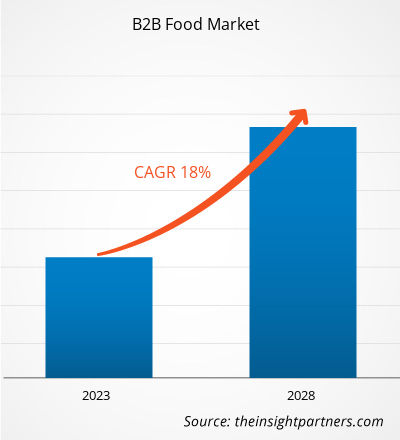
The B2B Food Marketplace Platform Market is undergoing a significant transformation as digital procurement platforms reshape how enterprises source, distribute, and manage food supply chains. Valued at US$ 47.63 Billion in 2025, the market is projected to reach US$ 203.96 Billion by 2034, expanding at a robust CAGR of 17.5% between 2026 and 2034, driven by rising demand for streamlined wholesale distribution and digitized ordering ecosystems.
Within this landscape, North America's B2B Food Marketplace Platform Market size is estimated to expand at a CAGR of 15.8–16.9% through 2034, supported by consolidation among wholesale distributors and rapid adoption of cloud-based procurement software. Structural drivers include labor shortages in foodservice operations and increasing enterprise reliance on real-time inventory visibility, prompting large-scale investment in automated ordering platforms across grocery, restaurant, and institutional supply channels throughout the region.
B2B Food Marketplace Platform Market Assessment and Insights
- North America: Leads the B2B Food Marketplace Platform Market with an estimated 34–38% share in 2025, growing at a CAGR of 15.8–16.9% during 2026–2034, propelled by digitized wholesale distribution and enterprise-grade procurement platforms.
- US: The US accounts for 82–86% of North America's share in 2025, expanding at a CAGR of 15.5–16.5% through 2034, anchored by large-scale grocery and foodservice distribution networks.
- Europe: Held approximately 26–29% share in 2025 and is set to grow at a CAGR of 16.5–17.5% between 2026 and 2034, with Germany and the UK leading adoption of digital wholesale food platforms.
- Asia Pacific commanded 24–27% share in 2025 and is forecast to expand at the fastest CAGR of 19–20.5% through 2034, led by China and India amid rising organized retail penetration and digital B2B adoption.
- Largest Segment: Grocery led the offering segment with a 40–44% share in 2025, growing at a CAGR of 16.5–17.5% through 2034 owing to consistent bulk procurement demand.
- High Growth Segment: Beverages represented 22–25% share in 2025 and is projected to expand at the highest CAGR of 19–20.5% through 2034, driven by rising institutional consumption.
- Key companies analyzed in detail: FoodMaven, Amazon.com Inc., eFoodChoice.com, Cheetah Technologies Inc., eWorldTrade.com, FoodsTrade, Ufoodin, Pod Foods Co., Emerge Srl, Notch
Source: The Insight Partners' analysis based on proprietary research, government publications, company annual reports, investor presentations, industry databases, and expert interviews.
The process of wholesale food purchasing has seen an ever-evolving trend towards moving away from fragmented and relational purchases to platform-based transactions. Digital platforms play a bigger role in the procurement of perishable, packaged grocery and beverages, minimizing dependency on regional brokers. In terms of production, suppliers have adopted cold chain logistics, real-time inventory tracking and automated replenishment systems to be able to deal with the high-volume orders of enterprises. The above process has been expedited by labor shortage in the food service and retail industries, making it necessary for distributors to automate processes and improve their ability to forecast demand and consolidate supplier networks.
Growth projections point to a development trend that would see the sector grow outside of its mature markets as suppliers venture into emerging economies like Southeast Asia, Latin America and parts of Africa, where wholesale structures are still lacking. Private equity investments in food tech logistics, in addition to government programs geared towards food safety traceability and supply chain digitization, should see increased enterprise adoption. Sustainability and transparency regulations should ensure more efficient compliance processes within suppliers in the future.
B2B Food Marketplace Platform Market Report Scope
| Report Attribute | Details |
|---|---|
| Market size in 2025 | US$ 47.63 Billion |
| Market Size by 2034 | US$ 203.96 Billion |
| Global CAGR (2026 - 2034) | 17.5% |
| Historical Data | 2021-2024 |
| Forecast period | 2026-2034 |
B2B Food Marketplace Platform Market Analysis
Expansion of B2B Food Marketplace Platform Markets is fueled by enterprises' need for consistent, efficient, and scalable access to grocery, dairy, and beverage products. More and more enterprises are using digital purchasing mechanisms where they get the opportunity to aggregate a number of suppliers on one procurement platform. Moreover, growing demand from consumers for fresh and packaged food has compelled the distributors to offer more diversified catalogs and reliable deliveries.
The value chain includes the following participants: producers, aggregators, cold storage facilities, and last-mile logistics companies. The supply process is still influenced by perishability constraints because suppliers and buyers should coordinate better to prevent spoilage of products. Enterprises' consolidation of their vendor relationships puts mid-sized distributors under increasing pressure to go digital and compete against bigger rivals.
An extensive analysis of the B2B Food Marketplace Platform Market indicates an evolving competitive environment that is becoming more fragmented but consolidated at the same time. FoodMaven and Pod Foods Co. concentrate on connecting regional producers with enterprise buyers, while Amazon.com Inc. utilizes its logistics capabilities to scale its wholesale grocery distribution. Cheetah Technologies Inc. and Notch stand out with mobile-first ordering solutions catering to independent restaurants, while eFoodChoice.com, eWorldTrade.com, and FoodsTrade build cross-border B2B marketplaces for global suppliers and institutional buyers.
Ufoodin and Emerge Srl are developing their niche positions in specialty and artisan food distribution, and strategic investments keep pouring into platform scalability, cold chain development, and AI-based demand prediction technologies. Increasing competitive pressure drives mid-market players to enter into partnerships and raise capital to develop a wider product selection and geographic footprint of technology-based distributors that become preferred partners for enterprise buyers.
● REPORT CUSTOMIZATION
Tailor This Report To Align With Your Specific Business Requirements
This report can be customized to align precisely with your business objectives, scope, and target markets. Customization options include tailored segmentation, geography, competitive analysis, and strategic insights to support informed decision-making.
Customize This Report →WHAT YOU CAN ADJUST
- ● Segmentations
- ● Geography
- ● Competitive Analysis
- ● Language Preferences
B2B Food Marketplace Platform Market: Strategic Insights
Regional Insights
North America B2B Food Marketplace Platform Market
North America held an estimated 34–38% B2B Food Marketplace Platform Market share in 2025, sustained by a mature wholesale distribution network and high enterprise adoption of digital procurement tools. Growth across the region is projected at a CAGR of 15.8–16.9% between 2026 and 2034, supported by consolidation among regional distributors and increasing enterprise demand for centralized, technology-enabled ordering platforms. Structural labor shortages within foodservice operations continue to push restaurants and institutional buyers toward automated replenishment systems that reduce manual purchasing dependency.
Investment in cold-chain infrastructure and last-mile logistics remains a defining feature of the region, particularly as grocery retailers and foodservice operators seek faster, more reliable fulfillment. Enterprise buyers increasingly prioritize suppliers offering integrated inventory visibility and flexible payment terms, reinforcing platform-based procurement as the regional standard. Canada and Mexico contribute incremental growth, though the United States remains the dominant contributor to overall regional demand and platform adoption.
U.S. B2B Food Marketplace Platform Market
The United States accounted for approximately 82–86% of North America's share of the B2B Food Marketplace Platform Market in 2025, reflecting its position as the region's primary hub for wholesale grocery, dairy, and beverage distribution. The market is expected to grow at a CAGR of 15.5–16.5% through 2034, driven by expanding digital marketplaces serving restaurants, hospitals, and retail chains. Amazon.com Inc. and Cheetah Technologies Inc. maintain a strong operational presence, leveraging logistics networks and mobile ordering platforms to serve independent and enterprise buyers alike.
Application trends show growing enterprise reliance on subscription-based ordering, real-time price transparency, and integrated payment reconciliation. Institutional buyers, including healthcare and education systems, increasingly favor platforms offering nutritional compliance tracking alongside bulk pricing. FoodMaven and Pod Foods Co. further compete by connecting regional producers with foodservice buyers, reinforcing a diversified competitive base across both large-scale distributors and specialized niche platforms operating within the country.
Europe B2B Food Marketplace Platform Market
Europe accounted for approximately 26–29% share of the global market in 2025, growing at a CAGR of 16.5–17.5% through 2034, supported by stringent food traceability regulations and rising demand for consolidated wholesale procurement among grocery chains, hospitality groups, and institutional caterers across the region's fragmented but maturing distribution landscape.
The UK continues to be a dominant contributor, with businesses using digital procurement to cope with increasing costs of inputs and the complexities of the supply chain in the post-Brexit era, as well as distributors building cold-chain capacities to cater to foodservice and retail clients. Germany is the biggest market in the region, owing to the large presence of grocery retailers, manufacturing capabilities, and automation of replenishment for various sectors such as dairy products, beverages, and processed foods at the enterprise level.
APAC B2B Food Marketplace Platform Market
Asia Pacific held approximately 24–27% share of the global market in 2025 and is projected to expand at the fastest CAGR of 19–20.5% through 2034, led by China, driven by organized retail expansion and government-backed cold-chain modernization programs supporting enterprise-scale food distribution.
Japan and South Korea emphasize automation and quality compliance, while India and Australia show rising adoption of digital wholesale platforms amid expanding organized grocery retail and foodservice sectors, supported by favorable policy frameworks encouraging supply chain digitization and rural distribution network expansion.
Middle East & Africa B2B Food Marketplace Platform Market
The Middle East & Africa region is projected to grow at a CAGR of 18–19.5% through 2034, with Saudi Arabia leading regional demand, supported by national food security initiatives and large-scale investment in cold-chain and logistics infrastructure tied to broader economic diversification programs.
The UAE strengthens its position as a regional trade hub for wholesale food re-export, while South Africa and the Rest of MEA show gradual digital adoption as retailers and distributors modernize infrastructure to support growing urban, institutional and foodservice demand.
Segmentation Analysis
Offering
The offering category is projected to grow at a CAGR of 17.1–18.2% during 2026–2034, anchoring the B2B Food Marketplace Platform Market scope and encompassing chilled and dairy products, grocery staples, and beverages supplied through wholesale and digital procurement channels. Grocery items dominate transaction volume due to consistent institutional demand, while beverages are gaining traction amid rising foodservice consumption, collectively reinforcing offering diversity as a key differentiator among competing distribution platforms.
- Chilled & Dairy: Represents a high-frequency purchase category for restaurants and retailers, requiring temperature-controlled logistics and rapid replenishment cycles to maintain freshness and minimize spoilage-related losses across enterprise buyers.
- Grocery: Forms the largest transaction volume category, spanning packaged staples and shelf-stable items favored by institutional buyers seeking predictable, bulk-order fulfillment across diversified supplier catalogs.
- Beverages: Includes both alcoholic and non-alcoholic categories, increasingly ordered through digital platforms by hospitality operators seeking consolidated supplier relationships and flexible delivery scheduling.
Enterprise Size
Enterprise size is projected to grow at a CAGR of 17.8–18.9% during 2026–2034, shaping procurement behavior significantly, as buying scale, negotiating leverage, and technology adoption vary considerably between smaller operators and larger institutional buyers. Large enterprises increasingly demand integrated platforms offering analytics and multi-location ordering, while smaller businesses prioritize affordability and simplicity, together sustaining broad-based platform adoption across the enterprise size spectrum.
- Small and Medium Enterprises: Independent restaurants and regional retailers favor lightweight, mobile-first ordering tools that reduce administrative burden without requiring dedicated procurement staff or complex integrations.
- Large Enterprises: National retail chains and institutional buyers demand advanced platforms offering multi-location visibility, negotiated pricing tiers, and integrated payment reconciliation across extensive supplier networks.
Opportunity Snapshot
| Enterprise Size | Revenue Contribution | Trend Tag | Adoption Stage |
|---|---|---|---|
| Small and Medium Enterprises | High | Digital Access | Scaling |
| Large Enterprises | Medium | Procurement AI | Mature |
B2B Food Marketplace Platform Market Growth Drivers and Impact Analysis
Enterprise Adoption of Digital Procurement Platforms
Companies in the foodservice, retail, and institutional segments are quickly adopting procurement systems that allow for the automation of orders by digitizing them and consolidating multiple suppliers onto a single dashboard. The process lowers error rates, decreases cycle times, and increases transparency when it comes to pricing, which is beneficial to companies making mass buys. In restaurants and grocery stores, the use of digital procurement systems allows for real-time viewing of the supplier catalog and automatically initiates an order based on inventory levels. In light of ongoing staffing shortages in the foodservice industry, companies have turned to digital procurement platforms to replace manual procurement processes and staff. This change has transformed the dynamics of supplier partnerships, making it necessary for them to adopt technologies and offer flexible delivery and payment methods.
Expansion of Cold Chain and Logistics Infrastructure
Cold chain logistics capabilities have been emerging as key differentiators for suppliers targeting sectors with high perishables, including dairy products, fruits and vegetables, and processed foods. The trend is towards companies preferring distributors with the capacity to ensure that their goods can be transported under temperature control conditions as well as quickly delivered to their destinations, especially those involving fast-moving consumer goods like grocery and foodservice channels. Investments in cold storage facilities, route planning technologies, and electrified fleets have been increasing as suppliers endeavor to minimize the costs incurred as a result of spoilage and also meet increasingly tighter window requirements from institutions.
Consolidation Among Foodservice and Retail Distributors
Consolidation trends in both regional and national distributors continue to alter the competitive landscape, with bigger players consolidating through acquisition of smaller players, thereby increasing the breadth of their catalogs as well as their geographical footprint. This allows the consolidating distributor companies to deliver a wider selection of products at a standard price for their enterprise customers, while providing them with an integrated approach to account management at all locations. Smaller distributors who are not able to invest in technology or ensure reliable delivery will be under increasing pressure to consolidate with or sell out to bigger competitors.
B2B Food Marketplace Platform Market Future Trends
AI-Enabled Demand Forecasting Reshapes Procurement
Artificial intelligence is increasingly embedded within wholesale ordering platforms, enabling suppliers and enterprise buyers to anticipate demand fluctuations with greater precision. Predictive algorithms analyze historical order patterns, seasonality, and regional consumption trends to optimize inventory allocation and reduce spoilage across perishable categories. As this capability matures, B2B Food Marketplace Platform Market trends increasingly point toward algorithmic replenishment replacing manual reorder processes, particularly among large enterprise buyers managing multi-location operations. Suppliers offering integrated forecasting tools are gaining a competitive advantage by reducing stockouts and improving fulfillment accuracy, positioning predictive technology as a defining differentiator among wholesale distribution platforms over the coming years.
Rise of Embedded Financing in Wholesale Transactions
Financing options have been embedded in B2B food order management platforms, where enterprise purchasers are given the ability to finance orders using deferred payments and credit facilities. This move has come to help small foodservice providers deal with the cash flow problems they experience, while at the same time facilitating the speedy collection of receivables by suppliers. As more companies embrace this option, the financing aspect is becoming one of the most important criteria when making a choice among various platforms especially for mid-size distributors trying to distinguish themselves on the basis of their product offerings.
B2B Food Marketplace Platform Market Opportunities
Expansion Into Underserved Emerging Geographies
Significant opportunity exists for suppliers and platform operators to expand wholesale food distribution into underserved regions across Southeast Asia, Latin America, and parts of Africa, where organized procurement infrastructure remains limited relative to enterprise demand growth. Investment in localized cold-chain networks and mobile-first ordering interfaces tailored to regional purchasing behaviors can unlock substantial incremental volume. Current B2B Food Marketplace Platform Market forecasts suggest these emerging geographies will contribute disproportionately to long-term growth as organized retail and foodservice sectors mature, creating first-mover advantages for suppliers willing to establish early distribution infrastructure and enterprise relationships ahead of broader competitive entry into these developing wholesale ecosystems.
Platform-Based Financing and Value-Added Services
Suppliers and technology platforms have a good chance of increasing their sources of income through the addition of value-added services such as financing, inventory tracking, and compliance monitoring on top of existing wholesale ordering capabilities. With enterprise customers seeking out consolidated platforms that go beyond just providing wholesale ordering capabilities, there is space for creating unique service offerings that increase the likelihood of customer retention and higher average spending per order. The money put into developing these complementary offerings helps increase switching costs for suppliers and establish stronger relationships with enterprises, especially medium-sized distributors who are going up against bigger companies.
Frequently Asked Questions

- Comprehensive Market Sizing and Forecast Analysis
- Detailed Segmentation Analysis
- In-Depth Market Dynamics Assessment
- Regional and Country-Level Insights
- Competitive Landscape and Company Benchmarking
- Strategic Business Intelligence
Recent Reports
Testimonials

The Insight Partners provided valuable market intelligence that supported our global go-to-market strategy. Their team was professional, responsive, and attentive to our feedback, providing thoughtful analysis and helpful methodological clarifications throughout the project.
Junmo Kim Chief Financial Officer (CFO), Enertech Co., Ltd.
The Insight Partners' SCADA System Market report is comprehensive, with valuable insights on current trends and future forecasts. The team was highly professional, responsive, and supportive throughout. We are very satisfied and highly recommend their services.
RAN KEDEM Partner, Reali Technologies LTDs
I requested a report on a very specific software market and the team produced the report in a few days. The information was very relevant and well presented. I then requested some changes and additions to the report. The team was again very responsive and I got the final report in less than a week.
JEAN-HERVE JENN Chairman, Future Analytica
We worked with The Insight Partners for an important market study and forecast. They gave us clear insights into opportunities and risks, which helped shape our plans. Their research was easy to use and based on solid data. It helped us make smart, confident decisions. We highly recommend them.
PIYUSH NAGPAL Sr. Vice President, High Beam Global
The Insight Partners delivered insightful, well-structured market research with strong domain expertise. Their team was professional and responsive throughout. The user-friendly website made accessing industry reports seamless. We highly recommend them for reliable, high-quality research services
YUKIHIKO ADACHI CEO, Deep Blue, LLC.
This is the first time I have purchased a market report from The Insight Partners.While I was unsure at first, I visited their web site and felt more comfortable to take the risk and purchase a market report.I am completely satisfied with the quality of the report and customer service. I had several questions and comments with the initial report, but after a couple of dialogs over email with their analyst I believe I have a report that I can use as input to our strategic planning process.Thank you so much for taking the extra time and making this a positive experience.I will definitely recommend your service to others and you will be my first call when we need further market data.
JOHN SUZUKI President and Chief Executive Officer, Board Director, BK Technologies
I wish to appreciate your support and the professionalism you displayed in the course of attending to my request for information regarding to infectious disease IVD market in Nigeria. I appreciate your patience, your guidance, and the fact that you were willing to offer a discount, which eventually made it possible for us to close a deal. I look forward to engaging The Insight Partners in the future, all thanks to the impression you have created in me as a result of this first encounter.
DR CHIJIOKE ONYIA MANAGING DIRECTOR, PineCrest Healthcare Ltd.Reason to Buy
- Informed Decision-Making
- Understanding Market Dynamics
- Competitive Analysis
- Identifying Emerging Markets
- Customer Insights
- Market Forecasts
- Risk Mitigation
- Boosting Operational Efficiency
- Strategic Planning
- Investment Justification
- Tracking Industry Innovations
- Aligning with Regulatory Trends






 Get Free Sample for