
Beverage Packaging Market Share, Growth & Forecast by 2034
Coverage: by Type (Aluminum Can, Glass Bottle, PET Bottle, Carton Pack); Packaging Size (Upto 200 ml, 200 to 330 ml, Above 330 ml); Application (Non-alcoholic Beverages, Alcoholic Beverages) , and Geography (North America, Europe, Asia Pacific, and South and Central America)
- Status : Data Released
- Report Code : TIPRE00007847
- Category : Chemicals and Materials
- No. of Pages : 150
- Available Report Formats :


- Last update date : August 27, 2026


2025 Market Size
US$ 166.38 Bn
Base year value
2034 Forecast
US$ 272.72 Bn
Projected by 2034
CAGR 2026-2034
5.64 %
Growth rate
Addressable Market
US$ 1,989.92 Bn
(2026-2034)
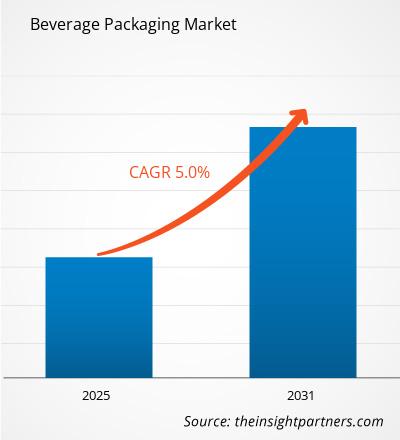
The Beverage Packaging Market was valued at US$ 166.38 Billion in 2025 and is projected to reach US$ 272.72 Billion by 2034, expanding at a CAGR of 5.64% during 2026–2034. The market covers aluminum cans, glass bottles, PET bottles, and carton packs serving alcoholic and non-alcoholic beverage applications. Convenience consumption, material efficiency, recycling requirements, lightweighting, premiumization, and investment in modern filling and packaging infrastructure shape demand.
North America represents a mature packaging environment supported by established beverage manufacturing, extensive retail distribution, and high consumption of packaged drinks. The regional market is expected to expand at a CAGR of 4.70–5.20% during 2026–2034. Growth is supported by ready-to-drink beverages, energy drinks, sports beverages, bottled water, and the continued replacement of heavier containers with lightweight formats.
Beverage Packaging Market Assessment and Insights
- North America: North America is estimated to hold a 2025 share of 25–29% and expand at a CAGR of 4.70–5.20% during 2026–2034, supported by mature beverage production, established recycling systems, and strong demand for convenient formats.
- U.S.: The U.S. represents approximately 72–76% of North America's 2025 share and is expected to register a CAGR of 4.60–5.10% during 2026–2034, supported by diversified beverage consumption.
- Europe: Europe is estimated to account for a 22–26% share in 2025, growing at a CAGR of 4.50–5.00% during 2026–2034, with Germany, the UK, France, Italy, and Spain supporting regional demand.
- Asia Pacific: Asia Pacific is projected to hold a 36–40% share in 2025, expanding at a CAGR of 6.00–6.60% during 2026–2034, led by China, India, Japan, South Korea, and Australia.
- Largest Segment: Aluminum Can is estimated to hold a 31–35% market share in 2025, advancing at a CAGR of 5.70–6.20% during 2026–2034, supported by portability and recyclability.
- High Growth Segment: Carton Pack is estimated at a 12–16% market share in 2025 and projected to grow at a CAGR of 6.30–6.90% during 2026–2034, driven by shelf-stable beverages.
- Key companies analyzed in detail: Alcoa Corporation, Amcor plc, Ball Corporation, Trivium Packaging B.V., Crown Holdings, Inc., Mondi plc, Reynolds Group Holdings Limited, Compagnie de Saint-Gobain S.A., Stora Enso Oyj, Tetra Laval International S.A.
Source: The Insight Partners' analysis based on proprietary research, government publications, company annual reports, investor presentations, industry databases, and expert interviews.
Packaging technology will be moving toward light-weighting, increased recycling content, better barrier properties, and faster filling speeds. The aluminum can takes advantage of its existing recovery system, while the PET supplier focuses on downgauging and recycling. The glass is still suitable for premium use cases, and the carton focuses on shelf-stable transport. These developments have been causing changes in the economics of production, buying specifications, and capital spending for packaging converters and beverage producers.
The future developments will probably focus on localized production capabilities, recyclable materials, and flexible manufacturing platforms. New markets of beverages, mainly in Asia, the Middle East, and select economies of Latin America, are drawing packaging investments because of the increase in local beverage production. The regulatory environment of waste minimization and recycling is also driving the suppliers to re-think the materials used and their recyclability.
Beverage Packaging Market Report Scope
| Report Attribute | Details |
|---|---|
| Market size in 2025 | US$ 166.38 Billion |
| Market Size by 2034 | US$ 272.72 Billion |
| Global CAGR (2026 - 2034) | 5.64% |
| Historical Data | 2021-2024 |
| Forecast period | 2026-2034 |
Beverage Packaging Market Analysis
Beverage Packaging Market growth is supported by expanding beverage portfolios, convenience-oriented consumption, and the increasing diversity of packaging requirements. The value chain is comprised of players from the aluminum, polymer, glass, and paperboard manufacturers; converters; container makers; closures producers; filling equipment makers; beverage firms; retailers; and recyclers. Packaging is selected based on barrier properties, shelf life, filling properties, transportation cost, recycling facilities and product positioning.
The supply situation is still dependent on the availability of materials such as aluminum, polymers, paperboard, glass, energy, and recycled feedstock. Packaging makers are now building plants in close proximity to areas where there is beverage processing for reasons of lower logistics costs and reliability of delivery. Light weighting may result in reduced material and logistic costs, while container standardization leads to higher efficiencies in production.
The Beverage Packaging Market analysis indicates a competitive structure led by multinational suppliers with extensive manufacturing networks and specialized material expertise. Ball Corporation and Crown Holdings, Inc. continue to have a robust presence in aluminum beverage cans, whereas Amcor plc is involved in both rigid and flexible packaging solutions. Tetra Laval International S.A. has a substantial stake in carton-based beverage systems, whereas Mondi plc and Stora Enso Oyj have a strong presence in paper-based packaging.
Increasingly, investment activities are based on capacity optimization, circularity, automation, and proximity to customers. Ball Corporation increased its European presence in the field of beverage cans by acquiring the European operations of Benepack in January 2026. Crown Holdings, Inc. has also been looking for opportunities to increase the capacity of beverage cans in India.
● REPORT CUSTOMIZATION
Tailor This Report To Align With Your Specific Business Requirements
This report can be customized to align precisely with your business objectives, scope, and target markets. Customization options include tailored segmentation, geography, competitive analysis, and strategic insights to support informed decision-making.
Customize This Report →WHAT YOU CAN ADJUST
- ● Segmentations
- ● Geography
- ● Competitive Analysis
- ● Language Preferences
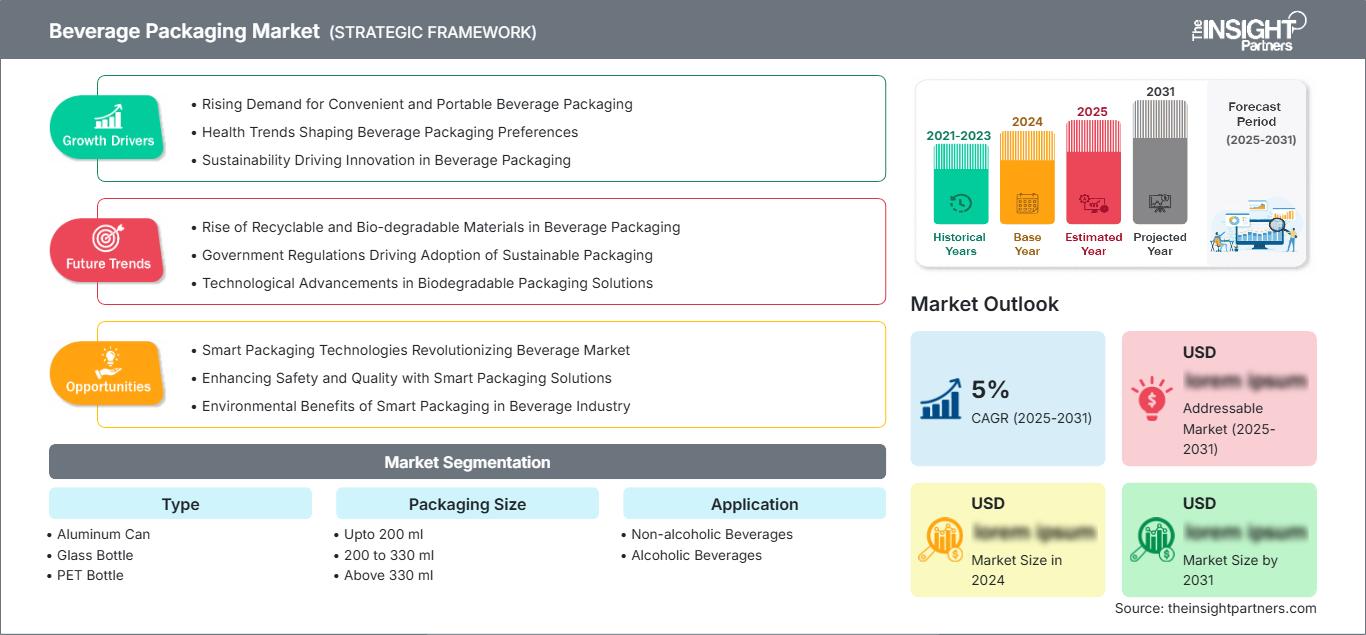
Beverage Packaging Market: Strategic Insights
Regional Insights
North America Beverage Packaging Market
North America is estimated to represent 25–29% of the 2025 Beverage Packaging Market share, with regional expansion projected at a CAGR of 4.70–5.20% during 2026–2034. The demand is predominantly sourced from the U.S., whereas Canada and Mexico add to the demand by producing beverages, consuming packaged water, drinking beer and soft drinks, and by developing modern retail systems. The use of aluminum cans and PET bottles persists in high-volume uses.
There are advantages provided by well-developed converting facilities as well as well-established relationships between beverage producers and packaging manufacturers. Aspects such as lightweighting, use of recycled materials, and collection systems affect purchasing decisions. Premium beverages enable differentiation and decoration. Suppliers consider such aspects as plant locations, logistics, access to recycled materials, and the stability of contracts in terms of capital investment.
U.S. Beverage Packaging Market
The U.S. represents approximately 72–76% of North America's 2025 Beverage Packaging share and is expected to grow at a CAGR of 4.60–5.10% during 2026–2034. Demand includes carbonated drinks, beer, water, energy and sports drinks, juices, and ready-to-drink beverages. Aluminum cans and PET bottles meet large single-serve and multi-pack needs.
Material selection is now influenced by factors such as total cost of delivery, material efficiencies, availability of recycled content, and security of supply. Ball Corporation, Crown Holdings, Inc., and Amcor plc retain significant market share due to economies of scale and partnerships with beverage manufacturers. Glass still has a role to play in premium beer and spirits, while cartons are used in certain juice and dairy applications. Innovation drives demand for diverse packaging.
Europe Beverage Packaging Market
Europe is estimated to hold a 22–26% share of the Beverage Packaging Market in 2025 and expand at a CAGR of 4.50–5.00% during 2026–2034, with Germany among the leading national markets. Recycling infrastructure, deposit systems, material-efficiency requirements, and sustainability policies influence packaging selection. Aluminum, glass, PET, and carton formats compete according to beverage category and distribution model.
The United Kingdom has a high demand for beer, soft drinks, bottled water, and ready-to-drink products. Germany gains the advantage of high beverage production and established collection programs. France, Italy, and Spain contribute to demand via soft drinks, beer, applications related to wine production, bottled water, and beverage demand due to tourism. Manufacturers become more and more focused on lightweighting, the use of recycled materials, reusability, and compatibility with European collection infrastructure.
APAC Beverage Packaging Market
APAC is estimated to represent a 36–40% share of the Beverage Packaging Market in 2025 and expand at a CAGR of 6.00–6.60% during 2026–2034. China is the top regional consumer, followed by Japan, India, South Korea, and Australia. Growth in beverage production, urbanization, new retailing, and increasing consumption of packaged beverages drives the use of containers in various forms.
While China is providing the manufacturing scale, India is providing growth potential from beverage production and distribution growth. Efficient and lightweight packaging is the key for Japan and South Korea, whereas Australia is a combination of mature consumption and recycling efforts.
Middle East & Africa Beverage Packaging Market
The Middle East & Africa Beverage Packaging Market is expected to expand at a CAGR of 4.20–4.80% during 2026–2034, supported by beverage-processing investment, population growth, urbanization, tourism, and infrastructure development. Saudi Arabia and the UAE represent major Gulf markets, while South Africa remains an important southern African packaging hub.
Availability of energy and diversification of industries have an effect on the economic production of the region. Saudi Arabia and the UAE encourage the expansion of manufacturing beverages and developing a modern retail infrastructure, whereas South Africa has maintained diversification of demands, both for alcoholic and non-alcoholic drinks. The other MEA countries represent the future prospects.
Segmentation Analysis
Type
The Type segment includes Aluminum Can, Glass Bottle, PET Bottle, Carton Pack, and is projected to grow at a CAGR of 5.20–5.90% during 2026–2034. Material selection depends on beverage properties, filling compatibility, distribution requirements, recycling infrastructure, cost, and brand positioning. The Beverage Packaging Market scope increasingly includes material circularity and lightweighting alongside conventional performance requirements.
- Aluminum Can: Aluminum cans remain important for beer, carbonated beverages, energy drinks, and ready-to-drink products because they provide portability, barrier protection, stackability, and established recycling pathways.
- Glass Bottle: Glass bottles retain relevance in premium beverages, beer, spirits, and selected soft drinks where product presentation, inertness, and established filling infrastructure influence packaging decisions.
- PET Bottle: PET bottles support high-volume water, soft drink, sports drink, and functional beverage applications because of their low weight, design flexibility, and filling-line compatibility, which improves distribution efficiency.
- Carton Pack: Carton packs serve shelf-stable and portion-controlled beverages, particularly applications requiring extended ambient distribution, aseptic processing, and efficient transportation.
Packaging Size
The Packaging Size segment comprises up to 200 ml, 200 to 330 ml, and above 330 ml and is expected to grow at a CAGR of 4.90–5.60% during 2026–2034. The Beverage Packaging Market size structure reflects consumption occasion, portability, price positioning, and beverage category requirements. Smaller formats support controlled portions, while larger packs address household and sharing consumption.
- Up to 200 ml: Small formats support portion control, children's beverages, foodservice, and sampling applications, with cartons and PET containers providing flexible options for controlled-volume consumption.
- 200 to 330 ml: Mid-sized formats suit single-serve consumption, vending, convenience retail, and ready-to-drink beverages by balancing portability with beverage quantity.
- Above 330 ml: Larger containers address household consumption, hydration, sharing occasions, and value purchasing, particularly for bottled water, soft drinks, juices, and selected alcoholic beverages.
Application
The Application segment of the Beverage Packaging Market covers Non-alcoholic Beverages, Alcoholic Beverages, and is projected to grow at a CAGR of 5.40–6.00% during 2026–2034. Product diversification creates packaging requirements based on carbonation, shelf life, filling conditions, distribution, product positioning, and consumption occasion. Non-alcoholic beverages provide broad volume exposure, while alcoholic beverages support substantial can and glass demand.
- Non-alcoholic Beverages: Water, carbonated drinks, energy beverages, sports drinks, juices, teas, and functional beverages generate broad packaging demand across PET, aluminum, glass, and carton formats.
- Alcoholic Beverages: Beer, spirits, wine-based drinks, and ready-to-drink products use cans, glass bottles, PET, and selected cartons according to filling requirements, portability, product positioning, and presentation.
Opportunity Snapshot
| Application | Revenue Contribution | Trend Tag | Adoption Stage |
|---|---|---|---|
| Non-alcoholic Beverages | High | Functional Drinks | Mature |
| Alcoholic Beverages | High | RTD Formats | Scaling |
Beverage Packaging Market Growth Drivers and Impact Analysis
Expansion of Ready-to-Drink and Functional Beverage Portfolios
Ready-to-drink products are creating increasing demands for packaging in the energy drinks category, sports drinks, functional water drinks, tea drinks, coffee drinks, and alcoholic ready-to-drink products. Many of these categories involve differentiation in terms of size, shape, decoration, and fill requirements. It is imperative, therefore, that packaging manufacturers develop production capabilities to handle changing production cycles and varying customer needs. Smaller-sized aluminum cans, PET bottles, and cartons might provide an advantage when convenience and portion size have an influence on the buying decision. The effect is felt in printing, closure, fill capability, and logistics planning. Manufacturers of beverages are looking for packaging companies that will help them launch products quickly without affecting production continuity.
Rising Focus on Recyclability and Material Efficiency
The packaging sustainability requirements are altering the procurement considerations within beverage supply chains. Beverage companies are now considering recycled content, recyclability, material intensity, recovery compatibility, and packaging weight when choosing suppliers. There are established ways of recycling aluminum and glass, while producers of PET are continuing to increase their use of recycled resin. Carton manufacturers are becoming more efficient in their fiber usage and recovery compatibility. Such considerations push companies to invest in equipment that will allow them to recycle these materials without sacrificing mechanical properties and protection. Lightweighting could also help to reduce the amount of material used as well as transportation requirements. The regulatory differences between countries complicate the matter further for multinational companies, which encourages packaging companies to create country-specific solutions.
Localized Capacity Expansion in High-Consumption Markets
Manufacturers of packaging are increasingly building capacity near clusters of beverage production facilities to help ensure security of supply and minimize risks from transportation. This approach is especially critical for heavy packaging, where transportation charges could make a significant impact on economics at delivery. Proximity of capacity will enable packaging providers to better serve beverage introductions and seasons. Decisions on investments in capacity are becoming driven by the proximity of filling plants, availability of raw materials, utilities, logistical infrastructure, labor, and recycling capacity. The purchase in January 2026 by Ball Corporation of Benepack's European business for beverage cans was facilitated by facilities in Belgium and Hungary. The acquisition reflects the value of proximity to manufacturing for beverage producers seeking reliable and sustainable packaging.
Beverage Packaging Market Future Trends
Recycled-Content Integration and Circular Design
Future Beverage Packaging Market trends will increasingly emphasize recycled content, material efficiency, lightweighting, and compatibility with collection systems. Suppliers are likely to deepen relationships with recyclers and material processors to secure consistent feedstock quality. Beverage companies may increasingly incorporate recycled-content requirements into procurement specifications alongside traditional measures such as weight, barrier performance, machinability, and shelf life. Aluminum and glass can leverage mature recycling pathways, while PET and carton formats will depend more strongly on collection and processing improvements. Packaging design may also prioritize simplified structures that facilitate sorting and recovery. As sustainability requirements become more measurable, suppliers will need to demonstrate material traceability and recovery compatibility rather than relying solely on broad environmental claims. This trend should influence product development, plant investment, and long-term customer contracts.
Format Differentiation by Consumption Occasion
Expect packaging formats to become more differentiated by consumption occasion. One-serve packs will continue to facilitate commuting, convenience, vending, outdoor consumption, and portion control, while the larger formats will serve household and sharing occasions. Luxury drinks will call for special glass shapes and decoration and finish, while mass market products will have to be efficient in materials and manufacturing. Carton formats can capitalize on portion-controlled and shelf-stable applications, while aluminum cans will remain fit for portable beverages and fast-filling applications. More format differentiation will motivate packagers to retain flexible manufacturing platforms and tooling. Digital decoration and changeover systems will lower the cost of smaller runs. This trend will make manufacturing flexibility an ever more important procurement consideration for drink makers with diverse product ranges.
Beverage Packaging Market Opportunities
Localized Manufacturing in Emerging Beverage Hubs
Companies can use Beverage Packaging Market Forecasts to prioritize capacity expansion, identify high-growth applications, evaluate material investments, and align production assets with changing beverage consumption patterns. Emerging markets provide opportunities for packaging manufacturers to establish facilities close to rapidly expanding beverage-processing clusters. India, Southeast Asia, selected Middle Eastern economies, and Latin American markets offer potential where packaged beverage consumption and organized retail are expanding. Investment decisions should evaluate local beverage volumes, raw-material availability, logistics, utilities, recycling infrastructure, and customer concentration. Regional facilities can reduce transportation exposure and shorten lead times for major beverage customers. Modernizing existing plants through automation, quality-control systems, lightweighting technology, and energy-efficient equipment can also improve output without requiring entirely new manufacturing networks.
Integrated Circular Packaging Services
An additional opportunity involves combining container production with recycled-material sourcing, recovery partnerships, material redesign, and lifecycle support. Beverage producers increasingly require measurable progress on circularity, creating demand for packaging suppliers that can support more than container conversion. Companies can develop partnerships with recyclers, improve feedstock traceability, and provide customers with packaging designs optimized for collection and processing. Aluminum and glass have established recovery systems, while PET and carton solutions require continued infrastructure development. Integrated approaches can strengthen customer relationships because suppliers become involved in material planning, design, recovery, and performance evaluation. Such models may also reduce exposure to virgin material volatility when reliable recycled feedstock is available. The strongest opportunities are likely in regions where collection infrastructure and packaging regulations are developing simultaneously.
Recent Developments
- January 2026: CCL Label advanced sustainable beverage packaging technologies for functional drinks, introducing solutions such as EcoFloat White, EcoShear, WashOff, and EcoStream pressure-sensitive labels. These technologies are designed to improve label separation during PET and glass recycling, support returnable packaging systems, and increase recyclate purity. The development strengthens the shift toward packaging formats designed for circularity and improved recyclability.
- November 2025: Ball Corporation announced further investment to increase beverage-can production capacity in India, following its existing manufacturing presence in Taloja and Sri City. The investment targets rising demand for aluminum packaging and supports expanding applications across RTD beverages and milk-based drinks. Ball also highlighted retort technology for beverage applications requiring extended shelf life.
- November 2025: ALPLA strengthened its packaging manufacturing footprint through the acquisition of a closure-production facility from Energoplast in Serbia. The move expands ALPLA's capabilities in closures while supporting its broader packaging portfolio. The company has also expanded its recycling activities, with reported installed and projected recycling capacity of approximately 400,000 metric tons, linking packaging production with increased recycled-material utilization.
Frequently Asked Questions

- Comprehensive Market Sizing and Forecast Analysis
- Detailed Segmentation Analysis
- In-Depth Market Dynamics Assessment
- Regional and Country-Level Insights
- Competitive Landscape and Company Benchmarking
- Strategic Business Intelligence
Recent Reports
Testimonials

The Insight Partners' SCADA System Market report is comprehensive, with valuable insights on current trends and future forecasts. The team was highly professional, responsive, and supportive throughout. We are very satisfied and highly recommend their services.
RAN KEDEM Partner, Reali Technologies LTDs
I requested a report on a very specific software market and the team produced the report in a few days. The information was very relevant and well presented. I then requested some changes and additions to the report. The team was again very responsive and I got the final report in less than a week.
JEAN-HERVE JENN Chairman, Future Analytica
We worked with The Insight Partners for an important market study and forecast. They gave us clear insights into opportunities and risks, which helped shape our plans. Their research was easy to use and based on solid data. It helped us make smart, confident decisions. We highly recommend them.
PIYUSH NAGPAL Sr. Vice President, High Beam Global
The Insight Partners delivered insightful, well-structured market research with strong domain expertise. Their team was professional and responsive throughout. The user-friendly website made accessing industry reports seamless. We highly recommend them for reliable, high-quality research services
YUKIHIKO ADACHI CEO, Deep Blue, LLC.
This is the first time I have purchased a market report from The Insight Partners.While I was unsure at first, I visited their web site and felt more comfortable to take the risk and purchase a market report.I am completely satisfied with the quality of the report and customer service. I had several questions and comments with the initial report, but after a couple of dialogs over email with their analyst I believe I have a report that I can use as input to our strategic planning process.Thank you so much for taking the extra time and making this a positive experience.I will definitely recommend your service to others and you will be my first call when we need further market data.
JOHN SUZUKI President and Chief Executive Officer, Board Director, BK Technologies
I wish to appreciate your support and the professionalism you displayed in the course of attending to my request for information regarding to infectious disease IVD market in Nigeria. I appreciate your patience, your guidance, and the fact that you were willing to offer a discount, which eventually made it possible for us to close a deal. I look forward to engaging The Insight Partners in the future, all thanks to the impression you have created in me as a result of this first encounter.
DR CHIJIOKE ONYIA MANAGING DIRECTOR, PineCrest Healthcare Ltd.Reason to Buy
- Informed Decision-Making
- Understanding Market Dynamics
- Competitive Analysis
- Identifying Emerging Markets
- Customer Insights
- Market Forecasts
- Risk Mitigation
- Boosting Operational Efficiency
- Strategic Planning
- Investment Justification
- Tracking Industry Innovations
- Aligning with Regulatory Trends





 Get Free Sample for