
Binders Excipients Market Size, Growth & Demand by 2034
Coverage: by Source (Natural, Synthetic); Type (Cellulosics Lactose, Polyols, Povidones, Starch and Polysaccharides, Others); Application (Solution Binder, Dry Binder); End-user (Pharmaceutical Companies, Nutraceutical Companies, Others), and Geography (North America, Europe, Asia Pacific, and South and Central America)
- Status : Data Released
- Report Code : TIPRE00013369
- Category : Chemicals and Materials
- No. of Pages : 150
- Available Report Formats :


- Last update date : August 27, 2026


2025 Market Size
US$ 1.42 Bn
Base year value
2034 Forecast
US$ 2.1 Bn
Projected by 2034
CAGR 2026-2034
4.46 %
Growth rate
Addressable Market
US$ 16.00 Bn
(2026-2034)
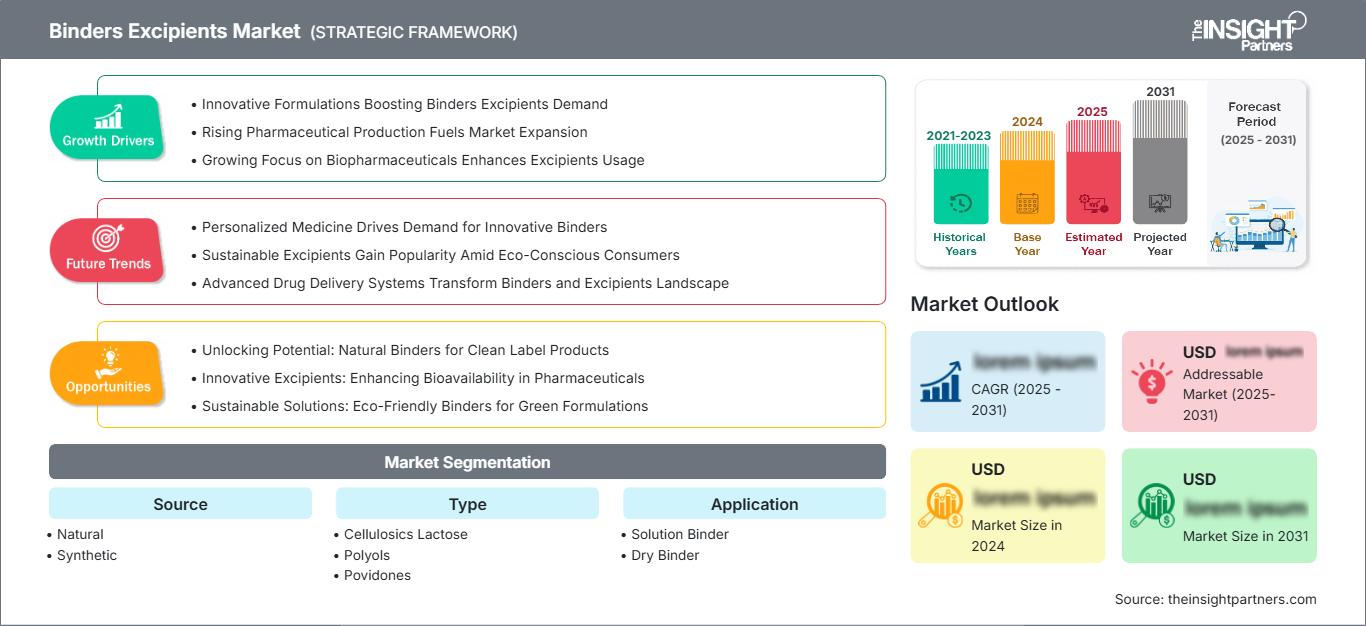
The Binders Excipients market was valued at US$ 1.42 Billion in 2025 and is projected to reach US$ 2.1 Billion by 2034, expanding at a CAGR of 4.46% during 2026–2034. Demand is shaped by pharmaceutical manufacturing volumes, formulation complexity, direct compression adoption, and requirements for consistent excipient functionality. Binders and excipients represent a specialized segment of the pharmaceutical excipient industry, supporting tablet formation, granulation, powder flow, and dosage-form performance.
North America remains a structurally important market because of its established pharmaceutical manufacturing base, sophisticated formulation capabilities, and demand for high-functionality excipients. The region is expected to register approximately 4.1–4.6% CAGR during 2026–2034, supported by oral solid dosage development, controlled-release formulations, and increasing attention to excipient quality, traceability, and supply continuity. The Binders Excipients Market size is therefore influenced by both formulation innovation and replacement demand.
Binders Excipients Market Assessment and Insights
- North America: North America is expected to account for a 28–32% share in 2025 and grow at a CAGR of 4.1–4.6% between 2026 and 2034, supported by pharmaceutical R&D, established tablet manufacturing, and demand for high-purity functional excipients.
- U.S.: The U.S. is expected to represent a 62–66% share of North America in 2025 and expand at a CAGR of 4.0–4.5% between 2026 and 2034, driven by oral solid dosage production and formulation innovation.
- Europe: Europe is projected to hold a 24–28% share in 2025 and register a CAGR of 3.8–4.3% between 2026 and 2034, with Germany, France, Italy, Switzerland, and the UK supporting pharmaceutical formulation and excipient consumption.
- Asia Pacific: Asia Pacific is estimated at a 27–31% share in 2025 and is expected to grow at a CAGR of 5.0–5.6% between 2026 and 2034, led by China, India, Japan, and South Korea through expanding pharmaceutical production.
- Largest Segment: Natural sources are estimated at 55–59% market share in 2025, with a CAGR of 4.0–4.5% during 2026–2034, reflecting broad use of cellulose, starch, and polysaccharide-based binders.
- High Growth Segment: Dry Binder is expected to hold 39–43% market share in 2025 and expand at a CAGR of 4.8–5.2% during 2026–2034, supported by direct compression and simplified manufacturing.
- Key companies analyzed in detail: Ashland Inc., BASF SE, BENEO GmbH, BPSI Holdings LLC, DFE Pharma GmbH & Co. KG, Dow Inc., Ingredion Incorporated, JRS PHARMA LP, Kerry Group plc, Lonza Group Ltd.
Source: The Insight Partners' analysis based on proprietary research, government publications, company annual reports, investor presentations, industry databases, and expert interviews.
The formulation techniques are evolving from traditional single-purpose binding agents to more functional and co-processing excipients, which enhance flowability, compressibility, dissolution, and manufacturing processes. Direct compression and roller compaction play an increasingly crucial role in selecting the ingredients, with wet granulation playing a significant role in formulating tough-to-compress medicines. Manufacturers are developing particle size distribution, moisture levels, density, and functionality to accommodate the higher amounts of drugs and complex oral dosages.
In the future, there is going to be a greater need for new pharmaceutical manufacturing regions, especially India and China, but mature markets will continue emphasizing quality, compliance, and reliability. Building technical centers, application labs, and local manufacturing capabilities will accelerate the formulation development process. Excipient identity, traceability, purity, and manufacturing quality will receive greater regulatory scrutiny in the coming years, further increasing the need for standardized pharmaceutical-grade ingredients.
Binders Excipients Market Report Scope
| Report Attribute | Details |
|---|---|
| Market size in 2025 | US$ 1.42 Billion |
| Market Size by 2034 | US$ 2.1 Billion |
| Global CAGR (2026 - 2034) | 4.46% |
| Historical Data | 2021-2024 |
| Forecast period | 2026-2034 |
Binders Excipients Market Analysis
Pharmaceutical tablet production remains the central demand engine because binders provide cohesion during granulation and compression while helping manufacturers achieve acceptable tablet hardness and mechanical integrity. The Binders Excipients Market growth outlook also reflects greater use of direct compression, controlled-release systems, nutraceutical tablets, and high-dose formulations. The value chain includes cellulose, starch, lactose, polyol, and polymer manufacturers; processing; grading; formulating assistance; distribution; and pharmaceutical manufacturing.
The supply chain is affected by agricultural-based materials, specialty polymers, cellulose derivatives, production capacity, and regional quality demands. The purchasing process is now based on particle properties, batch uniformity, regulatory paperwork, and technical assistance as opposed to purely cost. Companies that produce products internally and have several regional locations will limit exposure to raw material shortages, while pharmaceutical companies are qualifying other grades for supply chain assurance.
Competitive positioning increasingly depends on functionality, technical support, regulatory documentation, and manufacturing consistency rather than product availability alone. The Binders Excipients Market analysis indicates that suppliers with broad portfolios can address multiple formulation requirements across cellulosics, povidones, starches, polysaccharides, lactose, and polyols. Ashland Inc., BASF SE, DFE Pharma GmbH & Co. KG, and JRS PHARMA LP maintain differentiated positions through pharmaceutical excipient portfolios and formulation expertise.
Differentiation strategy for some other players includes the use of starches, carbohydrates, polymers, and specialty excipients. Ingredion Incorporated and BENEO GmbH are two leading players with carbohydrate-based functional ingredient technology. Dow Inc. is another key player with its cellulose-based technology. Inclusion of Kerry Group plc, Lonza Group Ltd., and BPSI Holdings LLC has added to the competitiveness in terms of pharmaceutical and nutritional ingredients.
● REPORT CUSTOMIZATION
Tailor This Report To Align With Your Specific Business Requirements
This report can be customized to align precisely with your business objectives, scope, and target markets. Customization options include tailored segmentation, geography, competitive analysis, and strategic insights to support informed decision-making.
Customize This Report →WHAT YOU CAN ADJUST
- ● Segmentations
- ● Geography
- ● Competitive Analysis
- ● Language Preferences
Binders Excipients Market: Strategic Insights
Regional Insights
North America Binders Excipients Market
North America Binders Excipients Market is expected to maintain a 28–32% share in 2025 and record a 4.1–4.6% CAGR through 2034. The U.S. leads the region's consumption due to its well-established manufacture of pharmaceuticals, generics, and ongoing investments in technology for oral solid dosage form. The contribution of Canada includes pharmaceutical and nutraceutical manufacture, despite its lower consumption levels. There is demand for cellulosics with higher purity, povidones, and direct compression compounds.
The region is advantaged by its strong formulation development and high-quality standards. In addition, pharmaceutical companies require detailed information on excipients with respect to impurities, specification, documentation, and availability. Market growth is driven by controlled-release tablets, nutraceutical formulations, and manufacturing technologies. Technical centers and formulation laboratories enable local suppliers to help customers in selecting and processing materials.
U.S. Binders Excipients Market
The U.S. represents approximately 62–66% of North America Binders Excipients Market in 2025 and is expected to expand at a 4.0–4.5% CAGR through 2034. Large pharmaceutical companies, generic drug manufacturers, contract research organizations, and nutraceutical companies produce a constant demand. Cellulose-based products, povidones, starches, and specialty binders assist tableting, capsule forming, modified release systems, and direct compression.
The suppliers include Ashland Inc., BASF SE, Dow Inc., Ingredion Incorporated, JRS PHARMA LP, and various specialty excipient providers. Buyers increasingly focus on reproducibility, regulatory requirements, and supply assurance. Applications require materials with multiple functions to simplify formulation and production processes. In addition, the USA is a significant developer of new excipients for high-dose APIs, poor powder flow properties, dissolution challenges, and controlled release.
Europe Binders Excipients Market
Europe is estimated to have a 24–28% share in 2025 and is projected to register a 3.8–4.3% CAGR through 2034, with Germany representing the leading country. Pharmaceutical manufacturing concentration, established excipient production, and stringent quality expectations sustain regional demand.
The United Kingdom has an established pharmaceutical formulation infrastructure wherein the need lies for pharmaceutical-grade raw materials and scientifically based excipient selection. Germany has advantages in terms of pharmaceutical manufacturing, excipient manufacturing, and formulations. France meets its needs through branded pharmaceuticals and contract manufacturing, whereas Italy and Spain meet their needs by means of generic drugs, nutraceuticals, and pharmaceutical manufacturing.
APAC Binders Excipients Market
Asia Pacific is becoming an increasingly important demand center, particularly because of pharmaceutical manufacturing expansion in China and India. The Binders Excipients Market share is supported by growing generic-drug production, expanding formulation capacity, and increasing adoption of modern tableting technologies. Japan and South Korea contribute through higher-value pharmaceutical manufacturing, while Australia maintains a smaller but established pharmaceutical and nutraceutical production base. APAC is projected to hold a 27–31% share in 2025 and grow at a 5.0–5.6% CAGR through 2034, with China leading regional consumption. India, Japan, South Korea, and Australia contribute through pharmaceutical, generic-drug, nutraceutical, and formulation activities.
China and India provide manufacturing scale, while Japan and South Korea emphasize advanced pharmaceutical quality and formulation technologies. India's expanding pharmaceutical production and regulatory modernization support demand for standardized excipients. Regional policies promoting domestic pharmaceutical manufacturing can encourage localized sourcing and production. Suppliers increasingly establish application support and technical capabilities within APAC to address direct compression, high-dose formulations, modified release, and cost-sensitive generic manufacturing requirements.
Middle East & Africa Binders Excipients Market
The Middle East & Africa Binders Excipients Market is expected to expand at approximately 4.8–5.4% CAGR through 2034. Saudi Arabia and the UAE are strengthening pharmaceutical manufacturing infrastructure, while South Africa remains an important regional pharmaceutical production center. The rest of the MEA demand is linked to imported medicines and gradually developing domestic formulation capacity.
Energy availability and industrial infrastructure influence manufacturing economics across the region. Pharmaceutical localization programs can increase demand for pharmaceutical-grade binders as domestic tablet and capsule production expands. Suppliers with regional distribution networks can address documentation, storage, and supply continuity requirements. Saudi Arabia is positioned as a leading growth market because pharmaceutical localization initiatives can encourage investment in formulation facilities and associated excipient procurement.
Segmentation Analysis
Source
Natural materials remain the dominant source category, while synthetic materials support specialized formulations requiring controlled functionality and consistent polymer characteristics. The Binders Excipients Market scope increasingly includes multifunctional materials capable of supporting direct compression, wet granulation, controlled release, and higher drug loading. Natural materials benefit from established regulatory histories, while synthetic grades offer precise molecular and functional characteristics.
- Natural: Natural binders include cellulose, starch, lactose-derived materials, and polysaccharides. Their established pharmaceutical use, broad availability, and compatibility with conventional processing make them important for tablets, granules, and nutraceutical formulations.
- Synthetic: Synthetic binders include polymeric materials such as povidones and cellulose derivatives. They provide controlled viscosity, binding strength, and formulation flexibility for technically demanding dosage forms and modified-release applications.
Type
Type-based demand of the Binders Excipients Market reflects differences in binding mechanism, compressibility, solubility, and processing requirements. Cellulosics and starch-based materials support large-volume tablet production, while povidones and polyols address specialized formulation requirements. The type segment is expected to record a 4.2–4.7% CAGR during 2026–2034 as formulators seek optimized performance across different manufacturing processes.
- Cellulosics: Cellulosic binders provide strong compactability and broad formulation compatibility. Their functionality supports direct compression, wet granulation, controlled release, and tablet coating applications across pharmaceutical and nutraceutical manufacturing.
- Lactose: Lactose-based materials serve as established formulation components where flow, dilution, and compression properties must be balanced. They remain relevant in conventional tablets and selected direct-compression formulations.
- Polyols: Polyols contribute binding and functional characteristics while supporting formulations requiring specific solubility, mouthfeel, or stability profiles. Their relevance extends across pharmaceutical and nutraceutical products with specialized dosage requirements.
- Povidones: Povidones offer strong binding performance and versatility across wet granulation, solid oral dosage, and selected advanced processing approaches. Their molecular-weight range allows formulators to adjust functionality.
- Starch and Polysaccharides: Starch and polysaccharide binders provide economical, established functionality and broad processing compatibility. They remain important where manufacturers prioritize scalable production and familiar excipient systems.
Application
Application requirements increasingly determine binder selection because formulation processes place different demands on flowability, compactability, dissolution, and moisture sensitivity. The application segment is projected to expand at a 4.3–4.8% CAGR during 2026–2034, supported by wider adoption of efficient tableting technologies.
- Solution Binder: Solution binders are introduced through granulation liquids and support particle adhesion during wet processing. They remain strategically important for formulations requiring improved cohesion, uniformity, and tablet strength.
- Dry Binder: Dry binders support direct compression and dry granulation while reducing processing steps and water exposure. Their adoption benefits formulations seeking shorter manufacturing cycles, lower energy consumption, and improved process efficiency.
End-user
Pharmaceutical companies in the Binders Excipients Market represent the primary demand base because binders directly influence tablet manufacturability, quality attributes, and product performance. Nutraceutical companies provide an additional demand stream, particularly as tablet and capsule formats expand. The segment is expected to register a 4.0–4.5% CAGR during 2026–2034, with procurement increasingly emphasizing functionality and supply reliability.
- Pharmaceutical Companies: Pharmaceutical manufacturers require consistent excipient quality across development and commercial production. Procurement focuses on regulatory compliance, batch consistency, functional performance, documentation, and continuity of supply.
- Nutraceutical Companies: Nutraceutical manufacturers use binders in tablets and related dosage formats where processing efficiency, product stability, consumer acceptability, and cost control influence formulation decisions.
Opportunity Snapshot
| End-user | Revenue Contribution (High/Medium/Low) | Trend Tag | Adoption Stage |
| Pharmaceutical Companies | High | Advanced Tableting | Mature |
| Nutraceutical Companies | Medium | Functional Tablets | Scaling |
Binders Excipients Market Growth Drivers and Impact Analysis
Expansion of Direct Compression and Efficient Tableting
Direct compression makes the process simple by avoiding wet granulation steps or reducing them, making binders that guarantee good flowability, compressibility, and tablet strength very important. The change in process impacts the procurement strategy since pharmaceutical companies need to consider excipients not only in terms of the specification but also in terms of their performance. A multi-functional excipient system that combines filler and binder may reduce the number of ingredients used in the product formula and make its production simpler. This can be exemplified by JRS PHARMA LP with its products for direct compression and other tableting techniques. BASF SE also provides grades of povidone and copovidone suitable for different processing methods.
Growing Complexity of Oral Solid Dosage Formulations
Increased drug content, low solubility APIs, modified delivery mechanisms, and combination products make for complex formulations. Binders are required to deliver consistent compaction without compromising on dissolution and delivery performance. The need is for materials that possess controlled particle properties, controlled molecular weight distribution, and processability for special production procedures. In addition, pharmaceutical developers are looking for excipients that will be able to serve more than one purpose, thus simplifying the formulation and process. The impact goes beyond traditional tablets since controlled delivery, orally dispersible and nutraceutical products need excipients in specific combinations. Excipient suppliers with application laboratories and formulation knowledge can capitalize on that situation.
Stronger Regulatory Focus on Excipient Quality and Traceability
Increased regulatory scrutiny increases the importance of managing excipient quality. There is an increasing need for documentation of the origin, specifications, manufacturing process, contaminants, and supply chain details of the raw material. In India, the regulatory changes made in the year 2026 regarding the excipient have put a focus on qualitative information about the excipient and its formulation intermediates. This shows that the excipient is gaining increasing visibility through pharmaceutical regulations. These factors may increase the qualifications needed for the supplier and increase the cost of switching after qualification. Manufacturers who have the ability to maintain documentation, GMP manufacturing, analysis, and consistency of batch quality have an advantage in pharmaceutical regulation.
Binders Excipients Market Future Trends
Greater Adoption of Co-processed and Multifunctional Excipients
Binders Excipients Market trends increasingly point toward co-processed and multifunctional materials that combine binding, filling, flow enhancement, and compression functionality. Such substances have the potential to decrease the number of components in formulations and, thereby, contribute to process robustness. Co-processed excipients from BASF SE are currently sold under the concept of lower ingredient and process needs. On the other hand, JRS PHARMA LP offers composite excipient systems intended for use in tableting. During the forecast period, formulation scientists are expected to evaluate excipients on the basis of overall manufacturing performance instead of functional performance. This trend will drive the development of application-specific formulations suitable for direct compression, continuous processing, roller compaction, and high-dose formulations.
Digital Formulation and Data-driven Excipient Selection
Digital formulation tools are expected to influence how pharmaceutical developers evaluate binders, particularly when formulations involve multiple interacting material attributes. Predictive models can connect excipient characteristics with powder flow, compaction, porosity, tensile strength, dissolution, and manufacturing conditions. This approach can reduce experimental iterations and accelerate the selection of suitable grades. Digital workflows may also improve knowledge transfer between development, scale-up, and commercial manufacturing teams. Suppliers that combine material databases with formulation expertise can support more systematic decision-making. Over time, data-driven selection could shift customer relationships toward technical collaboration, where excipient manufacturers provide characterization data, formulation guidance, and process recommendations alongside the physical material.
Binders Excipients Market Opportunities
Localization of Excipient Manufacturing in Asia Pacific
Investment in emerging pharmaceutical manufacturing hubs can create opportunities for suppliers that combine localized production with technical services. Asia Pacific is particularly relevant because pharmaceutical manufacturers increasingly seek shorter supply chains and dependable access to qualified excipients. Binders Excipients Market Forecasts indicate that suppliers can target direct-compression materials, multifunctional grades, and specialized binders through regional application laboratories and customer-support centers. Localization can also improve qualification support and responsiveness to formulation requirements. Partnerships with pharmaceutical manufacturers, contract development organizations, and local distributors can strengthen market access while reducing delivery constraints. Suppliers can prioritize markets where pharmaceutical capacity expansion coincides with increasing requirements for standardized, documented, and technically supported excipients.
Development of High-purity and Application-specific Grades
High-purity, application-specific grades offer an attractive opportunity because pharmaceutical manufacturers increasingly require predictable performance and tighter impurity control. Demand can develop around low-nitrite polymers, controlled particle-size materials, specialized molecular-weight grades, and excipients optimized for difficult APIs. Ashland Inc. has demonstrated this direction through pharmaceutical excipient developments addressing nitrite control and specialized oral solid dosage requirements. Suppliers can differentiate by designing materials around defined manufacturing challenges rather than selling generic binder grades. Commercial opportunities also exist in co-processed systems that combine multiple functionalities. Successful development requires close coordination among excipient producers, pharmaceutical formulators, analytical laboratories, and regulatory teams to demonstrate equivalence, safety, consistency, and manufacturing suitability.
Recent Developments
- April 2026: RIBUS, Inc. expanded production of Nu-FILL, a plant-based excipient made from rice hulls, rice bran extract, and agave syrup. The product is positioned as a clean-label and certified-organic alternative to microcrystalline cellulose for tablets, capsules, and stick packs. The production expansion followed an initial commercial order and reflects growing formulation demand for natural excipient options.
- August 2026: Medios AG signed an agreement to acquire a 74% stake in Caesar & Loretz GmbH (Caelo), a German supplier of APIs, excipients, and pharmaceutical raw materials. Caelo expects approximately €40 million in revenue for fiscal 2026. The transaction gives Medios entry into the German API and excipient market and establishes a platform for expanding its European Compounding Essentials business, subject to antitrust approval.
Frequently Asked Questions

- Comprehensive Market Sizing and Forecast Analysis
- Detailed Segmentation Analysis
- In-Depth Market Dynamics Assessment
- Regional and Country-Level Insights
- Competitive Landscape and Company Benchmarking
- Strategic Business Intelligence
Recent Reports
Testimonials

The Insight Partners provided valuable market intelligence that supported our global go-to-market strategy. Their team was professional, responsive, and attentive to our feedback, providing thoughtful analysis and helpful methodological clarifications throughout the project.
Junmo Kim Chief Financial Officer (CFO), Enertech Co., Ltd.
The Insight Partners' SCADA System Market report is comprehensive, with valuable insights on current trends and future forecasts. The team was highly professional, responsive, and supportive throughout. We are very satisfied and highly recommend their services.
RAN KEDEM Partner, Reali Technologies LTDs
I requested a report on a very specific software market and the team produced the report in a few days. The information was very relevant and well presented. I then requested some changes and additions to the report. The team was again very responsive and I got the final report in less than a week.
JEAN-HERVE JENN Chairman, Future Analytica
We worked with The Insight Partners for an important market study and forecast. They gave us clear insights into opportunities and risks, which helped shape our plans. Their research was easy to use and based on solid data. It helped us make smart, confident decisions. We highly recommend them.
PIYUSH NAGPAL Sr. Vice President, High Beam Global
The Insight Partners delivered insightful, well-structured market research with strong domain expertise. Their team was professional and responsive throughout. The user-friendly website made accessing industry reports seamless. We highly recommend them for reliable, high-quality research services
YUKIHIKO ADACHI CEO, Deep Blue, LLC.
This is the first time I have purchased a market report from The Insight Partners.While I was unsure at first, I visited their web site and felt more comfortable to take the risk and purchase a market report.I am completely satisfied with the quality of the report and customer service. I had several questions and comments with the initial report, but after a couple of dialogs over email with their analyst I believe I have a report that I can use as input to our strategic planning process.Thank you so much for taking the extra time and making this a positive experience.I will definitely recommend your service to others and you will be my first call when we need further market data.
JOHN SUZUKI President and Chief Executive Officer, Board Director, BK Technologies
I wish to appreciate your support and the professionalism you displayed in the course of attending to my request for information regarding to infectious disease IVD market in Nigeria. I appreciate your patience, your guidance, and the fact that you were willing to offer a discount, which eventually made it possible for us to close a deal. I look forward to engaging The Insight Partners in the future, all thanks to the impression you have created in me as a result of this first encounter.
DR CHIJIOKE ONYIA MANAGING DIRECTOR, PineCrest Healthcare Ltd.Reason to Buy
- Informed Decision-Making
- Understanding Market Dynamics
- Competitive Analysis
- Identifying Emerging Markets
- Customer Insights
- Market Forecasts
- Risk Mitigation
- Boosting Operational Efficiency
- Strategic Planning
- Investment Justification
- Tracking Industry Innovations
- Aligning with Regulatory Trends





 Get Free Sample for