
Bismuth Iron Garnet (BIG) based Optical Isolators Market Size, Share & Trends by 2034
Coverage: By Category (Polarization Independent and Polarization Dependent), Power Level (Medium Power, High Power, and Low Power), Wavelength (1064 nm, 1310 nm, 1550 nm, and Others), End-use (Telecommunications, Manufacturing, Defense, Medical, Research and Development, and Others), and Geography (North America, Europe, Asia Pacific, Middle East and Africa, and South and Central America)
- Status : Published
- Report Code : TIPRE00043877
- Category : Electronics and Semiconductor
- No. of Pages : 266
- Available Report Formats :


- Last update date : September 04, 2026


2025 Market Size
US$ 58,912.69 Th
Base year value
2034 Forecast
US$ 95,766.63 Th
Projected by 2034
CAGR 2026-2034
5.5 %
Growth rate
Addressable Market
US$ 699,609.04 Th
(2026-2034)
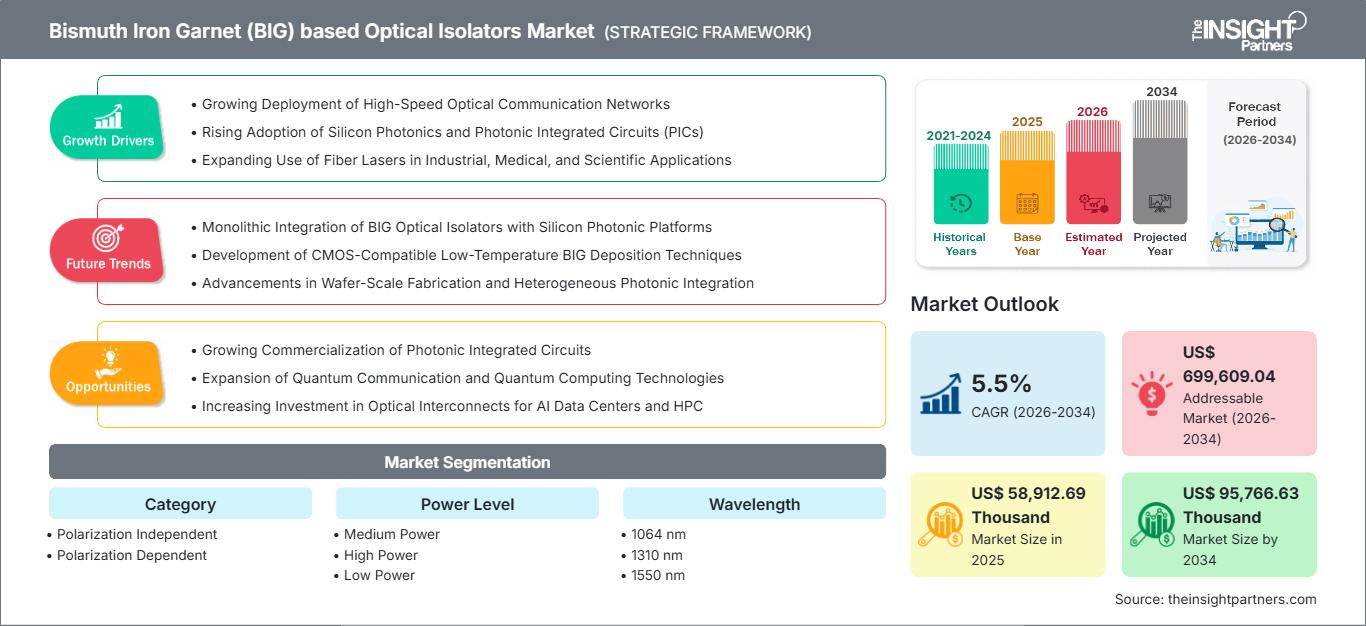
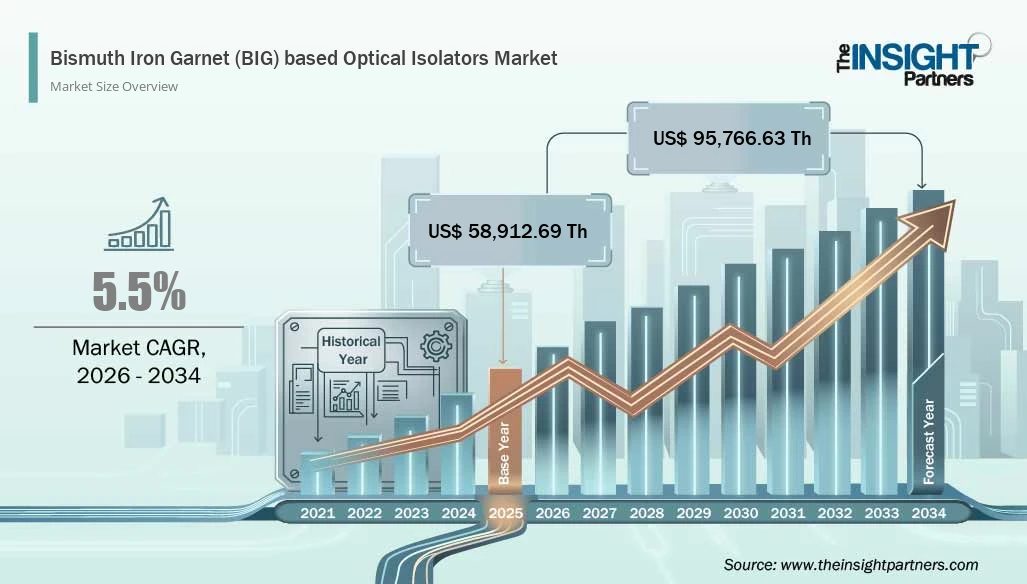
The Bismuth Iron Garnet (BIG) based Optical Isolators Market is expected to reach US$ 95,766.63 thousand by 2034 from US$ 58,912.69 thousand in 2025. The market is anticipated to register a CAGR of 5.5% during 2026–2034. Demand is supported by the use of non-reciprocal optical components in telecom, laser manufacturing, defense photonics, precision medical systems, and laboratory instrumentation.
North America remains a technically important demand center, with the Bismuth Iron Garnet (BIG)-based Optical Isolators Market size shaped by laser system upgrades, aerospace photonics, and domestic optical component sourcing. The region is modelled to grow at a CAGR of 4.1% during 2026–2034, supported by high-value 1064 nm and 1550 nm applications and resilient demand from research, defense, and semiconductor inspection ecosystems.
Bismuth Iron Garnet (BIG) based Optical Isolators Market Assessment and Insights
- North America accounted for 28.3% share in 2025 and is modelled to grow at a CAGR of 4.1% during 2026–2034, supported by laser integration, defense optics, and advanced research procurement.
- US represented 81.1% of North America in 2025 and is modelled to expand at a CAGR of 4.3% during 2026–2034.
- Europe held 20.4% share in 2025 and is modelled to grow at a CAGR of 5.9% during 2026–2034, led by Germany, the UK, France, and Italy.
- Asia Pacific captured 43.0% share in 2025 and is modelled to grow at a CAGR of 6.6% during 2026–2034, with China, Japan, South Korea, and India driving demand.
- Largest Segment Polarization Independent isolators held 63.3% market share in 2025 and are modelled to grow at a CAGR of 6.1% during 2026–2034.
- High Growth Segment High Power isolators held 36.2% market share in 2025 and are modelled to grow at a CAGR of 6.6% during 2026–2034.
- Key companies analyzed in detail: Edmund Optics Inc., Conoptics, Inc., Hefei ModuOptik Technologies Co., Ltd., Unice E-O Services Inc., Agiltron Inc., Newport Corporation, Wavelength Opto-Elecstronic Pte Ltd, Nippon Electric Glass Co., Ltd., Thorlabs, Inc., Coherent Corp., Electro-Optics Technology GmbH, and Faraday Photonics LLC.
Source: The Insight Partners' analysis based on proprietary research, government publications, company annual reports, investor presentations, industry databases, and expert interviews.
Migration towards technology has shifted the market of Bismuth Iron Garnet (BIG)-based Optical Isolators from catalog-based components to engineered optical sub-assemblies. The BIG material and other kinds of garnets are appreciated due to the high Faraday rotation at near-infrared wavelengths, namely 1310 nm and 1550 nm telecom wavelengths. The production process will depend on crystal growth potential, coating uniformity, aperture sizes, and specific packaging. Those suppliers who unite magneto-optic material knowledge and alignment and thermal capabilities will benefit from this.
In terms of procurement trends, one should expect the market of Bismuth Iron Garnet (BIG)-based Optical Isolators to shift beyond conventional photonics industry clusters as laser processing applications, quantum technologies development, and optical communications security programs develop in Asia Pacific and certain countries in the Middle East. Support for domestic supply chains of semiconductors, telecommunications industry, and military sector is expected to motivate qualification of additional suppliers.
Bismuth Iron Garnet (BIG) based Optical Isolators Market Report Scope
| Report Attribute | Details |
|---|---|
| Market size in 2025 | US$ 58,912.69 Thousand |
| Market Size by 2034 | US$ 95,766.63 Thousand |
| Global CAGR (2026 - 2034) | 5.5% |
| Historical Data | 2021-2024 |
| Forecast period | 2026-2034 |
Bismuth Iron Garnet (BIG) based Optical Isolators Market Analysis
The demand for BIG-based optical isolators is tied to the requirement of safeguarding the lasers from reflected light that causes instability in output, generates noise, or damages the upstream optics. The Bismuth Iron Garnet (BIG)-based Optical Isolators Market will be most clearly seen in fiber amplifiers, coherent telecom modules, lidar test benches, industrial lasers, and medical imaging systems. The value chain starts with magneto-optic garnet growth, polishing, and coating, followed by rotator, polarizer, magnet, housing, and connector assembly.
The supply base remains specialized because the BIG materials require controlled liquid phase epitaxy, precise thickness tolerance, and low absorption at near-infrared wavelengths. The manufacturers have to meet isolation, insertion loss, aperture size, power handling, and temperature stability constraints. Consequently, modelled demand grows steadily rather than explosively because customers qualify the optical isolators through system-level validation cycles prior to production procurement.
The competitive landscape is fragmented but highly technical. Edmund Optics Inc., Newport Corporation, Thorlabs, Inc., and Coherent Corp. facilitate broad photonics procurement, whereas Agiltron Inc., Electro-Optics Technology GmbH, Faraday Photonics LLC, and Hefei ModuOptik Technologies Co., Ltd. provide customised and specialist solutions. This Bismuth Iron Garnet (BIG)-based Optical Isolators Market analysis reveals that the differentiation factor is not based on scale alone, but on wavelength range, packaging options, high-power design and customer engineering support.
The investments are focused on higher power handling, packaging miniaturisation, and better thermal reliability. Nippon Electric Glass Co., Ltd. demonstrates the material-oriented positioning strategy through the use of proprietary magneto-optical glass, while Conoptics, Inc. and Unice E-O Services Inc. reinforce their niche positioning through laser and electro-optics systems. Strategic positioning is increasingly based on both catalog and customisation capabilities, since the customers may need to adjust apertures, wavelength, connectors, and isolation levels.
● REPORT CUSTOMIZATION
Tailor This Report To Align With Your Specific Business Requirements
This report can be customized to align precisely with your business objectives, scope, and target markets. Customization options include tailored segmentation, geography, competitive analysis, and strategic insights to support informed decision-making.
Customize This Report →WHAT YOU CAN ADJUST
- ● Segmentations
- ● Geography
- ● Competitive Analysis
- ● Language Preferences
Bismuth Iron Garnet (BIG) based Optical Isolators Market: Strategic Insights
Regional Insights
North America Bismuth Iron Garnet (BIG) based Optical Isolators Market
In North America, the share in 2025 was recorded to be 28.3%, and it is projected to grow at a CAGR of 4.1% from 2026 to 2034. The market share for the Bismuth Iron Garnet (BIG)-Based Optical Isolators in the region depends on defense photonics, laser diagnostic applications, semiconductor inspection applications, and universities’ research initiatives.
The demand in the region will be driven by applications in the fiber lasers labs, coherent communication test equipment, and high power free space systems. Demand in the US is driven by procurements, while in Canada, it is driven by research in photonics and aerospace projects.
U.S. Bismuth Iron Garnet (BIG) based Optical Isolators Market Market
The US comprised 81.1% of North America in 2025 and was projected to have a CAGR of 4.3% for 2026-2034. Demand was driven by military-funded optics, high-tech manufacturing, medical lasers, and telecommunication test platforms requiring optical isolation at 1064 nm, 1310 nm, and 1550 nm wavelengths.
Presence of players includes Edmund Optics Inc., Newport Corporation, Thorlabs, Inc., Agiltron Inc., and Faraday Photonics LLC with a strong presence for both catalog and customization products. Applications will trend towards low loss, small size, and thermal reliability for benchtops, fiber amplifiers, coherent sources, and high power solid state lasers.
Europe Bismuth Iron Garnet (BIG) based Optical Isolators Market Market
Europe had a share of 20.4% in 2025 and is forecast to witness growth at a CAGR of 5.9% between 2026 and 2034. Germany has been identified as the key nation due to factors like laser processing, machine tools, photonics clusters, and precision manufacturing.
The UK derives benefit from its quantum projects and military optics projects. France, Italy, and Spain derive their contribution from aerospace, medical devices, and instrumentation research. European customers usually look out for good documentation, RoHS compliance, stability in optical coatings, and longevity of performance. This presents good business prospects for manufacturers of qualified products.
APAC Bismuth Iron Garnet (BIG) based Optical Isolators Market Market
APAC captured 43.0% share in 2025 and is modelled to grow at a CAGR of 6.6% during 2026–2034. China is the leading country, followed by Japan, South Korea, India, and Australia. Growth is supported by telecom expansion, semiconductor tools, industrial lasers, and homegrown photonics supply chains.
Japan contributes through material science and high-precision optics, while South Korea benefits from semiconductor and display manufacturing. India’s research laboratories and defense modernization programs are emerging demand pockets. Policy support for domestic electronics and optical communication infrastructure strengthens regional qualification activity.
Middle East & Africa Bismuth Iron Garnet (BIG) based Optical Isolators Market Market
Middle East & Africa is modelled to grow at a CAGR of 3.8% during 2026–2034. Saudi Arabia is the leading country, followed by the UAE and South Africa. Demand is linked to research universities, energy-sector sensing, defense optics, and industrial modernization programs.
Adoption remains project-based because local manufacturing depth is limited. However, energy infrastructure monitoring, smart-city optics, and laboratory investments create selective opportunities. Suppliers with distributor networks, training support, and ruggedized configurations can improve conversion rates across high-value pilot and institutional projects.
Segmentation Analysis
Category
Category is modelled to grow at a CAGR of 6.1% during 2026–2034. The Bismuth Iron Garnet (BIG)-based Optical Isolators Market scope across polarization independent and polarization dependent designs reflects different beam control requirements. Polarization independent products are preferred in fiber communication and systems with uncontrolled polarization, while polarization dependent units remain important in free-space laser benches.
- Polarization Independent products lead demand because they support signal stability across telecom, fiber amplifier, and integrated optical systems where input polarization cannot always be controlled.
- Polarization Dependent products remain strategically important in free-space laser applications, offering strong isolation, lower complexity, and effective protection in controlled optical paths.
Power Level
Power Level is modelled to grow at a CAGR of 6.6% during 2026–2034. Selection depends on laser output, beam diameter, heat load, and damage threshold requirements. High-power systems require larger apertures and robust polarizers, while low-power units prioritize compactness and cost efficiency. Medium-power devices serve the broadest laboratory and industrial integration base.
- Medium Power isolators address routine laser protection needs in test systems, materials processing, and instrumentation where performance, cost, and availability must be balanced.
- High Power isolators are gaining importance in fiber lasers, solid-state lasers, and semiconductor inspection systems that require stable operation under intense optical loads.
- Low Power isolators remain relevant in compact telecom modules, education laboratories, sensing platforms, and optical benches with modest power handling requirements.
Wavelength
Wavelength is modelled to grow at a CAGR of 4.3% during 2026–2034. The 1550 nm band benefits from optical communication and sensing, while 1064 nm is important for Nd:YAG and fiber laser systems. The 1310 nm band supports telecom and test applications where low-loss isolation and temperature stability remain essential.
- 1064 nm products support industrial laser processing, medical lasers, research benches, and laser protection systems requiring reliable isolation around common solid-state laser outputs.
- 1310 nm products serve telecom testing, optical communication modules, and specialty sensing systems that require low insertion loss in established transmission windows.
- 1550 nm products hold strategic relevance in coherent telecom, fiber amplifiers, lidar, and long-haul communication environments that need stable near-infrared isolation.
End-use
End-use is modelled to grow at a CAGR of 5.5% during 2026–2034. Telecommunications remains structurally important, while manufacturing generates higher-value demand through high-power laser adoption. Defense and research applications require customization, documentation, and rugged performance. Medical use is expanding through imaging, laser treatment, and diagnostic platforms where feedback protection supports system stability.
- Telecommunications remains a core use case because isolators protect laser sources and amplifiers in optical networks, coherent transmission systems, and laboratory validation platforms.
- Manufacturing generates demand from industrial laser systems, micromachining, semiconductor inspection, and materials processing where back reflections can damage sources or reduce process stability.
- Defense requires reliable isolators for secure communication, sensing, directed-energy research, and rugged optical systems operating under strict performance and qualification requirements.
- Medical adoption is supported by optical coherence tomography, laser surgery, diagnostic instruments, and precision imaging systems needing stable low-noise optical output.
- Research and Development remains influential because universities, national laboratories, and photonics startups test new laser architectures, quantum optics, and integrated photonic platforms.
Opportunity Snapshot
| End-use | Revenue Contribution | Trend Tag | Adoption Stage |
| Telecommunications | High | Coherent Links | Mature |
| Manufacturing | High | Laser Safety | Scaling |
| Defense | Medium | Secure Optics | Scaling |
| Medical | Medium | OCT Systems | Scaling |
| Research and Development | Medium | Quantum Labs | Emerging |
Bismuth Iron Garnet (BIG) based Optical Isolators Market Growth Drivers and Impact Analysis
Rising Optical Network Complexity Requires Stable Isolation
Network operators and equipment vendors continue to deploy dense optical links, coherent transmission, and amplifier-rich architectures. These systems increase exposure to back reflections, polarization effects, and laser instability. The Bismuth Iron Garnet (BIG)-based Optical Isolators Market benefits because BIG rotators support compact and efficient isolation in near-infrared telecom windows. The real-world impact is longer laser life, lower signal noise, and fewer system-level failures in transmission and validation environments.
Industrial Laser Power Density Is Increasing
Manufacturing users are adopting higher-power fiber and solid-state lasers for micromachining, welding, marking, additive manufacturing, and semiconductor processing. As optical power rises, even small back-reflected signals can destabilize sources or damage expensive components. High-power isolators with optimized apertures, coatings, and thermal pathways therefore become necessary protective elements. This driver supports premium product demand and encourages suppliers to develop wider wavelength coverage and stronger power-handling portfolios.
Research and Defense Programs Need Custom Photonics
Defense laboratories, quantum optics groups, and national research facilities frequently require non-standard wavelengths, apertures, and environmental tolerances. These programs create demand for engineered BIG-based isolators rather than only off-the-shelf components. The impact is visible in longer qualification cycles, higher average selling prices, and closer collaboration between users and photonics suppliers. Vendors with design flexibility and documented performance data are better positioned to win repeat projects.
Bismuth Iron Garnet (BIG) based Optical Isolators Market Future Trends
Miniaturized Isolators for Integrated Photonic Systems
The Bismuth Iron Garnet (BIG)-based Optical Isolators Market trends will increasingly favor smaller packages that can fit compact benches, fiber modules, and hybrid photonic assemblies. As optical systems become denser, isolator suppliers must reduce footprint without sacrificing isolation, insertion loss, or thermal stability. This shift will require tighter magnet design, precision coatings, and application-specific assembly methods for telecom, sensing, and laboratory platforms.
Higher Reliability Standards for Harsh Environments
Future demand will place greater emphasis on vibration tolerance, temperature stability, long operating life, and documented performance drift. Defense, aerospace, energy sensing, and industrial laser users are expected to request more rugged configurations. Suppliers that combine BIG material control with stronger package qualification can capture higher-margin requirements. Reliability evidence will become a commercial differentiator, especially where isolators are embedded in mission-critical systems.
Bismuth Iron Garnet (BIG) based Optical Isolators Market Opportunities
Qualification in High-Power Laser Platforms
Suppliers can create value by aligning product development with high-power fiber laser makers and semiconductor equipment integrators. The strongest Bismuth Iron Garnet (BIG)-based Optical Isolators Market Forecasts are linked to applications where optical feedback directly affects uptime, yield, and repair cost. Early qualification in platform designs can convert custom prototypes into recurring production business. Companies should prioritize thermal testing, aperture customization, and application-focused technical support.
Localized Supply for Strategic Photonics Programs
Domestic photonics programs in the US, Europe, Japan, China, India, and the Middle East create opportunities for alternate qualified sources. Buyers increasingly value supply resilience for optical communication, defense, medical, and semiconductor tools. Vendors can invest in distributor training, regional assembly support, and documentation packages to shorten buyer qualification. This opportunity is most attractive for suppliers that can offer catalog products and engineered variants through the same commercial channel.
Recent Developments
- February 2026: Edmund Optics highlighted one of the industry's most comprehensive portfolios of off-the-shelf optical windows, supporting applications in spectroscopy, imaging, sensing, industrial instrumentation, and laser systems.
- January 2026: Unice E-O Services completed third-party verification of its 2024 full-scope greenhouse gas (GHG) emissions inventory in accordance with the GHG Protocol, marking a milestone in sustainability and environmental governance unice-eo.
- January 2025: AFR released a high-power optical isolator at Photonics West 2025, designed for high-power laser systems with improved optical isolation and thermal performance for industrial and scientific laser applications.
Frequently Asked Questions

- Comprehensive Market Sizing and Forecast Analysis
- Detailed Segmentation Analysis
- In-Depth Market Dynamics Assessment
- Regional and Country-Level Insights
- Competitive Landscape and Company Benchmarking
- Strategic Business Intelligence
Recent Reports
Testimonials

The Insight Partners provided valuable market intelligence that supported our global go-to-market strategy. Their team was professional, responsive, and attentive to our feedback, providing thoughtful analysis and helpful methodological clarifications throughout the project.
Junmo Kim Chief Financial Officer (CFO), Enertech Co., Ltd.
The Insight Partners' SCADA System Market report is comprehensive, with valuable insights on current trends and future forecasts. The team was highly professional, responsive, and supportive throughout. We are very satisfied and highly recommend their services.
RAN KEDEM Partner, Reali Technologies LTDs
I requested a report on a very specific software market and the team produced the report in a few days. The information was very relevant and well presented. I then requested some changes and additions to the report. The team was again very responsive and I got the final report in less than a week.
JEAN-HERVE JENN Chairman, Future Analytica
We worked with The Insight Partners for an important market study and forecast. They gave us clear insights into opportunities and risks, which helped shape our plans. Their research was easy to use and based on solid data. It helped us make smart, confident decisions. We highly recommend them.
PIYUSH NAGPAL Sr. Vice President, High Beam Global
The Insight Partners delivered insightful, well-structured market research with strong domain expertise. Their team was professional and responsive throughout. The user-friendly website made accessing industry reports seamless. We highly recommend them for reliable, high-quality research services
YUKIHIKO ADACHI CEO, Deep Blue, LLC.
This is the first time I have purchased a market report from The Insight Partners.While I was unsure at first, I visited their web site and felt more comfortable to take the risk and purchase a market report.I am completely satisfied with the quality of the report and customer service. I had several questions and comments with the initial report, but after a couple of dialogs over email with their analyst I believe I have a report that I can use as input to our strategic planning process.Thank you so much for taking the extra time and making this a positive experience.I will definitely recommend your service to others and you will be my first call when we need further market data.
JOHN SUZUKI President and Chief Executive Officer, Board Director, BK Technologies
I wish to appreciate your support and the professionalism you displayed in the course of attending to my request for information regarding to infectious disease IVD market in Nigeria. I appreciate your patience, your guidance, and the fact that you were willing to offer a discount, which eventually made it possible for us to close a deal. I look forward to engaging The Insight Partners in the future, all thanks to the impression you have created in me as a result of this first encounter.
DR CHIJIOKE ONYIA MANAGING DIRECTOR, PineCrest Healthcare Ltd.Reason to Buy
- Informed Decision-Making
- Understanding Market Dynamics
- Competitive Analysis
- Identifying Emerging Markets
- Customer Insights
- Market Forecasts
- Risk Mitigation
- Boosting Operational Efficiency
- Strategic Planning
- Investment Justification
- Tracking Industry Innovations
- Aligning with Regulatory Trends





 Get Free Sample for