
Direct-View LED Display Market Size, Growth & Demand by 2034
Coverage: By Panel Size (Microdisplays, Small & Medium-sized Panels, and Large Panels), Panel Type (Flat Panel Display, Flexible Display, Foldable Display, Curved Display, and Others), Product Type (Smartphones and Tablets, Television Sets, Monitors and Laptops, Digital Signage and Large Format Displays, Automotive Displays, Wearables, and Others), Industry Vertical (Consumer Electronics, Automotive, Sports and Entertainment, Retail, BFSI, Education, Healthcare, Aerospace and Defense, and Others) and Geography
- Status : Published
- Report Code : TIPRE00043798
- Category : Electronics and Semiconductor
- No. of Pages : 326
- Available Report Formats :


- Last update date : September 02, 2026


2025 Market Size
US$ 18.57 Bn
Base year value
2034 Forecast
US$ 28.23 Bn
Projected by 2034
CAGR 2026-2034
4.8 %
Growth rate
Addressable Market
US$ 212.83 Bn
(2026-2034)
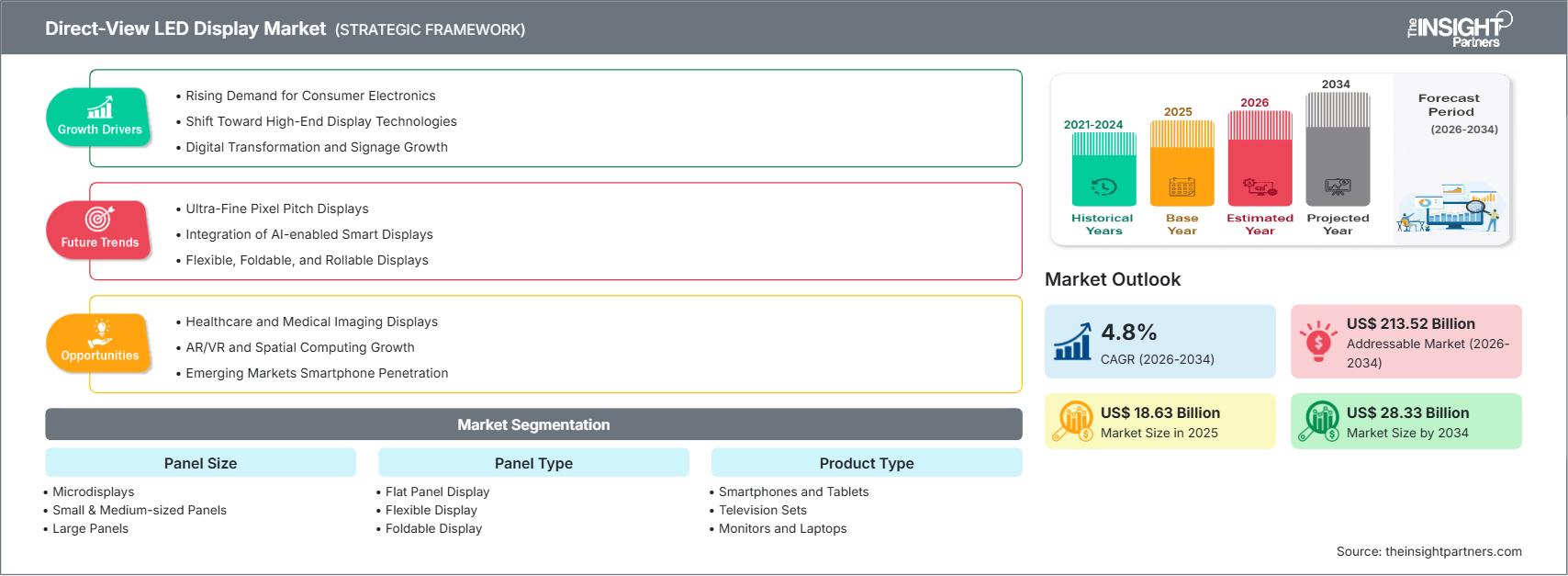
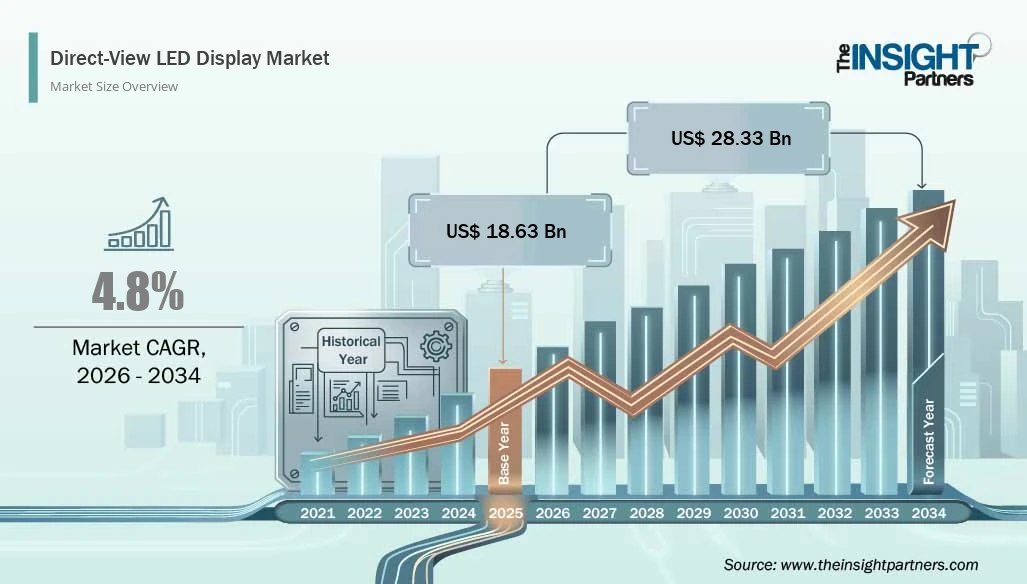
The Direct-View LED Display Market was valued at US$ 18.57 Billion in 2025 and is projected to reach US$ 28.23 Billion by 2034, expanding at a CAGR of 4.8% during 2026–2034. The market encompasses quantum-dot-enhanced and quantum-dot-emissive panels used across consumer, commercial, automotive, healthcare, education, aerospace, defense, retail, and financial-service display applications.
Across Asia Pacific, the Direct-View LED Display Market size is expected to advance at a 6.3% CAGR through 2034. Premium television renewal, gaming-monitor demand, and commercial adoption of high-brightness digital signage support the region, while cadmium restrictions encourage wider use of indium-phosphide materials and highly efficient quantum-dot color conversion.
Direct-View LED Display Market Assessment and Insights
- North America held 28% share in 2025 and is growing at a CAGR of 3.9% between 2026–2034, supported by premium televisions, gaming monitors, and commercial displays.
- US represented 86% of North America in 2025 and is growing at a CAGR of 4.1% between 2026–2034, driven by strong replacement demand.
- Europe accounted for 22% share in 2025 and is growing at a CAGR of 3.5% between 2026–2034, led by Germany, the UK, France, Italy, and Spain.
- Asia Pacific captured 40% share in 2025 and is growing at a CAGR of 6.3% between 2026–2034, with China, South Korea, Japan, and India leading.
- Largest Segment Large Panels held 48% market share in 2025 and are growing at a CAGR of 3.8% between 2026–2034.
- High Growth Segment Automotive Displays held 17% market share in 2025 and are growing at a CAGR of 5.9% between 2026–2034.
- Key companies analyzed in detail: Samsung Electronics Co., Ltd., BOE Technology Group Co., Ltd., LG Electronics Inc., TCL Technology Group Corporation, Sharp Corporation, Panasonic Holdings Corporation, AUO Corporation, Innolux Corporation, Truly International Holdings Limited, and Sony Group Corporation.
Source: The Insight Partners' analysis based on proprietary research, government publications, company annual reports, investor presentations, industry databases, and expert interviews.
From enhancement films incorporated in LCD backlights to QD-OLED and novel electroluminescence approaches, quantum dot display technology has progressed. In terms of production efficiency, film uniformity, ink-jet patterning, encapsulation, blue light efficiency, and yield, and not just color quality, have become critical elements. Television manufacturing is still the key large area market, but there are also other applications in monitors and automotive that increase the number of qualifications. The availability of cadmium-free products is also an important procurement consideration.
Through 2034, investment will concentrate in Korean and Chinese panel capacity, premium monitor formats, automotive cockpits, and emerging microdisplay platforms. Policy support for advanced semiconductor materials and energy-efficient electronics should reinforce Asia Pacific manufacturing, while European chemical regulation will favor traceable, cadmium-free supply. Emerging demand in India, Southeast Asia, and the Gulf adds geographic diversity but requires localized brands, channels, service coverage, and price-sensitive product configurations.
Direct-View LED Display Market Report Scope
| Report Attribute | Details |
|---|---|
| Market size in 2025 | US$ 18.57 Billion |
| Market Size by 2034 | US$ 28.23 Billion |
| Global CAGR (2026 - 2034) | 4.8% |
| Historical Data | 2021-2024 |
| Forecast period | 2026-2034 |
Direct-View LED Display Market Analysis
The Direct-View LED Display Market growth will be stimulated by the increasing demand for higher color gamut range, brightness, HDR, and light conversion efficiency. TV brands still remain the primary demand aggregators; yet monitors, notebooks, in-car display, signage, and near-eye displays increase the addressable market size. The value chain includes manufacturers of quantum dots, barrier films, panels, driver ICs, modules, brands, software platforms, resellers, and system integrators.
Competitive advantage in the supply side is provided by material robustness, deposition precision, yield and qualification of panels of various sizes. In case of large panels, there is the maturity of LCD backplane technology and quantum dot film technology, but for QD-OLED it is important to have control over the emissive layer and color conversion. Therefore, the purchasing factors are the lifetime, burn-in prevention, brightness uniformity, power consumption and availability of components besides the price and brand.
Direct-View LED Display Market analysis shows a concentrated but differentiated competitive field. Samsung Electronics Co., Ltd. and Sony Group Corporation compete in premium QD-OLED televisions, while TCL Technology Group Corporation scales quantum-dot Mini LED across broader price bands. BOE Technology Group Co., Ltd., AUO Corporation, Innolux Corporation, and Truly International Holdings Limited strengthen upstream panel depth for monitors, automotive systems, and specialized formats.
Investment techniques vary according to the assets under consideration. LG Electronics Inc., Sharp Corporation, and Panasonic Holdings Corporation utilize display integration and image processing along with consumer sales channels, whereas display makers emphasize oxide backplanes, ink jet processing, and flexible substrates. Business positions is becoming more and more dependent on differentiating themselves with respect to their displays, minimizing the risk of material, and leveraging their display performance.
● REPORT CUSTOMIZATION
Tailor This Report To Align With Your Specific Business Requirements
This report can be customized to align precisely with your business objectives, scope, and target markets. Customization options include tailored segmentation, geography, competitive analysis, and strategic insights to support informed decision-making.
Customize This Report →WHAT YOU CAN ADJUST
- ● Segmentations
- ● Geography
- ● Competitive Analysis
- ● Language Preferences
Direct-View LED Display Market: Strategic Insights
Regional Insights
North America Direct-View LED Display Market
North America held 28% share in 2025 and is projected to expand at a 3.9% CAGR during 2026–2034. Direct-View LED Display Market share is sustained by premium television replacement, gaming monitor adoption, streaming-led home entertainment, and commercial demand for bright, color-accurate signage. Mature retail channels help vendors monetize larger screen sizes and premium specifications.
Regional expansion is also made possible by digitization of automotive cockpits, health care visualization, and creativity in enterprises. The priority for North American consumers includes high dynamic range quality, refresh rates, warranties, power efficiency, and platform compatibility. The strong branding of Samsung Electronics Co., Ltd., Sony Group Corporation, LG Electronics Inc., and TCL Technology Group Corporation adds to the availability of products, whereas design labs and ecosystems qualify advanced formats.
U.S. Direct-View LED Display Market Market
The U.S. represented 86% of North American revenue in 2025 and is expected to grow at a 4.1% CAGR through 2034. Demand centers on premium televisions, esports monitors, professional notebooks, digital signage, and increasingly sophisticated vehicle displays. Screen-size migration and high-refresh-rate gaming create recurring upgrade cycles despite market maturity.
Availability of products from Samsung Electronics Co., Ltd., Sony Group Corporation, LG Electronics Inc., and TCL Technology Group Corporation has been achieved through domestic distributors as well as direct sales. Application development has been most successful wherever color accuracy or luminance contributes value to its use such as content production, medical review, luxury automobiles, control rooms, and retail display windows facing outwards. Consumers are becoming more aware of differences in panel construction, firmware, calibration, and energy usage.
Europe Direct-View LED Display Market Market
Europe accounted for 22% share in 2025 and is forecast to grow at a 3.5% CAGR through 2034. Germany leads through premium consumer demand, automotive engineering, and industrial visualization. The UK combines gaming, broadcasting, and creative-sector adoption with a developed online retail channel, favoring high-refresh-rate monitors and premium televisions.
France provides support for design-focused domestic entertainment and luxury retail displays; Italy offers applications in broadcasting, hospitality, and automobiles; and Spain provides needs in sports, tourism, and digital signage. The buying practices in Europe pay undue attention to energy labels, repairability, chemical composition, and durability of the products. This is advantageous to cadmium-free designs, backlights efficiency, and environmental disclosures, among others. Growth is restricted by replacement cycle maturity.
APAC Direct-View LED Display Market Market
APAC held 40% share in 2025 and is expected to grow at a 6.3% CAGR during 2026–2034. China leads through panel fabrication, television production, and government support for advanced displays, while South Korea anchors QD-OLED development.
Japan offers materials and premium brand expertise; India provides price-sensitive demand for televisions and signage; Australia aids in high-value domestic entertainment and commercial applications. Electronic supply chain density, engineering skills, export capabilities, and semiconductor inducements help keep costs low and innovation high.
Middle East & Africa Direct-View LED Display Market Market
MEA is projected to grow at a 3.3% CAGR through 2034. The UAE leads premium retail, hospitality, events, and smart-building displays, while Saudi Arabia adds entertainment districts, large venues, and digital infrastructure linked to economic diversification.
SA utilizes well-established consumer electronics and corporate routes; RoMEA is still inconsistent but benefits from telecommunication retailing, education, and infrastructural projects. Temperature, dust, availability, power stability, and budget impact product design and supplier choices.
Segmentation Analysis
Panel Size
Panel Size is projected to grow at a 4.2–4.8% CAGR during 2026–2034. Direct-View LED Display Market scope spans compact near-eye modules, portable-device panels, and large-format screens, but manufacturing economics vary sharply by substrate size and pixel density. Large panels remain commercially central, while microdisplays attract strategic investment for augmented reality, defense optics, and medical visualization.
- Microdisplays occupy an emerging position, with demand tied to augmented-reality headsets, viewfinders, simulation, and defense optics where compactness, pixel density, efficiency, and brightness are decisive.
- Small & Medium-sized Panels serve tablets, laptops, smartphones, wearables, and vehicle clusters, benefiting from premiumization while facing stringent power, thickness, yield, and durability requirements.
- Large Panels dominate through televisions, gaming monitors, signage, and control rooms, where quantum dots deliver visible color and brightness gains across high-value screen sizes.
Panel Type
Panel Type is expected to advance at a 4.3–4.9% CAGR through 2034. Flat displays retain scale because television and monitor production uses mature backplanes and standardized modules. Flexible, foldable, and curved variants command higher engineering intensity, requiring robust encapsulation, bend-tolerant materials, optical uniformity, and application-specific mechanics before volume deployment.
- Flat Panel Display leads mainstream adoption across televisions, monitors, laptops, signage, and vehicle displays, supported by established fabrication, standardized assembly, broad supplier capacity, and predictable yields.
- Flexible Display supports conformable dashboards, wearables, and novel handheld devices, but depends on thin-film encapsulation, flexible backplanes, optical stability, and mechanical qualification.
- Foldable Display targets premium portable electronics through expanded usable screen area, although hinge durability, crease control, thickness, lifetime, and repair economics constrain wider adoption.
- Curved Display remains strategically relevant in gaming monitors, simulations, automotive cockpits, and specialty signage where immersion and ergonomic viewing justify added module complexity.
Product Type
Product Type is forecast to grow at a 4.4–5.0% CAGR during 2026–2034. Television sets remain the largest outlet, yet monitor, laptop, automotive, signage, and wearable programs diversify revenue. Design wins depend on matching brightness, refresh rate, thickness, lifetime, cost, and viewing environment rather than applying one panel architecture across every device category.
- Smartphones and Tablets represent a selective premium opportunity, as quantum-dot benefits must justify tight power budgets, thin modules, high pixel density, and intense competition from established OLED.
- Television Sets remain the revenue anchor, supported by large-screen migration, HDR content, Mini LED backlights, premium retail demonstration, and differentiated QD-OLED picture quality.
- Monitors and Laptops gain through gaming, content creation, engineering, and productivity, where color accuracy, high refresh rates, text clarity, and certification influence purchasing.
- Digital Signage and Large Format Displays use high brightness and broad color for retail, venues, studios, control rooms, and corporate installations requiring visual impact.
- Automotive Displays are strategically important as cockpits add larger, curved, and passenger-facing screens requiring sunlight readability, long lifetimes, thermal robustness, and automotive qualification.
- Wearables remain emerging, with potential in headsets and specialized devices where compactness and vivid color matter, but efficiency, cost, and lifetime remain constraints.
Industry Vertical
Industry Vertical is projected to expand at a 4.5–5.1% CAGR through 2034. Consumer electronics provides scale, while automotive, retail, healthcare, education, and aerospace applications value brightness, color fidelity, or form-factor flexibility. Vertical growth depends on certification, installation environments, software integration, service models, and customer ability to monetize better visual performance.
- Consumer Electronics dominates through televisions, monitors, laptops, tablets, and premium mobile devices, supported by recognizable picture-quality improvements and mature global retail channels.
- Automotive scales with digital cockpits, passenger displays, and rear-seat entertainment, where high brightness, broad color, curved formats, and long qualification cycles shape sourcing.
- Sports and Entertainment adopts premium displays for broadcast production, gaming arenas, venues, and home viewing, prioritizing motion clarity, HDR, color consistency, and immersion.
- Retail uses quantum-dot signage for attention, product visualization, and premium brand environments, with adoption linked to brightness, duty cycle, content management, and energy costs.
- BFSI applies high-resolution displays in trading floors, branches, advisory environments, and control rooms, valuing readability, uptime, data density, and secure integration.
- Education deploys interactive displays, lecture capture monitors, and simulation systems where wide viewing angles, legibility, durability, and manageable total cost guide procurement.
- Healthcare requires color-consistent visualization for diagnostics, surgery, telemedicine, and training, making calibration, reliability, hygiene-compatible design, and regulatory compliance strategically important.
- Aerospace and Defense values high-brightness, compact, and rugged displays for cockpits, simulators, command systems, and head-mounted optics under demanding environmental and security conditions.
Opportunity Snapshot
| Industry Vertical | Revenue Contribution | Trend Tag | Adoption Stage |
| Consumer Electronics | High | Premium Screens | Mature |
| Automotive | Medium | Digital Cockpits | Scaling |
| Sports and Entertainment | Medium | Immersive Viewing | Scaling |
| Retail | Medium | Vivid Signage | Scaling |
| BFSI | Low | Trading Walls | Mature |
| Education | Low | Interactive Learning | Scaling |
| Healthcare | Medium | Clinical Color | Scaling |
| Aerospace and Defense | Low | Rugged Optics | Emerging |
| Others | Low | Specialty Displays | Emerging |
Direct-View LED Display Market Forecasts point to industry verticals with mandatory visual-performance requirements as the most defensible opportunities. Automotive and healthcare programs can support long qualification cycles and premium margins; retail and entertainment provide faster project turnover. Consumer electronics remains essential for scale, but suppliers should balance it with specialized applications that value calibration, durability, brightness, flexible form factors, and long-term service support.
Direct-View LED Display Market Growth Drivers and Impact Analysis
Premium television and monitor replacement
Consumers look at factors like brightness, color volume, HDR capability, refresh rate, and screen sizes when they need to replace their TVs and monitors. The quantum dot technology allows companies to create a story that is noticeable in terms of performance for LCD-based Mini LED and self-emissive QD-OLED products, making it possible to differentiate themselves based on technology and cost of production. Gamers and creators also need fast reaction time and frame rates along with good color reproduction capabilities. The impact of quantum dots is not limited to sales growth but also includes higher average selling price, large screen size, and investments in panel efficiency and picture processing.
Cadmium-free material innovation
The forces of regulation and sustainable development requirements are driving manufacturers towards cadmium-free quantum dots, particularly those based on indium phosphides. Such an approach opens up new market opportunities where substance-restriction policies affect purchasing decisions, but it also imposes stricter requirements concerning color purity, stability, conversion efficiency, and durability. Appropriate material development mitigates compliance risks for globally available products and simplifies regulatory documentation in different jurisdictions. From a commercial standpoint, the ability to maintain performance of cadmium-free materials makes it possible for television, monitor, automotive, and signage makers to preserve quantum dot distinction without developing unique chemistries for highly regulated environments.
Automotive cockpit digitization
Large instrument panels, center information displays, passenger displays, and rear seat entertainment systems are being integrated into vehicle cabins, providing a valuable market opportunity for more advanced panels. Quantum dot technology can be used to increase sunlight readability, color volume, and efficiency, while accommodating wide-angled and curved cockpits. Thermal and vibration stability, long-term durability, low reflection rates, and consistent sourcing through multiple model years are all automotive qualification factors that make initial qualification challenging but protect qualified vendors against rapid commoditization. This market is one where platform successes will come through design wins established many years prior to vehicle introduction.
Direct-View LED Display Market Future Trends
Direct electroluminescent quantum-dot displays
Trends in the Quantum Dot Display Industry continue to move away from photoluminescent quantum dot conversion layers to electroluminescent quantum dot pixels. Though direct emissions will enable simpler optical stack design, color purity, and thin panels, their development will be contingent on blue material lifetime, deposition uniformity, current efficiency, encapsulation, and yield issues. Scale-up will see inkjet printing and photolithography processes vying for primacy. The early commercialization of quantum dots will occur in high-margin, low-volume applications, not in mass-market television production lines. Those suppliers that can produce cadmium-free emitters and patterned pixels will gain an advantage over the competition.
Quantum dots move into near-eye systems
Augmented reality displays, virtual production, medical opticals, and military displays will define an important developmental frontier for microdisplays. Extreme pixel density, brightness, low power consumption, compact optics, and thermal management will be needed in these display applications. Quantum dot color conversion, or even direct quantum dot emission, can enhance efficiency and color performance where filters lose light. Commercial success will hinge upon integration with silicon backplanes, patterning, optical coupling, and encapsulation. While unit volumes may be small at first, engineering complexity and mission-critical application can warrant premium pricing and joint development efforts.
Direct-View LED Display Market Opportunities
Localized premium displays in emerging Asia
India and Southeast Asia present viable growth opportunities with regard to assembly of television sets, e-commerce, video gaming, and consumption from the urban middle class. Screen sizes, operating systems, languages, finance options, and after-sales service need localization rather than deployment of flagship product ranges. Partnering with local manufacturers may help reduce costs of transportation and increase price sensitivity, while quantum dot Mini LED bridges the gap between LCD and self-emitting devices. Priorities in investment include educating the channel, demonstrations of localized content, and consistent warranty support. These initiatives can ensure that performance benefits result in sell-through, independent of metro first adopters.
Automotive and clinical qualification partnerships
Supply Chain Partners can increase revenue potential by developing panels together with automotive Tier Ones and Medical Systems OEMs. Direct-View LED Display Market Forecasts favor business opportunities that start with optics, thermal analysis, calibration, functional safety, and longevity data instead of panel sales alone. Early engagement increases the probability of gaining multi-year platforms and recurring engineering/validation revenues. Key investment considerations must be application labs, regional qualifications teams, material traceability data, and component roadmaps. Very few players can marry display science to vertical qualification. Thus, collaboration becomes a differentiated path.
Direct-View LED Display Market Recent Developments
- January 2026: Samsung Display announced that it has begun the mass production of the world’s first 34-inch 360Hz QD-OLED panel, featuring a “V (Vertical)-Stripe” pixel structure. The company has been supplying the panels to seven global monitor manufacturers, including ASUS, MSI, and Gigabyte, since December 2025.
- May 2026: BOE, a global leader in the display industry, marked its twelfth consecutive participation at the prestigious event, showcasing more than 30 world-first or industry-first innovations driven by its three technology brands. Notably, 65% of the exhibits made their industry debut, establishing new benchmarks in the industrialization maturity and industry leadership of pioneering technologies. BOE presented the complete range of display technologies, including LCD, OLED, MLED, and AI-integrated solutions.
- May 2026: LG Electronics unveils its Red Dot Award-winning LG E-paper Display, designed for diverse commercial environments. The display comes equipped with an ultra-low-power SoC and a high-capacity 72Wh battery, enabling extended operation that requires power only when updating content. Designed to emulate the look and feel of paper posters, the display comes in a slim form factor (8.6 millimeters at its thinnest) that facilitates smooth spatial integration.
Frequently Asked Questions (FAQs)
1. Which architecture offers the clearest near-term investment case?
Quantum-dot Mini LED offers the broadest price coverage and established LCD manufacturing, while QD-OLED delivers stronger differentiation in premium televisions and gaming monitors. Investors should compare yield, panel availability, and channel fit rather than treating all architectures as interchangeable.
2. What is the main upstream supply risk?
Material consistency and concentration matter more than raw nanocrystal availability alone. Batch-to-batch optical performance, barrier-film quality, encapsulation, and qualification delays can affect yield, product timing, and warranty exposure across an entire device launch.
3. How should device brands differentiate beyond picture quality?
Brands can combine calibrated modes, gaming features, energy management, service coverage, and content partnerships. The strongest proposition translates panel capability into a specific use case, such as esports, cinematic viewing, clinical imaging, or sunlight-readable vehicle interfaces.
4. What strategic insight does the Direct-View LED Display Market Report provide?
It distinguishes scale businesses from qualification-led niches, clarifies regional manufacturing and demand patterns, and explains where materials, panel architecture, software, and channel strategy create defensible value across the supply chain.
5. Which commercial metric deserves closest attention?
Panel yield is critical because small improvements spread across materials, cycle time, capacity utilization, and warranty economics. Investors should also track premium-screen mix, design-win duration, qualified supplier concentration, and the share of revenue tied to serviceable applications.
Direct-View LED Display Market: Statistics
| Metric | Value |
| Market Size 2025 | US$ 18.63 Billion |
| Market Size 2034 | US$ 28.33 Billion |
| Global CAGR (2026–2034) | 4.8% |
| North America Share 2025 | 34–36% |
| North America CAGR | 4.0–4.6% |
| U.S. Share (of NA) 2025 | 85–88% |
| U.S. CAGR | 4.1–4.7% |
| Europe Share 2025 | 24–26% |
| Europe CAGR | 3.3–4.1% |
| APAC Share 2025 | 28–31% |
| APAC CAGR | 5.2–6.2% |
| MEA CAGR | 4.6–5.2% |
| Largest Segment Share and CAGR | Large Panels: 45–48% share, 3.9–4.5% CAGR |
| High Growth Segment Share and CAGR | Automotive Displays: 15–19% share, 5.1-5.7% CAGR |
Direct-View LED Display Market Growth Drivers and Impact Analysis
Premium television and monitor replacement
Consumers look at factors like brightness, color volume, HDR capability, refresh rate, and screen sizes when they need to replace their TVs and monitors. The quantum dot technology allows companies to create a story that is noticeable in terms of performance for LCD-based Mini LED and self-emissive QD-OLED products, making it possible to differentiate themselves based on technology and cost of production. Gamers and creators also need fast reaction time and frame rates along with good color reproduction capabilities. The impact of quantum dots is not limited to sales growth but also includes higher average selling price, large screen size, and investments in panel efficiency and picture processing.
Cadmium-free material innovation
The forces of regulation and sustainable development requirements are driving manufacturers towards cadmium-free quantum dots, particularly those based on indium phosphides. Such an approach opens up new market opportunities where substance-restriction policies affect purchasing decisions, but it also imposes stricter requirements concerning color purity, stability, conversion efficiency, and durability. Appropriate material development mitigates compliance risks for globally available products and simplifies regulatory documentation in different jurisdictions. From a commercial standpoint, the ability to maintain performance of cadmium-free materials makes it possible for television, monitor, automotive, and signage makers to preserve quantum dot distinction without developing unique chemistries for highly regulated environments.
Automotive cockpit digitization
Large instrument panels, center information displays, passenger displays, and rear seat entertainment systems are being integrated into vehicle cabins, providing a valuable market opportunity for more advanced panels. Quantum dot technology can be used to increase sunlight readability, color volume, and efficiency, while accommodating wide-angled and curved cockpits. Thermal and vibration stability, long-term durability, low reflection rates, and consistent sourcing through multiple model years are all automotive qualification factors that make initial qualification challenging but protect qualified vendors against rapid commoditization. This market is one where platform successes will come through design wins established many years prior to vehicle introduction.
Direct-View LED Display Market Future Trends
Direct electroluminescent quantum-dot displays
Trends in the Quantum Dot Display Industry continue to move away from photoluminescent quantum dot conversion layers to electroluminescent quantum dot pixels. Though direct emissions will enable simpler optical stack design, color purity, and thin panels, their development will be contingent on blue material lifetime, deposition uniformity, current efficiency, encapsulation, and yield issues. Scale-up will see inkjet printing and photolithography processes vying for primacy. The early commercialization of quantum dots will occur in high-margin, low-volume applications, not in mass-market television production lines. Those suppliers that can produce cadmium-free emitters and patterned pixels will gain an advantage over the competition.
Quantum dots move into near-eye systems
Augmented reality displays, virtual production, medical opticals, and military displays will define an important developmental frontier for microdisplays. Extreme pixel density, brightness, low power consumption, compact optics, and thermal management will be needed in these display applications. Quantum dot color conversion, or even direct quantum dot emission, can enhance efficiency and color performance where filters lose light. Commercial success will hinge upon integration with silicon backplanes, patterning, optical coupling, and encapsulation. While unit volumes may be small at first, engineering complexity and mission-critical application can warrant premium pricing and joint development efforts.
Direct-View LED Display Market Opportunities
Localized premium displays in emerging Asia
India and Southeast Asia present viable growth opportunities with regard to assembly of television sets, e-commerce, video gaming, and consumption from the urban middle class. Screen sizes, operating systems, languages, finance options, and after-sales service need localization rather than deployment of flagship product ranges. Partnering with local manufacturers may help reduce costs of transportation and increase price sensitivity, while quantum dot Mini LED bridges the gap between LCD and self-emitting devices. Priorities in investment include educating the channel, demonstrations of localized content, and consistent warranty support. These initiatives can ensure that performance benefits result in sell-through, independent of metro first adopters.
Automotive and clinical qualification partnerships
Supply Chain Partners can increase revenue potential by developing panels together with automotive Tier Ones and Medical Systems OEMs. Direct-View LED Display Market Forecasts favor business opportunities that start with optics, thermal analysis, calibration, functional safety, and longevity data instead of panel sales alone. Early engagement increases the probability of gaining multi-year platforms and recurring engineering/validation revenues. Key investment considerations must be application labs, regional qualifications teams, material traceability data, and component roadmaps. Very few players can marry display science to vertical qualification. Thus, collaboration becomes a differentiated path.
Recent Developments
- January 2026: Samsung Display announced that it has begun the mass production of the world’s first 34-inch 360Hz QD-OLED panel, featuring a “V (Vertical)-Stripe” pixel structure. The company has been supplying the panels to seven global monitor manufacturers, including ASUS, MSI, and Gigabyte, since December 2025.
- May 2026: BOE, a global leader in the display industry, marked its twelfth consecutive participation at the prestigious event, showcasing more than 30 world-first or industry-first innovations driven by its three technology brands. Notably, 65% of the exhibits made their industry debut, establishing new benchmarks in the industrialization maturity and industry leadership of pioneering technologies. BOE presented the complete range of display technologies, including LCD, OLED, MLED, and AI-integrated solutions.
- May 2026: LG Electronics unveils its Red Dot Award-winning LG E-paper Display, designed for diverse commercial environments. The display comes equipped with an ultra-low-power SoC and a high-capacity 72Wh battery, enabling extended operation that requires power only when updating content. Designed to emulate the look and feel of paper posters, the display comes in a slim form factor (8.6 millimeters at its thinnest) that facilitates smooth spatial integration.
Frequently Asked Questions

- Comprehensive Market Sizing and Forecast Analysis
- Detailed Segmentation Analysis
- In-Depth Market Dynamics Assessment
- Regional and Country-Level Insights
- Competitive Landscape and Company Benchmarking
- Strategic Business Intelligence
Recent Reports
Testimonials

The Insight Partners provided valuable market intelligence that supported our global go-to-market strategy. Their team was professional, responsive, and attentive to our feedback, providing thoughtful analysis and helpful methodological clarifications throughout the project.
Junmo Kim Chief Financial Officer (CFO), Enertech Co., Ltd.
The Insight Partners' SCADA System Market report is comprehensive, with valuable insights on current trends and future forecasts. The team was highly professional, responsive, and supportive throughout. We are very satisfied and highly recommend their services.
RAN KEDEM Partner, Reali Technologies LTDs
I requested a report on a very specific software market and the team produced the report in a few days. The information was very relevant and well presented. I then requested some changes and additions to the report. The team was again very responsive and I got the final report in less than a week.
JEAN-HERVE JENN Chairman, Future Analytica
We worked with The Insight Partners for an important market study and forecast. They gave us clear insights into opportunities and risks, which helped shape our plans. Their research was easy to use and based on solid data. It helped us make smart, confident decisions. We highly recommend them.
PIYUSH NAGPAL Sr. Vice President, High Beam Global
The Insight Partners delivered insightful, well-structured market research with strong domain expertise. Their team was professional and responsive throughout. The user-friendly website made accessing industry reports seamless. We highly recommend them for reliable, high-quality research services
YUKIHIKO ADACHI CEO, Deep Blue, LLC.
This is the first time I have purchased a market report from The Insight Partners.While I was unsure at first, I visited their web site and felt more comfortable to take the risk and purchase a market report.I am completely satisfied with the quality of the report and customer service. I had several questions and comments with the initial report, but after a couple of dialogs over email with their analyst I believe I have a report that I can use as input to our strategic planning process.Thank you so much for taking the extra time and making this a positive experience.I will definitely recommend your service to others and you will be my first call when we need further market data.
JOHN SUZUKI President and Chief Executive Officer, Board Director, BK Technologies
I wish to appreciate your support and the professionalism you displayed in the course of attending to my request for information regarding to infectious disease IVD market in Nigeria. I appreciate your patience, your guidance, and the fact that you were willing to offer a discount, which eventually made it possible for us to close a deal. I look forward to engaging The Insight Partners in the future, all thanks to the impression you have created in me as a result of this first encounter.
DR CHIJIOKE ONYIA MANAGING DIRECTOR, PineCrest Healthcare Ltd.Reason to Buy
- Informed Decision-Making
- Understanding Market Dynamics
- Competitive Analysis
- Identifying Emerging Markets
- Customer Insights
- Market Forecasts
- Risk Mitigation
- Boosting Operational Efficiency
- Strategic Planning
- Investment Justification
- Tracking Industry Innovations
- Aligning with Regulatory Trends





 Get Free Sample for