
Portable Air Quality Monitoring System Market Growth, Share & Trends by 2034
Coverage: By Component (Hardware, Software, and Services), Product Type (Outdoor and Indoor), Sampling Method (Active Monitoring Systems, Passive Monitoring, Manual Monitoring, and Others), End User Industry (Government and Regulatory Bodies, Industrial and Manufacturing Sector, Commercial and Institutional Buildings, Residential Users, and Environmental Research and Academia), and Geography
- Status : Published
- Report Code : TIPRE00043825
- Category : Electronics and Semiconductor
- No. of Pages : 313
- Available Report Formats :


- Last update date : September 02, 2026


2025 Market Size
US$ 2.45 Bn
Base year value
2034 Forecast
US$ 5.26 Bn
Projected by 2034
CAGR 2026-2034
8.8 %
Growth rate
Addressable Market
US$ 34.42 Bn
(2026-2034)
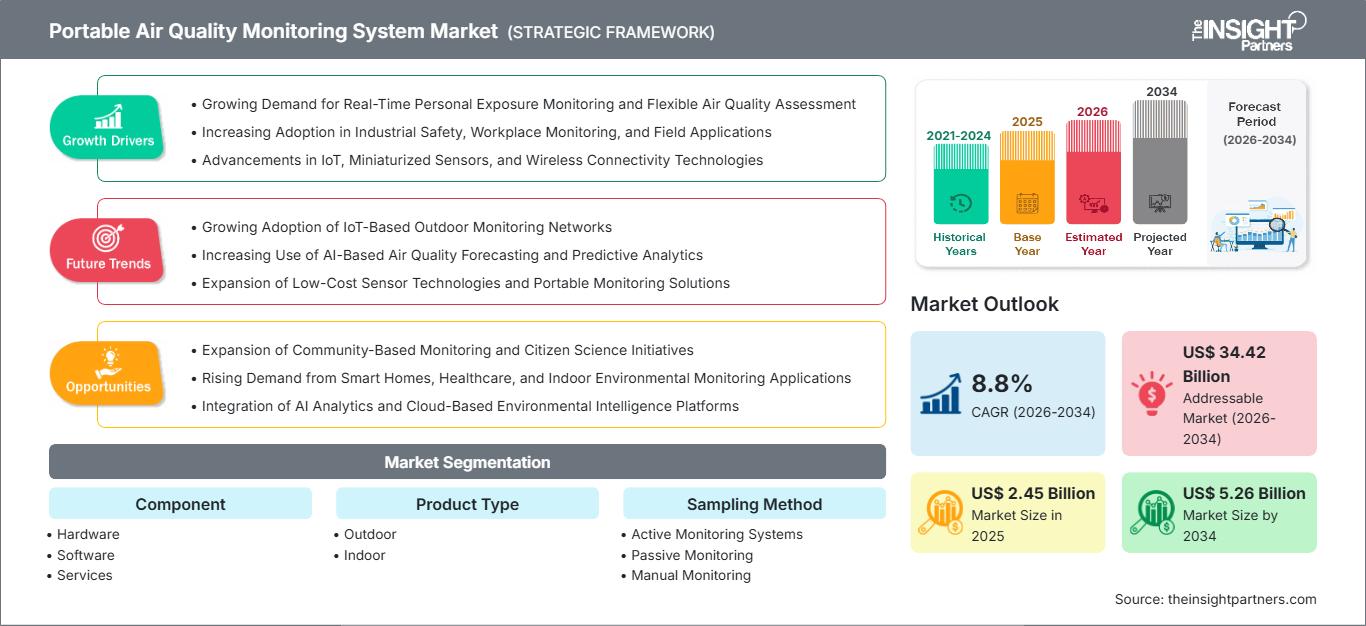
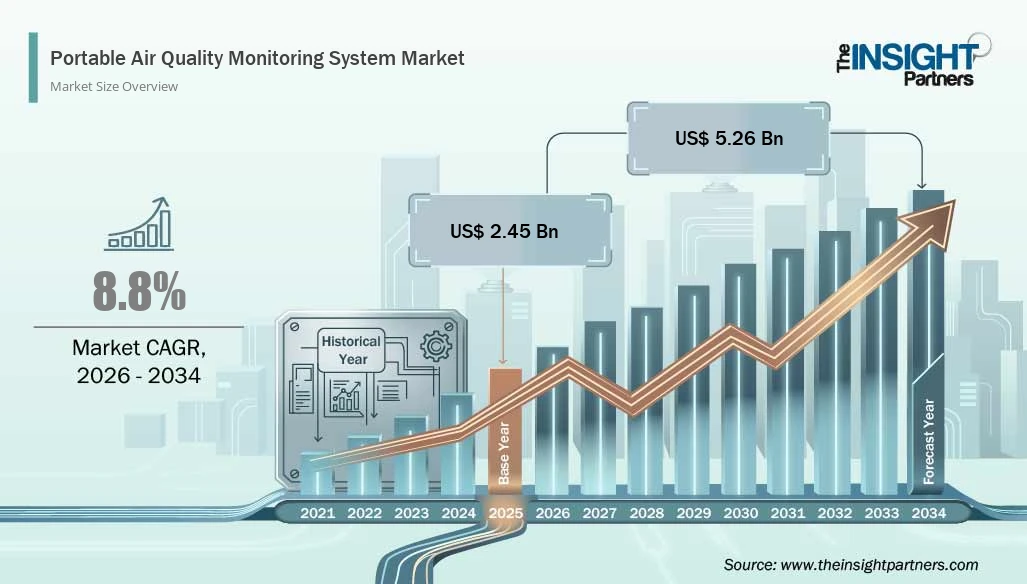
The Portable Air Quality Monitoring System Market was valued at US$ 2.45 billion in 2025 and is projected to reach US$ 5.26 billion by 2034, expanding at a CAGR of 8.8% during 2026–2034. The market reflects rising use of compact pollutant measurement systems across public agencies, industrial sites, smart buildings, homes, and research programs where real-time, location-flexible air quality intelligence is becoming operationally important.
North America remains a high-value adoption center, with an estimated 8.7–9.4% CAGR supported by stricter ambient monitoring requirements, worker exposure management, wildfire smoke tracking, and indoor air quality programs. Portable Air Quality Monitoring System Market size in the region is reinforced by EPA network modernization, industrial compliance spending, and commercial building operators seeking continuous evidence for ventilation, occupant safety, and sustainability reporting.
Portable Air Quality Monitoring System Market Assessment and Insights
- North America held 26–29% share in 2025 and is growing at a CAGR of 8.7–9.4% between 2026–2034, driven by EPA monitoring programs, wildfire risk, industrial hygiene, and smart building adoption.
- US represented 56–61% of North America in 2025 and is growing at a CAGR of 9.2–10.1% between 2026–2034, supported by industrial compliance and community monitoring.
- Europe accounted for 19–22% share in 2025 and is growing at a CAGR of 8.1–8.7% between 2026–2034, led by Germany, the UK, France, Italy, and Spain.
- Asia Pacific captured 21–25% share in 2025 and is growing at a CAGR of 9.4–10.2% between 2026–2034, with China, India, Japan, South Korea, and Australia leading deployment.
- Largest Segment Hardware held 62-69% market share in 2025 and is growing at a CAGR of 8.9-9.3% between 2026–2034.
- High Growth Segment Software held 19–22% market share in 2025 and is growing at a CAGR of 8.2–8.9% between 2026–2034.
- Key companies analyzed in detail: Emerson Electric Co., Thermo Fisher Scientific Inc., Siemens AG, Teledyne Technologies Incorporated, Honeywell International Inc., HORIBA, Ltd., 3M Company, Testo SE & Co. KGaA, Agilent Technologies, Inc., and Aeroqual Limited.
Source: The Insight Partners' analysis based on proprietary research, government publications, company annual reports, investor presentations, industry databases, and expert interviews.
Technological migration is driving the evolution of portable monitors from single parameter devices to connected systems that utilize electrochemical sensors, particulate counters, cloud dashboards, calibration and alerting protocols. Industrial dynamics are trending towards modular sensor heads and robust cases that can be deployed at outside stations, worker exposure assessments, and indoor inspections. The Portable Air Quality Monitoring Systems Market gains as consumers value mobility while maintaining data traceability.
Upcoming trends in the market include citywide monitoring networks, industrial fence line monitoring, and indoor air quality monitoring on the building level. Tailwinds from regulations like the WHO guidelines, US EPA ambient monitoring rules, and new air policies in Europe create a need for scientifically robust data. Investments are growing in the Asia Pacific region due to urbanization, industrialization, and public health initiatives.
Portable Air Quality Monitoring System Market Report Scope
| Report Attribute | Details |
|---|---|
| Market size in 2025 | US$ 2.45 Billion |
| Market Size by 2034 | US$ 5.26 Billion |
| Global CAGR (2026 - 2034) | 8.8% |
| Historical Data | 2021-2024 |
| Forecast period | 2026-2034 |
Portable Air Quality Monitoring System Market Analysis
Demand is growing due to the need to get quick results about the presence of particulates, nitrogen dioxide, ozone, carbon monoxide, volatile organic compounds, and potential work site dangers at a quicker pace for governments, manufacturing facilities, educational institutions, health facilities, and commercial properties. Growth drivers in the Portable Air Quality Monitoring System Market include advancements in affordable sensors, pollution incidents, and the need to confirm ventilation plans, decontamination efforts, construction practices, and emergency response procedures.
The eco-system comprises of sensor suppliers, instrumentation companies, calibration providers, software providers, cloud integration services, and users who have to comply with the laws. The supply side favors companies offering hardware along with calibration and data correction capabilities. While hardware forms the income base of the business model, software and services are adding value through report generation.
Competitive positioning is shaped by precision, sensor range, regulatory acceptance, connectivity, and channel reach. Thermo Fisher Scientific Inc. and HORIBA, Ltd. bring reference-grade environmental monitoring credibility, while Aeroqual Limited specializes in portable and real-time field systems. This Portable Air Quality Monitoring System analysis indicates that suppliers with validated instruments and analytics can defend pricing as buyers demand reliable, audit-ready data.
Investment priorities include miniaturized multi-gas sensing, particulate accuracy in variable humidity, battery performance, cloud dashboards, and remote calibration support. Emerson Electric Co., Siemens AG, Honeywell International Inc., Teledyne Technologies Incorporated, 3M Company, Testo SE & Co. KGaA, and Agilent Technologies, Inc. participate through environmental sensing, industrial safety, analytical measurement, and data-enabled service portfolios that support strategic positioning.
● REPORT CUSTOMIZATION
Tailor This Report To Align With Your Specific Business Requirements
This report can be customized to align precisely with your business objectives, scope, and target markets. Customization options include tailored segmentation, geography, competitive analysis, and strategic insights to support informed decision-making.
Customize This Report →WHAT YOU CAN ADJUST
- ● Segmentations
- ● Geography
- ● Competitive Analysis
- ● Language Preferences
Portable Air Quality Monitoring System Market: Strategic Insights
Regional Insights
North America Portable Air Quality Monitoring System Market
North America held 26–29% share in 2025 and is expected to grow at a CAGR of 8.7–9.4% during 2026–2034. Portable Air Quality Monitoring System Market share is reinforced by EPA ambient monitoring guidance, wildfire smoke events, industrial hygiene audits, and workplace safety programs that require faster field deployment than fixed stations can provide.
Adoption is highest within regional government surveillance departments, oil industry clusters, construction sites, academic institutions, and business real estate holdings. Consumers appreciate the portability of devices that can be transferred from one hotspot to another, are calibrated for credibility among regulators, and linked up to dashboards. The strong service network and regional know-how in environmental monitoring make it attractive for high-end devices and software subscriptions.
U.S. Portable Air Quality Monitoring System Market
The US represented 56–61% of North America in 2025 and is projected to grow at a CAGR of 9.2–10.1% through 2034. Demand is concentrated in environmental agencies, oil and gas facilities, laboratories, remediation sites, schools, and commercial buildings where portable monitors support compliance checks, exposure screening, and incident response.
Thermo Fisher Scientific Inc., Emerson Electric Co., Honeywell International Inc., 3M Company, and Teledyne Technologies Incorporated have visible regional presence across analytical instruments, industrial safety, and monitoring infrastructure. Application trends include wildfire smoke mapping, warehouse ventilation audits, fenceline monitoring, occupational hygiene surveys, and temporary community networks deployed before permanent stations receive funding.
Europe Portable Air Quality Monitoring System Market
Europe accounted for 19–22% share in 2025 and is forecast to grow at a CAGR of 8.1–8.7% through 2034. Germany leads adoption because industrial emissions oversight, automotive testing, and environmental instrumentation capability align with portable monitoring demand. The UK is advancing through urban air zone management and school air quality initiatives.
France benefits from public health monitoring and building ventilation programs, while Italy and Spain add demand through industrial clusters, transport corridors, and municipal air quality projects. EU policy alignment with tighter pollutant limits encourages portable systems for screening, verification, and community engagement. Testo SE & Co. KGaA, Siemens AG, and HORIBA, Ltd. support regional technology depth.
APAC Portable Air Quality Monitoring System Market
APAC held 21–25% share in 2025 and is expected to grow at a CAGR of 9.4–10.2% during 2026–2034. China leads due to industrial monitoring scale, urban pollution control, and domestic sensor manufacturing. India adds demand through the National Clean Air Programme, while Japan and South Korea contribute advanced instrumentation adoption.
Australian mines, construction and wildfire monitoring contribute to the adoption of portable deployments. The increasing number of regional buyers is deploying outdoor air sensors along with indoor monitoring systems for educational institutions, hospitals, and commercial buildings. Increasing pressure from policy makers, industrial growth, and smart city investments fuel the Portable Air Quality Monitoring System market in Asia Pacific.
Middle East & Africa Portable Air Quality Monitoring System Market
Middle East & Africa is projected to grow at a CAGR of 8.5–9.3% during 2026–2034, with Saudi Arabia leading demand through energy, petrochemical, and infrastructure projects. The UAE supports adoption through smart city and indoor air programs, while South Africa requires monitoring for mining, power, and industrial communities.
The rest of the demand for MEA will be linked to construction dust, oil & gas sites, and urban air quality monitoring. The advantage of portable systems is that they lower the capital cost of fixed systems and can cater to temporary needs.
Segmentation Analysis
Component
Component is expected to grow at a CAGR of 8.6–9.3% during 2026–2034. The Portable Air Quality Monitoring System Market scope across components is widening as buyers require instruments, connectivity, dashboards, calibration, and managed reporting together. Hardware remains essential for measurements, but software and services improve usability, quality assurance, and recurring value.
- Hardware dominates revenue because sensors, pumps, batteries, particulate modules, enclosures, and displays carry core measurement value and must withstand outdoor, industrial, and mobile field conditions.
- Software and Services are gaining strategic importance as users need calibration records, data correction, alerts, dashboards, automated reports, and expert support for defensible air quality decisions.
Product Type
Product Type is projected to grow at a CAGR of 8.3–9.0% during 2026–2034. Outdoor products serve ambient monitoring, construction, fenceline, and emergency response applications, while indoor systems address ventilation, occupant health, and building performance. Demand is increasingly linked to systems that can transition between temporary, mobile, and semi-permanent deployments.
- Outdoor systems are used for ambient air surveillance, industrial boundary monitoring, construction dust control, wildfire smoke tracking, and community exposure studies requiring rugged, weather-resistant designs.
- Indoor systems address offices, schools, hospitals, laboratories, homes, and institutions where ventilation, carbon dioxide, particulate matter, and VOC visibility support operational decisions.
Sampling Method
Sampling Method is forecast to grow at a CAGR of 8.4–9.1% during 2026–2034. Active systems lead where real-time measurements and alarms are needed, while passive and manual methods remain relevant for lower-cost screening, verification, and research comparison. Procurement decisions depend on response time, data defensibility, maintenance burden, and monitoring duration.
- Active Monitoring Systems hold strong demand because pumps, powered sensors, and real-time data capture support alerts, field decisions, and regulatory screening across industrial and urban environments.
- Passive Monitoring remains useful for long-duration exposure indication, lower-cost network expansion, and supplementary studies where continuous telemetry is less critical than spatial coverage.
- Manual Monitoring supports reference checks, laboratory validation, and campaign-based sampling where trained personnel collect data for quality-controlled analysis and compliance documentation.
End User Industry
End User Industry is expected to grow at a CAGR of 8.7–9.5% during 2026–2034. Government and regulatory bodies remain core buyers, but industrial sites, commercial buildings, residential users, and research institutions are expanding use cases. The Portable Air Quality Monitoring System Market increasingly serves both compliance and operational risk management.
- Government and Regulatory Bodies use portable systems for hotspot screening, enforcement support, community monitoring, emergency response, and network gap assessment before fixed infrastructure is installed.
- Industrial and Manufacturing Sector relies on monitors for worker exposure, fenceline emissions, process leaks, dust control, and incident investigations across chemicals, energy, mining, and manufacturing facilities.
- Commercial and Institutional Buildings deploy systems in offices, schools, hospitals, universities, airports, and public venues to validate ventilation and respond to occupant health concerns.
- Residential Users adopt compact monitors for particulate matter, carbon dioxide, VOCs, and wildfire smoke awareness, especially in urban homes and health-sensitive households.
- Environmental Research and Academia use portable platforms for field campaigns, sensor validation, exposure studies, and community science programs requiring flexible deployment and data comparability.
Opportunity Snapshot
| End User Industry | Revenue Contribution | Trend Tag | Adoption Stage |
| Government and Regulatory Bodies | High | Urban Networks | Mature |
| Industrial and Manufacturing Sector | High | Fenceline Safety | Scaling |
| Commercial and Institutional Buildings | Medium | Ventilation Proof | Scaling |
| Residential Users | Low | Smoke Awareness | Emerging |
| Environmental Research and Academia | Medium | Field Studies | Mature |
Portable Air Quality Monitoring System Market Growth Drivers and Impact Analysis
Regulatory pressure for faster ambient evidence
The air quality agencies will require additional monitoring flexibility in light of tightening emission levels and increasing public demands for transparency regarding their local air quality data. While fixed monitoring stations are important, they do not always have the capability to measure street-level pollution hot spots, construction effects, smoke dispersion from wildfires, and industrial emergencies. Portable monitoring solutions offer this capability through fast deployments, quick campaigns, and feasibility studies prior to network installations. The actual consequence is that more municipalities, government agencies, and consulting firms have to purchase such equipment for their needs of documenting air quality conditions.
Industrial safety and fenceline monitoring expansion
Industrial buyers are using portable monitoring more frequently to control exposure levels, perimeter areas, maintenance outages, and emergency events. Industrial buyers need chemical plants, refineries, mining operations, distribution centers, and manufacturing sites to have real-time access to information about dusts, gases, vapors, and pollutants associated with combustion processes. Portable instruments increase visibility due to the ability of the safety team to deploy monitoring tools in new locations where exposure could occur. This will increase investment in multi-gas analyzers, particulate detectors, durable enclosures, and software with alarm features. Equipment manufacturers who provide training and calibration services will benefit.
Indoor air quality accountability in buildings
Facility managers of commercial and institutional buildings are shifting from comfort surveys to metrics to prove indoor air quality. Educational institutions, hospitals, offices, labs, and other places require proof of the efficacy of their ventilation, filtration, occupant management, and cleaning systems. Portable devices give practical results since facility managers can assess individual spaces, investigate complaints, and compare zones prior to installation of fixed monitors. The effect on the market is in the expansion of potential buyers beyond environmental agencies and large industries. Increased demand will be seen in convenient monitors, CO2 and VOC detection, particulate tracking, and reporting.
Portable Air Quality Monitoring System Market Future Trends
AI-assisted data validation and sensor correction
Trends in the Portable Air Quality Monitoring Systems market will be towards software to bolster trust in less expensive and more mobile monitoring devices. Algorithms are able to compensate for any sensor drift, humidity issues, calibration errors, and outlier data, by analyzing the performance of the device relative to known information, meteorological conditions, and historical data. The future of this space will be characterized by confidence ratings, automatic flagging, and traceable audit trails that can assist agencies and enterprises in defending their decisions. The industry trend is one that shifts the competitive landscape from hardware capabilities to data accuracy.
Hybrid indoor-outdoor monitoring networks
Future implementations will consist of a combination of portable outdoor air monitors, indoor sensors, fixed stations, weather information, and building management systems into air intelligence systems. Cities may utilize this technology to establish links between neighborhood pollution and the exposure in schools, hospitals, and workplaces, while businesses can contrast site limits with their indoor environments. What follows is better context-driven decision-making when it comes to ventilation, filtration, traffic planning, and response to incidents. This scenario will drive the use of interoperable platforms with an open data interface, secure cloud infrastructure, and a device fleet which can be deployed on a seasonal basis.
Portable Air Quality Monitoring System Market Opportunities
Managed monitoring services for cities and campuses
Municipal governments, university campuses, hospitals, and corporate campuses require air quality information but do not have specialists who can set up a network of monitors, perform routine calibrations, interpret the results, and report the findings. Managed services present a good opportunity for delivering a package that includes hardware, calibration, cloud access, maintenance, and analysis within subscription agreements. Such packages minimize upfront capital outlays and provide the customers with a budget that they can rely on. Providers of such services may also keep connections with the data that could be used to promote renewals, upsells, and expand fleets.
Localized portable platforms for emerging markets
Portable Platforms That Are Credible, Affordable, Serviceable, and Durable In Extreme Environmental Conditions Are Required by Emerging Markets. Mobile monitoring solutions can reduce downtime and provide a viable solution for the implementation of public projects in urban centers where there is a lack of fixed monitoring infrastructure. Moreover, industrial companies will require a solution that is tailored to dusty, hot, humid, and unpredictable environmental conditions with varying degrees of connection. Companies that collaborate with local distributors, laboratories, and environmental consulting firms will grow much faster than those companies selling foreign-made instruments.
Recent Developments
- September 2025: HORIBA Group’s Air Quality Monitor AP-380 Series has received type approvals from certification bodies including the U.S. Environmental Protection Agency (U.S. EPA), the German Federal Environment Agency (UBA) jointly with TÜV Rheinland Energy GmbH (TÜV), CSA Group Testing UK Ltd (CSA Group) on behalf of the UK Environment Agency (EA), South Korea’s National Institute of Environmental Research (NIER), and the State Administration for Market Regulation of the People’s Republic of China (SAMR). These approvals enable the analyzers to be sold to national and local governments, and other organizations, primarily focused on Europe, the Americas, the Middle East, East Asia, and Southeast Asia.
- February 2026: Honeywell (NASDAQ: HON) today announced that it has entered into an amended agreement to acquire Johnson Matthey's Catalyst Technologies business segment, which adjusts the total consideration from £1.8 billion (US$ 2.25 billion) to £1.325 billion (US$ 1.66 billion) and extends the long stop date to July 21, 2026.
- March 2026: Siemens announced its participation in the groundbreaking Advanced Research Projects Agency for Health (ARPA-H) BREATHE program, an up to five-year initiative aimed at improving indoor air quality and reducing respiratory disease incidence by at least 25%. This effort underscores Siemens’ commitment to leveraging technology for healthier, more resilient environments. The BREATHE program intends to advance the next generation of smart and healthy buildings by developing integrated systems that will provide continual measurement and risk assessment of indoor air quality and deploy real-time interventions, like extra ventilation or disinfection, to reduce airborne threats to human health.
Frequently Asked Questions

- Comprehensive Market Sizing and Forecast Analysis
- Detailed Segmentation Analysis
- In-Depth Market Dynamics Assessment
- Regional and Country-Level Insights
- Competitive Landscape and Company Benchmarking
- Strategic Business Intelligence
Recent Reports
Testimonials

The Insight Partners provided valuable market intelligence that supported our global go-to-market strategy. Their team was professional, responsive, and attentive to our feedback, providing thoughtful analysis and helpful methodological clarifications throughout the project.
Junmo Kim Chief Financial Officer (CFO), Enertech Co., Ltd.
The Insight Partners' SCADA System Market report is comprehensive, with valuable insights on current trends and future forecasts. The team was highly professional, responsive, and supportive throughout. We are very satisfied and highly recommend their services.
RAN KEDEM Partner, Reali Technologies LTDs
I requested a report on a very specific software market and the team produced the report in a few days. The information was very relevant and well presented. I then requested some changes and additions to the report. The team was again very responsive and I got the final report in less than a week.
JEAN-HERVE JENN Chairman, Future Analytica
We worked with The Insight Partners for an important market study and forecast. They gave us clear insights into opportunities and risks, which helped shape our plans. Their research was easy to use and based on solid data. It helped us make smart, confident decisions. We highly recommend them.
PIYUSH NAGPAL Sr. Vice President, High Beam Global
The Insight Partners delivered insightful, well-structured market research with strong domain expertise. Their team was professional and responsive throughout. The user-friendly website made accessing industry reports seamless. We highly recommend them for reliable, high-quality research services
YUKIHIKO ADACHI CEO, Deep Blue, LLC.
This is the first time I have purchased a market report from The Insight Partners.While I was unsure at first, I visited their web site and felt more comfortable to take the risk and purchase a market report.I am completely satisfied with the quality of the report and customer service. I had several questions and comments with the initial report, but after a couple of dialogs over email with their analyst I believe I have a report that I can use as input to our strategic planning process.Thank you so much for taking the extra time and making this a positive experience.I will definitely recommend your service to others and you will be my first call when we need further market data.
JOHN SUZUKI President and Chief Executive Officer, Board Director, BK Technologies
I wish to appreciate your support and the professionalism you displayed in the course of attending to my request for information regarding to infectious disease IVD market in Nigeria. I appreciate your patience, your guidance, and the fact that you were willing to offer a discount, which eventually made it possible for us to close a deal. I look forward to engaging The Insight Partners in the future, all thanks to the impression you have created in me as a result of this first encounter.
DR CHIJIOKE ONYIA MANAGING DIRECTOR, PineCrest Healthcare Ltd.Reason to Buy
- Informed Decision-Making
- Understanding Market Dynamics
- Competitive Analysis
- Identifying Emerging Markets
- Customer Insights
- Market Forecasts
- Risk Mitigation
- Boosting Operational Efficiency
- Strategic Planning
- Investment Justification
- Tracking Industry Innovations
- Aligning with Regulatory Trends





 Get Free Sample for