
Outdoor Air Quality Monitoring System Market Trends, Size & Growth by 2034
Coverage: By Component (Hardware, Software, and Services), Deployment Type (Fixed Monitoring Systems, Portable Monitoring System), Sampling Method (Active Monitoring Systems, Passive Monitoring, Manual Monitoring, and Others), End User Industry (Government and Regulatory Bodies, Industrial and Manufacturing Sector, Commercial and Institutional Buildings, Residential Users, and Environmental Research and Academia), and Geography
- Status : Published
- Report Code : TIPRE00043824
- Category : Electronics and Semiconductor
- No. of Pages : 299
- Available Report Formats :


- Last update date : September 02, 2026


2025 Market Size
US$ 5.45 Bn
Base year value
2034 Forecast
US$ 11.05 Bn
Projected by 2034
CAGR 2026-2034
8.2 %
Growth rate
Addressable Market
US$ 74.26 Bn
(2026-2034)
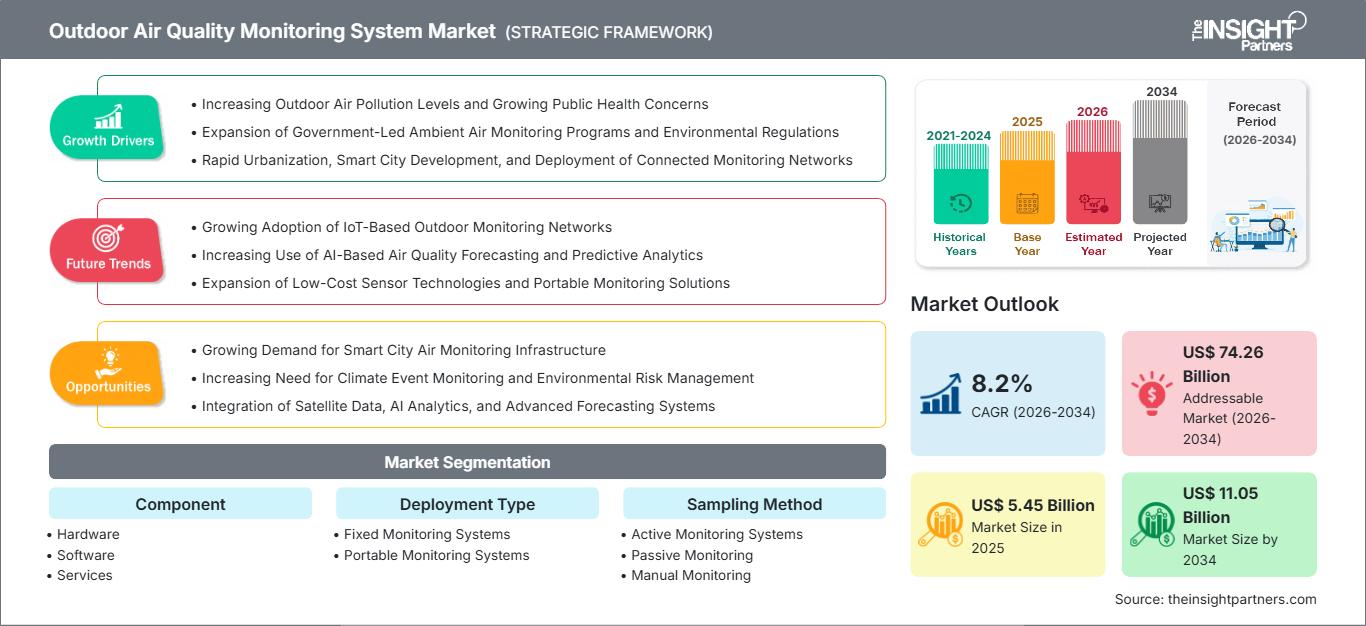
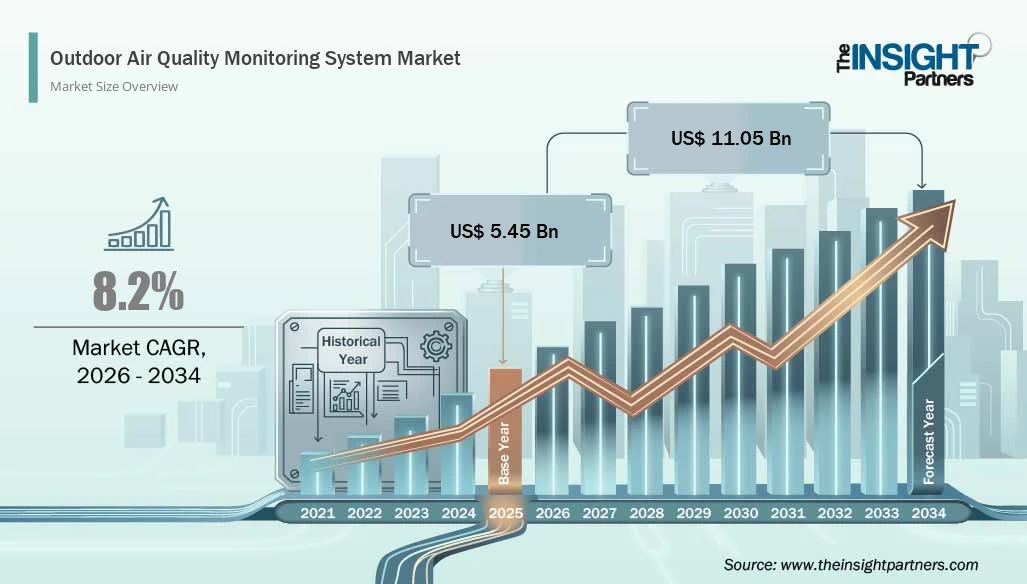
Outdoor Air Quality Monitoring System Market was valued at US$ 5.45 Billion in 2025 and is projected to reach US$ 11.05 Billion by 2034, expanding at a CAGR of 8.2% during 2026–2034. Growth reflects expanding regulatory networks, industrial perimeter surveillance, wildfire and urban pollution response, and demand for continuous particulate and gas measurements across government, commercial, research, and residential applications.
North America is expected to advance at a 7.8–8.4% CAGR through 2034 as federal and state monitoring programs modernize reference stations and supplement them with connected sensor networks. Outdoor Air Quality Monitoring System Market size in the region benefits from stricter emissions accountability, wildfire-smoke surveillance, and funding for community-scale environmental justice projects that require defensible, near-real-time data.
Outdoor Air Quality Monitoring System Market Assessment and Insights
- North America held 26–28% share in 2025 and is growing at a CAGR of 7.8–8.4% between 2026–2034, supported by regulatory modernization, wildfire monitoring, and industrial fenceline programs.
- US represented 59–63% of North America in 2025 and is growing at a CAGR of 7.9–8.5% between 2026–2034, driven by public networks and community monitoring grants.
- Europe accounted for 41–45% share in 2025 and is growing at a CAGR of 7.3–7.9% between 2026–2034, led by Germany, the UK, France, Italy, and Spain.
- Asia Pacific captured 20–22% share in 2025 and is growing at a CAGR of 9.2–9.8% between 2026–2034, with China, India, Japan, South Korea, and Australia advancing deployment.
- Largest Segment Hardware held 69-72% market share in 2025 and is growing at a CAGR of 7.9–8.6% between 2026–2034.
- High Growth Segment Software held 18–22% market share in 2025 and is growing at a CAGR of 7.2-7.6% between 2026–2034.
- Key companies analyzed in detail: Emerson Electric Co., Thermo Fisher Scientific Inc., Siemens AG, Teledyne Technologies Incorporated, Honeywell International Inc., HORIBA, Ltd., 3M Company, Testo SE & Co. KGaA, Agilent Technologies, Inc., and Aeroqual Limited.
Source: The Insight Partners' analysis based on proprietary research, government publications, company annual reports, investor presentations, industry databases, and expert interviews.
Air monitoring systems have moved away from standalone, analysis-driven stations to hybrid architectures, including reference-grade monitors, small optical sensors, telemetry, cloud-based analytics, and automated quality control. The result is that production is shifting to modular systems where there is sharing of enclosures, communication systems, calibration protocols, and data handling capabilities among pollutants. In this regard, the Outdoor Air Quality Monitoring System market is rewarding vendors that strike a balance between regulation-driven precision and reduced costs of installation and operation, while reliable sampling, traceability, and robustness continue to be key purchase factors.
Over 2034, spending will diversify into smaller cities, industry corridors, port facilities, mining sites, construction locations, and areas at risk of wildfires. New regulations, requirements for public disclosures, and climate adaptation planning will provide persistent regulatory headwinds. Faster uptake of these systems in Asia Pacific and selected Middle Eastern cities will offset replacement-driven sales in Europe and North America.
Outdoor Air Quality Monitoring System Market Report Scope
| Report Attribute | Details |
|---|---|
| Market size in 2025 | US$ 5.45 Billion |
| Market Size by 2034 | US$ 11.05 Billion |
| Global CAGR (2026 - 2034) | 8.2% |
| Historical Data | 2021-2024 |
| Forecast period | 2026-2034 |
Outdoor Air Quality Monitoring System Market Analysis
Demand is expanding as regulators and asset operators require continuous evidence of particulate matter, ozone, nitrogen oxides, sulfur dioxide, carbon monoxide, and volatile organic compounds. Outdoor Air Quality Monitoring System Market growth is supported by a global health burden that keeps ambient pollution high on policy agendas. The value chain spans sensing materials, pumps, samplers, analyzers, calibration equipment, enclosures, communications, software, integration, and field maintenance.
Supply factors tend to reward vendors with certified techniques, consistent consumable supply chain, durable electronics and local technical assistance. Reference stations will always be crucial for compliance, but dense secondary networks help with geographic coverage and incident response. Particular components may limit projects due to need to qualify some parts such as pumps, optical modules, and specific detectors, which is why buyers consider life cycle availability, calibration traceability, cybersecurity and interoperability in addition to purchase price.
Outdoor Air Quality Monitoring System Market overview reveals competitive environment consisting of diversified automation companies, laboratory technology suppliers, environmental instruments specialists and network of sensors providers. Thermo Fisher Scientific Inc., Teledyne Technologies Incorporated and HORIBA, Ltd. offer high-end measuring solutions, whereas Aeroqual Limited positions itself via connectivity of nearly-reference systems. Emerson Electric Co., Siemens AG and Honeywell International Inc. provide industrial integration expertise and digital backbone.
Priorities of investment are low power consumption sensors, automated calibration, multi-pollutant modules, edge processing and cloud-based quality control. Portable and occupational measurements adjacent areas are covered by Testo SE & Co. KGaA and 3M Company, while Agilent Technologies, Inc. provides advanced analytical work flows. The competitive strategy is increasingly focused on transforming raw measurements into actionable alerts, attribution of sources, compliance and maintenance activities.
● REPORT CUSTOMIZATION
Tailor This Report To Align With Your Specific Business Requirements
This report can be customized to align precisely with your business objectives, scope, and target markets. Customization options include tailored segmentation, geography, competitive analysis, and strategic insights to support informed decision-making.
Customize This Report →WHAT YOU CAN ADJUST
- ● Segmentations
- ● Geography
- ● Competitive Analysis
- ● Language Preferences
Outdoor Air Quality Monitoring System Market: Strategic Insights
Regional Insights
North America Outdoor Air Quality Monitoring System Market
North America held 26–28% share in 2025 and is projected to expand at a 7.8–8.4% CAGR during 2026–2034. Outdoor Air Quality Monitoring System Market share is sustained by federal, state, provincial, and municipal monitoring networks, industrial permit requirements, wildfire-smoke events, and environmental justice initiatives. Reference analyzers remain central, while compact sensors extend coverage around schools, transport corridors, ports, and disadvantaged communities.
Replacement demand is about analyzer aging, telemetry improvements, automatic calibration, and secure data platforms. Oil & gas, chemical, utility, mining, construction, and logistics companies install perimeter systems to show proof of compliance and solve complaints. In the process of procurement, accuracy is now accompanied by reliability, remote diagnostics, and services for the vendors with regional calibration labs, engineers, and interoperable software.
U.S. Outdoor Air Quality Monitoring System Market Market
The U.S. represented 59–63% of North American revenue in 2025 and is expected to grow at a 7.9–8.5% CAGR through 2034. Federal reference methods, state implementation plans, wildfire surveillance, and community air-monitoring grants sustain demand. Application growth is strongest in PM2.5, ozone, industrial fenceline, transportation-corridor, and construction-dust monitoring, where rapid alerts complement established regulatory stations.
Instruments, Integration, Safety and Service are some of the commercial routes through which Thermo Fisher Scientific Inc., Teledyne Technologies Incorporated, Honeywell International Inc. and 3M Company operate. Cellular communication, automated testing, public dashboards, and integration of weather information are becoming increasingly important. The utilities, refineries, ports, academic institutions, and local agencies prefer systems that can withstand high temperatures, smoke events, humidity, and remote operation, while maintaining logs for audit purposes.
Europe Outdoor Air Quality Monitoring System Market Market
Europe accounted for 41–45% share in 2025 and is forecast to grow at a 7.3–7.9% CAGR through 2034. Germany leads through dense regulatory infrastructure, industrial monitoring, and engineering capacity. The UK combines statutory networks with local authority and research deployments, while investment increasingly targets roadside nitrogen dioxide, particulate matter, ozone, and public data accessibility.
Regional observatories help France achieve urban and industrial monitoring, whereas metropolitan pollution, ports, heat-induced ozone and wildfires constitute priority topics in Italy and Spain. Procurement processes across Europe favor standardized procedures, clear quality assurance and extended lifecycles for the devices used. Competition among suppliers such as Siemens AG, Testo SE & Co. KGaA, and HORIBA, Ltd. is based on technical support and platform connectivity.
APAC Outdoor Air Quality Monitoring System Market Market
APAC held 20–22% share in 2025 and is expected to grow at a 9.2–9.8% CAGR during 2026–2034. China leads deployment through industrial oversight and city networks, while India expands continuous ambient stations and source-focused surveillance.
The Japanese and Korean cities measure urban and industrial pollutants precisely, while the Australian cities invest in wildfire smoke monitoring, mining pollution monitoring, and community monitoring. Industrial expansion, urbanization, and stronger policy enforcement can lead to mixed systems of regulatory monitoring and low-cost sensors in the clouds.
Middle East & Africa Outdoor Air Quality Monitoring System Market Market
MEA is projected to grow at an 8.6–9.2% CAGR through 2034. Saudi Arabia leads regional opportunities through industrial diversification and megaproject monitoring, while the UAE deploys connected systems around cities, transport, construction, and energy assets.
South Africa maintains demand for mining operations, electricity generation, and municipal utilities. Adoption rates for RoMEA continue to be inconsistent but increase in areas where donor-funded initiatives, industrial licenses, and urban construction projects support baseline monitoring. Dust, heat, remoteness of access, and power reliability influence specifications.
Segmentation Analysis
Component
Component is projected to grow at a 8.0–8.6% CAGR during 2026–2034. Hardware anchors regulatory measurement, while software and services support network management, validation, reporting, and lifecycle performance. Outdoor Air Quality Monitoring System Market scope increasingly extends beyond instrument sales as buyers seek integrated deployments with remote diagnostics, calibration planning, cybersecurity, and public-facing visualization.
- Hardware holds the largest position because analyzers, sensors, samplers, pumps, enclosures, calibration units, and meteorological instruments form the physical measurement backbone of regulatory and supplemental networks.
- Software gains strategic importance as agencies and operators require automated quality assurance, alarm management, source visualization, fleet status, cloud storage, cybersecurity controls, and interoperable reporting workflows.
- Services support recurring revenue through site assessment, installation, calibration, preventive maintenance, repairs, data validation, training, and compliance documentation across geographically distributed monitoring assets.
Deployment Type
Deployment Type is expected to advance at a 8.1–8.7% CAGR through 2034. Fixed systems remain essential for long-duration regulatory records, while portable systems address incident response, temporary projects, network audits, and spatial screening. Hybrid procurement allows reference stations to validate flexible sensors, improving coverage without replicating full-station costs at every location.
- Fixed Monitoring Systems dominate compliance applications through stable siting, controlled sampling, continuous operation, certified analyzers, and integration with agency data systems for long-term trend assessment.
- Portable Monitoring Systems gain demand for wildfire response, construction oversight, industrial investigations, research campaigns, and community mapping where rapid relocation and battery operation create operational flexibility.
Sampling Method
Sampling Method is forecast to grow at a 7.8–8.4% CAGR during 2026–2034. Selection depends on pollutant chemistry, averaging period, detection limits, maintenance capacity, and evidentiary requirements. Active monitoring supports continuous measurement, while passive and manual approaches remain valuable for screening, integrated exposure assessment, validation, and locations with limited infrastructure.
- Active Monitoring Systems lead continuous applications by drawing air through controlled pathways for real-time particulate and gas analysis, alarms, data logging, and regulatory reporting.
- Passive Monitoring supports cost-efficient spatial campaigns by collecting pollutants without powered pumps, enabling broad screening and long-term averages before agencies prioritize reference-grade station investments.
- Manual Monitoring remains important for gravimetric sampling, filter analysis, method verification, calibration checks, and targeted campaigns requiring laboratory confirmation or legally defensible chain-of-custody procedures.
End User Industry
End User Industry is projected to expand at an 8.3–8.9% CAGR through 2034. Government agencies remain foundational buyers, but industrial, institutional, residential, and research users are widening the addressable base. Adoption reflects differing needs for compliance, risk communication, operational control, exposure research, and neighborhood-level awareness.
- Government and Regulatory Bodies maintain the largest installed base through national standards, urban networks, enforcement programs, public alerts, source inventories, and long-term epidemiological datasets.
- Industrial and Manufacturing Sector deploys fenceline and perimeter systems to verify permits, investigate complaints, manage emissions events, protect workers, and document community exposure conditions.
- Commercial and Institutional Buildings use outdoor measurements to manage ventilation intake, campus operations, event planning, and occupant communication during smoke, dust, ozone, or traffic episodes.
- Residential Users adopt compact connected monitors for neighborhood awareness, outdoor activity decisions, smart-home integration, and localized smoke or traffic exposure tracking.
- Environmental Research and Academia require calibrated instruments and flexible sensors for source attribution, atmospheric chemistry, exposure modeling, method validation, and dense urban measurement campaigns.
Opportunity Snapshot
| End Users | Revenue Contribution | Trend Tag | Adoption Stage |
| Government and Regulatory Bodies | High | Network Renewal | Mature |
| Industrial and Manufacturing Sector | High | Fenceline Data | Scaling |
| Commercial and Institutional Buildings | Medium | Intake Control | Scaling |
| Residential Users | Low | Local Alerts | Emerging |
| Environmental Research and Academia | Medium | Sensor Validation | Scaling |
Outdoor Air Quality Monitoring System Market Forecasts indicate that government and industrial users offer the strongest near-term monetization because compliance, public reporting, and incident response support multi-year instrument, software, and service contracts. Research deployments accelerate sensor validation, while institutional and residential channels create broader data ecosystems and future subscription opportunities.
Outdoor Air Quality Monitoring System Market Growth Drivers and Impact Analysis
Tighter ambient standards and auditable compliance
The regulatory community is tightening ambient air standards and broadening the range of pollutants necessary for an enforceable plan. There are updated standards databases maintained by the World Health Organization that include 140 nations, while the ambient database contains 8,023 settlements monitored in 127 member states, associates, territories, or regions. These projects will lead to increased need for traceable calibration, reference methods, secure data logging, and maintenance. Agencies need to prove the trends and violations, thus replacing old instrumentation and adding monitoring in underserved locations becomes more necessary. Industrial organizations will need perimeter data due to permits, complaints, or occasional emissions.
Wildfire smoke and extreme-event surveillance
Wildfires, dust storms, ozone from heat, and accidental releases from industry create dynamic pollutant sources that cannot be comprehensively described by sparsely placed monitors. Government bodies are using portable sensors, temporary monitors, and mobile communication capabilities in addition to their permanent facilities in emergencies. Particulate concentrations help determine whether schools close or not, how outdoor work is performed, public alerts and allocations are done, and meteorological support is provided for interpretation of the plume. Such operations require tough, energy-efficient monitors with remote troubleshooting capabilities, automatic validation, and rapid deployment. Vendors have continuous opportunities through rental, calibration, data hosting, and maintenance services.
Dense sensor networks complement reference stations
Affordable optical and electrochemical sensors allow higher density installations along roads, at ports, construction sites, residential areas, and industrial perimeters. The market benefits most from those systems that are used alongside certified analyzers rather than substitute them. Reference stations ensure accuracy, whereas distributed stations detect spatial gradients and temporal hot spots. This strategy increases the quantity of hardware and creates a need for calibration transfers, collocation studies, drift adjustments, fleet management, and cloud-based analysis. While customers face uncertainties, better algorithms and automated quality controls increase the credibility of supplemental networks. Manufacturers who combine sensors, meteorology, communication, and reliable reporting can meet regulatory and operational decision-making needs.
Outdoor Air Quality Monitoring System Market Future Trends
AI-assisted quality assurance and source attribution
Trends in the Outdoor Air Quality Monitoring System market will progressively shift towards automated quality control in an integrated fleet of reference analyzers and miniature sensors. Machine learning algorithms can help with drift detection, inlet blockage recognition, cross-sensitivity recognition, and equipment maintenance based on instrument status, weather data, and adjacent measurements. The next generation systems will go past dashboards to probabilistic source apportionment through the use of wind data, traffic patterns, facility activities, and chemical data. Even as human evaluation will still be important for regulatory compliance purposes, automation will ensure that workloads for analysts will be minimized and response times will be fast.
Interoperable environmental data platforms
Monitoring systems will evolve into nodes for environmental intelligence systems integrating air quality, emission, weather, satellite, health, and asset data. Open interfaces and metadata standards will emerge as must-haves because organizations want to prevent silos in vendor technology. Edge computing will enable continuous monitoring even when communications are not available, while cloud computing will enable alarm handling, validation, disclosure, and maintenance coordination. The integration with digital twins and process control could enable facilities to change processes even before boundary concentrations increase. Business value will be determined by vendors capable of delivering accurate measurements and flexible, contextualized data.
Outdoor Air Quality Monitoring System Market Opportunities
Monitoring expansion in underserved cities
There are large geographic gaps, even as global databases grow. The WHO ambient database recognizes disparities in coverage and methods, leaving room for investment in modular networks in secondary cities and developing nations. Governments, development organizations, universities, and integrators could stage deployments using a small number of reference sites together with sensor fleets. Instrument suppliers need to build finance, training, calibration, and maintenance schemes around local technical capability. Solar energy, cell communication, multilingual software, and robust housings may mitigate operational difficulties. Early platform deployments may set up service agreements to last as standards, inventories, and oversight evolve.
Industrial fenceline monitoring as a managed service
Industrial locations present a scalable potential for monitoring agreements based on outcomes for equipment, installation, calibration, data analysis, alerting, and compliance reporting. Refineries, chemical works, mines, waste operations, port areas, and construction operations require credible data but lack specialist staff. Service providers can combine fixed and portable equipment with meteorological forecasting, source apportionment techniques, and response measures. Outdoor Air Quality Monitoring System Forecast products justify investments in managed services because recurring revenues match vendor motives to availability and data reliability. Collaboration with engineering consulting firms and laboratories will expand geographical coverage, whereas common templates will speed up the process at multi-location customers.
Recent Developments
- March 2026: 3M (NYSE: MMM) announced that it has entered into a definitive agreement to acquire Madison Fire & Rescue, in partnership with Bain Capital. 3M and Bain Capital will establish a new joint venture in which 3M will contribute Scott Safety, receive $700M of cash proceeds upon closing and own 50.1% of the new company, with Bain Capital owning 49.9%. 3M's deep expertise and track record in the safety industry, combined with Bain Capital's capability to integrate businesses, accelerate growth and drive synergies, make this an ideal partnership.
- February 2026: Honeywell (NASDAQ: HON) today announced that it has entered into an amended agreement to acquire Johnson Matthey's Catalyst Technologies business segment, which adjusts the total consideration from £1.8 billion (US$ 2.25 billion) to £1.325 billion (US$ 1.66 billion) and extends the long stop date to July 21, 2026.
- August 2024: Emerson updated the product data sheet for the Rosemount CT4400 Continuous Gas Analyzer, highlighting its hybrid Quantum Cascade Laser (QCL) and Tunable Diode Laser (TDL) technology for continuous emissions monitoring. The analyzer is designed to measure gases including NO, NO2, SO2, CO, CO2, and O2 for environmental and industrial air quality monitoring applications.
Frequently Asked Questions

- Comprehensive Market Sizing and Forecast Analysis
- Detailed Segmentation Analysis
- In-Depth Market Dynamics Assessment
- Regional and Country-Level Insights
- Competitive Landscape and Company Benchmarking
- Strategic Business Intelligence
Recent Reports
Testimonials

The Insight Partners provided valuable market intelligence that supported our global go-to-market strategy. Their team was professional, responsive, and attentive to our feedback, providing thoughtful analysis and helpful methodological clarifications throughout the project.
Junmo Kim Chief Financial Officer (CFO), Enertech Co., Ltd.
The Insight Partners' SCADA System Market report is comprehensive, with valuable insights on current trends and future forecasts. The team was highly professional, responsive, and supportive throughout. We are very satisfied and highly recommend their services.
RAN KEDEM Partner, Reali Technologies LTDs
I requested a report on a very specific software market and the team produced the report in a few days. The information was very relevant and well presented. I then requested some changes and additions to the report. The team was again very responsive and I got the final report in less than a week.
JEAN-HERVE JENN Chairman, Future Analytica
We worked with The Insight Partners for an important market study and forecast. They gave us clear insights into opportunities and risks, which helped shape our plans. Their research was easy to use and based on solid data. It helped us make smart, confident decisions. We highly recommend them.
PIYUSH NAGPAL Sr. Vice President, High Beam Global
The Insight Partners delivered insightful, well-structured market research with strong domain expertise. Their team was professional and responsive throughout. The user-friendly website made accessing industry reports seamless. We highly recommend them for reliable, high-quality research services
YUKIHIKO ADACHI CEO, Deep Blue, LLC.
This is the first time I have purchased a market report from The Insight Partners.While I was unsure at first, I visited their web site and felt more comfortable to take the risk and purchase a market report.I am completely satisfied with the quality of the report and customer service. I had several questions and comments with the initial report, but after a couple of dialogs over email with their analyst I believe I have a report that I can use as input to our strategic planning process.Thank you so much for taking the extra time and making this a positive experience.I will definitely recommend your service to others and you will be my first call when we need further market data.
JOHN SUZUKI President and Chief Executive Officer, Board Director, BK Technologies
I wish to appreciate your support and the professionalism you displayed in the course of attending to my request for information regarding to infectious disease IVD market in Nigeria. I appreciate your patience, your guidance, and the fact that you were willing to offer a discount, which eventually made it possible for us to close a deal. I look forward to engaging The Insight Partners in the future, all thanks to the impression you have created in me as a result of this first encounter.
DR CHIJIOKE ONYIA MANAGING DIRECTOR, PineCrest Healthcare Ltd.Reason to Buy
- Informed Decision-Making
- Understanding Market Dynamics
- Competitive Analysis
- Identifying Emerging Markets
- Customer Insights
- Market Forecasts
- Risk Mitigation
- Boosting Operational Efficiency
- Strategic Planning
- Investment Justification
- Tracking Industry Innovations
- Aligning with Regulatory Trends





 Get Free Sample for