
Blood Component Utilization Market Share, Size & Demand by 2034
Coverage: By Product Type (Plasma, Red Blood Cells, Platelets); Application (Body Contouring, Skin Rejuvenation and Resurfacing, Others), and Geography (North America, Europe, Asia Pacific, and South and Central America)
- Status : Data Released
- Report Code : TIPRE00018768
- Category : Life Sciences
- No. of Pages : 150
- Available Report Formats :


- Last update date : August 17, 2026


2025 Market Size
US$ 14.92 Bn
Base year value
2034 Forecast
US$ 20.84 Bn
Projected by 2034
CAGR 2026-2034
4.26 %
Growth rate
Addressable Market
US$ 166.39 Bn
(2026-2034)
The global Blood Component Utilization Market size is forecasted to rise from US$ 14.92 Billion in 2025 to US$ 20.84 Billion by 2034 at a Compound Annual Growth Rate (CAGR) of 4.26% during the period 2026-2034. The market demonstrates continuous clinical dependence on blood component separation, driven by surgeries, trauma care, oncology, hematology, obstetrics, and transfusion medicine.
North America is predicted to experience relatively advanced growth dynamics, with its CAGR ranging between 3.70–4.20% until 2034. The market size in North America is driven by existing transfusion system and blood bank infrastructure. Increasing focus on patient blood management, restrictive transfusion policies, digital monitoring of blood bank inventories, and specific component matching will drive market demand.
Blood Component Utilization Market Assessment and Insights
- North America: North America is expected to account for a 35–39% Blood Component Utilization Market share in 2025 and expand at a 3.70–4.20% CAGR between 2026–2034, supported by mature transfusion services, hospital networks, patient blood management, and component-specific clinical protocols.
- US: The US is estimated to represent 72–76% of North America in 2025 and grow at a 3.80–4.20% CAGR between 2026–2034, driven by advanced blood banking, trauma care, oncology, and utilization controls.
- Europe: Europe is projected to hold a 27–31% share in 2025 and record a 3.80–4.30% CAGR between 2026–2034, with Germany, the UK, France, Italy, and Spain supported by coordinated transfusion services and stringent quality frameworks.
- Asia Pacific: Asia Pacific is estimated at a 24–28% share in 2025 and is expected to grow at a 5.20–5.80% CAGR between 2026–2034, led by China, Japan, India, South Korea, and Australia as hospital capacity and component processing expand.
- Largest Segment: Red Blood Cells is expected to command a 47–51% market share in 2025 and grow at a 3.80–4.30% CAGR during 2026–2034, reflecting broad clinical utility.
- High Growth Segment: Platelets are projected to represent a 21–25% market share in 2025 and advance at a 5.10–5.70% CAGR during 2026–2034, supported by oncology and complex surgical demand.
- Key companies analyzed in detail: UCLA Medical Center, The Johns Hopkins Hospital, Massachusetts General Hospital, Mayo Clinic, Cleveland Clinic, Brigham and Women’s Hospital, NewYork-Presbyterian Hospital, University of Michigan Hospitals and Health Centers, Indiana University Health, Inc., and UCSF Medical Center.
Source: The Insight Partners' analysis based on proprietary research, government publications, company annual reports, investor presentations, industry databases, and expert interviews.
The market for Blood Components utilization has moved from reliance on whole blood to reliance on component technology. With the development of automation, leukoreduction, apheresis, pathogen reduction techniques, cold chain, and computerization of blood banks, there has been an increase in consistency. Dynamics in production now include the balancing between preparation of components in line with local needs, reduced losses due to expirations, and compatibility. Hospitals increasingly integrate transfusion committees into laboratory and clinical practices in order to improve utilization decisions, while sophisticated blood centers have developed standardized processing and inventory management to optimize availability against shelf life of components.
Future developments will be geared towards improvements in health care in non-traditionally mature markets of blood components utilization. Emerging markets in Asia invest in capacity of blood centers, hospital laboratories, component separation and quality assurance systems while established markets focus on optimization of utilization. Attention paid by regulations to traceability, hemovigilance, protection of donors, and quality of components will prompt investments into monitoring systems. Technological solutions that enable better forecast, decreased wastage, and rapid access to components in case of trauma, oncology, transplantation and surgery are expected to perform well.
Blood Component Utilization Market Report Scope
| Report Attribute | Details |
|---|---|
| Market size in 2025 | US$ 14.92 Billion |
| Market Size by 2034 | US$ 20.84 Billion |
| Global CAGR (2026 - 2034) | 4.26% |
| Historical Data | 2021-2024 |
| Forecast period | 2026-2034 |
Blood Component Utilization Market Analysis
The demand in the Blood Component Utilization Market depends on hospital admissions, surgeries performed, traumas, cancer treatments, transplantation needs, treatment of anemia, and blood-related genetic diseases. It is initiated by recruiting and collecting the blood from donors, then screening, processing, storing, distributing, crossmatching, and finally the administration of the components. This generates various demands at each phase such as proper temperature regulation, labeling, ensuring compatibility, and traceability. The demand chain includes blood banks, hospitals, labs, logistics firms, and departments of transfusion medicine.
The supply side is influenced by the supply of donors, shelf-life of the components, processing capability, seasonality, and imbalance between regions. The red cells demand constant stock rotation, while platelets demand more stringent logistics due to shorter storage time. The plasma has more flexibility if properly frozen. The blood centers have started managing their stocks in collaboration with hospitals’ demands, while the hospitals have been employing patient blood management to minimize unnecessary utilization.
Market Analysis of Blood Component Utilization shows that competitive positioning relies more on clinical integration, transfusion knowledge, reliability of inventory, and research than traditional product differentiation. Academic institutions such as Mayo Clinic, Cleveland Clinic, The Johns Hopkins Hospital, Massachusetts General Hospital, and Brigham and Women’s Hospital play a significant role in evidence-based transfusion medicine. This is supported by their special focus on hematology, oncology, transplant medicine, trauma, and surgery that need a variety of components.
Funding is increasingly focused on blood bank automation, apheresis capability, digital inventory management, traceability, and clinical decision support. Examples of institutions that need such capabilities in the complex environment of care are UCLA Medical Center, NewYork-Presbyterian Hospital, University of Michigan Hospitals and Health Centers, Indiana University Health, Inc., and UCSF Medical Center. Participants in Blood Component Utilization Market can increase competitive positioning through analytics, interoperability, component quality program, and research collaboration for better matching of available inventory with clinical needs.
● REPORT CUSTOMIZATION
Tailor This Report To Align With Your Specific Business Requirements
This report can be customized to align precisely with your business objectives, scope, and target markets. Customization options include tailored segmentation, geography, competitive analysis, and strategic insights to support informed decision-making.
Customize This Report →WHAT YOU CAN ADJUST
- ● Segmentations
- ● Geography
- ● Competitive Analysis
- ● Language Preferences
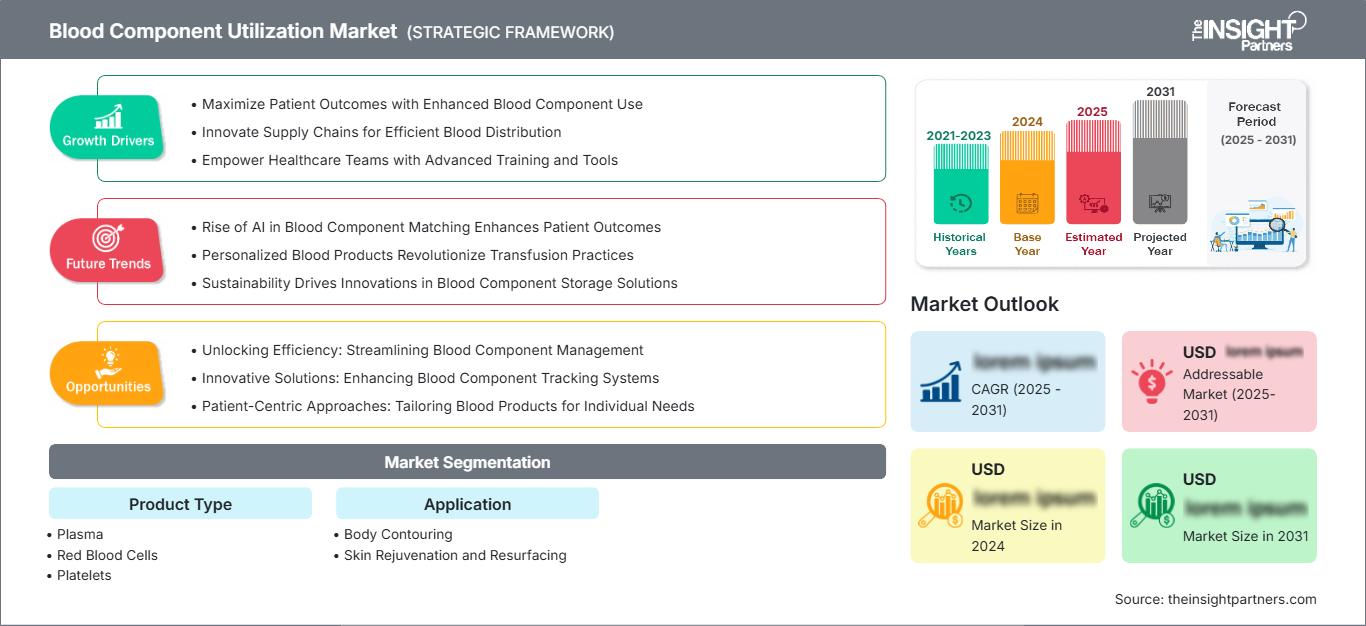
Blood Component Utilization Market: Strategic Insights
Regional Insights
North America Blood Component Utilization Market
North America has been forecast to hold a market share of 35-39% in 2025 and grow at a rate of 3.70-4.20% CAGR through 2034. North America enjoys an advantage due to the presence of well-developed blood donation systems, highly developed hospital laboratories, transfusion medicine divisions, and patient blood management programs. The US is the largest national market, while Canada contributes through its organized blood services and advanced hospitals. The demand is still related to surgery, trauma, oncology, transplant medicine, and hematology.
Structure-based growth is facilitated by improved inventory analytics, component tracking, strict transfusion policies, and more attention paid to reducing wastage. Standardized policies for red cells, plasma, and platelets are being introduced in hospitals, while specialist centers have access to matched and customized components. Regional supply management is becoming more dependent on forecasting and digital coordination in times of seasonal shortages and unexpected increases in emergency use.
U.S. Blood Component Utilization Market Market
The US is projected to represent 72–76% of North America in 2025 and grow at a 3.80–4.20% CAGR through 2034. The market is supported by large academic hospitals, national blood networks, trauma systems, cancer centers, and advanced transfusion laboratories. UCLA Medical Center, The Johns Hopkins Hospital, Mayo Clinic, Cleveland Clinic, and UCSF Medical Center contribute to specialized utilization practices.
Application patterns are increasingly shaped by patient blood management, surgical blood conservation, oncology support, emergency transfusion, and component-specific protocols. Red cells remain central to utilization, while platelet requirements are more concentrated in oncology, transplantation, and complex procedures. Digital inventory tools and hospital transfusion committees are becoming strategically important as providers seek to manage shortages, expiration, compatibility, and procurement costs without reducing clinical readiness.
Europe Blood Component Utilization Market Market
Europe is projected to hold a 27-31% share in 2025 and exhibit a 3.80-4.30% CAGR between 2025 and 2034, with Germany accounting for the most prominent domestic market. National coordination, strict quality standards, and the practice of separating components create an excellent operational base. The emphasis is shifting more toward safety, traceability, donor stewardship, and proper transfusion.
The UK possesses an advanced structure of blood services, with hospitals focusing on standardized transfusion practices, component traceability, and patient blood management. Germany possesses a large number of hospitals in conjunction with blood bank infrastructure and specialized transfusion services. Quality management and hospital level stewardship remains prevalent in France, Italy, and Spain, while clinical organizations become more focused on proper selection of components and reduction of unnecessary transfusions.
APAC Blood Component Utilization Market Market
The APAC region is projected to represent 24-28% of the market in 2025 and grow at 5.20-5.80% CAGR during 2025-2034 with the major demand generated by China. Japan and South Korea benefit from highly developed transfusion services along with hospitals, whereas India and Australia add on account of clinical and blood services development.
The growth of industry, investment in healthcare, increase in tertiary care and focus on blood safety drive adoption. China and India have strong volume potential driven by the growing use of component separation and organized transfusion systems. Japan and Australia prioritize quality, efficiency and traceability, whereas South Korea benefits from the advanced infrastructure of hospitals and laboratories. The regional trend is therefore shaped by access as well as gradual modernization of components.
Middle East & Africa Blood Component Utilization Market Market
Middle East and Africa is projected to grow at a 4.70–5.20% CAGR through 2034, with Saudi Arabia and the UAE representing leading Gulf markets and South Africa anchoring advanced transfusion activity. Hospital modernization and investments in tertiary care are expanding demand for reliable component availability.
Healthcare infrastructure development in Saudi Arabia provides an advantage, whereas for the UAE, there is an improvement in specialized hospital capacity and laboratory services. South Africa has an existing framework for transfusion, whereas other MEA regions have different accessibility and availability of blood products. Energy infrastructure, reliability of transport, cold chain needs, and blood center capacity are some of the factors that determine blood utilization in the region.
Segmentation Analysis
Tube Type
The Product Type structure remains centered on differentiated clinical requirements, storage characteristics, and component-specific therapeutic applications. Red Blood Cells form the largest component category, while plasma provides coagulation support and platelets address hemostatic needs. Blood Component Utilization Market scope within this segment is influenced by surgical volumes, emergency medicine, oncology, and transfusion protocols. The segment is expected to grow at a 3.80–4.30% CAGR during 2026–2034.
- Plasma: Plasma remains strategically important for coagulation-factor replacement, trauma management, liver-related bleeding, and selected critical-care applications, requiring controlled freezing, thawing, compatibility assessment, and rapid availability.
- Red Blood Cells: Red blood cells occupy the largest utilization position because they support anemia treatment, acute blood loss, surgery, trauma, and chronic transfusion requirements across numerous hospital departments.
- Platelets: Platelets serve high-acuity applications involving thrombocytopenia, bleeding, oncology, transplantation, and invasive procedures, making inventory freshness and rapid distribution particularly important.
Application
Application patterns vary considerably according to clinical pathway, patient acuity, and component requirement. Clinical utilization is influenced by procedure volume and institutional protocols, while specialized applications depend on transfusion medicine capacity. Blood Component Utilization Market scope across these applications is also shaped by evolving evidence on appropriate use and patient-specific component selection. The segment is expected to grow at a 4.00–4.60% CAGR during 2026–2034.
- Body Contouring: Utilization is associated with procedural environments requiring careful blood-loss management, perioperative monitoring, and coordinated access to compatible components when substantial bleeding risks are identified.
- Skin Rejuvenation and Resurfacing: This application has a more limited role in conventional transfusion utilization, with demand concentrated in specialized clinical settings and procedures where blood-derived materials or component-related techniques intersect with tissue-management workflows.
Opportunity Snapshot
| Segment Name | Revenue Contribution | Trend Tag | Adoption Stage |
| Hospitals | High | Patient Blood | Mature |
| Diagnostic Laboratories | Medium | Component Testing | Scaling |
| Blood Banks | High | Inventory Analytics | Mature |
Blood Component Utilization Market Growth Drivers and Impact Analysis
Expansion of Patient Blood Management Programs
The patient blood management approach is revolutionizing the way hospitals assess their component requests based on the connection between blood transfusion, diagnosis of anemia, blood conservation, surgical procedures, and critical limits. This can help reduce unnecessary exposure while still allowing those with true needs to have access. The significance of this market influence is high because hospitals are becoming more focused on assessing not just the cost of procurement but also the quality of utilization of components. In response to this, blood centers will have to become more accurate with their forecasting instead of simply increasing supply. Academic hospitals play an important role in developing the protocols that later spread into community settings. As health systems implement transfusion committees and monitor utilization of components per department, there will be a need for more data-driven utilization of components.
Growth in Complex Surgical and Oncology Care
Increasingly complex surgical procedures, cancer therapies, transplantation, trauma interventions, and hematology services create differentiated requirements for red cells, plasma, and platelets. These clinical pathways often require rapid access to specific components, particularly when bleeding risks are unpredictable or patients have compromised hematopoiesis. The resulting impact extends beyond volume because hospitals must maintain readiness for specialized components, crossmatching, and modified products. Oncology centers can generate recurring platelet demand, while major surgery and trauma services may require coordinated red-cell and plasma availability. As tertiary-care networks expand, component utilization becomes more geographically distributed across specialized facilities. Blood centers consequently need flexible logistics, reliable cold-chain systems, and demand visibility. This structural shift supports investment in processing, storage, transportation, and hospital coordination while encouraging institutions to strengthen contingency planning for high-acuity events.
Improved Blood-System Infrastructure in Emerging Economies
Modernization of blood systems in emerging economies can expand utilization by increasing donor collection, component separation, laboratory screening, and hospital access. WHO guidance continues to emphasize coordinated national blood systems, quality management, and reliable access to safe blood products. The commercial impact is strongest where hospitals transition from whole-blood dependence toward standardized component therapy. Investment in centralized processing, refrigeration, laboratory automation, and distribution networks can improve availability while reducing inconsistencies between facilities. China and India provide particularly important growth contexts because large populations, expanding tertiary-care infrastructure, and rising medical capacity create substantial requirements for reliable blood components. However, expansion depends on workforce training, regulatory enforcement, financing, and transportation. Suppliers and healthcare institutions that support integrated blood-center development can therefore address infrastructure gaps while establishing scalable operational models.
Blood Component Utilization Market Future Trends
Digital Forecasting and Component-Level Inventory Optimization
Digital forecasting is likely to become a defining feature of Blood Component Utilization Market trends as hospitals connect laboratory systems, blood banks, electronic health records, and supply platforms. Advanced analytics can identify seasonal demand, procedure schedules, expiration risk, and component-specific consumption patterns before shortages emerge. Machine-learning models may increasingly support procurement and allocation decisions without replacing clinical judgment. Interoperable dashboards could allow hospital networks to view inventories across multiple facilities, improving redistribution and reducing avoidable disposal. For platelets, where storage limitations create particularly strong operational pressure, predictive tools may help prioritize allocation and delivery. Over time, these capabilities should shift inventory management from reactive replenishment toward coordinated demand planning. The resulting operating model is likely to emphasize transparency, traceability, rapid alerts, and measurable utilization performance across the transfusion ecosystem.
Extended Component Availability and Specialized Processing
Future development is likely to prioritize technologies that increase component flexibility without compromising safety or clinical effectiveness. Research into platelet preservation, pathogen reduction, improved storage conditions, and specialized processing could gradually address the limitations imposed by short shelf lives. Blood Component Utilization Market trends may therefore increasingly include components designed for difficult logistics, emergency response, and remote healthcare environments. Such advances could reduce dependence on immediate donor-to-patient timing, particularly in trauma systems and geographically dispersed hospitals. However, adoption will depend on regulatory authorization, clinical evidence, manufacturing economics, and compatibility with existing blood-bank workflows. Institutions are likely to evaluate new technologies according to total system value rather than shelf-life alone. Products that demonstrate reliable performance while lowering wastage, transportation pressure, or emergency procurement requirements should have the strongest strategic relevance.
Blood Component Utilization Market Opportunities
Integrated Regional Blood Inventory Platforms
Regional inventory platforms present an actionable opportunity to connect blood centers, hospitals, laboratories, and emergency services through shared visibility. Investment in interoperable systems could allow participating facilities to identify excess inventory, forecast shortages, and coordinate component transfers before products approach expiration. Blood Component Utilization Market Forecasts should increasingly account for the value created by network-level optimization rather than evaluating hospitals as isolated purchasing entities. Providers with established transfusion infrastructure can serve as anchor institutions for regional platforms, while technology partners can supply analytics, alerts, and traceability functionality. The strongest opportunity lies in markets where multiple hospitals operate within interconnected health systems but maintain fragmented inventory information. A scalable platform could improve resilience during disasters, seasonal disruptions, and major trauma events while supporting better utilization metrics and reducing avoidable component disposal.
Specialized Components for High-Acuity Care
Specialized components for oncology, transplantation, trauma, neonatal care, and immunocompromised patients offer another investment opportunity because these populations often require differentiated transfusion support. Providers can develop services around leukoreduced, irradiated, matched, or otherwise modified components where clinically appropriate. Blood Component Utilization Market Forecasts should recognize that value growth may arise from higher clinical specialization rather than simply greater unit volumes. Hospitals with advanced hematology and transplant programs can become reference centers for complex component management, while blood services can establish dedicated logistics and procurement arrangements. Commercial opportunities also extend to software that tracks patient requirements, component modifications, compatibility, and future demand. Successful strategies will require close alignment with transfusion specialists, laboratory teams, regulators, and hospital procurement groups, ensuring that specialized offerings address documented clinical requirements and operational constraints.
Recent Developments
- July 2026: AABB reported moderate platelet demand with national availability meeting known requirements within 24 hours, while Rh-negative and O-positive red-cell inventories remained under pressure. The update illustrates continuing volatility in component availability and the importance of real-time inventory monitoring for hospitals and blood centers.
- April 2026: UCSF Medical Center Researchers reported preclinical findings for a freeze-dried platelet-derived product designed to remain stable for substantially longer than conventional platelets. The work highlights ongoing efforts to develop deployable blood products for trauma and remote emergency settings where conventional platelet storage and transportation can constrain availability.
- March 2026: Massachusetts General Hospital Investigators at Mass General Brigham reported findings indicating that red blood cell exchange transfusion may benefit patients hospitalized with severe babesiosis. The study, published in JAMA Internal Medicine, reinforces the role of specialized red-cell utilization strategies in complex infectious disease management.
Frequently Asked Questions

- Comprehensive Market Sizing and Forecast Analysis
- Detailed Segmentation Analysis
- In-Depth Market Dynamics Assessment
- Regional and Country-Level Insights
- Competitive Landscape and Company Benchmarking
- Strategic Business Intelligence
Recent Reports
Testimonials

The Insight Partners' SCADA System Market report is comprehensive, with valuable insights on current trends and future forecasts. The team was highly professional, responsive, and supportive throughout. We are very satisfied and highly recommend their services.
RAN KEDEM Partner, Reali Technologies LTDs
I requested a report on a very specific software market and the team produced the report in a few days. The information was very relevant and well presented. I then requested some changes and additions to the report. The team was again very responsive and I got the final report in less than a week.
JEAN-HERVE JENN Chairman, Future Analytica
We worked with The Insight Partners for an important market study and forecast. They gave us clear insights into opportunities and risks, which helped shape our plans. Their research was easy to use and based on solid data. It helped us make smart, confident decisions. We highly recommend them.
PIYUSH NAGPAL Sr. Vice President, High Beam Global
The Insight Partners delivered insightful, well-structured market research with strong domain expertise. Their team was professional and responsive throughout. The user-friendly website made accessing industry reports seamless. We highly recommend them for reliable, high-quality research services
YUKIHIKO ADACHI CEO, Deep Blue, LLC.
This is the first time I have purchased a market report from The Insight Partners.While I was unsure at first, I visited their web site and felt more comfortable to take the risk and purchase a market report.I am completely satisfied with the quality of the report and customer service. I had several questions and comments with the initial report, but after a couple of dialogs over email with their analyst I believe I have a report that I can use as input to our strategic planning process.Thank you so much for taking the extra time and making this a positive experience.I will definitely recommend your service to others and you will be my first call when we need further market data.
JOHN SUZUKI President and Chief Executive Officer, Board Director, BK Technologies
I wish to appreciate your support and the professionalism you displayed in the course of attending to my request for information regarding to infectious disease IVD market in Nigeria. I appreciate your patience, your guidance, and the fact that you were willing to offer a discount, which eventually made it possible for us to close a deal. I look forward to engaging The Insight Partners in the future, all thanks to the impression you have created in me as a result of this first encounter.
DR CHIJIOKE ONYIA MANAGING DIRECTOR, PineCrest Healthcare Ltd.Reason to Buy
- Informed Decision-Making
- Understanding Market Dynamics
- Competitive Analysis
- Identifying Emerging Markets
- Customer Insights
- Market Forecasts
- Risk Mitigation
- Boosting Operational Efficiency
- Strategic Planning
- Investment Justification
- Tracking Industry Innovations
- Aligning with Regulatory Trends





 Get Free Sample for