
Cancer Cachexia Market Trends, Size & Forecast by 2034
Coverage: By Therapeutics (Progestogens, Corticosteroids, Combination Therapies, Others); Mechanism of Action (Appetite Stimulators, Weight Loss Stabilizers, Others); Distribution Channel (Hospital Stores, Retail Pharmacy Store, Online Pharmacy) , and Geography (North America, Europe, Asia Pacific, and South and Central America)
- Status : Data Released
- Report Code : TIPRE00005209
- Category : Life Sciences
- No. of Pages : 156
- Available Report Formats :


- Last update date : August 12, 2026


2025 Market Size
US$ 2.80 Bn
Base year value
2034 Forecast
US$ 4.15 Bn
Projected by 2034
CAGR 2026-2034
4.49 %
Growth rate
Addressable Market
US$ 31.59 Bn
(2026-2034)
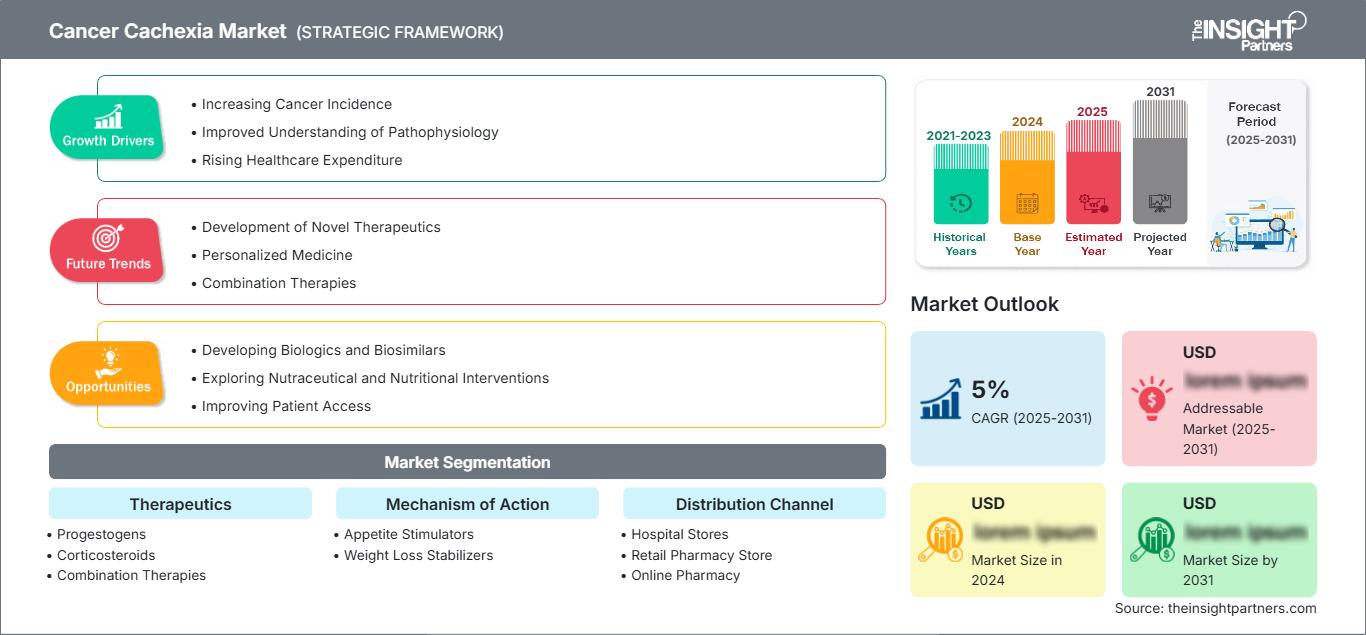
The Cancer Cachexia Market was valued at US$ 2.80 Billion in 2025 and is projected to reach US$ 4.15 Billion by 2034, expanding at a CAGR of 4.49% during 2026–2034. Growth reflects rising clinical recognition of cancer-associated wasting, expanding supportive oncology protocols, and stronger use of pharmacologic appetite and weight-stabilizing therapies across advanced cancer care pathways.
In North America, structured oncology care, reimbursement access, and supportive-care guideline integration continue to shape Cancer Cachexia Market size expansion. The region is estimated to grow at a CAGR range of 4.2–4.7% during 2026–2034, supported by high advanced-cancer treatment volumes, established hospital pharmacy networks, and increasing trial activity around GDF-15-targeted and multimodal interventions. ASCO guidance recognizes progesterone analogs and short-term corticosteroids as pharmacologic options when appetite or weight support is pursued.
Cancer Cachexia Market Assessment and Insights
- North America held a 38–41% share in 2025 and is projected to grow at a CAGR range of 4.2–4.7% during 2026–2034, driven by supportive oncology adoption, specialist access, and active clinical development.
- US represented 81–84% of North America in 2025 and is projected to grow at a CAGR range of 4.3–4.8% during 2026–2034, supported by trial density and oncology pharmacy infrastructure.
- Europe accounted for 27–30% share in 2025 and is projected to grow at a CAGR range of 4.0–4.5% during 2026–2034, led by Germany, the UK, France, Italy, and Spain.
- Asia Pacific held 21–24% share in 2025 and is projected to grow at a CAGR range of 5.0–5.7% during 2026–2034, with Japan, China, South Korea, India, and Australia advancing clinical uptake.
- Largest Segment Progestogens accounted for 36–39% market share in 2025, growing at a CAGR range of 3.7–4.2% during 2026–2034 due to established appetite and weight-gain use.
- High Growth Segment Combination Therapies held 18–21% market share in 2025, growing at a CAGR range of 5.4–6.1% during 2026–2034 as multimodal care becomes more common.
- Key companies analyzed in detail: Alder BioPharmaceuticals, Inc. (a Lundbeck company), Aphios Corporation, Bristol Myers Squibb Company, Eli Lilly and Company, GTx, Inc. (Oncternal Therapeutics legacy), Helsinn Healthcare SA, Merck & Co., Inc., Novartis AG, XBiotech Inc., Pfizer Inc., CatalYm GmbH, Endevica Bio, Inc.
Source: The Insight Partners' analysis based on proprietary research, government publications, company annual reports, investor presentations, industry databases, and expert interviews.
Clinical practice is changing from regarding cachexia as inevitable and an end-stage problem to screening for cachexia, symptom management, and supportive oncology. Development continues to focus on existing generics steroids and progestogens, whereas innovation is trending towards biologicals, neuroendocrinology, and biomarker-based clinical trials. ESMO defines cancer cachexia as an under-diagnosed multifactorial disease that requires multidimensional treatment involving nutrition, pharmacological therapy, and supportive care.
In terms of future development, investments are projected to be primarily located in the US, Japan, Germany, China, and selected Gulf oncology centers where cancer centers are growing. Regulatory headwinds are strong where body weight, appetite, muscle mass, and function are incorporated as endpoint in the trials. The BMJ reported that cancers of the pancreas, hepatobiliary tract, and oesophago-gastric area have a high percentage of patients with cachexia.
Cancer Cachexia Market Report Scope
| Report Attribute | Details |
|---|---|
| Market size in 2025 | US$ 2.80 Billion |
| Market Size by 2034 | US$ 4.15 Billion |
| Global CAGR (2026 - 2034) | 4.49% |
| Historical Data | 2021-2024 |
| Forecast period | 2026-2034 |
Cancer Cachexia Market Analysis
Market Development of Cancer Cachexia is influenced by the rising number of cases of advanced solid cancer, nutrition oncology programs, and understanding the impact of wasting in poor tolerance of treatment. As per a systematic review study conducted in 2024, the overall prevalence of cachexia was reported at 33.0%, ranging from 13.9% to 56.5%.
In the value chain are the oncologists, palliative care physicians, hospital pharmacies, retail distribution channels, online pharmacies, and the producers of appetite stimulants or weight stabilizers. The supply of corticosteroids and progestins is assured as these medicines utilize well-established manufacturing processes. In the case of the pipeline, however, the requirement for biologic manufacturing, biomarker testing, trial site coordination, and proof of improved functionality through weight gain is necessary.
Competitive positioning in the Cancer Cachexia Market Report becomes more pronounced as the focus of the market shifts from just stimulating appetite to targeting mechanisms. Helsinn Healthcare SA will be maintaining educational positioning for its cachexia. On the other hand, Pfizer Inc. and CatalYm GmbH will be pursuing pipeline GDF-15 antibodies. The melanocortin pathway targeting will be the strategy used by Endevica Bio, Inc., while Merck & Co., Inc., Novartis AG, Bristol Myers Squibb Company, Eli Lilly and Company, and XBiotech Inc. will remain relevant due to oncology.
Investments are being made in endpoints that can be understood by regulators and oncologists, such as changes in weight, appetite scores, skeletal muscle index, physical activity, and tolerance during chemotherapy. Pfizer indicated that ponsegromab led to an average body weight gain of 5.61% at 400 mg for 12 weeks in a Phase 2 study involving 187 patients.
● REPORT CUSTOMIZATION
Tailor This Report To Align With Your Specific Business Requirements
This report can be customized to align precisely with your business objectives, scope, and target markets. Customization options include tailored segmentation, geography, competitive analysis, and strategic insights to support informed decision-making.
Customize This Report →WHAT YOU CAN ADJUST
- ● Segmentations
- ● Geography
- ● Competitive Analysis
- ● Language Preferences
Cancer Cachexia Market: Strategic Insights
Regional Insights
North America Cancer Cachexia Market
North America held 38–41% Cancer Cachexia Market share in 2025 and is forecast to expand at a CAGR range of 4.2–4.7% during 2026–2034. The region benefits from advanced oncology centers, early supportive-care screening, and a high concentration of interventional trials. ClinicalTrials.gov records Pfizer’s PROACC-1 ponsegromab study as completed, with 187 enrolled participants and study completion in April 2025.
The demand depends on hospital-based cancer care management programs particularly where malnutrition could disrupt the course of chemotherapy in patients with pancreatic, colorectal, lung, or upper GI cancers. Online pharmacy has been gaining popularity for the purchase of supportive drugs, although hospital pharmacies will always be crucial when it comes to prescriptions for oncological purposes. The region's expansion is also related to payer focus on proven dose reductions and better patient outcomes.
U.S. Cancer Cachexia Market
The U.S. accounted for 81–84% of North America in 2025 and is expected to grow at a CAGR range of 4.3–4.8% during 2026–2034. Its leadership reflects major academic oncology networks, broad oncology-drug reimbursement, and concentration of sponsors such as Pfizer Inc., Endevica Bio, Inc., Merck & Co., Inc., and Bristol Myers Squibb Company.
These application models include pharmacologic therapy alongside nutrition counseling, symptom management, and assessment of chemotherapy tolerance. The FDA approved pharmacologic therapy gap is significant since, according to ASCO, there has been inadequate evidence to support the recommendation of pharmacologic therapy, although the use of progesterone analogs and corticosteroids was acceptable on a selective basis.
Europe Cancer Cachexia Market
Europe constituted 27–30% market share in 2025 and is forecasted to record a CAGR of 4.0–4.5% in 2026–2034, with Germany being the dominant country. In the UK, early referrals of palliative care and nutrition assessment have become essential practices. On the other hand, the oncology centers in Germany together with the access to the supportive care team makes this country an attractive choice for adoption.
France, Italy, and Spain are contributing significantly by means of the volumes of GI, lung, and pancreatic cancer treatments. The adoption rate will be influenced by hospital formularies, reimbursement restrictions on a national level, and physicians' preferences towards medicines that can demonstrate some sort of functional improvement. The European growth will be slow due to the limited number of approved DMARDs; however, biologics targeting biomarkers will increase adoption rates if proved effective in the late-stage trials.
APAC Cancer Cachexia Market
The APAC region held a share of 21%–24% in 2025 and is expected to grow at a CAGR of 5.0%–5.7% during 2026–2034, with Japan being the major market in this region. Japan’s cachexia-based treatment expertise, South Korea’s oncology infrastructure, and Australia’s clinical trials network will aid product adoption.
China and India hold huge future potential due to rising advanced detection and treatment programs for cancer patients. Hospital pharmacy continues to be the key mode of distribution, but the growth of online pharmacies will help in increasing the availability of supportive care products.
Middle East & Africa Cancer Cachexia Market
Middle East & Africa is expected to grow at a CAGR range of 3.6–4.1% during 2026–2034, led by Saudi Arabia. The UAE is investing in oncology infrastructure, while South Africa remains the most developed sub-Saharan access point for cancer-supportive therapeutics.
Growth will be inconsistent since nutrition-oncology specialist services and availability of biologics are still centered in tertiary urban centers. Investment by the energy sector into health care in the Gulf market region is helping in establishing state-of-the-art cancer treatment centers; however, cost and late diagnoses will limit the use of these facilities. Other demands in MEA will depend on corticosteroids, progestogens, and hospitals.
Segmentation Analysis
Therapeutics
Therapeutics are projected to grow at a CAGR range of 4.1–4.7% during 2026–2034 as prescribing remains centered on appetite improvement, weight stabilization, and symptom relief. The Cancer Cachexia Market scope within therapeutics is broadening from established generic agents toward biologics and combination approaches that address inflammation, appetite, muscle wasting, and chemotherapy tolerance in coordinated care models.
- Progestogens remain the largest therapeutic class because physicians recognize their appetite and body-weight effects, especially in advanced cancer patients requiring pragmatic supportive-care intervention.
- Corticosteroids are used for short-term appetite improvement and well-being support, but safety concerns limit prolonged use in frail oncology populations with infection or metabolic risks.
- Combination Therapies are gaining strategic relevance as clinicians integrate nutrition, exercise guidance, anti-inflammatory approaches, and investigational agents to address multifactorial wasting.
Mechanism of Action
Mechanism of Action is projected to grow at a CAGR range of 4.4–5.0% during 2026–2034 as development moves from nonspecific symptom relief toward defined biological pathways. Appetite signaling, GDF-15 biology, melanocortin modulation, inflammatory cytokines, and anabolic-catabolic balance are becoming important differentiators for clinical trial design and future product positioning.
- Appetite Stimulators hold a strong position because anorexia is visible to clinicians and caregivers, making appetite improvement a practical outcome in routine oncology care.
- Weight Loss Stabilizers are strategically important because preserving body weight, muscle index, and functional capacity may improve chemotherapy tolerance and patient-reported outcomes.
Distribution Channel
Distribution Channel is projected to grow at a CAGR range of 4.0–4.6% during 2026–2034. Hospital stores dominate high-acuity oncology prescribing, while retail and online pharmacy channels support continuity after discharge. Distribution strategy is increasingly tied to patient monitoring, refill adherence, and safe use of supportive medications in advanced cancer populations.
- Hospital Stores lead because cachexia treatment is usually initiated by oncologists, palliative-care physicians, or supportive-care teams within cancer centers.
- Retail Pharmacy Store channels support maintenance prescriptions, caregiver access, and continuity for patients receiving outpatient chemotherapy or palliative symptom control.
- Online Pharmacy is expanding where e-prescribing, home delivery, and chronic supportive-care refill needs align with mobility limitations among advanced cancer patients.
Opportunity Snapshot
| Therapeutics | Revenue Contribution | Trend Tag | Adoption Stage |
| Progestogens | High | Appetite Gain | Mature |
| Corticosteroids | Medium | Short Course | Mature |
| Combination Therapies | Medium | Multimodal Care | Scaling |
Cancer Cachexia Market Growth Drivers and Impact Analysis
Rising Advanced Cancer Burden and Earlier Cachexia Screening
The expanding advanced-cancer treatment population is increasing the number of patients who require cachexia assessment before functional decline becomes irreversible. Systematic review evidence shows cachexia prevalence can vary widely by diagnostic criteria, reinforcing the need for standardized screening at oncology visits. Earlier identification supports timely appetite intervention, nutrition counseling, and medication selection before severe muscle loss limits chemotherapy tolerance. For manufacturers, this widens the treatable population beyond late palliative care and increases demand for therapies that can demonstrate measurable benefit in weight, appetite, body composition, and activity. For providers, the impact is operational because screening creates referral pathways linking oncologists, dietitians, pharmacists, and palliative-care teams.
Expansion of Mechanism-Based Clinical Pipelines
Pipeline momentum is reshaping expectations for the Market because targeted candidates are testing whether tumor-host signaling can be modified rather than only managed symptomatically. GDF-15 blockade is especially influential after Pfizer reported statistically meaningful weight increases in its Phase 2 ponsegromab study and CatalYm advanced visugromab into a Phase 2/3 trial in 2026. These programs are raising the evidence bar for future entrants by linking appetite, body weight, muscle metrics, and functional outcomes. The commercial impact is significant because successful pivotal data could shift prescribing toward biomarker-defined, premium therapies while retaining established generics for broad supportive use.
Integration of Supportive Oncology into Treatment Continuity
Cancer centers increasingly recognize that nutritional decline, fatigue, and weight loss can disrupt chemotherapy schedules, limit dose intensity, and reduce quality of life. Merck Manual describes cachexia as associated with reduced chemotherapy response, poor functional performance, and higher mortality, giving clinicians a practical rationale for intervention. This driver supports hospital-led demand because supportive regimens are usually coordinated alongside chemotherapy, antiemetics, pain control, and palliative-care planning. The market impact is stronger formulary attention to therapies that are easy to prescribe, monitor, and combine with cancer treatment. It also creates room for therapy bundles that combine drug treatment with nutrition and physical-function monitoring.
Cancer Cachexia Market Future Trends
Biomarker-Guided Cachexia Intervention
Cancer Cachexia Market trends are expected to move toward biomarker-guided patient selection, particularly where elevated GDF-15 or inflammatory markers help identify individuals most likely to benefit from targeted agents. Trials using defined biomarkers may reduce clinical heterogeneity, improve response measurement, and support stronger reimbursement arguments. This approach also aligns with oncology’s broader precision-medicine infrastructure, where molecular testing, imaging, and longitudinal monitoring already guide treatment decisions. Over time, biomarker-guided cachexia intervention could create distinct therapy tiers: low-cost symptom control for broad use, multimodal care for complex patients, and targeted biologics for validated high-risk populations.
Digital Monitoring of Weight, Activity, and Function
Remote monitoring is likely to become more important as cachexia care shifts from episodic weight checks toward continuous assessment of activity, appetite, fatigue, and muscle-related function. Trial designs already include patient questionnaires, actigraphy, body-composition measures, and longitudinal safety monitoring, creating a foundation for real-world digital follow-up. This trend may improve adherence and earlier therapy adjustment, especially for patients receiving outpatient chemotherapy. For companies, digital endpoints can strengthen evidence packages by showing whether body-weight preservation translates into daily function, reduced caregiver burden, and more stable treatment participation across advanced cancer pathways.
Cancer Cachexia Market Opportunities
Late-Stage Pipeline Commercialization and Specialty Launch Readiness
Cancer Cachexia Market Forecasts indicate an opportunity for companies to prepare specialty launch models around targeted therapies that demonstrate weight, appetite, and functional benefits. Commercial readiness should focus on oncology-center education, biomarker workflow, payer evidence, and integration with supportive-care teams. Sponsors can differentiate by proving that treatment improves outcomes meaningful to oncologists, such as chemotherapy continuation, patient activity, and fewer cachexia-related interruptions. If pivotal programs succeed, manufacturers will need clear positioning against low-cost progestogens and corticosteroids, making health-economic evidence and patient-reported outcomes central to adoption.
Expansion of Multimodal Care in High-Risk Tumor Types
High-risk tumor types such as pancreatic, gastric, colorectal, and lung cancers create an actionable opportunity for integrated cachexia programs. Providers can standardize screening at diagnosis of advanced disease, pair pharmacologic therapy with nutrition and activity support, and track outcomes over chemotherapy cycles. This model is attractive because cachexia is not fully reversible through nutrition alone, as noted in contemporary clinical literature. Companies can support adoption with pathway tools, pharmacist education, and evidence packages tailored to hospital stores and outpatient oncology clinics. The opportunity is especially strong where payers reward care continuity and reduction of avoidable functional decline.
Recent Developments
- April 2026: CatalYm GmbH announced the first patient dosed in the Phase 2/3 VINCIT trial evaluating visugromab, an anti-GDF-15 antibody, in cancer-associated cachexia. The randomized, double-blind, placebo-controlled study is designed to enroll about 518 patients with advanced solid tumors and includes body weight and appetite as primary endpoints.
- April 2025: Endevica Bio, Inc. announced first patient dosing in a Phase 2 trial of TCMCB07, also known as B07, to prevent weight loss in patients with stage 4 metastatic colorectal cancer undergoing chemotherapy. The study involves 20 sites and 100 patients, with prevention of weight loss as the primary endpoint.
- September 2024: Pfizer Inc. presented positive Phase 2 data for ponsegromab in patients with cancer cachexia and elevated GDF-15. The study met its primary endpoint, showed a 5.61% mean body-weight increase at the highest dose over 12 weeks, and supported registration-enabling studies starting in 2025.
Frequently Asked Questions

- Comprehensive Market Sizing and Forecast Analysis
- Detailed Segmentation Analysis
- In-Depth Market Dynamics Assessment
- Regional and Country-Level Insights
- Competitive Landscape and Company Benchmarking
- Strategic Business Intelligence
Recent Reports
Testimonials

The Insight Partners provided valuable market intelligence that supported our global go-to-market strategy. Their team was professional, responsive, and attentive to our feedback, providing thoughtful analysis and helpful methodological clarifications throughout the project.
Junmo Kim Chief Financial Officer (CFO), Enertech Co., Ltd.
The Insight Partners' SCADA System Market report is comprehensive, with valuable insights on current trends and future forecasts. The team was highly professional, responsive, and supportive throughout. We are very satisfied and highly recommend their services.
RAN KEDEM Partner, Reali Technologies LTDs
I requested a report on a very specific software market and the team produced the report in a few days. The information was very relevant and well presented. I then requested some changes and additions to the report. The team was again very responsive and I got the final report in less than a week.
JEAN-HERVE JENN Chairman, Future Analytica
We worked with The Insight Partners for an important market study and forecast. They gave us clear insights into opportunities and risks, which helped shape our plans. Their research was easy to use and based on solid data. It helped us make smart, confident decisions. We highly recommend them.
PIYUSH NAGPAL Sr. Vice President, High Beam Global
The Insight Partners delivered insightful, well-structured market research with strong domain expertise. Their team was professional and responsive throughout. The user-friendly website made accessing industry reports seamless. We highly recommend them for reliable, high-quality research services
YUKIHIKO ADACHI CEO, Deep Blue, LLC.
This is the first time I have purchased a market report from The Insight Partners.While I was unsure at first, I visited their web site and felt more comfortable to take the risk and purchase a market report.I am completely satisfied with the quality of the report and customer service. I had several questions and comments with the initial report, but after a couple of dialogs over email with their analyst I believe I have a report that I can use as input to our strategic planning process.Thank you so much for taking the extra time and making this a positive experience.I will definitely recommend your service to others and you will be my first call when we need further market data.
JOHN SUZUKI President and Chief Executive Officer, Board Director, BK Technologies
I wish to appreciate your support and the professionalism you displayed in the course of attending to my request for information regarding to infectious disease IVD market in Nigeria. I appreciate your patience, your guidance, and the fact that you were willing to offer a discount, which eventually made it possible for us to close a deal. I look forward to engaging The Insight Partners in the future, all thanks to the impression you have created in me as a result of this first encounter.
DR CHIJIOKE ONYIA MANAGING DIRECTOR, PineCrest Healthcare Ltd.Reason to Buy
- Informed Decision-Making
- Understanding Market Dynamics
- Competitive Analysis
- Identifying Emerging Markets
- Customer Insights
- Market Forecasts
- Risk Mitigation
- Boosting Operational Efficiency
- Strategic Planning
- Investment Justification
- Tracking Industry Innovations
- Aligning with Regulatory Trends





 Get Free Sample for