
Cardiac Resynchronisation Therapy Market Demand, Share & Growth by 2034
Coverage: By Product (CRT-Defibrillator (CRT-D), CRT-Pacemaker (CRT-P)); End user (Hospitals and Cardiac Centers, Ambulatory surgical centers, Others), and Geography (North America, Europe, Asia Pacific, and South and Central America)
- Status : Data Released
- Report Code : TIPMD00002385
- Category : Life Sciences
- No. of Pages : 150
- Available Report Formats :


- Last update date : September 08, 2026


2025 Market Size
US$ 10.33 Bn
Base year value
2034 Forecast
US$ 20.12 Bn
Projected by 2034
CAGR 2026-2034
7.69 %
Growth rate
Addressable Market
US$ 137.13 Bn
(2026-2034)
The Cardiac Resynchronisation Therapy Market was valued at US$ 10.3 Billion in 2025 and is projected to reach US$ 20.12 Billion by 2034, registering a CAGR of 7.69% during 2026–2034. Expansion reflects a growing clinical need to manage heart failure with ventricular dyssynchrony, alongside wider adoption of implantable defibrillation, biventricular pacing, remote device monitoring, and guideline-based electrophysiology care across developed and emerging healthcare systems.
North America remains the principal commercial market, with an estimated CAGR of 7.2–7.8% through 2034. The Cardiac Resynchronisation Therapy Market size is supported by established reimbursement pathways, concentrated electrophysiology expertise, and approximately 6.7 million US adults living with heart failure. Regional demand also benefits from updated appropriate-use criteria covering CRT, conduction-system pacing, implantable defibrillators, and generator replacement decisions.
Cardiac Resynchronisation Therapy Market Assessment and Insights
- North America: The region represented an estimated 39–42% Cardiac Resynchronisation Therapy Market share in 2025 and is projected to record a 7.2–7.8% CAGR between 2026–2034, supported by reimbursement, specialist infrastructure, remote monitoring, and high heart-failure prevalence.
- US: The country accounted for approximately 84–87% of North American revenue in 2025 and is expected to expand at a 7.3–7.9% CAGR between 2026–2034.
- Europe: Europe held an estimated 27–30% share in 2025 and is forecast to grow at a 6.8–7.4% CAGR between 2026–2034, led by Germany, the UK, France, Italy, and Spain.
- Asia Pacific: Asia Pacific represented approximately 21–24% in 2025 and is projected to register an 8.3–9.0% CAGR between 2026–2034, with China, Japan, India, South Korea, and Australia supporting expansion.
- Largest Segment: CRT-Defibrillator accounted for an estimated 60–64% market share in 2025 and is projected to expand at a 7.5–8.1% CAGR during 2026–2034.
- High Growth Segment: Ambulatory surgical centers represented approximately 15–18% market share in 2025 and are forecast to grow at an 8.4–9.1% CAGR during 2026–2034.
- Key companies analyzed in detail: Medtronic plc, Abbott Laboratories, Boston Scientific Corporation, BIOTRONIK SE & Co. KG, LivaNova PLC, Merit Medical Systems, Inc., NIHON KOHDEN CORPORATION, Koninklijke Philips N.V., Lepu Medical Technology (Beijing) Co., Ltd., Japan Lifeline Co., Ltd., MicroPort Scientific Corporation, and MEDICO S.p.A.
Source: The Insight Partners' analysis based on proprietary research, government publications, company annual reports, investor presentations, industry databases, and expert interviews.
Product development has advanced away from traditional biventricular pacing towards MRI conditional devices, multi-point stimulation, increased battery life, algorithm-driven programming, and telemetry. Innovations in the design of leads, generator technology, telemetry, and diagnostic software will continue as producers enhance supply chain management capabilities for semiconductors, batteries, titanium cases, and insulated wires. Production will remain highly centralized due to the stringent requirements of implantable products in terms of reliability, sterilization, traceability, and proof of efficacy. The concept of leadless left-ventricular pacing and conduction-system technology is also influencing product development.
Through 2034, investments in the Cardiac Resynchronisation Therapy Market will be directed to emerging centers of excellence in China, India, Southeast Asia, Gulf countries, and certain centers in Latin America. Growth will be driven by specialized training, cardiac catheterization laboratory capability, referral pathways, and sustainable reimbursement policies. Regulatory approval for remote monitoring, MRI compatibility, and evidence-based conduction system pacing will aid adoption, and local production joint ventures could add competitive advantage in tenders, protecting against foreign exchange risk, tariffs, and international supply chain disruption.
Cardiac Resynchronisation Therapy Market Report Scope
| Report Attribute | Details |
|---|---|
| Market size in 2025 | US$ 10.33 Billion |
| Market Size by 2034 | US$ 20.12 Billion |
| Global CAGR (2026 - 2034) | 7.69% |
| Historical Data | 2021-2024 |
| Forecast period | 2026-2034 |
Cardiac Resynchronisation Therapy Market Analysis
Growth drivers of the Cardiac Resynchronisation Therapy Market include growing prevalence of heart failure, aging of population, higher survival rate of patients after myocardial infarction and greater incidence of electrical dyssynchrony. Worldwide prevalence of heart failure increased from an estimated 25.4 million people in 1990 to 55.5 million in 2021, increasing the size of the clinical population subject to structured evaluation.
The ecosystem in the Cardiac Resynchronisation Therapy Market comprises component suppliers, implantable device makers, regulatory testing labs, distributors, electrophysiologists, hospitals, and providers of remote monitoring solutions. Demand is refined according to guideline-based eligibility criteria, ejection fraction, QRS morphology, symptoms class, and effectiveness of medication. Supply chain reliability is based on skilled electronics, batteries, leads, coatings, sterilized packaging, and manufacturing lines, therefore planning and sourcing from two suppliers is vital.
According to the Cardiac Resynchronisation Therapy Market research report, the market structure is relatively concentrated with Medtronic plc, Abbott Laboratories, Boston Scientific Corporation, and BIOTRONIK SE & Co. KG having a wide rhythm-management portfolio, clinical evidence, and programmer infrastructure. MicroPort Scientific Corporation, Japan Lifeline Co., Ltd., MEDICO S.p.A., and Lepu Medical Technology (Beijing) Co., Ltd. compete through regional distribution, pricing, specialization or procurement capabilities.
R&D focus areas include long-term reliability of leads, cybersecurity features, remote diagnostics capabilities, physiological pacing options, battery longevity and software-based therapy customization capabilities. LivaNova PLC, Merit Medical Systems, Inc., NIHON KOHDEN CORPORATION, and Koninklijke Philips N.V. are involved in related cardiovascular technologies, monitoring equipment, procedural tools and hospital infrastructure. Strategic relevance is increasingly focused on lifecycle economics, including implantation, follow-ups, replacement needs, advisory services, and integration with clinical information systems.
● REPORT CUSTOMIZATION
Tailor This Report To Align With Your Specific Business Requirements
This report can be customized to align precisely with your business objectives, scope, and target markets. Customization options include tailored segmentation, geography, competitive analysis, and strategic insights to support informed decision-making.
Customize This Report →WHAT YOU CAN ADJUST
- ● Segmentations
- ● Geography
- ● Competitive Analysis
- ● Language Preferences
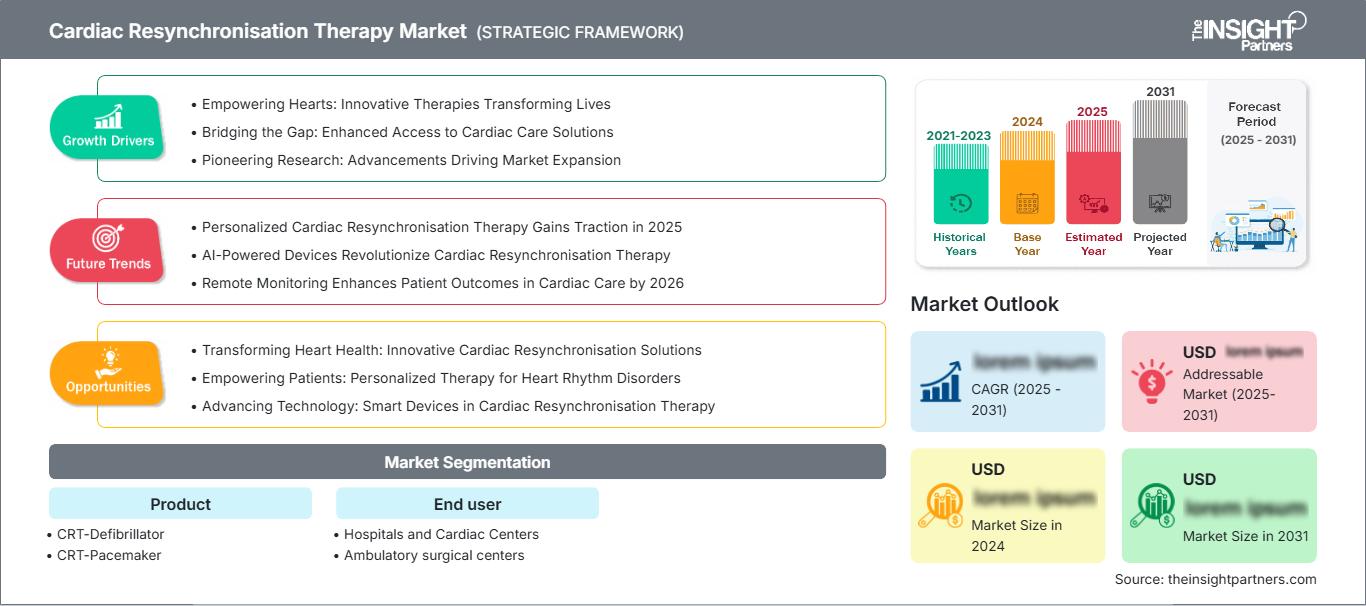
Cardiac Resynchronisation Therapy Market: Strategic Insights
Regional Insights
North America Cardiac Resynchronisation Therapy Market
North America generated an estimated 39–42% of global revenue in 2025 and is forecast to expand at a 7.2–7.8% CAGR through 2034. The Cardiac Resynchronisation Therapy Market share is defined by the advanced electrophysiology infrastructure, broad coverage for implantable devices, the existence of heart failure referral networks, and a high rate of tele-monitoring. The US population with heart failure is forecasted to increase from 6.7 million patients to 8.7 million by 2030, increasing the addressable market.
Canada makes its contribution via government-sponsored cardiological programs, centralized buying, and tertiary care facilities that can perform complicated procedures concerning lead positioning and generator handling. In Mexico, there is a small but growing market in private hospitals and metropolitan cardiological centers. Purchasing decisions in the region take into consideration the total cost of ownership, battery life, connection capabilities, advisory service, and data on decreased hospitalization. Conduction system pacing becomes an increasingly relevant competitor, motivating vendors to invest in flexible technology accommodating standard biventricular and physiological pacing methods.
U.S. Cardiac Resynchronisation Therapy Market
The US represented approximately 84–87% of North American revenue in 2025 and is projected to record a 7.3–7.9% CAGR during 2026–2034. The demand is limited to hospitals and cardiac centers equipped with electrophysiology laboratories, imaging facilities, implantation teams, and post-procedure surveillance. One out of four individuals in America lives under the threat of developing heart failure in their lifetime. In addition, the pre-heart-failure traits are observed in 24–34% of adults.
Medtronic plc, Abbott Laboratories, and Boston Scientific Corporation have an important presence in terms of clinical, sales, and remote monitoring in the United States market. Application patterns are gradually moving towards the personalization of devices considering arrhythmic risk, dependence on pacing, venous anatomy, co-morbidities, and longevity. The 2025 appropriate-use criteria were developed to assess 335 clinical scenarios related to CRT, defibrillation, conduction system pacing, replacement, and leadless pacing.
Europe Cardiac Resynchronisation Therapy Market
Europe accounted for an estimated 27–30% share in 2025 and is expected to grow at a 6.8–7.4% CAGR through 2034. Germany represents the primary national market owing to implant capacity, coverage in law, specialist density, and established device follow-up. In the United Kingdom, centralized clinical pathways are advantageous, although waiting times, budgetary restrictions, and regional differences in access to electrophysiology affect its adoption.
In France, national coverage together with high-capability cardiac centers is the case; and in Italy and Spain, there is relevant demand as a result of public hospital systems and aging populations. The tender process promotes the demonstration of device longevity, clinical service coverage, and programmer compatibility in addition to the purchase price. Additionally, medical device regulation, evidence-based requirements, cybersecurity, sustainability issues, and multilingual technical support influence adoption of devices in Europe.
Access in the region is facilitated by such companies as BIOTRONIK SE & Co. KG, MEDICO S.p.A., Medtronic plc, Abbott Laboratories, and Boston Scientific Corporation. Remote interrogation and MRI compatibility are relevant criteria during the purchase decision-making process.
APAC Cardiac Resynchronisation Therapy Market
Asia Pacific held an estimated 21–24% share in 2025 and is projected to post an 8.3–9.0% CAGR through 2034, the fastest regional rate. Japan leads current value through mature reimbursement, specialist infrastructure, and participation by Japan Lifeline Co., Ltd., NIHON KOHDEN CORPORATION, and global manufacturers.
China offers greater volume potential through hospital expansion, local production, and provincial procurement, while India remains underpenetrated but benefits from private cardiac networks. South Korea and Australia support premium adoption through developed electrophysiology services. Training, insurance expansion, localized pricing, and dependable after-sales coverage will determine conversion from clinical need to implantation.
Middle East & Africa Cardiac Resynchronisation Therapy Market
The Middle East & Africa region is forecast to expand at a 6.2–7.0% CAGR through 2034. Saudi Arabia leads regional value through hospital investment, specialist recruitment, and cardiac-service modernization, while the UAE functions as a referral and private-care hub.
South Africa anchors sub-Saharan adoption but faces funding and specialist-capacity constraints. Across the Rest of MEA, growth depends on cath-laboratory infrastructure, reliable electricity, trained device technicians, and maintenance support. Public investment, medical tourism, distributor capability, and centralized procurement can expand access, although import dependence and currency volatility continue to affect affordability.
Segmentation Analysis
Product
The Product segment is forecast to grow at a 7.4–8.0% CAGR during 2026–2034. The Cardiac Resynchronisation Therapy Market scope includes systems that coordinate ventricular contraction, with or without defibrillation capability. Product selection is influenced by sudden-cardiac-death risk, pacing requirement, comorbidities, expected longevity, battery replacement implications, and clinician preference. Connected diagnostics and physiological pacing compatibility will influence future portfolio differentiation.
- CRT-Defibrillator: This sub-segment holds the leading position because it combines resynchronization with protection against dangerous ventricular arrhythmias, supporting use among eligible heart-failure patients with elevated sudden-death risk.
- CRT-Pacemaker: Demand centers on patients requiring synchronized pacing without defibrillation, particularly when age, comorbidity, personal preference, clinical prognosis, or lower arrhythmic risk affects therapy selection.
End user
The End user segment is expected to register a 7.6–8.2% CAGR during 2026–2034. Adoption follows access to electrophysiologists, imaging, anesthesia, sterile procedure rooms, emergency support, device programming, and longitudinal monitoring. Hospitals retain leadership because complex patients require multidisciplinary care, while ambulatory facilities can capture selected lower-risk procedures where regulation, reimbursement, transfer agreements, and post-discharge surveillance support safe decentralization.
- Hospitals and Cardiac Centers: These facilities dominate implantation because they integrate electrophysiology laboratories, advanced imaging, surgical backup, inpatient stabilization, procurement systems, trained programming teams, and structured remote-monitoring services.
- Ambulatory surgical centers: Adoption is scaling for appropriately selected patients as payers seek efficient care settings, although capital requirements, credentialing, emergency-transfer protocols, and reimbursement eligibility limit universal migration.
Opportunity Snapshot
| End user | Revenue Contribution (High/Medium/Low) | Trend Tag | Adoption Stage |
| Hospitals and Cardiac Centers | High | Connected Follow-up | Mature |
| Ambulatory surgical centers | Medium | Outpatient Implant | Scaling |
Cardiac Resynchronisation Therapy Market Growth Drivers and Impact Analysis
Rising Heart-Failure Burden and Eligibility Assessment
A growing heart-failure population is expanding the number of patients evaluated for reduced ejection fraction, ventricular conduction delay, and persistent symptoms despite guideline-directed medication. Global prevalence was estimated at 55.5 million people in 2021, while US prevalence is projected to reach 8.7 million by 2030. This obligation does not automatically lead to implantation due to factors such as rhythm, QRS interval, morphometry, symptoms, prognosis, and therapy adjustment which determine eligibility for the procedure. Yet, better screening and referral practices will increase the number of patients that undergo evaluation. Standardized processes that link primary care, heart-failure clinics, imaging, and electrophysiology will be profitable to device makers when adopted by healthcare providers. This will make the biggest commercial difference when need turns into practice.
Remote Monitoring Improves Lifecycle Value
Follow-up with connections adds to the operational effectiveness of the implanted devices by allowing the clinical teams to assess the state of the devices, rhythm detections, lead assessments, battery assessment, and certain measures for heart failure. This aspect acquires more significance when the number of patients with implants grows much faster than the number of specialists available. Monitoring can allow for prioritizing patients needing care and decreasing the number of trips for the rest of them. From the perspective of the manufacturers, the monitoring systems help to retain their clients as the hospitals purchase compatible programmers, develop workflow solutions, and train the employees. The factors affecting adoption include interoperability, quality of alerts, reimbursement, patient connection, and accountability procedures.
Guideline Development Supports Consistent Clinical Decisions
The multisociety appropriate use criteria of 2025 evaluated 335 cases related to cardiac resynchronization therapy, defibrillation, conduction system pacing, leadless pacing, and generator reprogramming. Such tools will enable clinicians to consider the evidence, patient features, benefits, and procedure risk in the choice of devices. Consistency will allow them to provide more effective referrals and decrease institutional variability in inappropriate care. The guidelines offer a framework to hospitals and payers regarding the structure of prior authorizations, quality reviews, and shared decision-making. From the commercial point of view, the effect will be maximal for the companies producing strong clinical evidence and enabling physicians' education without hiding contraindications. In relation to the development of physiological pacing, comparative evidence is becoming increasingly important. This means that CRT platforms should be positioned in the context of pacing treatment algorithms rather than being considered a separate technology category.
Cardiac Resynchronisation Therapy Market Future Trends
Convergence of Biventricular and Conduction-System Pacing
Cardiac Resynchronisation Therapy market trends suggest an increasing emphasis on dual therapy that includes coronary sinus pacing and conduction system-based techniques. In the 134 patient study called CONSYST-CRT, the conduction system pacing technique was not inferior to biventricular pacing for a clinical and echocardiographic composite endpoint. Nevertheless, crossover and sample size justify a need for additional research into the issue. Future technologies can allow physicians to choose one of several techniques including traditional CRT, left bundle branch pacing, and combinations depending on anatomy and conduction abnormalities. It will enhance demand for flexible leads, delivery catheters, generators, mapping tools, and education.
Leadless Left-Ventricular Stimulation Advances
Leadless left-ventricular endocardial pacing could prove to be a potential option for those patients who fail to get benefit from traditional coronary sinus leads. In July 2025, a center in the United States described the use of the WiSE CRT System along with right-sided leadless pacemaker to achieve a leadless biventricular configuration. The success of this technique would depend upon its safety record, training requirements, compatibility, battery strategy, selection criteria, and reimbursement. This system would not replace the traditional system in the very beginning, however, could open up a rescue pathway.
Cardiac Resynchronisation Therapy Market Opportunities
Build Implantation and Follow-up Capacity in Underserved Markets
Manufacturers and hospital groups can unlock demand by investing in electrophysiology training, referral protocols, programmer availability, remote-monitoring infrastructure, and distributor technical competence. Device supply alone will not resolve underpenetration because implantation requires imaging, sterile facilities, lead-management expertise, emergency support, and longitudinal surveillance. Commercial programs should target high-volume cardiac centers in China, India, Southeast Asia, the Gulf states, and selected African cities before expanding through hub-and-spoke networks. Risk-sharing arrangements, structured training, and service-level agreements can improve tender performance. Local inventory planning is equally important because delayed leads, programmers, or replacement generators can interrupt care. Investment should prioritize complete clinical pathways rather than isolated product placement.
Develop Evidence-Based Upgrade and Replacement Services
A large installed base creates recurring opportunities in generator replacement, software updates, lead evaluation, advisory management, and therapy upgrades. Suppliers can differentiate through predictive battery information, standardized patient communication, cybersecurity maintenance, and efficient scheduling tools. Boston Scientific Corporation’s 2025 ACCOLADE communications demonstrated how battery-impedance surveillance and programmer software can materially affect management of CRT-P recipients. Providers need accurate identification of affected devices, risk stratification, and documented follow-up. Investment in lifecycle service platforms can reduce hospital workload while strengthening manufacturer accountability. The opportunity is particularly relevant for ageing recipients whose clinical status may require reassessment when changing from pacemaker-only support to defibrillation, or when considering physiological pacing during replacement.
Recent Developments
- March 2026: Medtronic plc received US Food and Drug Administration approval for an expanded indication allowing its OmniaSecure defibrillation lead to be placed in the left bundle branch area. The lead can connect to a CRT-D and may support left-bundle-branch optimized cardiac resynchronization therapy combining conduction-system and left-ventricular pacing.
- September 2025: Boston Scientific Corporation updated its urgent medical device correction concerning Model 3869 v2.04 software for ACCOLADE-family pacemakers, including VISIONIST and VALITUDE CRT-P systems. The software was designed to detect high battery impedance and reduce ambulatory initiation of Safety Mode, with revised guidance addressing observed telemetry behaviors.
- July 2025: Medtronic plc participated in a reported US procedure combining its Micra right-sided leadless pacemaker with the WiSE CRT System. The configuration enabled completely leadless biventricular pacing for a patient considered unsuitable for conventional lead-based resynchronization, illustrating future interoperability opportunities in complex heart-failure care.
Frequently Asked Questions

- Comprehensive Market Sizing and Forecast Analysis
- Detailed Segmentation Analysis
- In-Depth Market Dynamics Assessment
- Regional and Country-Level Insights
- Competitive Landscape and Company Benchmarking
- Strategic Business Intelligence
Recent Reports
Testimonials

The Insight Partners' SCADA System Market report is comprehensive, with valuable insights on current trends and future forecasts. The team was highly professional, responsive, and supportive throughout. We are very satisfied and highly recommend their services.
RAN KEDEM Partner, Reali Technologies LTDs
I requested a report on a very specific software market and the team produced the report in a few days. The information was very relevant and well presented. I then requested some changes and additions to the report. The team was again very responsive and I got the final report in less than a week.
JEAN-HERVE JENN Chairman, Future Analytica
We worked with The Insight Partners for an important market study and forecast. They gave us clear insights into opportunities and risks, which helped shape our plans. Their research was easy to use and based on solid data. It helped us make smart, confident decisions. We highly recommend them.
PIYUSH NAGPAL Sr. Vice President, High Beam Global
The Insight Partners delivered insightful, well-structured market research with strong domain expertise. Their team was professional and responsive throughout. The user-friendly website made accessing industry reports seamless. We highly recommend them for reliable, high-quality research services
YUKIHIKO ADACHI CEO, Deep Blue, LLC.
This is the first time I have purchased a market report from The Insight Partners.While I was unsure at first, I visited their web site and felt more comfortable to take the risk and purchase a market report.I am completely satisfied with the quality of the report and customer service. I had several questions and comments with the initial report, but after a couple of dialogs over email with their analyst I believe I have a report that I can use as input to our strategic planning process.Thank you so much for taking the extra time and making this a positive experience.I will definitely recommend your service to others and you will be my first call when we need further market data.
JOHN SUZUKI President and Chief Executive Officer, Board Director, BK Technologies
I wish to appreciate your support and the professionalism you displayed in the course of attending to my request for information regarding to infectious disease IVD market in Nigeria. I appreciate your patience, your guidance, and the fact that you were willing to offer a discount, which eventually made it possible for us to close a deal. I look forward to engaging The Insight Partners in the future, all thanks to the impression you have created in me as a result of this first encounter.
DR CHIJIOKE ONYIA MANAGING DIRECTOR, PineCrest Healthcare Ltd.Reason to Buy
- Informed Decision-Making
- Understanding Market Dynamics
- Competitive Analysis
- Identifying Emerging Markets
- Customer Insights
- Market Forecasts
- Risk Mitigation
- Boosting Operational Efficiency
- Strategic Planning
- Investment Justification
- Tracking Industry Innovations
- Aligning with Regulatory Trends





 Get Free Sample for