
Cloud Backup Market Size, Share & Growth by 2034
Cloud Backup Market Size and Forecasts (2021–2034), Global and Regional Share, Trends, and Growth Opportunity Analysis Report Coverage : By Component (Solution and Services), Deployment Mode (Public Cloud, Private Cloud, and Hybrid Cloud), End-User Industry (BFSI, IT & Telecom, Media & Entertainment, Retail, Healthcare, Others); Geography (North America, Europe, Asia-Pacific, Middle East & Africa, South and Central America)
- Status : Data Released
- Report Code : TIPRE00039774
- Category : Technology, Media and Telecommunications
- No. of Pages : 150
- Available Report Formats :


- Last update date : July 31, 2026


2025 Market Size
US$ 7.24 Bn
Base year value
2034 Forecast
US$ 38.91 Bn
Projected by 2034
CAGR 2026-2034
23.39 %
Growth rate
Addressable Market
US$ 215.03 Bn
(2026-2034)
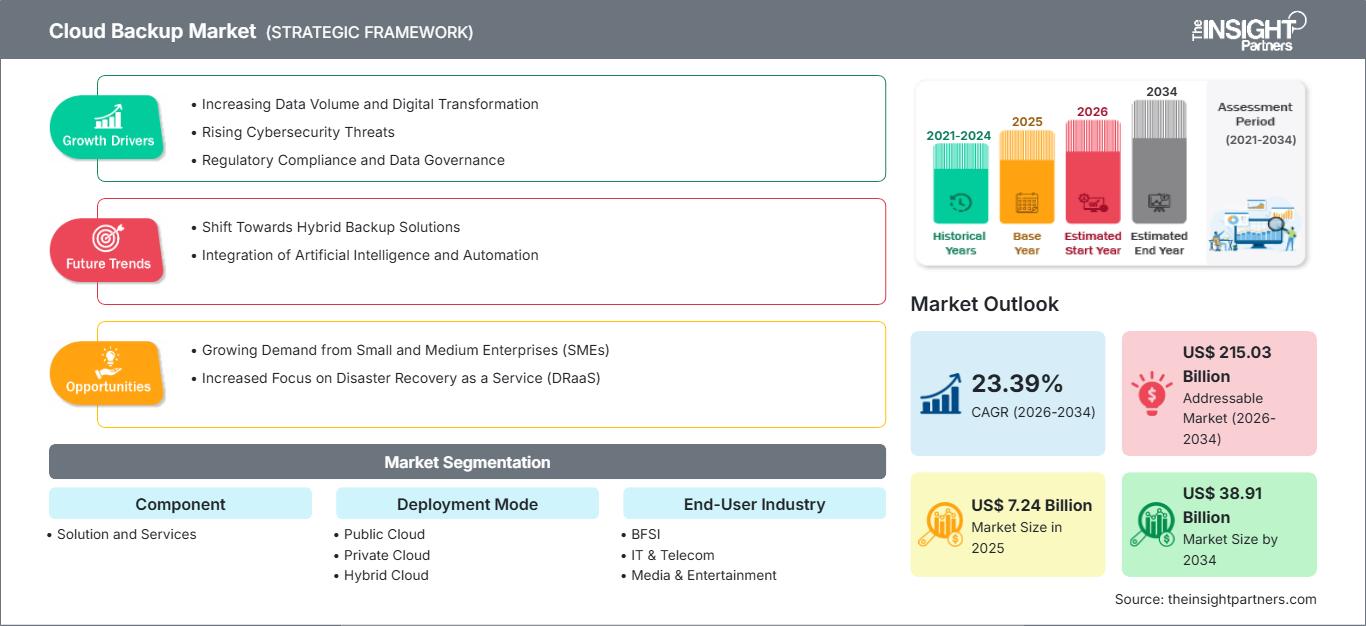
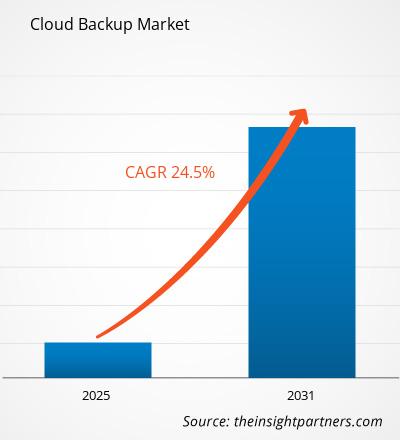
The Cloud backup market was valued at US$ 7.24 Billion in 2025 and is projected to reach US$ 38.91 Billion by 2034, registering a CAGR of 23.39% during 2026–2034. Rising enterprise dependence on distributed data environments, growing ransomware exposure, and increasing adoption of software-as-a-service applications continue to accelerate demand for scalable cloud-based data protection architectures across industries.
Across North America, enterprises are accelerating cloud-native resilience strategies as hybrid workforces and multi-cloud deployments expand. The cloud backup market size in the region benefits from strong cybersecurity spending, mature cloud infrastructure, and regulatory compliance requirements. Regional growth is expected to remain robust, supported by increasing backup automation adoption and wider integration of recovery orchestration technologies.
Cloud Backup Market Assessment and Insights
- North America: Share in 2025 of 38–42%, supported by enterprise cloud maturity, strong cybersecurity investment, and advanced recovery requirements. CAGR between 21–24% during 2026–2034.
- US: Represents 74–78% of North America in 2025. High SaaS utilization and extensive enterprise data volumes support a CAGR of 21–24% during 2026–2034.
- Europe: Share in 2025 of 24–28%, led by Germany, the UK, and France. Data sovereignty initiatives support a CAGR of 20–23% during 2026–2034.
- Asia Pacific: Share in 2025 of 22–26%, led by China, Japan, India, South Korea, and Australia. CAGR of 25–28% during 2026–2034.
- Largest Segment: Solution segment holds 62–66% market share in 2025, driven by platform subscriptions and centralized management. CAGR 22–25% during 2026–2034.
- High Growth Segment: Hybrid Cloud segment accounts for 28–32% share in 2025 and is projected to expand at 26–29% CAGR during 2026–2034.
- Key companies analyzed in detail: Acronis International GmbH, Amazon Web Services, Inc., Asigra Inc., Backblaze, Inc., Datto, Inc., Dropbox, Inc., IDrive Inc., International Business Machines Corporation, Microsoft Corporation, OpenText Corporation.
Source: The Insight Partners' analysis based on proprietary research, government publications, company annual reports, investor presentations, industry databases, and expert interviews.
The market has evolved from basic off-site storage services into intelligent protection platforms capable of automated backup, ransomware detection, workload mobility, and rapid recovery. Growing adoption of containers, virtualized environments, SaaS applications, and edge computing has transformed backup requirements. Vendors increasingly integrate artificial intelligence, immutable storage, and policy-driven orchestration into offerings, allowing organizations to improve resilience while reducing administration complexity. As enterprises consolidate infrastructure, the cloud backup market growth is increasingly tied to multi-cloud and hybrid-cloud strategies.
In the future, there will be increased investments in the Asia Pacific, the Middle East, and emerging countries undergoing digital transformation. There will be continued growth of regulatory policies on the security of personal data, infrastructure, and financial data storage, which are expected to boost demand. Investments from the government in cloud services, large-scale data centers, and business continuity for enterprises will increase in the long run.
Cloud Backup Market Report Scope
| Report Attribute | Details |
|---|---|
| Market size in 2025 | US$ 7.24 Billion |
| Market Size by 2034 | US$ 38.91 Billion |
| Global CAGR (2026 - 2034) | 23.39% |
| Historical Data | 2021-2024 |
| Forecast period | 2026-2034 |
Cloud Backup Market Analysis
Growing digitalization continues to generate unprecedented volumes of structured and unstructured information. Organizations require cost-efficient methods to secure data stored across endpoints, applications, virtual machines, and cloud workloads. Demand is increasingly influenced by ransomware recovery requirements, strict compliance mandates, and the need to minimize operational downtime.
The cloud backup market analysis indicates that value creation extends beyond storage services toward integrated resilience ecosystems. Service providers, software vendors, cybersecurity specialists, infrastructure operators, and hyperscale cloud platforms collectively support deployment, recovery, monitoring, encryption, and governance functions. This ecosystem approach improves retention efficiency and strengthens disaster recovery readiness.
The competition intensity remains relatively high because the vendors compete on cyber-resilience, automation, and the scope of workloads that they protect. Acronis International GmbH, Microsoft Corporation, International Business Machines Corporation, and Amazon Web Services, Inc. are making investments in advanced protection technologies, while OpenText Corporation, Datto, Inc., and Asigra Inc. concentrate on working with the managed service providers and offering their services to enterprises.
There is a tendency for investments to move towards AI-based recovery, immutable storage, SaaS protection, and cloud management capabilities. Companies such as Backblaze, Inc., Dropbox, Inc., and IDrive Inc. develop their cloud storage solutions in order to attract more customers and retain them with subscription services.
● REPORT CUSTOMIZATION
Tailor This Report To Align With Your Specific Business Requirements
This report can be customized to align precisely with your business objectives, scope, and target markets. Customization options include tailored segmentation, geography, competitive analysis, and strategic insights to support informed decision-making.
Customize This Report →WHAT YOU CAN ADJUST
- ● Segmentations
- ● Geography
- ● Competitive Analysis
- ● Language Preferences
Cloud Backup Market: Strategic Insights
Regional Insights
North America Cloud Backup Market
North America accounted for 38–42% of global revenue in 2025 and is expected to grow at a 21–24% CAGR through 2034. The region benefits from extensive cloud adoption, strong cybersecurity awareness, and high spending on digital infrastructure. Financial institutions, healthcare providers, retailers, and technology companies increasingly deploy automated backup and recovery solutions to improve operational resilience.
The cloud backup market share remains highest in North America due to mature cloud ecosystems and concentration of major technology vendors. Regulatory requirements involving data retention, privacy protection, and ransomware preparedness continue to support investment. Rising demand for SaaS protection, multi-cloud management, and disaster recovery orchestration is expected to maintain long-term market momentum.
U.S. Cloud Backup Market
The United States represented 74–78% of North American revenue in 2025 and is projected to expand at a 21–24% CAGR. Enterprise data volumes continue rising across government, BFSI, healthcare, and telecommunications sectors. Large-scale cloud migration programs and widespread hybrid work environments create persistent demand for scalable backup infrastructure.
Concentration among vendors continues to be high, with Microsoft Corporation, Amazon Web Services, Inc., International Business Machines Corporation, and many other specialty vendors having sizable customer bases. There is an increasing focus on ransomware protection, immutable backup services, and quick recovery mechanisms. Additional growth opportunities come from investments made in AI cybersecurity and cloud-based continuity solutions.
Europe Cloud Backup Market
Europe accounted for 24–28% of global revenue in 2025 and is forecast to grow at a 20–23% CAGR. Regulatory mandates surrounding privacy, governance, and operational resilience continue driving adoption. The country is still leading in terms of national market adoption on account of industrial digitization, widespread enterprise cloud adoption, and high adoption rates of compliance-oriented products and services.
The UK stands out for its highly sophisticated financial services industry and wide adoption of cloud-based continuity applications. In France, there is increasing investment in sovereign cloud adoption and cyber resilience solutions. In Italy and Spain, there are increased initiatives around digital transformation, which help with adoption among both public entities and small and medium businesses.
APAC Cloud Backup Market
Asia Pacific represented 22–26% of global revenue in 2025 and is anticipated to register a 25–28% CAGR, making it the fastest-growing regional market. China leads regional demand, supported by large-scale digital infrastructure investment and cloud platform expansion.
Japan, South Korea, India, and Australia continue investing in cybersecurity modernization and enterprise cloud adoption. Government digital economy programs, rising data generation, and expanding hyperscale facilities strengthen regional growth prospects. Increasing awareness of ransomware risks further supports deployment across industries.
Middle East & Africa Cloud Backup Market
The Middle East and Africa market is expected to expand at a 22–25% CAGR through 2034. Increasing digital government initiatives and growing enterprise cloud adoption support demand for secure backup infrastructure. Saudi Arabia and the UAE remain key investment centers.
South Africa leads adoption across the African market, supported by expanding data center ecosystems and financial sector modernization. Infrastructure diversification, smart city investments, and energy-sector digital transformation create additional opportunities for cloud-based resilience solutions throughout the broader region.
Segmentation Analysis
Component
Component is expected to grow at a 22–25% CAGR during 2026–2034. The segment benefits from increasing enterprise preference for integrated data protection environments combining backup, recovery, monitoring, security, and compliance functionality. The cloud backup market scope continues expanding as organizations seek centralized visibility across increasingly distributed IT ecosystems.
- Solution: Represents the dominant category, driven by software platforms that deliver scheduling, replication, recovery automation, encryption, retention management, and centralized policy enforcement across diverse enterprise workloads.
- Services: Demand is supported by implementation assistance, managed backup operations, migration support, optimization consulting, and ongoing monitoring designed to improve operational efficiency and recovery readiness.
Deployment Mode
Deployment Mode is anticipated to record a 24–27% CAGR during 2026–2034. Enterprises increasingly align deployment choices with compliance obligations, security objectives, data residency requirements, and workload mobility needs. Hybrid approaches are gaining traction as organizations balance flexibility with governance requirements.
- Public Cloud: Widely adopted because of scalability, subscription pricing, rapid deployment, and extensive integration with software ecosystems, making it attractive for diverse organizations.
- Private Cloud: Preferred where stringent security controls, dedicated infrastructure, and industry-specific compliance requirements influence technology procurement decisions.
- Hybrid Cloud: Combines flexibility and control, enabling workload distribution across environments while strengthening resilience and disaster recovery performance.
End-User Industry
End-User Industry is projected to grow at a 23–26% CAGR during 2026–2034. Sector-specific regulatory obligations, digital transformation initiatives, and increasing cybersecurity awareness contribute to sustained adoption across commercial and institutional users.
- BFSI: Requires continuous protection of transaction records, customer information, and regulated data assets while maintaining strict recovery objectives.
- IT & Telecom: Generates substantial data volumes and prioritizes scalable backup architectures capable of supporting distributed network environments.
- Media & Entertainment: Relies on secure storage and rapid retrieval of high-volume digital content supporting production and distribution activities.
- Retail: Expanding e-commerce ecosystems create growing requirements for customer data protection and application continuity.
- Healthcare: Adoption is driven by electronic health records, compliance obligations, and increasing cybersecurity threats targeting medical institutions.
Opportunity Snapshot
| End-User Industry | Revenue Contribution | Trend Tag | Adoption Stage |
| BFSI | High | Cyber Recovery | Mature |
| IT & Telecom | High | Multi-Cloud | Mature |
| Media & Entertainment | Medium | Content Archive | Scaling |
| Retail | Medium | Omnichannel Data | Scaling |
| Healthcare | High | Patient Records | Scaling |
Cloud Backup Market Growth Drivers and Impact Analysis
Escalating ransomware and cyber resilience requirements
Organizations are slowly realizing that prevention is not enough when it comes to dealing with modern cyberattacks. Backup systems have become integral components in security architectures since they offer immutability and fast recovery in case of any attack. Industries such as health care, banking, and government sectors are exposed to more risk due to the valuable data that they hold. With continued ransomware attacks hitting companies from around the world, enterprises are spending more of their cybersecurity budget on disaster recovery. This trend is affecting procurement processes for both large and small enterprises.
Expansion of multi-cloud and hybrid infrastructure strategies
IT environments of enterprises today often include multiple cloud services, private data centers, and edge sites. Backup of IT infrastructure in such an environment requires a centralized backup management platform that can handle various types of workloads. The need for such systems is growing as companies implementing their digital transformation require solutions that offer visibility and management of backups, policies, and recovery across all sites, no matter where they reside. Companies pursuing their digital transformation programs usually implement multi-cloud strategies. Backup vendors are working on improving management options, handling workloads, and interoperability.
Growth in compliance and data governance obligations
Regulatory structures related to retention, privacy, and resilience are getting larger every day. Businesses need to show more control over business documentation, customer data, and their operational data. Cloud backup solutions can provide a solution for these requirements by providing such features as encryption, audits, policy enforcement, and retention management. Some industries, such as BFSI, healthcare, and government, have even more serious compliance requirements. Retrieving information while maintaining the governance controls is becoming more and more crucial. In light of this situation, investments in advanced backup software will still be a priority for many businesses.
Cloud Backup Market Future Trends
AI-driven backup management and recovery automation
The most prominent among emerging cloud backup market trends is the integration of artificial intelligence into backup operations. Vendors are embedding predictive analytics, anomaly detection, policy optimization, and automated remediation tools within platforms. These capabilities improve operational efficiency by identifying unusual data activity, predicting storage requirements, and accelerating recovery procedures. Over time, AI is expected to reduce administrative workloads while improving resilience. Organizations are likely to prioritize solutions that can intelligently manage data protection across complex environments without extensive manual intervention.
Immutable storage becoming a standard requirement
Immutability is making a shift from being a premium feature to a standard requirement within enterprise-level installations. Businesses are now demanding proof that their backup files can never be tampered with, erased, or encrypted by any malicious force. Moving forward, the focus on developing future platforms will be on improving immutability, ensuring enhanced verification processes, and integrating these features into the cyber-recovery process. With rising levels of threats, immutability will shape the industry and enterprise purchase decisions.
Cloud Backup Market Opportunities
Expansion of industry-specific protection platforms
Growing regulatory complexity creates opportunities for vendors to develop sector-focused backup services tailored to healthcare, financial services, public administration, and telecommunications. Customized retention policies, governance controls, and workflow integrations can improve customer value while supporting compliance objectives. According to long-term cloud backup market Forecasts, industry-specific solutions are expected to attract investment because they address distinct operational requirements that generic platforms may not fully satisfy. Vendors capable of combining security, recovery, and compliance capabilities within verticalized offerings may secure stronger competitive positioning.
Managed backup services for mid-sized organizations
Many medium-sized companies find themselves lacking resources even as they become increasingly vulnerable to cyber attacks and have to deal with many regulations. Managed services become appealing because they simplify the process and make it possible to have predictable operational costs. Services that cover monitoring, recovery testing, and lifecycle management would appeal to customers who are not being served adequately at the moment. The rising need for cloud governance skills becomes another driver.
Frequently Asked Questions

- Comprehensive Market Sizing and Forecast Analysis
- Detailed Segmentation Analysis
- In-Depth Market Dynamics Assessment
- Regional and Country-Level Insights
- Competitive Landscape and Company Benchmarking
- Strategic Business Intelligence
Recent Reports
Testimonials

The Insight Partners' SCADA System Market report is comprehensive, with valuable insights on current trends and future forecasts. The team was highly professional, responsive, and supportive throughout. We are very satisfied and highly recommend their services.
RAN KEDEM Partner, Reali Technologies LTDs
I requested a report on a very specific software market and the team produced the report in a few days. The information was very relevant and well presented. I then requested some changes and additions to the report. The team was again very responsive and I got the final report in less than a week.
JEAN-HERVE JENN Chairman, Future Analytica
We worked with The Insight Partners for an important market study and forecast. They gave us clear insights into opportunities and risks, which helped shape our plans. Their research was easy to use and based on solid data. It helped us make smart, confident decisions. We highly recommend them.
PIYUSH NAGPAL Sr. Vice President, High Beam Global
The Insight Partners delivered insightful, well-structured market research with strong domain expertise. Their team was professional and responsive throughout. The user-friendly website made accessing industry reports seamless. We highly recommend them for reliable, high-quality research services
YUKIHIKO ADACHI CEO, Deep Blue, LLC.
This is the first time I have purchased a market report from The Insight Partners.While I was unsure at first, I visited their web site and felt more comfortable to take the risk and purchase a market report.I am completely satisfied with the quality of the report and customer service. I had several questions and comments with the initial report, but after a couple of dialogs over email with their analyst I believe I have a report that I can use as input to our strategic planning process.Thank you so much for taking the extra time and making this a positive experience.I will definitely recommend your service to others and you will be my first call when we need further market data.
JOHN SUZUKI President and Chief Executive Officer, Board Director, BK Technologies
I wish to appreciate your support and the professionalism you displayed in the course of attending to my request for information regarding to infectious disease IVD market in Nigeria. I appreciate your patience, your guidance, and the fact that you were willing to offer a discount, which eventually made it possible for us to close a deal. I look forward to engaging The Insight Partners in the future, all thanks to the impression you have created in me as a result of this first encounter.
DR CHIJIOKE ONYIA MANAGING DIRECTOR, PineCrest Healthcare Ltd.Reason to Buy
- Informed Decision-Making
- Understanding Market Dynamics
- Competitive Analysis
- Identifying Emerging Markets
- Customer Insights
- Market Forecasts
- Risk Mitigation
- Boosting Operational Efficiency
- Strategic Planning
- Investment Justification
- Tracking Industry Innovations
- Aligning with Regulatory Trends





 Get Free Sample for