
Composite AI Market Growth, Size & Forecast by 2034
Composite AI Market Size and Forecasts (2021–2034), Global and Regional Share, Trends, and Growth Opportunity Analysis Report Coverage : By Offering (Software, Hardware, and Services), Technique (Data Processing, Pattern Recognition, Condition Monitoring, Proactive Mechanism, Others), Application (Product Design and Development, Customer Service, Security and Surveillance, Others), Vertical (BFSI, Reail and ECommerce, Manufacturing, Energy and Utilities, Others)
- Status : Data Released
- Report Code : TIPRE00039794
- Category : Technology, Media and Telecommunications
- No. of Pages : 150
- Available Report Formats :


- Last update date : August 04, 2026


2025 Market Size
US$ 1.81 Bn
Base year value
2034 Forecast
US$ 20.73 Bn
Projected by 2034
CAGR 2026-2034
35.64 %
Growth rate
Addressable Market
US$ 100.17 Bn
(2026-2034)
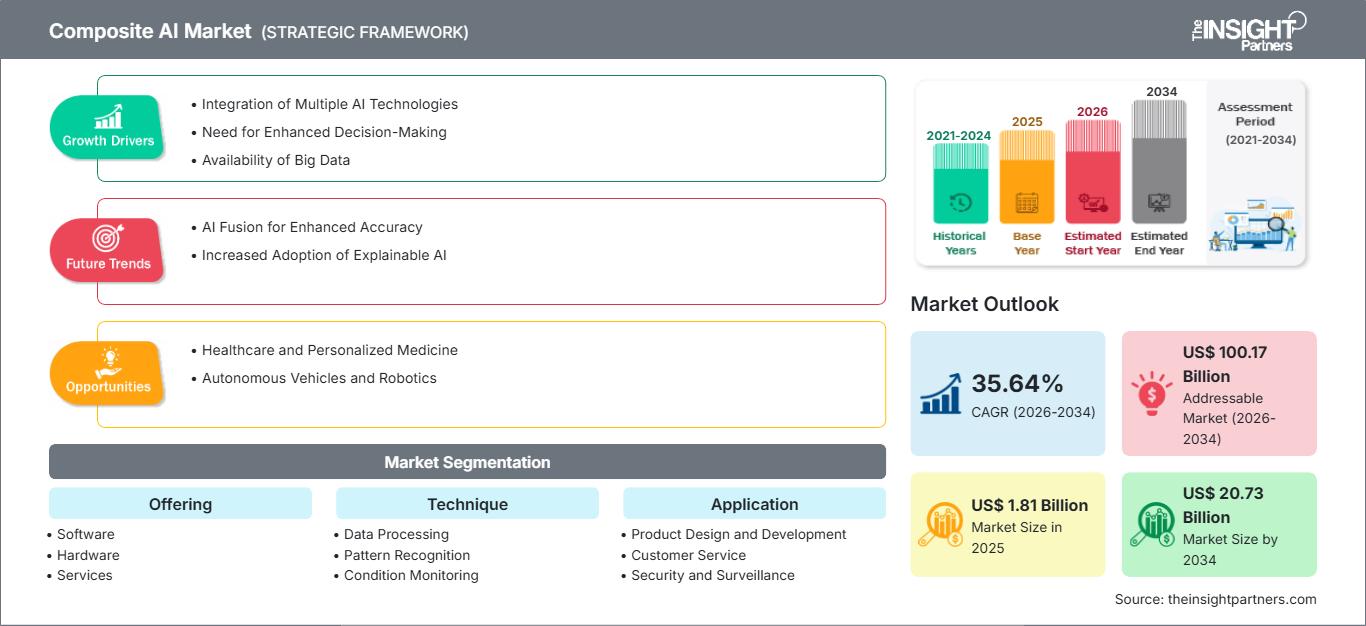
The Composite AI Market is projected to grow significantly, expanding from US$ 1.81 Billion in 2025 to US$ 20.73 Billion by 2034, reflecting a robust CAGR of 35.64% between 2026 and 2034. This rapid expansion is supported by advances in data processing, pattern recognition, and condition monitoring techniques that allow enterprises to orchestrate multiple artificial intelligence models for complex decision-making.
North America is expected to be the leading region for composite AI adoption, with the market registering a high‑growth trajectory supported by strong cloud and AI investments. Over 2026–2034, the region is anticipated to record a CAGR in the range of 30–36% as enterprises integrate AI agents, knowledge graphs, and machine learning ensembles into customer service automation, security analytics, and product design workflows.
Composite AI Market Assessment and Insights
- North America: The market in North America is estimated to account for around 34–38% share in 2025, underpinned by early enterprise adoption of AI platforms and strong cloud infrastructure. Between 2026–2034, the region is expected to grow at a CAGR range of 30–36%, supported by investments in multi‑agent systems and sector‑specific AI accelerators.
- US: Within North America, the US is projected to capture approximately 70–74% of regional revenue in 2025, driven by hyperscaler platforms and large enterprise deployments. From 2026–2034, the US market is anticipated to grow at a CAGR in the range of 31–37%, benefiting from strong R&D and early regulatory experimentation.
- Europe: Europe is expected to represent 27–31% of global revenue in 2025, with leading adoption in the UK, Germany, and France. Over 2026–2034, Europe is forecast to grow at a CAGR range of 29–35%, supported by industrial automation, automotive AI integration, and adherence to emerging AI governance frameworks.
- Asia Pacific: Asia Pacific is estimated to capture 24–28% of global revenue in 2025, driven by China, Japan, South Korea, and India. Between 2026–2034, APAC is projected to grow at a CAGR range of 32–38% as governments promote AI ecosystems, cloud‑native infrastructure, and digital manufacturing initiatives.
- Largest Segment: Software is expected to be the largest segment of the Composite AI Market, contributing around 55–60% share in 2025 as enterprises prioritize AI platforms, orchestration layers, and analytics tools. From 2026–2034, the software segment is likely to grow at a CAGR range of 33–39%, supported by subscription‑based delivery and scalable deployment models.
- High Growth Segment: Services are anticipated to be the highest growth segment, accounting for approximately 18–22% share in 2025 as consulting, integration, and managed AI operations gain traction. During 2026–2034, services are forecast to expand at a CAGR range of 36–42%, driven by demand for composite AI design, governance, and lifecycle management.
- Key companies analyzed in detail: International Business Machines Corporation (IBM), SAP SE, Squirro AG, CognitiveScale Inc., Diwo.ai Inc., ACTICO GmbH, Intel Corporation, Amazon Web Services, Inc. (AWS), Google LLC, and additional active players offering composite AI platforms, orchestration software, and services.
Source: The Insight Partners' analysis based on proprietary research, government publications, company annual reports, investor presentations, industry databases, and expert interviews.
Over the past few years, the Composite AI Market has evolved from isolated machine learning deployments to orchestrated environments that combine multiple models, rules engines, and knowledge representations. While early deployments were limited to specific applications like customer scoring, anomaly detection, and simple recommendations, today’s paradigm is based on more holistic systems for decision-making, combining the processing of data, pattern recognition, and proactive tools throughout the company’s value chain. Hardware accelerators, such as GPUs or dedicated AI chips, have become necessary to provide real-time inference and advanced computations in industries like finance, manufacturing, and healthcare.
Looking ahead, the Composite AI Market size in emerging geographies is expected to grow notably as digital infrastructure and data availability improve. Asia Pacific, Latin America, and parts of the Middle East are seeing increased AI investments from both governments and private enterprises, aligning with broader digital transformation and productivity agendas. Regulatory tailwinds, including guidance from bodies such as the OECD and harmonization with International Organization for Standardization (ISO) standards, are helping organizations develop composite AI systems that meet transparency, robustness, and governance requirements.
Composite AI Market Report Scope
| Report Attribute | Details |
|---|---|
| Market size in 2025 | US$ 1.81 Billion |
| Market Size by 2034 | US$ 20.73 Billion |
| Global CAGR (2026 - 2034) | 35.64% |
| Historical Data | 2021-2024 |
| Forecast period | 2026-2034 |
Composite AI Market Analysis
The Composite AI Market growth is being propelled by organizations’ need to move beyond single‑model solutions towards integrated architectures that combine machine learning, rules‑based logic, optimization engines, and generative AI capabilities. There is a high demand in those areas where complex decision-making is required by combining historical data, live data, and expertise, such as risk management in the financial sector, industrial operations management, and cybersecurity threat intelligence. Data intake, feature engineering, model orchestration, and monitoring tools can now be found on the market in a modular form, which allows companies to build custom AI stacks based on their governance and performance requirements.
From the supplier’s side, there is an expansion in both horizontal and vertical product lines with composite AI being incorporated into traditional analytics platforms, ERP systems, and cloud infrastructure. Hyperscalers and specialist vendors are building infrastructure supporting multi-model pipelines, which include vector databases, workflow engines, and observability tooling capable of managing different workloads. As a result, the ecosystem features collaborations among hardware manufacturers, software vendors, and service integrators working to deliver end-to-end solutions that can be adapted to regulated and high-stakes environments, as highlighted in the Composite AI Market Report.
Competition in the Composite AI Market analysis is intensifying as leading players and niche innovators position themselves around platform depth, integration capabilities, and domain‑specific solutions. IBM, SAP, AWS, Google, and Intel have improved their AI product lines with capabilities for multi-agent orchestration, hybrid delivery, and governance features that will be well received by large enterprises. Specialists, such as Squirro, CognitiveScale, Diwo.ai, and ACTICO offer specific solutions, like contextual knowledge management for the finance sector, decision intelligence for operations and rule-based automation in the area of risk and compliance.
Market investment trends suggest growing investments into the areas of AI infrastructure, data platform, and orchestration capabilities, which could help deliver scalable deployment. Companies are starting to value strategic positioning in terms of combining their models with other components and focusing on observability, cost efficiency, and interoperability. It helps create collaboration between cloud vendors, system integrators, and sector-specific consultants to create composite AI projects based on business results, like increased productivity, revenues, and risk avoidance.
● REPORT CUSTOMIZATION
Tailor This Report To Align With Your Specific Business Requirements
This report can be customized to align precisely with your business objectives, scope, and target markets. Customization options include tailored segmentation, geography, competitive analysis, and strategic insights to support informed decision-making.
Customize This Report →WHAT YOU CAN ADJUST
- ● Segmentations
- ● Geography
- ● Competitive Analysis
- ● Language Preferences
Composite AI Market: Strategic Insights
Regional Insights
North America Composite AI Market
North America holds a leading position in the composite AI landscape, supported by its mature cloud ecosystem, advanced data analytics capabilities, and early experimentation with multi‑agent architectures. In 2025, the region is estimated to account for around 34–38% of global revenue, as financial services, technology, and healthcare organizations deploy composite AI solutions to enhance personalization, risk analysis, and operational efficiency.
Over 2026–2034, the Composite AI Market share in North America is expected to grow at a CAGR of 30–36% as enterprises expand pilot projects into production‑scale deployments and integrate generative AI with predictive analytics and rule‑based engines. Policy guidance from US and Canadian regulators on AI risk management, combined with voluntary frameworks informed by institutions such as the IMF and OECD, is gradually shaping responsible adoption without constraining innovation.
U.S. Composite AI Market
The US is the largest national market within North America, accounting for approximately 70–74% of regional composite AI revenue in 2025. Strong presence of leading AI vendors such as IBM, AWS, Google, Intel, and SAP, along with a vibrant ecosystem of startups, accelerates composite AI adoption in customer experience, cybersecurity, and industrial automation.
From 2026–2034, the US is projected to grow at a CAGR range of 31–37%, supported by rapid digitalization across manufacturing, financial services, and retail, as well as public‑sector interest in multi‑model decision systems. Application trends emphasize AI‑enabled process optimization, intelligent assistants for knowledge workers, and integrated analytics platforms that combine structured data, unstructured content, and sensor feeds.
Europe Composite AI Market
Europe’s composite AI landscape is shaped by strong industrial bases, digital policy frameworks, and investments in trustworthy AI. In 2025, the region is estimated to represent 27–31% of global revenue, with leading contributions from the UK, Germany, and France. The UK market, with a focus on financial services, public‑sector analytics, and healthcare AI, is expected to see composite AI adoption that supports risk scoring, resource planning, and clinical decision support.
Germany’s Composite AI Market benefits from advanced manufacturing, automotive innovation, and Industry 4.0 programs that encourage data‑driven optimization of production lines and supply chains. France, Italy, and Spain contribute to regional growth through investments in digital public services, telecom modernization, and tourism‑related analytics, where composite AI techniques help balance demand forecasting, pricing, and operational decisions. Collectively, Europe is projected to grow at a CAGR of 29–35% from 2026–2034, with Germany and the UK emerging as leading adopters.
APAC Composite AI Market
In Asia Pacific, the Composite AI Market share is expected to reach 24–28% of global revenue in 2025, with China, Japan, South Korea, India, and Australia playing pivotal roles. China leads through large‑scale AI investments aligned with manufacturing, logistics, and smart city initiatives, while Japan and South Korea leverage composite AI to enhance robotics, electronics, and telecom services.
Across 2026–2034, APAC is projected to register a CAGR of 32–38% as India and Australia expand their AI ecosystems, focusing on financial inclusion, digital government, and resource management. Industrial drivers such as export‑oriented manufacturing and regional supply chain integration, combined with supportive policy programs, underpin broader composite AI adoption.
Middle East & Africa Composite AI Market
The Composite AI Market in the Middle East & Africa is at an earlier stage but is gaining momentum as governments and enterprises pursue digital transformation and data‑driven planning. Saudi Arabia and the UAE lead adoption, using composite AI to support smart city initiatives, energy sector optimization, and citizen services.
Across 2026–2034, MEA is forecast to grow at a CAGR of 27–33%, helped by infrastructure investments and increasing cloud availability in key hubs. South Africa and the Rest of MEA are steadily exploring composite AI use cases in financial services, mining, logistics, and public‑sector analytics, aligning with broader economic diversification and efficiency goals.
Segmentation Analysis
Offering
The Offering segment in the Composite AI Market encompasses Software, Hardware, and Services, each contributing differently to adoption and value creation. Overall, the Offering segment is projected to grow at a CAGR of 33–38% between 2026–2034, as organizations balance investments in AI platforms, accelerators, and consulting expertise to build scalable and governed composite AI solutions. Vendors increasingly bundle software with managed services to simplify deployment and lifecycle management.
- Software: The software portfolio consists of orchestration platforms, analytics engines utilizing AI, and multi-model decision-making engines catering to the needs of flexible, governable, and integrated composite AI systems within an enterprise's IT environment. There is a lot of demand for such solutions from banks and financial institutions, manufacturers, and governments seeking to introduce standardized composite AI processes.
- Hardware: The hardware portfolio features general-purpose servers, GPUs, and custom AI accelerators providing intensive training and inference in composite AI deployments. Data center infrastructure and edge infrastructure depend on this hardware to deliver low-latency performance and effective scaling.
- Services: The services portfolio includes consultation and design, integration, and managed operations that enable enterprises to develop and govern their composite AI strategy and ensure sustainable performance in the long run.
Technique
The Technique segment includes Data Processing, Pattern Recognition, Condition Monitoring, and Proactive Mechanism, representing the functional layers that underpin composite AI workflows. From 2026–2034, the Technique segment is anticipated to grow at a CAGR of 34–39% as organizations enhance their ability to ingest diverse data types, derive patterns, and take early action on emerging risks or opportunities. This segment is central to the Composite AI Market scope in operational and decision‑support applications.
- Data Processing: Data Processing techniques help in ingesting, normalizing, and transforming structured and unstructured data, thereby ensuring that composite AI systems have uniform inputs to work with. Scalability and high-quality data are of primary importance for enterprises.
- Pattern Recognition: Pattern Recognition techniques utilize machine learning and deep learning algorithms to analyze correlations and behavioral patterns. Use cases of Pattern Recognition include fraud detection, demand forecasting, and predictive maintenance. Pattern Recognition is an important component of composite AI systems.
- Condition Monitoring: Condition Monitoring techniques utilize data from sensors, operational logs, and environmental variables to monitor the state of assets and systems. Such analysis helps to detect problems on time, which can then be processed by composite AI systems. The industrial and infrastructure sectors are prominent adopters of condition monitoring technologies.
- Proactive Mechanism: Proactive Mechanism techniques utilize predictions based on data analytics along with rules and optimizations to take actions before potential problems occur. Examples of proactive mechanisms include manufacturing process automation, dynamic pricing, and resource management.
Application
The Application segment covers Product Design and Development, Customer Service, and Security and Surveillance, reflecting the main business domains where composite AI delivers measurable impact. Between 2026–2034, this segment is forecast to grow at a CAGR of 32–37%, driven by demand for intelligent automation, enhanced user experiences, and stronger risk management across industries. Organizations prioritize applications that can directly improve productivity, revenue, or resilience.
- Product Design & Development: In applications related to Product Design & Development, composite AI helps to model various situations, optimize product features and facilitate faster innovation cycles in industries like automotive, electronics, and industrial equipment. The applications include workflows based on generative design, predictive analytics, and lifecycle intelligence.
- Customer Service: In applications related to Customer Service, composite AI drives virtual assistants, knowledge-driven support, and routing to provide effective, efficient experience while controlling the cost of operations. The applications leverage the combination of conversational AI and analytics and rules engines.
- Security & Surveillance: In applications related to Security & Surveillance, composite AI is applied to detect threats, perform situation analysis and incident triaging. These applications leverage video analytics, log and context data.
Opportunity Snapshot
| Application | Revenue Contribution (High/Medium/Low) | Trend Tag | Adoption Stage (Emerging/Scaling/Mature) |
| Product Design and Development | Medium | Generative Design | Scaling |
| Customer Service | High | Intelligent Support | Scaling |
| Security and Surveillance | High | Real‑time Analytics | Emerging |
Composite AI Market Growth Drivers and Impact Analysis
Convergence of multi‑model AI architectures in enterprises
Adoption of composite AI is also driven by the requirement of companies to consolidate various AI models, rule engines, and optimization engines in order to make consistent decisions. Organizations can deal with complex issues through the convergence of predictive analytics, generative modeling, and symbolic reasoning because it allows for achieving robust and understandable results. In particular, it can be especially helpful in cases when organizations operate within regulated industries where it is important to have understandable decisions, such as the financial sector and the healthcare industry.
Advances in AI hardware, cloud platforms, and data infrastructure
The Composite AI Market will continue to get help from new developments in the areas of AI accelerators, scalable cloud, and strong data infrastructures capable of managing high demands. Advanced GPUs, dedicated chips, and optimized storage infrastructures allow carrying out complex training and inference processes, making multi-model pipelines efficient in execution. Managed AI capabilities, orchestration, and observability tools from cloud vendors facilitate their deployment and ensure performance and cost management. On the other hand, modern data platforms feature support for multiple data formats, ingest streams, and governance capabilities required by composite AI solutions.
Growing emphasis on AI governance, risk, and compliance
Another important driver is the increasing focus on governance, risk, and compliance when implementing AI, which benefits composite AI solutions where rules and controls can be built in to the decision process. Governance and advisory bodies like the IMF, OECD, and regional entities are advocating or requiring processes like risk categorization, impact analysis, and reporting. Composite AI solutions can incorporate policy-based limitations, explainability functions, and monitoring directly in the solution, thus enabling the organization to comply with these requirements more easily. With the enforcement increasing and scrutiny from stakeholders becoming more intense, composite AI solutions that are governance-ready will become more popular among industries facing increased regulation, like finance, insurance, and public administration.
Composite AI Market Future Trends
Expansion of agentic and autonomous composite AI systems
One emerging trend in the Composite AI Market trends is the expansion of agentic systems that coordinate multiple AI models to perform complex tasks autonomously. The vendors, among them IBM and the major cloud players, are developing orchestration platforms that enable coordination between AI agents, delegation of subtasks by AI agents, and modification of goals for AI agents. Such platforms can manage workflows like application rearchitecture, multistep customer experiences, or flexible supply chain management, which are more efficient and require less human intervention. With increased trust in governed autonomy, agentic AI implementations are anticipated to scale up from experiments to full-fledged projects.
Integration of composite AI with industry‑specific digital twins
The second trend is related to closer ties between composite AI and digital twins of physical objects and processes. Through the use of multi-model analytics and simulation techniques along with real-time data inputs, companies will be able to develop models that simulate behavior. Such an approach will help make more accurate predictions and interventions in the manufacturing, energy, logistics and other industries. With improvements in interoperability and standardization, composite AI-driven digital twins will become useful for collaborative planning by different stakeholders.
Composite AI Market Opportunities
Scaling decision intelligence in operational and industrial contexts
A major opportunity lies in scaling composite AI‑driven decision intelligence across operational and industrial environments. Organizations can use multi‑model frameworks to balance cost, quality, risk, and sustainability objectives in real time, from production scheduling to maintenance planning. By aligning Composite AI Market Forecasts for demand, supply, and asset performance, enterprises can achieve more efficient and responsive operations. Investments in edge computing, sensor networks, and industrial connectivity further support the deployment of composite AI at or near the point of action, enabling faster, data‑driven interventions that improve overall system performance.
Enhancing customer and citizen experiences with contextual intelligence
A further possibility is improving the experience of customers and citizens through the combination of behavioral data, contextual cues, and knowledge bases in composite AI. Within industries including banking, telecommunications, healthcare, and government, there is an opportunity for multi-model architectures that personalize interactions in accordance with privacy and fairness considerations. This can include recommendation algorithms, personalized assistance, and simplified workflows that decrease friction and improve satisfaction. Companies investing in context-aware composite AI stand to differentiate themselves and derive value through data-driven engagements.
Frequently Asked Questions

- Comprehensive Market Sizing and Forecast Analysis
- Detailed Segmentation Analysis
- In-Depth Market Dynamics Assessment
- Regional and Country-Level Insights
- Competitive Landscape and Company Benchmarking
- Strategic Business Intelligence
Recent Reports
Testimonials

The Insight Partners' SCADA System Market report is comprehensive, with valuable insights on current trends and future forecasts. The team was highly professional, responsive, and supportive throughout. We are very satisfied and highly recommend their services.
RAN KEDEM Partner, Reali Technologies LTDs
I requested a report on a very specific software market and the team produced the report in a few days. The information was very relevant and well presented. I then requested some changes and additions to the report. The team was again very responsive and I got the final report in less than a week.
JEAN-HERVE JENN Chairman, Future Analytica
We worked with The Insight Partners for an important market study and forecast. They gave us clear insights into opportunities and risks, which helped shape our plans. Their research was easy to use and based on solid data. It helped us make smart, confident decisions. We highly recommend them.
PIYUSH NAGPAL Sr. Vice President, High Beam Global
The Insight Partners delivered insightful, well-structured market research with strong domain expertise. Their team was professional and responsive throughout. The user-friendly website made accessing industry reports seamless. We highly recommend them for reliable, high-quality research services
YUKIHIKO ADACHI CEO, Deep Blue, LLC.
This is the first time I have purchased a market report from The Insight Partners.While I was unsure at first, I visited their web site and felt more comfortable to take the risk and purchase a market report.I am completely satisfied with the quality of the report and customer service. I had several questions and comments with the initial report, but after a couple of dialogs over email with their analyst I believe I have a report that I can use as input to our strategic planning process.Thank you so much for taking the extra time and making this a positive experience.I will definitely recommend your service to others and you will be my first call when we need further market data.
JOHN SUZUKI President and Chief Executive Officer, Board Director, BK Technologies
I wish to appreciate your support and the professionalism you displayed in the course of attending to my request for information regarding to infectious disease IVD market in Nigeria. I appreciate your patience, your guidance, and the fact that you were willing to offer a discount, which eventually made it possible for us to close a deal. I look forward to engaging The Insight Partners in the future, all thanks to the impression you have created in me as a result of this first encounter.
DR CHIJIOKE ONYIA MANAGING DIRECTOR, PineCrest Healthcare Ltd.Reason to Buy
- Informed Decision-Making
- Understanding Market Dynamics
- Competitive Analysis
- Identifying Emerging Markets
- Customer Insights
- Market Forecasts
- Risk Mitigation
- Boosting Operational Efficiency
- Strategic Planning
- Investment Justification
- Tracking Industry Innovations
- Aligning with Regulatory Trends





 Get Free Sample for