
Composite Insulation Materials Market Growth, Size & Forecast by 2034
Coverage: By Type (Epoxy Resin, Glass Fiber, Silicone Rubber, Stone Wool); Application (Cables and Transmission Lines, Switchgears, Busbars, Others.), and Geography (North America, Europe, Asia Pacific, and South and Central America)
- Status : Data Released
- Report Code : TIPRE00016165
- Category : Chemicals and Materials
- No. of Pages : 150
- Available Report Formats :


- Last update date : August 19, 2026


2025 Market Size
US$ 15.48 Bn
Base year value
2034 Forecast
US$ 31.38 Bn
Projected by 2034
CAGR 2026-2034
8.17 %
Growth rate
Addressable Market
US$ 210.59 Bn
(2026-2034)
The Composite Insulation Materials Market size reached US$ 15.48 Billion in 2025, which is anticipated to be US$ 31.38 Billion by 2034, growing at a CAGR of 8.17% from 2026–2034. Growing power networks, increasing voltage requirements for equipment, integration of renewables, and requirement for durable insulation materials in cables, transmission lines, switchgears, and busbars is driving the demand.
North America is predicted to stay one of the major regions of demand due to transmission upgrades, replacement of existing electrical infrastructure, increase in loads associated with data centers, and grid resilience investments. The Composite Insulation Materials Market in North America is forecast to grow at a CAGR of 7.5-8.5% until 2034.
Composite Insulation Materials Market Assessment and Insights
- North America: North America is estimated to account for 27–31% Composite Insulation Materials Market share in 2025 and expand at a 7.5–8.5% CAGR between 2026–2034, supported by transmission modernization, grid resilience programs, electrification, and rising high-voltage equipment requirements.
- US: The US represents approximately 22–25% of the global market in 2025 and is projected to grow at a 7.5–8.5% CAGR between 2026–2034, led by transmission upgrades and large-load electrification.
- Europe: Europe is estimated at 22–26% share in 2025, with a 7.0–8.0% CAGR between 2026–2034. Germany, France, the UK, Italy, and Spain remain important markets because of grid reinforcement and renewable integration.
- Asia Pacific: Asia Pacific is estimated at 31–35% share in 2025 and is expected to record a 9.0–10.0% CAGR between 2026–2034, led by China, India, Japan, and South Korea.
- Largest Segment: Epoxy Resin is estimated to hold a 30–34% market share in 2025, expanding at a 7.5–8.5% CAGR between 2026–2034, reflecting extensive use in high-voltage composite components.
- High Growth Segment: Silicone Rubber is estimated at 18–22% share in 2025, with a 9.0–10.0% CAGR between 2026–2034, supported by outdoor insulation and demanding environmental conditions.
- Key companies analyzed in detail: Advanced Innergy Ltd, Azuria Water Solutions, BASF SE, Cabot Corporation, DuPont de Nemours, Inc., Exel Composites Oyj, General Electric Company, Hitachi Energy Ltd, Synergy Global Sourcing, and Reinhausen Power Composites GmbH.
Source: The Insight Partners' analysis based on proprietary research, government publications, company annual reports, investor presentations, industry databases, and expert interviews.
The Composite Insulation Materials market trends have moved from traditional rigid insulating systems into engineered systems that integrate resins, reinforcements, elastomers, and minerals. Glass fiber reinforced epoxy constructions find increasing use where mechanical strength and dielectric properties need to coexist, and silicone rubber provides hydrophobic properties for use in outdoor environments. Automation in manufacturing through molding, pultrusion, filament winding, and precision machining is another trend emerging in the market.
Prospects for the future lie with firms able to integrate materials and applications engineering into their production. Upcoming power lines in Asia, energy grids with large amounts of renewable energy in Europe, and maintenance activities in North America create markets for appropriate composites. An increasingly regulatory environment, concerned with safety, reliability, environmental performance, and grid resilience, pushes utilities and equipment producers to consider insulation systems over their entire life cycle.
Composite Insulation Materials Market Report Scope
| Report Attribute | Details |
|---|---|
| Market size in 2025 | US$ 15.48 Billion |
| Market Size by 2034 | US$ 31.38 Billion |
| Global CAGR (2026 - 2034) | 8.17% |
| Historical Data | 2021-2024 |
| Forecast period | 2026-2034 |
Composite Insulation Materials Market Analysis
According to the Composite Insulation Materials Market report, the demand for this product is directly associated with investments in power generation, transmission, distribution, electrification of industry, and manufacture of electrical equipment. The value chain includes suppliers of resin, reinforcement, elastomer, and minerals, compounding, impregnation, molding, winding, pultrusion, machining, and assembly of components. Finally, utility companies, OEMs, EPC contractors, and electricity grid operators set the specifications due to voltage, temperature, mechanical, contamination, and life-time requirements.
The supply will depend on availability and price levels of epoxy systems, glass fiber, silicon systems, and mineral fibers. As failures of the insulations have severe operational and safety implications, the qualification cycles may take some time. In this regard, well-established suppliers having their manufacturing processes, testing procedures, and engineering partnerships with the customers tend to be stronger players in the equipment development process. Local manufacturing is getting increasingly important in utilities' demand.
The competitive environment in the Composite Insulation Materials Market is split up into the chemical companies that are diversified, the composite companies, electrical equipment companies and suppliers of specific applications. The two companies which contribute the high technology materials are BASF SE and DuPont de Nemours, Inc. The composite companies that are involved in the engineering of composite structures are Exel Composites Oyj and Reinhausen Power Composites GmbH. Hitachi Energy Ltd offers manufacturing, insulation and components for specific applications.
The Composite Insulation Materials Market forecast indicates that strategic positioning is based more and more on capacity expansion, localization of manufacturing facilities, technical qualifications and lower impact material processing. Synergy Global Sourcing offers electrical insulation needs while General Electric Company still plays a role in the domain of the electrical equipment. Cabot Corporation provides the specialty materials while Advanced Innergy Ltd and Azuria Water Solutions still have roles in the domain of the engineered insulation and infrastructure applications.
● REPORT CUSTOMIZATION
Tailor This Report To Align With Your Specific Business Requirements
This report can be customized to align precisely with your business objectives, scope, and target markets. Customization options include tailored segmentation, geography, competitive analysis, and strategic insights to support informed decision-making.
Customize This Report →WHAT YOU CAN ADJUST
- ● Segmentations
- ● Geography
- ● Competitive Analysis
- ● Language Preferences
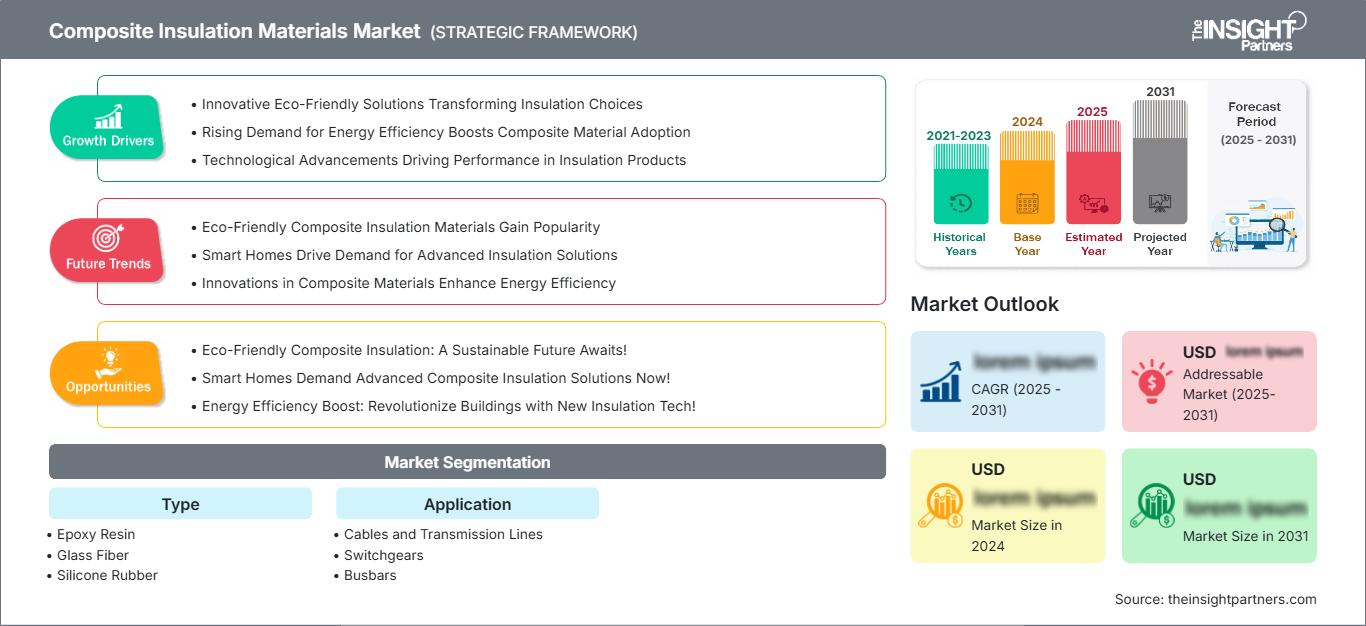
Composite Insulation Materials Market: Strategic Insights
Regional Insights
North America Composite Insulation Materials Market
The North American market is expected to account for 27–31% of global revenues in 2025 and register CAGR growth in the range of 7.5–8.5% up to 2034. Utilities are actively adopting composite materials due to the aging of their transmission infrastructure combined with the growing need to accommodate electrification, renewable generation, and heavy industrial loads. Composite insulation is gaining favor in the market due to the requirement of high dielectric strength, low weight, corrosion resistance, and longevity.
The investment of utility companies is stimulated by grid modernization activities of federal authorities and the increase in the demand for transmission infrastructure. There is demand for composite insulation in transmission lines, switchgears, substations, and other related equipment. There are regular opportunities in replacement of equipment. Canada plays its part through transmission infrastructure to facilitate renewable generation and industrial projects.
U.S. Composite Insulation Materials Market
The US is believed to contribute up to 75-82% of North America's 2025 market share, which equals about 22-25% of the global market and will grow at a 7.5-8.5% CAGR until 2034. The drivers of growth include transmission system modernization, renewables integration, industrial electrification, and rapid expansion of electricity needs of data centers. Increasingly, grid operators need insulation materials that can withstand greater electrical stress and adverse environmental conditions.
Insulation materials are used in cables, transmission systems, switchgears, and busbars; the needs of switchgears and high-voltage transmission lines result in even greater demand for engineered composite insulating materials. There are a number of international suppliers competing with specialist suppliers. Local transformer and grid equipment production is contributing to greater demand for matching insulation materials.
Europe Composite Insulation Materials Market
Europe is estimated to account for 22–26% share in 2025 and expand at a 7.0–8.0% CAGR through 2034. Germany is the leading national market, supported by industrial electrification and transmission reinforcement. The UK is strengthening networks for offshore wind integration, while France requires reliable grid infrastructure for nuclear, renewable, and industrial loads. Italy and Spain are also expanding grid capacity as renewable penetration rises.
Across the region, grid operators face increasing requirements for interconnection, resilience, and renewable integration. Composite insulation is consequently gaining importance in compact switchgear, transmission equipment, substations, and high-voltage components. Germany remains the leading country by demand, while the UK and Spain offer strong project pipelines associated with renewable power. European manufacturers also emphasize material efficiency, durability, and lower environmental impact throughout equipment lifecycles.
APAC Composite Insulation Materials Market
APAC is estimated to hold 31–35% share in 2025 and register a 9.0–10.0% CAGR through 2034, making it the fastest-growing major region. China leads regional consumption, followed by Japan, South Korea, India, and Australia. Large transmission projects, renewable integration, industrial expansion, and electrification are strengthening demand for engineered insulation.
China's ultra-high-voltage development provides substantial structural demand, while India is expanding transmission infrastructure to accommodate non-fossil generation. Japan and South Korea emphasize grid reliability and advanced electrical equipment, while Australia requires network investment to connect renewable resources. Government-backed infrastructure programs and domestic manufacturing initiatives are supporting local supply chains, qualification capabilities, and investment in high-performance insulation components.
Middle East & Africa Composite Insulation Materials Market
Middle East & Africa is projected to expand at approximately 6.5–7.5% CAGR through 2034, with Saudi Arabia representing the leading demand center. UAE investment in power infrastructure and South Africa's network modernization provide additional opportunities, while the rest of MEA is supported by electrification and generation projects.
The region's demand is closely linked with large-scale energy infrastructure, industrial development, renewable projects, and transmission expansion. Harsh heat, dust, humidity, and pollution create requirements for materials with strong environmental resistance. Composite insulation therefore offers advantages in outdoor electrical applications where conventional materials can face accelerated degradation. Saudi Arabia's large power and renewable programs provide particularly strong prospects for high-voltage equipment and associated insulation components.
Segmentation Analysis
Type
Type is a fundamental segmentation dimension because insulation performance depends on electrical strength, thermal endurance, mechanical loading, moisture resistance, manufacturing method, and operating environment. The segment is projected to grow at a 7.5–8.5% CAGR during 2026–2034, with epoxy resin and glass fiber maintaining broad industrial adoption while silicone rubber expands in outdoor applications.
- Epoxy Resin: Epoxy resin holds a strong position in rigid electrical insulation because of its dielectric strength, dimensional stability, adhesion, and compatibility with glass-fiber reinforcement. Demand is concentrated in high-voltage equipment and molded components.
- Glass Fiber: Glass fiber provides mechanical reinforcement and dimensional stability in composite insulation structures. Its strategic importance increases where lightweight construction, tensile strength, fatigue resistance, and electrical performance must be combined within compact equipment.
- Silicone Rubber: Silicone rubber is increasingly important for outdoor insulation because hydrophobicity, weather resistance, thermal stability, and resistance to contamination support reliable performance in demanding transmission and distribution environments.
- Stone Wool: Stone wool serves insulation requirements where thermal resistance, fire performance, and inorganic material characteristics are important. Its relevance is strongest where electrical installations require additional thermal or fire-management properties.
Application
Application determines the operating conditions and performance requirements imposed on insulation materials. This segment is expected to expand at an 8.0–9.0% CAGR during 2026–2034, supported by transmission expansion, switchgear modernization, and increasing electrical loading across power networks.
- Cables and Transmission Lines: Demand is driven by network expansion, renewable interconnection, underground transmission, and higher-voltage systems. Insulation must withstand electrical stress, thermal cycling, moisture, mechanical loading, and long service periods.
- Switchgears: Switchgear applications require compact, mechanically stable insulation capable of maintaining dielectric separation under switching, thermal, and fault conditions. Growth is supported by substation modernization and increasing deployment of compact high-voltage equipment.
- Busbars: Busbar insulation supports compact electrical distribution and reliable current handling within switchboards and power equipment. Adoption is strengthened by higher power density, industrial electrification, modular equipment designs, and space-efficient electrical architectures.
Opportunity Snapshot
| Application | Revenue Contribution | Trend Tag | Adoption Stage |
|---|---|---|---|
| Cables and Transmission Lines | High | Grid Expansion | Scaling |
| Switchgears | High | Compact Switchgear | Mature |
| Busbars | Medium | Power Density | Scaling |
Composite Insulation Materials Market Growth Drivers and Impact Analysis
Accelerating Transmission Network Modernization
Transmission infrastructure is being expanded and refurbished as electricity systems integrate renewable generation, electrify industrial demand, and accommodate geographically concentrated generation resources. The US Department of Energy announced approximately US$1.9 billion in 2026 funding for accelerated transmission upgrades, while European planning indicates substantial long-term transmission and distribution requirements. These investments directly increase the addressable pool for high-voltage insulation components used in transmission equipment, substations, and associated switchgear. Composite materials can reduce component weight and improve resistance to corrosion, contamination, and mechanical stress. Suppliers with established qualification records are positioned to capture replacement as well as greenfield demand, particularly where utilities seek longer maintenance intervals and improved asset reliability.
Rising Electrical Load from Data Centers and Industrial Electrification
Electricity demand from data centers, electric mobility, advanced manufacturing, and industrial electrification is changing the loading profile of power networks. Large, concentrated loads require additional substations, transmission capacity, switchgear, transformers, and busbar systems, creating incremental demand for insulation materials throughout the electrical equipment chain. The impact is especially significant in North America, Europe, China, and India, where grid operators are balancing new load connections with reliability requirements. Higher power density also favors materials that maintain dielectric and thermal performance within compact designs. Manufacturers able to provide engineered insulation systems rather than commodity materials can benefit from higher qualification barriers and closer integration with equipment manufacturers during product design and procurement.
Expansion of Renewable Generation and Grid Interconnection
Solar, wind, storage, and hybrid generation projects require extensive transmission and substation infrastructure to connect variable generation with consumption centers. Grid reinforcement is particularly important where renewable resources are located far from industrial and population centers. Composite insulation benefits from this development because high-voltage equipment must operate reliably across outdoor environments, pollution exposure, temperature variation, and increased switching activity. China, India, Europe, Australia, and the US are especially important demand centers because their energy strategies require substantial network reinforcement. The resulting market impact extends beyond new transmission lines to switchgear replacement, substation upgrades, compact equipment, and retrofit programs. Material suppliers that combine electrical performance with weather resistance and process efficiency are likely to gain specification opportunities.
Composite Insulation Materials Market Future Trends
Greater Adoption of Advanced Multi-Material Insulation Systems
The next phase of material development is likely to emphasize engineered combinations rather than single-material insulation solutions. Manufacturers are expected to combine epoxy matrices, glass reinforcement, silicone surfaces, mineral fillers, and specialized additives to optimize dielectric strength, mechanical performance, thermal behavior, hydrophobicity, and environmental durability. Such combinations can reduce component dimensions while supporting higher voltage classes and longer operating periods. Digital simulation and automated manufacturing are also expected to improve consistency by enabling tighter control of resin distribution, fiber orientation, curing, and dimensional tolerances. Over time, material qualification will increasingly evaluate complete component performance under electrical, mechanical, thermal, and environmental stresses rather than relying on isolated laboratory properties.
Lower-Impact Manufacturing and Electrification-Focused Material Design
Environmental considerations are expected to influence insulation formulation and manufacturing more strongly as utilities and equipment manufacturers establish broader sustainability requirements. Suppliers will increasingly investigate lower-emission processing, longer service life, reduced material intensity, recyclable reinforcement strategies, and manufacturing processes that consume less energy. At the same time, electrical systems will require materials capable of supporting higher voltage and power density without proportionally increasing component size. This combination will encourage research into optimized resin systems, advanced fillers, improved silicone formulations, and more efficient composite processing. Manufacturers that can demonstrate measurable lifecycle advantages while maintaining stringent electrical performance will be better positioned in future equipment qualification programs and large infrastructure procurement cycles.
Composite Insulation Materials Market Opportunities
Regionalized Production for Critical Grid Components
Regional manufacturing represents a strategic opportunity because long lead times for electrical equipment can delay transmission and generation projects. Insulation suppliers can capture value by establishing production, machining, finishing, and testing capabilities closer to major equipment manufacturing clusters. North America offers opportunities associated with domestic grid-equipment investment, while India and Southeast Asia provide cost-competitive manufacturing locations for APAC supply. Europe also offers opportunities for high-specification production linked with advanced grid projects. Localized facilities can improve delivery reliability, reduce logistics exposure, simplify customer qualification support, and strengthen collaboration during equipment development. Suppliers that combine local manufacturing with centralized material research can potentially achieve both responsiveness and technical consistency across international projects.
Integrated Insulation Solutions for High-Voltage Equipment
A second opportunity lies in moving from individual material sales toward engineered insulation packages that combine materials, components, machining, testing, and application support. Equipment manufacturers increasingly require insulation systems that are compatible with defined voltage classes, thermal limits, mechanical loads, pollution levels, and installation environments. Integrated suppliers can participate earlier in product development and become embedded within customer qualification processes, creating stronger switching barriers than commodity material suppliers. The opportunity is particularly relevant for switchgears, transformer components, transmission equipment, and compact busbar assemblies. Strategic investment in testing laboratories, application engineering, automated processing, and digital design tools can therefore create differentiation while improving manufacturing repeatability and reducing customers' engineering burden.
Recent Developments
- October 2025: Saint-Gobain, through its building materials division CertainTeed Siding, announced its acquisition of RISE Building Products (RISE), an innovative manufacturer of composite cladding in the United States. RISE’s patented technology enhances the production of siding products made from recycled materials. This acquisition follows a successful joint venture between CertainTeed and RISE, which began in early 2024.
- May 2025: Tata AutoComp Systems Ltd., a leading Indian automotive components manufacturer, and Katcon Global, a leader in exhaust systems, thermal insulation and advanced materials components, announced a new joint venture in Mexico to manufacture advanced composites, with a focus on serving the North American market. The venture will specialize in lightweight applications for passenger and commercial vehicles, agricultural tractors, off-road vehicles, and specialized non-automotive segments.
Frequently Asked Questions

- Comprehensive Market Sizing and Forecast Analysis
- Detailed Segmentation Analysis
- In-Depth Market Dynamics Assessment
- Regional and Country-Level Insights
- Competitive Landscape and Company Benchmarking
- Strategic Business Intelligence
Recent Reports
Testimonials

The Insight Partners' SCADA System Market report is comprehensive, with valuable insights on current trends and future forecasts. The team was highly professional, responsive, and supportive throughout. We are very satisfied and highly recommend their services.
RAN KEDEM Partner, Reali Technologies LTDs
I requested a report on a very specific software market and the team produced the report in a few days. The information was very relevant and well presented. I then requested some changes and additions to the report. The team was again very responsive and I got the final report in less than a week.
JEAN-HERVE JENN Chairman, Future Analytica
We worked with The Insight Partners for an important market study and forecast. They gave us clear insights into opportunities and risks, which helped shape our plans. Their research was easy to use and based on solid data. It helped us make smart, confident decisions. We highly recommend them.
PIYUSH NAGPAL Sr. Vice President, High Beam Global
The Insight Partners delivered insightful, well-structured market research with strong domain expertise. Their team was professional and responsive throughout. The user-friendly website made accessing industry reports seamless. We highly recommend them for reliable, high-quality research services
YUKIHIKO ADACHI CEO, Deep Blue, LLC.
This is the first time I have purchased a market report from The Insight Partners.While I was unsure at first, I visited their web site and felt more comfortable to take the risk and purchase a market report.I am completely satisfied with the quality of the report and customer service. I had several questions and comments with the initial report, but after a couple of dialogs over email with their analyst I believe I have a report that I can use as input to our strategic planning process.Thank you so much for taking the extra time and making this a positive experience.I will definitely recommend your service to others and you will be my first call when we need further market data.
JOHN SUZUKI President and Chief Executive Officer, Board Director, BK Technologies
I wish to appreciate your support and the professionalism you displayed in the course of attending to my request for information regarding to infectious disease IVD market in Nigeria. I appreciate your patience, your guidance, and the fact that you were willing to offer a discount, which eventually made it possible for us to close a deal. I look forward to engaging The Insight Partners in the future, all thanks to the impression you have created in me as a result of this first encounter.
DR CHIJIOKE ONYIA MANAGING DIRECTOR, PineCrest Healthcare Ltd.Reason to Buy
- Informed Decision-Making
- Understanding Market Dynamics
- Competitive Analysis
- Identifying Emerging Markets
- Customer Insights
- Market Forecasts
- Risk Mitigation
- Boosting Operational Efficiency
- Strategic Planning
- Investment Justification
- Tracking Industry Innovations
- Aligning with Regulatory Trends





 Get Free Sample for