
Concentrated Nitric Acid Market Size, Demand & Growth by 2034
Coverage: by Type (Strong Nitric Acid, Fuming Nitric Acid); Application (Ammonium Nitrate, Adipic Acid, Nitrobenzene, Toluene Diisocyanate, Others); End use Industry (Agrochemicals, Explosives, Automotive, Electronics, Others) , and Geography (North America, Europe, Asia Pacific, and South and Central America)
- Status : Data Released
- Report Code : TIPRE00005483
- Category : Chemicals and Materials
- No. of Pages : 150
- Available Report Formats :


- Last update date : August 24, 2026


2025 Market Size
US$ 19.74 Bn
Base year value
2034 Forecast
US$ 25.87 Bn
Projected by 2034
CAGR 2026-2034
3.05 %
Growth rate
Addressable Market
US$ 207.08 Bn
(2026-2034)
The Concentrated Nitric Acid market size is estimated at US$ 19.74 Billion in 2025 and expected to grow at a compound annual growth rate of 3.05% to reach US$ 25.87 Billion by 2034. Key drivers include the application of concentrated grades in the manufacture of ammonium nitrate, adipic acid, nitrobenzene, and toluene diisocyanate products and rising demand for high purity chemicals used in electronics and specialty chemicals industries.
North America remains strategically significant as a base for production and consumption of nitric acid due to presence of integrated ammonia to nitric acid plants, fertilizer production, mining activities, and industrial chemicals manufacturing. Regional prospects will be impacted by investments in green ammonia, plant modernizations and emissions control measures. Ample feedstock availability and well-established manufacturing value chains could lead to relatively steady growth through 2034.
Concentrated Nitric Acid Market Assessment and Insights
- North America accounted for an estimated 14–17% Concentrated Nitric Acid Market share in 2025 and is expected to grow at a 2.7–3.1% CAGR between 2026–2034, supported by integrated chemical production and mining applications.
- US represented approximately 72–76% of North America's 2025 market and is projected to expand at a 2.5–2.9% CAGR between 2026–2034, led by fertilizer, chemicals, and explosives demand.
- Europe held an estimated 18–21% share in 2025 and is expected to register a 1.8–2.3% CAGR between 2026–2034, with Germany, France, the UK, Italy, and Spain remaining important industrial markets.
- Asia Pacific represented approximately 52–56% share in 2025 and is projected to grow at a 3.4–3.8% CAGR between 2026–2034, led by China, India, Japan, South Korea, and Australia.
- Largest Segment: Strong Nitric Acid accounted for approximately 78–82% market share in 2025 and is expected to grow at a 2.8–3.2% CAGR during 2026–2034, reflecting broad industrial applicability.
- High Growth Segment: Electronics accounted for approximately 5–7% market share in 2025 and is projected to grow at a 5.0–5.6% CAGR during 2026–2034, supported by high-purity chemical requirements.
- Key companies analyzed in detail: Nutrien Ltd., BASF SE, DuPont de Nemours, Inc., Hanwha Corporation, LSB Industries, Inc., OCI N.V., The Linde Group, UBE Corporation, Yara International ASA, CF Industries Holdings, Inc., Deepak Fertilisers and Petrochemicals Corporation Limited, and Orica Limited.
Source: The Insight Partners' analysis based on proprietary research, government publications, company annual reports, investor presentations, industry databases, and expert interviews.
There has been an evolution in the production process to use integrated ammonia and nitric acid complexes which help in ensuring feedstock security, efficiency in energy usage, and downstream conversion economics. Technology for concentration helps in increasing the purity of weak nitric acid into commercial concentrated acid, where absorption, rectification, corrosion control, and emissions control are critical aspects of production. There is also an increased focus on high-purity production due to rising demands of semiconductors and electronics industry.
According to the Concentrated Nitric Acid market forecast, the future will be influenced more by the capacity expansions in Asia, targeted investments in North America, and decarbonization needs in Europe. Nitrous oxide reduction, renewable power, low-carbon ammonia, and new process catalysts will become part of the investment strategy and not just environmental projects. Companies that have integrated assets and sources of competitive ammonia and energy supplies will be well placed moving forward.
Concentrated Nitric Acid Market Report Scope
| Report Attribute | Details |
|---|---|
| Market size in 2025 | US$ 19.74 Billion |
| Market Size by 2034 | US$ 25.87 Billion |
| Global CAGR (2026 - 2034) | 3.05% |
| Historical Data | 2021-2024 |
| Forecast period | 2026-2034 |
Concentrated Nitric Acid Market Analysis
The key driver for demand is downstream conversion and not direct use, thus fertilizer, explosives, polyurethane, nylon, and chemical manufacture are critical demand drivers. Ammonium nitrate continues to be one of the largest consumers of nitric acid while adipic acid, nitrobenzene, and TDI are the diversifiers in chemical demand. The process flow usually starts from ammonia oxidation, then absorption, and when needed, concentration. Thus, the competition lies in ammonia supply, energy efficiency, capacity utilization, logistics, purity, and environmental performance.
Supply conditions differ greatly depending on the geography of the region. For integrated producers, it is possible to cover their ammonia and downstream nitrate production, thus minimizing dependency on external feedstocks and logistics. In regions where the production is not integrated, the economics of delivery is more dependent on ammonia, natural gas, electricity, freight, and storage costs. Higher concentration grades also have a number of technical challenges including equipment resistant to corrosion, proper storage, and proper transportation.
The Concentrated Nitric Acid Market forecast indicates that competitive dynamics involve large scale integrated nitrogen producers as well as specialty chemical manufacturers for higher purity applications. Nutrien Ltd., Yara International ASA, OCI N.V., and CF Industries Holdings, Inc. enjoy benefits from integration of nitrogen value chain, whereas BASF SE, DuPont de Nemours, Inc., and Hanwha Corporation are involved in downstream chemical and industrial applications. The company that provides unique high-purity nitric acid capabilities is UBE Corporation, whereas Deepak Fertilisers and Petrochemicals Corporation Limited and LSB Industries, Inc. have strengthened their regional presence.
The Concentrated Nitric Acid Market trends show that investments are made in capacity optimization, emission reduction, specialized products, and vertical integration instead of uncontrolled capacity growth in commodities. Nitrogen product range of Yara is an example of the significance of emissions control, whereas semiconductor industry oriented investment of UBE Corporation is an example of attractiveness of high-purity applications. The producers are also looking at low-carbon ammonia and plant upgrading to mitigate energy risks. Competitive advantage would be achieved increasingly through feedstock integration, diversified applications, geographical proximity, and meeting environmental and purity requirements.
● REPORT CUSTOMIZATION
Tailor This Report To Align With Your Specific Business Requirements
This report can be customized to align precisely with your business objectives, scope, and target markets. Customization options include tailored segmentation, geography, competitive analysis, and strategic insights to support informed decision-making.
Customize This Report →WHAT YOU CAN ADJUST
- ● Segmentations
- ● Geography
- ● Competitive Analysis
- ● Language Preferences
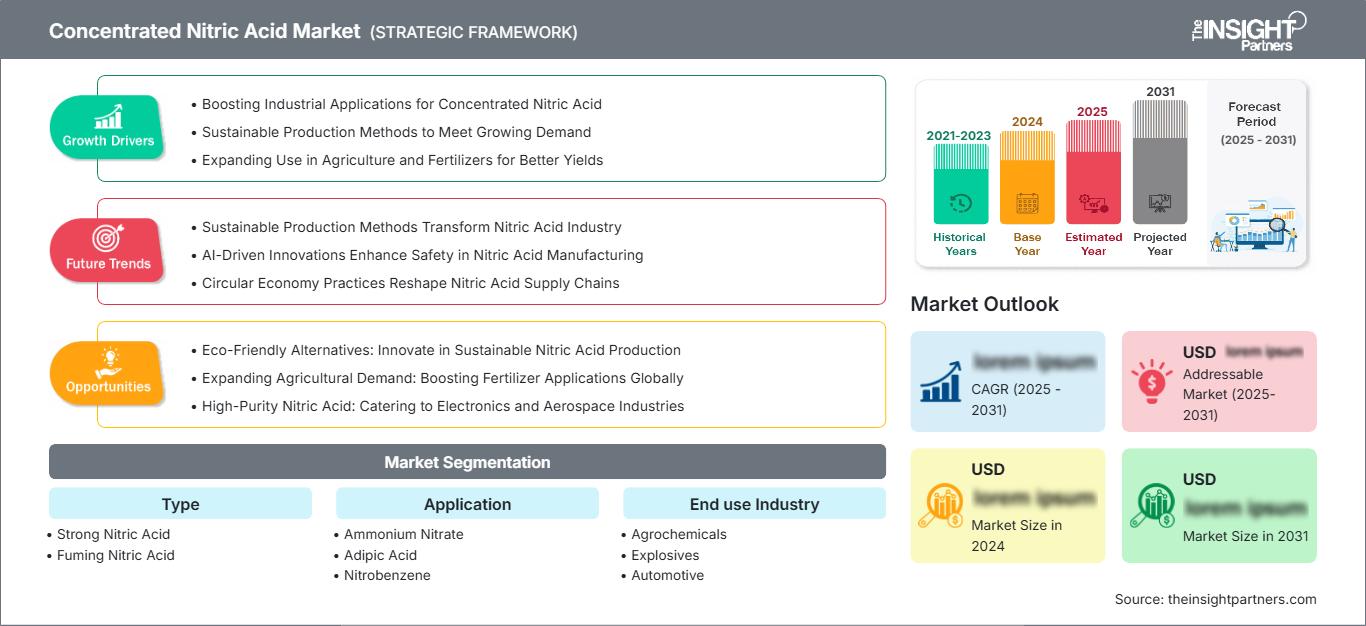
Concentrated Nitric Acid Market: Strategic Insights
Regional Insights
North America Concentrated Nitric Acid Market
North America accounted for 14-17% of global Concentrated Nitric Acid Market in 2025 and is expected to grow at a CAGR of 2.7-3.1% through 2034. The region is favored by an already established ammonia infrastructure, extensive agricultural demand, mining operations, and chemical production. The US is the key market in the region, with Canada contributing through fertilizer and industrial chemicals use. Domestic access to raw materials ensures economic production, but natural gas, power, transportation, and environmental costs remain relevant. Companies are looking into the options of lower carbon ammonia and process efficiencies as their industrial customers demand supply chain resilience and emission reduction.
Demand in the region is diversified across ammonium nitrate, adipic acid, nitrobenzene, TDI, and industrial uses. Explosives demand is related to mining and quarrying activities, infrastructure construction, and the energy sector, while chemical uses represent a stable industrial demand base. Modernization and emissions reduction investment will help ensure consistent production, especially if companies are able to upgrade rather than replace existing assets. North American producers are also well positioned to take advantage of increasing domestic chemical production and supply chain localization, although imports and energy price fluctuations may affect economics.
U.S. Concentrated Nitric Acid Market Market
The US contributed about 72%–76% of the Concentrated Nitric Acid Market share in North America in 2025 and is forecast to expand at a CAGR of 2.5%–2.9% up to 2034. This is due to substantial fertilizer production, industrial chemicals, mining, and explosives use. The integrated nitrogen producers can take advantage of well-developed ammonia infrastructure and large customer base downstream, while specialty producers target the chemical and high-purity applications. The local production helps in reducing dependency on long-range transportation of a corrosive and regulated commodity.
There are shifts in application trends towards areas other than conventional ammonium nitrate use. Adipic acid and polyurethane value chain drive the chemical usage, and electronics manufacturing offers possibilities for the high purity product. Companies like CF Industries Holdings, Inc., LSB Industries, Inc., and Nutrien Ltd. are active in the nitrogen value chain, while the global chemical producers have the downstream exposure. Environmental regulations, N2O emissions reduction, reliability of operations, and energy efficiency become more important drivers in capital expenditures and procurement.
Europe Concentrated Nitric Acid Market Market
In 2025, Europe was approximately 18-21% of total global Concentrated Nitric Acid Market and projected to experience CAGR growth between 1.8% to 2.3% until 2034. Germany continues to be the dominant market country due to its integrated chemicals manufacturing, while France, the UK, Italy, and Spain continue to have important fertilizer, industrial, automotive, and specialty chemical markets. High energy costs and stringent emissions regulations limit commodity growth, with increased focus on efficiency and integration.
The UK continues to have demand for fertilizers, industrial chemicals, defense manufacturing, and explosives; however, domestic chemical manufacturing is under pressure from foreign chemical competition and high cost of operation. Germany has an especially strong base for chemical manufacturing that drives demand for nitric acid with its integrated downstream supply chain. France continues to benefit from its agriculture and industrial chemical applications, while Italy and Spain offer demand for fertilizers, chemicals, automotive-related chemicals, and industrial processing. There is growing focus among European producers on N2O abatement, energy efficiency, low-carbon ammonia integration, and selective modernization.
APAC Concentrated Nitric Acid Market Market
The Asia Pacific region had about 52-56% of global demand in 2025 and will grow at a 3.4-3.8% CAGR to 2034. Leading countries include China, India, Japan, South Korea, and Australia. Demand will be driven by production of chemicals, fertilizers, mining explosives, electronics, and polyurethane. Growth is becoming increasingly centered on integrated industrial complexes, whereas high purity grades are benefiting from semiconductor manufacturing and electronics localization.
China benefits from its large chemical industry, India is developing its own domestic capacity for nitrogen and industrial chemicals, whereas Japan and South Korea are focused on high purity grades and manufacturing. Australia, on the other hand, is well-connected to mining chemicals and explosives. Industrial policies, semiconductor investments, infrastructure development, and localization of the supply chain are likely to keep the demand robust. Manufacturers are also investing in emissions reduction and efficiency improvements due to tighter industrial environmental regulations.
Middle East & Africa Concentrated Nitric Acid Market Market
MEA is forecast to experience 3.0-3.5% CAGR growth until 2034 on the basis of fertilizer manufacturing, mining, industry diversification, and infrastructure construction. Saudi Arabia will be leading in the region's development, whereas the UAE will be benefiting from the chemical logistics and industrial investments. South Africa will be remaining important due to the demand for mining and explosives. Markets in the rest of MEA are smaller, but offer possibilities where the domestic fertilizer and mining capacities increase.
The availability of energy resources is going to be an important competitive advantage for the Gulf players, especially when ammonia and the related nitrogen chemicals are being integrated. The development of the low-carbon ammonia value chain in Saudi Arabia can help in the future competitiveness of the nitrogen chain, whereas the logistics infrastructure in the UAE is going to allow for the regional distribution. The demand in South Africa will be more linked to mining and industrial explosives.
Segmentation Analysis
Type
Strong Nitric Acid accounted for the dominant product position in 2025 and is projected to grow at a 2.9–3.2% CAGR during 2026–2034. Its broad applicability across industrial oxidation, nitration, fertilizer intermediates, explosives, and chemical synthesis supports stable demand. Fuming grades occupy specialized applications where higher concentration and strong oxidizing performance justify premium handling and production requirements.
- Strong Nitric Acid remains the principal commercial grade because it combines broad downstream applicability with established production infrastructure. Demand is supported by fertilizer intermediates, chemical synthesis, metal treatment, and industrial oxidation.
- Fuming Nitric Acid serves more specialized requirements where very high concentration and strong oxidizing properties are necessary. Strategic demand comes from explosives, specialty chemicals, propulsion-related applications, and selected advanced manufacturing processes.
Application
Application demand is projected to expand at a 2.9–3.3% CAGR during 2026–2034, with ammonium nitrate remaining the largest outlet while specialty chemical applications provide diversification. The balance is gradually shifting toward higher-value chemical and electronic uses as manufacturers seek application-specific grades, consistent quality, and greater supply reliability.
- Ammonium Nitrate remains a core application because nitric acid is chemically integrated into fertilizer and explosives value chains. Agricultural nutrient demand and mining activity create recurring requirements, although regional regulations influence product allocation.
- Adipic Acid provides demand from nylon 6,6 and polyurethane-related value chains. Automotive lightweighting, durable polymers, and industrial materials support consumption, with producers emphasizing reliable purity and consistent oxidation performance.
- Nitrobenzene is strategically important because it feeds aniline and downstream polyurethane intermediates. Expanding construction, automotive, furniture, and insulation applications can support demand through the broader MDI and polyurethane value chain.
- Toluene Diisocyanate demand is linked to polyurethane flexible foams, coatings, adhesives, and related materials. Nitric acid participates upstream through nitration chemistry, connecting consumption with construction, furniture, transportation, and industrial manufacturing.
End use Industry
End-use industries are expected to grow at a 3.1–3.6% CAGR during 2026–2034 as traditional fertilizer and explosives applications coexist with higher-growth electronics and specialty manufacturing. Increasing process purity requirements and supply-chain localization should improve the strategic value of reliable concentrated grades.
- Agrochemicals remain a foundational end-use industry because nitrogen products and related intermediates support agricultural productivity. Demand follows fertilizer production, crop economics, nutrient application requirements, and regional food-security policies.
- Explosives generate concentrated demand through ammonium nitrate and nitration chemistry used in mining, quarrying, infrastructure, and defense-related applications. Mining investment and infrastructure development remain key determinants of regional consumption.
- Automotive uses nitric-acid-derived intermediates through adipic acid, polyurethane, coatings, and other chemical chains. Vehicle production, lightweight materials, seating, insulation, and polymer demand indirectly support nitric acid consumption.
- Electronics represents a smaller but rapidly developing end-use industry because high-purity nitric acid is used in semiconductor cleaning and etching. Semiconductor localization and advanced-node manufacturing are strengthening this application.
Opportunity Snapshot
| End use Industry | Revenue Contribution (High/Medium/Low) | Trend Tag (MAX 2 words) | Adoption Stage (Emerging/Scaling/Mature) |
|---|---|---|---|
| Agrochemicals | High | Nutrient Security | Mature |
| Explosives | Medium | Mining Blasting | Mature |
| Automotive | Medium | Polymer Demand | Mature |
| Electronics | Low | Wafer Cleaning | Scaling |
Concentrated Nitric Acid Market Growth Drivers and Impact Analysis
Expansion of Integrated Nitrogen Chemical Complexes
According to the Concentrated Nitric Acid Market report, integrated ammonia, nitric acid, ammonium nitrate, and downstream chemical complexes are strengthening supply reliability and improving production economics. Vertical integration allows producers to coordinate ammonia procurement, acid production, downstream conversion, storage, and logistics, reducing exposure to external feedstock disruptions. This structure is particularly important where ammonia represents a major variable cost and transportation of concentrated acid introduces safety and compliance requirements. New capacity is therefore increasingly evaluated as part of a broader nitrogen-chain strategy rather than as an isolated acid project. The impact is likely to include higher utilization rates, improved inventory management, and greater regional supply resilience. Integrated producers can also direct material toward fertilizer, explosives, or industrial chemical customers according to relative margins, making their portfolios more adaptable to changing downstream demand.
Rising Demand for High-Purity Chemicals in Electronics
Semiconductor manufacturing is creating a structurally different demand pool for high-purity nitric acid. Wafer cleaning and etching require tightly controlled chemical specifications, low metallic contamination, stable concentration, and reliable packaging and delivery systems. As semiconductor manufacturing expands across Asia, North America, and Europe, chemical suppliers are increasingly developing dedicated purification and quality-control capabilities. This application has a smaller volume requirement than fertilizer-linked consumption but can support stronger value realization because qualification requirements and process reliability create barriers to entry. The growth of advanced computing, data centers, automotive electronics, and artificial intelligence hardware further strengthens the downstream opportunity. Suppliers capable of maintaining consistent purity across geographically distributed production and logistics networks can develop longer customer relationships and reduce exposure to commodity-oriented pricing.
Mining and Infrastructure Activity Supporting Explosives Demand
Mining and infrastructure development continue to support nitric acid consumption through ammonium nitrate and related explosive products. Quarrying, metal extraction, construction, and civil engineering projects require blasting systems that depend on consistent chemical inputs and dependable regional supply. Demand is particularly relevant in Australia, North America, South Africa, Latin America, and selected Asian markets where mining remains a major industrial activity. The market impact extends beyond direct nitric acid volumes because integrated suppliers can capture value across ammonia, ammonium nitrate, technical-grade products, and blasting services. Mining companies are simultaneously seeking safer and lower-emission blasting solutions, encouraging suppliers to improve product quality, logistics, and environmental performance. Long-term supply agreements can therefore become strategically important, particularly in remote mining regions where transportation and storage constraints increase the value of local production.
Concentrated Nitric Acid Market Future Trends
Greater Adoption of Low-Carbon Nitrogen Production
Low-carbon ammonia is expected to become increasingly relevant to nitric acid production as nitrogen manufacturers seek to reduce the embedded emissions of downstream products. Green and blue ammonia projects can provide alternative feedstock pathways, while renewable electricity can lower emissions associated with auxiliary plant operations. Nitrous oxide abatement will remain especially important because nitric acid production can generate N2O during ammonia oxidation. Producers are likely to combine catalyst improvements, thermal destruction, renewable power procurement, and carbon-management measures rather than rely on one technology. Customer procurement policies may gradually introduce carbon-intensity requirements alongside conventional specifications. This shift could create differentiated product categories, encourage premium pricing for lower-carbon grades, and influence the location of future capacity toward regions offering competitive clean energy, ammonia infrastructure, and supportive industrial policies.
Specialty and High-Purity Grades Gain Strategic Importance
The product mix is expected to become more differentiated as semiconductor, electronics, pharmaceutical, and advanced manufacturing applications increase their requirements for controlled chemical purity. Producers are likely to invest in additional purification, contamination monitoring, dedicated storage, specialized packaging, and application-specific quality assurance. These investments can create stronger customer qualification barriers than conventional commodity production and reduce sensitivity to short-term fertilizer cycles. High-purity demand will also encourage regional production near semiconductor clusters because shorter supply chains improve reliability and reduce handling complexity. Asia Pacific should remain a major center of this transition because of its electronics manufacturing base, while North America and Europe are likely to expand local chemical supply alongside semiconductor capacity. Over time, specialty grades could become an important portfolio-balancing mechanism for integrated producers.
Concentrated Nitric Acid Market Opportunities
Localized Production Near Emerging Industrial Clusters
New industrial clusters in India, Southeast Asia, the Middle East, and North America present opportunities for localized concentrated nitric acid supply. Investors can target sites where ammonia, natural gas, renewable energy, fertilizer plants, mining customers, and chemical manufacturers are located within efficient logistics corridors. Co-location can reduce transportation exposure while enabling flexible allocation across ammonium nitrate, specialty chemicals, and industrial customers. Project developers should prioritize reliable feedstock access, corrosion-resistant infrastructure, compliant storage, and established hazardous-material transportation networks. Long-term offtake agreements with fertilizer, explosives, polyurethane, and chemical manufacturers can improve project bankability. The opportunity is strongest where existing supply is dependent on imports or where downstream industries are expanding faster than domestic acid capacity.
Investment in Decarbonized and Specialty Production Platforms
Investors can capture emerging value by combining emissions-reduction technologies with high-purity production capabilities. Nitrous oxide abatement can reduce environmental exposure, while low-carbon ammonia and renewable electricity can improve the future carbon profile of nitric acid output. At the same time, dedicated purification systems can address semiconductor and electronics requirements that are less sensitive to commodity pricing. A combined platform can diversify revenue between established industrial customers and higher-value specialty users. Producers should evaluate modular purification, digital process monitoring, catalyst optimization, and dedicated logistics infrastructure when upgrading existing assets. Strategic partnerships with semiconductor chemical suppliers, ammonia producers, and technology licensors can accelerate market entry while reducing technical risk. Such investments can also improve resilience against tightening environmental regulations and customer carbon-accounting requirements.
Recent Developments
- December 2025: A-1 Ltd (formerly A-1 Acid) entered into a tri-partite supply arrangement with leading companies for the supply of 10,000 tonnes of Concentrated Nitric Acid. The deal is a long-term supply arrangement for 10,000 tonnes of concentrated nitric acid for industrial use, valid till March next year, with provision for additional quantities by mutual consent.
- December 2025: Deepak Chem Tech, a subsidiary of Deepak Nitrite, started operations at its new Rs 515-crore nitric acid plant in Nandesari, Vadodara district, Gujarat. The new facility strengthens the company’s backward and forward integration capabilities, ensuring better supply security for essential intermediates. It boosts resilience across Deepak Nitrite’s overall chemical value chain.
Frequently Asked Questions

- Comprehensive Market Sizing and Forecast Analysis
- Detailed Segmentation Analysis
- In-Depth Market Dynamics Assessment
- Regional and Country-Level Insights
- Competitive Landscape and Company Benchmarking
- Strategic Business Intelligence
Recent Reports
Testimonials

The Insight Partners' SCADA System Market report is comprehensive, with valuable insights on current trends and future forecasts. The team was highly professional, responsive, and supportive throughout. We are very satisfied and highly recommend their services.
RAN KEDEM Partner, Reali Technologies LTDs
I requested a report on a very specific software market and the team produced the report in a few days. The information was very relevant and well presented. I then requested some changes and additions to the report. The team was again very responsive and I got the final report in less than a week.
JEAN-HERVE JENN Chairman, Future Analytica
We worked with The Insight Partners for an important market study and forecast. They gave us clear insights into opportunities and risks, which helped shape our plans. Their research was easy to use and based on solid data. It helped us make smart, confident decisions. We highly recommend them.
PIYUSH NAGPAL Sr. Vice President, High Beam Global
The Insight Partners delivered insightful, well-structured market research with strong domain expertise. Their team was professional and responsive throughout. The user-friendly website made accessing industry reports seamless. We highly recommend them for reliable, high-quality research services
YUKIHIKO ADACHI CEO, Deep Blue, LLC.
This is the first time I have purchased a market report from The Insight Partners.While I was unsure at first, I visited their web site and felt more comfortable to take the risk and purchase a market report.I am completely satisfied with the quality of the report and customer service. I had several questions and comments with the initial report, but after a couple of dialogs over email with their analyst I believe I have a report that I can use as input to our strategic planning process.Thank you so much for taking the extra time and making this a positive experience.I will definitely recommend your service to others and you will be my first call when we need further market data.
JOHN SUZUKI President and Chief Executive Officer, Board Director, BK Technologies
I wish to appreciate your support and the professionalism you displayed in the course of attending to my request for information regarding to infectious disease IVD market in Nigeria. I appreciate your patience, your guidance, and the fact that you were willing to offer a discount, which eventually made it possible for us to close a deal. I look forward to engaging The Insight Partners in the future, all thanks to the impression you have created in me as a result of this first encounter.
DR CHIJIOKE ONYIA MANAGING DIRECTOR, PineCrest Healthcare Ltd.Reason to Buy
- Informed Decision-Making
- Understanding Market Dynamics
- Competitive Analysis
- Identifying Emerging Markets
- Customer Insights
- Market Forecasts
- Risk Mitigation
- Boosting Operational Efficiency
- Strategic Planning
- Investment Justification
- Tracking Industry Innovations
- Aligning with Regulatory Trends





 Get Free Sample for