
Crop Harvesting Robots Market Growth, Trends & Demand by 2034
Coverage: By Product Type (Solar-Powered Crop Harvesting Robots, Autonomous Robots); Application (Grain harvesting robots, Fruit and vegetable harvesting robots) , and Geography (North America, Europe, Asia Pacific, and South and Central America)
- Status : Data Released
- Report Code : TIPRE00026488
- Category : Electronics and Semiconductor
- No. of Pages : 150
- Available Report Formats :


- Last update date : August 12, 2026


2025 Market Size
US$ 1.82 Bn
Base year value
2034 Forecast
US$ 8.86 Bn
Projected by 2034
CAGR 2026-2034
19.22 %
Growth rate
Addressable Market
US$ 43.64 Bn
(2026-2034)
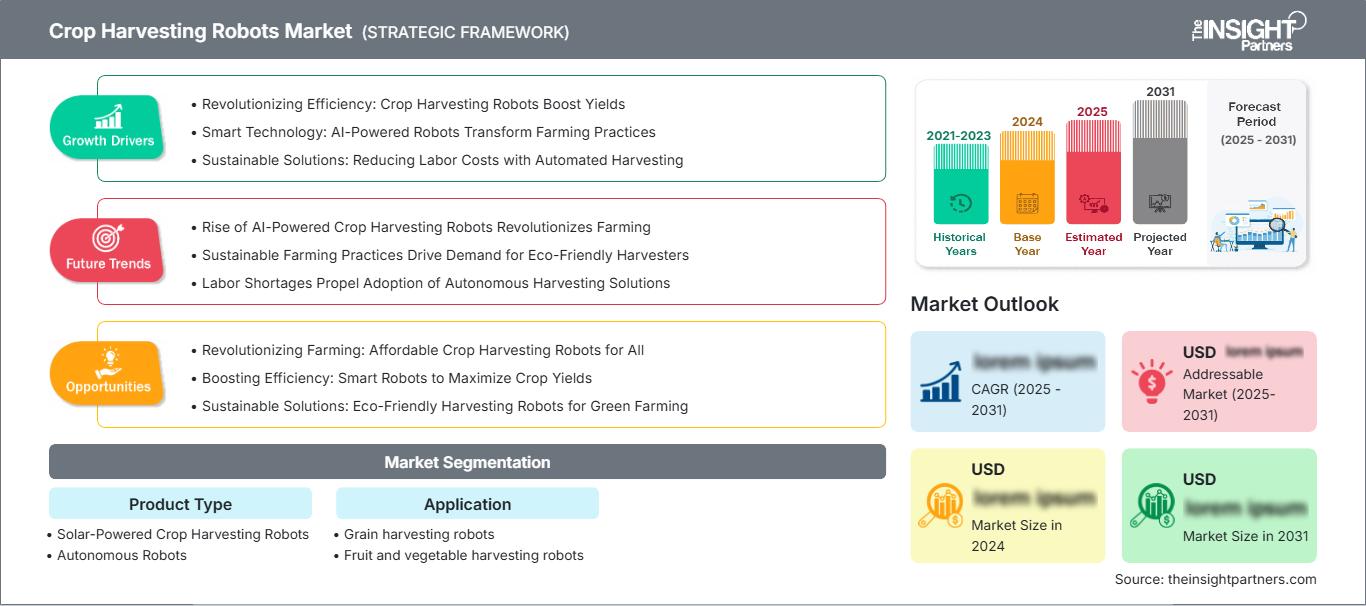
The Crop Harvesting Robots Market size stood at US$ 1.82 billion in 2025 and is forecasted to grow to US$ 8.86 billion by 2034. The market is anticipated to grow at a CAGR of 19.22% in 2026-2034, driven by the movement from manual harvesting operations towards AI-powered, sensor-driven, and automated crop harvesting robots in grains, fruits, and vegetables.
The Crop Harvesting Robots Market in North America is influenced by specialty crop labor shortage issues, automation in greenhouses, and commercialization of fruit harvesting robots. The region is anticipated to grow at a CAGR of 18-20% in 2026-2034 owing to usage by larger farms, controlled environment crop growers, and growers wanting less harvest loss, more reliable production, and crop quality sorting.
Crop Harvesting Robots Market Assessment and Insights
- North America accounted for 36–40% share in 2025 and is projected to grow at a CAGR of 18–20% between 2026–2034, supported by specialty-crop automation, farm consolidation, and strong venture activity.
- US represented 72–76% of North America in 2025 and is expected to grow at a CAGR of 18–20% between 2026–2034, led by strawberry, apple, and vegetable harvesting pilots.
- Europe held 27–31% share in 2025 and is forecast to grow at a CAGR of 17–19% between 2026–2034, with the UK, Germany, France, Spain, and Italy leading commercial adoption.
- Asia Pacific captured 21–25% share in 2025 and is projected to grow at a CAGR of 20–22% between 2026–2034, led by China, Japan, South Korea, India, and Australia.
- Largest Segment Fruit and vegetable harvesting robots held 58–62% market share in 2025 and are expected to grow at a CAGR of 19–21% between 2026–2034.
- High Growth Segment Autonomous Robots held 63–67% market share in 2025 and are forecast to grow at a CAGR of 20–22% between 2026–2034.
- Key companies analyzed in detail: Agrobot, Cerescon B.V., Clearpath Robotics Inc., Dogtooth Technologies Ltd., Energid Technologies Corporation, FFRobotics Ltd., Green Robot Machinery Pvt. Ltd., Harvest Automation Inc., Harvest CROO Robotics LLC, Tortuga Agricultural Technologies Inc.
Source: The Insight Partners' analysis based on proprietary research, government publications, company annual reports, investor presentations, industry databases, and expert interviews.
The progress in commercial development has been from simple one-use prototypes to multi-functional robots using technologies like machine vision, robotic arms, mobility, and crop analysis. The adoption of Crop Harvesting Robots is high in places where there is a short harvest window, high labor cost, and crop value. Modular robots are gaining popularity since they can be used in greenhouses, orchards, and polytunnels and collect data about their yields, ripeness, and quality.
Future developments will be from specialty crops production in North America and Europe and from demographic factors, protected crops production, and food security programs in Asia Pacific. There is also a focus on fleet use, robotics as a service, and working with growers. The regulatory environment is also favorable because of safer farm work, less chemical exposure, and resilient food supply chain in horticultural crops and high-value grain production.
Crop Harvesting Robots Market Report Scope
| Report Attribute | Details |
|---|---|
| Market size in 2025 | US$ 1.82 Billion |
| Market Size by 2034 | US$ 8.86 Billion |
| Global CAGR (2026 - 2034) | 19.22% |
| Historical Data | 2021-2024 |
| Forecast period | 2026-2034 |
Crop Harvesting Robots Market Analysis
The market is propelled by perennial shortage of seasonal harvesters, requirement to minimize wastage in crops, and timely harvesting for proper ripeness. Highest demands prevail for strawberries, asparagus, apples, berries, and greenhouses vegetables as quality considerations require delicate harvesting and picking process. In addition, field data provided by robots assist farmers in labor management, harvest forecasting, and increasing packhouse efficiency.
The ecosystem comprises of robot arm producers, artificial vision developers, farm management software companies, greenhouses, machinery distributors, and crop advisors. Nevertheless, while supply conditions are limited by hardware prices, field efficiency, and specialization for particular crops, lease arrangements and contractual services facilitate the entry barrier reduction process. The success of the market becomes evident where vendors incorporate harvesting function with grading, mapping, and agriculture intelligence capabilities.
Competitive positioning is disparate, where there are specialists catering to different kinds of produce and operational settings. Agrobot and Dogtooth Technologies Ltd. cater to soft-fruit harvesting, Cerescon B.V. caters to asparagus harvesting, FFRobotics Ltd. caters to orchard fruits, whereas Harvest CROO Robotics LLC and Tortuga Agricultural Technologies Inc. are oriented towards strawberry harvesting. According to the analysis of Crop Harvesting Robots Market, crop specialization, data and services are becoming equally important as the mechanical performance.
Investments are being made in companies that demonstrate consistent harvest precision, low damage, and scalable operational economics. Clearpath Robotics Inc. and Energid Technologies Corporation provide autonomous solutions and motion control respectively, whereas Green Robot Machinery Pvt. Ltd. indicates the interest in efficient mechanization in developing markets. Partnerships with farmers, vertical farms, and equipment dealers are going to influence the market more than isolated machinery purchases.
● REPORT CUSTOMIZATION
Tailor This Report To Align With Your Specific Business Requirements
This report can be customized to align precisely with your business objectives, scope, and target markets. Customization options include tailored segmentation, geography, competitive analysis, and strategic insights to support informed decision-making.
Customize This Report →WHAT YOU CAN ADJUST
- ● Segmentations
- ● Geography
- ● Competitive Analysis
- ● Language Preferences
Crop Harvesting Robots Market: Strategic Insights
Regional Insights
North America Crop Harvesting Robots Market
North America accounted for 36–40% share in 2025 and is expected to grow at a CAGR of 18–20% during 2026–2034. The Crop Harvesting Robots Market share is supported by high labor intensity in berries, apples, vegetables, and greenhouse crops, where growers face narrow harvest windows and rising wage exposure.
Commercial adoption is concentrated among large growers, controlled-environment farms, and technology-forward cooperatives. USDA-backed specialty-crop automation research and industry pilots strengthen confidence in sensor accuracy, machine vision, and robotic handling. Vendors benefit from customer proximity, field-testing networks, and financing models that convert capital expenditure into predictable seasonal operating costs.
U.S. Crop Harvesting Robots Market
In 2025, the US was responsible for 72%-76% of North America share and is expected to exhibit a CAGR of 18%-20% between 2026-2034. Market adoption is driven by the states of California, Florida, and Washington, as well as controlled-environment areas where selective harvesting of strawberries, apples, citrus, tomatoes, and leafy vegetables takes place.
Geographical market penetration is strong in the soft fruit and greenhouse sectors, which includes Harvest CROO Robotics LLC, Tortuga Agricultural Technologies Inc. and automation partners conducting field testing and fleet training. Key application trends include minimizing missed picking, consistent pack out rates, and harvesting data to predict labor, logistics and cold chain needs.
Europe Crop Harvesting Robots Market
Europe accounted for 27-31% share in 2025 and is expected to increase its share with a CAGR of 17-19% during 2026-2034. The UK represents one of the major users because of berry harvest, seasonal restrictions, and automation of glasshouses. Germany profits from good engineering background and investments in highly precise agricultural machinery.
In turn, France, Italy, and Spain increase the size of the market via fruit harvesting in orchards, grapes in vineyards, greenhouse vegetables, and asparagus. Protected horticulture in Spain and supply chains for exports contribute to testing of automation, while labor efficiency and quality maintenance are the primary drivers for France and Italy.
APAC Crop Harvesting Robots Market
The Asia Pacific region registered a market share of 21–25% in 2025 and is estimated to exhibit a CAGR of 20–22% during the forecast period, 2026 to 2034. China takes the lead with an interest in scale, greenhouse expansion, and food security, while Japan and South Korea consider aging farming population and protected cultivation, respectively.
India and Australia present unique markets, with mechanization and labor-saving practices being more cost-sensitive in India and more prevalent in Australia. Support in regional policy towards digital farming and smart agriculture fuels piloting projects. It is estimated that the market will grow fastest in regions that adapt robots to the crop and farm economics.
Middle East & Africa Crop Harvesting Robots Market
CAGR in the Middle East & Africa is expected to be around 16-18% in 2026-2034, with major implementations in controlled-environment agriculture in Saudi Arabia & the UAE. Energy-intensive requirements, food security policies, and greenhouse construction necessitate automation to minimize dependency on labor and maintain consistent productivity.
Selective implementation seen in South Africa & Rest of MEA for fruits, vegetables, and export-oriented horticulture. Limitations in infrastructure and financial constraints hinder widespread adoption, although solar-powered technology and subscription models will help in increasing feasibility. The market is in an initial phase within the region but holds strategic importance for drought-prone agricultural systems.
Segmentation Analysis
Product Type
Product Type is expected to record a CAGR of 19–21% during 2026–2034 as growers evaluate power configuration, autonomy level, payload capacity, and field adaptability. The Crop Harvesting Robots Market scope is increasingly defined by robots that can operate with minimal supervision, integrate renewable power where practical, and deliver reliable picking performance across varied crop formats.
- Solar-Powered Crop Harvesting Robots address farms seeking lower energy cost and reduced charging dependence, particularly in high-irradiance regions where long operating hours and remote-field deployment are operationally valuable.
- Autonomous Robots held 63–67% market share in 2025 and are prioritized for navigation, sensing, robotic picking, and fleet coordination because they reduce supervision needs and support scalable harvesting models.
Application
Application is projected to grow at a CAGR of 18–20% during 2026–2034 as use cases expand from structured grain environments to delicate fruit and vegetable systems. Adoption depends on crop value, harvesting complexity, bruising tolerance, and the ability to convert machine vision data into scheduling, grading, and logistics decisions.
- Grain harvesting robots support precision operations in large fields where autonomy, route optimization, and equipment coordination can reduce operator dependency and improve harvesting efficiency during compressed seasonal windows.
- Fruit and vegetable harvesting robots held 58–62% market share in 2025 because selective picking, ripeness detection, and gentle handling directly affect revenue, shelf life, and packhouse quality outcomes.
Opportunity Snapshot
| Application | Revenue Contribution | Trend Tag | Adoption Stage |
| Grain harvesting robots | Medium | Fleet Routing | Scaling |
| Fruit and vegetable harvesting robots | High | Soft Picking | Scaling |
Crop Harvesting Robots Market Growth Drivers and Impact Analysis
Seasonal Labor Scarcity and Rising Harvest Costs
Harvesting continues to be one of the most manpower-intensive operations on the farm, especially when it comes to berries, orchard fruits, greenhouse vegetables, and asparagus. Where there is no availability of manpower, the farmers will have no choice but to leave their crop unharvested or compromise on the quality due to delayed harvest. Robotic solutions help in dealing with this challenge through increased working hours and standardized harvesting processes, as well as reduced reliance on migrant workers. The market is likely to reap the maximum advantage from areas where labor costs, visa issues, and safety considerations come together along with crop value.
Advances in Machine Vision and Gentle Manipulation
Technical progress is reducing the historical gap between human dexterity and robotic harvesting. Modern systems combine depth cameras, AI ripeness detection, soft grippers, motion planning, and crop-specific end effectors to identify fruit, avoid obstacles, and detach produce with limited damage. These advances improve throughput, but also create data streams on size, defects, maturity, and yield density. The Crop Harvesting Robots Market gains credibility when robots deliver both physical harvesting and measurable agronomic intelligence. Vendors that prove consistent performance across changing weather, canopy density, and crop presentation are positioned to move from pilots to multi-farm deployment.
Controlled-Environment Farming and Structured Crop Systems
Greenhouses, vertical farms, tabletop strawberry systems, and trained orchards provide more predictable layouts than open-field environments. Structured growing systems reduce navigation complexity, improve camera visibility, and help robotic arms repeat movements more accurately. This accelerates commercialization because vendors can optimize machines for known crop geometry rather than highly variable field conditions. The market is therefore advancing faster in protected cultivation and trellised crops than in unstructured acreage. As growers redesign farms for automation, robots become part of the production system rather than a late-stage equipment add-on.
Crop Harvesting Robots Market Future Trends
Harvesting Robots as Data Platforms
Crop Harvesting Robots Market trends are moving beyond mechanical picking toward continuous crop intelligence. Future robots will count fruit, classify defects, map yield density, estimate maturity curves, and feed data into enterprise farm systems. This changes purchasing logic because growers can justify investment through labor savings plus better forecasting, procurement planning, and packhouse allocation. Data-rich fleets may also support insurance assessments, sustainability reporting, and buyer transparency. As algorithms improve, vendors that own large crop-image datasets will have a defensible advantage, particularly in crops where visual variability has historically limited automation reliability.
Robotics-as-a-Service for Seasonal Deployment
Seasonal crop cycles make full equipment ownership difficult for many growers, especially where harvesting lasts only weeks. Robotics-as-a-service models can align payments with harvest activity, transfer maintenance risk to vendors, and accelerate adoption among farms that lack technical staff. Over time, service providers may deploy mobile fleets across regions following crop calendars, improving robot utilization and reducing unit economics. This trend will likely support the market by making automation accessible to mid-sized producers, cooperatives, and exporters that need reliability but cannot absorb high upfront capital costs.
Crop Harvesting Robots Market Opportunities
Automation-Ready Farm Design and Crop Training
Growers, equipment suppliers, and agronomists have an opportunity to redesign production systems around automation from the start. Trellising, row spacing, tabletop systems, lighting, crop pruning, and standardized fruit presentation can raise robot productivity and reduce picking errors. Crop Harvesting Robots Market Forecasts are stronger where farms treat robotics as an integrated agronomic decision rather than a replacement machine. Investors should watch companies that bundle hardware with crop-system consulting, because such models can improve payback and create deeper customer relationships. This approach also helps vendors reduce deployment variability across farms and regions.
Emerging-Market Mechanization for High-Value Produce
Emerging economies with export-oriented fruit and vegetable production represent a long-term opportunity if vendors adapt machines to local price points, service networks, and farm sizes. India, Mexico, parts of Southeast Asia, South Africa, and the Middle East combine labor challenges with rising quality requirements from retailers and importers. Solar-powered robots, cooperative ownership, and pay-per-harvest contracts can improve affordability. The Crop Harvesting Robots Market can expand meaningfully when automation supports traceability, consistent grading, and reduced post-harvest losses, not only direct labor replacement.
Recent Developments
- May 2026: Egyptian startup Egrobots launched an autonomous agricultural harvesting robot developed by local engineers, marking a step forward in the adoption of artificial intelligence and robotics in farming. The robot uses AI, computer vision, and autonomous navigation technologies to identify ripe crops, move through agricultural fields, and perform harvesting tasks with minimal human involvement.
- March 2026: German agritech startup eternal.ag launched Harvester, a fully autonomous robot designed for tomato harvesting in greenhouse environments. The AI-powered system aims to address ongoing labor shortages in the greenhouse farming sector by automating repetitive harvesting tasks and enabling more consistent crop production.
- December 2025: Agroz Inc. launched Agroz Robotics in collaboration with UBTECH Robotics to integrate artificial intelligence and robotics technologies into its farm operating system for controlled-environment agriculture. The initiative combines robotic automation, real-time agricultural intelligence, and Agroz’s proprietary farm management platform to create a more automated and data-driven farming ecosystem.
Frequently Asked Questions

- Comprehensive Market Sizing and Forecast Analysis
- Detailed Segmentation Analysis
- In-Depth Market Dynamics Assessment
- Regional and Country-Level Insights
- Competitive Landscape and Company Benchmarking
- Strategic Business Intelligence
Recent Reports
Testimonials

The Insight Partners provided valuable market intelligence that supported our global go-to-market strategy. Their team was professional, responsive, and attentive to our feedback, providing thoughtful analysis and helpful methodological clarifications throughout the project.
Junmo Kim Chief Financial Officer (CFO), Enertech Co., Ltd.
The Insight Partners' SCADA System Market report is comprehensive, with valuable insights on current trends and future forecasts. The team was highly professional, responsive, and supportive throughout. We are very satisfied and highly recommend their services.
RAN KEDEM Partner, Reali Technologies LTDs
I requested a report on a very specific software market and the team produced the report in a few days. The information was very relevant and well presented. I then requested some changes and additions to the report. The team was again very responsive and I got the final report in less than a week.
JEAN-HERVE JENN Chairman, Future Analytica
We worked with The Insight Partners for an important market study and forecast. They gave us clear insights into opportunities and risks, which helped shape our plans. Their research was easy to use and based on solid data. It helped us make smart, confident decisions. We highly recommend them.
PIYUSH NAGPAL Sr. Vice President, High Beam Global
The Insight Partners delivered insightful, well-structured market research with strong domain expertise. Their team was professional and responsive throughout. The user-friendly website made accessing industry reports seamless. We highly recommend them for reliable, high-quality research services
YUKIHIKO ADACHI CEO, Deep Blue, LLC.
This is the first time I have purchased a market report from The Insight Partners.While I was unsure at first, I visited their web site and felt more comfortable to take the risk and purchase a market report.I am completely satisfied with the quality of the report and customer service. I had several questions and comments with the initial report, but after a couple of dialogs over email with their analyst I believe I have a report that I can use as input to our strategic planning process.Thank you so much for taking the extra time and making this a positive experience.I will definitely recommend your service to others and you will be my first call when we need further market data.
JOHN SUZUKI President and Chief Executive Officer, Board Director, BK Technologies
I wish to appreciate your support and the professionalism you displayed in the course of attending to my request for information regarding to infectious disease IVD market in Nigeria. I appreciate your patience, your guidance, and the fact that you were willing to offer a discount, which eventually made it possible for us to close a deal. I look forward to engaging The Insight Partners in the future, all thanks to the impression you have created in me as a result of this first encounter.
DR CHIJIOKE ONYIA MANAGING DIRECTOR, PineCrest Healthcare Ltd.Reason to Buy
- Informed Decision-Making
- Understanding Market Dynamics
- Competitive Analysis
- Identifying Emerging Markets
- Customer Insights
- Market Forecasts
- Risk Mitigation
- Boosting Operational Efficiency
- Strategic Planning
- Investment Justification
- Tracking Industry Innovations
- Aligning with Regulatory Trends





 Get Free Sample for