
Dark Fiber Market Trends, Share & Demand by 2034
Coverage: By Fiber Type (Single-Mode, Multi-Mode), Network Type (Metro Dark, Long-haul), and Application (BFSI, Internet Service Providers (ISPs) and Telecom, Manufacturing, Healthcare, Others), and Geography
- Status : Data Released
- Report Code : TIPRE00009900
- Category : Electronics and Semiconductor
- No. of Pages : 150
- Available Report Formats :


- Last update date : July 27, 2026


2025 Market Size
US$ 8.8 Bn
Base year value
2034 Forecast
US$ 29.57 Bn
Projected by 2034
CAGR 2026-2034
14.41 %
Growth rate
Addressable Market
US$ 164.80 Bn
(2026-2034)
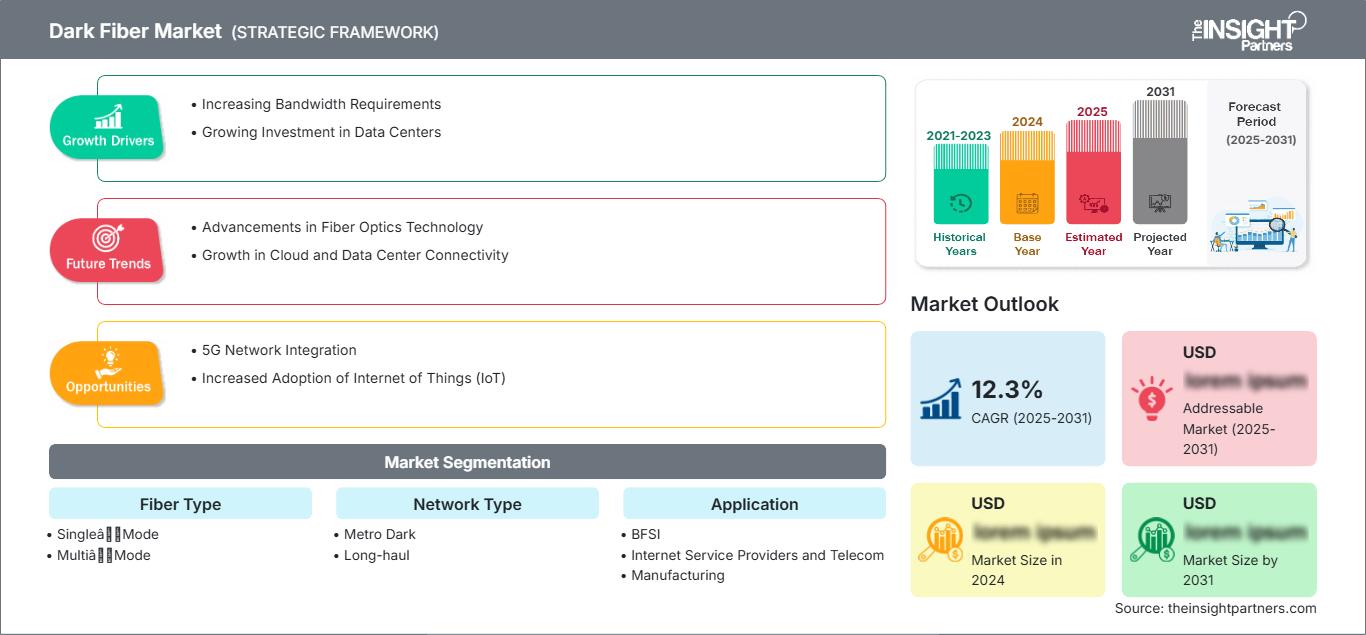
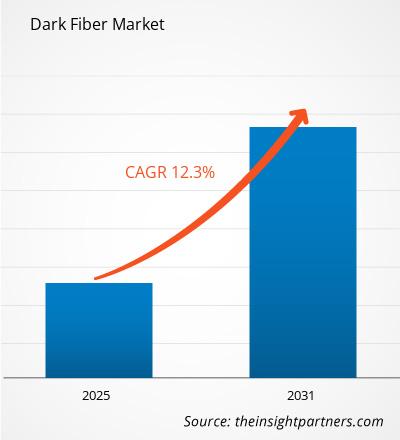
The Dark Fiber Market size is estimated at US$ 8.8 Billion in 2025 and is anticipated to be US$ 29.57 Billion by 2034, growing at a CAGR of 14.41% during the forecast period of 2026-2034. The market includes single mode and multi-mode fiber in metro dark fiber networks and long-haul networks, including BFSI, internet service providers, telecom, manufacturing, healthcare and more enterprise uses.
North America continues to be a major demand hub owing to the expansion of hyperscale data centers, cloud nodes, 5G densification, and Artificial Intelligence capable interconnect. The growth rate of the Dark Fiber Market in North America will grow at a CAGR of 12.5–13.5% from 2026-2034.
Dark Fiber Market Assessment and Insights
- North America held 33–36% Dark Fiber Market share in 2025 and is growing at a CAGR of 12.5–13.5% during 2026–2034, led by hyperscale interconnects, 5G backhaul, cloud regions, and private enterprise networks.
- US represented 82–86% of North American revenue in 2025 and is growing at a CAGR of 12.7–13.7% during 2026–2034, supported by AI corridors and carrier-neutral data center density.
- Europe accounted for 22–25% share in 2025 and is growing at a CAGR of 11.8–12.8% during 2026–2034, with the UK, Germany, France, Netherlands, and Spain leading deployment.
- Asia Pacific held 27–31% share in 2025 and is growing at a CAGR of 15.2–16.2% during 2026–2034, led by China, Japan, South Korea, India, Singapore, and Australia.
- Largest Segment Single-Mode held 78–82% market share in 2025 and is growing at a CAGR of 14.0–15.0% during 2026–2034 due to long-distance, high-capacity transmission suitability.
- High Growth Segment Metro Dark represented 57–61% market share in 2025 and is growing at a CAGR of 15.0–16.0% during 2026–2034, supported by edge, cloud, and 5G densification.
- Key companies analyzed in detail: Lumen Technologies, Inc.; Cologix, Inc.; Colt Technology Services Group Limited; Crown Castle Inc.; Dinesh Engineers Limited; FirstLight Fiber, Inc.; Sterlite Technologies Limited; Verizon Partner Solutions; Windstream Services, LLC; Zayo Group, LLC.
Source: The Insight Partners' analysis based on proprietary research, government publications, company annual reports, investor presentations, industry databases, and expert interviews.
Dark fiber networks have transitioned from redundant telecommunications assets into key digital infrastructure for clouds, AI, 5G, and enterprise control. The focus is on low-loss single mode routes, dense metro rings, and diverse long-haul routes to mitigate latency and minimize reliance on shared services. Manufacturing is centered around route approval, duct entry, splicing labor, optical testing, and expensive build-out cycles that need anchor clients to expand.
Future demand is likely to expand into secondary data center clusters, manufacturing regions, and digital public infrastructure initiatives. Government funding for broadband and 5G fiberization will help, along with pre-provisioning of dedicated routes by cloud service providers and telecommunications carriers prior to network congestion. Suppliers with metro density, long-haul diversity, disciplined construction, and enterprise contracting skills will thrive due to robust growth in strategic bandwidth capacity.
Dark Fiber Market Report Scope
| Report Attribute | Details |
|---|---|
| Market size in 2025 | US$ 8.8 Billion |
| Market Size by 2034 | US$ 29.57 Billion |
| Global CAGR (2026 - 2034) | 14.41% |
| Historical Data | 2021-2024 |
| Forecast period | 2026-2034 |
Dark Fiber Market Analysis
The Growth Factors behind the Dark Fiber Market include heavy bandwidth applications, cloud computing infrastructure, internet traffic, 5G backhaul, and enterprise requirements for a dedicated private optical connection. The value chain comprises fiber manufacturers, civil engineers, rights-of-way, network operators, data centers, carriers, cloud providers, and systems integrator players. There is high demand for locations where there is impact on latency, resiliency, route diversity, and scalable capacity.
On the supply side, there is limited supply owing to issues related to the permitting process, availability of conduit, skilled labor, high cost of investment, and proximity to data centers for interconnection density. It is found through dark fiber market analysis that the buying decision of consumers focuses on comparison of route diversity, splice integrity, level of services, collocation, and scalability.
The factors that define competition include network coverage, on-net buildings, long-distance transport capabilities, and serving hyperscale and carriers. The competitive players are Lumen Technologies, Inc., Zayo Group, LLC, Crown Castle Inc., Verizon Partner Solutions, and Windstream Services, LLC using U.S. fiber footprint, while Colt Technology Services Group Limited and FirstLight Fiber, Inc. add value with their region-specific and enterprise-oriented services.
There is an increasing shift towards investments in AI corridors, metro fiber purchases, edge interconnects, and carrier-neutral facilities. Cologix, Inc. caters to the demand for data center ecosystem services, while Sterlite Technologies Limited and Dinesh Engineers Limited help with fiber and infrastructure skills. Strategic positioning will be influenced by proven route capability, quick connectivity, customer-defined bandwidth, and good asset life contract terms.
● REPORT CUSTOMIZATION
Tailor This Report To Align With Your Specific Business Requirements
This report can be customized to align precisely with your business objectives, scope, and target markets. Customization options include tailored segmentation, geography, competitive analysis, and strategic insights to support informed decision-making.
Customize This Report →WHAT YOU CAN ADJUST
- ● Segmentations
- ● Geography
- ● Competitive Analysis
- ● Language Preferences
Dark Fiber Market: Strategic Insights
Regional Insights
North America Dark Fiber Market
North America held 33-36% share in the Dark Fiber Market in 2025 and is expected to register a CAGR of 12.5-13.5% from 2026 to 2034. The area enjoys advantages in the form of hyperscale data centers, high cloud penetration, 5G backhaul requirements, AI compute clusters, and enterprise preference towards private and controlled optical network.
Deployment occurs in the vicinity of major data center corridors, carrier hotels, financial hubs, healthcare campuses, and industrial automation centers. Route diversity, low latency metro loops, and long hauls are favored owing to cloud data transfer and critical application traffic. North America provides a developed leased market which fulfills the needs of wholesale carriers and owned network of enterprises.
U.S. Dark Fiber Market Market
The United States accounted for 82%-86% of revenue in North America in 2025 and is projected to grow at a CAGR of 12.7%-13.7% from 2026 to 2034. The applications are powered by hyperscalers' cloud regions, AI data centers, densified mobile operators, financial exchanges, and healthcare networks requiring resilience.
Lumen Technologies, Inc., Zayo Group, LLC, Verizon Partner Solutions, Crown Castle Inc., Windstream Services, LLC, and FirstLight Fiber, Inc. play a visible role through fiber presence, enterprise sales, and carrier interconnectivity. Demand for the application is high in internet service providers and telecom, BFSI, healthcare, and manufacturing segments for ensuring up-time, security, and bandwidth management.
Europe Dark Fiber Market Market
The Europe region accounted for 22% to 25% market share in 2025 and is expected to experience a CAGR of 11.8% to 12.8% between 2026 and 2034. The United Kingdom dominates through the financial connectivity and densification of data centers of London. Germany ranks second through the interconnectivity of Frankfurt, industrial digitization, and backbones requirement.
Colt Technology Services Group Limited operates extensively within European cities, whereas the international carriers and the neutral data centers' eco-system strengthen the cross-border routes. The buyers look out for the low latency and transparency of the routes between the financial centers, cloud zones, and content delivery points. The regulatory framework for the gigabit connectivity and digital sovereignty lays out a conducive environment for dark fiber purchases.
APAC Dark Fiber Market Market
The Asia-Pacific region represents 27-31% market share in 2025, with further projected growth of 15.2-16.2% CAGR from 2026 to 2034. The region is driven by China's data centers, telecommunications fiberization, and smart manufacturing initiatives. Japan and South Korea facilitate premium low-latency requirements, whereas India, Singapore, and Australia provide cloud computing services, subsea cable landings, and enterprise opportunities.
Broadband, digital public infrastructure, and industrial automation policies are driving the growth of fiber optic routes. Sterlite Technologies Limited and Dinesh Engineers Limited are related to fiber optics infrastructure. The fastest-growing markets are those where there is an intersection between cloud regions, 5G deployments, and digitization of manufacturing facilities, with permitting, right-of-way access, and power generation being determining factors.
Middle East & Africa Dark Fiber Market Market
Middle East & Africa is estimated to witness growth at CAGR of 13.0–14.0% during 2026-2034. Saudi Arabia dominates regional demand due to digital economy initiatives, cloud zones, smart cities, and connectivity initiatives in the energy sector which need robust fiber infrastructures. UAE boosts high-end demand due to data centers, finance services, and international connectivity.
South Africa and the rest of MEA depend on carrier backbone buildout, enterprise broadband, and metro fiber buildouts. Energy and infrastructure initiatives will drive demand for secure private routes in industrial locations, port facilities, and logistics corridors. Funding, right-of-way planning, and terrestrial route diversification will be key in turning demand into dark fiber deployments.
Segmentation Analysis
Fiber Type
Fiber Type is projected to grow at a CAGR of 13.8–14.8% during 2026–2034. The Dark Fiber Market scope spans single-mode routes for metro, long-haul, and data center interconnect, while multi-mode fiber remains relevant inside campuses and shorter enterprise environments. Selection depends on distance, bandwidth, latency tolerance, upgrade economics, and compatibility with optical equipment strategies.
- Single-Mode fiber dominates because it supports long-distance, high-capacity transmission, low attenuation, wavelength upgrades, and intercity routes connecting data centers, carriers, and enterprise hubs.
- Multi-Mode fiber serves shorter-distance enterprise, campus, and data center environments where installation economics, equipment compatibility, and limited reach make it suitable for localized private networks.
Network Type
Network Type is forecast to grow at a CAGR of 14.4–15.4% during 2026–2034. Metro dark networks are increasingly strategic because edge computing, 5G small cells, carrier hotels, and cloud on-ramps need dense last-mile and middle-mile capacity. Long-haul routes remain essential for resilient intercity connectivity, data center replication, and geographically diverse enterprise architectures.
- Metro Dark networks connect dense urban nodes, data centers, financial districts, hospitals, and telecom sites, offering low latency and scalable capacity for bandwidth-intensive users.
- Long-haul networks provide intercity and cross-regional routes that support redundancy, disaster recovery, cloud replication, wholesale carrier traffic, and AI data movement across distributed locations.
Application
Application is expected to grow at a CAGR of 14.2–15.2% during 2026–2034. Internet service providers and telecom users form the largest demand base, while BFSI, manufacturing, and healthcare require secure private capacity for latency-sensitive and regulated workloads. Adoption rises as enterprises seek control over routing, encryption, throughput, and network resilience.
- BFSI users prioritize deterministic latency, secure connectivity, route diversity, and business continuity for trading, payments, data replication, and regulated information flows across financial campuses.
- Internet Service Providers and Telecom represent the core adoption base as operators use dark fiber for 5G backhaul, broadband aggregation, wholesale services, and network capacity upgrades.
- Manufacturing demand is rising as smart factories, industrial IoT, private wireless, and automation systems require resilient fiber connectivity across plants, warehouses, and logistics nodes.
- Healthcare organizations use dedicated fiber for imaging, telehealth, research data, cloud migration, and hospital network resilience where uptime and data protection are operational priorities.
Opportunity Snapshot
| Application | Revenue Contribution | Trend Tag | Adoption Stage |
| BFSI | Medium | Low Latency | Mature |
| Internet Service Providers and Telecom | High | 5G Backhaul | Scaling |
| Manufacturing | Medium | Smart Factory | Scaling |
| Healthcare | Medium | Secure Imaging | Scaling |
| Others | Low | Campus Fiber | Emerging |
Dark Fiber Market Growth Drivers and Impact Analysis
AI and cloud workloads intensify bandwidth requirements
AI training, inference, cloud storage, and application architectures that distribute workloads require more east-west and intercity data traffic. Enterprises and hyperscalers will look for scalable optical routes, which would not require renegotiations of managed bandwidth each time there is an increase in traffic volume. Dark fiber allows customers to manage light equipment, wavelengths, encryption, and upgrades. This makes dark fiber appealing for AI clusters, cloud on-ramps, and data centers. Market implications include the need for diversity in the routes, low-latency metro rings, and long-haul network capabilities supported by large customers.
5G fiberization expands carrier backhaul demand
The demand for increased fiber depth grows on mobile operators with 5G radio, small cells, and other elements. The dark fiber is used for backhaul and fronthaul schemes since service providers are able to plan capacity, latency, synchronization, and redundancy by themselves based on the design of the network. In this regard, the driver contributes to metro route leasing, connectivity from towers to the core, and cooperation between wireless companies and fiber infrastructure operators. It is also favorable for the rights-of-way located near dense urban areas and suburban expansion areas.
Enterprise security and control shift procurement models
Regulated enterprises increasingly want private connectivity that reduces exposure to shared network congestion, third-party routing limitations, and unpredictable performance. BFSI, healthcare, manufacturing, and public infrastructure users value dark fiber because it allows dedicated encryption, custom monitoring, and direct control over optical capacity. The impact is visible in higher demand for point-to-point routes between data centers, headquarters, disaster recovery sites, and operational facilities. Procurement decisions now weigh resilience, compliance, auditability, and scalability alongside price. Providers that document physical route diversity, splice records, and service assurance can win strategic contracts with longer-term commitments.
Dark Fiber Market Future Trends
AI corridor fiber routes become strategic assets
Dark Fiber Market trends point toward purpose-built AI corridors connecting power-rich data center clusters, cloud regions, and network-neutral interconnection hubs. Future route planning will prioritize latency, route diversity, power availability, and proximity to emerging compute campuses rather than only traditional telecom demand centers. Operators may secure anchor customers before construction, then monetize additional strands through wholesale, enterprise, and cloud ecosystem sales. This shift will make fiber a strategic input to AI infrastructure development, especially where compute capacity moves toward secondary markets with available land, power, and permitting support.
Open access and neutral interconnection models expand
Neutral access models are expected to gain traction as municipalities, data center operators, utilities, and private infrastructure funds seek to maximize fiber utilization. Instead of vertically integrated ownership, more networks may support multiple carriers, enterprises, and cloud customers through standardized access, transparent route availability, and flexible lease structures. The model can accelerate broadband, smart city, and enterprise connectivity while reducing duplicated civil works. Successful execution will require clear governance, reliable maintenance, and commercial neutrality so customers can combine dark fiber control with competitive ecosystem choice.
Dark Fiber Market Opportunities
Metro densification for edge and 5G ecosystems
Dark Fiber Market Forecasts support investment in dense metro routes that connect carrier hotels, small-cell clusters, edge data centers, hospitals, campuses, and enterprise districts. Providers can convert demand by packaging route diversity, meet-me-room access, rapid cross-connects, and scalable strand leases for carriers and large enterprises. The opportunity is attractive because metro networks support multiple use cases over the same physical footprint, improving asset utilization. Investors should prioritize markets where cloud on-ramps, mobile densification, and enterprise digital transformation overlap with constrained conduit availability and strong recurring lease potential.
Private fiber for regulated enterprise networks
BFSI, healthcare, manufacturing, and public-sector organizations represent a strong opportunity for private fiber solutions tied to compliance, uptime, and operational resilience. Vendors can offer engineered routes, audit-ready documentation, managed optical equipment options, and lifecycle support without removing customer control over capacity. This approach helps enterprises avoid bottlenecks from shared services while supporting cloud migration, disaster recovery, imaging, automation, and secure data replication. Winning suppliers will combine consultative network design with flexible commercial models, because buyers increasingly want infrastructure certainty without carrying all construction and maintenance risk internally.
Recent Developments
- April 2026: Light Source Communications (LSC), a leading provider of high-capacity, future-proof dark fiber networks, is laying the groundwork for AI innovation with its newest dark fiber route bridging Amarillo, Texas, with Oklahoma City, Stillwater, and Tulsa, Oklahoma. This represents the third new dark fiber build LSC has commenced this year, underscoring its emergence as a key infrastructure partner in the AI era.
- May 2026: Uniti Wholesale today announced a series of strategic infrastructure expansions and new customer agreements, further strengthening its position as a premier infrastructure partner for hyperscale and neo-cloud providers. These developments reflect Uniti’s strategy and its commitment to scaling high-capacity fiber and colocation infrastructure in key growth markets.
- June 2025: Lumen Technologies (NYSE: LUMN) announced it will provide the terrestrial backhaul connectivity for the JUNO Trans-Pacific Cable System, the highest-capacity trans-Pacific cable linking Japan and the United States. Lumen’s fiber network will carry traffic from the cable’s U.S. landing point in Grover Beach, Ca., to two major points of presence (PoPs) in San Jose and Los Angeles— helping to revolutionize business operations and technological advancements in both countries.
Frequently Asked Questions

- Comprehensive Market Sizing and Forecast Analysis
- Detailed Segmentation Analysis
- In-Depth Market Dynamics Assessment
- Regional and Country-Level Insights
- Competitive Landscape and Company Benchmarking
- Strategic Business Intelligence
Recent Reports
Testimonials

The Insight Partners' SCADA System Market report is comprehensive, with valuable insights on current trends and future forecasts. The team was highly professional, responsive, and supportive throughout. We are very satisfied and highly recommend their services.
RAN KEDEM Partner, Reali Technologies LTDs
I requested a report on a very specific software market and the team produced the report in a few days. The information was very relevant and well presented. I then requested some changes and additions to the report. The team was again very responsive and I got the final report in less than a week.
JEAN-HERVE JENN Chairman, Future Analytica
We worked with The Insight Partners for an important market study and forecast. They gave us clear insights into opportunities and risks, which helped shape our plans. Their research was easy to use and based on solid data. It helped us make smart, confident decisions. We highly recommend them.
PIYUSH NAGPAL Sr. Vice President, High Beam Global
The Insight Partners delivered insightful, well-structured market research with strong domain expertise. Their team was professional and responsive throughout. The user-friendly website made accessing industry reports seamless. We highly recommend them for reliable, high-quality research services
YUKIHIKO ADACHI CEO, Deep Blue, LLC.
This is the first time I have purchased a market report from The Insight Partners.While I was unsure at first, I visited their web site and felt more comfortable to take the risk and purchase a market report.I am completely satisfied with the quality of the report and customer service. I had several questions and comments with the initial report, but after a couple of dialogs over email with their analyst I believe I have a report that I can use as input to our strategic planning process.Thank you so much for taking the extra time and making this a positive experience.I will definitely recommend your service to others and you will be my first call when we need further market data.
JOHN SUZUKI President and Chief Executive Officer, Board Director, BK Technologies
I wish to appreciate your support and the professionalism you displayed in the course of attending to my request for information regarding to infectious disease IVD market in Nigeria. I appreciate your patience, your guidance, and the fact that you were willing to offer a discount, which eventually made it possible for us to close a deal. I look forward to engaging The Insight Partners in the future, all thanks to the impression you have created in me as a result of this first encounter.
DR CHIJIOKE ONYIA MANAGING DIRECTOR, PineCrest Healthcare Ltd.Reason to Buy
- Informed Decision-Making
- Understanding Market Dynamics
- Competitive Analysis
- Identifying Emerging Markets
- Customer Insights
- Market Forecasts
- Risk Mitigation
- Boosting Operational Efficiency
- Strategic Planning
- Investment Justification
- Tracking Industry Innovations
- Aligning with Regulatory Trends





 Get Free Sample for