
Data Acquisition Hardware Market Size, Share & Trends by 2034
Coverage: By Product (Terminal Units, HMI Components, PLC Components, Signal Convertors, Others); Industry Vertical (Manufacturing, Energy and Power, Transportation, Others), and Geography (North America, Europe, Asia Pacific, and South and Central America)
- Status : Data Released
- Report Code : TIPRE00017498
- Category : Electronics and Semiconductor
- No. of Pages : 150
- Available Report Formats :


- Last update date : August 05, 2026


2025 Market Size
US$ 59.54 Bn
Base year value
2034 Forecast
US$ 96.31 Bn
Projected by 2034
CAGR 2026-2034
5.49 %
Growth rate
Addressable Market
US$ 706.70 Bn
(2026-2034)
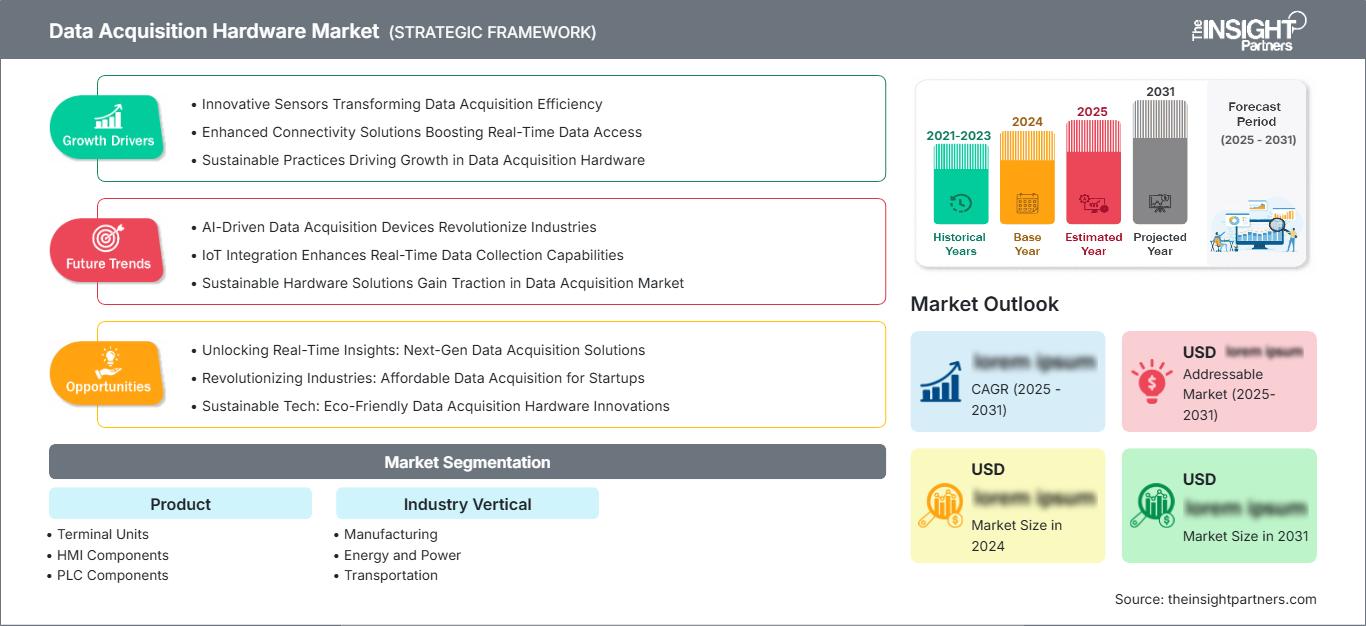
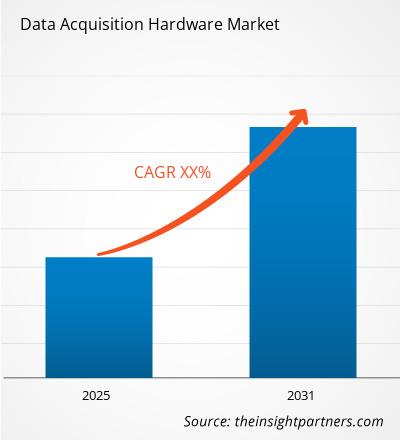
The Data Acquisition Hardware Market was valued at US$ 59.54 Billion in 2025 and is projected to reach US$ 96.31 Billion by 2034, registering a CAGR of 5.49% during 2026–2034. The market is expanding as industries modernize terminal units, HMI components, PLC components, and signal convertors to capture machine, utility, and transport data with higher reliability.
Across North America, the market is expected to advance at a CAGR range of 4.9–5.6% as manufacturers and utilities upgrade industrial networks, OT cybersecurity, and edge-connected monitoring. The Data Acquisition Hardware Market size is supported by reshoring of advanced manufacturing, grid modernization, oil and gas automation, and rail infrastructure programs requiring rugged control and acquisition devices.
Data Acquisition Hardware Market Assessment and Insights
- North America held 27–30% share in 2025 and is growing at a CAGR of 4.9–5.6% during 2026–2034, supported by smart manufacturing, grid reliability investment, and test-intensive industrial automation.
- US represented 78–82% of North America in 2025 and is growing at a CAGR of 5.0–5.7%, led by manufacturing, energy, transportation, and automation upgrades.
- Europe accounted for 25–28% share in 2025 and is advancing at a CAGR of 4.6–5.3%, with Germany, France, Italy, Spain, and the UK leading demand.
- Asia Pacific captured 32–36% share in 2025 and is expanding at a CAGR of 6.1–6.9%, led by China, Japan, South Korea, India, and Australia automation investments.
- Largest Segment PLC Components held 38–42% market share in 2025 and are growing at a CAGR of 5.3–5.9%, supported by machine control and factory modernization.
- High Growth Segment HMI Components held 22–25% market share in 2025 and are growing at a CAGR of 6.0–6.8%, driven by visualization and operator-centric automation.
- Key companies analyzed in detail: ABB Ltd., Alstom SA, Dataforth Corporation, Emerson Electric Co., General Electric Company, Honeywell International Inc., National Instruments Corporation, Rockwell Automation, Inc., Schneider Electric SE, and Siemens AG.
Source: The Insight Partners' analysis based on proprietary research, government publications, company annual reports, investor presentations, industry databases, and expert interviews.
The industrial acquisition architecture is shifting from standalone controller-based design towards networked edge architecture that involves field signal capturing, logic implementation, visualization, and secure data communication. The core of PLC components lies in its capability to make deterministic control decisions based on real-time situation whereas the richness of HMI components is increasing to serve as better operator interface. This trend can be seen in the Data Acquisition Hardware Market as production lines, substations, rolling stock, and process facilities produce more signals for analysis.
Future demand trends will be driven by trends in electrification, digitization of factories, transportation automation, and resilience initiatives in countries with heavy infrastructures. There will be an investment inclination towards robust terminal devices, accurate signal converters, and modular controllers which can run in the brownfield setting.
Data Acquisition Hardware Market Report Scope
| Report Attribute | Details |
|---|---|
| Market size in 2025 | US$ 59.54 Billion |
| Market Size by 2034 | US$ 96.31 Billion |
| Global CAGR (2026 - 2034) | 5.49% |
| Historical Data | 2021-2024 |
| Forecast period | 2026-2034 |
Data Acquisition Hardware Market Analysis
The market is boosted by the requirement for capturing signals from machine, process, electrical, vibration, temperature, and pressure sources in a timely manner. The manufacturing plants use them for their quality control purposes, predictive maintenance and traceability applications whereas the energy operators use them for their visibility into the grid and substation automation. The transportation network uses them for their reliable acquisition systems to signal, monitor rolling stocks, and diagnostic systems.
The supply chain is dependent upon semiconductors, industrial communications, rugged housing, isolation, firmware security, and certified integration. The buyers are increasingly looking for lifecycle reliability, cybersecurity preparedness, open protocols, stability of calibration and field service capability. The ecosystem comprises of component providers, automation original equipment manufacturers, system integrators, software platforms, and end-users requiring physical to digital conversions.
Market analysis reveals competition between general automation players and specialized measurement companies. The competition between ABB Ltd., Siemens AG, Schneider Electric SE, Honeywell International Inc., Rockwell Automation, Inc., and Emerson Electric Co. is characterized by comprehensive automation products portfolios. National Instruments Corporation and Dataforth Corporation specialize in measurements, signal conditioning, and modular acquisition technology, while Alstom SA and General Electric Company have strengths in the transportation and energy-related applications area.
Current investment trends include edge-capable controllers, secure remote monitoring capabilities, modular I/O systems, compact HMI panels, and signal convertors that support legacy equipment. Positioning in the market involves the installed base, industrial protocols certification, migration tools, and channel reach. Those suppliers that can integrate acquisition hardware into analysis, testing software and lifecycle services would generate more value than standalone device vendors.
● REPORT CUSTOMIZATION
Tailor This Report To Align With Your Specific Business Requirements
This report can be customized to align precisely with your business objectives, scope, and target markets. Customization options include tailored segmentation, geography, competitive analysis, and strategic insights to support informed decision-making.
Customize This Report →WHAT YOU CAN ADJUST
- ● Segmentations
- ● Geography
- ● Competitive Analysis
- ● Language Preferences
Data Acquisition Hardware Market: Strategic Insights
Regional Insights
North America Data Acquisition Hardware Market
North America held 27–30% share in 2025 and is forecast to grow at a CAGR of 4.9–5.6% through 2034. The Data Acquisition Hardware Market share is supported by automation refresh cycles, grid resilience programs, reshored manufacturing, and high test intensity in aerospace, automotive, electronics, and energy industries. Demand is strongest where plants require secure connection between sensors, PLCs, HMIs, and supervisory systems.
The region benefits from large industrial software ecosystems, mature system integrators, and strong presence of Rockwell Automation, Inc., Emerson Electric Co., Honeywell International Inc., and National Instruments Corporation. Replacement demand remains meaningful because many facilities are upgrading legacy I/O, terminal units, and signal conditioning hardware without replacing full control architectures.
U.S. Data Acquisition Hardware Market
The United States comprised 78-82% of North America in 2025 and is anticipated to register a CAGR of 5.0-5.7%. The demand is high in discrete manufacturing, energy infrastructure, process automation, rail, and advanced test environments. Emerson Electric Co. has launched NI DAQ products for rugged and modular applications, while Rockwell Automation, Inc. and Honeywell International Inc. have been major players in control and visualization ecosystems.
Increasing use of PLC components, HMI components, terminal devices, and signal converters for predictive maintenance, production monitoring, cybersecurity segmentation, and compliance reporting is seen in application trends. Projects in semiconductor, batteries, aerospace, oil and gas, and utility segments need precise data acquisition systems that can work with Ethernet-based industrial network systems.
Europe Data Acquisition Hardware Market
Europe has accounted for 25-28% of market shares in 2025 with an expected CAGR of 4.6-5.3%. Germany is at the forefront due to its machine building, automotive automation, and Siemens AG control systems dominance. The UK is focusing on utilities, rail, and process improvements. France, Italy, and Spain are contributing with their energy transition, transport, and manufacturing projects demanding terminal units and signal conversion.
The buying behavior of European consumers favors energy efficiency, machine safety, interoperability, and product life-cycle support. Schneider Electric SE, ABB Ltd., Siemens AG, and Alstom SA meet such demand with automation, grid, and transport solutions. Growth will remain stable as brownfield modernization, EU industrial resilience programs, and cybersecurity demands drive gradual hardware updates and not the replacement of entire systems.
APAC Data Acquisition Hardware Market
Asia Pacific has 32-36% share in 2025 and is projected to grow at a CAGR of 6.1-6.9%. China dominates through the scale in electronics, power, and industrial automation applications, whereas Japan and South Korea require high reliability acquisition for automotive, semiconductors, and robotics. India and Australia contribute growth through manufacturing incentives, power grids, mining automation, and transportation systems.
Policy support of smart factories, renewable energy adoption, and industrial capacity in the country drives adoption. The market is benefiting from PLC replacement, HMI upgrade, and rugged signal conversion applications where uptime is critical.
Middle East & Africa Data Acquisition Hardware Market
Middle East & Africa is projected to grow at a CAGR of 4.8–5.5% as Saudi Arabia, the UAE, South Africa, and rest of MEA invest in energy, water, mining, logistics, and industrial diversification. Saudi Arabia leads through oil and gas automation, utility expansion, and industrial city development, while the UAE emphasizes smart infrastructure and logistics.
Demand is shaped by harsh operating environments, remote assets, and need for reliable signal conditioning. Terminal units, PLC components, and HMI components are adopted where operators need dependable monitoring across substations, pipelines, ports, and manufacturing sites with limited tolerance for unplanned downtime.
Segmentation Analysis
Product
Product is expected to grow at a CAGR of 5.2–5.9% from 2026 to 2034 as the Data Acquisition Hardware Market scope spans terminal units, HMI components, PLC components, and signal convertors. Selection depends on signal type, response time, plant architecture, environmental rating, safety requirements, communication protocol, and compatibility with legacy automation systems.
- Terminal Units support distributed signal collection at substations, transport assets, and industrial sites where rugged field connectivity, secure communication, and remote monitoring improve asset visibility and response.
- HMI Components provide operator visualization, alarms, recipe interaction, and machine status awareness, making them strategically important as plants move from local controls toward data-rich operating environments.
- PLC Components remain the largest product group because deterministic control, modular I/O expansion, and machine integration are fundamental to manufacturing, energy, and transportation automation.
- Signal Convertors enable accurate translation between field signals and control systems, supporting brownfield modernization where plants need reliable isolation, conditioning, and protocol bridging.
Industry Vertical
Industry Vertical is projected to grow at a CAGR of 5.1–5.8% during 2026–2034 as acquisition hardware becomes essential across manufacturing, energy and power, and transportation. Adoption is strongest where operators need real-time monitoring, downtime reduction, compliance reporting, and safer connection between physical assets and digital control systems.
- Manufacturing generates high demand through smart factories, machine retrofits, robotics, quality inspection, and predictive maintenance programs that require scalable acquisition of temperature, motion, vibration, and electrical signals.
- Energy and Power uses terminal units, PLC components, and signal convertors for substations, renewables, grids, pipelines, and plants where reliability, isolation, and remote diagnostics are critical.
- Transportation requires robust hardware for rail, metro, signaling, fleet diagnostics, and infrastructure monitoring, with demand linked to safety, uptime, asset condition, and system interoperability.
Opportunity Snapshot
Market Opportunity Snapshot
| Industry Vertical | Revenue Contribution | Trend Tag | Adoption Stage |
| Manufacturing | High | Smart Factory | Scaling |
| Energy and Power | High | Grid Resilience | Scaling |
| Transportation | Medium | Rail Uptime | Emerging |
Data Acquisition Hardware Market Growth Drivers and Impact Analysis
Industrial Automation Refresh Raises Signal Density
There are now more sensors, actuators, drives, robots, and inspection devices being installed in factories for quality assurance, productivity improvement, and preventive maintenance. There are, therefore now more signals to be captured, conditioned, displayed, and controlled in real time. This market will see its biggest benefits from PLC modules, terminal boxes, HMI modules, and signal converters, which serve as the interface between the physical asset and the supervisory system. Real world impact is seen mostly in industries such as automotive, electronics, food processing, and machinery manufacturing where any downtime directly affects margins. The buyers are becoming more interested in modular hardware.
Grid Modernization Expands Remote Monitoring Needs
Energy networks are becoming more distributed as utilities integrate renewables, storage, substations, and flexible loads. Operators need terminal units and signal convertors that can capture voltage, current, temperature, breaker status, and equipment condition across geographically dispersed assets. This creates sustained demand in the market because grid reliability depends on faster visibility and accurate field data. The market impact is not limited to new substations; older assets also require retrofit hardware compatible with existing protection and SCADA systems. Vendors with ruggedized, secure, and protocol-flexible devices are better positioned for utility modernization programs.
Transportation Automation Demands Rugged Control Layers
Rail, metro, port, airport, and fleet infrastructure are adopting more monitoring hardware to improve safety, uptime, and service reliability. Acquisition devices must withstand vibration, temperature variation, electrical noise, and long operating cycles while supporting diagnostics and control. The market gains from signaling upgrades, rolling stock monitoring, traction systems, station automation, and condition-based maintenance programs. Alstom SA, Siemens AG, ABB Ltd., and General Electric Company illustrate how transportation and energy automation portfolios increasingly overlap. The commercial impact is higher demand for certified hardware that can integrate with legacy infrastructure while supporting future digital maintenance models.
Data Acquisition Hardware Market Future Trends
Edge-Ready Acquisition Becomes the Default Architecture
Data Acquisition Hardware Market trends will increasingly center on devices that preprocess signals close to machines, substations, and vehicles before sending selected data to supervisory or cloud systems. Edge-ready controllers and terminal units will reduce bandwidth loads, improve response time, and support local decision-making during network interruptions. Future designs will combine I/O density, cybersecurity, diagnostics, and firmware manageability. This shift favors suppliers that can align hardware with analytics, digital twins, and industrial AI workflows while maintaining deterministic control. Buyers will evaluate whether acquisition hardware supports secure updates, time synchronization, and consistent data models across multi-site operations.
Open Protocols and Cybersecure Hardware Shape Procurement
Industrial buyers will place greater weight on open communication, encrypted connectivity, and secure lifecycle management as IT and OT environments converge. Hardware that supports protocol flexibility, authenticated access, and segmentation will be preferred for plants and infrastructure assets exposed to remote monitoring. The future competitive edge will come from acquisition devices that simplify integration without weakening cybersecurity posture. Schneider Electric SE, Honeywell International Inc., Rockwell Automation, Inc., and Siemens AG are already positioning automation platforms around secure, software-defined operations. Procurement teams will increasingly reject closed or difficult-to-patch hardware.
Data Acquisition Hardware Market Opportunities
Brownfield Retrofit Programs in Industrial Facilities
Data Acquisition Hardware Market Forecasts support targeted retrofit programs in plants where legacy cabinets, older PLC racks, and analog signal paths limit visibility. Suppliers can capture opportunity by offering migration kits, protocol bridges, compact signal convertors, and HMI replacements that reduce downtime during installation. Manufacturing and energy customers often prefer phased upgrades because complete system replacement can disrupt production. The strongest commercial pathway is consultative selling that maps obsolete components, validates communication compatibility, and quantifies reduced maintenance risk. Vendors with local integrator networks and documented retrofit references can convert aging installed bases into repeatable hardware revenue.
Integrated Hardware for Energy and Transport Resilience
Energy and transport operators need dependable acquisition hardware to monitor assets that are geographically spread, exposed to harsh conditions, and critical to public service continuity. Opportunity exists for terminal units, PLC components, HMI panels, and signal convertors bundled with remote diagnostics, cybersecurity features, and lifecycle service. Utilities, rail systems, pipelines, and ports increasingly value hardware that can operate for long service cycles while remaining upgradable. Suppliers can differentiate through certified designs, fast replacement logistics, and compatibility with existing SCADA and control layers. This opportunity is especially relevant in North America, Europe, India, and the Gulf economies.
Recent Developments
- April 2025: Emerson Electric Co. at NI Connect 2025, the company announced expanded NI DAQ hardware, including IP67-rated NI FieldDAQ for extreme environments, USB-C NI CompactDAQ chassis, and new snap-in C Series module connectors to simplify signal connection and support modular test and measurement applications.
- May 2025: Schneider Electric SE the company presented open, software-defined automation innovations at Automate 2025, including an industrial copilot developed with Microsoft and robotics-focused digital factory demonstrations intended to support connected, data-driven manufacturing ecosystems.
- February 2025: National Instruments Corporation now part of Emerson, NI added Ethernet-enabled CompactDAQ chassis and NI-9204 input module enhancements, giving engineers lower-cost access to modular acquisition hardware with synchronization and scalable sensor measurement capability for entry-level testing systems.
Frequently Asked Questions

- Comprehensive Market Sizing and Forecast Analysis
- Detailed Segmentation Analysis
- In-Depth Market Dynamics Assessment
- Regional and Country-Level Insights
- Competitive Landscape and Company Benchmarking
- Strategic Business Intelligence
Recent Reports
Testimonials

The Insight Partners provided valuable market intelligence that supported our global go-to-market strategy. Their team was professional, responsive, and attentive to our feedback, providing thoughtful analysis and helpful methodological clarifications throughout the project.
Junmo Kim Chief Financial Officer (CFO), Enertech Co., Ltd.
The Insight Partners' SCADA System Market report is comprehensive, with valuable insights on current trends and future forecasts. The team was highly professional, responsive, and supportive throughout. We are very satisfied and highly recommend their services.
RAN KEDEM Partner, Reali Technologies LTDs
I requested a report on a very specific software market and the team produced the report in a few days. The information was very relevant and well presented. I then requested some changes and additions to the report. The team was again very responsive and I got the final report in less than a week.
JEAN-HERVE JENN Chairman, Future Analytica
We worked with The Insight Partners for an important market study and forecast. They gave us clear insights into opportunities and risks, which helped shape our plans. Their research was easy to use and based on solid data. It helped us make smart, confident decisions. We highly recommend them.
PIYUSH NAGPAL Sr. Vice President, High Beam Global
The Insight Partners delivered insightful, well-structured market research with strong domain expertise. Their team was professional and responsive throughout. The user-friendly website made accessing industry reports seamless. We highly recommend them for reliable, high-quality research services
YUKIHIKO ADACHI CEO, Deep Blue, LLC.
This is the first time I have purchased a market report from The Insight Partners.While I was unsure at first, I visited their web site and felt more comfortable to take the risk and purchase a market report.I am completely satisfied with the quality of the report and customer service. I had several questions and comments with the initial report, but after a couple of dialogs over email with their analyst I believe I have a report that I can use as input to our strategic planning process.Thank you so much for taking the extra time and making this a positive experience.I will definitely recommend your service to others and you will be my first call when we need further market data.
JOHN SUZUKI President and Chief Executive Officer, Board Director, BK Technologies
I wish to appreciate your support and the professionalism you displayed in the course of attending to my request for information regarding to infectious disease IVD market in Nigeria. I appreciate your patience, your guidance, and the fact that you were willing to offer a discount, which eventually made it possible for us to close a deal. I look forward to engaging The Insight Partners in the future, all thanks to the impression you have created in me as a result of this first encounter.
DR CHIJIOKE ONYIA MANAGING DIRECTOR, PineCrest Healthcare Ltd.Reason to Buy
- Informed Decision-Making
- Understanding Market Dynamics
- Competitive Analysis
- Identifying Emerging Markets
- Customer Insights
- Market Forecasts
- Risk Mitigation
- Boosting Operational Efficiency
- Strategic Planning
- Investment Justification
- Tracking Industry Innovations
- Aligning with Regulatory Trends





 Get Free Sample for