
Data Center GPU Market Share, Demand & Growth by 2034
Data Center GPU Market Size and Forecasts (2021–2034), Global and Regional Share, Trends, and Growth Opportunity Analysis Report Coverage : By Deployment Type (Cloud, On-premise), Function (Training, Inference), End User (Cloud Service Providers, Enterprises, Government)
- Status : Data Released
- Report Code : TIPRE00039846
- Category : Technology, Media and Telecommunications
- No. of Pages : 150
- Available Report Formats :


- Last update date : July 30, 2026


2025 Market Size
US$ 122.37 Bn
Base year value
2034 Forecast
US$ 340.28 Bn
Projected by 2034
CAGR 2026-2034
12.03 %
Growth rate
Addressable Market
US$ 2,028.19 Bn
(2026-2034)
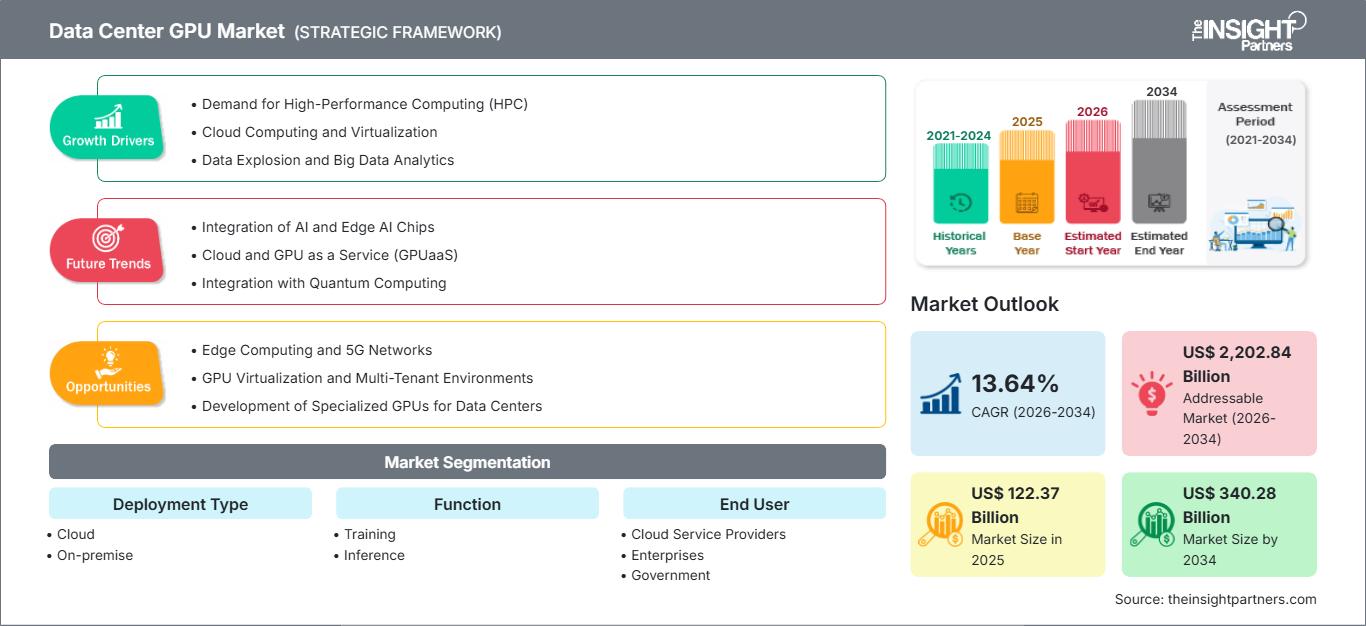
The Data Center Gpu market was valued at US$ 122.37 billion in 2025 and is expected to reach US$ 340.28 billion by 2034; it is estimated to record a CAGR of 12.03% during 2026-2034.
Data Center GPU Market Assessment and Insights
- North America: The region leads global adoption owing to the presence of hyperscale cloud providers, advanced semiconductor ecosystems, and strong AI infrastructure investments. Share in 2025: 40–44%, growing at a CAGR between 13.2%–14.6% during 2026–2034.
- US: The country accounts for the majority of regional investments through AI model development, cloud expansion, and enterprise GPU deployments. Share in North America in 2025: 82–86%, growing at a CAGR between 13.4%–14.8% during 2026–2034.
- Europe: Strong digital transformation initiatives across Germany, the UK, France, Italy, and the Netherlands continue driving GPU adoption for AI research and industrial computing. Share in 2025: 22–26%, growing at a CAGR between 12.6%–13.8% during 2026–2034.
- Asia Pacific: China, Japan, South Korea, India, and Singapore are expanding hyperscale facilities and AI infrastructure rapidly. Share in 2025: 28–32%, growing at a CAGR between 15.2%–16.8% during 2026–2034.
- Largest Segment: Cloud Deployment dominates revenue generation as hyperscale providers continue investing in AI-ready infrastructure. Market share in 2025: 64–68%, growing at a CAGR between 14.0%–15.2% during 2026–2034.
- High-Growth Segment: Training is expected to witness the fastest expansion owing to increasing investments in foundation models and generative AI. Market share in 2025: 54–58%, growing at a CAGR between 15.5%–17.0% during 2026–2034.
- • Key companies analyzed in detail: NVIDIA Corporation, Intel Corporation, Advanced Micro Devices, Inc., Samsung Electronics Co., Ltd., Micron Technology, Inc., Qualcomm Technologies, Inc., International Business Machines Corporation, Google LLC, Microsoft Corporation, and Advantech Co., Ltd.
Source: The Insight Partners' analysis based on proprietary research, government publications, company annual reports, investor presentations, industry databases, and expert interviews.
The evolution of AI infrastructure has fundamentally transformed GPU deployment across modern data centers. Earlier GPU installations primarily supported graphics acceleration and scientific computing, whereas current deployments increasingly power generative AI, recommendation engines, autonomous systems, natural language processing, and advanced analytics. Semiconductor manufacturers continue introducing architectures with higher memory bandwidth, improved energy efficiency, and integrated AI acceleration, enabling enterprises to process significantly larger datasets while improving operational efficiency.
Looking ahead, investments are expected to accelerate across emerging economies as governments strengthen AI capabilities and domestic semiconductor ecosystems, supporting growth in the Data Center GPU Market. Cloud providers, research organizations, and enterprise customers are expanding GPU clusters to support digital transformation initiatives. Regulatory emphasis on secure AI development, coupled with increasing capital expenditure on sustainable data center infrastructure, is expected to strengthen long-term industry expansion.
Data Center GPU Market Report Scope
| Report Attribute | Details |
|---|---|
| Market size in 2025 | US$ 122.37 Billion |
| Market Size by 2034 | US$ 340.28 Billion |
| Global CAGR (2026 - 2034) | 12.03% |
| Historical Data | 2021-2024 |
| Forecast period | 2026-2034 |
Data Center GPU Market Analysis
The data center GPU market growth is driven by increasing enterprise adoption of generative AI, machine learning, scientific simulation, and cloud-native applications requiring high-performance parallel computing. Advanced GPU technology is being used by companies from industries such as cloud computing, finance, healthcare, manufacturing, and research for boosting AI applications in training, inference, and other computing tasks. It involves a chain of GPU providers, cloud service providers, semiconductor vendors, networking providers, and software providers working together to achieve better performance in AI applications through hardware and software integration.
The supply factors are driven by continuous innovation in GPU technology, memory, packaging, and interconnect technology. The vendors are increasing their capacity and introducing new generation AI accelerators to meet the growing demand in hyperscale data centers and enterprises. Increasing investments in energy-efficient computing, liquid cooling technologies, and scalable AI infrastructure are encouraging organizations to deploy high-performance GPU clusters capable of supporting large-scale AI and scientific computing applications.
The data center GPU market analysis indicates that competition continues to intensify as vendors invest in AI accelerators, high-bandwidth memory technologies, advanced packaging, and energy-efficient architectures. NVIDIA Corporation maintains leadership in AI computing, while Advanced Micro Devices, Inc. and Intel Corporation continue expanding competitive product portfolios. Google LLC and Microsoft Corporation increasingly design custom AI infrastructure to optimize cloud services, whereas Samsung Electronics Co., Ltd., Micron Technology, Inc., Qualcomm Technologies, Inc., International Business Machines Corporation, and Advantech Co., Ltd. strengthen the ecosystem through memory technologies, enterprise platforms, edge computing, and integrated AI solutions.
Investment activity within the market is centered on next-generation AI infrastructure, hyperscale data center expansion, advanced semiconductor manufacturing, and high-performance networking technologies. Vendors are strengthening their portfolios through strategic partnerships, product innovation, and software ecosystem enhancements to improve AI workload efficiency and scalability. Continued investments in AI-optimized hardware, cloud infrastructure, and integrated computing platforms remain key strategies for companies seeking competitive differentiation in the data center GPU market.
● REPORT CUSTOMIZATION
Tailor This Report To Align With Your Specific Business Requirements
This report can be customized to align precisely with your business objectives, scope, and target markets. Customization options include tailored segmentation, geography, competitive analysis, and strategic insights to support informed decision-making.
Customize This Report →WHAT YOU CAN ADJUST
- ● Segmentations
- ● Geography
- ● Competitive Analysis
- ● Language Preferences
Data Center GPU Market: Strategic Insights
Regional Insights
North America Data Center GPU Market
North America accounted for an estimated 40–44% share of the global market in 2025, supported by the presence of hyperscale cloud providers, advanced semiconductor companies, and leading artificial intelligence developers. The data center GPU market share remains the highest in this region as organizations continue investing in AI infrastructure, high-performance computing clusters, and large-scale cloud platforms. The regional market is projected to expand at a CAGR of 13.2%–14.6% during 2026–2034, driven by continuous investments in next-generation data centers and accelerated enterprise AI adoption.
Demand is further strengthened by favorable digital infrastructure, mature cloud ecosystems, and growing investments in generative AI applications across financial services, healthcare, manufacturing, and public sector organizations. Expansion of liquid-cooled AI data centers, increasing deployment of GPU-as-a-Service platforms, and government initiatives supporting semiconductor manufacturing are expected to reinforce regional leadership throughout the forecast period.
U.S. Data Center GPU Market
The United States represented approximately 82–86% of the North American Data Center GPU Market in 2025, reflecting the country's concentration of hyperscale cloud operators, AI startups, and semiconductor innovators. The domestic market is projected to witness a CAGR of 13.4% to 14.8% from 2026 to 2034 owing to continuous developments in AI modeling, expansion of cloud computing facilities, and digital transformations in enterprises. The demand for high-performance computing, generative AI capabilities, and big data analytics is also adding to the increased adoption of next-generation GPU solutions in various data centers in the United States.
Large technology firms keep on deploying advanced GPU systems for applications such as generative AI, autonomous systems, cybersecurity analytics, and scientific computing. Research collaboration among universities, private organizations, and government agencies is also propelling the growth of AI. The growing demand for sovereign AI systems, along with investment in sustainable high-density data centers and advanced network technologies, will boost future market growth in the region.
Europe Data Center GPU Market
Europe accounted for approximately 22–26% of global revenue in the Data Center GPU Market in 2025 and is expected to expand at a CAGR of 12.6%–13.8% during 2026–2034. Regional demand is supported by growing AI adoption, stricter data governance regulations, and increasing investments in digital infrastructure. Germany continues to lead the regional market owing to its strong manufacturing base, industrial AI adoption, and significant investments in high-performance computing facilities.
The United Kingdom remains a major contributor through expanding cloud infrastructure, fintech innovation, and AI research initiatives. France, Italy, and Spain are strengthening regional demand through public investments in digital transformation, national AI strategies, and modernization of enterprise computing infrastructure. Increasing adoption of GPU-accelerated computing for healthcare research, financial modeling, and industrial automation is expected to strengthen regional market growth throughout the forecast period.
APAC Data Center GPU Market
Asia Pacific held an estimated 28–32% share of the global Data Center GPU Market in 2025 and is projected to record the fastest regional expansion, with a CAGR of 15.2%–16.8% during 2026–2034. China remains the leading market, while Japan, South Korea, India, Singapore, and Australia continue investing in hyperscale data centers and AI infrastructure. Growing demand for cloud computing, generative AI, high-performance computing, and large-scale data analytics is further accelerating GPU deployment across the region, supporting continued growth of the Data Center GPU Market.
Government support for semiconductor manufacturing, rapid cloud adoption, and increasing enterprise AI deployment are strengthening regional demand. Growth in digital services, smart manufacturing, autonomous technologies, and national AI development programs continues to accelerate GPU deployment across both public and private sectors.
Middle East & Africa Data Center GPU Market
The Middle East & Africa is emerging as a promising regional market and is expected to register a CAGR of 12.4%–13.6% during 2026–2034. Saudi Arabia and the United Arab Emirates continue investing in AI-enabled digital economies, while South Africa is expanding enterprise cloud infrastructure and modern data center capacity.
Regional demand is supported by government digital transformation programs, smart city initiatives, and increasing enterprise adoption of AI-powered analytics. Continued investments in renewable-energy-powered data centers and sovereign cloud infrastructure are expected to create new opportunities for GPU vendors across the region.
Segmentation Analysis
Deployment Type
Cloud deployment represents the leading deployment model as enterprises increasingly migrate AI, machine learning, and high-performance computing workloads to scalable cloud environments. The data center GPU market scope continues to expand with cloud-based GPU services enabling organizations to reduce infrastructure costs while accessing high-performance computing resources on demand. The deployment type segment is projected to register a CAGR of 14.0%–15.2% during 2026–2034, supported by continued investments from hyperscale cloud providers and growing adoption of GPU-as-a-Service offerings.
- Cloud – The dominant deployment model owing to elastic computing capabilities, lower upfront infrastructure investment, simplified GPU resource management, and increasing adoption of AI model training, inference, and analytics workloads across enterprises and research organizations.
- On-premise – Continues to maintain importance among organizations requiring low-latency computing, enhanced data security, regulatory compliance, and dedicated infrastructure for mission-critical AI applications, financial modeling, healthcare imaging, and defense workloads.
Function
The function segment is witnessing rapid technological evolution as enterprises deploy specialized GPU infrastructure for both AI model development and production-scale inferencing. Increasing adoption of generative AI, large language models, recommendation engines, and scientific simulations continues to strengthen demand. The segment is expected to expand at a CAGR of 14.6%–15.8% during 2026–2034 as organizations optimize computing resources for increasingly complex AI workloads.
- Training – Represents the largest functional category due to growing investments in foundation models, deep learning frameworks, and large-scale neural network development requiring substantial computational performance and memory bandwidth.
- Inference – Demand continues increasing as enterprises deploy trained AI models into production environments for real-time analytics, conversational AI, fraud detection, recommendation systems, and intelligent business automation.
End User
Cloud service providers remain the largest consumers of advanced GPU infrastructure because of expanding AI services, cloud computing platforms, and enterprise digital transformation initiatives. Continuous investments in hyperscale facilities, sovereign cloud infrastructure, and AI computing clusters are expected to sustain market expansion. The end-user segment is anticipated to register a CAGR of 13.8%–14.9% during 2026–2034.
- Cloud Service Providers – Account for the largest share of GPU deployments as hyperscale operators continuously expand AI-ready infrastructure to support enterprise workloads, generative AI services, and high-performance computing applications across global cloud platforms.
- Enterprises – Increasingly invest in dedicated GPU infrastructure for predictive analytics, digital twins, cybersecurity, engineering simulation, financial modeling, and intelligent automation initiatives supporting business transformation.
- Government – Public sector organizations continue adopting GPU-enabled computing for scientific research, weather forecasting, defense simulations, healthcare research, cybersecurity operations, and national artificial intelligence initiatives.
Opportunity Snapshot
| End User | Revenue Contribution | Trend Tag | Adoption Stage |
| Cloud Service Providers | High | AI Infrastructure | Mature |
| Enterprises | Medium | Private AI | Scaling |
| Government | Medium | Sovereign AI | Emerging |
Data Center GPU Market Growth Drivers and Impact Analysis
Accelerating Enterprise Adoption of Generative AI
The swift commercialization of generative AI has led to a surge in the need for high-performance GPU technology. Enterprises in the fields of healthcare, finance, manufacturing, retail, and telecommunications will be using increasingly complex AI algorithms and will therefore require advanced systems with the capacity to execute parallel computing tasks. Contemporary foundation models need considerable computing power, memory bandwidth, and networking capabilities, which traditional infrastructure based on CPUs is unable to provide. The continued incorporation of AI in business operations will keep the focus on GPU-enabled data centers.
Expansion of Hyperscale Cloud Infrastructure
Global cloud vendors continue pumping billions of dollars into building next-generation data centers that will be designed to perform efficiently with AI and HPC workloads. The increasing availability of GPU-as-a-service solutions allows companies to leverage computing power without having to spend much capital. Such a strategy will not only increase efficiency but also promote the widespread use of AI technology within enterprises regardless of their size. The development of hyperscale data centers in North America, Europe, and the Asia Pacific should drive future demand for data center GPUs.
Growing Need for High-Performance Computing
Tasks related to scientific research, engineering simulations, drug discoveries, climate modeling, autonomous transportation, and financial analysis have been steadily moving toward GPU-enabled computing environments. Such tasks need high levels of parallel processing, which can cut down their execution times considerably when compared to the use of traditional computing infrastructures. The growing requirements for higher GPU capabilities are bound to persist as more data is collected and more complex models are created.
Data Center GPU Market Future Trends
AI-Optimized GPU Architectures and Liquid-Cooled Data Centers
The data center GPU market trends indicate a significant shift toward AI-specific GPU architectures featuring high-bandwidth memory, chiplet-based designs, and advanced interconnect technologies. As AI models continue increasing in size and computational complexity, operators are adopting liquid cooling, direct-to-chip cooling, and energy-efficient rack designs to support higher power densities. Future deployments are expected to integrate optical networking, intelligent workload scheduling, and AI-driven infrastructure management, enabling hyperscale facilities to improve performance while reducing energy consumption and operating costs.
Rise of Sovereign AI Infrastructure
The government agencies and businesses are increasingly making investments in AI infrastructure for their countries to guarantee the security of data, regulatory compliance, and in-house computing facilities. The National AI projects being carried out in North America, Europe, Asia-Pacific, and the Middle East are facilitating the development of specific GPU clusters inside the data centers in these regions. This will eventually create more demand for in-house AI infrastructure to enable secure model training, governmental studies, healthcare applications, and important government workloads.
Data Center GPU Market Opportunities
Expansion of AI Infrastructure in Emerging Economies
Emerging markets present substantial investment potential as governments and private organizations accelerate digital transformation initiatives. Data Center GPU Market Forecasts indicate increasing investments in hyperscale cloud facilities, AI research centers, and national semiconductor programs across India, Southeast Asia, the Middle East, and Latin America. Vendors capable of delivering energy-efficient GPU platforms, localized support services, and scalable deployment models are expected to benefit from expanding enterprise AI adoption and growing public-sector investments in advanced computing infrastructure.
Edge AI and Industry-Specific GPU Solutions
The requirement for GPU-driven edge computing is growing more and more as businesses make use of artificial intelligence near the sources of data. Organizations that operate in industries like manufacturing, healthcare, finance, telecommunication, and smart cities have the need for low-latency AI computation to support their decision-making. Companies that design compact and power-saving GPU hardware suited for specific industries can take advantage of this market trend.
Frequently Asked Questions

- Comprehensive Market Sizing and Forecast Analysis
- Detailed Segmentation Analysis
- In-Depth Market Dynamics Assessment
- Regional and Country-Level Insights
- Competitive Landscape and Company Benchmarking
- Strategic Business Intelligence
Recent Reports
Testimonials

The Insight Partners' SCADA System Market report is comprehensive, with valuable insights on current trends and future forecasts. The team was highly professional, responsive, and supportive throughout. We are very satisfied and highly recommend their services.
RAN KEDEM Partner, Reali Technologies LTDs
I requested a report on a very specific software market and the team produced the report in a few days. The information was very relevant and well presented. I then requested some changes and additions to the report. The team was again very responsive and I got the final report in less than a week.
JEAN-HERVE JENN Chairman, Future Analytica
We worked with The Insight Partners for an important market study and forecast. They gave us clear insights into opportunities and risks, which helped shape our plans. Their research was easy to use and based on solid data. It helped us make smart, confident decisions. We highly recommend them.
PIYUSH NAGPAL Sr. Vice President, High Beam Global
The Insight Partners delivered insightful, well-structured market research with strong domain expertise. Their team was professional and responsive throughout. The user-friendly website made accessing industry reports seamless. We highly recommend them for reliable, high-quality research services
YUKIHIKO ADACHI CEO, Deep Blue, LLC.
This is the first time I have purchased a market report from The Insight Partners.While I was unsure at first, I visited their web site and felt more comfortable to take the risk and purchase a market report.I am completely satisfied with the quality of the report and customer service. I had several questions and comments with the initial report, but after a couple of dialogs over email with their analyst I believe I have a report that I can use as input to our strategic planning process.Thank you so much for taking the extra time and making this a positive experience.I will definitely recommend your service to others and you will be my first call when we need further market data.
JOHN SUZUKI President and Chief Executive Officer, Board Director, BK Technologies
I wish to appreciate your support and the professionalism you displayed in the course of attending to my request for information regarding to infectious disease IVD market in Nigeria. I appreciate your patience, your guidance, and the fact that you were willing to offer a discount, which eventually made it possible for us to close a deal. I look forward to engaging The Insight Partners in the future, all thanks to the impression you have created in me as a result of this first encounter.
DR CHIJIOKE ONYIA MANAGING DIRECTOR, PineCrest Healthcare Ltd.Reason to Buy
- Informed Decision-Making
- Understanding Market Dynamics
- Competitive Analysis
- Identifying Emerging Markets
- Customer Insights
- Market Forecasts
- Risk Mitigation
- Boosting Operational Efficiency
- Strategic Planning
- Investment Justification
- Tracking Industry Innovations
- Aligning with Regulatory Trends





 Get Free Sample for