
Data Center UPS Market Growth, Trends & Demand by 2034
Coverage: By Setup (Centralized, Distributed), Data Center Size (Large Data Center, Mid-Sized Data Center, Small Data Center), Product (Standby, Double Conversion, Line Interactive), End User (Enterprises, Telecom Service Providers, Cloud Service Providers) and Geography (North America, Europe, Asia Pacific, Middle East and Africa, and South and Central America)
- Status : Published
- Report Code : TIPTE100001081
- Category : Electronics and Semiconductor
- No. of Pages : 277
- Available Report Formats :


- Last update date : August 04, 2026


2025 Market Size
US$ 5.85 Bn
Base year value
2034 Forecast
US$ 12.81 Bn
Projected by 2034
CAGR 2026-2034
11.6 %
Growth rate
Addressable Market
US$ 94.85 Bn
(2026-2034)
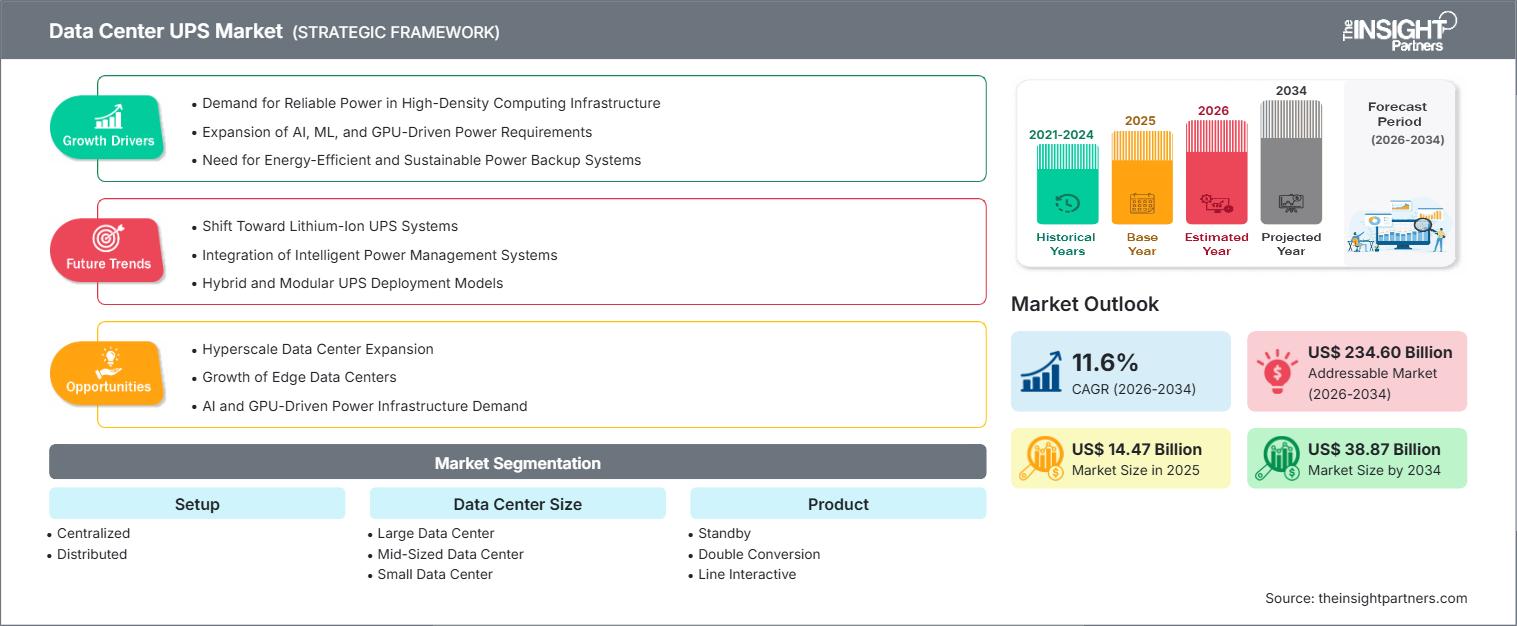
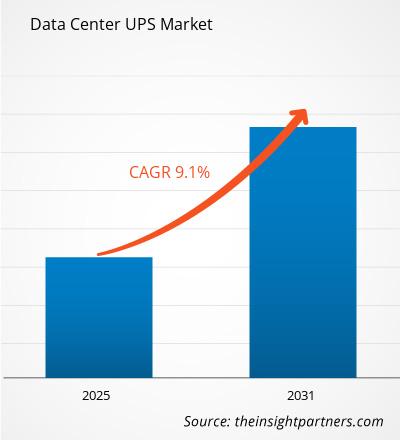
The Data Center UPS Market is worth US$ 5.85 Billion in 2025 and estimated to be worth US$ 12.81 Billion by 2034, registering a CAGR of 9.1% from 2026 to 2034. The market is growing because the cloud, enterprise, and AI-enabled data centers need to have a continuous power supply, voltage regulation, battery management system, and fault tolerance architecture.
The growth rate of North America is estimated to be 8.2-9.0% due to the expansion of the hyperscale data center campuses, colocation centers, and enterprise data centers upgrades in terms of the power supply continuity requirement. Data Center UPS Market size is driven by AI workload density, grid interconnection limitation, edge installations, and use of lithium-ion batteries.
Data Center UPS Market Assessment and Insights
- North America held 34–37% share in 2025 and is growing at a CAGR of 8.2–9.0% during 2026–2034, supported by hyperscale AI campuses, colocation demand, and grid reliability planning.
- US represented 82–86% of North America in 2025 and is growing at a CAGR of 8.4–9.2%, led by cloud, AI, and enterprise hosting investments.
- Europe accounted for 24–27% share in 2025 and is advancing at a CAGR of 7.6–8.4%, with Germany, the UK, France, Italy, and Spain leading deployments.
- Asia Pacific captured 27–31% share in 2025 and is expanding at a CAGR of 10.2–11.4%, led by China, Japan, South Korea, India, and Australia.
- Largest Segment Solution held 68–72% market share in 2025 and is growing at a CAGR of 8.8–9.6%, supported by modular three-phase UPS and lithium-ion systems.
- High Growth Segment Large Data Centers held 46–50% market share in 2025 and are growing at a CAGR of 10.4–11.6%, driven by hyperscale and AI-ready facilities.
- Key companies analyzed in detail: Vertiv Holdings Co, Delta Electronics, Inc., Eaton Corporation plc, ABB Ltd., AEG Power Solutions B.V., General Electric Company, Schneider Electric SE, Gamatronic Electronic Industries Ltd., Emerson Electric Co., Toshiba Corporation, Mitsubishi Electric Power Products, Inc., Cyber Power Systems, Inc., Aspen Systems, Inc., Legrand SA, Rolls-Royce plc, Riello UPS, Right Power Technology Sdn. Bhd., and Numeric.
Source: The Insight Partners' analysis based on proprietary research, government publications, company annual reports, investor presentations, industry databases, and expert interviews.
Data center power protection has transitioned from static backup systems to smart, flexible and software-enabled solutions. Providers have transitioned from using valve-regulated lead-acid batteries to more modern lithium-ion batteries, where factors like spatial efficiency, maintenance, and life-cycle reliability are critical. The modular UPS structure is also evolving due to suppliers now considering cabinet designs, power modules, switchgear interfaces, and monitoring solutions as part of one coherent system.
Future demand will depend on AI clusters, sovereign cloud facilities, edge computing and greater uptime management. The International Energy Agency estimates that data center electricity consumption experienced an increase in 2025, while according to the Uptime Institute, electricity continues to be the leading contributor to impactful data center failures. These trends will drive UPS investments in areas where grid interconnection problems, high rack density and digital service continuity are key buying criteria.
Data Center UPS Market Report Scope
| Report Attribute | Details |
|---|---|
| Market size in 2025 | US$ 5.85 Billion |
| Market Size by 2034 | US$ 12.81 Billion |
| Global CAGR (2026 - 2034) | 11.6% |
| Historical Data | 2021-2024 |
| Forecast period | 2026-2034 |
Data Center UPS Market Analysis
The drivers for growth in the Data Center UPS market are cloud-based storage, enterprise application software, customer relationship management solutions, and data warehouse computing operations that cannot be interrupted due to power issues. The UPS acts as a short-term supply of backup power, filtering of the power, and orderly transition until power restoration by the generators or alternative supply becomes stable.
The chain consists of battery cell producers, power electronics makers, switchgear producers, facility designers, system integrators, and maintenance personnel. Some of the supply-side factors are lithium ion batteries supply, transformers lead time, adoption of silicon carbide, firmware security, and service capabilities. The buyers focus more on efficiency curves, physical size, autonomy of the battery, thermal performance, modularity, and compatibility with distributed energy resources.
The Data Center UPS Market analysis reveals competitive dynamics between global electrical infrastructure giants and dedicated power protection solutions providers. Vertiv Holdings Co, Schneider Electric SE, Eaton Corporation plc, ABB Ltd., Delta Electronics, Inc., and Legrand SA compete via comprehensive portfolios for data centers. Riello UPS, Gamatronic Electronic Industries Ltd., Numeric, Cyber Power Systems, Inc., and Right Power Technology Sdn. Bhd. meet tailored needs of modular, enterprise, and regional implementations.
Current investment trends include high-efficiency double conversion architecture, lithium-ion batteries, grid interactive UPS systems, and predictive maintenance software. Successful positioning requires installed base, global service network, hyperscale capabilities, and integration potential of UPS within power distribution, cooling, and energy management. Vendors that are capable of decreasing deployment times by increasing observability will have a more favorable position due to accelerated implementation of AI campuses.
● REPORT CUSTOMIZATION
Tailor This Report To Align With Your Specific Business Requirements
This report can be customized to align precisely with your business objectives, scope, and target markets. Customization options include tailored segmentation, geography, competitive analysis, and strategic insights to support informed decision-making.
Customize This Report →WHAT YOU CAN ADJUST
- ● Segmentations
- ● Geography
- ● Competitive Analysis
- ● Language Preferences
Data Center UPS Market: Strategic Insights
Regional Insights
North America Data Center UPS Market
North America held 34–37% Data Center UPS Market share in 2025 and is projected to grow at 8.2–9.0% during 2026–2034. Hyperscale clusters in Northern Virginia, Texas, Arizona, Ontario, and Quebec are raising UPS capacity requirements as AI racks place sharper step-load stress on electrical chains.
Utility interconnection queues and rising outage costs are pushing operators toward lithium-ion, modular, and grid-aware systems. The Uptime Institute has consistently identified power as a leading outage trigger, making redundant UPS architectures central to colocation contracts, cloud availability zones, and enterprise disaster recovery planning.
U.S. Data Center UPS Market
North America is accounted for by the U.S., covering 82–86%, and will grow at 8.4–9.2%. Applications of this market include demand in hyperscale cloud corridors, financial services, healthcare networks, media, and federal workload applications that necessitate service-level agreements that call for constant backup, conditioned power, and chain of power visibility.
Companies such as Vertiv Holdings Co, Eaton Corporation plc, Schneider Electric SE, ABB Ltd., and Legrand SA have strong service infrastructure in the U.S. that allows for lifecycle replacement. In terms of applications, it can be noted that there is faster adoption in cloud storage, application servers, CRM systems, and AI-enabled ERP environments.
Europe Data Center UPS Market
The Europe segment had a 24-27% share in 2025 and is estimated to register a CAGR of 7.6-8.4%. The United Kingdom is the leading colocation absorption in the region because of its proximity to London and Manchester, where tenants require redundancy due to the presence of financial, cloud, and government companies.
Germany continues to be the engineering hub, with Frankfurt's presence helping due to its interconnection density and uptime requirements. France, Italy, and Spain are developing in the region via sovereign clouds, content delivery, and regional enterprise hosting, whereas EU energy efficiency policies favor high-efficiency UPS replacements.
APAC Data Center UPS Market
APAC held market share of 27%-31% in 2025 and has a growth rate of 10.2%-11.4%, driven by China. Japan and South Korea are meeting demand because of their cloud, telecom, and semiconductor ecosystems, whereas India and Australia are expanding due to digitized public infrastructures, banking transformation, and cloud availability zones.
Government policies, data localization, and renewables procurement are driving power architecture selections. Operators have chosen modular UPS systems along with lithium-ion batteries to enable fast deployments, a limited footprint, and increased rack density.
Middle East & Africa Data Center UPS Market
The Middle East & Africa region is expected to grow at 8.8–9.8% during 2026–2034, with the UAE leading regional deployment. Saudi Arabia, South Africa, and the Rest of MEA are investing in cloud regions, digital government, banking infrastructure, and media delivery platforms.
Energy availability, heat management, and backup autonomy shape procurement decisions in desert and grid-constrained environments. UPS suppliers with integrated service, battery monitoring, and generator coordination capabilities are favored as operators balance uptime with efficiency and infrastructure resilience.
Segmentation Analysis
Type
Type is expected to grow at 8.7–9.5% during 2026–2034 as operators balance equipment modernization with managed lifecycle services. The Data Center UPS Market scope under this segment covers installed systems, commissioning, remote monitoring, preventive maintenance, and battery replacement planning across facilities with different redundancy designs.
- Solution remains the largest sub-segment because new data halls require three-phase UPS, power modules, batteries, bypass cabinets, and controls designed for high availability and predictable runtime.
- Services gain strategic importance as owners outsource inspection, firmware updates, battery health analytics, and emergency response to reduce downtime risk across distributed data center portfolios.
Data Center Size
Data Center Size is projected to grow at 9.2–10.2% during 2026–2034 as the market shifts toward larger, denser facilities while edge and enterprise rooms continue replacing legacy backup systems. Procurement varies by power density, runtime requirement, redundancy tier, and service access constraints.
- Small Data Centers rely on compact UPS systems for branch IT, edge compute, telecom rooms, and local applications where space, ease of maintenance, and predictable battery replacement are decisive.
- Medium Data Centers support enterprise resource planning, file servers, and regional workloads, requiring scalable UPS capacity that can expand without disrupting live production environments.
- Large Data Centers represent the high growth segment as hyperscale, AI, and colocation operators deploy modular electrical rooms, high-capacity UPS frames, and advanced battery monitoring.
Application
Application is expected to grow at 8.9–9.8% during 2026–2034 as workload criticality becomes a procurement filter. Cloud storage, application servers, and customer platforms need uninterrupted power, while enterprise workloads require conditioned input, resilience reporting, and coordinated failover.
- Cloud Storage drives continuous availability needs because object storage, backup repositories, and distributed file systems must remain accessible during grid disturbances and power transfer events.
- Enterprise Resource Planning System workloads require stable backup power because finance, procurement, manufacturing, and compliance processes depend on transaction integrity and planned shutdown protection.
- Data Warehouse deployments need UPS capacity that supports analytics platforms, storage arrays, and clustered compute nodes during transfer to generators or redundant electrical feeds.
- File Servers remain important in enterprise and public-sector environments where shared records, imaging files, and operational data need low-risk power continuity.
- Application Servers depend on UPS protection for customer portals, middleware, and internal applications where downtime quickly affects revenue, productivity, and service quality.
- Customer Relationship Management Systems require dependable backup power because sales, service, and customer support operations increasingly run on hosted platforms with strict availability expectations.
End-user
End-user is forecast to grow at 9.0–10.0% during 2026–2034 as digital services move deeper into regulated and latency-sensitive industries. Banking, healthcare, government, and media buyers place higher value on uptime documentation, resilient architectures, and service-level compliance.
- Banking and Financial Services maintain high revenue contribution because trading, payments, core banking, and risk platforms require power continuity with redundant paths and rapid incident response.
- Information Technology represents mature adoption as cloud, hosting, managed services, and software firms operate dense environments with continuous refresh cycles and detailed resilience benchmarks.
- Manufacturing adopts UPS systems for industrial data rooms, digital twins, quality systems, and plant-level applications that support automation and production visibility.
- Energy uses UPS protection for operational technology, grid control, asset monitoring, and dispatch systems where short interruptions can affect reliability and safety processes.
- Healthcare requires protected infrastructure for electronic medical records, imaging archives, laboratory systems, and hospital networks where service continuity supports clinical operations.
- Government deployments focus on citizen services, defense, public safety, and data sovereignty, creating demand for secure, serviceable, and standards-aligned UPS infrastructure.
- Entertainment and Media depends on backup power for streaming platforms, rendering farms, content storage, and broadcast workflows where downtime directly affects audience reach.
Opportunity Snapshot
Market Opportunity Snapshot
| End-user | Revenue Contribution | Trend Tag | Adoption Stage |
| Banking and Financial Services | High | Risk Uptime | Mature |
| Information Technology | High | AI Hosting | Scaling |
| Manufacturing | Medium | Plant Edge | Scaling |
| Energy | Medium | Grid Control | Scaling |
| Healthcare | Medium | Clinical Data | Scaling |
| Government | Medium | Sovereign Cloud | Scaling |
| Entertainment and Media | Low | Streaming Load | Emerging |
Data Center UPS Market Growth Drivers and Impact Analysis
AI Workload Density Raises Critical Power Requirements
UPS sizing considerations are also being altered due to graphics processors that generate sharper load spikes and higher power densities compared to traditional enterprise servers. Vertiv has commented that AI racks have the tendency to go from low idle load to overload situations rapidly, thus increasing the need for resilient UPS, batteries, switchgear, and control technologies. In terms of market impact, this means a move towards larger three-phase UPS units, modular cores, and software that enables quick commissioning while safeguarding uptime.
Grid Constraints Increase Need for Onsite Resilience
The ability to deliver power to facilities is becoming the limiting factor when building data centers in certain clusters. Providers who are facing long wait times at interconnects, congestion, and volatility in electricity prices are extending their site resilience using UPS, batteries, generators, and energy management systems. This driver creates an increased demand for retrofits within existing facilities, as well as increased UPS per MW installed in new facilities.
Lifecycle Efficiency Becomes a Procurement Requirement
Nowadays, energy efficiency has become a business necessity instead of just a technical feature. Advanced UPS modes with high efficiency, lithium-ion batteries, battery prediction, and reduced cooling demand will allow operators to save on operational cost and support their environmental goals. The motivation to adopt energy efficiency will influence the vendors' choice since customers will assess conversion efficiency, service frequency, cybersecurity of monitoring, and carbon footprint of the whole system life cycle.
Data Center UPS Market Future Trends
Grid-Interactive Backup Power Architectures
Data Center UPS Market trends will become characterized by the presence of UPS solutions that have backup power and selected energy flexibility capabilities. Battery-backed UPS systems will be capable of aiding the operator in handling peak demand, synchronizing with on-site generation, and being part of resilience planning where regulations allow. The procurement process will assess bidirectional capability, controls integration, battery technology, warranty conditions, and security, along with traditional runtime and redundancy.
Higher-Voltage Power Distribution for AI Facilities
AI factories will push electrical design toward higher-voltage distribution and closer integration between UPS, busways, rectifiers, and rack-level converters. The shift responds to megawatt-scale compute blocks where traditional low-voltage architectures become less efficient and more space intensive. Vendors developing 800 VDC and high-density AC-DC approaches are likely to influence specifications for next-generation campuses, especially where operators seek reduced copper use, smaller electrical rooms, and faster modular deployment.
Data Center UPS Market Opportunities
Battery Modernization Across Installed Data Centers
Replacement of valve-regulated lead-acid batteries creates a measurable opportunity for suppliers offering lithium-ion systems, monitoring software, and lifecycle services. Many mature enterprise and colocation sites are approaching renewal cycles where space, temperature tolerance, and maintenance labor are stronger decision factors than initial purchase price. Data Center UPS Market Forecasts indicate that vendors can capture value by bundling battery analytics, safety validation, and phased migration plans that reduce shutdown risk.
Integrated Electrical Rooms for Fast-Track Construction
Prefabricated and skidded electrical rooms offer a strong opportunity as data center developers compress construction timelines. Integrated UPS, switchgear, busway, controls, and battery modules can reduce onsite labor, simplify testing, and improve repeatability across multi-campus programs. This opportunity is strongest for hyperscale, colocation, and government cloud projects where standardization supports faster capacity delivery, tighter quality control, and better coordination between power protection and building management systems.
Recent Developments
- October 2025: Vertiv Holdings Co announced progress with NVIDIA on 800 VDC platform designs for next-generation AI factories, including centralized rectifiers, high-efficiency DC busways, rack-level converters, and integrated energy storage. The portfolio is planned for release in the second half of 2026 to support future high-density AI infrastructure.
- May 2025: Eaton Corporation plc launched the 9PX Gen2 5–11 kW UPS for data centers, distributed IT, edge networks, and server rooms. The system delivers up to 97.2% efficiency in the 11 kW unit using silicon carbide components, includes remote configuration capability, and supports compact deployment with 11 kW in 4U.
- March 2025: Schneider Electric SE introduced the Galaxy VXL UPS in India for AI, hyperscale data centers, and critical infrastructure. The 500–1250 kW system supports up to 1.25 MW per frame, scales to 5 MW in parallel, delivers up to 99% efficiency in eConversion mode, and includes live-swap capability.
Frequently Asked Questions

- Comprehensive Market Sizing and Forecast Analysis
- Detailed Segmentation Analysis
- In-Depth Market Dynamics Assessment
- Regional and Country-Level Insights
- Competitive Landscape and Company Benchmarking
- Strategic Business Intelligence
Recent Reports
Testimonials

The Insight Partners' SCADA System Market report is comprehensive, with valuable insights on current trends and future forecasts. The team was highly professional, responsive, and supportive throughout. We are very satisfied and highly recommend their services.
RAN KEDEM Partner, Reali Technologies LTDs
I requested a report on a very specific software market and the team produced the report in a few days. The information was very relevant and well presented. I then requested some changes and additions to the report. The team was again very responsive and I got the final report in less than a week.
JEAN-HERVE JENN Chairman, Future Analytica
We worked with The Insight Partners for an important market study and forecast. They gave us clear insights into opportunities and risks, which helped shape our plans. Their research was easy to use and based on solid data. It helped us make smart, confident decisions. We highly recommend them.
PIYUSH NAGPAL Sr. Vice President, High Beam Global
The Insight Partners delivered insightful, well-structured market research with strong domain expertise. Their team was professional and responsive throughout. The user-friendly website made accessing industry reports seamless. We highly recommend them for reliable, high-quality research services
YUKIHIKO ADACHI CEO, Deep Blue, LLC.
This is the first time I have purchased a market report from The Insight Partners.While I was unsure at first, I visited their web site and felt more comfortable to take the risk and purchase a market report.I am completely satisfied with the quality of the report and customer service. I had several questions and comments with the initial report, but after a couple of dialogs over email with their analyst I believe I have a report that I can use as input to our strategic planning process.Thank you so much for taking the extra time and making this a positive experience.I will definitely recommend your service to others and you will be my first call when we need further market data.
JOHN SUZUKI President and Chief Executive Officer, Board Director, BK Technologies
I wish to appreciate your support and the professionalism you displayed in the course of attending to my request for information regarding to infectious disease IVD market in Nigeria. I appreciate your patience, your guidance, and the fact that you were willing to offer a discount, which eventually made it possible for us to close a deal. I look forward to engaging The Insight Partners in the future, all thanks to the impression you have created in me as a result of this first encounter.
DR CHIJIOKE ONYIA MANAGING DIRECTOR, PineCrest Healthcare Ltd.Reason to Buy
- Informed Decision-Making
- Understanding Market Dynamics
- Competitive Analysis
- Identifying Emerging Markets
- Customer Insights
- Market Forecasts
- Risk Mitigation
- Boosting Operational Efficiency
- Strategic Planning
- Investment Justification
- Tracking Industry Innovations
- Aligning with Regulatory Trends





 Get Free Sample for