
Dental 3D Printing Market Share, Size & Demand by 2034
Coverage: By Product & Services (Equipment and Services), Technology (VAT Photopolymerisation, Selective Laser Sintering, PolyJet Technology, Fused Deposition Modeling, and Other Technologies), Material (Plastics, Metals and Other Materials), Application (Prosthodontics, Implantology and Endodontics), End User (Dental Hospitals & Clinics, Dental Laboratories and Dental Academic & Research Institutes), and Geography (North America, Europe, Asia Pacific, and South and Central America)
- Status : Data Released
- Report Code : TIPMD00002681
- Category : Life Sciences
- No. of Pages : 150
- Available Report Formats :


- Last update date : October 14, 2026


2025 Market Size
US$ 4.37 Bn
Base year value
2034 Forecast
US$ 15.64 Bn
Projected by 2034
CAGR 2026-2034
15.21 %
Growth rate
Addressable Market
US$ 85.27 Bn
(2026-2034)
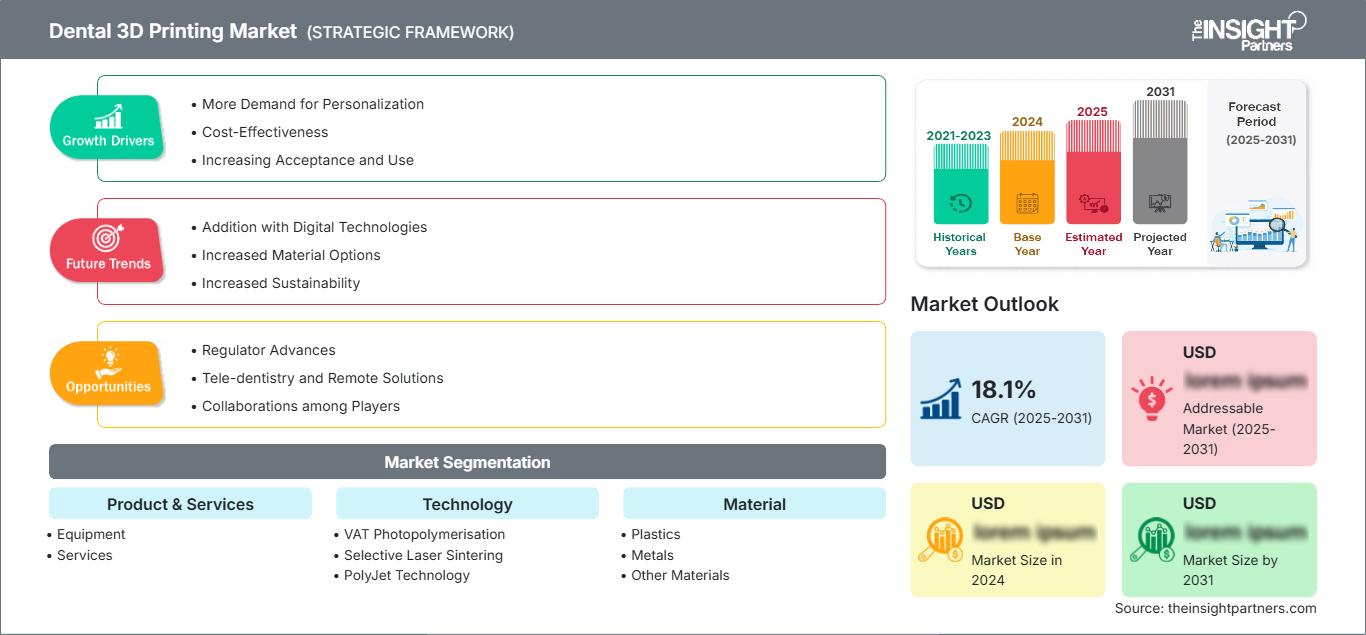
The Dental 3D Printing Market is valued at US$ 4.37 Billion in 2025 and is projected to reach US$ 15.64 Billion by 2034, expanding at a CAGR of 15.21% during 2026–2034. The market is changing due to the advent of digital dentistry, patient-specific manufacturing, fast-chairside processes, and the adoption of additive manufacturing technologies in prosthetics, implantology, and restoration within dental practices and laboratories.
North America offers an attractive market for adoption, with the Dental 3D Printing Market Size driven by digital dentistry systems already installed in the region, high digitalization of dental laboratories, and an increased need for same-day/days reduced process. The market in North America is expected to grow at a CAGR of 14.2-15.2% between 2026 and 2034, fueled by the adoption of intraoral scanning and validated printing materials.
Dental 3D Printing Market Assessment and Insights
- North America: North America is estimated to hold a 30–34% share in 2025 and grow at a CAGR of 14.2–15.2% between 2026–2034, supported by mature digital workflows, laboratory adoption, and increasing in-office manufacturing.
- US: The US is estimated to represent 78–82% of North America’s 2025 revenue and expand at a CAGR of 14.0–15.0% during 2026–2034, supported by digital dental practices and laboratory automation.
- Europe: Europe is estimated at a 26–30% share in 2025 and a CAGR of 14.5–15.5% through 2034, with Germany, the UK, France, Italy, and Spain forming major adoption centers for digital laboratories.
- Asia Pacific: Asia Pacific is estimated at a 25–29% share in 2025 and a CAGR of 16.0–17.0% during 2026–2034, led by China, Japan, South Korea, India, and Australia as digital dental infrastructure expands.
- Largest Segment: VAT Photopolymerisation is estimated to command a 42–46% market share in 2025 and grow at a CAGR of 15.4–16.4%, supported by precision and dental-specific resin availability.
- High Growth Segment: Prosthodontics is estimated at a 36–40% market share in 2025 and a CAGR of 16.2–17.2% through 2034, driven by digitally produced dentures, crowns, and related prosthetic workflows.
- Key companies analyzed in detail: 3D Systems, Inc.; Asiga Pty Ltd; DWS S.r.l.; EnvisionTEC, Inc.; Formlabs, Inc.; Renishaw plc; Roland DG Corporation; Nikon SLM Solutions AG; Stratasys Ltd.; Rapid Shape GmbH.
Source: The Insight Partners' analysis based on proprietary research, government publications, company annual reports, investor presentations, industry databases, and expert interviews.
Dental 3D Printing Market technologies have progressed from laboratory-based prototyping to manufacturing workflows able to produce patient-specific models, guides, dentures, orthodontics, and restorations. Resin-based photopolymerization technologies have become more important due to their high resolution capabilities and wide range of dental materials available. Economies of production are changing due to bigger build areas, automation of post-processing, and software integration minimizing hands-on work in repetitive laboratory workflows.
Further growth will require the use of emerging Asian markets, laboratory networks, and chairside manufacturing processes. Validation of printed materials and devices is critical due to specific intended-use evaluations. US regulation framework evaluates dental printing materials within the context of finished product and its intended use, making the importance of validated workflow and materials traceability even more critical.
Dental 3D Printing Market Report Scope
| Report Attribute | Details |
|---|---|
| Market size in 2025 | US$ 4.37 Billion |
| Market Size by 2034 | US$ 15.64 Billion |
| Global CAGR (2026 - 2034) | 15.21% |
| Historical Data | 2021-2024 |
| Forecast period | 2026-2034 |
Dental 3D Printing Market Analysis
Dental 3D Printing Market growth is directly related to the digitalization of dental practices and labs. According to a survey by the American Dental Association, dentists use 3D printing as a way to support other digital technology, control their work processes, increase efficiency, utilize already gained digital skills, and save either cost or production time. This proves that the implementation of the technology is becoming more connected with workflow economics than the novelty of the equipment itself.
This system comprises intraoral scanners, imaging, CAD software, build preparation solutions, 3D printers, dental materials, cleaning and curing stations, lab and clinical services delivery. The vendors have to compete within this interrelated workflow rather than just in a particular category of 3D printers. The differentiation on the supply side becomes more connected with proven material-printer pairs, speed, consistency, automation, and technical assistance.
The competitive analysis in the Dental 3D printing market Report reveals a diverse market ranging from integrated additive manufacturing solutions suppliers, dental printers specialists, to diversified digital manufacturing players. 3D Systems and Stratasys possess a large dental product portfolio, whereas Formlabs specializes in affordable stereolithography solutions. DWS S.r.l., Asiga Pty Ltd, and Rapid Shape GmbH offer dental production-oriented solutions, whereas Roland DG Corporation integrates digital manufacturing technologies with dental application solutions.
The capital movement supports higher output manufacturing processes, automation, and material oriented towards the application. The companies Renishaw plc and Nikon SLM Solutions AG offer advanced additive manufacturing technology, but their concentration on dentistry is different from the advanced polymer technology. The company EnvisionTEC, Inc. continues to be an active supplier of photopolymerization technology.
● REPORT CUSTOMIZATION
Tailor This Report To Align With Your Specific Business Requirements
This report can be customized to align precisely with your business objectives, scope, and target markets. Customization options include tailored segmentation, geography, competitive analysis, and strategic insights to support informed decision-making.
Customize This Report →WHAT YOU CAN ADJUST
- ● Segmentations
- ● Geography
- ● Competitive Analysis
- ● Language Preferences
Dental 3D Printing Market: Strategic Insights
Regional Insights
North America Dental 3D Printing Market
It is estimated that North America will represent 30-34% of the 2025 Dental 3D Printing Market Share and grow with a CAGR of 14.2-15.2% until 2034. Factors driving growth in this region include an existing advanced infrastructure of dental labs, CAD/CAM technology, equipment specialists, and sufficient financial capabilities. Digital scanning and additive manufacturing are increasingly functioning as a single process chain, enabling laboratories to decrease manual fabrication procedures and improve their production performance.
The United States is dominating regional consumption, whereas Canada represents a smaller yet technically advanced market. Increasingly, implementation is being driven by prosthetic production, implants planning, orthodontic models, surgical guides, and chairside solutions. Material validation has become one of the purchase criteria as regulators differentiate intended use for dental materials. This creates opportunities for those suppliers who can offer tested combinations of printer, software, and material.
U.S. Dental 3D Printing Market
The US contributes about 78-82% to North America’s 2025 revenues and is forecasted to witness a CAGR of 14.0-15.0% between 2026 and 2034. The factors responsible for adoption include the advanced dental laboratories, the presence of a high level of digital workflow integration, and an increasing trend towards in-house manufacturing. According to ADA, workflow control and efficiency are the primary reasons for adopting dental printers.
Some companies that exist within the market are 3D Systems, Formlabs, Stratasys, Asiga, and others, and they are all major providers to laboratories and clinics. In terms of applications, it is being used for not only models but for dentures, surgical guides, orthodontics, and restoration purposes as well. The larger laboratories look into the aspect of automation, and the smaller ones care more about convenience and materials.
Europe Dental 3D Printing Market
Europe is estimated to have a market share of 26–30% of the 2025 market and grow at a rate of 14.5–15.5% up to 2034. Germany holds the leadership position in the region due to its experience in dental manufacturing and a solid laboratory infrastructure. The UK, France, Italy, and Spain also hold a material share in the market thanks to growing digital workflows in laboratories and additive manufacturing for prosthodontics and orthodontics.
The UK has a well-established market for private dentistry and digital planning interest. Germany has state-of-the-art manufacturing capabilities with CAD/CAM. In France, there is increasing adoption in laboratories. In Italy, there is equipment expertise and specialty distributors, whereas Spain is quickly developing as laboratories change their manufacturing process. It is important for manufacturers of products that come into contact with the patients to be in line with the European medical device regulations.
APAC Dental 3D Printing Market
The APAC region captures a market share ranging between 25 and 29% in 2025 and is predicted to expand at a CAGR ranging between 16.0 and 17.0%, making it the most rapidly growing region during the forecast period till 2034. The leading country within the region will be China, which is followed by Japan, South Korea, India, and Australia.
Large production facilities along with the development of local dental technology will distinguish China, the emphasis on precision and innovation in clinical workflow will make the leading factors for Japanese and South Korean countries, India possesses significant potential due to the further development of private dental care infrastructure, Australia possesses a developed professional environment.
Digital health policy and technology investments should help in the move from outsourced laboratory production to more localized manufacturing.
Middle East & Africa Dental 3D Printing Market
Middle East & Africa market is expected to grow at a CAGR of 11.5-12.5% from 2026 to 2034. The leading nations in the region in terms of adoption are Saudi Arabia, followed by UAE and South Africa. The factors driving demand for technology in digital dentistry include investments in healthcare facilities, development of medical tourism, specialized dental facilities, and hospitals.
In Saudi Arabia and UAE, there are higher purchasing capabilities for laboratory equipment, whereas South Africa acts as the regional center for specialty dental facilities. Rest of MEA depends more on distributors and capital-intensive purchases. Opportunities for smaller systems can emerge from healthcare facility investment, economic diversification, and growth of the private sector in the region.
Segmentation Analysis
Product & Services
The Product & Services segment is forecast to grow at a CAGR of 14.8–15.8% during 2026–2034. Equipment remains central to adoption, while service models are gaining importance as laboratories seek outsourced production, technical support, maintenance, and workflow optimization. Dental 3D Printing Market scope increasingly encompasses the complete production ecosystem rather than printer hardware alone.
- Equipment: Equipment remains the core purchasing category because laboratories and practices require printers, curing systems, washing units, and related production hardware. Demand increasingly favors automated workflows and higher throughput.
- Services: Services support customers that prefer outsourced production, technical maintenance, training, workflow implementation, and application development. Their strategic importance rises as dental laboratories seek specialized expertise without expanding internal capabilities.
Technology
Technology is projected to expand at a CAGR of 15.0–16.0% through 2034. Photopolymerisation remains prominent because dental applications demand fine detail and validated resin compatibility, while powder-based and extrusion technologies retain specialized roles. Technology selection increasingly depends on application, throughput, material characteristics, post-processing requirements, and total workflow cost.
- VAT Photopolymerisation: VAT photopolymerisation holds the leading position because it supports high-resolution dental models, surgical guides, prosthetic components, and specialized resins. Its strategic value is reinforced by broad application-specific material development.
- Selective Laser Sintering: Selective Laser Sintering serves applications requiring powder-based production and durable polymer components. Its importance is linked to batch production, design flexibility, and reduced dependence on conventional tooling.
- PolyJet Technology: PolyJet is important for multi-material and full-color dental workflows. Its ability to combine materials within a build supports realistic models, dentures, and complex laboratory applications requiring high visual fidelity.
- Fused Deposition Modeling: Fused Deposition Modeling addresses selected dental models, educational applications, and cost-sensitive workflows. Its accessibility supports entry-level experimentation, although precision requirements limit its use in some patient-specific applications.
- Other Technologies: Other technologies include emerging and specialized additive processes used for niche dental applications. Their strategic relevance depends on improvements in material compatibility, productivity, accuracy, and integration with established digital workflows.
Material
The Material segment is expected to grow at a CAGR of 15.2–16.2% during 2026–2034. Material development is increasingly application-specific, with manufacturers targeting mechanical performance, biocompatibility, aesthetics, sterilization compatibility, and regulatory requirements. Material portfolios are therefore becoming a major competitive lever because validated formulations can create recurring consumables demand.
- Plastics: Plastics dominate dental additive manufacturing because photopolymer and thermoplastic formulations support models, guides, dentures, aligner-related workflows, and selected restorative applications. Material specialization continues to broaden clinical usability.
- Metals: Metals serve implantology and specialized prosthetic workflows requiring strength, durability, and dimensional stability. Their strategic importance is higher in complex restorations and implant-related production where material performance justifies advanced manufacturing costs.
- Other Materials: Other materials encompass specialized formulations and emerging composites designed for targeted dental applications. Their position depends on regulatory validation, clinical performance, aesthetic requirements, and compatibility with commercial printer platforms.
Application
The Application segment is forecast to grow at a CAGR of 15.4–16.4% during 2026–2034. Prosthodontics remains the largest application because digital workflows can address dentures, models, and restorative components, while implantology and endodontics benefit from increasingly precise patient-specific planning and fabrication. Adoption is reinforced by the broader digital transformation of dental laboratories.
- Prosthodontics: Prosthodontics represents the largest application area, supported by digital dentures, crowns, bridges, try-ins, and restorative models. High-volume laboratory production makes automation and repeatability particularly valuable.
- Implantology: Implantology benefits from patient-specific models, surgical guides, and digitally planned restorative workflows. Demand is linked to precision, treatment planning, and integration between imaging, design, and manufacturing systems.
- Endodontics: Endodontics represents a more specialized application where additive manufacturing can support planning models, guides, educational tools, and selected procedural components. Its strategic role should increase as digital workflows mature.
Opportunity Snapshot
| Application | Revenue Contribution (High/Medium/Low) | Trend Tag (MAX 2 words) | Adoption Stage (Emerging/Scaling/Mature) |
| Prosthodontics | High | Digital Dentures | Scaling |
| Implantology | Medium | Surgical Guides | Scaling |
| Endodontics | Low | Guided Access | Emerging |
Dental 3D Printing Market Growth Drivers and Impact Analysis
Digital workflow integration is increasing the economic value of printers
The biggest pull factor is the combination of 3D printing with scanning, CAD design, treatment planning, and lab management. As reported by ADA, the main reason why dentists choose 3D printers is that they use them to support the digitalization process, streamline workflows, and save on manufacturing time or cost. This suggests that more and more equipment is acquired as a part of a combined production system rather than individually. The commercial effect is significant since the integrated workflows will decrease handoffs between clinicians and labs, increase repeatability, and decrease physical storing of models. In addition, suppliers that provide for the connection between printers and scanning machines, CAD design programs, curing units, and materials will be able to retain their customers.
Rising oral disease burden is expanding the addressable dental workload
There is a large structural base provided by the burden of disease in the world population with regard to dentistry and adoption of dental technologies. WHO has determined that oral diseases impact nearly 3.7 billion people and untreated dental caries remain the world's most prevalent health problem. Population growth and aging ensure pressure on dental treatments will continue in regions where there is growing access to dental care services. Impact on additive manufacturing is indirect, but very relevant, since rising volumes of procedures make it economical to invest in manufacturing systems that automate repetitive lab processes. Dental labs may use additive manufacturing to fabricate many individualized components without using traditional molds and complicated manual setups. Increased volume of procedures makes automation economical, and therefore this factor should be most powerful in regions where there is both growing access to dental care facilities and advanced technologies.
Validated dental materials are broadening the range of printable clinical devices
Innovation in the field of materials is taking additive manufacturing out of merely making diagnostic models to making devices for patient contact and functionality in dentistry. In terms of regulation, material performance is being evaluated not only on the basis of how well it functions as a resin but also in the context of its use in a particular finished device, which encourages manufacturers to tailor the formulation rather than use printing resins. Dental uses mentioned by the FDA include denture resins, orthodontic retainers, night guards, crowns, bridges, inlays, and onlays in their guidelines of printed devices. Having more validated materials will increase the use of the printers and also provide a source of recurring consumables revenue for the supplier. They will also diminish the need for dental laboratories to depend on traditional manufacturing methods.
Dental 3D Printing Market Future Trends
AI-assisted design will increasingly connect diagnosis with automated production
Dental 3D Printing Market trends are expected to move toward software systems that connect patient scans, automated design, treatment planning, and machine-ready files with fewer manual interventions. Artificial intelligence can support segmentation, landmark recognition, design recommendations, and production preparation, while rule-based validation can reduce avoidable workflow errors. The next stage will likely emphasize interoperability rather than isolated AI features, allowing clinical data to move securely between scanners, design platforms, printers, and laboratory systems. This development could reduce technician workload and improve consistency in high-volume applications such as dentures, models, surgical guides, and orthodontic production. Vendors with open interfaces and validated workflow integrations may gain an advantage because laboratories increasingly operate mixed technology environments. Regulatory expectations around software validation, cybersecurity, traceability, and clinical responsibility will shape how rapidly these capabilities move from assisted design toward automated production.
Distributed manufacturing will reduce dependence on centralized laboratories
Dental production is likely to become more distributed as compact printers, validated materials, and cloud-enabled workflows make local manufacturing increasingly practical. Instead of sending every case to centralized laboratories, practices may produce selected models, guides, temporary restorations, and appliances internally while retaining complex work for specialist facilities. This hybrid model can shorten turnaround times and reduce logistics costs without eliminating laboratory expertise. Large laboratories will remain important because they can justify high-capacity equipment and specialized technicians, but smaller practices can adopt focused systems for predictable, repeatable applications. The strategic consequence is a segmentation of production by complexity, volume, and clinical urgency. Manufacturers can address this shift through equipment tiers, subscription services, material bundles, and remote technical support. Over time, interoperability will become critical because distributed production requires consistent data transfer and standardized manufacturing parameters across locations.
Dental 3D Printing Market Opportunities
Expand production ecosystems through laboratory partnerships
Dental 3D Printing Market Forecasts point toward opportunities for suppliers that build partnerships with regional laboratories, dental service organizations, clinics, and software providers. Instead of selling printers as isolated capital equipment, companies can establish complete production ecosystems covering scanning, design, printing, post-processing, materials, training, and maintenance. This approach can lower adoption barriers for smaller practices while creating recurring consumables and service revenue. Partnerships with laboratories can also provide manufacturers with access to real production data, enabling refinement of print parameters and workflow automation. Investors should prioritize suppliers with strong recurring-revenue potential and application-specific material portfolios because printer placements alone may not fully capture the long-term economics of digital dentistry. Geographic partnerships can additionally accelerate expansion in markets where local regulatory knowledge and technical support are prerequisites for successful commercialization.
Develop affordable systems for emerging dental economies
Emerging dental economies provide an opportunity for manufacturers to adapt equipment portfolios to different capital constraints, production volumes, and technical capabilities. India, Southeast Asia, Latin America, and selected Middle Eastern markets are potential targets because dental infrastructure is expanding while laboratories increasingly seek digital production methods. Successful strategies should combine affordable hardware with validated materials, localized training, financing, and distributor-based technical support. Compact systems may be particularly attractive where clinic space and capital budgets are limited. Suppliers can also use regional laboratory partnerships to establish reference workflows before pursuing larger institutional accounts. Rather than competing only through lower equipment prices, manufacturers can differentiate through simplified operation, low material waste, predictable maintenance, and application-specific bundles. This model can improve adoption while maintaining a pathway toward higher-capacity systems as customer volumes increase.
Recent Developments
- August 2026: Formlabs, Inc. announced a strategic distribution partnership with Nobel Biocare covering the Form 4B and Form 4BL dental printers, dental resins, and accessories. The agreement expands the distribution reach of Formlabs’ dental portfolio through Nobel Biocare’s implantology and prosthetics network, strengthening the connection between additive manufacturing and established digital dentistry workflows.
- May 2026: 3D Systems, Inc. reported that dental revenue excluding aligners grew more than 20% year over year in the first quarter, supported by new dental products including advanced systems for monolithic dentures. The company also reported strong Healthcare performance, indicating continued investment in dental production technologies and application-specific additive manufacturing solutions.
- April 2026: Stratasys Ltd. announced European CE Class IIa certification for TrueDent 3D-printed dentures under EU MDR 2017/745. The certification expands the regulatory basis for commercial use of the material in European dental workflows and supports broader adoption of digitally manufactured removable prosthetics across laboratories and clinics.
Frequently Asked Questions

- Comprehensive Market Sizing and Forecast Analysis
- Detailed Segmentation Analysis
- In-Depth Market Dynamics Assessment
- Regional and Country-Level Insights
- Competitive Landscape and Company Benchmarking
- Strategic Business Intelligence
Recent Reports
Testimonials

The Insight Partners provided valuable market intelligence that supported our global go-to-market strategy. Their team was professional, responsive, and attentive to our feedback, providing thoughtful analysis and helpful methodological clarifications throughout the project.
Junmo Kim Chief Financial Officer (CFO), Enertech Co., Ltd.
The Insight Partners' SCADA System Market report is comprehensive, with valuable insights on current trends and future forecasts. The team was highly professional, responsive, and supportive throughout. We are very satisfied and highly recommend their services.
RAN KEDEM Partner, Reali Technologies LTDs
I requested a report on a very specific software market and the team produced the report in a few days. The information was very relevant and well presented. I then requested some changes and additions to the report. The team was again very responsive and I got the final report in less than a week.
JEAN-HERVE JENN Chairman, Future Analytica
We worked with The Insight Partners for an important market study and forecast. They gave us clear insights into opportunities and risks, which helped shape our plans. Their research was easy to use and based on solid data. It helped us make smart, confident decisions. We highly recommend them.
PIYUSH NAGPAL Sr. Vice President, High Beam Global
The Insight Partners delivered insightful, well-structured market research with strong domain expertise. Their team was professional and responsive throughout. The user-friendly website made accessing industry reports seamless. We highly recommend them for reliable, high-quality research services
YUKIHIKO ADACHI CEO, Deep Blue, LLC.
This is the first time I have purchased a market report from The Insight Partners.While I was unsure at first, I visited their web site and felt more comfortable to take the risk and purchase a market report.I am completely satisfied with the quality of the report and customer service. I had several questions and comments with the initial report, but after a couple of dialogs over email with their analyst I believe I have a report that I can use as input to our strategic planning process.Thank you so much for taking the extra time and making this a positive experience.I will definitely recommend your service to others and you will be my first call when we need further market data.
JOHN SUZUKI President and Chief Executive Officer, Board Director, BK Technologies
I wish to appreciate your support and the professionalism you displayed in the course of attending to my request for information regarding to infectious disease IVD market in Nigeria. I appreciate your patience, your guidance, and the fact that you were willing to offer a discount, which eventually made it possible for us to close a deal. I look forward to engaging The Insight Partners in the future, all thanks to the impression you have created in me as a result of this first encounter.
DR CHIJIOKE ONYIA MANAGING DIRECTOR, PineCrest Healthcare Ltd.Reason to Buy
- Informed Decision-Making
- Understanding Market Dynamics
- Competitive Analysis
- Identifying Emerging Markets
- Customer Insights
- Market Forecasts
- Risk Mitigation
- Boosting Operational Efficiency
- Strategic Planning
- Investment Justification
- Tracking Industry Innovations
- Aligning with Regulatory Trends





 Get Free Sample for