
Dental Delivery Systems Market Growth, Share & Trends by 2034
Coverage: By Modality ( Fixed dental delivery systems, Rear-delivery systems, Side-delivery systems, Over-the-patient systems, Over-the-head systems, Portable dental delivery, Systems Dental Delivery Carts ); End User ( Hospitals, Ambulatory Surgical Centers, Dental Clinics ), and geography, and Geography (North America, Europe, Asia Pacific, and South and Central America)
- Status : Data Released
- Report Code : TIPRE00018630
- Category : Life Sciences
- No. of Pages : 150
- Available Report Formats :


- Last update date : August 24, 2026


2025 Market Size
US$ 1.62 Bn
Base year value
2034 Forecast
US$ 3.26 Bn
Projected by 2034
CAGR 2026-2034
8.12 %
Growth rate
Addressable Market
US$ 21.98 Bn
(2026-2034)
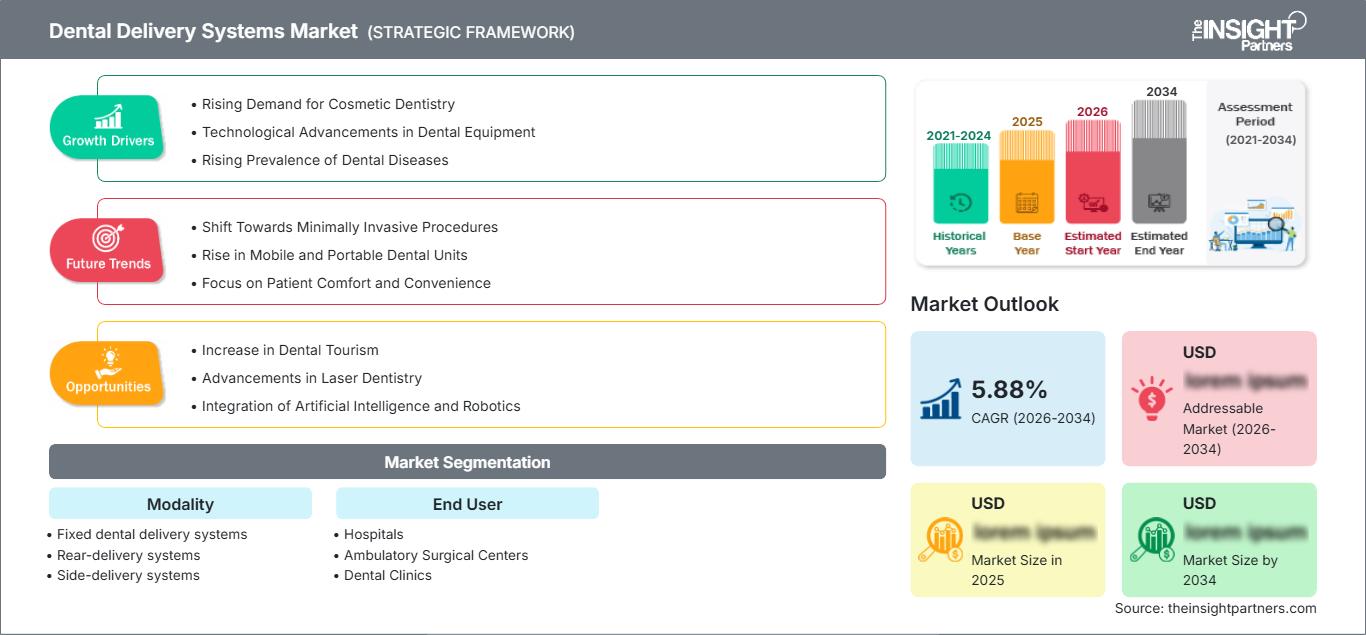
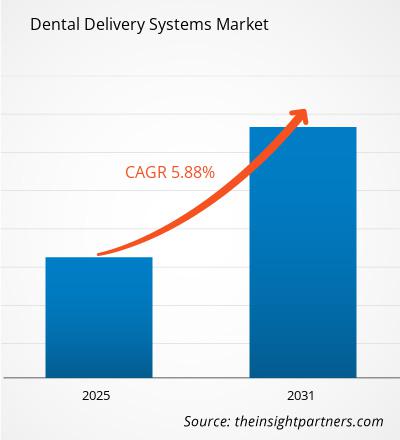
The Dental Delivery Systems Market is positioned for sustained expansion, with the market valued at US$ 1.62 Billion in 2025 and projected to reach US$ 3.26 Billion by 2034, reflecting a CAGR of 8.12% from 2026 to 2034. The market’s demand would be driven by the modernization of dental operatories, ergonomics in equipment, increased procedural integration, and growth in investments in digital technology in clinical setups in well-established and new healthcare markets.
North America is projected to hold its leading market position owing to the factors of demand from replacement, well-established dental setup, and investments in technologically integrated operatories. The North America Dental Delivery Systems Market Size is expected to grow at a CAGR of 7.4–8.0% during 2026–2034.
Dental Delivery Systems Market Assessment and Insights
- North America: North America is estimated to represent a 34–38% share in 2025 and expand at a 7.4–8.0% CAGR between 2026–2034, supported by established clinics, replacement cycles, ergonomic upgrades, and integrated operatory investments.
- US: The US is estimated to account for 76–80% of North America's 2025 revenue and grow at a 7.5–8.1% CAGR during 2026–2034, led by private dental practices and group organizations.
- Europe: Europe is estimated at a 25–29% share in 2025 and is projected to grow at a 7.6–8.2% CAGR, with Germany, the UK, France, Italy, and Spain supporting demand through modernization and replacement programs.
- Asia Pacific: Asia Pacific is estimated to hold a 24–28% share in 2025 and grow at an 8.8–9.5% CAGR, led by China, Japan, South Korea, India, and Australia as dental infrastructure expands.
- Largest Segment: Fixed dental delivery systems are estimated to hold a 48–52% market share in 2025, with a 7.6–8.1% CAGR during 2026–2034, reflecting established operatory configurations.
- High Growth Segment: Portable dental delivery systems represent an estimated 8–12% share in 2025 and are expected to achieve a 9.4–10.2% CAGR, supported by flexible care models.
- Key companies analyzed in detail: A-dec, Inc.; DentalEZ Group; Pelton & Crane Co.; Flight Dental Systems; Safari Dental Inc.; Tenko Medical Systems Corp.; E.T.I. Dental Industries; Dynamic Group; DNTLworks Equipment Corporation; ASI Medical, Inc. DBA ASI Dental Specialties.
Source: The Insight Partners' analysis based on proprietary research, government publications, company annual reports, investor presentations, industry databases, and expert interviews.
While mechanically oriented delivery units dominated the past, today’s market consists of systems incorporating handpieces, control devices, utilities, lighting, storage, and computerized interfaces. In terms of conventional operatories, fixed configurations continue to play an important role, whereas carts and portable systems are applied to solve issues of space and reach out to care. Nowadays, modular design, ease of cleaning, serviceability, and ergonomic configuration have become key aspects emphasized by manufacturers.
Future growth must increasingly be related to the development of dental infrastructure in Asia Pacific and selected countries of the Middle East region. Today’s capital is directed at equipment supporting multiple specialties care, flexibility in room usage, and simplicity of installation. The increasing attention paid to issues of infection control and water line management by regulation bodies must favor the above-mentioned characteristics of equipment.
Dental Delivery Systems Market Report Scope
| Report Attribute | Details |
|---|---|
| Market size in 2025 | US$ 1.62 Billion |
| Market Size by 2034 | US$ 3.26 Billion |
| Global CAGR (2026 - 2034) | 8.12% |
| Historical Data | 2021-2024 |
| Forecast period | 2026-2034 |
Dental Delivery Systems Market Analysis
The demand side is driven by the need for replacement of old equipment in the surgery rooms, growth in dental clinics, and modernization of the existing treatment rooms. The Dental Delivery Systems Market growth is highly dependent on the entire dental equipment industry, including dental chairs, lights, compressors, evacuations, dental imaging, and instrument platform.
The supply is determined by precise mechanical parts, electric controls, tubing, valves, cabinetry, mountings, and even digital interfaces. The manufacturer needs to balance between the mass production process and custom production due to differences among dental practices that are characterized by various sizes of treatment rooms, specialty, personal preferences, and other factors. Portable systems eliminate the need in constant plumbing.
Competitive positioning in the Dental Delivery Systems Market Report is based on factors such as durability of the product, ergonomic design, modularity, service scope, configurability, and integration features. A-dec, Inc. integrates its delivery systems with connectivity, and DentalEZ Group, Pelton & Crane Co., and Flight Dental Systems compete in traditional as well as specialized equipment categories. ASI Medical, Inc. DBA ASI Dental Specialties and DNTLworks Equipment Corporation offer configurability and portability of architectures.
Current investments will focus on product development, which extends life of equipment, while offering possibilities for digitization. Tenko Medical Systems Corp., Safari Dental Inc., E.T.I. Dental Industries, and Dynamic Group are some other competitors, and DNTLworks Equipment Corporation increases competitiveness in the portable category. Competitive positioning will therefore become less dependent on delivery functions and will become more focused on workflow integration, after sales service, customization, and diversification of practice types.
● REPORT CUSTOMIZATION
Tailor This Report To Align With Your Specific Business Requirements
This report can be customized to align precisely with your business objectives, scope, and target markets. Customization options include tailored segmentation, geography, competitive analysis, and strategic insights to support informed decision-making.
Customize This Report →WHAT YOU CAN ADJUST
- ● Segmentations
- ● Geography
- ● Competitive Analysis
- ● Language Preferences
Dental Delivery Systems Market: Strategic Insights
Regional Insights
North America Dental Delivery Systems Market
North America is anticipated to have a Dental Delivery Systems Market share of 34-38% and grow at a CAGR of 7.4-8.0% during 2025-2034. This region boasts of an advanced dental infrastructure, strong need for replacement products, presence of robust distribution channels, and needs for ergonomics in operatories. US forms around 76-80% of the regional revenue, whereas Canada is represented by means of private practices, institutions, and specialties.
Structural demand comes from consolidation of dental groups, renovation of existing dental practices, and rising expectations regarding clinical equipment integration. Purchasers are increasingly looking at delivery systems together with chairs, imaging, lighting, and sterilization systems. Manufacturers gain because of high penetration level and therefore, regular needs of replacements and services.
U.S. Dental Delivery Systems Market
The US represents an estimated 76–80% share of North America's 2025 market and is projected to grow at a 7.5–8.1% CAGR through 2034. Demand is concentrated across independent practices, dental service organizations, specialty clinics, academic institutions, and hospital-based dental departments. A-dec, Inc., DentalEZ Group, Pelton & Crane Co., DNTLworks Equipment Corporation, and ASI Medical, Inc. DBA ASI Dental Specialties have relevant market presence.
Current trends in the market place emphasize ergonomically designed operatories, control systems for the hand pieces, flexibility in assisting placement, and systems that will be able to handle imaging or digitized work flow equipment. It is vital that replacement purchases continue to occur due to the durability of the system and the longevity of the system life cycle. However, new group practices have begun to consider standard equipment configurations for replication at other sites.
Europe Dental Delivery Systems Market
Europe is estimated to represent a 25–29% share in 2025 and is expected to grow at a 7.6–8.2% CAGR. Germany is the leading country, supported by a large dental equipment ecosystem, while the UK, France, Italy, and Spain provide additional demand through private dentistry and modernization.
The UK market takes advantage of private investment in dental practices, practice refurbishments, and a rising focus on ergonomics. In Germany, there is a mix of highly advanced dental manufacturing facilities together with an already existing clinical network and a need for replacement equipment. There are market opportunities available in France, Italy, and Spain through upgrading clinics, specialty dentistry, and organized care providers.
APAC Dental Delivery Systems Market
The APAC region is forecasted to account for a share of 24% to 28% in 2025 with a compound annual growth rate of 8.8% to 9.5%. The market is headed by China, followed by Japan, South Korea, India, and Australia. The growing industrial activities and investments made towards the dental infrastructure development drive the use of equipment.
China and India offer great scope of capacity, whereas Japan and South Korea focus on advanced equipment and replacement. The benefit for Australia lies in well-established private dentistry. The growth in the market can be attributed to the healthcare initiatives of the government, urbanization, dental education capacity, and investments in the clinics.
Middle East & Africa Dental Delivery Systems Market
Demand from Middle East and Africa is forecasted to grow at a CAGR of 8.3%-9.0%. Market leadership lies in Saudi Arabia because of the development of the infrastructure of healthcare, whereas UAE and medical tourism have benefited due to the development of private healthcare facilities. South Africa is a dominant market among African nations.
Energy driven investments in healthcare infrastructure allow building and upgrading of healthcare facilities including dental clinics. Advanced clinics are preferred in Saudi Arabia and the UAE, while portable and modular solutions are needed in South Africa and Rest of MEA due to differences in infrastructure.
Segmentation Analysis
Modality
The modality segment is projected to grow at an 8.0–8.4% CAGR during 2026–2034. Dental Delivery Systems Market scope within modality is widening as practices compare fixed installations with rear, side, over-the-patient, over-the-head, portable, and cart-based configurations. Purchasing decisions increasingly reflect room architecture, operator ergonomics, installation costs, mobility requirements, and specialty-specific workflows.
- Fixed dental delivery systems: Fixed systems remain central to conventional operatories because they support stable utility connections, integrated instrumentation, and standardized workflows. Their strategic importance is reinforced by established clinic infrastructure and replacement purchasing.
- Rear-delivery systems: Rear delivery configurations support organized instrument access and can separate equipment from the dentist's primary working zone. They remain relevant where room planning favors clean operator movement.
- Side-delivery systems: Side-delivery systems provide accessible instrumentation while preserving operator visibility. Their flexibility makes them suitable for practices seeking alternative positioning without extensive changes to established operatory architecture.
- Over-the-patient systems: Over-the-patient systems remain widely used because they offer direct instrument access and efficient use of clinical space. Their established installed base supports continuing replacement and upgrade demand.
- Over-the-head systems: Over-the-head systems provide alternative instrument positioning and can support ergonomic preferences where ceiling or upper-room configurations are practical. They remain a specialized option within broader delivery architectures.
- Portable dental delivery: Portable systems support mobile clinics, outreach programs, temporary facilities, and practices requiring flexible room utilization. Their lower infrastructure dependence strengthens strategic relevance in emerging and nontraditional care settings.
- Systems Dental Delivery Carts: Delivery carts provide movable instrumentation, storage, and utility integration. Their strategic value is increasing where clinics seek adaptable treatment-room layouts, modular upgrades, and simplified installation.
End User
The end-user segment is expected to advance at an 8.1–8.5% CAGR during 2026–2034. Dental Delivery Systems Market adoption varies according to capital budgets, patient throughput, room standardization, specialty mix, and infrastructure requirements. Dental clinics remain central buyers, while hospitals and ambulatory surgical centers create demand for specialized, durable, and procedure-oriented configurations.
- Hospitals: Hospitals require durable systems capable of supporting specialized dentistry, surgical procedures, teaching, and multidisciplinary care. Procurement often prioritizes integration, infection-control compatibility, service availability, and lifecycle reliability.
- Ambulatory Surgical Centers: Ambulatory surgical centers favor equipment that supports procedure efficiency, compact layouts, and dependable utility management. Delivery systems must accommodate specialized workflows while aligning with broader facility equipment standards.
- Dental Clinics: Dental clinics constitute the broadest purchasing base, spanning independent practices, group practices, specialty centers, and organized chains. Their decisions balance ergonomics, customization, installation requirements, reliability, and total ownership cost.
Opportunity Snapshot
| End User | Revenue Contribution | Trend Tag | Adoption Stage |
|---|---|---|---|
| Hospitals | Medium | Specialty Integration | Scaling |
| Ambulatory Surgical Centers | Low | Procedure Flexibility | Emerging |
| Dental Clinics | High | Operatory Standardization | Mature |
Dental Delivery Systems Market Growth Drivers and Impact Analysis
Expansion of Organized Dental Practice Networks
Growth of organized dental groups is fueling the need for standardized operatory systems that can be used at different locations. In contrast to individual practices that acquire equipment separately, operators of different locations consider standardization, maintenance needs, installation process, operator proficiency, and economic value over the lifetime of equipment. This purchasing model suits companies able to offer such services. Standardization may decrease training needs for dentists and assistants who work at different locations. From the perspective of equipment producers, the effect of such a model is not limited to selling equipment. Growth of organized dentistry provides possibilities for equipment replacement, parts exchange, and updates in the future. Such a purchasing model changes the competition to the one that focuses on lifecycle and uniformity. Delivery system companies can take advantage of the development of organized dentistry by designing their products according to room design standards.
Rising Preference for Ergonomic Clinical Workflows
Ergonomic considerations increasingly influence equipment selection because dental professionals perform repetitive procedures requiring precise hand positioning and sustained posture. Delivery systems affect instrument reach, assistant coordination, patient access, and movement around the treatment area. Designs that reduce unnecessary stretching or repositioning can support workflow efficiency and help practices optimize treatment-room layouts. The commercial impact is significant because ergonomic improvements can justify replacement of functioning equipment when existing configurations restrict productivity or clinical preferences. Manufacturers are therefore incorporating adjustable positioning, flexible mounting, modular controls, and improved access to instruments. Practices with multiple operatories can also use ergonomic standardization to create consistent working environments. As purchasing criteria become more sophisticated, suppliers that demonstrate workflow benefits alongside durability are better positioned to compete for capital equipment budgets.
Increasing Demand for Flexible and Space-Efficient Operatories
Dental practices are increasingly seeking equipment that can accommodate constrained rooms, changing specialties, and evolving technology requirements. Fixed infrastructure can restrict chair placement and require significant renovation when room functions change. Flexible delivery platforms, carts, and modular systems can reduce those constraints by allowing equipment positioning to adapt to different procedures. The commercial impact is particularly relevant for smaller practices, leased facilities, teaching environments, and mobile programs where permanent construction is undesirable. Portable configurations can also broaden access to dentistry in community and institutional settings. Suppliers benefit when systems can be configured or upgraded without replacing the complete operatory. This creates a more resilient purchasing proposition and allows customers to spread capital expenditure over equipment lifecycles. Flexibility therefore becomes both a clinical and financial consideration in equipment procurement.
Dental Delivery Systems Market Future Trends
Software-Enabled Operatory Connectivity
Dental Delivery Systems Market trends are likely to move toward deeper connectivity between delivery systems, chairs, imaging equipment, practice software, and operator controls. Future platforms may increasingly use software layers to configure device settings, monitor equipment status, manage maintenance alerts, and support standardized workflows across multiple operatories. Connectivity can create value without requiring complete hardware replacement because software updates can extend functional capabilities. Manufacturers may therefore compete on architecture that supports future integrations rather than only current specifications. Multi-site dental groups could use connected equipment to compare utilization, identify maintenance needs, and standardize configurations. Over time, connected delivery systems may become components of broader digital operatories rather than isolated mechanical units, creating new opportunities for recurring software, service, and data-enabled revenue models.
Modular Architectures for Adaptive Treatment Rooms
Future systems are likely to emphasize modular architecture that allows practices to add, remove, or reposition instruments as clinical requirements change. This approach can support general dentistry, endodontics, periodontics, surgery, orthodontics, and hygiene within adaptable room environments. Modular delivery platforms may also simplify upgrades because individual components can be replaced without disrupting the complete operatory. Manufacturers can reduce obsolescence risk by designing standardized interfaces for emerging instruments, digital displays, sensors, and diagnostic accessories. This evolution could shift purchasing decisions from initial equipment price toward upgradeability and lifecycle economics. Practices may increasingly assess whether a delivery platform can accommodate future procedures and technology investments. Such flexibility should be particularly relevant to growing group practices and facilities operating multiple specialties within limited physical space.
Dental Delivery Systems Market Opportunities
Expansion of Portable Dentistry Infrastructure
Dental Delivery Systems Market Forecasts indicate an opportunity for suppliers to address mobile, community, institutional, and temporary care environments where permanent infrastructure is unavailable or uneconomic. Portable delivery systems can reduce dependence on fixed plumbing and enable equipment deployment in schools, nursing facilities, outreach programs, military settings, and temporary clinics. Investors and manufacturers can target this opportunity through lightweight architectures, integrated utilities, simplified transportation, and rapid setup capabilities. Distribution partnerships with community-care providers could extend market access beyond traditional dental equipment channels. Product development should emphasize durability, cleanability, water management, suction performance, and straightforward maintenance because mobile settings impose different operational constraints than fixed clinics. A portfolio combining portable units with carts, accessories, service programs, and replacement components could create multiple revenue streams around expanding nontraditional dental-care delivery models.
Standardized Equipment Platforms for Multi-Site Clinics
The Dental Delivery Systems Market Forecasts opportunity extends to standardized equipment platforms for dental groups expanding through new locations, acquisitions, and practice renovations. Suppliers can develop configurable product families that preserve common controls and service procedures while allowing variations for specialty requirements. This approach can simplify procurement, installation, training, inventory management, and maintenance across geographically dispersed facilities. Strategic partnerships with dental service organizations, architects, distributors, and equipment service companies can strengthen access to these accounts. Manufacturers should prioritize compatibility with commonly deployed chairs, lights, imaging systems, and digital devices to reduce integration friction. Contract-based purchasing and planned replacement programs can further improve visibility into future demand. As clinic networks seek consistent patient and staff experiences, scalable equipment platforms can become a strategic procurement tool rather than merely a capital equipment choice.
Recent Developments
- February 2026: A-dec, Inc. — A-dec and Dentsply Sirona expanded their strategic partnership by integrating the Dentsply Sirona Midwest Motor System directly into A-dec 500 Pro and A-dec 300 Pro delivery systems. The development strengthens interoperability between delivery equipment and motor technology while extending the role of connected operatory platforms in clinical workflows.
- July 2025: DNTLworks Equipment Corporation published an engineering-focused update covering its portable dental systems, emphasizing modular construction, durability, sterility, portability, and performance comparable with stationary clinical environments. The update highlights the company's continued product-development focus on mobile dentistry and equipment designed for nontraditional treatment settings.
- June 2025: ASI Medical, Inc. DBA published an analysis of the shift toward cart-based dental delivery, detailing flexible positioning, modular instrument integration, computer and diagnostic integration, and treatment-room design benefits. The publication signals continued development emphasis on movable delivery architectures and adaptable operatory layouts.
Frequently Asked Questions

- Comprehensive Market Sizing and Forecast Analysis
- Detailed Segmentation Analysis
- In-Depth Market Dynamics Assessment
- Regional and Country-Level Insights
- Competitive Landscape and Company Benchmarking
- Strategic Business Intelligence
Recent Reports
Testimonials

The Insight Partners' SCADA System Market report is comprehensive, with valuable insights on current trends and future forecasts. The team was highly professional, responsive, and supportive throughout. We are very satisfied and highly recommend their services.
RAN KEDEM Partner, Reali Technologies LTDs
I requested a report on a very specific software market and the team produced the report in a few days. The information was very relevant and well presented. I then requested some changes and additions to the report. The team was again very responsive and I got the final report in less than a week.
JEAN-HERVE JENN Chairman, Future Analytica
We worked with The Insight Partners for an important market study and forecast. They gave us clear insights into opportunities and risks, which helped shape our plans. Their research was easy to use and based on solid data. It helped us make smart, confident decisions. We highly recommend them.
PIYUSH NAGPAL Sr. Vice President, High Beam Global
The Insight Partners delivered insightful, well-structured market research with strong domain expertise. Their team was professional and responsive throughout. The user-friendly website made accessing industry reports seamless. We highly recommend them for reliable, high-quality research services
YUKIHIKO ADACHI CEO, Deep Blue, LLC.
This is the first time I have purchased a market report from The Insight Partners.While I was unsure at first, I visited their web site and felt more comfortable to take the risk and purchase a market report.I am completely satisfied with the quality of the report and customer service. I had several questions and comments with the initial report, but after a couple of dialogs over email with their analyst I believe I have a report that I can use as input to our strategic planning process.Thank you so much for taking the extra time and making this a positive experience.I will definitely recommend your service to others and you will be my first call when we need further market data.
JOHN SUZUKI President and Chief Executive Officer, Board Director, BK Technologies
I wish to appreciate your support and the professionalism you displayed in the course of attending to my request for information regarding to infectious disease IVD market in Nigeria. I appreciate your patience, your guidance, and the fact that you were willing to offer a discount, which eventually made it possible for us to close a deal. I look forward to engaging The Insight Partners in the future, all thanks to the impression you have created in me as a result of this first encounter.
DR CHIJIOKE ONYIA MANAGING DIRECTOR, PineCrest Healthcare Ltd.Reason to Buy
- Informed Decision-Making
- Understanding Market Dynamics
- Competitive Analysis
- Identifying Emerging Markets
- Customer Insights
- Market Forecasts
- Risk Mitigation
- Boosting Operational Efficiency
- Strategic Planning
- Investment Justification
- Tracking Industry Innovations
- Aligning with Regulatory Trends





 Get Free Sample for