
Dental Liners and Base Market Drivers, Strategies, Upcoming Trends, and Forecast by 2034
Coverage: By Material (Zinc Oxide Eugenol, Glass Ionomer, Resin-modified Glass Ionomers, Others); End User (Hospitals, Dental Clinics, Research and Academic Institutes) , and Geography (North America, Europe, Asia Pacific, and South and Central America)
- Status : Data Released
- Report Code : TIPRE00004733
- Category : Life Sciences
- No. of Pages : 150
- Available Report Formats :


- Last update date : August 27, 2026


2025 Market Size
US$ 1.59 Bn
Base year value
2034 Forecast
US$ 2.24 Bn
Projected by 2034
CAGR 2026-2034
3.83 %
Growth rate
Addressable Market
US$ 17.35 Bn
(2026-2034)
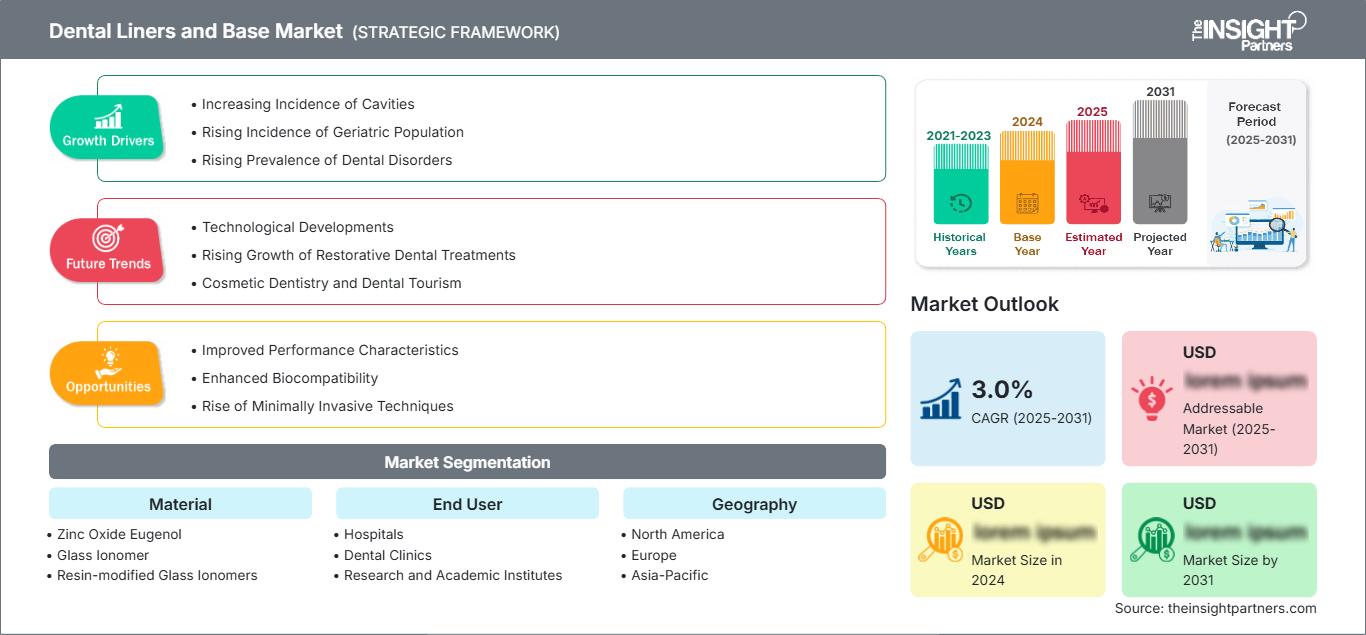
The Dental Liners And Base Market is projected to expand from US$ 1.59 Billion in 2025 to US$ 2.24 Billion by 2034, registering a CAGR of 3.83% from 2026 to 2034. The market encompasses materials used for pulpal protection, cavity lining, dentin replacement, and restorative foundation procedures. Demand is shaped by restorative dentistry volumes, material handling characteristics, clinical preference for minimally invasive approaches, and continuing development of glass-based and resin-modified formulations.
Across North America, the Dental Liners And Base Market size is supported by established restorative care infrastructure, high dental expenditure, and broad availability of advanced biomaterials. The regional market is estimated to grow at a 3.8–4.3% CAGR during 2026–2034, supported by replacement procedures and clinician preference for simplified restorative protocols. Regulatory emphasis on material safety and consistency also favors suppliers with established quality systems and diversified dental portfolios.
Dental Liners and Base Market Assessment and Insights
- North America: North America is expected to maintain a leading position, with a 34–38% Dental Liners And Base Market share in 2025 and a 3.8–4.3% CAGR between 2026–2034, supported by mature dental practices, restorative procedure volumes, and established material distribution networks.
- US: The US represents 82–86% of North America's 2025 market, with a 3.7–4.2% CAGR during 2026–2034, reflecting extensive restorative care infrastructure and strong adoption of premium biomaterials.
- Europe: Europe is estimated at a 27–31% share in 2025 and a 3.5–4.0% CAGR between 2026–2034. Germany, the UK, France, Italy, and Spain provide the principal demand base through established clinical systems.
- Asia Pacific: Asia Pacific is estimated at a 24–28% share in 2025 and a 4.2–4.8% CAGR through 2034. China, Japan, India, South Korea, and Australia combine expanding dental access with rising private clinic activity.
- Largest Segment: Glass Ionomer holds an estimated 36–40% market share in 2025 and is expected to register a 3.7–4.1% CAGR from 2026–2034, supported by fluoride release and established clinical familiarity.
- High Growth Segment: Resin-modified Glass Ionomers represent an estimated 19–23% market share in 2025 and are projected to grow at a 4.6–5.2% CAGR from 2026–2034, supported by handling and performance advantages.
- Key companies analyzed in detail: Danaher, DENTSPLY SIRONA Inc., GC India Dental, Henry Schein, Inc., 3M Company, Ivoclar Vivadent AG, Shofu Dental Corporation, Den-Mat Holdings, LLC, VITA Zahnfabrik H. Rauter GmbH & Co. KG, and VOCO GmbH.
Source: The Insight Partners' analysis based on proprietary research, government publications, company annual reports, investor presentations, industry databases, and expert interviews.
Product development is focusing on materials which have adhesive, moisture tolerance, fluoride release, controlled setting, and handling properties. Glass ionomers remain relevant when adhesion and ion release become essential, whereas resin modified glass ionomers cater to requirements of strength and control over working times. The focus for production is on consistent particle size distribution, controlled polymerization, packaging stability, and compatibility with standard restoration techniques.
Future developments will see manufacturers concentrate on bioactivity, ease of application, and restorative systems that lend themselves to minimally invasive restoration procedures. New markets will generate some additional demand as there is increased access to dental treatments, while the established markets will place emphasis on longevity and efficiency of procedures. Environmental issues, reducing mercury content, and dental materials safety are likely to influence product development towards alternative restorative systems.
Dental Liners and Base Market Report Scope
| Report Attribute | Details |
|---|---|
| Market size in 2025 | US$ 1.59 Billion |
| Market Size by 2034 | US$ 2.24 Billion |
| Global CAGR (2026 - 2034) | 3.83% |
| Historical Data | 2021-2024 |
| Forecast period | 2026-2034 |
Dental Liners and Base Market Analysis
The Dental Liners And Base Market development is closely related to the ecosystem of restorative dentistry, which involves dentists, distributors, laboratories, manufacturers of materials, and healthcare institutions within a consumables cycle that repeats itself over and over again. There is demand for caries treatment, indirect restoration, pulpal protection, and dentine replacement. The materials manufacturers provide powders, liquids, capsules, pastes, as well as light or chemical-curing materials, while the distributors influence the availability of products, their economics, and choice of brands.
Despite the changes, the value chain in the Dental Liners And Base Market is still very sensitive to the quality of raw materials, consistent formulas, packaging and expiration period of products. Calcium-based materials, glass powder, resins, acids, fillers and photoinitiators should satisfy application-specific performance requirements. Large manufacturers have advantages in buying and regulations, while the specialist producers use differentiation in terms of formula and applications. According to WHO, almost 3.7 billion people suffer from oral diseases.
The Dental Liners And Base Market forecast indicates that competitive intensity results from the varying levels of formulation knowledge, distribution capabilities, physician recognition, and diversification. The competing companies for the restorative materials include DENTSPLY SIRONA Inc., 3M Company, GC India Dental, Henry Schein, Inc., Ivoclar Vivadent AG, Shofu Dental Corporation, VITA Zahnfabrik H. Rauter GmbH & Co. KG, and VOCO GmbH, within restorative-material categories and distribution channels. Danaher is included in the supplied competitive set, even though the former dental portfolio of the company has changed after separating its dental segment.
The Dental Liners And Base Market report reveals that companies are shifting their focus from individual products towards integrating them into comprehensive restorative workflow solutions. The wide distribution networks enable companies to package the restorative materials with instruments and digital solutions, among others. The specialist players, including Den-Mat Holdings, LLC, can differentiate themselves with focused applications in restorative dentistry.
● REPORT CUSTOMIZATION
Tailor This Report To Align With Your Specific Business Requirements
This report can be customized to align precisely with your business objectives, scope, and target markets. Customization options include tailored segmentation, geography, competitive analysis, and strategic insights to support informed decision-making.
Customize This Report →WHAT YOU CAN ADJUST
- ● Segmentations
- ● Geography
- ● Competitive Analysis
- ● Language Preferences
Dental Liners and Base Market: Strategic Insights
Regional Insights
North America Dental Liners And Base Market
North America accounts for a 34–38% share of the 2025 market and is projected to expand at a 3.8–4.3% CAGR through 2034. There is mature dental infrastructure, developed reimbursement system, high restorative procedure rate, and wide specialization coverage in the region. The US is the leading regional market, with Canada supplying dental services through its private and institutional systems.
Structural demand is driven by restoration work on aging patients and the continuous replacing of old dental products. Increasingly, dentists are valuing easy application, easy dispensing, moisture resistance, and compatibility with adhesive restorative processes. As such, product differentiation is moving away from mere lining function to performance-based attributes. Compliance, training, and distribution play key roles in commercialization of products in the region.
U.S. Dental Liners And Base Market Market
The US represents 82–86% of North America's 2025 market and is expected to grow at a 3.7–4.2% CAGR through 2034. Demand for restorative materials is provided through an extensive system of dental offices, both private and institutionalized. Large firms have comprehensive distribution and education networks that allow quick delivery of materials to a variety of clinical settings.
The pattern of application requires materials that minimize the level of procedure complexity while at the same time provide pulp protection and dentin substitution. Glass ionomers are needed for adhesive properties and fluoride release, while resin-modified materials cater to those who require better handling capabilities. Among such suppliers are DENTSPLY SIRONA Inc., 3M Company, GC India Dental, Henry Schein, Inc., and Ivoclar Vivadent AG.
Europe Dental Liners And Base Market
Europe represents a 27–31% of the Dental Liners And Base Market in 2025 and is projected to grow at a 3.5–4.0% CAGR through 2034. The leader in the market among the countries under review is Germany, followed by the United Kingdom, France, Italy, and Spain. The region is characterized by high standards of restorative dentistry together with high standards of documentation and quality of products in use.
The demand of the UK is sustained due to the presence of already existing private and public dental care services, with purchases becoming more efficient and paying attention to material consistency. Germany can take advantage of the advanced dental products manufacturing industry and clinicians being familiar with the use of glass-based restorative materials.
APAC Dental Liners And Base Market
APAC holds an estimated 24–28% share in 2025 and is expected to register a 4.2–4.8% CAGR through 2034. China drives regional demand, whereas Japan, South Korea, India, and Australia present significant prospects. Growing number of private dental practices, urbanization, rising awareness, and training drive material consumption.
Localized production and healthcare accessibility programs can enhance access in emerging countries. Suppliers have to find a balance between premium materials and affordable products tailored for different environments. Long-term prospects in India appear to be particularly promising because awareness increases and Japan & South Korea focus on advanced materials.
Middle East & Africa Dental Liners And Base Market Market
Middle East and Africa is projected to record a 3.2–3.8% CAGR through 2034, with Saudi Arabia representing the leading Gulf market. The UAE benefits from private healthcare investment, while South Africa remains an important regional dental-services hub. Rest of MEA demand is more fragmented and closely tied to access to trained professionals.
Healthcare infrastructure development, dental tourism, and investment in private clinics can expand material consumption. Energy-linked economic capacity in Gulf markets supports investment in advanced equipment and consumables, while African markets face greater affordability and distribution constraints. Suppliers with scalable product portfolios and dependable regional logistics are better positioned to address differing purchasing requirements.
Segmentation Analysis
Material
The Material segment in the Dental Liners And Base Market is expected to expand at a 3.7–4.2% CAGR from 2026–2034. Product selection depends on adhesion, fluoride release, strength, setting behavior, moisture sensitivity, and compatibility with restorative procedures. Glass-based systems retain broad clinical relevance, while resin-modified formulations address performance and handling requirements. Manufacturers increasingly differentiate through simplified delivery, predictable working times, improved esthetics, and multifunctional clinical indications.
- Zinc Oxide Eugenol: Zinc Oxide Eugenol remains important where sedative properties, ease of manipulation, and established clinical familiarity support use. Demand is concentrated in applications requiring dependable temporary or protective lining performance.
- Glass Ionomer: Glass Ionomer maintains a strong market position because of chemical adhesion, fluoride release, and broad clinician familiarity. Its relevance extends across restorative foundations and situations requiring material compatibility with tooth structure.
- Resin-modified Glass Ionomers: Resin-modified Glass Ionomers are strategically important where clinicians require improved handling, moisture tolerance, and mechanical performance. Their hybrid characteristics support use in increasingly efficiency-focused restorative workflows.
- Others: Other material formulations serve specialized clinical requirements and provide manufacturers with opportunities to address niche indications, formulation preferences, and evolving biomaterial approaches.
End User
The End User segment in the Dental Liners And Base Market is forecast to grow at a 3.5–4.0% CAGR from 2026–2034. Dental clinics represent the principal purchasing environment because restorative procedures are routinely performed in office-based settings. Hospitals support demand through dental departments and multidisciplinary care, while academic institutions influence future material preferences through research, clinical training, and professional education.
- Hospitals: Hospitals require dependable materials for restorative procedures associated with dental departments, trauma services, medically complex patients, and multidisciplinary care. Procurement tends to emphasize standardization, reliability, documentation, and supply continuity.
- Dental Clinics: Dental clinics constitute the principal recurring-use environment, driven by high procedure frequency and direct clinician control over material selection. Workflow efficiency, handling, and patient-oriented restorative outcomes influence purchasing decisions.
- Research and Academic Institutes: Research and Academic Institutes influence long-term material development through biomaterial testing, clinical education, and formulation research. Their strategic importance extends beyond immediate consumption by shaping future professional preferences.
Opportunity Snapshot
| End User | Revenue Contribution (High/Medium/Low) | Trend Tag | Adoption Stage |
| Hospitals | Medium | Complex Care | Mature |
| Dental Clinics | High | Chairside Restorations | Mature |
| Research and Academic Institutes | Low | Biomaterial Research | Scaling |
Dental Liners and Base Market Growth Drivers and Impact Analysis
Rising Global Burden of Dental Caries
The growing burden of untreated caries leads to an enduring clinical need for materials applied in cavity management and tooth retention. According to WHO, untreated dental caries among permanent teeth are the most prevalent disease condition in the WHO Global Burden of Disease 2021 analysis, while 3.7 billion individuals suffer from oral disease globally. The burden leads to an increase in the addressable base of materials including liners, bases, dentine substitutes, and restorative substrates. Commercial attractiveness is the highest in regions where access to dentistry treatment is rising, with the number of patients demanding tooth retention operations growing. Suppliers will be able to benefit from the development of cost-efficient formulas for developing regions while keeping superior systems for well-established practices.
Preference for Minimally Invasive Restorative Procedures
Modern restorative dentistry increasingly emphasizes preservation of healthy tooth structure, which strengthens the role of protective and adhesive intermediate materials. Liners and bases can support pulp protection, dentin management, and restorative placement while limiting unnecessary removal of tooth tissue. This clinical direction encourages demand for products with controlled placement, strong adhesion, and predictable interaction with restorative materials. The commercial consequence is a shift from commodity positioning toward performance-based differentiation. Manufacturers that demonstrate consistent clinical behavior, simplified application, and compatibility with contemporary restorative systems can strengthen professional adoption. Training and chairside education also become important because correct material selection depends on cavity depth, remaining dentin, moisture conditions, and the type of definitive restoration planned.
Transition Toward Mercury-Free Restorative Alternatives
International efforts to reduce dental amalgam use are creating a longer-term environment for alternative restorative materials. The Minamata Convention's 2025 COP6 decision established 2034 as the global phase-out date for manufacture, import, and export of dental amalgam, subject to an exemption for clinically necessary use. This policy trajectory can increase attention toward mercury-free materials and associated restorative protocols. The impact is uneven because affordability, clinician training, procurement practices, and national implementation differ substantially. Nevertheless, suppliers with glass ionomer, resin-modified glass ionomer, and related restorative technologies can position their portfolios around accessible alternatives. Regulatory readiness, clinical evidence, and supply capacity will increasingly influence purchasing decisions as national transition plans develop.
Dental Liners and Base Market Future Trends
Greater Integration of Bioactive Material Concepts
Future product development is likely to place greater emphasis on materials that interact beneficially with the tooth environment rather than functioning only as passive barriers. Formulations may increasingly target mineral exchange, ion release, remineralization support, and improved interfacial behavior. Research organizations and manufacturers are expected to investigate calcium-phosphate systems, enhanced glass formulations, and resin hybrids capable of supporting biological objectives while maintaining restorative compatibility. Commercial differentiation will increasingly depend on evidence demonstrating meaningful clinical benefits rather than simply introducing new ingredients. This shift could also encourage premiumization in mature markets while prompting simplified versions for cost-sensitive regions. Over time, bioactive positioning may become a core product-development criterion across protective and restorative material portfolios.
Digital Workflow Compatibility in Restorative Dentistry
The Dental Liners And Base Market trends indicate that digital dentistry will increasingly influence how liners and bases are selected, dispensed, and incorporated into restorative workflows. Although these materials are not themselves digital products, their performance must complement faster diagnosis, digital treatment planning, CAD/CAM restorations, and standardized chairside protocols. Manufacturers may respond with packaging and dispensing formats designed to minimize preparation time and reduce technique sensitivity. Digital documentation can also support traceability, inventory control, and clinician training. As same-day restorative procedures expand, material suppliers will face greater pressure to provide predictable setting and compatibility with rapid restoration placement. The resulting market opportunity lies less in digitizing the material itself and more in reducing workflow friction around its clinical use.
Dental Liners and Base Market Opportunities
Localized Product Portfolios for Emerging Dental Systems
Emerging markets offer manufacturers an opportunity to tailor product portfolios around affordability, availability, and clinical simplicity rather than transferring premium-market specifications unchanged. A tiered portfolio could combine conventional glass ionomer systems with higher-performance resin-modified products, allowing distributors and clinics to select materials according to procedure complexity and purchasing capacity. Localization of packaging, education, regulatory documentation, and distributor inventory can further improve market penetration. India, Southeast Asia, Latin America, and selected Middle Eastern markets offer particularly relevant conditions because private dental infrastructure is expanding while price sensitivity remains significant. Companies that establish local technical support and dependable supply chains can improve adoption without relying solely on aggressive pricing, creating more sustainable positions across fragmented dental markets.
Clinical Evidence and Training as Commercial Differentiators
Clinical education provides an actionable investment opportunity because material selection is strongly influenced by dentist familiarity, handling experience, and confidence in indications. Suppliers can strengthen market access by investing in continuing education, university collaborations, application protocols, and comparative clinical evidence. The opportunity extends beyond conventional promotional activity because structured training can demonstrate correct case selection and reduce material misuse. Academic partnerships may also help manufacturers generate evidence for newer resin-modified and bioactive formulations. Companies should prioritize evidence that connects material characteristics with practical outcomes such as handling, marginal integrity, postoperative sensitivity, and restorative longevity. Such investments can build professional confidence and create differentiation in a market where multiple formulations may appear technically similar at the point of purchase.
Recent Developments
- July 2026: DENTSPLY SIRONA Inc. announced an expanded Canadian distribution relationship with Medline Sinclair, describing it as its sixth dealer-network enhancement of 2026. The initiative is intended to broaden access to its digital dentistry portfolio through established distribution channels, reinforcing the industry's continuing movement toward integrated dental technology and consumables ecosystems.
- June 2026: Shofu Inc. launched several products within its S-WAVE print portfolio, including UltraCraft A2D HD, AirCure, Wash, and associated printing materials. The launches expand its digital dental manufacturing ecosystem and demonstrate continuing investment in workflow-oriented technologies that connect materials, equipment, and production processes across professional dental applications.
- February 2026: Through Zahn Dental, Henry Schein introduced Zirlux Independence ML, multilayered zirconia discs manufactured in the US with imported materials. The product emphasizes shade consistency, esthetics, strength, and milling productivity, illustrating continued investment in material solutions designed to improve efficiency and predictability across dental laboratory workflows.
Frequently Asked Questions

- Comprehensive Market Sizing and Forecast Analysis
- Detailed Segmentation Analysis
- In-Depth Market Dynamics Assessment
- Regional and Country-Level Insights
- Competitive Landscape and Company Benchmarking
- Strategic Business Intelligence
Recent Reports
Testimonials

The Insight Partners' SCADA System Market report is comprehensive, with valuable insights on current trends and future forecasts. The team was highly professional, responsive, and supportive throughout. We are very satisfied and highly recommend their services.
RAN KEDEM Partner, Reali Technologies LTDs
I requested a report on a very specific software market and the team produced the report in a few days. The information was very relevant and well presented. I then requested some changes and additions to the report. The team was again very responsive and I got the final report in less than a week.
JEAN-HERVE JENN Chairman, Future Analytica
We worked with The Insight Partners for an important market study and forecast. They gave us clear insights into opportunities and risks, which helped shape our plans. Their research was easy to use and based on solid data. It helped us make smart, confident decisions. We highly recommend them.
PIYUSH NAGPAL Sr. Vice President, High Beam Global
The Insight Partners delivered insightful, well-structured market research with strong domain expertise. Their team was professional and responsive throughout. The user-friendly website made accessing industry reports seamless. We highly recommend them for reliable, high-quality research services
YUKIHIKO ADACHI CEO, Deep Blue, LLC.
This is the first time I have purchased a market report from The Insight Partners.While I was unsure at first, I visited their web site and felt more comfortable to take the risk and purchase a market report.I am completely satisfied with the quality of the report and customer service. I had several questions and comments with the initial report, but after a couple of dialogs over email with their analyst I believe I have a report that I can use as input to our strategic planning process.Thank you so much for taking the extra time and making this a positive experience.I will definitely recommend your service to others and you will be my first call when we need further market data.
JOHN SUZUKI President and Chief Executive Officer, Board Director, BK Technologies
I wish to appreciate your support and the professionalism you displayed in the course of attending to my request for information regarding to infectious disease IVD market in Nigeria. I appreciate your patience, your guidance, and the fact that you were willing to offer a discount, which eventually made it possible for us to close a deal. I look forward to engaging The Insight Partners in the future, all thanks to the impression you have created in me as a result of this first encounter.
DR CHIJIOKE ONYIA MANAGING DIRECTOR, PineCrest Healthcare Ltd.Reason to Buy
- Informed Decision-Making
- Understanding Market Dynamics
- Competitive Analysis
- Identifying Emerging Markets
- Customer Insights
- Market Forecasts
- Risk Mitigation
- Boosting Operational Efficiency
- Strategic Planning
- Investment Justification
- Tracking Industry Innovations
- Aligning with Regulatory Trends





 Get Free Sample for