
Dental Spatulas Market Demand, Share & Growth by 2034
Coverage: By Type (2R Rigid Standard, 3R Rigid Standard, 4R Rigid Standard, 8R Rigid Standard, 10R Rigid Standard, 11R Rigid Standard, Others); Application (Oral Hospitals, Oral Clinic, General Hospitals, Others), and Geography (North America, Europe, Asia Pacific, and South and Central America)
- Status : Data Released
- Report Code : TIPRE00014234
- Category : Life Sciences
- No. of Pages : 150
- Available Report Formats :


- Last update date : September 07, 2026


2025 Market Size
US$ 152.49 Mn
Base year value
2034 Forecast
US$ 255.89 Mn
Projected by 2034
CAGR 2026-2034
5.92 %
Growth rate
Addressable Market
US$ 1,849.91 Mn
(2026-2034)
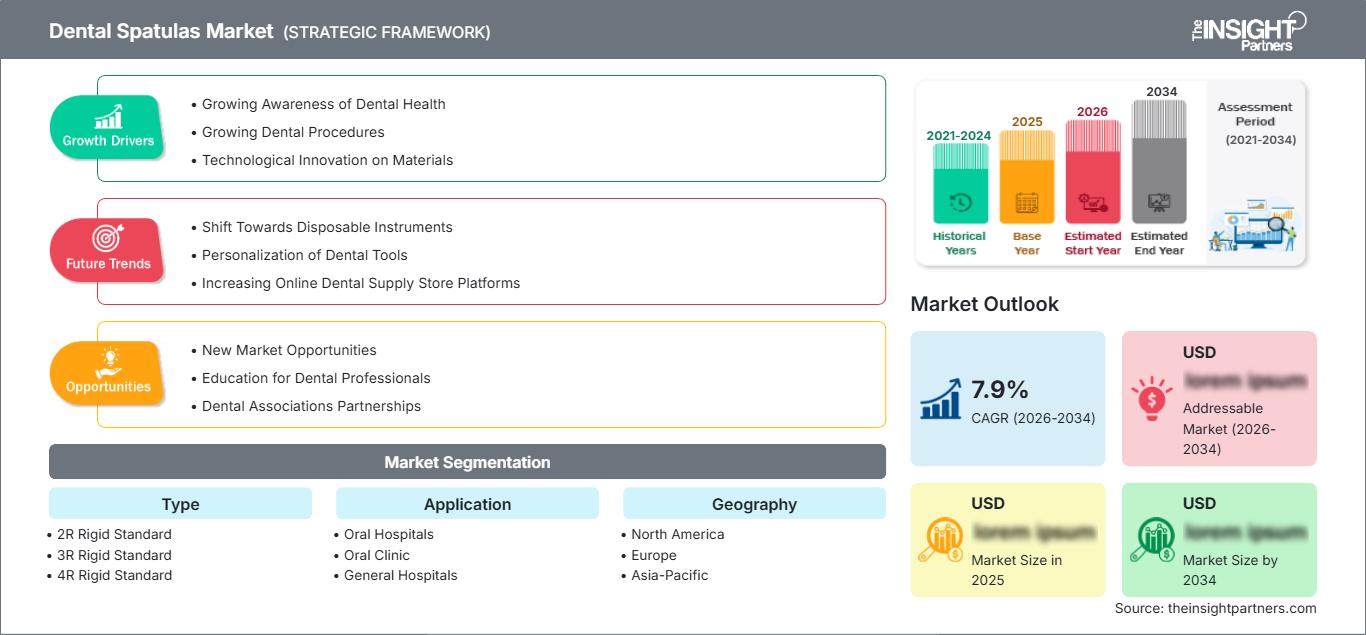
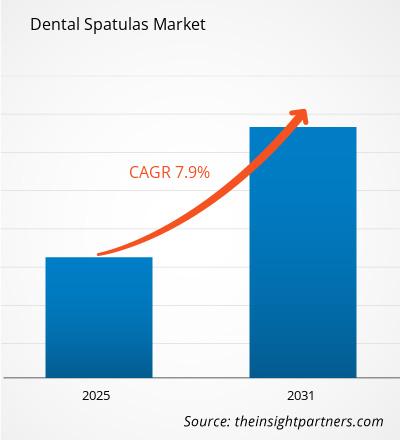
The Dental Spatulas Market is valued at US$ 152.49 Million in 2025 and is projected to reach US$ 255.89 Million by 2034, registering a CAGR of 5.92% from 2026 to 2034. Market includes standardized rigid dental spatulas, which are available for usage in oral hospitals, oral clinics, general hospitals, and other care facilities, where the purchase decision depends on factors like the durability of the material, ergonomics, sterilization capability, procedure appropriateness, and need for replacement.
In North America, the Dental Spatulas Market Size drivers include the existing dental infrastructure, high rate of instruments replacement, and stringent infection control measures. Market size will be affected by the use of reusable stainless steel hand instruments throughout restorative and laboratory procedures. Structural factors described above drive the regional CAGR in the range of 5.6% to 6.2% through 2034.
Dental Spatulas Market Assessment and Insights
- North America: North America is estimated to hold a 34–37% share in 2025 and grow at a CAGR of 5.6–6.2% between 2026–2034, supported by established dental practices, instrument replacement cycles, and stringent sterilization requirements.
- US: The US is estimated to account for 82–86% of North American revenue in 2025 and expand at a CAGR of 5.5–6.1%, reflecting broad clinical utilization.
- Europe: Europe is estimated at a 29–32% share in 2025 and is projected to grow at a CAGR of 5.8–6.4%, led by Germany, the UK, France, Italy, and Spain, where established dental supply networks support recurring instrument procurement.
- Asia Pacific: Asia Pacific is estimated to represent a 21–24% share in 2025 and expand at a CAGR of 6.5–7.2%, led by China, Japan, India, South Korea, and Australia as dental infrastructure and professional capacity develop.
- Largest Segment: 2R Rigid Standard is estimated to hold a 19–23% market share in 2025, with a CAGR of 5.4–5.9%, supported by broad general-purpose clinical use.
- High Growth Segment: Oral Clinic is estimated to account for a 38–42% market share in 2025 and grow at a CAGR of 6.2–6.8%, supported by high procedure volumes and decentralized procurement.
- Key companies analyzed in detail: Carl Martin, Daniel Kürten, DEPPELER, Renfert GmbH, SCHULER-DENTAL GmbH, DynaFlex, ASA DENTAL S.p.A., J&J Instruments, Kerr Dental, HuFriedyGroup, and PRODONT-HOLLIGER.
Source: The Insight Partners' analysis based on proprietary research, government publications, company annual reports, investor presentations, industry databases, and expert interviews.
Dental spatulas continue to be manufactured via precision forming, stainless steel forming, polishing and testing. Differentiation among the products is made by means of the shape and rigidity of the blade, balance of the handle, corrosion resistance and sterility. The patterns such as 2R, 3R, 4R, 8R, 10R and 11R guarantee clinical manipulation properties. For example, the company Renfert still manufactures some types of dental spatulas for laboratory purposes.
Demand in future years is expected to be positively impacted by increased dental care capacity in Asia Pacific and certain Middle East markets while developed countries would contribute replacement needs. Purchasing decisions will be more influenced by traceability, reprocessability, instrument longevity, and ergonomics. Infection control is an issue that will still concern many institutions because reusable instruments have to be cleaned, disinfected, and sterilized before distribution to other patients.
Dental Spatulas Market Report Scope
| Report Attribute | Details |
|---|---|
| Market size in 2025 | US$ 152.49 Million |
| Market Size by 2034 | US$ 255.89 Million |
| Global CAGR (2026 - 2034) | 5.92% |
| Historical Data | 2021-2024 |
| Forecast period | 2026-2034 |
Dental Spatulas Market Analysis
Dental Spatulas Market Growth is driven by the constant need for efficient hand instruments for restorative, prosthodontic, orthodontic, and laboratory treatments. The ecosystem involves steel and alloy suppliers, manufacturers of precision instruments, finishing companies, distributors, dental hospitals, clinics, labs, and procurement firms. This market is robust as spatulas are affordable tools which are constantly needed in the material handling and mixing process.
The supply chain rewards standardization since established practices enable manufacturers to consistently make the same size and behavior of instruments. Stainless steel is still relevant due to its mechanical strength, corrosion resistance, cleanability, and compatibility with most sterilization techniques. Suppliers have an opportunity to increase their profits by enhancing surface finishing, handles, use of high-end alloys, coating, and bundled sets of instruments. Efficient distribution is also a factor since these instruments are regularly bought through reputable dental distributors.
According to the Dental Spatulas market Report, the competitive environment is fragmented among instrument specialists and diversified dental suppliers. Carl Martin specializes in precise dental instruments, while Daniel Kürten and DEPPELER have long-established European instrument ranges. Renfert GmbH is especially interesting for laboratory applications. SCHULER-DENTAL GmbH, ASA DENTAL S.p.A., DynaFlex, and J&J Instruments are widening competitive scope among professional hand instruments and dental supplies.
Increasingly, investment goes to manufacturing accuracy, ergonomics, and range rather than innovations in products. Kerr Dental enjoys economies of scale from its wider restorative and endodontic portfolio, while HuFriedyGroup includes both instrumentation and reprocessing and practice support services. ProDont Holliger adds specialization in European manufacturing. Thus, competitive advantage will be gained through quality assurance, distribution channels, range, sterilization properties, and capability to provide standardized products.
● REPORT CUSTOMIZATION
Tailor This Report To Align With Your Specific Business Requirements
This report can be customized to align precisely with your business objectives, scope, and target markets. Customization options include tailored segmentation, geography, competitive analysis, and strategic insights to support informed decision-making.
Customize This Report →WHAT YOU CAN ADJUST
- ● Segmentations
- ● Geography
- ● Competitive Analysis
- ● Language Preferences
Dental Spatulas Market: Strategic Insights
Regional Insights
North America Dental Spatulas Market
North America is estimated to contribute to a Dental Spatulas Market Share of 34–37% in 2025 and is expected to grow at a CAGR of 5.6–6.2% until 2034. North America has advantages such as mature dental infrastructure, well-established procurement practices, strong presence of private practices, and periodic replacement of reprocessable instruments. US is the main market, and Canada adds its share through structured dental practices.
Dental procedures, laboratory work, and strict infection control standards drive the demand. More emphasis is being given by dentists on assessing the longevity and performance of the instruments during reprocessing along with the cost, as the frequent sterilizations can impact the quality of the surface and performance of the instruments. The specialized vendors and extensive dental distributors are well-represented, whereas premium manufacturers are differentiated based on steel quality, finish, ergonomics, and standardized designs.
U.S. Dental Spatulas Market
The United States accounts for 82–86% of North American revenue in 2025 and is predicted to witness CAGR of 5.5–6.1%. Recurring buys are supported by extensive private practice, dental service organizations, hospitals, laboratories, and educational organizations. Standardization of the instruments is especially pertinent to multi-location businesses requiring standardized clinical workflow.
The companies involved in the market include Kerr Dental, DynaFlex, J&J Instruments, HuFriedyGroup, and foreign firms that operate in the US market through distribution channels. The applications are largely occupied by oral clinics, hospitals, and laboratories. The rising importance of factors such as corrosion resistance, sterilization resistance, ergonomic design, and replacement availability by clients is noted. Large firms might prefer vendors that can achieve standardization in specification and inventory across several sites through central purchasing.
Europe Dental Spatulas Market
Europe accounts for a share of 29–32% in 2025 and is likely to have a CAGR of 5.8–6.4%, and Germany is seen as an advanced market. Germany has a strong dental manufacturing infrastructure and technical standards while the UK has dental services networks. France, Italy, and Spain add up to the demand due to private practices, hospitals, labs, and distribution network.
Germany offers manufacturing of specialized instruments and export of supplies which results in strong base of precision hand instruments. Infection control and standardization of clinical processes in both private and public dentistry are important aspects for the UK. France adds up hospital demand along with private clinics, and Italy has a good dental manufacturing base. Spain has good private dental services networks and professional procurement.
APAC Dental Spatulas Market
The APAC region is expected to contribute 21–24% to the market and to witness a growth rate of 6.5–7.2% CAGR over 2025. The key regional markets include China, followed by Japan, India, South Korea, and Australia. Growth in number of dental practices and dentists creates demand for standardized instruments.
China and India present significant opportunities driven by infrastructure, whereas Japan and South Korea provide advanced technological environment in the clinics. Australia enjoys dental education and developed system of private practices. Growth in healthcare spending, urbanization, and accessibility of oral healthcare is driving demand for such products, along with local production and regional distribution.
Middle East & Africa Dental Spatulas Market
The Middle East & Africa market is estimated to have a CAGR of 5.9%-6.6% up to 2034, being driven by growth in Saudi Arabia and the UAE. South Africa is seen as a developed market, whereas the Rest of MEA region will become more developed in terms of healthcare infrastructure and professionals.
Healthcare facilities in Gulf countries have high investments due to their energy income, allowing clinics and hospitals to purchase dental equipment from other countries. The Saudi Arabia region has the biggest scale within the region, whereas the UAE acts as an important transit point for healthcare products. South Africa has a developed demand, and the Rest of MEA is sensitive to import costs and distributors' presence.
Segmentation Analysis
Type
Type segmentation is defined by standardized rigid patterns that correspond to different working geometries and handling preferences. The Dental Spatulas Market scope is therefore shaped by procedure requirements, clinician familiarity, and institutional standardization. The Type segment is projected to grow at a CAGR of 5.7–6.1% during 2026–2034, with established patterns retaining broad relevance.
- 2R Rigid Standard: Commonly suited to routine material handling and general dental applications. Its standardized geometry supports broad procurement, replacement compatibility, and familiar handling across clinics and educational environments.
- 3R Rigid Standard: Serves applications requiring a defined working profile and controlled manipulation. Demand is supported by clinicians who prefer standardized dimensions for repeatable procedures and material preparation.
- 4R Rigid Standard: Provides another established configuration for material manipulation. Its importance derives from compatibility with specific procedural preferences and the ability of practices to maintain consistent instrument sets.
- 8R Rigid Standard: Addresses specialized handling requirements where a particular blade geometry improves access or manipulation. Procurement tends to be influenced by procedure mix and clinician preference.
- 10R Rigid Standard: Supports specialized dental workflows requiring a defined working shape. It remains strategically relevant for comprehensive instrument catalogs and practices maintaining multiple standardized patterns.
- 11R Rigid Standard: Serves selected clinical and laboratory requirements where working geometry influences control. Demand is supported by replacement purchasing and availability through specialist distributors.
- Others: Covers additional configurations that serve narrower procedural preferences. Their strategic role is to complete instrument portfolios and address clinicians requiring less common working geometries.
Application
Application demand varies according to patient volume, procedure mix, procurement structure, and instrument utilization intensity. Oral clinics represent the largest application opportunity, while hospitals provide institutional demand and broader instrument standardization. The Application segment is projected to expand at a CAGR of 5.9–6.4% during 2026–2034.
- Oral Hospitals: Require standardized instruments across multiple departments and clinicians. Demand is shaped by centralized procurement, sterilization capacity, replacement schedules, and the need to maintain consistent instrument sets for recurring procedures.
- Oral Clinic: Represents the largest application opportunity because high procedure frequency creates recurring instrument utilization. Clinics value dependable availability, ergonomic handling, sterilization compatibility, and rapid replacement through established distributors.
- General Hospitals: Purchase dental instruments as part of broader oral-care and surgical support requirements. Their procurement decisions emphasize durability, inventory control, standardized specifications, and compatibility with institutional reprocessing systems.
- Others: Includes educational, laboratory, specialty, and related settings. These buyers generally require smaller quantities but can create demand for specialized geometries and premium instruments used in focused workflows.
Opportunity Snapshot
| Application | Revenue Contribution (High/Medium/Low) | Trend Tag (MAX 2 words) | Adoption Stage (Emerging/Scaling/Mature) |
|---|---|---|---|
| Oral Hospitals | Medium | Central Procurement | Mature |
| Oral Clinic | High | Chairside Handling | Mature |
| General Hospitals | Medium | Sterile Sets | Scaling |
| Others | Low | Specialty Mixing | Emerging |
Dental Spatulas Market Growth Drivers and Impact Analysis
Increasing Volume of Dental Procedures and Clinical Workflows
The expanding number of dental consultations and restorative procedures directly supports recurring consumption and replacement of hand instruments. Dental spatulas are used in material handling, mixing, application, and laboratory preparation, making their demand connected to procedure volumes rather than a single therapeutic category. The World Health Organization estimates that oral diseases affect nearly 3.5 billion people globally, indicating a large underlying need for oral-health services. As treatment access expands, clinics require dependable instrument inventories that can withstand repeated use and reprocessing. The impact is strongest in markets where private practices are expanding and in countries investing in dental infrastructure. Suppliers can capture this demand through standardized product families, distributor availability, and instrument sets tailored to common procedures. The resulting market effect is steady replacement demand rather than abrupt technology-driven substitution.
Greater Emphasis on Infection Prevention and Reprocessing Performance
Reusable dental instruments must withstand cleaning, disinfection, sterilization, drying, storage, and repeated clinical handling. These requirements increase the importance of material selection, surface finishing, corrosion resistance, and mechanical integrity. Dental practices are therefore assessing instruments not only on initial purchase price but also on their ability to retain performance across repeated reprocessing cycles. This shift favors manufacturers capable of maintaining tight production tolerances and documenting product specifications. Institutions with centralized sterilization facilities may also prefer standardized instruments that simplify tray organization, inspection, and replacement. The commercial impact extends to premium product positioning, where higher durability can justify greater acquisition cost through longer useful life. Manufacturers that combine precision manufacturing with clear maintenance guidance can strengthen customer retention and reduce price-only competition within standardized instrument categories.
Demand for Ergonomic and Procedure-Specific Instrument Designs
Ergonomics is becoming a more important consideration as dental professionals perform repetitive procedures for extended periods. Handle diameter, weight distribution, surface texture, blade geometry, and balance can influence clinician comfort and working control. Manufacturers are responding through refined handle designs and procedure-specific configurations rather than relying solely on conventional shapes. The effect is especially relevant for established practices where clinicians develop strong preferences for particular instrument patterns and brands. Product differentiation can therefore emerge from small design improvements that reduce hand strain or improve material manipulation. Dental schools and multi-site organizations also benefit from standardized ergonomic designs because they can establish consistent instrument protocols across learners and clinicians. This driver encourages suppliers to maintain broad pattern portfolios while improving manufacturing precision and user-centered design, supporting gradual premiumization within a traditionally standardized product category.
Dental Spatulas Market Future Trends
Greater Adoption of Sustainable and Reprocessing-Efficient Instruments
Dental Spatulas Market trends are likely to increasingly reflect sustainability requirements alongside conventional performance criteria. Reusable stainless-steel instruments already offer a durable alternative to many disposable tools, but future procurement may place greater emphasis on lifecycle performance, repairability, corrosion resistance, and efficient reprocessing. Manufacturers may introduce improved surface treatments and material combinations designed to preserve working characteristics after repeated sterilization. Procurement teams could also evaluate packaging reduction, instrument longevity, and recycling pathways when comparing suppliers. The strongest opportunity will be for products that demonstrate measurable lifecycle advantages without compromising tactile performance. Sustainability requirements are unlikely to eliminate conventional reusable spatulas, but they may change how institutions assess total value. Suppliers able to document durability and support responsible end-of-life management can strengthen their position as healthcare systems incorporate environmental criteria into purchasing decisions.
Digitally Supported Instrument Inventory Management
Inventory management is likely to become more structured as dental groups expand and procurement becomes increasingly centralized. Digital inventory systems can connect product identification, purchasing records, sterilization cycles, maintenance activity, and replacement planning. Although the spatula itself remains a simple mechanical instrument, digital tracking can improve availability and reduce losses across large clinical networks. Barcode and RFID-enabled workflows may become more relevant where hospitals or dental service organizations manage extensive instrument inventories. Manufacturers and distributors can support this transition through standardized product identifiers, digital catalogs, and replenishment integrations. The long-term effect could be greater visibility into instrument utilization and replacement intervals, allowing buyers to optimize inventory levels rather than relying on manual stock checks. This trend favors suppliers with strong distribution infrastructure and consistent catalog management, particularly in institutional accounts with multiple locations.
Dental Spatulas Market Opportunities
Expansion Through Emerging Dental Infrastructure
Dental Spatulas Market Forecasts indicate a sustained opportunity to expand distribution into countries where dental infrastructure and professional capacity are developing. Suppliers can target growing urban centers through regional distributors, hospital procurement partnerships, dental-school programs, and specialist wholesalers. Entry strategies should emphasize reliable availability of standardized patterns rather than excessively broad portfolios at the outset. Local inventory can reduce delivery times and improve competitiveness against fragmented import channels. Manufacturers can also adapt packaging, instrument sets, and ordering quantities to match local procurement practices. Partnerships with established distributors may provide a faster route to market because dental instruments are frequently purchased alongside other consumables and hand tools. The strongest opportunities are likely to emerge where oral-care access is improving but specialist instrument manufacturing remains limited, creating demand for internationally standardized products supported by dependable regional service and logistics.
Premium Instrument Portfolios and Lifecycle Service Models
Manufacturers can create additional value by combining premium spatulas with broader hand-instrument portfolios, maintenance services, sharpening programs, replacement planning, and digital ordering. This model shifts the relationship from individual instrument transactions toward account-level procurement. Hospitals and dental groups can benefit from standardized instrument families that simplify training, inventory management, and reprocessing procedures. Suppliers can also use product data to recommend replacement intervals and optimize stock levels across multiple locations. Premiumization should focus on measurable attributes such as material quality, surface finish, ergonomic balance, dimensional consistency, and sterilization durability. Service-backed portfolios may be particularly attractive to institutional buyers because procurement teams can consolidate suppliers while maintaining clinical specifications. For manufacturers, the approach can increase customer retention, improve forecasting visibility, and create cross-selling opportunities across restorative, surgical, orthodontic, and laboratory instrument categories.
Recent Developments
- April 2026: Renfert GmbH introduced Renfert Polish for 3D-printed materials, a specialized diamond polishing paste accompanied by a polishing kit designed for structured workflows involving printed restorations. The development demonstrates the company's continued expansion of materials and workflow solutions for digitally produced dental applications, complementing its established portfolio of dental laboratory instruments and accessories.
- April 2026: HuFriedyGroup continued expanding its dental workflow portfolio, with its 2026 product catalog covering instrumentation and procedural products, instrument maintenance, restorative, surgical, endodontic, orthodontic, infection prevention, and related categories. The breadth of the current portfolio reinforces its strategy of supplying integrated clinical and instrument-management solutions rather than isolated hand instruments.
- April 2026: Kerr Dental launched ZenSeal Pro with ZenSave Tips, a new bioceramic sealer and tip combination intended to improve canal obturation workflow and reduce material waste. The launch illustrates continued product development across restorative and endodontic workflows and reinforces Kerr's broader strategy of simplifying procedural steps through dedicated dental products.
Frequently Asked Questions

- Comprehensive Market Sizing and Forecast Analysis
- Detailed Segmentation Analysis
- In-Depth Market Dynamics Assessment
- Regional and Country-Level Insights
- Competitive Landscape and Company Benchmarking
- Strategic Business Intelligence
Recent Reports
Testimonials

The Insight Partners' SCADA System Market report is comprehensive, with valuable insights on current trends and future forecasts. The team was highly professional, responsive, and supportive throughout. We are very satisfied and highly recommend their services.
RAN KEDEM Partner, Reali Technologies LTDs
I requested a report on a very specific software market and the team produced the report in a few days. The information was very relevant and well presented. I then requested some changes and additions to the report. The team was again very responsive and I got the final report in less than a week.
JEAN-HERVE JENN Chairman, Future Analytica
We worked with The Insight Partners for an important market study and forecast. They gave us clear insights into opportunities and risks, which helped shape our plans. Their research was easy to use and based on solid data. It helped us make smart, confident decisions. We highly recommend them.
PIYUSH NAGPAL Sr. Vice President, High Beam Global
The Insight Partners delivered insightful, well-structured market research with strong domain expertise. Their team was professional and responsive throughout. The user-friendly website made accessing industry reports seamless. We highly recommend them for reliable, high-quality research services
YUKIHIKO ADACHI CEO, Deep Blue, LLC.
This is the first time I have purchased a market report from The Insight Partners.While I was unsure at first, I visited their web site and felt more comfortable to take the risk and purchase a market report.I am completely satisfied with the quality of the report and customer service. I had several questions and comments with the initial report, but after a couple of dialogs over email with their analyst I believe I have a report that I can use as input to our strategic planning process.Thank you so much for taking the extra time and making this a positive experience.I will definitely recommend your service to others and you will be my first call when we need further market data.
JOHN SUZUKI President and Chief Executive Officer, Board Director, BK Technologies
I wish to appreciate your support and the professionalism you displayed in the course of attending to my request for information regarding to infectious disease IVD market in Nigeria. I appreciate your patience, your guidance, and the fact that you were willing to offer a discount, which eventually made it possible for us to close a deal. I look forward to engaging The Insight Partners in the future, all thanks to the impression you have created in me as a result of this first encounter.
DR CHIJIOKE ONYIA MANAGING DIRECTOR, PineCrest Healthcare Ltd.Reason to Buy
- Informed Decision-Making
- Understanding Market Dynamics
- Competitive Analysis
- Identifying Emerging Markets
- Customer Insights
- Market Forecasts
- Risk Mitigation
- Boosting Operational Efficiency
- Strategic Planning
- Investment Justification
- Tracking Industry Innovations
- Aligning with Regulatory Trends





 Get Free Sample for