
Digital Agriculture Market Share, Growth & Forecast by 2034
Coverage: By Platform (Crop Monitoring, Precision Farming); Solution (Hardware, Software, Services); Application (Field Mapping, Crop Management, Soil Monitoring, Farm Inventory Management, Weather Tracking and Forecasting, Others) , and Geography (North America, Europe, Asia Pacific, and South and Central America)
- Status : Data Released
- Report Code : TIPRE00018757
- Category : Electronics and Semiconductor
- No. of Pages : 150
- Available Report Formats :


- Last update date : August 06, 2026


2025 Market Size
US$ 20.22 Bn
Base year value
2034 Forecast
US$ 35.12 Bn
Projected by 2034
CAGR 2026-2034
6.33 %
Growth rate
Addressable Market
US$ 250.46 Bn
(2026-2034)
The global Digital Agriculture market was valued at US$ 20.22 billion in 2025 and is expected to reach US$ 35.12 billion by 2034; it is estimated to record a CAGR of 6.33% during 2026-2034.
Digital Agriculture Market Assessment and Insights
- North America: North America held a 34–37% share in 2025 and is growing at a 6.8–7.6% CAGR between 2026–2034, supported by large commercial farms, connected machinery, and analytics-led input optimization.
- US: The US represented 78–82% of North America in 2025 and is growing at a 6.9–7.8% CAGR between 2026–2034, led by precision row-crop systems.
- Europe: Europe accounted for a 24–27% share in 2025 and is growing at a 6.1–6.9% CAGR between 2026–2034, with Germany, France, the UK, Italy, and Spain leading adoption.
- Asia Pacific: Asia Pacific held a 25–28% share in 2025 and is growing at an 8.2–9.4% CAGR between 2026–2034, driven by China, India, Japan, South Korea, and Australia.
- Largest Segment: Precision Farming led with a 46–49% market share in 2025 and a 6.9–7.7% CAGR between 2026–2034, reflecting guidance, sensing, and variable-rate adoption.
- High Growth Segment: Services held a 24–27% market share in 2025 and are growing at an 8.4–9.6% CAGR between 2026–2034 due to analytics, integration, and advisory demand.
- Key companies analyzed in detail: AGCO Corporation, AgEagle Aerial Systems Inc., Bayer AG, CNH Industrial N.V., Deere & Company, Gamaya SA, Hummingbird Technologies Limited, International Business Machines Corporation, Microsoft Corporation, and Small Robot Company.
Source: The Insight Partners' analysis based on proprietary research, government publications, company annual reports, investor presentations, industry databases, and expert interviews.
Digitized Agriculture has evolved from isolated use cases to systems that utilize machine data, imaging from fields, weather data, and prescriptions from agronomy. The Digital Agriculture industry is based on sensors which are cost-effective, satellite analytics, drones, machine capability autonomy, and cloud computing which make variable fields actionable. Production Dynamics now depends more and more on interoperability between machines from various brands, connectivity in rural areas, and data management.
Future Demand will be driven by climate adaptation plans, margin squeeze, carbon footprint management, and investment in digital infrastructure of rural regions. New geographies are built on mobile advisory services, satellite scouting, and machinery sharing even before full automation. Tailwinds include fertilizer efficiency initiatives, reduction of pesticides usage, water limitations, and traceability requirements.
Digital Agriculture Market Report Scope
| Report Attribute | Details |
|---|---|
| Market size in 2025 | US$ 20.22 Billion |
| Market Size by 2034 | US$ 35.12 Billion |
| Global CAGR (2026 - 2034) | 6.33% |
| Historical Data | 2021-2024 |
| Forecast period | 2026-2034 |
Digital Agriculture Market Analysis
Drivers for Digital Agriculture Market include farmers' need to protect their yields by minimizing wastage of fertilizers, seeds, fuels, water, and crop protection chemicals. There is a huge uptake of automated guidance technology for over 50% of the total acreage of major crops grown in the U.S., while several crops lack a robust adoption rate in terms of variable-rate technology. High uptake is observed in situations where there is field variability, labor shortage, and high costs of inputs, hence making the investment worth within 1-2 years.
The ecosystem includes equipment makers, drone providers, firms analyzing data via satellites, cloud computing providers (hyperscalers), companies managing agronomic data platforms, dealers, cooperatives, insurers, and buyers within the food value chain. The supply situation favors those suppliers that offer hardware, software, and consultancy services without trapping farmers within their closed data ecosystems. The factors that have been pointed out by the USDA include labor shortages, changing climate, and increased cost of production, while FAO emphasizes digital technology.
The Digital Agriculture Market report reveals that competition within the industry is influenced by platform diversity, machinery integration, data science, usability at the field level, and dealer support. Deere & Company offers connected equipment, guidance, and workflow between Operations Center, and AGCO Corporation provides mixed-fleet precision with PTx. Bayer AG provides decision-making support based on agronomy with FieldView, while Microsoft Corporation and International Business Machines Corporation offer cloud computing, AI and data technologies.
CNH Industrial N.V. offers connected equipment and precision application, while AgEagle Aerial Systems Inc., Gamaya SA, Hummingbird Technologies Limited, and Small Robot Company offer their solutions in the field of aerial imaging, remote sensing, analytics, and robotics. Current investments are oriented toward AI assistants, autonomy, variable-rate prescription, carbon measurements, and API. Positioning strategy is based on results of agronomic experiments, subscription rates, service availability, and trust in farm data processing.
● REPORT CUSTOMIZATION
Tailor This Report To Align With Your Specific Business Requirements
This report can be customized to align precisely with your business objectives, scope, and target markets. Customization options include tailored segmentation, geography, competitive analysis, and strategic insights to support informed decision-making.
Customize This Report →WHAT YOU CAN ADJUST
- ● Segmentations
- ● Geography
- ● Competitive Analysis
- ● Language Preferences
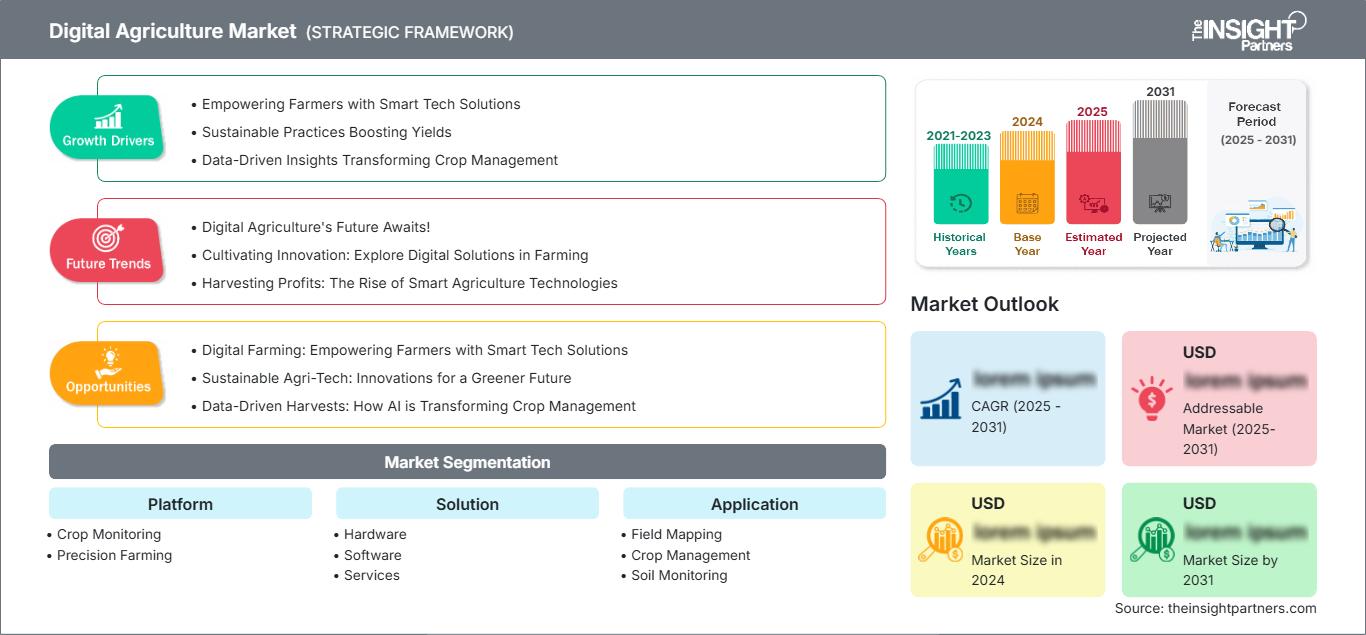
Digital Agriculture Market: Strategic Insights
Regional Insights
North America Digital Agriculture Market
North America had a 34-37% market share in 2025 and is projected to grow at a 6.8-7.6% CAGR during 2026-2034. Factors supporting Digital Agriculture market share include large farms, mechanized row-crop operations, extensive network of dealers, and high adoption of guided farming practices. The adoption is evolving from machine management to crop intelligence, field mapping, and sustainability reporting.
Factors influencing the structural growth include USDA conservation initiatives, private crop advisory groups, rural broadband development, and requirement for efficient inputs utilization. The United States is leading regional demand while Canada supports via wideacre digitization of grain, oilseeds, and specialty crops. Some of the key companies with significant regional presence include AGCO Corporation, Bayer AG, CNH Industrial N.V., Deere & Company, International Business Machines Corporation, and Microsoft Corporation.
U.S. Digital Agriculture Market
The US holds a 78–82% share of the North American region in 2025 and grows at 6.9–7.8% CAGR between 2026 and 2034. The demand is attributed to extensive use of autoguidance systems, yield mapping, fleet telemetry, and variable rate applicators in corn, soybean, cotton, rice, wheat, and specialty crops. Usage trends for ag technologies include crop management, soil sensing, and prescriptions related to weather.
Company coverage includes Deere & Company, AGCO Corporation, CNH Industrial N.V., Bayer AG, Microsoft Corporation, International Business Machines Corporation, and AgEagle Aerial Systems Inc. Growers and advisors prefer those technologies which offer easy file transfer, prescription implementation, and connectivity between equipment and crop analytics. Surveys from retailers indicate the growing popularity of machine vision, drone applications, telemetry, and profitability mapping.
Europe Digital Agriculture Market
The region accounted for a 24-27% market share in 2025 and is predicted to expand at a CAGR of 6.1-6.9% during 2026-2034. Germany is dominant by virtue of machinery integration, precision application, and industrial farming operations. France is second owing to the analysis of arable crops, advisory systems, and farm management related to sustainability. The United Kingdom specializes in data-based agronomy and labor saving devices.
Irrigation systems, unique crop, grape plantations, fruit orchards, and weather-related disease forecasting contribute to demand creation in Italy and Spain. The goals outlined in the Farm to Fork Strategy, the eco-schemes in the Common Agricultural Policy, and the rural digital development strategy help facilitate modernization. The major market participants in the sector include AGCO Corporation, Bayer AG, CNH Industrial N.V., Deere & Company, Gamaya SA, Hummingbird Technologies Limited, and Microsoft Corporation.
APAC Digital Agriculture Market
The APAC region held 25-28% market share in 2025 and is expected to grow at a CAGR of 8.2-9.4% between 2026 and 2034. China will lead on the basis of its scale, drone technology, machinery automation, and digital advisory solutions; India, on the other hand, will drive advancements in mobile agronomy, weather intelligence, and farm inventory applications for small-scale farmers.
Japan, South Korea, and Australia will drive demand by using robotics technology, protected cropping, broadacre precision, and traceability. Policy factors that are shaping the growth include food security, water efficiency, digital infrastructure, and climate adaptation. The FAO Asia Pacific Digital Agriculture conference placed a strong emphasis on artificial intelligence, satellite information, mobile apps, and drones for rice production.
Middle East & Africa Digital Agriculture Market
MEA region expected to grow at 7.6%-8.8% CAGR over 2026-2034. The leadership in terms of technology adoption will be held by Saudi Arabia due to controlled environment agriculture, innovative irrigation, and food security strategies, while UAE will promote the adoption of agritech pilots, analytical platforms, and greenhouse automation.
The growth in South Africa and Rest of MEA will depend on the factors such as drought detection, livestock feed planning, scouting using satellite imagery, and farm business financial management. The availability of energy resources, lack of infrastructure, and cost will play a role in deciding upon the deployment strategy.
Segmentation Analysis
Platform
The Platform segment is forecast to grow at a 7.1–8.0% CAGR during 2026–2034. Digital Agriculture Market scope by platform reflects the shift from single-purpose tools to integrated field intelligence. Crop monitoring supports detection and decision-making, while precision farming remains the largest value pool because it links guidance, prescriptions, machinery control, and measurable input optimization.
- Crop Monitoring: Crop monitoring gains relevance as satellite imagery, drones, sensors, and scouting software help identify stress, pest pressure, nutrient deficiency, and irrigation needs before yield loss becomes material.
- Precision Farming: Precision farming leads adoption because it connects guidance, variable-rate application, machine control, and field records, making input savings and productivity gains easier to verify.
Solution
The Solution segment is projected to grow at a 7.4–8.3% CAGR during 2026–2034. Hardware remains essential for field sensing, positioning, and machine execution, but software and services are expanding as farms require integration, analytics, training, and seasonal support. Services are the fastest-growing solution area because farmers need help translating data into operational decisions.
- Hardware: Hardware includes sensors, drones, GPS receivers, controllers, cameras, and connected machinery components that capture field data and enable accurate implementation of agronomic instructions.
- Software: Software organizes field maps, prescriptions, weather feeds, crop records, and analytics dashboards, allowing farms and advisers to plan, execute, and verify decisions consistently.
- Services: Services cover installation, agronomic consulting, data interpretation, integration, equipment calibration, and training, making technology adoption more practical for farms with limited digital expertise.
Application
The Application segment is projected to grow at a 7.6–8.6% CAGR during 2026–2034. Application demand is broadening from field mapping and crop management into soil intelligence, inventory control, and localized forecasting. Adoption improves when applications connect planning, in-field execution, and post-season analysis, creating a closed loop for resource allocation and risk reduction.
- Field Mapping: Field mapping creates the spatial foundation for boundaries, zones, yield layers, drainage issues, and prescription files, improving planning accuracy across machinery and advisory workflows.
- Crop Management: Crop management applications integrate scouting, imagery, prescriptions, and treatment records, helping producers prioritize interventions and align input timing with field conditions.
- Soil Monitoring: Soil monitoring supports nutrient, moisture, compaction, and salinity decisions, strengthening variable-rate application and irrigation scheduling across broadacre and specialty crop systems.
- Farm Inventory Management: Farm inventory management tracks seed, fertilizer, chemicals, fuel, equipment, and field-use records, improving cost control, compliance documentation, and seasonal procurement planning.
- Weather Tracking and Forecasting: Weather tracking and forecasting applications guide spraying windows, irrigation timing, disease risk, and harvest scheduling, making localized climate intelligence central to operational resilience.
Opportunity Snapshot
| Application | Revenue Contribution | Trend Tag | Adoption Stage |
| Field Mapping | Medium | Zone Planning | Mature |
| Crop Management | High | Decision Support | Scaling |
| Soil Monitoring | Medium | Nutrient Insight | Scaling |
| Farm Inventory Management | Low | Input Control | Emerging |
| Weather Tracking and Forecasting | Medium | Climate Alerts | Scaling |
Digital Agriculture Market Growth Drivers and Impact Analysis
Input-Cost Volatility Accelerates Precision Decisions
Inputs including fertilizer, fuel, labor, seed, and crop protection expenses are now an integral part of farm margin management, thus creating incentive for digital technologies which help reduce waste but do not compromise the potential yield from the crops. With variable rate technology, nozzle management, prescription planting, and soil zoning, farmers are able to apply inputs depending on the field condition, rather than making a standard assumption about it. Its market relevance lies in the practical approach – farmers consider the efficiency of technology through payback period, dealership, and saving in passes, overlaps, and reworks. This driver will also boost the need for data platforms integrating yield mapping, weather, soil analysis, and machinery operation data.
Labor Shortages Push Automation Across Crop Operations
Farm operators face persistent seasonal labor gaps in planting, spraying, scouting, harvesting, and specialty crop management. Digital agriculture reduces dependency on manual observation and repeated field checks by using guidance, drones, machine vision, autonomous sprayers, remote monitoring, and workflow software. The impact is strongest in regions where farm scale is rising and skilled operators are scarce. Automation does not remove the need for agronomic judgment, but it changes how labor is allocated toward supervision, exception management, and data interpretation. This creates demand for intuitive interfaces, mixed-fleet compatibility, training, and reliable dealer service. Companies that retrofit existing machinery can reach farms unwilling to replace large equipment fleets immediately.
Climate Risk Increases Demand for Field-Level Intelligence
More frequent droughts, heat stress, rainfall variability, pest migration, and disease pressure are increasing the value of localized, timely farm intelligence. Weather tracking, soil moisture sensing, satellite imagery, and predictive analytics help producers adjust irrigation, spraying, planting, and harvest decisions before losses widen. The market impact extends beyond yield protection because insurers, lenders, food companies, and sustainability programs increasingly require evidence-based records. Digital platforms that document field conditions, interventions, and outcomes can support risk management and traceability. Adoption is likely to grow fastest where climate variability intersects with scarce water, high-value crops, or policy incentives for efficient input use and emissions reduction.
Digital Agriculture Market Future Trends
AI Agronomy Assistants Become Field Workflow Interfaces
Digital Agriculture Market trends point toward AI assistants becoming the daily interface between agronomic knowledge, farm records, and machine execution. Instead of searching manuals, spreadsheets, weather feeds, and crop guides separately, farmers and advisers will increasingly ask systems for field-specific recommendations, product constraints, risk alerts, and work plans. The next phase will depend on trusted datasets, explainable outputs, offline usability, and integration with equipment platforms. These assistants will not replace agronomists, but they can compress decision time and standardize routine recommendations. Vendors that combine domain data, cloud infrastructure, and local advisory networks will be positioned to build recurring relationships around decision confidence.
Interoperability Becomes a Purchasing Requirement
Farmers increasingly operate mixed fleets, multiple software subscriptions, and adviser-led data workflows, making interoperability a future requirement rather than a convenience. Data transfer between field platforms, machinery terminals, prescription tools, and reporting systems will influence renewal decisions because manual processes add errors and delay. Future purchasing will favor open APIs, wireless work-plan transfer, common field boundaries, standardized agronomic records, and permission-based data sharing. This trend will pressure vendors with closed ecosystems while rewarding providers that simplify cross-brand execution. It also supports service revenue, because integration, data cleaning, and workflow design become essential for farms scaling digital operations across crops and regions.
Digital Agriculture Market Opportunities
Service-Led Precision Programs for Mid-Sized Farms
Digital Agriculture Market Forecasts indicate strong opportunity in service-led precision programs for mid-sized farms that lack dedicated data teams but face the same input-cost and climate pressures as large producers. Providers can bundle soil sampling, imagery, prescription creation, equipment calibration, and seasonal performance reviews into subscription or dealer-delivered packages. This opportunity is action-oriented because farms often need outcomes, not disconnected dashboards. Vendors should prioritize simple onboarding, mixed-equipment compatibility, localized agronomy, and proof of savings by field or crop. Cooperatives, retailers, and machinery dealers can become key channels by turning digital tools into repeatable advisory services with measurable return on investment.
Climate and Traceability Platforms for Food Supply Chains
Food processors, retailers, lenders, and insurers are seeking better evidence on farm practices, emissions, water use, chemical application, and climate exposure. This creates an opportunity for platforms that connect field data with traceability, sustainability reporting, and risk scoring. Successful offerings will need farmer consent, clear data ownership, audit-ready records, and practical value for producers beyond compliance. Solution providers can partner with commodity groups, cooperatives, and enterprise buyers to create incentives for adoption. The strongest models will convert routine farm operations into verified records that support premium programs, financing, insurance, and resilient procurement without adding excessive administrative burden.
Recent Developments
- June 2026: Syngenta signed a Memorandum of Understanding (MoU) to become a strategic partner in Annam.AI, India’s first open-data agricultural ecosystem. As part of the initiative, Syngenta will contribute its R&D and agronomic expertise to develop AI-powered crop health, pest forecasting, and heat stress models, enabling hyperlocal, real-time advisory services for farmers. Backed by the Government of India, IIT Ropar, and global technology partners, the platform aims to advance precision agriculture, strengthen climate resilience, and improve productivity for millions of Indian farmers.
- January 2026: SAP and Syngenta announced a multi-year strategic technology partnership to scale AI-assisted agriculture by embedding AI across Syngenta’s global operations. The collaboration will leverage SAP Cloud ERP Private, SAP Business Data Cloud, SAP Business AI, and the Joule AI copilot to modernize manufacturing, strengthen supply chain resilience, unify enterprise data, and accelerate innovation. The initiative aims to improve operational efficiency, enable data-driven decision-making, and support the development of more sustainable and resilient agricultural systems to meet future global food demand.
- November 2025: Syngenta opened its AI-powered Cropwise digital platform to third-party developers through the Cropwise Open Platform, enabling developers to build and integrate digital agriculture applications using Syngenta’s agronomic models and APIs. Supporting over 70 million hectares across more than 30 countries, the initiative aims to accelerate agricultural innovation, bridge the technology gap between large and small farms, and expand access to AI-driven, data-powered farming solutions while ensuring farmers retain control over their data.
Frequently Asked Questions

- Comprehensive Market Sizing and Forecast Analysis
- Detailed Segmentation Analysis
- In-Depth Market Dynamics Assessment
- Regional and Country-Level Insights
- Competitive Landscape and Company Benchmarking
- Strategic Business Intelligence
Recent Reports
Testimonials

The Insight Partners provided valuable market intelligence that supported our global go-to-market strategy. Their team was professional, responsive, and attentive to our feedback, providing thoughtful analysis and helpful methodological clarifications throughout the project.
Junmo Kim Chief Financial Officer (CFO), Enertech Co., Ltd.
The Insight Partners' SCADA System Market report is comprehensive, with valuable insights on current trends and future forecasts. The team was highly professional, responsive, and supportive throughout. We are very satisfied and highly recommend their services.
RAN KEDEM Partner, Reali Technologies LTDs
I requested a report on a very specific software market and the team produced the report in a few days. The information was very relevant and well presented. I then requested some changes and additions to the report. The team was again very responsive and I got the final report in less than a week.
JEAN-HERVE JENN Chairman, Future Analytica
We worked with The Insight Partners for an important market study and forecast. They gave us clear insights into opportunities and risks, which helped shape our plans. Their research was easy to use and based on solid data. It helped us make smart, confident decisions. We highly recommend them.
PIYUSH NAGPAL Sr. Vice President, High Beam Global
The Insight Partners delivered insightful, well-structured market research with strong domain expertise. Their team was professional and responsive throughout. The user-friendly website made accessing industry reports seamless. We highly recommend them for reliable, high-quality research services
YUKIHIKO ADACHI CEO, Deep Blue, LLC.
This is the first time I have purchased a market report from The Insight Partners.While I was unsure at first, I visited their web site and felt more comfortable to take the risk and purchase a market report.I am completely satisfied with the quality of the report and customer service. I had several questions and comments with the initial report, but after a couple of dialogs over email with their analyst I believe I have a report that I can use as input to our strategic planning process.Thank you so much for taking the extra time and making this a positive experience.I will definitely recommend your service to others and you will be my first call when we need further market data.
JOHN SUZUKI President and Chief Executive Officer, Board Director, BK Technologies
I wish to appreciate your support and the professionalism you displayed in the course of attending to my request for information regarding to infectious disease IVD market in Nigeria. I appreciate your patience, your guidance, and the fact that you were willing to offer a discount, which eventually made it possible for us to close a deal. I look forward to engaging The Insight Partners in the future, all thanks to the impression you have created in me as a result of this first encounter.
DR CHIJIOKE ONYIA MANAGING DIRECTOR, PineCrest Healthcare Ltd.Reason to Buy
- Informed Decision-Making
- Understanding Market Dynamics
- Competitive Analysis
- Identifying Emerging Markets
- Customer Insights
- Market Forecasts
- Risk Mitigation
- Boosting Operational Efficiency
- Strategic Planning
- Investment Justification
- Tracking Industry Innovations
- Aligning with Regulatory Trends





 Get Free Sample for