
Digital Servo Press Market Trends, Demand & Growth by 2034
Coverage: By Motor Type (Positional Rotation, Continuous Rotation, Linea); Type (Less than 100KN, 100KN - 200KN, More than 200KN); Application (Automotive Industry, Motor and Electronic Industry, Aerospace Industry, Manufacturing, Others) , and Geography (North America, Europe, Asia Pacific, and South and Central America)
- Status : Data Released
- Report Code : TIPRE00021322
- Category : Manufacturing and Construction
- No. of Pages : 150
- Available Report Formats :


- Last update date : September 28, 2026


2025 Market Size
US$ 240.89 Mn
Base year value
2034 Forecast
US$ 359.45 Mn
Projected by 2034
CAGR 2026-2034
4.55 %
Growth rate
Addressable Market
US$ 2,726.11 Mn
(2026-2034)
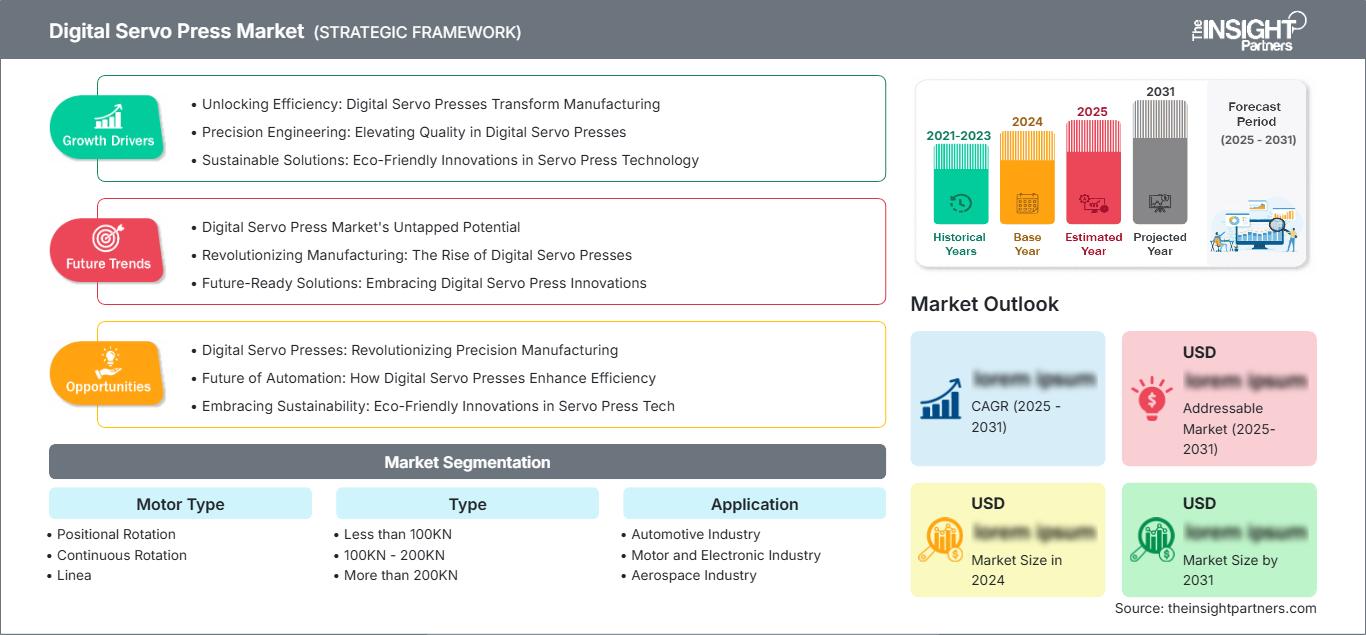
The digital servo press market was valued at US$ 240.89 Million in 2025 and is projected to reach US$ 359.45 Million by 2034, registering a CAGR of 4.55% during 2026–2034. Demand is advancing as manufacturers replace conventional hydraulic and pneumatic equipment with programmable electromechanical systems that combine precise force, speed, and position control with process traceability, flexible recipes, and lower maintenance requirements across automotive, electronics, aerospace, and general manufacturing operations.
North American adoption is expected to advance at a 4.1–4.5% CAGR as reshoring, electric vehicle investment, and quality-documentation requirements support modern assembly cells. The digital servo press market size in the region benefits from extensive automotive and aerospace supply networks, while labor scarcity encourages automated force-displacement monitoring. Retrofit demand is especially relevant where producers need traceable joins without replacing complete production lines.
Digital Servo Press Market Assessment and Insights
- North America – Accounted for 27–30% share in 2025 and is projected to record a 4.1–4.5% CAGR between 2026–2034, supported by reshoring, EV assembly investment, and automated quality assurance.
- US – Represented 78–82% of North American revenue in 2025, with a 4.2–4.6% CAGR between 2026–2034 as automotive and aerospace suppliers modernize joining cells.
- Europe – Held 24–27% share in 2025 and is expected to post a 4.0–4.4% CAGR between 2026–2034, led by Germany, the UK, France, Italy, and Spain.
- Asia Pacific – Captured 38–42% share in 2025 and is forecast to expand at a 5.0–5.5% CAGR between 2026–2034, led by China, Japan, South Korea, and India.
- Largest Segment – Automotive Industry represented 41–45% market share in 2025 and is projected to grow at a 4.6–5.0% CAGR between 2026–2034.
- High Growth Segment – Less than 100KN held 30–34% market share in 2025 and is expected to register a 5.1–5.6% CAGR between 2026–2034.
- Key companies analyzed in detail: ABB Ltd., Siemens AG, AIDA Engineering, Ltd., Schuler Group GmbH, AMADA PRESS SYSTEM CO., LTD., Komatsu Industries Corporation, JANOME Corporation, Promess Incorporated, TOX PRESSOTECHNIK SE & Co. KG, and Kistler Instrumente AG.
Source: The Insight Partners' analysis based on proprietary research, government publications, company annual reports, investor presentations, industry databases, and expert interviews.
The press technology has evolved from stroke-mechanical machinery and continuously powered hydraulic systems to digitally programmable motion profiling. Modern solutions consist of servo motors, screw drive systems, load cells, encoders, and control units which are able to manage force and position within each cycle. The economics of production is evolving to embrace recipe-controlled changeover, curve analysis capability, and energy recovery capability. Current suppliers design compact workstations, standalone presses, and line-synchronized systems around modular control systems, thus providing more variety while maintaining consistency and traceability.
Between 2014 and 2034, investments will extend out of the current automotive production centers and into the component clusters in India, Southeast Asia, and Eastern Europe. Machine investment will focus on scalable machines which are capable of integrating with plant data management systems and having lower life cycle energy consumption. There are several factors contributing to this trend such as safety standards for machine building, reduction of carbon footprint initiatives, and growth of the electronics industry at home.
Digital Servo Press Market Report Scope
| Report Attribute | Details |
|---|---|
| Market size in 2025 | US$ 240.89 Million |
| Market Size by 2034 | US$ 359.45 Million |
| Global CAGR (2026 - 2034) | 4.55% |
| Historical Data | 2021-2024 |
| Forecast period | 2026-2034 |
Digital Servo Press Market Analysis
Digital servo press development is based on manufacturers' demand to regulate force in the assembly process, reduce changeover times, and log all cycles. Assembly applications for automotive battery modules, bearings, connectors, and housing parts demand repeatable force-position profiles. Digital servo press OEMs purchase servo motors, ball or roller screws, load cells, safety devices, and industrial software and combine them into presses or entire lines.
Supply dynamics are driven by specialty engineering rather than commodity manufacturing equipment fundamentals. Precision screw, motor, and controller lead times may impact supply, whereas application trials and die integration will add to project timelines. However, modularity allows sharing components across different force ranges, thus reducing configuration and service time. As a result, integrators, automation equipment partners, sensor manufacturers, and plant software suppliers become part of the purchase consideration process.
The digital servo press market report reveals competition between general automation companies and joining experts. Siemens AG and ABB Ltd. consolidate their control in the domains of control, drives, and robotics, AIDA Engineering, Ltd., Schuler Group GmbH, AMADA PRESS SYSTEM CO., LTD., and Komatsu Industries Corporation are targeting high-throughput forming applications, whereas JANOME Corporation, Promess Incorporated, TOX PRESSOTECHNIK SE & Co. KG, and Kistler Instrumente AG specialize in compact electromechanical pressing and sensing.
Funding focuses on software-based motion control, edge computing, condition monitoring, and labs where potential customers can test the tooling prior to purchase. Differentiation is provided by the force range, position accuracy, cycle time, open interface, and service footprint. While big players offer their customers presses bundled with the whole line automation, specialists use configuration of workstations and faster engineering support to differentiate. System integration partnerships continue being critical in converting technology into results.
● REPORT CUSTOMIZATION
Tailor This Report To Align With Your Specific Business Requirements
This report can be customized to align precisely with your business objectives, scope, and target markets. Customization options include tailored segmentation, geography, competitive analysis, and strategic insights to support informed decision-making.
Customize This Report →WHAT YOU CAN ADJUST
- ● Segmentations
- ● Geography
- ● Competitive Analysis
- ● Language Preferences
Digital Servo Press Market: Strategic Insights
Regional Insights
North America digital servo press market
Revenue share for North America is 27-30% in 2025 and estimated to have a CAGR of 4.1-4.5% till 2034. The digital servo press market share of digital servo presses represents that there are significant manufacturing activities of automobiles, aerospace, medical devices, and industrial machinery. Reshoring, traceability, and labor concerns drive capital expenditure in programmable presses which record every force displacement curve and reduce post production inspection.
The maximum demand can be found around the Great Lakes region, Southern US automobiles manufacturing hub, Ontario, Quebec, and Mexican industrial regions. The end-users require Ethernet enabled for control system, safety features, and recipe management in mixed model assembly applications. System integrators help the adoption process by combining presses with robotic armatures, conveyors, tooling, and enterprise databases. Canada’s aerospace sector and Mexico’s growing vehicle and electronics supply chains provide implementation outside of the US market size.
U.S. Digital Servo Press Market
The USA accounted for 78% to 82% of the North American market in 2025 and is projected to expand at a compound annual growth rate of 4.2% to 4.6% through 2034. Electrification of vehicles has created the need for precision presses for battery modules, electric motors, heat management, and power electronics. Aerospace parts manufacturers utilize programmable motion and recorded signatures in processes while medical and appliance companies use smaller machines with cleanliness and repeatability of joints being key requirements.
Machine supplier base is wide: Promess Inc. offers machines for intelligent assembly processes and Siemens AG and ABB Ltd. offer solutions for automation and controls around press cells. Global machine companies have either sales and/or service network to handle automotive business. There is a trend toward adoption of machine cells which will allow storing recipes, force position window evaluation and passing/failure communications.
Europe Digital Servo Press Market
The share of Europe in the global revenues was 24% – 27% in 2025 and is expected to grow at a CAGR of 4.0% – 4.4% up to 2034. Germany holds its position due to the advanced automotive engineering, machine building, and existing suppliers like Schuler Group GmbH, Siemens AG, and TOX PRESSOTECHNIK SE & Co. KG.
The United Kingdom depends on aerospace industry, luxury cars manufacture, and special machinery manufacturers. France benefits from aerospace and vehicles projects, whereas Italy depends on machinery manufacturers and clustering of components in flexible form cells. Spain has an advantage from automotive assembly and requirements of its suppliers, especially in case of mixed-model lines. In these countries, the aspects of safety of machinery, objectives of energy management, and electronic documentation provide opportunities for development of electromechanical systems. However, the issue of payback periods is significant for users, thus providing an opportunity for modular solutions, retrofits, and service.
APAC Digital Servo Press Market
APAC accounted for 38-42% of the world revenue in 2025 and is expected to achieve 5.0-5.5% CAGR during the period between 2026 and 2034. It is led by China because of its capabilities related to EVs, batteries, electronics, and machinery. On the other hand, Japan has an expertise in the deep press process and precision manufacturing.
Korea is involved in battery and electronic investments, India is involved in manufacturing-related growth, and Australia is involved in its distinctive aerospace and industry-related applications. Government assistance in manufacturing processes and energy-efficient items assists in promoting the connected servo system despite financial constraints.
Middle East & Africa Digital Servo Press Market
Middle East and Africa will grow at a CAGR of 3.6–4.1% until 2034. In Saudi Arabia, industrial diversification drives investments into automotive parts, electricity equipment, and local manufacturing. UAE has facilities for maintenance of aircraft and advanced industrial districts.
The country with the longest experience in automotive manufacturing in the region is South Africa, with other countries in MEA being project-driven. Selective demands arise due to energy infrastructure, localization requirements, and assembly plants, yet there are few integrators and capital sensitivity issues.
Segmentation Analysis
Motor Type
Motor Type is expected to expand at a 4.4–4.9% CAGR during 2026–2034. Architecture selection depends on stroke profile, duty cycle, torque delivery, and required positioning precision. The digital servo press market scope spans rotary drive arrangements and direct linear actuation, with buyers balancing established component availability against compactness, responsiveness, and maintenance. Integrated feedback increasingly shapes specification decisions.
- Positional Rotation – Serves applications requiring controlled angular movement translated into repeatable ram positioning. Broad component availability, configurable motion profiles, and dependable feedback make it strategically important for general assembly.
- Continuous Rotation – Supports high-duty production where sustained motor operation and synchronized mechanical conversion are priorities. Demand is concentrated in automated lines that value throughput, stable torque delivery, and repeatable cycling.
- Linea – Addresses compact systems requiring direct, responsive motion with fewer mechanical conversion stages. Adoption is emerging in precision joining and electronics assembly where footprint, acceleration, and positioning accuracy are critical.
Type
Type is forecast to grow at a 4.6–5.1% CAGR during 2026–2034. Force class determines frame design, tooling, floor-space requirements, and integration cost. Compact platforms broaden access for electronics and precision assembly, medium-force machines serve diversified component work, and heavy systems support structural forming. Modular controls and shared software increasingly allow manufacturers to standardize operation across capacity bands.
- Less than 100KN – Holds strategic relevance for electronics, sensors, connectors, and small automotive assemblies. Lower installation cost, compact footprints, and easier automation integration support scaling among first-time servo press users.
- 100KN - 200KN – Meets mid-range assembly and forming requirements across motors, bearings, housings, and industrial components. Balanced force, flexibility, and cell integration sustain steady demand among diversified manufacturers.
- More than 200KN – Serves demanding automotive, aerospace, and structural applications requiring rigid frames and controlled high force. Purchases are project-led, technically complex, and closely tied to tooling and automation investment.
Application
Application is projected to register a 4.5–5.0% CAGR during 2026–2034. Automotive remains the broadest demand base, while electronics favors compact, high-resolution systems. Aerospace purchases emphasize validation and process documentation, and general manufacturing values recipe flexibility across product families. Across applications, investment decisions increasingly compare defect prevention, energy use, changeover time, and data integration rather than press price alone.
- Automotive Industry – Leads demand through battery, motor, bearing, chassis, and powertrain assembly. High production volumes and strict traceability make programmable force control strategically important for defect prevention.
- Motor and Electronic Industry – Requires precise pressing for connectors, stators, sensors, and compact housings. Miniaturization and tight tolerances favor low-force systems with rapid sampling and automated pass-fail evaluation.
- Aerospace Industry – Uses servo presses for controlled assembly of high-value components where process documentation and repeatability are essential. Qualification cycles are longer, but validated installations support durable service demand.
- Manufacturing – Covers machinery, appliances, medical devices, and general industrial components. Mixed product volumes encourage configurable workstations that store recipes, reduce setup errors, and support phased automation.
Opportunity Snapshot
| Application | Revenue Contribution | Trend Tag | Adoption Stage |
| Automotive Industry | High | Battery Assembly | Mature |
| Motor and Electronic Industry | High | Micro Pressing | Scaling |
| Aerospace Industry | Medium | Traceable Joining | Scaling |
| Manufacturing | Medium | Flexible Cells | Scaling |
Digital Servo Press Market Growth Drivers and Impact Analysis
Traceability Becomes an In-Line Production Requirement
The need for verification of whether an assembly has reached required force, position, and displacement levels is becoming more and more important for manufacturers. In such circumstances, digital servo presses provide cycle signatures and instant results on pass or failure, which makes it possible for a factory to isolate defects prior to adding any further value in the process. The mentioned advantage is especially important for products like battery modules, steering assemblies, motors, medical products, and aircraft components, because an invisible mistake in the joining process will mean warranty or safety risks. Data from the process can be used in audits, supplier evaluations, and root cause analyses.
Electrified Products Require Flexible Precision Assembly
The electrification of automobiles and electronics miniaturization are transforming the components that need to be pressed, staked, swaged, and assembled. The battery modules, busbars, stators, rotors, sensors, connectors, and thermal management assemblies require precise control over force profiles to ensure the safety of fragile components and the mechanical strength of the assembly. The programmability of motion allows a single piece of equipment to handle a wide variety of variants using stored recipes, thereby minimizing the need for customized tooling. The persistent findings of the IEA on rising sales of electric cars ensure continued investments in batteries and motors supply chains. For press machine manufacturers, the effects include not just selling machines but also testing, validation, automation, and data services.
Energy and Maintenance Economics Favor Electromechanical Drives
Servo-based machinery will draw electricity during operation only and will not require hydraulic pumps, oil lines, and their filtration. It might lead to a reduction in electricity usage when idling, decrease of possible oil leakage, and easy preventive maintenance. According to JANOME Corporation, the JP5S model of high-pressure machines uses up to 87% less electricity and emits less carbon dioxide emissions in comparison with hydraulic or pneumatic presses. Moreover, according to Komatsu Industries Corporation, the new H1F200-2 consumes 6% less electricity than the previous version. This information is machine specific depending on the duty cycle, yet this information clearly explains the rationale behind the purchase.
Digital Servo Press Market Future Trends
Edge Analytics Will Shift Presses Toward Self-Diagnosing Assets
The global digital servo press market trends will increasingly center on edge analytics that interpret force curves, motor current, vibration, temperature, and cycle timing within the machine. Instead of simply flagging an out-of-window part, future controls will distinguish tool wear, lubrication loss, material variation, and fixture misalignment. Local processing will reduce latency and protect production data, while standardized interfaces transmit selected indicators to plant platforms. Suppliers will monetize software updates, diagnostic libraries, and fleet benchmarking alongside hardware. The commercial advantage will move toward systems that convert raw press signals into actionable maintenance and quality decisions without requiring specialist data-science resources at each factory.
Modular Platforms Will Support Software-Defined Production
Machine builders will expand modular architectures that combine standardized drive units, controllers, safety functions, frames, and monitoring software. Customers will configure force capacity, stroke, sensors, interfaces, and automation around a common platform, then add functions through software rather than extensive cabinet redesign. This approach supports faster engineering, shorter spare-parts lists, and consistent operator training across plants. It also enables phased capital spending: a manual workstation can later connect to robots, conveyors, and central databases. Open communication standards will become a selection criterion as manufacturers avoid proprietary data silos and seek long-lived equipment that adapts to changing products.
Digital Servo Press Market Opportunities
Retrofit Packages for Brownfield Assembly Lines
Installed hydraulic and pneumatic presses create a substantial conversion opportunity where factories need traceability but cannot replace entire lines. Vendors can package electromechanical actuators, controllers, safety upgrades, sensors, and software with application engineering that preserves existing fixtures and upstream automation. The digital servo press market forecasts support investment in standardized retrofit assessments, migration kits, and financing tied to verified energy or scrap savings. Success requires careful frame, tooling, and cycle-time validation rather than a simple actuator substitution. Suppliers that document payback, manage commissioning during planned shutdowns, and train maintenance teams can access mid-sized producers that otherwise defer full-cell modernization.
Localized Application Centers in Emerging Manufacturing Hubs
India, Southeast Asia, Mexico, and selected Middle Eastern industrial zones are adding vehicle, electronics, appliance, and electrical-equipment capacity. Local application centers can shorten sales cycles by proving force profiles, tooling, and cycle times on customer parts before final investment. They also support operator training, service certification, and adaptation to regional automation partners. A hub-and-spoke model combining demonstration equipment with remote engineering can lower expansion cost while improving responsiveness. Vendors should prioritize clusters with rising component localization, strong technical education, and accessible integrators. Early presence can establish specifications and service relationships before purchasing standards become entrenched around incumbent machinery.
Recent Developments
- April 2026: TOX PRESSOTECHNIK SE & Co. KG – Reported ABNOX AG’s deployment of a FlexPress Compact, commissioned after an April 2025 delivery. The 1.5–60 kN system replaced three machines, supports configurable force and speed, and records process data for networked analysis, demonstrating consolidation potential in precision assembly
- July 2025: Komatsu Industries Corporation – Presented the upgraded H1F200-2 AC servo press ahead of its August 2025 launch. The machine introduced a new servo motor, 6% lower power consumption versus the previous model, faster production, ±10 kN load control, standard overload monitoring, and expanded Komtrax analytics for die-life and quality management
- January 2025: JANOME Corporation – Announced the JPU-30S5, a 30-ton JP5S electromechanical press launched in February 2025. JANOME highlighted compact high-speed operation, 0.25-millisecond sampling, external result-data communication, and up to 87% lower electricity consumption and carbon dioxide emissions compared with hydraulic or pneumatic presses
Frequently Asked Questions

- Comprehensive Market Sizing and Forecast Analysis
- Detailed Segmentation Analysis
- In-Depth Market Dynamics Assessment
- Regional and Country-Level Insights
- Competitive Landscape and Company Benchmarking
- Strategic Business Intelligence
Recent Reports
Testimonials

The Insight Partners' SCADA System Market report is comprehensive, with valuable insights on current trends and future forecasts. The team was highly professional, responsive, and supportive throughout. We are very satisfied and highly recommend their services.
RAN KEDEM Partner, Reali Technologies LTDs
I requested a report on a very specific software market and the team produced the report in a few days. The information was very relevant and well presented. I then requested some changes and additions to the report. The team was again very responsive and I got the final report in less than a week.
JEAN-HERVE JENN Chairman, Future Analytica
We worked with The Insight Partners for an important market study and forecast. They gave us clear insights into opportunities and risks, which helped shape our plans. Their research was easy to use and based on solid data. It helped us make smart, confident decisions. We highly recommend them.
PIYUSH NAGPAL Sr. Vice President, High Beam Global
The Insight Partners delivered insightful, well-structured market research with strong domain expertise. Their team was professional and responsive throughout. The user-friendly website made accessing industry reports seamless. We highly recommend them for reliable, high-quality research services
YUKIHIKO ADACHI CEO, Deep Blue, LLC.
This is the first time I have purchased a market report from The Insight Partners.While I was unsure at first, I visited their web site and felt more comfortable to take the risk and purchase a market report.I am completely satisfied with the quality of the report and customer service. I had several questions and comments with the initial report, but after a couple of dialogs over email with their analyst I believe I have a report that I can use as input to our strategic planning process.Thank you so much for taking the extra time and making this a positive experience.I will definitely recommend your service to others and you will be my first call when we need further market data.
JOHN SUZUKI President and Chief Executive Officer, Board Director, BK Technologies
I wish to appreciate your support and the professionalism you displayed in the course of attending to my request for information regarding to infectious disease IVD market in Nigeria. I appreciate your patience, your guidance, and the fact that you were willing to offer a discount, which eventually made it possible for us to close a deal. I look forward to engaging The Insight Partners in the future, all thanks to the impression you have created in me as a result of this first encounter.
DR CHIJIOKE ONYIA MANAGING DIRECTOR, PineCrest Healthcare Ltd.Reason to Buy
- Informed Decision-Making
- Understanding Market Dynamics
- Competitive Analysis
- Identifying Emerging Markets
- Customer Insights
- Market Forecasts
- Risk Mitigation
- Boosting Operational Efficiency
- Strategic Planning
- Investment Justification
- Tracking Industry Innovations
- Aligning with Regulatory Trends





 Get Free Sample for