
Dishwasher Market Size, Demand & Growth by 2034
Coverage: by Type (Freestanding, Built-in); Distribution Channel (Offline, Online); End-user (Residential, Commercial) , and Geography (North America, Europe, Asia Pacific, and South and Central America)
- Status : Data Released
- Report Code : TIPRE00010271
- Category : Electronics and Semiconductor
- No. of Pages : 150
- Available Report Formats :


- Last update date : August 07, 2026


2025 Market Size
US$ 10.82 Bn
Base year value
2034 Forecast
US$ 19.30 Bn
Projected by 2034
CAGR 2026-2034
6.64 %
Growth rate
Addressable Market
US$ 136.16 Bn
(2026-2034)
The Dishwasher Market Size was US$ 10.82 Billion in 2025 and forecasted to grow to US$ 19.30 Billion by 2034, registering a CAGR of 6.64% in 2026 – 2034. The market will experience growth due to the increasing demand for convenience, cleanliness, water efficiency, and performance of the appliances.
North America is forecasted to witness growth at a CAGR of 5.8–6.6% driven by higher appliance saturation, kitchen renovations, replacements, and the increasing use of smart homes. Structural growth will be driven by two income-earning households, awareness of the ENERGY STAR efficiency ratings, and preference for quieter, sensor cleaning systems.
Dishwasher Market Assessment and Insights
- North America held 31–35% share in 2025 and is growing at a CAGR range of 5.8–6.6% during 2026–2034, supported by replacement cycles, smart kitchens, and water-efficient appliance standards.
- US represented 78–82% of North America in 2025 and is growing at a CAGR range of 5.9–6.7%, led by built-in replacement demand and premium connected models.
- Europe accounted for 25–29% share in 2025 and is advancing at a CAGR range of 5.4–6.2%, with Germany, the UK, France, Italy, and Spain leading appliance adoption.
- Asia Pacific captured 28–32% share in 2025 and is expanding at a CAGR range of 7.4–8.5%, led by China, Japan, South Korea, India, and Australia.
- Largest Segment Freestanding dishwashers held 52–56% market share in 2025 and are growing at a CAGR range of 6.0–6.8%, supported by flexible installation and replacement affordability.
- High Growth Segment Online distribution held 26–30% market share in 2025 and is growing at a CAGR range of 8.0–9.2%, driven by omnichannel retail and comparison-led purchases.
- Key companies analyzed in detail: AGA Rangemaster Group Limited, Asko Appliances AB, BSH Hausgeräte GmbH, Electrolux AB, Fagor Industrial, S. Coop., Haier Smart Home Co., Ltd., LG Electronics Inc., Miele & Cie. KG, Samsung Electronics Co., Ltd., and Whirlpool Corporation.
Source: The Insight Partners' analysis based on proprietary research, government publications, company annual reports, investor presentations, industry databases, and expert interviews.
Product development in the Dishwasher Market is characterized by an increase in sophistication of products from purely mechanical washing process to sensor washing cycles, inverter motor technology, automatic dosing, Wi-Fi enabled controls, heat drying and noise dampening technology. The production dynamics include availability of stainless-steel tubs, electronics supply chain, pump efficiency, spray arm technology and economies of assembly location.
Future demand will rise in urban Asia, premium European replacement market and North American remodeling channel. Investments will flow towards modular kitchen partnerships, online selling platform and commercial hygiene systems for hotels and food service. Favorable regulatory environment in terms of water savings and energy efficiency labels will benefit those suppliers that can demonstrate lower water usage per cycle, durability and reparability of their platforms.
Dishwasher Market Report Scope
| Report Attribute | Details |
|---|---|
| Market size in 2025 | US$ 10.82 Billion |
| Market Size by 2034 | US$ 19.30 Billion |
| Global CAGR (2026 - 2034) | 6.64% |
| Historical Data | 2021-2024 |
| Forecast period | 2026-2034 |
Dishwasher Market Analysis
The Dishwasher Market growth is propelled by time-saving habits at home, increasing population in urban apartments, and recognition that contemporary dishwashers require far less water than hand washing. ENERGY STAR indicates that certified dishwashers require 12% less energy than regular machines, while industry sources state that efficient dishwashers consume 3–5 gallons per cycle while hand washing requires much more. The value chain includes steel and plastic, motors, control panels, detergents, distributors, installers, and after-sales service providers.
Pricing is still affected by electronics, logistics expenses, and regional capacities of appliances manufacturing. Commercial buyers care about sanitation uniformity, throughput, and savings on labor, while residential buyers are focused on tub capacity, rack flexibility, drying efficiency, and noise level. This way, in Dishwasher Market study, appliance technology is tied to consumer education since consumers have to see the proof that dishwasher saves water, cares about dishes, and is appropriate for small kitchens.
The competition is mainly centered around the global appliance groupings that have distinct positioning. The positioning of BSH Hausgeräte GmbH and Miele & Cie. KG focuses on the premium built-in engineering, Asko Appliances AB and AGA Rangemaster Group Limited are focused on the design-led kitchen, whereas Electrolux AB, Haier Smart Home Co., Ltd., LG Electronics Inc., Samsung Electronics Co., Ltd. and Whirlpool Corporation compete in the mass-premium channels. Fagor Industrial, S. Coop. differentiates itself through its professional dishwashing systems.
The current investment trends focus on diagnostic connectivity, localized design, efficient energy-drying capability, and effective online purchasing capability. Positioning will rely on warranty capability, retailer presence, installation services and specialized cleaning solutions for specific regional dishes. Those brands that can blend durability and smart controls within their hardware will be able to maintain prices even while increasing entry-level freestanding appliances.
● REPORT CUSTOMIZATION
Tailor This Report To Align With Your Specific Business Requirements
This report can be customized to align precisely with your business objectives, scope, and target markets. Customization options include tailored segmentation, geography, competitive analysis, and strategic insights to support informed decision-making.
Customize This Report →WHAT YOU CAN ADJUST
- ● Segmentations
- ● Geography
- ● Competitive Analysis
- ● Language Preferences
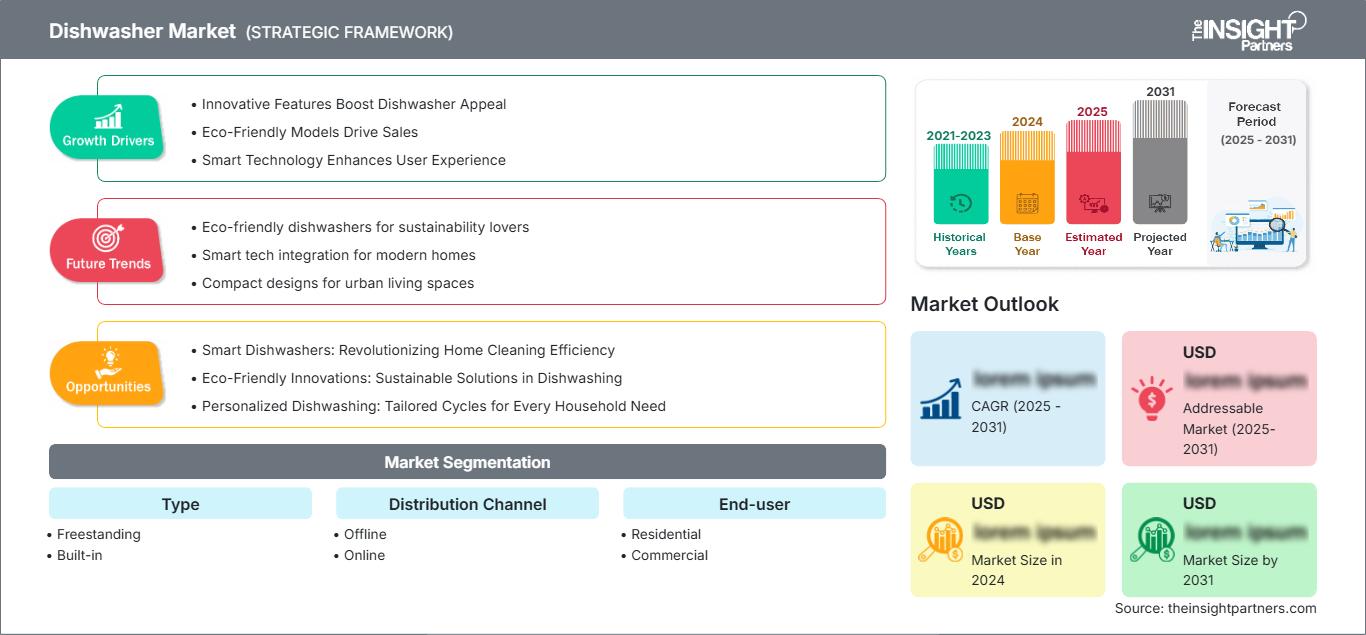
Dishwasher Market: Strategic Insights
Regional Insights
North America Dishwasher Market
Share in North America was around 31–35% in 2025 and is estimated to be increasing at a CAGR of 5.8–6.6% up to 2034. Drivers behind the dishwasher market share include established ownership of appliances, kitchen renovation, replacement demand, and increased home automation. Consumers evaluate noise levels, third-rack capability, drying performance, and energy ratings during replacement of old built-in models.
The region is benefited by strong finance options, relationships with builders, and service network. Condominium development and appliance efficiency initiatives in Canada, plus manufacturing and distribution of mid-level appliance products in Mexico contribute to regional demand. Growth is steady compared to APAC since penetration rates are already high, although premium offerings, connectivity, and water savings continue to drive replacement cycles.
U.S. Dishwasher Market Market
United States constituted 78% to 82% of North America in 2025 and is expected to see a CAGR between 5.9% to 6.7%. Whirlpool Corporation, BSH Hausgeräte GmbH, Electrolux AB, LG Electronics Inc., Samsung Electronics Co., Ltd., Haier Smart Home Co., Ltd., and Miele & Cie. KG remain highly visible via home centers, dealers, builders, and e-commerce channels.
Application trends revolve around built-in replacements, open kitchen design, low noise cycle below conversational levels, and intelligent notifications for servicing. Consumers are upgrading to stainless steel interiors, adjustable racks, and soil sensing capabilities. There is also demand for these products owing to renovation activities. Meanwhile, commercial kitchens employ professional appliances to address hygiene and labor concerns and increase table turnover rates.
Europe Dishwasher Market Market
The region accounts for the 25–29% share in 2025 and has a CAGR projection in the 5.4–6.2% range. Germany stands out due to high penetration, engineering-focused brand portfolio, and replacement need. The UK is benefiting from improved fitted kitchen and small-size households. France, Italy, and Spain create new demand due to urban apartments, hospitality foodservice, and energy label-driven appliance buying.
Low water consumption, low noise levels, maintenance, and design that fits well with cabinetry matter most to European consumers. Energy labeling and circular economy requirements motivate manufacturers to use energy-efficient motors and more durable components. Growth is solid but steady, driven by installed base replacement, commercial foodservice standards, and loyalty to premium brands.
APAC Dishwasher Market Market
APAC accounted for 28-32% share in 2025 and is estimated to witness CAGR of 7.4-8.5%. Leading nations include China with middle-class household appliance usage, smart home solutions, and manufacture in scale; Japan & South Korea with emphasis on small size, low noise, and efficient units; and India and Australia with growth fueled by modular kitchens and online retailing.
Policy incentives, increased number of women in labor force, and decreasing size of households favor product adoption. The Dishwasher Market in APAC gains from wash programs designed to handle heavy utensils and regional food particles. Affordability issues are mitigated with freestanding and tabletop dishwasher products.
Middle East & Africa Dishwasher Market Market
Middle East & Africa is projected to grow at a CAGR range of 6.2–7.2% as Saudi Arabia, the UAE, South Africa, and the rest of MEA invest in housing, hotels, restaurants, and premium retail. The UAE leads through hospitality and high-income residential demand, while Saudi Arabia adds smart-city and apartment development.
Regional adoption is linked to water conservation, domestic labor availability, and commercial kitchen hygiene. Import-dependent supply chains require strong distributor support and service coverage. Growth remains uneven, but premium residential projects and foodservice expansion support built-in and professional dishwasher demand.
Segmentation Analysis
Type
Type is expected to grow at a CAGR range of 6.1–6.9% during 2026–2034 as Dishwasher Market scope spans flexible freestanding demand and integrated built-in installations. Buyers choose based on kitchen layout, ownership status, installation cost, aesthetics, capacity, and replacement timing. Built-in models dominate fitted kitchens, while freestanding units widen access in rental and remodeling contexts.
- Freestanding models remain the volume foundation because they are easier to install, relocate, and replace, making them attractive for renters, first-time buyers, and mid-priced appliance shoppers.
- Built-in models hold strong strategic importance in premium kitchens, builder packages, and renovations where cabinetry integration, noise control, and higher-capacity interiors influence purchase decisions.
Distribution Channel
Distribution Channel is projected to grow at a CAGR range of 6.5–7.4% during 2026–2034 as appliance purchases blend showroom advice with digital comparison. Offline retail still matters for installation guidance and brand demonstration, while online channels accelerate specification research, consumer reviews, price discovery, and bundled delivery scheduling.
- Offline channels retain high relevance because consumers want to inspect finishes, rack layouts, noise claims, and installation requirements before committing to major kitchen appliances.
- Online channels gain share as buyers compare energy ratings, dimensions, reviews, and promotions, then coordinate delivery, installation, and extended warranties through marketplace or brand platforms.
End-user
End-user is expected to grow at a CAGR range of 6.3–7.1% during 2026–2034 as residential convenience and commercial sanitation needs expand together. Households prioritize time savings, water efficiency, and quieter kitchens, while hotels, restaurants, cafés, hospitals, and institutions require consistent cleaning throughput, hygiene compliance, and reduced manual labor dependency.
- Residential demand is strongest in urban and suburban households where dual-income routines, modular kitchens, smart-home adoption, and sustainability awareness make automated dishwashing more practical.
- Commercial demand is strategically important in foodservice and hospitality because high-volume dishwashing improves sanitation consistency, labor productivity, and service turnaround during peak operating periods.
Opportunity Snapshot
| End-user | Revenue Contribution | Trend Tag | Adoption Stage |
| Residential | High | Smart Kitchens | Scaling |
| Commercial | Medium | Hygiene Throughput | Mature |
Dishwasher Market Growth Drivers and Impact Analysis
Water and Energy Efficiency Reshape Appliance Replacement
Nowadays, the notion of efficiency is an obvious driver for buying and no longer a marketing claim on sustainability. New dishwashers are promoted for saving on water consumption, smart spraying mechanisms, soil detection systems, and efficient drying programs, which makes people buy the devices even though their old dishwashers might still be working. This trend is the most relevant in North America and Europe due to the impact of labeling and utilities cost awareness among the buyers. In developing countries, the same idea encourages buying a dishwasher as people consider it a cleaner way and less consuming than the traditional hand washing process.
Urban Lifestyles Increase Demand for Time-Saving Kitchens
Factors such as urbanization, small families, double income working schedules, and delivery lifestyle have altered the kitchen habits. Buyers need gadgets which lessen monotonous tasks and do not need complicated operating procedures, making the dishwasher more appealing in apartments, townhouses, and smaller modular kitchens. The practical implication is that there is greater demand for silent, slim, free-standing, and built-in models that suit the space but provide efficient cleaning results. The retailers are reacting with bundles of kitchen appliances and installation service, while brands are customizing the rack and wash cycle for the regional utensils.
Commercial Hygiene and Labor Constraints Support Professional Demand
Restaurant chains, hotel chains, café chains, hospitals, educational institutions, and caterers require regular sanitization and speed up processes due to difficult labor availability conditions. Commercial dishwashers help reduce manual labor, maintain consistent rinse temperatures, and comply with hygiene rules in busy kitchens. The effect on the market is more stable demand for the non-residential segment from tourism-driven countries and from dense foodservice zones in cities. Companies like Fagor Industrial, S. Coop., and others that specialize in manufacturing commercial dishwashers gain additional benefits by providing upgrades from manual washing and old equipment to reduce breakage and labor costs.
Dishwasher Market Future Trends
AI-Enabled Wash Optimization Moves into Mainstream Models
The Dishwasher Market trends will be characterized by intelligent cycles, load detection, detergent dispensation, and diagnostic features that will require minimum user intervention. High-end manufacturers currently use sensors for regulation of water temperature, washing cycle speed and time, but reduction in cost of manufacture will make such features available in middle-class machines as well. Intelligent systems will also be capable of identifying usage trends, diagnose problems in advance and help service engineers to resolve them before their arrival. Such changes will make future competition focus on software-based reliability rather than mere performance of hardware components, especially when connected kitchens become the norm.
Compact and Modular Designs Expand First-Time Adoption
Future demand will be shaped by households that want dishwashing automation but lack space for traditional full-size built-in models. Compact freestanding, slimline, and modular designs will support apartment living, rental housing, and smaller kitchens in Asia Pacific, the Middle East, and dense European cities. Manufacturers will also refine basket geometry for mixed cookware, regional utensils, and faster cycles. Retailers can position these products as entry points into automated dishwashing rather than downsized compromises. As consumers become comfortable with the category, compact models can create upgrade pathways toward larger built-in or premium connected units.
Dishwasher Market Opportunities
Premium Replacement Programs in Mature Appliance Markets
Dishwasher Market Forecasts point to a clear opportunity in replacement-led premiumization across the US, Canada, Germany, the UK, France, and Nordic markets. Installed bases are large, but consumers are willing to replace older units when brands demonstrate quieter cycles, better drying, flexible racks, and lower resource consumption. Retailers and manufacturers can target this opportunity through lifecycle marketing, trade-in offers, installation bundles, and comparison tools that show operating savings. The investment case is strongest for companies with reliable service networks because replacement buyers value reduced disruption. Premium programs also protect margins in markets where household penetration is already mature.
Localized Product Design for Emerging Urban Households
Emerging urban markets offer action-oriented growth when suppliers adapt products to local cooking habits, water pressure, voltage stability, and kitchen dimensions. India, Southeast Asia, the Gulf, and parts of Africa need models that handle heavier food residues, larger utensils, and flexible installation constraints. Companies can invest in consumer education, demonstration kitchens, financing, and after-sales support to overcome the perception that dishwashers are luxury products. Localized design also reduces return risk because cleaning performance must match regional expectations. Brands that combine affordable freestanding formats with credible hygiene and water-saving messages can build early loyalty before penetration accelerates.
Recent Developments
- January 2026: LG Electronics Inc. introduced updated smart home appliance capabilities across ThinQ-enabled products, including improved connected diagnostics and energy-management features relevant to kitchen appliances. The development supports dishwasher differentiation through remote monitoring, maintenance alerts, and broader smart-home integration as consumers compare appliance ecosystems before purchase.
- January 2025: BSH Hausgeräte GmbH expanded its connected home appliance portfolio with energy-efficient dishwasher features and Home Connect integration across selected Bosch and Siemens models. The update reinforced the company’s positioning in premium built-in kitchens where consumers evaluate quiet operation, app controls, drying performance, and sustainability credentials together.
- January 2025: Samsung Electronics Co., Ltd. showcased AI Home and connected appliance experiences for its Bespoke lineup, supporting broader integration of kitchen appliances with SmartThings. The announcement highlighted how appliance makers are using AI interfaces, energy insights, and remote control to strengthen premium positioning in the smart kitchen category.
Frequently Asked Questions

- Comprehensive Market Sizing and Forecast Analysis
- Detailed Segmentation Analysis
- In-Depth Market Dynamics Assessment
- Regional and Country-Level Insights
- Competitive Landscape and Company Benchmarking
- Strategic Business Intelligence
Recent Reports
Testimonials

The Insight Partners' SCADA System Market report is comprehensive, with valuable insights on current trends and future forecasts. The team was highly professional, responsive, and supportive throughout. We are very satisfied and highly recommend their services.
RAN KEDEM Partner, Reali Technologies LTDs
I requested a report on a very specific software market and the team produced the report in a few days. The information was very relevant and well presented. I then requested some changes and additions to the report. The team was again very responsive and I got the final report in less than a week.
JEAN-HERVE JENN Chairman, Future Analytica
We worked with The Insight Partners for an important market study and forecast. They gave us clear insights into opportunities and risks, which helped shape our plans. Their research was easy to use and based on solid data. It helped us make smart, confident decisions. We highly recommend them.
PIYUSH NAGPAL Sr. Vice President, High Beam Global
The Insight Partners delivered insightful, well-structured market research with strong domain expertise. Their team was professional and responsive throughout. The user-friendly website made accessing industry reports seamless. We highly recommend them for reliable, high-quality research services
YUKIHIKO ADACHI CEO, Deep Blue, LLC.
This is the first time I have purchased a market report from The Insight Partners.While I was unsure at first, I visited their web site and felt more comfortable to take the risk and purchase a market report.I am completely satisfied with the quality of the report and customer service. I had several questions and comments with the initial report, but after a couple of dialogs over email with their analyst I believe I have a report that I can use as input to our strategic planning process.Thank you so much for taking the extra time and making this a positive experience.I will definitely recommend your service to others and you will be my first call when we need further market data.
JOHN SUZUKI President and Chief Executive Officer, Board Director, BK Technologies
I wish to appreciate your support and the professionalism you displayed in the course of attending to my request for information regarding to infectious disease IVD market in Nigeria. I appreciate your patience, your guidance, and the fact that you were willing to offer a discount, which eventually made it possible for us to close a deal. I look forward to engaging The Insight Partners in the future, all thanks to the impression you have created in me as a result of this first encounter.
DR CHIJIOKE ONYIA MANAGING DIRECTOR, PineCrest Healthcare Ltd.Reason to Buy
- Informed Decision-Making
- Understanding Market Dynamics
- Competitive Analysis
- Identifying Emerging Markets
- Customer Insights
- Market Forecasts
- Risk Mitigation
- Boosting Operational Efficiency
- Strategic Planning
- Investment Justification
- Tracking Industry Innovations
- Aligning with Regulatory Trends





 Get Free Sample for