
Display Panel Market Growth, Demand & Size by 2034
Display Panel Market Size and Forecasts (2021–2034), Global and Regional Share, Trends, and Growth Opportunity Analysis Report Coverage :by Technology (LED, OLED, Others); Size (Small, Medium, Large); Form Factor (Flat, Flexible); Resolution (8K, 4K, WQHD, FHD, HD, Others); Application (TV, Desktop Monitor, Notebook PC, Tablet, Mobile Phone, Automotive, Digital Signage, Others) , and Geography (North America, Europe, Asia Pacific, and South and Central America)
- Status : Data Released
- Report Code : TIPRE00007945
- Category : Electronics and Semiconductor
- No. of Pages : 150
- Available Report Formats :


- Last update date : August 10, 2026


2025 Market Size
US$ 149.99 Bn
Base year value
2034 Forecast
US$ 330.57 Bn
Projected by 2034
CAGR 2026-2034
9.18 %
Growth rate
Addressable Market
US$ 2,148.47 Bn
(2026-2034)
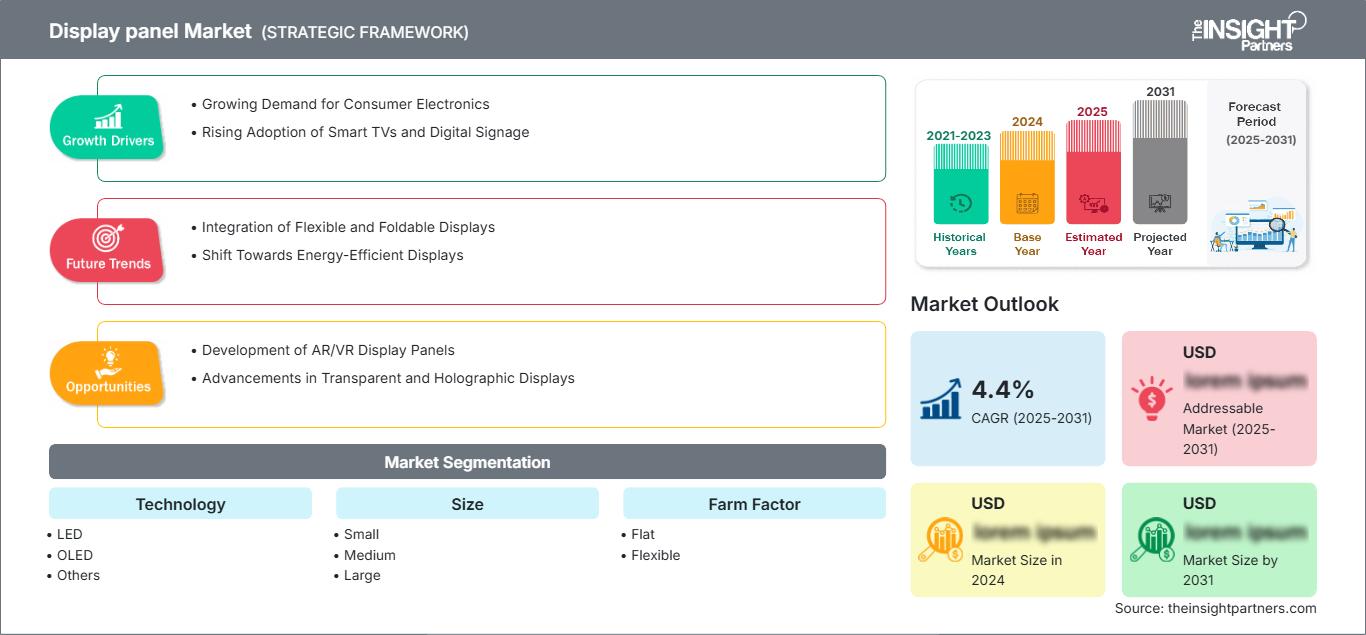
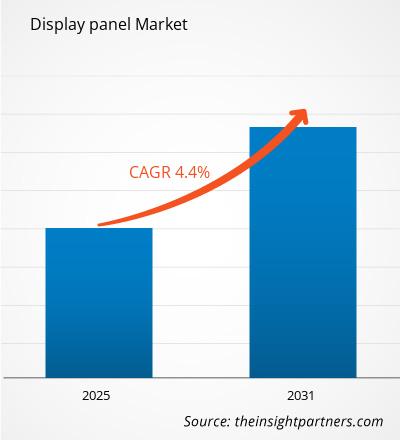
The Display Panel Market is expected to be US$ 149.99 Billion in 2025 and is forecasted to touch US$ 330.57 Billion by 2034, growing with a CAGR of 9.18% between 2026 and 2034. The Display Panel Market is driven by the increasing usage of LED, OLED, flat, flexible, 4K, 8K, WQHD, FHD, and HD panels used in various applications including television, smartphone, monitors, automotive cockpit, digital signage, industrial interface, and immersive devices.
In North America, the growth of the Display Panel Market size is attributed to the upgradation of high-end TVs, enterprise collaboration display systems, medical imaging interface, infotainment of vehicles, and AI-based device ecosystem. The region is expected to register a CAGR range of 8.3–9.1% between 2026 and 2034 due to robust growth in automotive electronics, commercial digital signage upgradations, and OLED and Mini LED visual systems.
Display Panel Market Assessment and Insights
- North America: The region holds 23–26% share in 2025 and grows at a CAGR range of 8.3–9.1% during 2026–2034, supported by premium TVs, automotive displays, healthcare screens, and enterprise collaboration systems.
- US: The country represents 78–82% of North America in 2025 and grows at a CAGR range of 8.4–9.2% during 2026–2034, led by premium consumer electronics and automotive cockpit adoption.
- Europe: Europe accounts for 19–22% share in 2025 and grows at a CAGR range of 7.6–8.5% during 2026–2034, with Germany, the UK, France, Italy, and Spain leading demand.
- Asia Pacific: Asia Pacific holds 48–52% share in 2025 and grows at a CAGR range of 9.7–10.6% during 2026–2034, led by China, South Korea, Japan, India, and Taiwan.
- Largest Segment: LED holds 56–60% market share in 2025 and grows at a CAGR range of 7.8–8.7% during 2026–2034 due to scale, affordability, and broad device integration.
- High Growth Segment: Flexible holds 18–22% market share in 2025 and grows at a CAGR range of 11.2–12.4% during 2026–2034 as foldable devices and automotive displays expand.
- Key companies analyzed in detail: AUO Corporation, BOE Technology Group Co., Ltd., Chunghwa Picture Tubes, Ltd., HannStar Display Corporation, Innolux Corporation, Japan Display Inc., LG Display Co., Ltd., Panasonic Holdings Corporation, Samsung Electronics Co., Ltd., Sharp Corporation
Source: The Insight Partners' analysis based on proprietary research, government publications, company annual reports, investor presentations, industry databases, and expert interviews.
Display Panel Market Evolution involves a transition from volume-based LCD capacity cycles to differentiation in OLED, Mini LED backlights, gaming screens, and automotive screens. The production process will be influenced by flexibility of Gen-6 OLED lines, size of glass foundries, availability of driver ICs, and regional incentives. Companies will have to balance their utilization policy with premium policy as overcapacity may lead to price compression, but differentiation by brightness, contrast, thinness, and energy efficiency will ensure margins.
Future demand growth will be influenced by China manufacturing capabilities, South Korean OLED supremacy, Japanese display engineering specialization, and automotive, medical, and enterprise demand in North America and Europe. Investments will be made in foldable substrates, oxide backplanes, tandem OLED stacks, and bright screens. Governmental pressure on energy efficiency, recyclability, and hazardous materials will drive companies that manage to lower power consumption and increase reliability and traceability.
Display Panel Market Report Scope
| Report Attribute | Details |
|---|---|
| Market size in 2025 | US$ 149.99 Billion |
| Market Size by 2034 | US$ 330.57 Billion |
| Global CAGR (2026 - 2034) | 9.18% |
| Historical Data | 2021-2024 |
| Forecast period | 2026-2034 |
Display Panel Market Analysis
Growth Drivers for Display Panels include premium replacement cycles in televisions, smartphones, notebooks, monitors, and automotive cockpits. Consumers are moving towards 4K and 8K panels, while corporations are deploying collaboration displays and digital signage. Auto Original Equipment Manufacturers (OEMs) are increasing their display surface area per car as they transition from analog cockpit systems to connected cockpits.
The supply chain consists of substrate providers, backplane equipment providers, organic materials suppliers, LED/OLED emitter providers, driver IC manufacturers, module assembly companies, brands, and contract manufacturers. Supply chain conditions are cyclic in nature due to the need for high fab utilization but premium formats act as a hedge. Consumers dual-source more frequently in size, resolution, and panel type.
The competitive positioning in the Display Panel Market analysis is based on factors such as OLED yield, large panel capability, qualification of customers, reliability in the automotive field, and control over advanced process know-how. The competitors in premium OLED and large panel programs are Samsung Electronics Co., Ltd., LG Display Co., Ltd., and BOE Technology Group Co., Ltd. At the same time, AUO Corporation, Innolux Corporation, and Sharp Corporation improve their reach in IT, industrial, and television panels.
Trends for investments are in tandem OLED, oxide TFT, flexible substrates, higher refresh rate, and automotive safety certification. Japan Display Inc. and Panasonic Holdings Corporation impact the demand of specialized and industrial displays, whereas HannStar Display Corporation and Chunghwa Picture Tubes, Ltd. stay relevant in certain small and medium panels.
● REPORT CUSTOMIZATION
Tailor This Report To Align With Your Specific Business Requirements
This report can be customized to align precisely with your business objectives, scope, and target markets. Customization options include tailored segmentation, geography, competitive analysis, and strategic insights to support informed decision-making.
Customize This Report →WHAT YOU CAN ADJUST
- ● Segmentations
- ● Geography
- ● Competitive Analysis
- ● Language Preferences
Display Panel Market: Strategic Insights
Regional Insights
North America Display Panel Market
North America has a 23-26% market share in 2025 and experiences CAGR between 8.3% and 9.1% during 2026-2034. Drivers for the Display Panel Market share include premium TV sets, gaming displays, infotainment in vehicles, diagnostic imaging workstations, retail media networks, and meeting spaces within enterprises. Demand is focused on medium to large panels, where brightness, color rendering, reliability, and energy efficiency are key factors.
This growth is driven not only by policy considerations on semiconductor readiness, data center visualization, and connected car electronics but also by the leading position of the United States. Canada and Mexico contribute to assembly, automotive segments, and business applications of displays. Customers require lifetime availability, cybersecurity-ready display controllers, and optical performance certification, particularly in healthcare, aerospace, retail displays, and industrial controls.
U.S. Display Panel Market
U.S. constitutes 78–82% share of North America in 2025 and has a CAGR of 8.4–9.2% during 2026 to 2034. The drivers include replacement of premium TVs, gaming monitors, automotive cockpit display panels, telemedicine devices, digital signage, and military visualization tools. The rise in adoption rate of displays in cars and workstations drives the demand for highly bright and energy-saving panels.
Market penetration is high through sales centers, distributors, brands, and display module suppliers. Some players who cater to premium visual equipment include Samsung Electronics Co., Ltd., LG Display Co., Ltd., Sharp Corporation, and BOE Technology Group Co., Ltd., whereas, AUO Corporation and Innolux Corporation focus on industrial applications. The application trends include OLED monitors, Mini LED TVs, rugged panels, and automotive in-cabin display panels.
Europe Display Panel Market
The region contributes a share of 19 to 22% in 2025 and has a CAGR of 7.6 to 8.5% from 2026 to 2034. The dominant contributors are Germany, with automotive displays, industrial HMI, machine vision, and high-end consumer electronics. The United Kingdom contributes through commercial signage, broadcasting, and gaming monitors while France contributes through aerospace and defense, retail media, and public visualization projects.
Contributions from Italy and Spain are via hospitality, retail, transport, and smart city displays. European procurement focuses on energy labeling, repairability, supply chain transparency, and optical quality. Companies that would benefit in such an environment include LG Display Co., Ltd., Samsung Electronics Co., Ltd., Sharp Corporation, Japan Display Inc., and AUO Corporation.
APAC Display Panel Market
In 2025, APAC has a 48-52% share, with a CAGR of 9.7-10.6% in 2026-2034. APAC has China as the leader in terms of large area LCD, OLED, electronics assembly, and its own brand devices. Premium OLED comes from South Korea, while specialty displays and materials come from Japan.
Increasing demand will be coming from India, Taiwan, and Australia through smartphones, IT hardware, digital displays, automotive electronics, and educational technology. There will be an increase in domestic industrial policies and semiconductor incentive programs along with exports that make use of local suppliers. Thus, The Display Panel Market is most production intensive in APAC.
Middle East & Africa Display Panel Market
The Middle East & Africa segment is forecast to grow at CAGR between 8.0% to 9.0% from 2026 to 2034. Saudi Arabia will drive growth through smart city infrastructure, retail media, entertainment spaces, and transportation solutions. The UAE will contribute to this by premium hospitality, airports, digital signage, and control room requirements.
South Africa and Rest of MEA will contribute to demand through mining, education, telecom, and public sector upgrading initiatives. Energy environment favors efficient LED and OLED panels where heat and power availability become critical. Buyers will look for tough displays with serviceable modules and bright display modules.
Segmentation Analysis
Technology
Technology is projected to grow at a CAGR range of 8.8–9.7% during 2026–2034. Display Panel Market scope is defined by the shift from conventional LED-backlit panels toward OLED, Mini LED, and emerging high-efficiency architectures. LED remains dominant because of cost and scale, while OLED gains in premium smartphones, televisions, monitors, wearables, and automotive interiors where thinness, contrast, and flexibility matter.
- LED: LED panels maintain the broadest market position across televisions, monitors, signage, laptops, and industrial displays because established supply chains deliver competitive pricing, high brightness, and dependable performance.
- OLED: OLED panels are strategically important in premium devices because self-emissive pixels improve contrast, enable thinner form factors, support flexible designs, and strengthen differentiation in high-value applications.
Size
Size is expected to grow at a CAGR range of 8.6–9.5% during 2026–2034. Small panels benefit from smartphones, wearables, cameras, and handheld gaming devices. Medium panels gain from tablets, laptops, medical terminals, and automotive displays. Large panels remain essential for televisions, gaming monitors, commercial signage, meeting rooms, education displays, and control centers.
- Small: Small panels serve smartphones, wearables, cameras, and handheld devices where pixel density, touch integration, power efficiency, and thin form factors drive supplier qualification.
- Medium: Medium panels support laptops, tablets, automotive clusters, medical systems, and industrial HMIs, balancing resolution, durability, brightness, and cost for mobile and embedded use cases.
- Large: Large panels anchor televisions, monitors, signage, education boards, and control-room walls where brightness uniformity, high resolution, refresh rate, and supply scale shape purchasing decisions.
Form Factor
Form Factor is projected to grow at a CAGR range of 9.4–10.5% during 2026–2034. Flat panels retain the largest installed base because they fit mainstream televisions, monitors, laptops, signage, and industrial equipment. Flexible panels gain faster adoption in foldable smartphones, curved automotive displays, wearable devices, and next-generation laptops requiring mechanical resilience and differentiated industrial design.
- Flat: Flat panels dominate mass-market devices because they offer established assembly processes, broad compatibility, predictable yields, and strong price-performance across televisions, monitors, laptops, and signage.
- Flexible: Flexible panels are strategically important in foldable phones, curved vehicle interiors, wearables, and premium laptops where mechanical design freedom improves differentiation and user engagement.
Resolution
Resolution is expected to grow at a CAGR range of 8.9–9.8% during 2026–2034. Resolution demand is moving upward as premium video, gaming, medical imaging, design workflows, and automotive visualization require sharper detail. 4K remains the commercial anchor, 8K expands selectively in premium TVs and professional visualization, while WQHD and FHD remain efficient choices for monitors and mobile computing.
- 8K: 8K panels serve premium televisions, professional visualization, broadcast evaluation, and simulation environments where ultra-fine detail supports differentiation despite higher content and processing requirements.
- 4K: 4K panels hold strong demand across TVs, monitors, signage, and laptops because content availability, falling panel costs, and consumer expectations support broad adoption.
- WQHD: WQHD panels are important in gaming monitors, productivity laptops, and professional displays where users seek sharper images without the power and cost burden of 4K.
- FHD: FHD panels remain relevant in mainstream laptops, monitors, education devices, and embedded systems where affordability, adequate clarity, and lower graphics workload are priorities.
- HD: HD panels continue in cost-sensitive devices, entry televisions, industrial controls, and compact equipment where basic readability, low power use, and economical replacement matter most.
Opportunity Snapshot
| Resolution | Revenue Contribution | Trend Tag | Adoption Stage |
| 8K | Medium | Premium TV | Emerging |
| 4K | High | Mainstream UHD | Mature |
| WQHD | Medium | Gaming Sharpness | Scaling |
| FHD | Medium | Cost Balance | Mature |
| HD | Low | Entry Devices | Mature |
Display Panel Market Growth Drivers and Impact Analysis
Premium Device Refresh and Higher Visual Standards
Customers and organizations are adopting newer screens, which offer superior brightness, expanded color range, increased refresh rates, and reduced energy consumption. This trend impacts TVs, phones, displays, notebooks, tablets, and digital signage since quality of display has become a visible factor in the buying decision-making process. The strongest influence on the market will be seen for 4K displays, OLED displays, Mini LED displays, and gaming displays, for which consumers pay extra due to the fact that the screen increases their productivity, enjoyment, or brand perception.
Automotive Cockpit Digitization and Multi-Screen Interiors
The automobile industry is increasing the use of larger center panels, digital instrument panels, passenger panels, rear-seat entertainment panels, and heads-up display panels. There are more display surfaces in each car platform, and the panels have high requirements for temperature, vibration, brightness, life time, and safety. As a result of the market change, there is an extended qualifying period, but higher retention when the panel goes into design. OLED and good LED panels will win in areas where curvature, contrast, and design are important.
Manufacturing Scale in Asia and Technology Migration
Mass capacity in China, South Korea, Japan, and Taiwan maintains competitiveness in terms of panel supply but facilitates technology transfer to new applications. Gen-10.5 LCD mass capacity makes room for the production of large TVs and signage panels, whereas Gen-6 flexible OLED capacity enables production for smartphones, wearables, and automotive screens. The industry implications will be quicker adoption of premium features in midrange devices as the yield and cost improve. However, proper capacity management will be essential to avoid excess capacity and margins erosion.
Display Panel Market Future Trends
Tandem OLED and High-Brightness Architectures
The Display Panel Market trends would revolve around the use of tandem OLEDs, improved emitters, and optical designs that increase brightness without reducing panel lifespan. The importance of this trend is applicable to laptops, monitors, tablets, car display screens, and top-end TVs whose outdoor legibility and HDR performance play important roles in purchasing decisions. Future panels will consist of increased brightness alongside improved heat control and reduced energy consumption. Manufacturers who succeed in achieving stable blue light emissions, effective tandem OLEDs, and high throughput deposition technologies can drive OLEDs beyond smartphones.
Flexible, Foldable, and Shape-Adaptive Displays
Future display design will move beyond rectangular flat panels toward foldable, rollable, curved, and integrated surfaces. Device brands are using flexible screens to create larger viewing areas within portable form factors, while vehicle makers explore pillar-to-pillar dashboards and wraparound cockpit displays. The trend will require stronger cover windows, durable hinges, improved thin-film encapsulation, and better crease management. Panel makers with proven reliability testing and materials partnerships will gain leverage as flexible displays shift from novelty products to repeat platform designs.
Display Panel Market Opportunities
Automotive-Grade OLED and Mini LED Platforms
Display Panel Market Forecasts indicate a strong investment opportunity in automotive-grade OLED and Mini LED platforms. Automakers need panels that combine high brightness, curved design flexibility, low reflection, low power use, and long operating life. Suppliers can create value by offering pre-qualified display modules, optical bonding, driver electronics, and reliability documentation aligned with vehicle development cycles. The opportunity is strongest for companies that secure early design wins in electric vehicles, premium cockpits, and software-defined vehicle interiors.
High-Resolution IT Panels for Hybrid Work and Gaming
Hybrid work, content creation, e-sports, and AI-enabled productivity are creating demand for monitors, laptops, and tablets with sharper resolution, faster refresh rates, and better color accuracy. Panel makers can target professional and gaming segments with WQHD, 4K, OLED, and high-refresh displays that command higher margins than entry panels. The opportunity improves when suppliers co-develop panels with device brands, optimize power profiles, and support operating-system-level readability. This approach turns display quality into a measurable productivity and entertainment advantage.
Recent Developments
- July 2026: ASUS introduced the ProArt Display OLED PA279CDV and PA329CDV, featuring 26.5-inch and 31.5-inch 4K QD-OLED panels with up to 1,000 nits peak brightness, 99% DCI-P3 color gamut, true 10-bit color depth, and 120 Hz refresh rates. Designed for professional content creators, the monitors include LuxPixel™ anti-glare technology, factory calibration with Delta E < 1.5, 96 W USB-C Power Delivery, Auto KVM, and HDR support to deliver color-accurate, high-performance workflows for video editing and post-production.
- May 2026: LG Display showcased its next-generation OLED technologies at SID Display Week 2026 under the theme “OLED Evolution for the AI Era.” The company introduced third-generation Tandem OLED technology with 18% lower power consumption and more than double the lifespan of its predecessor, alongside Primary RGB Tandem 2.0 OLED TV panels delivering 4,500 nits peak brightness, 720 Hz Gaming OLED, and P-OLED displays for humanoid robots, targeting AI, automotive, gaming, and premium display applications.
- July 2026: BenQ launched the MA270S, a 27-inch 4K monitor designed specifically for MacBook users, featuring Display Pilot 2 software, USB-C connectivity with 90 W Power Delivery, 99% sRGB color coverage, and seamless macOS integration. The monitor is engineered to deliver accurate color reproduction, enhanced productivity, and a clutter-free single-cable workspace for creative professionals and everyday Mac users.
Frequently Asked Questions

- Comprehensive Market Sizing and Forecast Analysis
- Detailed Segmentation Analysis
- In-Depth Market Dynamics Assessment
- Regional and Country-Level Insights
- Competitive Landscape and Company Benchmarking
- Strategic Business Intelligence
Recent Reports
Testimonials

The Insight Partners' SCADA System Market report is comprehensive, with valuable insights on current trends and future forecasts. The team was highly professional, responsive, and supportive throughout. We are very satisfied and highly recommend their services.
RAN KEDEM Partner, Reali Technologies LTDs
I requested a report on a very specific software market and the team produced the report in a few days. The information was very relevant and well presented. I then requested some changes and additions to the report. The team was again very responsive and I got the final report in less than a week.
JEAN-HERVE JENN Chairman, Future Analytica
We worked with The Insight Partners for an important market study and forecast. They gave us clear insights into opportunities and risks, which helped shape our plans. Their research was easy to use and based on solid data. It helped us make smart, confident decisions. We highly recommend them.
PIYUSH NAGPAL Sr. Vice President, High Beam Global
The Insight Partners delivered insightful, well-structured market research with strong domain expertise. Their team was professional and responsive throughout. The user-friendly website made accessing industry reports seamless. We highly recommend them for reliable, high-quality research services
YUKIHIKO ADACHI CEO, Deep Blue, LLC.
This is the first time I have purchased a market report from The Insight Partners.While I was unsure at first, I visited their web site and felt more comfortable to take the risk and purchase a market report.I am completely satisfied with the quality of the report and customer service. I had several questions and comments with the initial report, but after a couple of dialogs over email with their analyst I believe I have a report that I can use as input to our strategic planning process.Thank you so much for taking the extra time and making this a positive experience.I will definitely recommend your service to others and you will be my first call when we need further market data.
JOHN SUZUKI President and Chief Executive Officer, Board Director, BK Technologies
I wish to appreciate your support and the professionalism you displayed in the course of attending to my request for information regarding to infectious disease IVD market in Nigeria. I appreciate your patience, your guidance, and the fact that you were willing to offer a discount, which eventually made it possible for us to close a deal. I look forward to engaging The Insight Partners in the future, all thanks to the impression you have created in me as a result of this first encounter.
DR CHIJIOKE ONYIA MANAGING DIRECTOR, PineCrest Healthcare Ltd.Reason to Buy
- Informed Decision-Making
- Understanding Market Dynamics
- Competitive Analysis
- Identifying Emerging Markets
- Customer Insights
- Market Forecasts
- Risk Mitigation
- Boosting Operational Efficiency
- Strategic Planning
- Investment Justification
- Tracking Industry Innovations
- Aligning with Regulatory Trends





 Get Free Sample for