
Electroceramics Market Trends, Size & Forecast by 2034
Coverage: By Material Type (Alumina, Zirconia, Silica, Others); End-Use (Electronics, Automobile, Medical, Aerospace and Defense, Others) , and Geography (North America, Europe, Asia Pacific, and South and Central America)
- Status : Data Released
- Report Code : TIPRE00017386
- Category : Chemicals and Materials
- No. of Pages : 150
- Available Report Formats :


- Last update date : August 10, 2026


2025 Market Size
US$ 15.04 Bn
Base year value
2034 Forecast
US$ 24.98 Bn
Projected by 2034
CAGR 2026-2034
5.80 %
Growth rate
Addressable Market
US$ 181.35 Bn
(2026-2034)
The Electroceramics Market was valued at US$ 15.04 Billion in 2025 and is projected to reach US$ 24.98 Billion by 2034, registering a CAGR of 5.80% during 2026–2034. The market is being shaped by expanding demand for electrically functional ceramics used in capacitors, sensors, actuators, substrates, insulation parts, and transducers across electronics, automobile, medical, aerospace, and defense applications.
North America is expected to record a 5.2–6.2% CAGR through 2034, supported by domestic semiconductor packaging, defense electronics, medical imaging, and electric mobility investments. The Electroceramics Market size in the region is influenced by higher adoption of alumina substrates, zirconia-based precision components, and piezoceramic sensing systems, while reshoring incentives and advanced manufacturing programs continue strengthening regional supply reliability.
Electroceramics Market Assessment and Insights
- North America: Share in 2025 of 27–31% and CAGR between 5.2–6.2%. Demand is led by semiconductor materials, defense electronics, medical imaging, and automotive sensor manufacturing.
- US: Share in 2025 of 79–83% of North America and CAGR between 5.3–6.3%. Strong aerospace, medical technology, and automotive electronics production support sustained component demand.
- Europe: Share in 2025 of 25–29% and CAGR between 5.0–6.0%. Germany, France, the UK, and Italy lead adoption through automotive electrification, industrial automation, and medtech manufacturing.
- Asia Pacific: Share in 2025 of 36–40% and CAGR between 6.2–7.2%. China, Japan, South Korea, and India dominate demand through electronics manufacturing, EV supply chains, and semiconductor packaging.
- Largest Segment: Electronics held a market share of 47–51% in 2025 and CAGR of 5.6–6.6% during 2026–2034 as capacitors, substrates, and sensors remained core applications.
- High Growth Segment: Medical held a market share of 13–17% in 2025 and CAGR of 6.8–7.8% during 2026–2034, driven by ultrasound transducers, surgical tools, and implantable devices.
- Key companies analyzed in detail: Annon Piezo Technology Co., Ltd.; CeramTec GmbH; FRIATEC GmbH; L3Harris Technologies, Inc.; Proterial, Ltd.; Kares Ceramic Co., Ltd.; Keltron Electro Ceramics Limited; Kyocera Corporation; Morgan Advanced Materials plc; Physik Instrumente (PI) SE & Co. KG.
Source: The Insight Partners' analysis based on proprietary research, government publications, company annual reports, investor presentations, industry databases, and expert interviews.
Technology migration is shifting production from commodity ceramic insulation toward engineered dielectric, piezoelectric, and ion-conductive materials. Alumina remains the manufacturing workhorse because of thermal stability, electrical insulation, and cost efficiency, while zirconia is gaining in precision components where toughness and dimensional stability matter. Producers are expanding tape casting, multilayer co-firing, metallization, and automated inspection capabilities to improve yield in high-reliability parts.
Future demand will be shaped by electrification, miniaturization, and regulated high-performance applications. Investment is moving toward Asia Pacific fabrication clusters, North American semiconductor packaging, and European medical and mobility platforms. Environmental limits on lead-containing piezoceramics are also accelerating research into compliant materials, creating opportunities for suppliers that can combine electrical performance, reliability, and regulatory readiness.
Electroceramics Market Report Scope
| Report Attribute | Details |
|---|---|
| Market size in 2025 | US$ 15.04 Billion |
| Market Size by 2034 | US$ 24.98 Billion |
| Global CAGR (2026 - 2034) | 5.80% |
| Historical Data | 2021-2024 |
| Forecast period | 2026-2034 |
Electroceramics Market Analysis
The Electroceramics Market growth outlook is supported by rising electronic content in vehicles, industrial automation, medical diagnostics, and connected infrastructure. Electroceramics convert, store, insulate, or transmit electrical energy, making them essential in multilayer ceramic capacitors, ultrasonic transducers, spark plugs, oxygen sensors, and RF modules. Demand also reflects the steady expansion of power electronics, where ceramic substrates assist heat dissipation and electrical isolation.
Supply dynamics depend on high-purity powders, dopants, firing control, and metallization quality. Disruptions in rare-earth additives, energy costs, and kiln capacity can affect lead times, especially for customized piezoelectric and dielectric parts. Producers are therefore strengthening supplier qualification, in-house powder processing, and regional manufacturing footprints to reduce quality variability and meet aerospace, medical, and automotive traceability requirements.
Current Electroceramics Market analysis shows a competitive landscape split between diversified advanced materials companies and focused piezoceramic specialists. Kyocera Corporation, CeramTec GmbH, and Morgan Advanced Materials plc compete through broad ceramic portfolios, global customer access, and process expertise. Physik Instrumente (PI) SE & Co. KG and Annon Piezo Technology Co., Ltd. strengthen the ecosystem by supplying motion-control and piezoelectric solutions for precision applications.
Investment priorities include lead-free formulations, higher-density multilayer architectures, ceramic substrates for power modules, and sensor packages for harsh environments. L3Harris Technologies, Inc. benefits from defense-grade electronics demand, while Proterial, Ltd., FRIATEC GmbH, Kares Ceramic Co., Ltd., and Keltron Electro Ceramics Limited address specialist industrial, electronic, and regional requirements. Strategic positioning increasingly depends on application engineering rather than only material supply.
● REPORT CUSTOMIZATION
Tailor This Report To Align With Your Specific Business Requirements
This report can be customized to align precisely with your business objectives, scope, and target markets. Customization options include tailored segmentation, geography, competitive analysis, and strategic insights to support informed decision-making.
Customize This Report →WHAT YOU CAN ADJUST
- ● Segmentations
- ● Geography
- ● Competitive Analysis
- ● Language Preferences
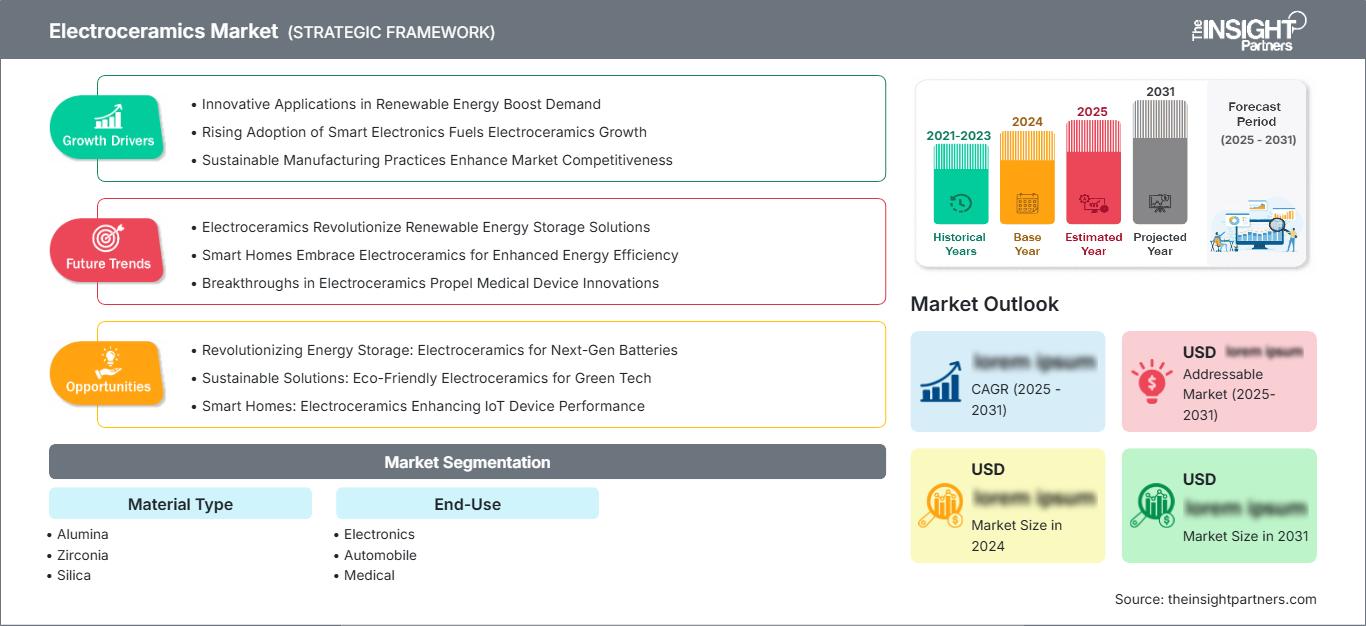
Electroceramics Market: Strategic Insights
Regional Insights
North America Electroceramics Market
North America accounted for 27–31% of global revenue in 2025 and is projected to advance at a 5.2–6.2% CAGR through 2034. The Electroceramics Market share position reflects strong demand from semiconductor packaging, aerospace electronics, medical imaging equipment, and vehicle electrification. U.S. fabrication incentives and defense modernization budgets are increasing demand for alumina substrates, piezoceramic actuators, and high-reliability insulation components.
Canada and Mexico add incremental demand through automotive assemblies, industrial electronics, and contract manufacturing. Regional buyers emphasize supplier qualification, long product lifecycles, and documented reliability. As production shifts closer to end users, ceramic component manufacturers with local technical support and validated quality systems are expected to capture higher-value contracts.
U.S. Electroceramics Market Market
The U.S. represented 79–83% of North American revenue in 2025 and is expected to expand at a 5.3–6.3% CAGR. Demand comes from defense electronics, ultrasound imaging, semiconductor tooling, and automotive sensors. Domestic suppliers and multinational manufacturers are strengthening application engineering capabilities for high-frequency, high-temperature, and miniaturized electroceramic parts.
Company presence is supported by L3Harris Technologies, Inc. in defense systems, Morgan Advanced Materials plc in technical ceramics, and Kyocera Corporation through electronic component channels. U.S. customers typically require long qualification cycles, which favors suppliers with proven consistency, cleanroom-compatible manufacturing, and traceable materials for regulated end uses.
Europe Electroceramics Market Market
Europe held 25–29% of global revenue in 2025 and is forecast to grow at a 5.0–6.0% CAGR. Germany is the leading country, supported by automotive electronics, industrial automation, and medical technology clusters. CeramTec GmbH and Physik Instrumente (PI) SE & Co. KG reinforce regional expertise in technical ceramics, piezoceramics, and precision motion applications.
The UK relies on aerospace, defense, and scientific instrumentation to meet its demand, whereas France enjoys the fruits of aerospace systems, medical instruments, and power electronics. The Italian and Spanish contributions include industrial machinery, automotive components, and infrastructure electronics. European laws on hazardous substances have increased the desire for lead-reduced and lead-free piezoceramic formulations without compromising performance.
APAC Electroceramics Market Market
Asia Pacific accounted for 36-40% of global revenues in 2025 and is expected to grow at a CAGR of 6.2-7.2%. China is the largest electronics manufacturing country, with electric vehicle expansion and industrial automation driving growth. Japan and South Korea remain important for their expertise in the production of capacitors, substrates, and semiconductor materials.
India is growing in electronics and automotive component manufacturing, while Australia is growing in demand for medical, military, and mining instrumentation. Policies that support semiconductor self-reliance, electric-vehicle localization, and advanced manufacturing are driving regional demand for alumina-, zirconia-, and silica-based electroceramic components.
Middle East & Africa Electroceramics Market Market
The Middle East and Africa are estimated to experience a 4.7-5.7% CAGR growth till 2034. In Saudi Arabia, demand is spurred by industrial diversification, energy, military, and smart city projects. In the UAE, adoption is enabled by the aerospace industry, the distribution of electronic products, and improvements within the healthcare sector.
South Africa participates through imports of mining equipment, industrial sensors, and medical equipment, whereas in the remaining MEA regions, a project-based strategy is pursued. Demand here is lower than in other regions and is growing due to demand for power supply systems and reliability.
Segmentation Analysis
Material Type
The Material Type segment is projected to register a 5.4-6.4% CAGR from 2026-2034. The scope of the Electroceramics Market is delineated by the performance of materials under electrical, thermal, and mechanical stress. Applications that require high dielectric and thermal stability use silica ceramics, while alumina ceramics are used in insulation and substrate applications.
- Alumina: Alumina leads demand due to high electrical insulation, thermal stability, mechanical strength, and established processing economics across substrates, insulators, sensor housings, and electronic packaging components.
- Zirconia: Zirconia serves applications needing fracture toughness, wear resistance, and dimensional stability, especially in precision medical, automotive, and aerospace components exposed to repeated mechanical stress.
- Silica: Silica-based electroceramics address dielectric, thermal, and optical stability needs in electronics, sensor assemblies, and specialized insulation systems where predictable behavior is strategically important.
End-Use
The End-Use segment is expected to post a CAGR growth of 5.8-6.8% till 2034. The electronics segment will continue to drive the company's revenues, while the automotive and medical segments provide high reliability. The aerospace and defense sectors are comparatively small yet technically challenging.
- Electronics: Electronics represents the largest use base for electroceramics, driven by capacitors, substrates, RF components, sensors, and insulation parts used in miniaturized and high-frequency devices.
- Automobile: Automobile demand is increasing as EVs, ADAS, battery management, exhaust sensing, and power electronics require durable ceramic components with stable electrical behavior under heat and vibration.
- Medical: Medical demand is expanding through ultrasound transducers, dental equipment, surgical instruments, and implantable systems where biocompatibility, precision, and energy conversion performance are valued.
- Aerospace and Defense: Aerospace and defense applications use electroceramics in radar, communications, avionics, propulsion sensing, and rugged electronics where reliability under temperature, vibration, and radiation exposure is mandatory.
Opportunity Snapshot
| Segment Name | Revenue Contribution | Trend Tag | Adoption Stage |
| Electronics | High | Power Modules | Mature |
| Automobile | Medium | EV Sensors | Scaling |
| Medical | Medium | Ultrasound Precision | Scaling |
| Aerospace and Defense | Low | Rugged Systems | Emerging |
Electroceramics Market Growth Drivers and Impact Analysis
Electronics Miniaturization and Power Density
The demand is growing for smaller components that can withstand higher voltage levels, narrow thermal margins, and fast switching frequency. Electroceramics fit the bill due to their stable dielectric properties, insulation level, and suitability for multilayer technology. The effect is most pronounced for capacitors, radio-frequency filters, ceramic substrates, and sensor assemblies in smartphones, servers, industrial controllers, and power converters. With the growing infrastructure of artificial intelligence and the Internet of Things, providers capable of producing uniform microstructures, low defect levels, and quality assurance at scale will have greater pricing power.
Vehicle Electrification and Sensor Proliferation
Electric vehicles and advanced driver assistance systems are increasing the demand for ceramic components that withstand heat, vibration, and electrical stress. Electroceramics are used in oxygen sensors, pressure sensors, actuators, capacitors, ignition components, and power electronics substrates. As the industry shifts towards high-voltage systems, reliability becomes a safety and warranty concern and no longer just a buying consideration. Suppliers capable of achieving automotive certifications and supplying from local plants will be best positioned to capitalize on the situation. Both zirconia and alumina will be attractive to the buyer due to their reliability in the harsh environment and suitability for electronic controls.
Medical Imaging and Precision Device Demand
Healthcare systems have increased the use of ultrasound scanning, minimally invasive surgery, and portable diagnostic tools. Piezoelectric electroceramics provide devices that convert electrical energy into mechanical output. There is significant market influence, as the medical sector tends to require higher margins, longer product lifespans, and stringent specifications compared to other industrial applications. The need is also fueled by increasing aging populations and infrastructural development in the healthcare sector in developing countries. Manufacturers who can make biocompatible, sensitive ceramic devices will gain an advantage from these innovations.
Electroceramics Market Future Trends
Lead-Free Piezoelectric Material Commercialization
Electroceramics Market trends indicate a growing shift toward lead-free piezoelectrics due to tightening regulations and sustainable consumer practices. There are ongoing developments in the use of potassium sodium niobate, barium titanate, and ferroelectric materials. However, equivalence to existing piezoelectrics depends on the application. In the forecast period, adoption will likely start in risk-reduced sensors, consumer electronics, and environmentally friendly medical devices, and then move toward critical operations. Those suppliers who can formulate and scale up the sintering and testing of such materials will have an advantage in their adoption.
Ceramic Substrates for Wide-Bandgap Power Electronics
Wide-bandgap semiconductors made from silicon carbide and gallium nitride are driving demand for ceramic substrates capable of withstanding high temperatures and providing electrical insulation. Ceramic materials, including alumina, aluminum nitride, and others, are becoming essential materials for EV inverters, renewable energy converters, electric vehicle charging stations, data centers, and even aerospace power systems. The future demands ceramic substrates with higher thermal conductivity and flatness, and that are reliably metalized. Such trends will demand suppliers to develop tighter process controls, bonding technology, and even collaborative efforts with module makers.
Electroceramics Market Opportunities
Localized Supply for Semiconductor and EV Ecosystems
Localizing the supply chain across different regions would offer an immediate opportunity for electroceramics suppliers in the semiconductor and EV sectors. Investment strategies based on Electroceramics Market Forecasts should focus on ceramic substrates, insulators, and sensors located near electronics manufacturing hubs and vehicle assembly lines. The increasing importance of fast delivery, dual sourcing, and traceability is evident from previous experiences. This opportunity can be leveraged through investment in regional finishing, metalizing, and engineering, without repeating the same processes at the powder level.
Medical and Industrial Ultrasonic Systems
High value lies in ultrasonic systems used for diagnostics, flow metering, cleaning, welding, and non-destructive testing, as they utilize piezoceramic components that offer consistent acoustic output, sensitivity, and durability. The potential for growth in the area is supported by portable medical imaging, smart metering, predictive maintenance, and quality assurance in the manufacturing industry. Assemblers can increase their competitiveness by providing transducer stack assemblies and customized geometries, along with application-specific testing, rather than supplying only ceramic discs and plates. The value of this opportunity lies in close cooperation among engineers, given the performance parameters involved.
Recent Developments
- March 2026: Lithoz is set to showcase three new materials at ceramitec 2026, enhancing its portfolio with upgraded LithaLox, a new variant of LithaCon zirconia, and Medical-Grade LithaCon ATZ. The Austrian company will also present 46 demonstrator components, including casting cores for single-crystal turbine blades, highlighting its innovations in Lithography-based Ceramic Manufacturing (LCM) technology.
- May 2025: Electro Ceramic Industries announces the expansion of its glass-to-metal product line through the acquisition of United Glass to Metal Sealing, Inc. This development enhances the company's leadership in precision-engineered sealing solutions and allows for greater manufacturing efficiencies and product innovation at its Hackensack, NJ facility. The expanded product portfolio now includes custom products for high-performance electronic packaging and coaxial feedthrough configurations, catering to ordnance and defense applications.
Frequently Asked Questions

- Comprehensive Market Sizing and Forecast Analysis
- Detailed Segmentation Analysis
- In-Depth Market Dynamics Assessment
- Regional and Country-Level Insights
- Competitive Landscape and Company Benchmarking
- Strategic Business Intelligence
Recent Reports
Testimonials

The Insight Partners' SCADA System Market report is comprehensive, with valuable insights on current trends and future forecasts. The team was highly professional, responsive, and supportive throughout. We are very satisfied and highly recommend their services.
RAN KEDEM Partner, Reali Technologies LTDs
I requested a report on a very specific software market and the team produced the report in a few days. The information was very relevant and well presented. I then requested some changes and additions to the report. The team was again very responsive and I got the final report in less than a week.
JEAN-HERVE JENN Chairman, Future Analytica
We worked with The Insight Partners for an important market study and forecast. They gave us clear insights into opportunities and risks, which helped shape our plans. Their research was easy to use and based on solid data. It helped us make smart, confident decisions. We highly recommend them.
PIYUSH NAGPAL Sr. Vice President, High Beam Global
The Insight Partners delivered insightful, well-structured market research with strong domain expertise. Their team was professional and responsive throughout. The user-friendly website made accessing industry reports seamless. We highly recommend them for reliable, high-quality research services
YUKIHIKO ADACHI CEO, Deep Blue, LLC.
This is the first time I have purchased a market report from The Insight Partners.While I was unsure at first, I visited their web site and felt more comfortable to take the risk and purchase a market report.I am completely satisfied with the quality of the report and customer service. I had several questions and comments with the initial report, but after a couple of dialogs over email with their analyst I believe I have a report that I can use as input to our strategic planning process.Thank you so much for taking the extra time and making this a positive experience.I will definitely recommend your service to others and you will be my first call when we need further market data.
JOHN SUZUKI President and Chief Executive Officer, Board Director, BK Technologies
I wish to appreciate your support and the professionalism you displayed in the course of attending to my request for information regarding to infectious disease IVD market in Nigeria. I appreciate your patience, your guidance, and the fact that you were willing to offer a discount, which eventually made it possible for us to close a deal. I look forward to engaging The Insight Partners in the future, all thanks to the impression you have created in me as a result of this first encounter.
DR CHIJIOKE ONYIA MANAGING DIRECTOR, PineCrest Healthcare Ltd.Reason to Buy
- Informed Decision-Making
- Understanding Market Dynamics
- Competitive Analysis
- Identifying Emerging Markets
- Customer Insights
- Market Forecasts
- Risk Mitigation
- Boosting Operational Efficiency
- Strategic Planning
- Investment Justification
- Tracking Industry Innovations
- Aligning with Regulatory Trends





 Get Free Sample for