
Electronic Chemicals and Materials Market Growth, Trends & Demand by 2034
Coverage: By Type (Silicon Wafers, Photoresists, Thin-Film Deposition Materials, Cleaning and Surface Chemicals, Soldering Materials, Specialty Gases, and Others) By Application [Semiconductor Manufacturing, Printed Circuit Board (PCB) Assembly, Photovoltaics (Solar Cells), Energy Storage, and Others]
- Status : Data Released
- Report Code : TIPRE00003565
- Category : Chemicals and Materials
- No. of Pages : 150
- Available Report Formats :


- Last update date : August 10, 2026


2025 Market Size
US$ 75.54 Bn
Base year value
2034 Forecast
US$ 126.46 Bn
Projected by 2034
CAGR 2026-2034
5.89 %
Growth rate
Addressable Market
US$ 915.01 Bn
(2026-2034)
The global Electronic Chemicals and Materials market was valued at US$ 75.54 billion in 2025 and is expected to reach US$ 126.46 billion by 2034; it is estimated to record a CAGR of 5.89% during 2026-2034.
Electronic Chemicals and Materials Market Assessment and Insights
- North America accounted for an estimated share of 27%–31% in 2025 and is expected to grow at a CAGR range of 5.8%–6.8% during 2026–2034. The region benefits from semiconductor investments, advanced manufacturing capabilities, and strong demand for high-purity materials.
- The US represented approximately 75%–80% of North America’s market share in 2025 and is projected to expand at a CAGR range of 5.9%–6.9% from 2026–2034. Growth is supported by semiconductor fabrication expansion and domestic supply chain initiatives.
- Europe held an estimated share of 20%–24% in 2025 and is forecast to grow at a CAGR range of 5.3%–6.3% during 2026–2034. Germany, France, the UK, and the Netherlands contribute through semiconductor manufacturing and industrial electronics applications.
- Asia Pacific dominated with an estimated share of 38%–43% in 2025 and is anticipated to grow at a CAGR range of 7.0%–8.0% through 2034. China, Japan, South Korea, and Taiwan drive demand through semiconductor production and electronics manufacturing ecosystems.
- Largest Segment: Semiconductor Manufacturing accounted for an estimated Electronic Chemicals and Materials Market share of 45%–50% in 2025 and is expected to grow at a CAGR range of 6.5%–7.5% during 2026–2034.
- High Growth Segment: Energy Storage accounted for approximately 10%–15% share in 2025 and is projected to grow at a CAGR range of 8.0%–9.0% due to battery technology expansion.
- Key companies analyzed in detail: Air Products and Chemicals, Inc., Albemarle Corporation, Ashland Inc., BASF SE, Bayer AG, Honeywell International Inc., Huntsman International LLC, KMG Chemicals, Inc., Merck KGaA, Dow Inc.
Source: The Insight Partners' analysis based on proprietary research, government publications, company annual reports, investor presentations, industry databases, and expert interviews.
The Electronic Chemicals and Materials Market has evolved through advancements in semiconductor manufacturing precision, chemical purity requirements, and material engineering capabilities. Increasing wafer complexity and shrinking semiconductor nodes have encouraged the development of ultra-high purity chemicals, advanced photoresists, deposition materials, and specialty gases. Manufacturers are investing in localized production facilities to improve supply reliability and reduce dependency on international supply chains. The transition toward advanced semiconductor architectures, renewable energy technologies, and next-generation electronic devices is increasing demand for materials with improved performance characteristics, contamination control, and process compatibility across multiple manufacturing environments.
Future expansion of the market is expected to be influenced by semiconductor ecosystem development, regional manufacturing strategies, and increasing investment in clean energy technologies. Emerging economies are strengthening electronics production capabilities through industrial policies and technology investments. The adoption of electric mobility, renewable power systems, and advanced computing infrastructure will create additional demand for specialized chemical solutions. Companies are focusing on improving production efficiency, developing sustainable formulations, and expanding technical support capabilities to address evolving requirements from semiconductor and electronics manufacturers.
Electronic Chemicals and Materials Market Report Scope
| Report Attribute | Details |
|---|---|
| Market size in 2025 | US$ 75.54 Billion |
| Market Size by 2034 | US$ 126.46 Billion |
| Global CAGR (2026 - 2034) | 5.89% |
| Historical Data | 2021-2024 |
| Forecast period | 2026-2034 |
Electronic Chemicals and Materials Market Analysis
Electronic Chemicals and Materials Market growth is supported by rising semiconductor production, increasing electronic component complexity, and expansion of renewable energy applications. The ecosystem includes chemical manufacturers, semiconductor producers, electronics assemblers, photovoltaic manufacturers, and energy storage companies. High-purity chemicals and specialty materials play an important role in wafer processing, circuit fabrication, component assembly, and battery manufacturing.
Supply dynamics are influenced by semiconductor investment cycles, raw material availability, and regional manufacturing concentration. Asia Pacific remains a major production hub due to its established semiconductor and electronics manufacturing infrastructure, while North America and Europe continue to strengthen domestic supply capabilities.
Electronic Chemicals and Materials Market analysis indicates that competition is shaped by technological expertise, material purity standards, and long-term relationships with semiconductor manufacturers. Companies such as Merck KGaA, BASF SE, Dow Inc., and Air Products and Chemicals, Inc. focus on developing advanced materials for semiconductor processing and electronic manufacturing applications.
Honeywell International Inc. and KMG Chemicals, Inc. maintain strong positions in specialty chemical and semiconductor material solutions. Albemarle Corporation, Ashland Inc., Bayer AG, and Huntsman International LLC contribute through chemical innovation and application-specific technologies. Strategic investments are increasingly directed toward expanding production capacity, improving supply chain resilience, and supporting next-generation electronics manufacturing requirements.
● REPORT CUSTOMIZATION
Tailor This Report To Align With Your Specific Business Requirements
This report can be customized to align precisely with your business objectives, scope, and target markets. Customization options include tailored segmentation, geography, competitive analysis, and strategic insights to support informed decision-making.
Customize This Report →WHAT YOU CAN ADJUST
- ● Segmentations
- ● Geography
- ● Competitive Analysis
- ● Language Preferences
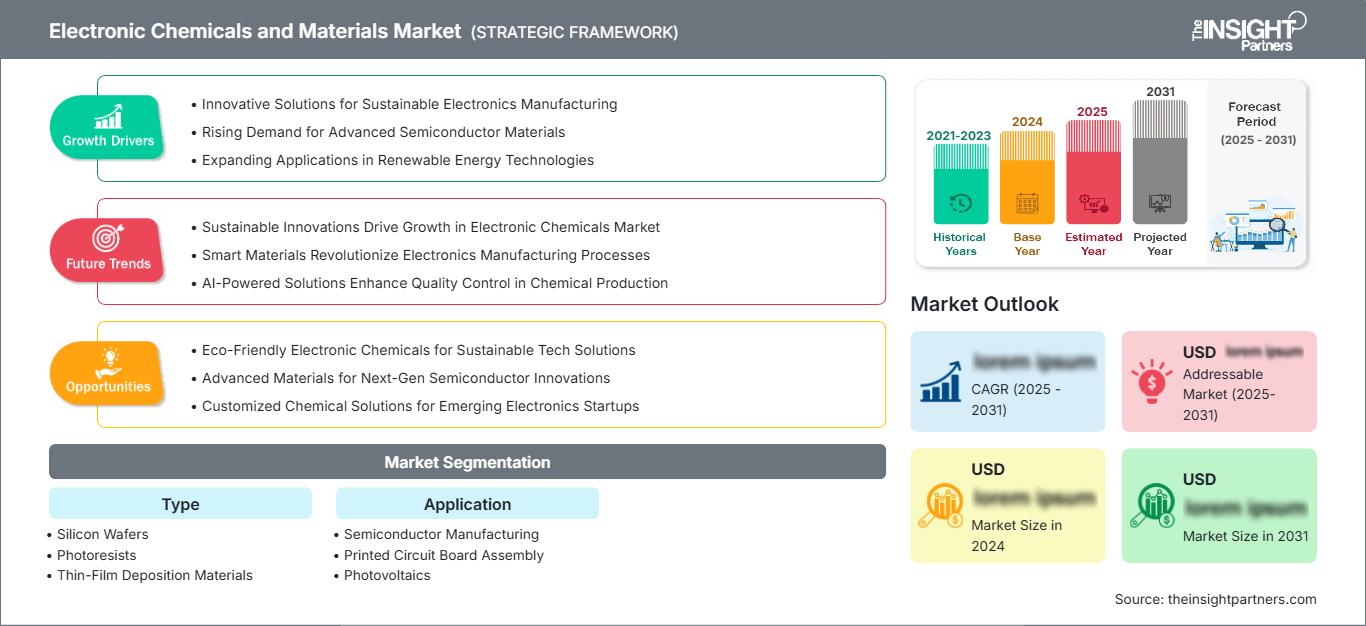
Electronic Chemicals and Materials Market: Strategic Insights
Regional Insights
North America Electronic Chemicals and Materials Market
North America Electronic Chemicals and Materials Market accounted for an estimated share of 27%–31% in 2025 and is projected to grow at a CAGR range of 5.8%–6.8% during 2026–2034. The region benefits from semiconductor manufacturing expansion, government-supported technology investments, and increasing demand for advanced electronic materials. The US represents the largest contributor due to its semiconductor research ecosystem, fabrication investments, and high demand for specialty chemicals.
The regional supply chain includes chemical producers, semiconductor manufacturers, and advanced electronics companies. Increasing focus on domestic semiconductor production is encouraging investments in high-purity chemical manufacturing and specialty material facilities. Canada contributes through technology development and industrial applications, while Mexico supports electronics manufacturing activities. The adoption of advanced packaging, artificial intelligence hardware, and renewable energy technologies is expected to strengthen regional demand for electronic materials throughout the forecast period.
U.S. Electronic Chemicals and Materials Market
The U.S. market represented approximately 75%–80% of North America’s market share in 2025 and is expected to expand at a CAGR range of 5.9%–6.9% during 2026–2034. The country maintains a strong position due to semiconductor manufacturing initiatives, research capabilities, and demand from advanced electronic applications. Increasing investment in fabrication facilities is supporting consumption of specialty gases, photoresists, and deposition materials.
Companies including Air Products and Chemicals, Inc., Honeywell International Inc., Merck KGaA, and Dow Inc. maintain significant market presence through advanced chemical solutions. Semiconductor manufacturing remains a major application area, while printed circuit board assembly and energy storage applications continue expanding. The growth of electric vehicles, artificial intelligence infrastructure, and advanced computing systems is increasing demand for high-performance electronic materials. Domestic supply chain development is expected to further strengthen the position of chemical suppliers operating in the US market.
Europe Electronic Chemicals and Materials Market
Europe market held an estimated share of 20%–24% in 2025 and is forecast to grow at a CAGR range of 5.3%–6.3% during 2026–2034. Germany represents the leading country due to its semiconductor initiatives, automotive electronics production, and industrial manufacturing expertise. The region is strengthening its electronic materials ecosystem through investments in advanced manufacturing and supply chain development.
The UK supports semiconductor technology, aerospace electronics, and technology development initiatives. Germany keeps up with the growing demand for automotive chips, industrial automation, and precision manufacturing. France, Italy, and Spain are growing their adoption of renewable energy technologies, electronics production, and industrial sectors. European chemical manufacturers are focusing on sustainability and process efficiency to meet environmental standards. The increasing demand for electric mobility, smart infrastructure, and electronics should support further growth of the regional market.
APAC Electronic Chemicals and Materials Market
APAC market represented the largest regional share of 38%–43% in 2025 and is projected to grow at a CAGR range of 7.0%–8.0% during 2026–2034. China leads regional demand due to its extensive semiconductor manufacturing base and electronics production ecosystem.
Japan, South Korea, Taiwan, and India contribute through semiconductor fabrication, display manufacturing, and electronic component production. Government support for domestic semiconductor development and technology investments is strengthening regional supply chains. Increasing photovoltaic production, battery manufacturing, and consumer electronics output are creating additional demand for specialty chemicals and materials.
Middle East & Africa Electronic Chemicals and Materials Market
Middle East & Africa Market is expected to expand at a CAGR range of 4.5%–5.5% during 2026–2034. The UAE and Saudi Arabia are emerging markets due to investments in industrial diversification, renewable energy projects, and technology infrastructure development.
South Africa contributes through industrial electronics and energy applications, while other Middle Eastern and African economies are gradually adopting advanced electronic systems. Growing digitalization, infrastructure modernization, and energy transition initiatives are supporting demand for electronic materials. The region remains relatively smaller but presents opportunities through expanding technology investments and industrial development programs.
Segmentation Analysis
Type
The Type segment of the market is projected to grow at a CAGR range of 6.0%–7.0% during 2026–2034. The Electronic Chemicals and Materials Market scope within this segment continues expanding due to rising semiconductor complexity, increasing purity requirements, and growing adoption of advanced manufacturing processes. Materials used in fabrication, cleaning, deposition, and assembly directly influence electronic device performance and reliability.
- Silicon Wafers represent a critical material category supporting semiconductor production. Demand is influenced by increasing chip manufacturing capacity, advanced node development, and growing requirements for high-performance computing applications.
- Photoresists enable precise semiconductor patterning and are essential for advanced lithography processes. Their importance is increasing with smaller semiconductor geometries and the transition toward more sophisticated chip architectures.
- Thin-Film Deposition Materials support semiconductor layers, photovoltaic components, and electronic device fabrication. Growth is driven by increasing adoption of advanced deposition technologies and demand for improved device efficiency.
- Cleaning and Surface Chemicals are essential for maintaining wafer quality and manufacturing precision. Rising semiconductor production volumes are increasing demand for contamination control and advanced cleaning solutions.
- Soldering Materials support electronic assembly processes by enabling reliable component connections. Their adoption is increasing across printed circuit board manufacturing and electronic component integration.
- Specialty Gases are used in semiconductor fabrication processes including etching and deposition. Demand is supported by semiconductor expansion and increasing requirements for high-purity manufacturing inputs.
Application
The Application segment of the Market is expected to register a CAGR range of 6.5%–7.5% during 2026–2034. Growing electronics production, semiconductor investments, and renewable energy adoption are increasing material consumption across multiple industries. Manufacturers are developing application-specific chemicals to meet performance, reliability, and efficiency requirements.
- Semiconductor Manufacturing is the largest application area due to increasing chip production, advanced packaging requirements, and expansion of fabrication facilities globally. It requires high-purity materials for multiple manufacturing stages.
- Printed Circuit Board Assembly demand is supported by increasing electronic device production and component integration. Materials enable reliable connections and efficient manufacturing processes across consumer, industrial, and automotive electronics.
- Photovoltaics applications are expanding due to renewable energy deployment and solar technology improvements. Electronic materials support cell manufacturing processes, efficiency enhancement, and long-term performance requirements.
- Energy Storage applications are gaining importance due to battery technology development and electric mobility adoption. Advanced materials support battery manufacturing, performance improvement, and reliability enhancement.
Opportunity Snapshot
| Segment Name | Revenue Contribution | Trend Tag | Adoption Stage |
| Semiconductor Manufacturing | High | Chip Scaling | Mature |
| Printed Circuit Board Assembly | Medium | Smart Devices | Mature |
| Photovoltaics | Medium | Solar Expansion | Scaling |
| Energy Storage | Medium | Battery Innovation | Scaling |
Electronic Chemicals and Materials Market Growth Drivers and Impact Analysis
Expansion of Semiconductor Manufacturing Capacity
The rising number of semiconductor fab investments is generating consistent demand for high-purity chemicals, specialty gases, and processing materials. The rise in AI, HPC, and automotive electronics is motivating chipmakers to expand their production capacity and adopt advanced nodes. This trend is directly impacting the material needs of wafer fab and packaging operations. The governments of North America, Europe, and the Asia-Pacific region are promoting the development of the semiconductor ecosystem through industrial policies and financial incentives. The increasing complexity of manufacturing is prompting suppliers to focus on ultra-high-purity materials, process compatibility, and robust supply chains. This shift is strengthening collaboration between chemical producers and semiconductor manufacturers while creating opportunities for innovation in advanced materials.
Increasing Adoption of Renewable Energy Technologies
The growing deployment of photovoltaic systems and energy storage technologies is supporting demand for specialized electronic materials used in clean energy applications. The fabrication of solar cells requires sophisticated chemicals and materials, which enhance production efficiency, durability, and effectiveness. Likewise, battery manufacturing involves sophisticated materials for electrode formation, cell construction, and performance enhancement. The world's shift to renewable energy sources is prompting investments in solar and battery manufacturing infrastructure. These developments are expanding the application base beyond traditional semiconductor markets. Material suppliers are developing solutions that address efficiency improvements, manufacturing scalability, and environmental requirements. The increasing integration of renewable energy into power systems is expected to create additional demand for electronic material solutions.
Rising Complexity of Electronic Devices
The continuous advancement of electronic devices is increasing demand for specialized chemicals and materials capable of supporting smaller components, higher processing power, and improved reliability. The manufacture of smartphones, wearable technology, automotive electronics, and industrial devices requires advanced manufacturing processes that rely on reliable material performance. The increasing density of semiconductors and the shrinking size of components are increasing demand for advanced photoresists, deposition materials, cleaner processes, and assembly methods. Material compatibility in future products is what companies aim for through research and development. The increasing use of electronics across all industries will drive growth in materials technologies.
Electronic Chemicals and Materials Market Future Trends
Development of Ultra-High Purity Materials
Electronic chemicals and materials Market trends are increasingly shaped by the need for ultra-high purity solutions that support advanced semiconductor manufacturing. As the chip makers move to smaller processes, purity and uniformity of materials have become important considerations. Expected improvements are said to be the development of purification systems, improved chemical formulas, and manufacturing control processes. The semiconductor industry needs to have materials with exact specifications. As a result of this need, suppliers are focusing on investing in manufacturing equipment and quality control systems. Improvements in advanced computing and artificial intelligence hardware will drive progress in materials purity technology.
Integration of Sustainable Chemical Manufacturing Practices
The industry is moving toward sustainable production approaches as manufacturers address environmental regulations and resource efficiency objectives. Future electronic chemicals and materials trends will include reduced waste generation, improved recycling processes, and lower-impact manufacturing methods. Chemical suppliers are focusing on producing eco-friendly formulations without compromising the technical specifications required by semiconductor and electronics manufacturers. Sustainability programs are now a key criterion for selecting suppliers, as electronics companies are focusing on their carbon footprints. The adoption of cleaner production technologies and efficient resource management practices is expected to influence future investments. These developments will encourage companies to balance advanced material performance with environmental responsibility across global manufacturing operations.
Electronic Chemicals and Materials Market Opportunities
Localization of Semiconductor Supply Chains
Electronic Chemicals and Materials Market Forecasts indicate increasing opportunities from regional semiconductor supply chain development. The nations have embarked on investments to develop local fabrication capacity. Such efforts are creating a market for chemical firms to establish regional production centers and provide technical assistance. Firms with the ability to establish localized manufacturing capabilities can build closer relationships with semiconductor manufacturers and mitigate potential supply chain challenges. New semiconductor centers in developing economies such as India and Southeast Asia are opening doors for material providers. Strategic partnerships with chip manufacturers, research institutions, and electronics companies will become increasingly important as countries expand their semiconductor capabilities.
Advanced Materials for Electric Mobility Applications
The growth of electric vehicles has created new opportunities for suppliers of materials and components that manufacture electronics, batteries, and power management systems for vehicles. An increase in the use of electronics in vehicles necessitates reliable materials that can withstand thermal and mechanical stresses and harsh operating conditions. Suppliers of electronic materials can gain from offering materials specifically developed for the automobile industry. Another opportunity arising from the growth of battery production is the chemical industry's need to develop chemicals for energy storage technologies.
Recent Developments
- October 2025: BASF is constructing an Electronic Grade Ammonium Hydroxide (NH4OH EG) plant in Ludwigshafen, Germany, to support semiconductor manufacturing processes such as wafer cleaning and etching. This ultra-pure chemical will enhance the local supply chain for advanced chip production in Europe, aligning with BASF's commitment to supply chain resilience in the semiconductor sector. Operations are anticipated to begin in 2027.
- March 2025: Renesas Electronics Corporation has launched all-in-one solutions for lithium-ion battery pack management, suitable for consumer products like e-bikes and drones. The R-BMS F offers pre-validated firmware to facilitate quick and safe designs of battery management systems, significantly lowering the learning curve for developers.
Frequently Asked Questions

- Comprehensive Market Sizing and Forecast Analysis
- Detailed Segmentation Analysis
- In-Depth Market Dynamics Assessment
- Regional and Country-Level Insights
- Competitive Landscape and Company Benchmarking
- Strategic Business Intelligence
Recent Reports
Testimonials

The Insight Partners' SCADA System Market report is comprehensive, with valuable insights on current trends and future forecasts. The team was highly professional, responsive, and supportive throughout. We are very satisfied and highly recommend their services.
RAN KEDEM Partner, Reali Technologies LTDs
I requested a report on a very specific software market and the team produced the report in a few days. The information was very relevant and well presented. I then requested some changes and additions to the report. The team was again very responsive and I got the final report in less than a week.
JEAN-HERVE JENN Chairman, Future Analytica
We worked with The Insight Partners for an important market study and forecast. They gave us clear insights into opportunities and risks, which helped shape our plans. Their research was easy to use and based on solid data. It helped us make smart, confident decisions. We highly recommend them.
PIYUSH NAGPAL Sr. Vice President, High Beam Global
The Insight Partners delivered insightful, well-structured market research with strong domain expertise. Their team was professional and responsive throughout. The user-friendly website made accessing industry reports seamless. We highly recommend them for reliable, high-quality research services
YUKIHIKO ADACHI CEO, Deep Blue, LLC.
This is the first time I have purchased a market report from The Insight Partners.While I was unsure at first, I visited their web site and felt more comfortable to take the risk and purchase a market report.I am completely satisfied with the quality of the report and customer service. I had several questions and comments with the initial report, but after a couple of dialogs over email with their analyst I believe I have a report that I can use as input to our strategic planning process.Thank you so much for taking the extra time and making this a positive experience.I will definitely recommend your service to others and you will be my first call when we need further market data.
JOHN SUZUKI President and Chief Executive Officer, Board Director, BK Technologies
I wish to appreciate your support and the professionalism you displayed in the course of attending to my request for information regarding to infectious disease IVD market in Nigeria. I appreciate your patience, your guidance, and the fact that you were willing to offer a discount, which eventually made it possible for us to close a deal. I look forward to engaging The Insight Partners in the future, all thanks to the impression you have created in me as a result of this first encounter.
DR CHIJIOKE ONYIA MANAGING DIRECTOR, PineCrest Healthcare Ltd.Reason to Buy
- Informed Decision-Making
- Understanding Market Dynamics
- Competitive Analysis
- Identifying Emerging Markets
- Customer Insights
- Market Forecasts
- Risk Mitigation
- Boosting Operational Efficiency
- Strategic Planning
- Investment Justification
- Tracking Industry Innovations
- Aligning with Regulatory Trends





 Get Free Sample for