
Epoxy Composite Market Size, Growth & Trends by 2034
Coverage: by Fiber Type (Glass, Carbon, Others); Manufacturing Process (Lay-up, Compression Molding, Resin Injection, Resin Transfer Molding, Filament Winding, Pultrusion); End-Use Industry (Wind Energy, Aerospace and Defense, Automotive and Transportation, Sporting Goods, Electrical and Electronics, Pipe and Tank, Marine, Others) , and Geography (North America, Europe, Asia Pacific, and South and Central America)
- Status : Data Released
- Report Code : TIPRE00010011
- Category : Chemicals and Materials
- No. of Pages : 150
- Available Report Formats :


- Last update date : September 01, 2026


2025 Market Size
US$ 35.47 Bn
Base year value
2034 Forecast
US$ 63.73 Bn
Projected by 2034
CAGR 2026-2034
6.73 %
Growth rate
Addressable Market
US$ 448.39 Bn
(2026-2034)
The Epoxy Composite Market was valued at US$ 35.47 Billion in 2025 and is projected to reach US$ 63.73 Billion by 2034, registering a CAGR of 6.73% during 2026–2034. Expansion will be driven by rising usage of lightweight structural materials, renewable energy deployment, aircraft manufacturing, and lightweighting transportation. The market is also getting a boost from developments in resin technology, reinforcement design, automation, and manufacturing of high-performance composites for structurally rigorous applications.
The growth potential for North America will stay high owing to the rising need for lightweight reinforcements for aerospace manufacturing, defense spending, wind energy, electric vehicles, and infrastructure upgrades. The Epoxy Composite Market Size in the region will be driven by strong capabilities for composite manufacturing, extensive qualification process, and availability of materials companies that serve aerospace, automotive, industrial, and energy sectors.
Epoxy Composite Market Assessment and Insights
- North America: North America accounted for a 31–35% share in 2025 and is projected to grow at a CAGR of 5.8–6.5% during 2026–2034, supported by aerospace production, defense programs, renewable energy infrastructure, and advanced manufacturing investment.
- US: The US represented 25–29% of the global market in 2025 and is expected to expand at a CAGR of 5.9–6.6% through 2034, supported by aerospace, defense, and automotive composite applications.
- Europe: Europe held a 25–29% share in 2025 and is expected to register a CAGR of 6.0–6.7% through 2034, with Germany, France, Italy, Spain, and the UK supporting aerospace, automotive, wind, and industrial applications.
- Asia Pacific: Asia Pacific represented 27–31% of the market in 2025 and is anticipated to grow at a CAGR of 7.4–8.2%, led by China, Japan, South Korea, and India through expanding aerospace, automotive, electronics, and renewable energy manufacturing.
- Largest Segment: Glass fiber held a 61–65% market share in 2025 and is projected to grow at a CAGR of 6.1–6.8%, reflecting cost efficiency, scalability, and broad industrial adoption.
- High Growth Segment: Carbon fiber is projected to hold a 35–39% share in 2025 and expand at a CAGR of 7.4–8.2%, driven by lightweighting requirements in aerospace, mobility, and high-performance applications.
- Key companies analyzed in detail: Axiom Materials, Inc.; Solvay SA; Gurit Holding AG; Hexcel Corporation; Mitsubishi Chemical Group Corporation; Park Aerospace Corp.; Koninklijke Ten Cate BV; SGL Carbon SE; Teijin Limited; Toray Industries, Inc.
Source: The Insight Partners' analysis based on proprietary research, government publications, company annual reports, investor presentations, industry databases, and expert interviews.
Epoxy Composite Market has advanced from standard hand layup to engineered solutions featuring optimized fiber architecture, toughened epoxy technology, automation of placement, infusion, compression molding, and computer-controlled curing. Companies are moving towards finding the right combination of performance and process parameters such as cycle time, material efficiency, repeatability and qualifying the product. This implies that manufacturing is moving towards the processes capable of delivering aerospace volume levels and at the same time affordable for wind, transport, maritime, and industrial applications.
Capacity expansion is foreseen in Asia-Pacific countries and select sites in Europe and North America in the forecast period, while more emphasis is seen in automation and energy efficient curing technologies. Regulation of transportation efficiency and development of renewable energy should drive the demand for light-weight structures. Recyclability, resin recycling, energy-efficient processes, and tracking materials will become more important criteria in sourcing.
Epoxy Composite Market Report Scope
| Report Attribute | Details |
|---|---|
| Market size in 2025 | US$ 35.47 Billion |
| Market Size by 2034 | US$ 63.73 Billion |
| Global CAGR (2026 - 2034) | 6.73% |
| Historical Data | 2021-2024 |
| Forecast period | 2026-2034 |
Epoxy Composite Market Analysis
The Epoxy Composite Market growth arises from the need to have light weight constructions which do not compromise on stiffness, fatigue resistance, corrosion resistance or flexibility. The value chain consists of the suppliers of epoxy resins, suppliers of fibers, suppliers of reinforcements, suppliers of prepregs, molders, parts manufacturers, system integrators, and OEMs. There is heavy qualification in the aerospace industry, butthe wind energy, automotive, marine, and industrial segments focus on economic production and efficiency.
Supply conditions are influenced by the availability of carbon fibers, glass fiber capacity, cost of epoxy resin feedstocks, availability of cure agents, and the availability of specialized prepregs. Leading suppliers have increased their integration in terms of reinforcement materials, resin formulation, intermediate material handling, and process know-how in order to increase consistency. Regional supply chains are also gaining importance as customers desire reduced lead times and dual sourcing opportunities.
Proprietary resin technology, qualified material data libraries, application engineering skills, and lab to production-scale up formulations are becoming important in competitive positioning. The leading companies highlighted in the Epoxy Composite Market Report include Hexcel Corporation, Solvay SA, Teijin Limited, and Toray Industries, Inc. They have a dominant position in the market for high-performance reinforcement and composite systems while Gurit Holding AG deals with formulated epoxy resins and composite manufacturing solutions.
Investment strategies are shifting towards fast curing formulations, automation, complex geometry, and low temperature manufacturing processes. Some of the companies that play a role in niche advanced material applications include Axiom Materials, Inc. and Park Aerospace Corp. Others that add value to the overall supplier landscape include Mitsubishi Chemical Group Corporation, SGL Carbon SE, and Koninklijke Ten Cate BV.
● REPORT CUSTOMIZATION
Tailor This Report To Align With Your Specific Business Requirements
This report can be customized to align precisely with your business objectives, scope, and target markets. Customization options include tailored segmentation, geography, competitive analysis, and strategic insights to support informed decision-making.
Customize This Report →WHAT YOU CAN ADJUST
- ● Segmentations
- ● Geography
- ● Competitive Analysis
- ● Language Preferences
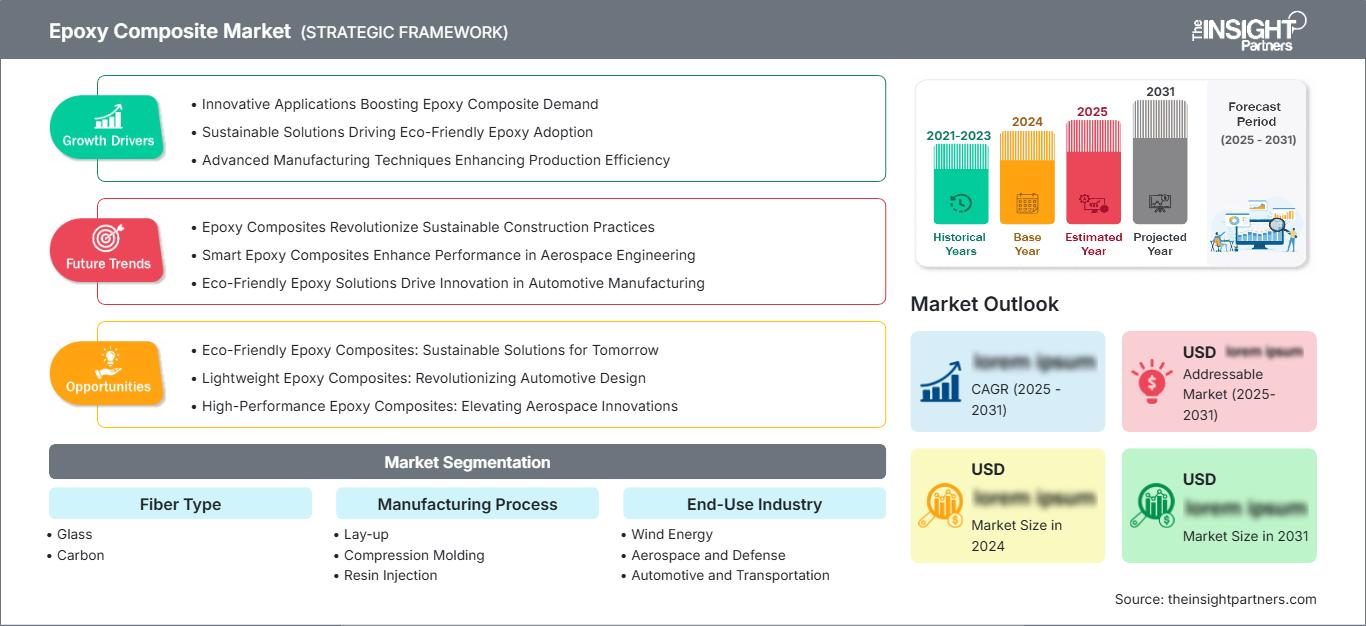
Epoxy Composite Market: Strategic Insights
Regional Insights
North America Epoxy Composite Market
North America was responsible for 31-35% of the total Epoxy Composite Market share in 2025, expected to witness a CAGR of 5.8-6.5% from 2025-2034. The US continues to be the key driver, backed by commercial aerospace production, defense, electric mobility, wind energy, and industrial construction. Canada adds its strength through wind energy components, transport uses, and advanced composite manufacturing.
The regional manufacturers have the advantage of well-developed qualification processes, existing aerospace industry chains, and ample research facilities. The growing demand includes carbon fiber epoxy systems used in high-performance structures; whereas glass fiber systems are significant in wind, marine, infrastructure, and industrial components. Automation in lay-up, resin infusion, compression molding, and rapid curing processes could enhance the efficiency of manufacturing processes.
U.S. Epoxy Composite Market
The United States accounted for 82-86% of demand in North America in 2025 and will experience a CAGR of 5.9-6.6%. Aerospace and defense are the main end-use industries, but automotive lightweighting, wind structures, sports goods, and electrical appliances contribute to demand. The country is home to significant manufacturers such as Axiom Materials, Inc., Hexcel Corporation, and Park Aerospace Corp.
There is a growing association between the use of advanced composites and aircraft manufacturing rates, defense upgrades, and automation. Carbon fiber/epoxy systems have become popular due to high stiffness-to-weight ratios, whereas glass fiber/epoxy is used in applications requiring lower costs. Increased use of out-of-autoclave manufacturing techniques and resin transfer molding is becoming more common.
Europe Epoxy Composite Market
Europe constituted 25–29% of the total market share in 2025 and is expected to expand at a CAGR of 6.0–6.7%. Germany has emerged as the largest consumer within the region due to its automotive engineering, aerospace, industrial machinery, and renewable energy industries. Similarly, UK and France have a significant aerospace and advanced composite industry, while Italy and Spain are contributing through their automotive, wind, marine, and industrial fabrication industries.
UK has advantages in terms of development of aerospace materials and advanced composite engineering, whereas Germany has a combination of its automotive engineering along with industrial automation and wind-energy equipment. On the other hand, France continues to be strong in its aerospace industry, Italy has a diversified automotive and industrial fabrication industry, and Spain is benefiting from wind-energy manufacturing.
APAC Epoxy Composite Market
In 2025, APAC accounted for 27–31% of the global market share and was forecast to grow at a CAGR of 7.4–8.2%, thus being the fastest growing major region. In the region, demand is led by China, followed by Japan, South Korea, India, and Australia. Demand is driven by aerospace localization, automotive production, wind installations, electronics manufacturing, and infrastructure development.
In China, there is an integration of both large-scale manufacturing and renewable energy projects. In Japan and South Korea, there is high development of aerospace, automotive, electronics, and industrial industries. India is currently working on developing its aerospace and renewable energy manufacturing sectors, while Australia drives its demand by wind, infrastructure, and special industrial applications.
Middle East & Africa Epoxy Composite Market
Middle East and Africa demand is supported by infrastructure development, energy projects, marine applications, and industrial modernization. Saudi Arabia leads the region, followed by the UAE and South Africa, while the Rest of MEA contributes through infrastructure and industrial projects. The region is projected to expand at a CAGR of 5.4–6.2%.
Investments have been made by Saudi Arabia and UAE towards energy diversification, transport infrastructure, and advanced industrial production. South Africa is a source of demand for composite application in renewable energy, transport, mining, and industries. The use of composites in these applications becomes significant when there is need for resistance to corrosion, lightweight, and longevity.
Segmentation Analysis
Fiber Type
Fiber type segment in the Epoxy Composite Market determines structural performance, material economics, processing requirements, and end-use suitability. Glass fiber remains dominant because of its relatively favorable cost-to-performance ratio and broad availability, while carbon fiber commands higher-value applications requiring superior stiffness and weight reduction. The segment is projected to grow at a CAGR of 6.3–7.0% during 2026–2034 as composite manufacturers optimize reinforcement selection for application-specific performance.
- Glass: Glass fiber remains the broader-volume reinforcement because of its cost efficiency, corrosion resistance, and suitability for wind blades, marine structures, pipes, tanks, transportation components, and industrial products requiring scalable composite production.
- Carbon: Carbon fiber occupies high-performance applications where weight reduction, stiffness, fatigue resistance, and dimensional stability justify higher material costs, particularly across aerospace, defense, premium mobility, sporting goods, and pressure-containing structures.
Manufacturing Process
Manufacturing process segment in the Epoxy Composite Market selection influences labor intensity, production volume, dimensional control, surface quality, scrap rates, and component complexity. The segment is projected to grow at a CAGR of 6.4–7.1% during 2026–2034. Automation and process repeatability are increasingly important as composite producers transition from low-volume fabrication toward standardized production for transportation, aerospace, energy, and industrial applications.
- Lay-up: Lay-up remains important for complex components and lower-volume production because it provides design flexibility and accommodates varied reinforcement orientations, although automation is increasingly introduced to improve repeatability and reduce labor requirements.
- Compression Molding: Compression molding supports repeatable, high-throughput production of structural components, particularly where controlled dimensions and shorter cycle times are essential for automotive, electrical, and transportation applications.
- Resin Injection: Resin injection enables controlled resin distribution and efficient production of reinforced structures, supporting applications where consistent impregnation, dimensional stability, and reduced manual processing are strategic priorities.
- Resin Transfer Molding: Resin transfer molding is increasingly relevant for complex components requiring repeatable fiber placement, controlled resin flow, and scalable production, particularly across transportation, industrial, electrical, and aerospace applications.
- Filament Winding: Filament winding is strategically important for cylindrical and pressure-bearing structures because continuous reinforcement placement provides favorable mechanical performance for tanks, pipes, pressure vessels, and selected mobility applications.
- Pultrusion: Pultrusion provides continuous production of profiles with consistent cross-sectional geometry, making it valuable for infrastructure, electrical, transportation, construction, and industrial components requiring repeatable dimensions and corrosion resistance.
End-Use Industry
End-Use Industry segment in the Epoxy Composite Market demand reflects different requirements for weight reduction, durability, corrosion resistance, certification, and production economics. The segment is projected to grow at a CAGR of 6.5–7.2% during 2026–2034. Wind energy and aerospace remain important demand centers, while automotive, electrical, marine, pipe, tank, and sporting applications expand the addressable base.
- Wind Energy: Wind-energy components require lightweight, fatigue-resistant, and durable structures, supporting extensive use of glass-fiber epoxy systems in blades and related components as turbine sizes and installed capacity increase.
- Aerospace and Defense: Aerospace and defense prioritize certified lightweight structures, fatigue resistance, and dimensional stability, sustaining demand for advanced carbon-fiber epoxy materials in primary and secondary aircraft structures.
- Automotive and Transportation: Transportation manufacturers increasingly use epoxy composites where weight reduction, corrosion resistance, and component integration can improve efficiency while supporting increasingly automated manufacturing processes.
- Sporting Goods: Sporting goods applications favor carbon-fiber epoxy systems for bicycles, rackets, shafts, protective equipment, and performance products where stiffness, low weight, and controlled mechanical response influence product design.
- Electrical and Electronics: Electrical and electronics applications use epoxy composites for insulation, structural components, housings, and equipment where dimensional stability, electrical performance, and resistance to environmental conditions are required.
- Pipe and Tank: Pipes and tanks benefit from corrosion resistance and high strength-to-weight performance, supporting epoxy composite adoption in chemical processing, water infrastructure, energy systems, and pressure-related applications.
- Marine: Marine applications use epoxy composites for hulls, decks, structural components, and specialized equipment because resistance to moisture, corrosion, and fatigue supports longer service intervals.
Opportunity Snapshot
| End-Use Industry | Revenue Contribution | Trend Tag | Adoption Stage |
| Wind Energy | High | Larger Blades | Mature |
| Aerospace and Defense | High | Aircraft Lightweighting | Mature |
| Automotive and Transportation | Medium | EV Lightweighting | Scaling |
| Sporting Goods | Medium | Performance Design | Mature |
| Electrical and Electronics | Medium | Insulation Systems | Scaling |
| Pipe and Tank | Medium | Corrosion Resistance | Mature |
| Marine | Low | Lightweight Hulls | Scaling |
Epoxy Composite Market Growth Drivers and Impact Analysis
Aircraft Production and Defense Modernization
Increases in aircraft manufacturing and continued investments in military aircraft are boosting demand for high-strength epoxy composite systems that offer fatigue resistance, dimensional stability, and lighter weight structures. The implications go beyond just the material supplier, as aerospace programs need qualified prepregs, reinforcing materials, adhesives, tooling, processing equipment, and technical support. Higher manufacturing rates also lead to demands for faster curing times and better material utilization. This benefits fast-cure prepregs, automated lay-ups, out-of-autoclave processing, and digital fabrication techniques. Material suppliers that can achieve repeatable performance while minimizing processing time have the potential to enter higher-value programs. Extended qualification time is both a challenge and an advantage, as customers are less likely to change their epoxy composite materials after approval.
Renewable Energy Infrastructure Expansion
Wind energy infrastructure expansion is creating increased demand for the Epoxy Composite Market used in large structural parts. Increasingly, larger turbines have required the use of materials for their blades that provide stiffness, fatigue strength, ease of fabrication, and controlled weight. In turn, this means that the market effects will be felt through resin infusion, vacuum-assisted technologies, and other reinforcing systems that allow the production of large parts. As a result, there is increased investment in resins that have lower viscosity, good curing properties, and better process windows. There is also increased emphasis on fatigue resistance due to extended operational lives. As the wind turbine manufacturers increase production capacity in Asia Pacific, Europe, and North America, the importance of regional supplies and technical services becomes more pronounced.
Transportation Lightweighting and Electrification
Vehicle manufacturers are evaluating composite structures to offset battery weight, improve efficiency, and consolidate components without compromising structural performance. Epoxy Composite Market provide corrosion resistance, design flexibility, and high strength-to-weight performance, making them relevant for selected body, chassis, battery-related, and interior structural applications. The strongest impact is expected where manufacturing processes can achieve repeatable cycle times compatible with automotive production economics. Compression molding, resin transfer molding, and automated lay-up therefore become more strategically important than purely manual fabrication. Suppliers are also developing formulations that support shorter cure schedules and improved surface quality. Although material cost remains a constraint compared with conventional metals, greater component integration can improve the overall economic case by reducing part counts, joining requirements, and secondary operations.
Epoxy Composite Market Future Trends
Rapid-Cure and Automated Composite Manufacturing
Rapid-cure epoxy systems and automated manufacturing are expected to become increasingly central to composite production as customers seek higher throughput and lower labor intensity in the Epoxy Composite Market Trends. Automated fiber placement, automated tape placement, robotic lay-up, compression molding, and digitally controlled resin processing can improve repeatability while reducing material waste. Future development will focus on resin chemistries that maintain mechanical performance despite shorter curing cycles and lower processing temperatures. Manufacturers will also increasingly combine process simulation with real-time monitoring to detect defects and optimize cure conditions. This transition should reduce the manufacturing penalty historically associated with composite components, particularly for automotive, aerospace, and industrial applications. Suppliers that integrate material formulation with equipment compatibility and process engineering are likely to gain stronger strategic positions.
Circularity and Lower-Impact Composite Systems
Sustainability considerations are expected to shift composite development toward lower-emission processing, improved material efficiency, recycled reinforcement, and recovery technologies. Epoxy composites remain technically challenging to recycle because conventional thermoset networks do not readily remelt, encouraging investment in recyclable resin chemistries, reversible crosslinking, mechanical recovery, and improved component design for end-of-life separation. Customers are also expected to evaluate manufacturing scrap and energy consumption alongside mechanical performance. Wind blades, aerospace components, and automotive structures will become important testing grounds for circularity solutions because their large material footprints create stronger incentives for recovery. Over time, procurement specifications may increasingly include lifecycle information, recycled content, traceability, and end-of-life pathways as part of supplier qualification.
Epoxy Composite Market Opportunities
Localized Composite Manufacturing in Asia Pacific
Asia Pacific Epoxy Composite Market Forecast offers significant investment potential because aerospace, automotive, renewable energy, electronics, and infrastructure manufacturing are expanding simultaneously. Localized production of epoxy systems, prepregs, reinforcements, and molded components can reduce logistics exposure while improving customer responsiveness. India and Southeast Asia offer opportunities for new processing capacity, while China, Japan, and South Korea provide established industrial ecosystems and advanced manufacturing capabilities. Investors can target specialized resin formulation, automated molding, component manufacturing, and technical service operations rather than competing solely on commodity materials. Partnerships with local OEMs and component manufacturers can accelerate qualification and market entry. The strongest opportunities are likely to arise where local production combines application engineering with reliable raw-material sourcing and scalable manufacturing processes.
Advanced Composite Solutions for Emerging Mobility
Emerging mobility applications create opportunities for suppliers capable of adapting epoxy composite systems to electric aircraft, unmanned platforms, advanced regional aircraft, and lightweight transportation structures. These applications place simultaneous emphasis on weight, fatigue resistance, dimensional stability, fire performance, and manufacturing speed. Suppliers can differentiate through tailored resin systems, automated processing compatibility, integrated structural design, and rapid qualification support. The opportunity extends beyond material sales because emerging programs often require engineering collaboration from prototype development through industrialization. Companies with established aerospace databases and processing expertise can leverage those capabilities into adjacent mobility platforms. Strategic investment should prioritize applications where composite structures deliver multiple benefits simultaneously, such as weight reduction, part consolidation, aerodynamic optimization, and corrosion resistance.
Recent Developments
- April 2026: Tricel Group completed the acquisition of Matrix Composite Materials Co. Ltd., effective April 1, 2026. The acquisition expands Tricel’s advanced composites capabilities in Bristol, UK, strengthening its presence in lightweight composite solutions for space, defense, and mission-critical applications. The transaction supports broader access to specialized composite manufacturing expertise and enhances Tricel’s position in high-performance structural composite applications.
- March 2026: Gurit launched its StrucPro range of high-performance epoxy systems for industrial composite manufacturing. Developed at the company’s UK facility on the Isle of Wight, the range is designed to address evolving requirements for structural composite production and strengthen Gurit’s materials portfolio for industrial applications. The launch demonstrates continued product development toward application-specific epoxy systems and improved composite manufacturing capabilities.
Frequently Asked Questions

- Comprehensive Market Sizing and Forecast Analysis
- Detailed Segmentation Analysis
- In-Depth Market Dynamics Assessment
- Regional and Country-Level Insights
- Competitive Landscape and Company Benchmarking
- Strategic Business Intelligence
Recent Reports
Testimonials

The Insight Partners provided valuable market intelligence that supported our global go-to-market strategy. Their team was professional, responsive, and attentive to our feedback, providing thoughtful analysis and helpful methodological clarifications throughout the project.
Junmo Kim Chief Financial Officer (CFO), Enertech Co., Ltd.
The Insight Partners' SCADA System Market report is comprehensive, with valuable insights on current trends and future forecasts. The team was highly professional, responsive, and supportive throughout. We are very satisfied and highly recommend their services.
RAN KEDEM Partner, Reali Technologies LTDs
I requested a report on a very specific software market and the team produced the report in a few days. The information was very relevant and well presented. I then requested some changes and additions to the report. The team was again very responsive and I got the final report in less than a week.
JEAN-HERVE JENN Chairman, Future Analytica
We worked with The Insight Partners for an important market study and forecast. They gave us clear insights into opportunities and risks, which helped shape our plans. Their research was easy to use and based on solid data. It helped us make smart, confident decisions. We highly recommend them.
PIYUSH NAGPAL Sr. Vice President, High Beam Global
The Insight Partners delivered insightful, well-structured market research with strong domain expertise. Their team was professional and responsive throughout. The user-friendly website made accessing industry reports seamless. We highly recommend them for reliable, high-quality research services
YUKIHIKO ADACHI CEO, Deep Blue, LLC.
This is the first time I have purchased a market report from The Insight Partners.While I was unsure at first, I visited their web site and felt more comfortable to take the risk and purchase a market report.I am completely satisfied with the quality of the report and customer service. I had several questions and comments with the initial report, but after a couple of dialogs over email with their analyst I believe I have a report that I can use as input to our strategic planning process.Thank you so much for taking the extra time and making this a positive experience.I will definitely recommend your service to others and you will be my first call when we need further market data.
JOHN SUZUKI President and Chief Executive Officer, Board Director, BK Technologies
I wish to appreciate your support and the professionalism you displayed in the course of attending to my request for information regarding to infectious disease IVD market in Nigeria. I appreciate your patience, your guidance, and the fact that you were willing to offer a discount, which eventually made it possible for us to close a deal. I look forward to engaging The Insight Partners in the future, all thanks to the impression you have created in me as a result of this first encounter.
DR CHIJIOKE ONYIA MANAGING DIRECTOR, PineCrest Healthcare Ltd.Reason to Buy
- Informed Decision-Making
- Understanding Market Dynamics
- Competitive Analysis
- Identifying Emerging Markets
- Customer Insights
- Market Forecasts
- Risk Mitigation
- Boosting Operational Efficiency
- Strategic Planning
- Investment Justification
- Tracking Industry Innovations
- Aligning with Regulatory Trends





 Get Free Sample for