
Eye Tracking Market Trends, Share & Demand by 2034
Coverage: By Component (Hardware, Software, Services); Tracking Device Type (Screen-Mounted Tracker, Wearable Tracker); Application (Assistive Communication, Human Behavior and Research, Virtual Reality, Others); Industry (Consumer Electronics, Healthcare and Research, Automotive, Others) , and Geography (North America, Europe, Asia Pacific, and South and Central America)
- Status : Data Released
- Report Code : TIPTE100000311
- Category : Electronics and Semiconductor
- No. of Pages : 150
- Available Report Formats :


- Last update date : August 27, 2026


2025 Market Size
US$ 1.98 Bn
Base year value
2034 Forecast
US$ 15.08 Bn
Projected by 2034
CAGR 2026-2034
25.31 %
Growth rate
Addressable Market
US$ 64.88 Bn
(2026-2034)
The Eye Tracking Market size is projected to grow from US$ 1.98 billion in 2025 to US$ 15.08 billion by 2034, registering a remarkable CAGR of 25.31% during the forecast period. This exponential growth is underpinned by the increasing integration of eye tracking technology in consumer electronics, the expanding application of gaze-based interfaces in virtual reality systems, and the growing adoption of assistive communication solutions. The market is witnessing a paradigm shift from specialized research tools to mainstream consumer and enterprise applications.
In North America, the Eye Tracking Market is estimated to grow at a CAGR of 23.2-24.5%, driven by substantial investments in healthcare research, automotive safety systems, and consumer electronics innovation. The region's market benefits from a strong ecosystem of technology developers and research institutions. Furthermore, the increasing focus on user experience optimization in digital products and the growing adoption of virtual reality in gaming and training applications are fueling demand.
Eye Tracking Market Assessment and Insights
- North America: Held a significant Eye Tracking Market share in 2025, estimated at 34-38%, and is growing at a CAGR of 23.2-24.5% from 2026 to 2034. Growth is propelled by strong research funding and early technology adoption.
- US: Accounted for over 85% of the North American market in 2025, growing at a CAGR of 23.8-25.0%. The market is characterized by high demand from healthcare, automotive, and consumer electronics sectors.
- Europe: Captured a 22-26% share in 2025 with a forecast CAGR of 22.5-23.8%. Leading countries include the UK and Germany, where strong automotive research and academic institutions drive adoption.
- Asia Pacific: Held a 28-32% market share in 2025 and is projected to be the fastest-growing region, with a CAGR of 28.0-29.5%. Growth is led by China and Japan, spurred by consumer electronics manufacturing and automotive innovation.
- Largest Segment: The Hardware component segment held the largest market share, estimated at 48-52% in 2025. It is expected to grow at a CAGR of 24.2-25.6% from 2026 to 2034, driven by continuous innovation in sensors and optics technology.
- High Growth Segment: The Virtual Reality application segment is experiencing high growth, with a projected CAGR of 28.5-30.0%. This growth is fueled by the rapid expansion of VR gaming, training, and metaverse applications.
- Key companies analyzed in detail: Ergoneers GmbH, Eyetech Digital Systems, Inc., Eyegaze Inc., Lumen Research Ltd., Pupil Labs GmbH, ISCAN, Sensomotoric Instruments GmbH (Apple Inc.), Smart Eye AB, SR Research Ltd. (EyeLink), Tobii AB.
Source: The Insight Partners' analysis based on proprietary research, government publications, company annual reports, investor presentations, industry databases, and expert interviews.
The development of the Eye Tracking Market greatly depends on the shrinking of the components and the progress in the machine learning algorithms needed for the gaze estimation. The manufacturing processes are moving to embedded components which can be used in consumer products such as smartphones, VR headsets, and automotive dashboard. There is an adjustment to the requirements for the applications of eye tracking technologies such as foveated rendering and gaze authentication. For these purposes, components with better accuracy and lower latency are needed.
The Eye Tracking Market report indicates that moving forward, the market is ready to experience exceptional growth because of the increase in the number of virtual/augmented reality devices and the need for hands-free interfaces. Research and development is largely focused on developing more precise, energy-saving, and integrable systems.
Eye Tracking Market Report Scope
| Report Attribute | Details |
|---|---|
| Market size in 2025 | US$ 1.98 Billion |
| Market Size by 2034 | US$ 15.08 Billion |
| Global CAGR (2026 - 2034) | 25.31% |
| Historical Data | 2021-2024 |
| Forecast period | 2026-2034 |
Eye Tracking Market Analysis
The major demand pull factors for the Eye Tracking Market consist of increasing usage of virtual reality and augmented reality, increasing demand for user experience research, and increasing demand for eye tracking in healthcare, automotive industry, gaming industry, and advertising. Developments in artificial intelligence, computer vision, and sensors are making tracking more accurate and enabling real-time analysis, which is driving growth in the market.
The supply chain in the Eye Tracking Market consists of sensor suppliers, optical component suppliers, software developers, system integrators, and end-users. The supply dynamics are affected by availability of optical components, imaging sensors, and infrared technologies. The manufacturers also need to calibrate and test the products and ensure high-quality performance in terms of accuracy.
The competitive dynamics of the industry is fueled by innovative activities, product development, and collaboration. Major market participants like Tobii AB, Smart Eye AB, and Sensomotoric Instruments GmbH (Apple Inc.) are emphasizing on improving accuracy, miniaturization, artificial intelligence, and real-time analysis.
The strategic positioning in the Eye Tracking Market involves partnerships with consumer electronics manufacturers, automotive OEMs, healthcare companies, and technology providers. The companies also focus on developing vertical-specific solutions for healthcare, research, retail, advertising, gaming, and automotive industries.
● REPORT CUSTOMIZATION
Tailor This Report To Align With Your Specific Business Requirements
This report can be customized to align precisely with your business objectives, scope, and target markets. Customization options include tailored segmentation, geography, competitive analysis, and strategic insights to support informed decision-making.
Customize This Report →WHAT YOU CAN ADJUST
- ● Segmentations
- ● Geography
- ● Competitive Analysis
- ● Language Preferences
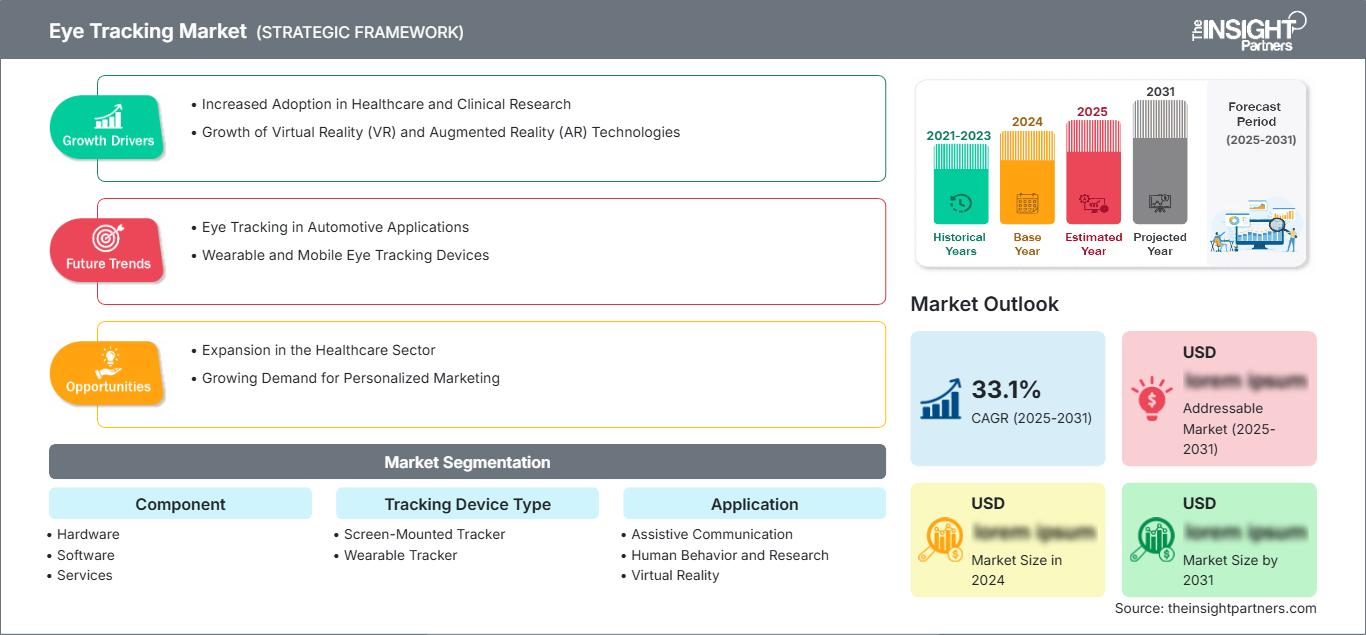
Eye Tracking Market: Strategic Insights
Regional Insights
North America Eye Tracking Market
North America remains a dominant region due to its strong research ecosystem and high adoption of emerging technologies. The market is characterized by a strong preference for advanced, high-precision eye tracking systems that meet stringent research and clinical standards. Growth is further supported by substantial funding for neuroscience and human-computer interaction research. The regional market is projected to witness a CAGR of 23.2-24.5% from 2026 to 2034.
The competitive environment in North America is intense, with a strong focus on technological innovation and product differentiation. Key players are developing next-generation systems that offer improved accuracy and integration with existing platforms. The market is also seeing a trend toward the adoption of cloud-based analytics platforms for eye tracking data. Demand is sustained by continuous investments in automotive safety research and consumer experience optimization.
U.S. Eye Tracking Market
The U.S. holds the largest share within North America, accounting for over 85% of the region's revenue. Growth is steady at a CAGR of 23.8-25.0%, driven by high demand from the healthcare, automotive, and consumer electronics sectors. The research and academic sector also presents a substantial consumer base, seeking reliable systems for behavioral and cognitive studies. The presence of leading technology companies and research institutions ensures a constant stream of advanced products.
Key application trends in the U.S. include the increasing integration of eye tracking in automotive driver monitoring systems and VR headsets. The demand for systems that support real-time gaze analysis is rising for gaming and marketing research applications. Market players are also focusing on developing solutions that address privacy concerns and data security.
Europe Eye Tracking Market
Europe holds a significant share of the global market, estimated at 22-26%, with a forecast CAGR of 22.5-23.8%. The UK and Germany are leading markets, characterized by strong automotive research and academic institutions. Demand is also driven by the region's focus on human factors engineering and consumer behavior research. The focus in this region is shifting toward integrated solutions that combine eye tracking with other biometric sensors.
The market is characterized by a strong emphasis on data privacy and compliance with GDPR regulations. Manufacturers are developing systems that offer high levels of accuracy and reliability for clinical and research applications. The integration of advanced algorithms to improve performance in challenging lighting conditions is a key trend. Competitors are actively engaging in strategic partnerships with research institutions and automotive manufacturers to expand their application scope.
APAC Eye Tracking Market
Asia Pacific is the fastest-growing market, with a projected share of 28-32% in 2025 and a CAGR of 28.0-29.5%, led by China and Japan. Rapid industrialization, urbanization, and increasing government spending on technology innovation are key drivers. The expansion of the consumer electronics and automotive sectors is fueling demand across the region.
The market is supported by strong policy drivers and the development of new smart cities, which integrate modern technologies. South Korea and India are seeing growth in the adoption of eye tracking for research and consumer applications. Market players are capitalizing on the significant production volumes of consumer electronics in the region.
Middle East & Africa Eye Tracking Market
The Middle East & Africa market is growing, with a significant CAGR, driven by large-scale infrastructure and healthcare development projects. Saudi Arabia and the UAE are leading markets, investing heavily in advanced healthcare technologies and smart city initiatives. The demand is also linked to the research and education sectors seeking modern behavioral analysis tools.
Investment in large-scale technology projects is a primary driver in this region. South Africa is a key market within Africa, with demand stemming from its research institutions and healthcare sector. The adoption of high-reliability, robust systems is essential for the region's diverse operating conditions. Market growth is also propelled by the need to modernize healthcare and research infrastructure.
Segmentation Analysis
Component
The component segmentation includes Hardware, Software, and Services. The Hardware segment is the dominant category, projected to grow at a CAGR of 24.2-25.6% from 2026 to 2034. Its market leadership is due to the essential nature of cameras, sensors, and illumination modules that form the foundation of any eye tracking system. These components require continuous innovation to achieve higher accuracy and lower latency.
- Hardware: This segment holds the largest market share due to the critical need for specialized sensors and optics in all eye tracking applications.
- Software: Software solutions are growing rapidly, offering gaze analytics, data visualization, and integration capabilities that are essential for end-users.
- Services: Services include installation, training, and support, providing recurring revenue streams and ensuring proper system utilization.
Tracking Device Type
The tracking device type segmentation divides the market into Screen-Mounted Tracker and Wearable Tracker. The Screen-Mounted Tracker segment is a significant driver of market growth, projected to grow at a substantial CAGR. This segment encompasses systems mounted on monitors for use in research, consumer behavior studies, and assistive communication.
- Screen-Mounted Tracker: These systems are widely used in research and commercial applications, offering high accuracy in controlled environments.
- Wearable Tracker: Wearable trackers are gaining traction in mobile research, automotive, and VR applications, providing flexibility and naturalistic data collection.
Application
The application segmentation includes Assistive Communication, Human Behavior and Research, Virtual Reality, and Others. The Eye Tracking Market scope across applications reveals distinct requirements for clinical, research, and consumer uses. The Virtual Reality segment is experiencing the highest growth, driven by the expanding VR ecosystem and the need for foveated rendering and gaze-based interaction.
- Assistive Communication: This critical application enables individuals with disabilities to communicate using gaze, representing a stable and essential market segment.
- Human Behavior and Research: This is a core application area, supporting academic and commercial research in psychology, marketing, and human factors.
- Virtual Reality: This fastest-growing segment leverages eye tracking for foveated rendering, social interaction, and intuitive interfaces in VR environments.
Industry
The industry segmentation includes Consumer Electronics, Healthcare and Research, Automotive, and Others. The Consumer Electronics segment holds a significant share, driven by the integration of eye tracking in smartphones, VR headsets, and gaming devices. This segment is expected to witness rapid growth with the increasing consumer demand for intuitive interfaces.
- Consumer Electronics: This segment is growing rapidly with the integration of eye tracking into mainstream devices for enhanced user experiences.
- Healthcare and Research: A mature segment encompassing clinical diagnostics, rehabilitation, and academic research, requiring high-precision systems.
- Automotive: This growing segment uses eye tracking for driver monitoring, fatigue detection, and advanced human-machine interfaces.
- Others: This segment includes retail, aerospace, and defense applications where gaze analysis provides valuable insights.
Opportunity Snapshot
| Application Segment | Revenue Contribution | Trend Tag | Adoption Stage |
|---|---|---|---|
| Virtual Reality | High | Foveated Rendering | Scaling |
| Human Behavior and Research | High | UX Research | Mature |
| Assistive Communication | Medium | Accessibility | Mature |
| Others (Retail, Defense) | Medium | Gaze Analytics | Emerging |
Eye Tracking Market Growth Drivers and Impact Analysis
Proliferation of Virtual and Augmented Reality Technologies
The rapid expansion of virtual and augmented reality markets is a primary driver for the Eye Tracking Market. VR and AR headsets increasingly incorporate eye tracking to enable foveated rendering, which reduces computational load by rendering only the area the user is looking at in high detail. This technology is essential for delivering high-quality immersive experiences with current hardware capabilities. The growing gaming, training, and enterprise applications of VR and AR are creating sustained demand, with major headset manufacturers making eye tracking a standard feature.
Growing Adoption in Automotive Driver Monitoring Systems
The need for regulatory compliance and safety programs is contributing to the usage of eye tracking technology in the automotive driver monitoring system. Eye tracking technology is used for identifying the driver’s drowsiness, distraction, and impairment, which can cause accidents. The Euro NCAP and other safety programs are mandating these systems, thus creating huge demand for them. This trend is going to escalate further as we move towards self-driving cars, wherein the driver's fitness would need to be determined through eye tracking technology.
Expansion of Consumer Electronics with Gaze-Based Interfaces
Inclusion of eye tracking technology in consumer electronics such as smartphones, laptops, and gaming consoles is another big factor in driving growth in this market. Eye tracking interfaces provide users with an intuitive interface that is hands free and can assist disabled people as well. Eye tracking technology in high-end consumer electronics by major companies is creating customer awareness about it. It has led to increasing adoption of the technology in mass-market consumer electronics.
Eye Tracking Market Future Trends
Integration with Artificial Intelligence and Machine Learning
Another major trend is the incorporation of AI and machine learning algorithms in eye tracking technology. The use of AI is increasing the accuracy of gaze estimation, allowing for gaze prediction, and advanced applications such as intent detection and emotion recognition. Machine learning algorithms are also being used in calibration processes and personalization for each user to make the system usable. Eye tracking technology is becoming more capable of analyzing more than just gaze points using this trend.
Advancements in Miniaturization and Embedded Solutions
There is a growing trend toward miniaturizing eye tracking components and embedding them into various devices. Advances in micro-optics and low-power sensors enable integration into smart glasses, VR headsets, and even contact lenses. This trend is making eye tracking more accessible and unobtrusive, paving the way for continuous, naturalistic gaze data collection in everyday environments. The Eye Tracking Market trends point towards seamless integration where eye tracking becomes an invisible but essential component of future human-machine interfaces.
Eye Tracking Market Opportunities
Expansion into Emerging Healthcare Applications
The healthcare sector presents significant opportunities for eye tracking beyond current applications in diagnostics. The Eye Tracking Market Forecasts indicate potential for early detection of neurological disorders, monitoring of cognitive decline, and even assistive technologies for patients with severe mobility impairments. Companies can capitalize by developing specialized diagnostic tools and integrated solutions for clinical settings. With increasing healthcare spending and a focus on early intervention, this opportunity offers substantial growth potential for specialized providers.
Development of Eye Tracking for Retail and Marketing Analytics
There is a growing opportunity to develop specialized eye tracking solutions for retail and marketing analytics. Understanding consumer gaze behavior can provide valuable insights into product placement, advertising effectiveness, and shopping patterns. Creating non-intrusive, scalable solutions for retail environments can open new revenue streams and allow companies to differentiate themselves. This approach is particularly relevant in the digital advertising and e-commerce sectors, where understanding visual attention is crucial.
Recent Developments
- July 2026: Pupil Labs, a global leader in wearable eye tracking technology, announced a partnership with NIL Technology (NILT) to integrate NILT’s ultra-compact metaEye technology into Pupil Labs’ forthcoming eye tracking product.
- December 2025: Tobii, the world leader in eye tracking and pioneer of attention computing, announces a design win for Pimax’s new headset Dream Air. Tobii and Pimax has an established relationship, with Tobii’s eye tracking technology being integrated in the Pimax Crystal headset launched in 2023.
- July 2026: Smart Eye, a leading developer of Driver Monitoring System (DMS) and interior sensing software for the automotive industry, has secured an additional order from a major Global OEM. The order adds further interior sensing features to three car models for which Smart Eye has previously been selected to deliver DMS software.
Frequently Asked Questions

- Comprehensive Market Sizing and Forecast Analysis
- Detailed Segmentation Analysis
- In-Depth Market Dynamics Assessment
- Regional and Country-Level Insights
- Competitive Landscape and Company Benchmarking
- Strategic Business Intelligence
Recent Reports
Testimonials

The Insight Partners' SCADA System Market report is comprehensive, with valuable insights on current trends and future forecasts. The team was highly professional, responsive, and supportive throughout. We are very satisfied and highly recommend their services.
RAN KEDEM Partner, Reali Technologies LTDs
I requested a report on a very specific software market and the team produced the report in a few days. The information was very relevant and well presented. I then requested some changes and additions to the report. The team was again very responsive and I got the final report in less than a week.
JEAN-HERVE JENN Chairman, Future Analytica
We worked with The Insight Partners for an important market study and forecast. They gave us clear insights into opportunities and risks, which helped shape our plans. Their research was easy to use and based on solid data. It helped us make smart, confident decisions. We highly recommend them.
PIYUSH NAGPAL Sr. Vice President, High Beam Global
The Insight Partners delivered insightful, well-structured market research with strong domain expertise. Their team was professional and responsive throughout. The user-friendly website made accessing industry reports seamless. We highly recommend them for reliable, high-quality research services
YUKIHIKO ADACHI CEO, Deep Blue, LLC.
This is the first time I have purchased a market report from The Insight Partners.While I was unsure at first, I visited their web site and felt more comfortable to take the risk and purchase a market report.I am completely satisfied with the quality of the report and customer service. I had several questions and comments with the initial report, but after a couple of dialogs over email with their analyst I believe I have a report that I can use as input to our strategic planning process.Thank you so much for taking the extra time and making this a positive experience.I will definitely recommend your service to others and you will be my first call when we need further market data.
JOHN SUZUKI President and Chief Executive Officer, Board Director, BK Technologies
I wish to appreciate your support and the professionalism you displayed in the course of attending to my request for information regarding to infectious disease IVD market in Nigeria. I appreciate your patience, your guidance, and the fact that you were willing to offer a discount, which eventually made it possible for us to close a deal. I look forward to engaging The Insight Partners in the future, all thanks to the impression you have created in me as a result of this first encounter.
DR CHIJIOKE ONYIA MANAGING DIRECTOR, PineCrest Healthcare Ltd.Reason to Buy
- Informed Decision-Making
- Understanding Market Dynamics
- Competitive Analysis
- Identifying Emerging Markets
- Customer Insights
- Market Forecasts
- Risk Mitigation
- Boosting Operational Efficiency
- Strategic Planning
- Investment Justification
- Tracking Industry Innovations
- Aligning with Regulatory Trends





 Get Free Sample for