
Family and Indoor Entertainment Centres Market Growth, Trends & Forecast by 2034
Coverage: By Facility Size (Below 5,000 Sq. ft., 5,001 to 10,000 Sq. ft., 10,001 to 20,000 Sq. ft., 20,001 to 40,000 Sq. ft., Above 40,000 Sq. ft.); Application (Arcade Studios, VR gaming Zones, Sports Arcades); Visitor Demographics (Children 0-9, Children 9-12, Teenagers 12-18, Young Adult 18-24, Adult 24 and Above); Revenue source (Entry Fees and Ticket, Food and Beverages, Merchandising, Advertisement) and Geography (North America, Europe, Asia Pacific, and South and Central America)
- Status : Data Released
- Report Code : TIPRE00014979
- Category : Electronics and Semiconductor
- No. of Pages : 150
- Available Report Formats :


- Last update date : September 09, 2026


2025 Market Size
US$ 10.51 Bn
Base year value
2034 Forecast
US$ 16.41 Bn
Projected by 2034
CAGR 2026-2034
5.08 %
Growth rate
Addressable Market
US$ 122.18 Bn
(2026-2034)
Family and Indoor Entertainment Centres Market size was valued at US$ 10.51 Billion in 2025 and is projected to reach US$ 16.41 Billion by 2034, expanding at a CAGR of 5.08% during 2026–2034. The market encompasses indoor leisure venues combining arcade gaming, immersive experiences, sports-oriented entertainment, food and beverage services, merchandising, and family-focused activities across diverse facility formats and visitor demographics.
The Family and Indoor Entertainment Centres Market is supported by established leisure infrastructure in North America, where premium entertainment concepts, competitive socializing, and mall-based venues continue to attract recurring family and group visits. Structural drivers include investment in immersive attractions and the integration of dining with entertainment. Consumer preference is also shifting toward experience-led leisure that accommodates children, teenagers, young adults, and multigenerational groups.
Family and Indoor Entertainment Centres Market Assessment and Insights
- North America: North America remains the largest regional contributor, with a 2025 Family and Indoor Entertainment Centres Market share of 34–36% and a 5.2–5.8% CAGR between 2026–2034, supported by mature venue networks, strong consumer spending, and established entertainment operators.
- US: The US represents 88–91% of North America in 2025 and is expected to grow at a 5.0–5.6% CAGR between 2026–2034, supported by venue modernization and experiential dining.
- Europe: Europe accounts for 27–29% in 2025 and is projected to expand at a 4.6–5.1% CAGR between 2026–2034, led by the UK, Germany, France, Italy, and Spain, where premium leisure and themed attractions remain important.
- Asia Pacific: Asia Pacific represents 20–22% in 2025 and is expected to record a 7.8–8.4% CAGR between 2026–2034, with China, Japan, South Korea, India, and Australia benefiting from urbanization and mall-based entertainment development.
- Largest Segment: Entry Fees and Ticket Sales hold a 42–46% market share in 2025, with a 4.6–5.2% CAGR from 2026–2034, retaining importance as the primary monetization mechanism.
- High Growth Segment: VR Gaming Zones represent a 9–12% market share in 2025 and are projected to grow at a 7.8–8.4% CAGR from 2026–2034, driven by immersive multiplayer formats.
- Key companies analyzed in detail: CEC Entertainment, LLC, Cinergy Entertainment Group, Inc., Dave & Buster’s Entertainment, Inc., KidZania Operations S.A.R.L., The LEGO Group, Lucky Strike Entertainment Group, Inc., Scene75 Entertainment Centers, Smaaash Entertainment Private Limited, The Walt Disney Company, and Fun City.
Source: The Insight Partners' analysis based on proprietary research, government publications, company annual reports, investor presentations, industry databases, and expert interviews.
The Family and Indoor Entertainment Centres market has moved away from traditional arcade facilities and kids' playgrounds into technology-based centres that include gaming, eating, sports, educational activities, entertainment, and immersive facilities. Digital scoring systems, cashless play, VR, interactivity and themed environments are becoming increasingly important and influencing the needs in equipment as well as layout design. There is an increasing trend for operators to balance attraction density with food service, party rooms, and versatile social spaces.
The Family and Indoor Entertainment Centres Market is looking into its future in new urban markets where organized leisure is increasingly gaining visibility as part of mixed-use development projects. Money is being invested increasingly in modular facilities, themed or branded experiences, and in concepts that allow localization without rebuilding the whole operating concept. Safety, accessibility, fire safety, food handling, and child supervision regulations are also pushing towards standardization and favouring operators with strong operating systems.
Family and Indoor Entertainment Centres Market Report Scope
| Report Attribute | Details |
|---|---|
| Market size in 2025 | US$ 10.51 Billion |
| Market Size by 2034 | US$ 16.41 Billion |
| Global CAGR (2026 - 2034) | 5.08% |
| Historical Data | 2021-2024 |
| Forecast period | 2026-2034 |
Family and Indoor Entertainment Centres Market Analysis
The market growth is driven by the demand for convenient, non-weather-dependent recreational facilities where people can enjoy several different activities under one roof. Ecosystem: real estate companies, attraction manufactures, video game publishers, technology companies, food service operators, franchising, advertising agencies, and venue owners. Increasingly, mall owners see entertainment anchor tenants as assets that can enhance the shopping experience by extending time spent at malls.
Supply dynamics in the Family and Indoor Entertainment Centres Market are greatly affected by location economics, equipment acquisition, labor costs, maintenance, and attraction life cycles. Big players benefit from being able to share costs related to technology, marketing, training, and equipment acquisition, whereas independent centers may have an edge due to locally-based theme and attractions. Increasingly, equipment manufacturers emphasize software-driven games and ability to remotely update the game library and equipment.
Competition in the Family and Indoor Entertainment Centres market is still fragmented even with some multinational and regional players. Dave & Buster’s Entertainment, Inc. is a gaming and dining company, while CEC Entertainment, LLC focuses mainly on family entertainment centers. KidZania Operations S.A.R.L. uses role-play edutainment for its unique offering, and Smaaash Entertainment Private Limited offers sportainment and technology-based gaming.
Portfolia diversification, location choices, licensing of brands, online loyalty programs, and monetization of food and beverages are becoming key elements of the competitive advantage of strategic positioning. In particular, The Walt Disney Company provides an example of the value of intellectual property-based immersive entertainment, and The LEGO Group enhances hands-on entertainment through its Discovery Centres. Lucky Strike Entertainment Group, Inc., Scene75 Entertainment Centers, Cinergy Entertainment Group, Inc., and Fun City are competitors through different entertainment venues.
● REPORT CUSTOMIZATION
Tailor This Report To Align With Your Specific Business Requirements
This report can be customized to align precisely with your business objectives, scope, and target markets. Customization options include tailored segmentation, geography, competitive analysis, and strategic insights to support informed decision-making.
Customize This Report →WHAT YOU CAN ADJUST
- ● Segmentations
- ● Geography
- ● Competitive Analysis
- ● Language Preferences
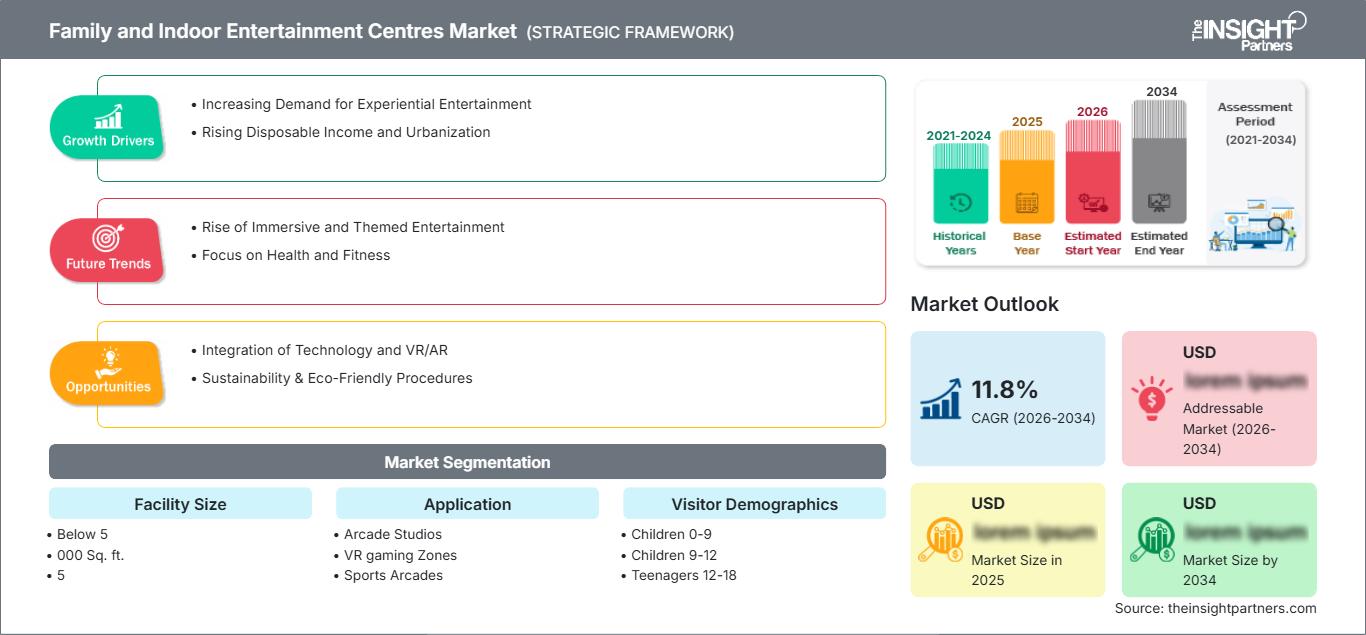
Family and Indoor Entertainment Centres Market: Strategic Insights
Regional Insights
North America Family and Indoor Entertainment Centres Market
North America commands a 34–36% share in 2025 and is projected to grow at a 5.2–5.8% CAGR during 2026–2034. The area enjoys the advantage of substantial indoor recreation facilities, franchise structures in place, and a customer base that knows how to enjoy arcade games, bowling, sports entertainment, and eatertainment. The US is still the main source of income, but Canada and Mexico offer further possibilities for development in urban retail and mixed use centers.
Demand drivers include renovation of venues, social competition, and family entertainment expenditures. Renovation involves adding connectivity to the existing arcades, digital payments, VR games, and multi-purpose party zones. Additionally, the region offers an opportunity for operators to develop alternative sources of income besides admissions. This allows for further investments into food and beverage, merchandise, loyalty programs, and special event packages, while being appealing to kids, teens, and adults.
U.S. Family and Indoor Entertainment Centres Market
The US accounts for 88–91% of North American revenue in 2025 and is expected to expand at a 5.0–5.6% CAGR during 2026–2034. The size of the industry is enabled by chains, densification of venues, the presence of mall infrastructure, and entertainment-first eating being well-accepted. The chain Dave & Buster’s Entertainment, Inc. has a wide-reaching network across North America, whereas CEC Entertainment, LLC remains strongly positioned as a family-focused brand.
Family and Indoor Entertainment Centres Market Trends driving demand include a mix of arcade studios, VR gaming centers, sports-based games, bowling, and social gaming. Consumers prefer venues that can accommodate different occasions, such as birthdays, family get-togethers, group meetings, and adult social activities. Operators, consequently, focus on flexible floor plans, loyalty apps, fresh games, and food services.
Europe Family and Indoor Entertainment Centres Market
Europe represents a 27–29% share in 2025 and is projected to grow at a 4.6–5.1% CAGR during 2026–2034. In the region, the market leaders are the existing leisure markets of UK, Germany, France, Italy, and Spain, where the demand revolves around urban centers, shopping malls, tourism hubs, and family-friendly venues.
The UK has an advanced socialization/competition leisure industry environment with venues like bowling alleys, arcade games, restaurants, and branded attractions providing the basis of diversified economic activity. The German market has a solid leisure demand from families along with a good retail and entertainment infrastructure, and France enjoys its benefits from tourism and theme-based offerings. France, Italy, and Spain have the potential for mall-based, edutainment, and indoor concepts.
APAC Family and Indoor Entertainment Centres Market
APAC holds a 20–22% share in 2025 and is forecast to grow at a 7.8–8.4% CAGR during 2026–2034. China and Japan remain major markets, while South Korea, India, and Australia contribute through organized retail, technology adoption, and growing experiential leisure demand. India and China offer particularly strong urban expansion potential.
Policy support for organized infrastructure, mall development, tourism, and urban recreation provides a favorable operating backdrop. Operators are adapting global formats to local preferences, combining arcade games, VR, sports entertainment, food service, and children's activities. Smaaash Entertainment Private Limited illustrates the region's emphasis on technology-enabled sportainment and multi-activity venues.
Middle East & Africa Family and Indoor Entertainment Centres Market
Middle East and Africa is a smaller regional market but is expected to grow at a 6.5–7.5% CAGR during 2026–2034. Saudi Arabia and the UAE lead regional development, supported by major leisure investments, tourism strategies, retail infrastructure, and destination-oriented entertainment projects. South Africa represents an established market within the wider region.
Gulf markets benefit from investment in mixed-use developments and climate-controlled leisure destinations, while energy availability supports large indoor facilities where cooling requirements are substantial. Infrastructure development and tourism diversification create opportunities for international brands, local operators, and franchised concepts. The UAE remains the leading regional hub, while Saudi Arabia provides substantial longer-term capacity for new family entertainment destinations.
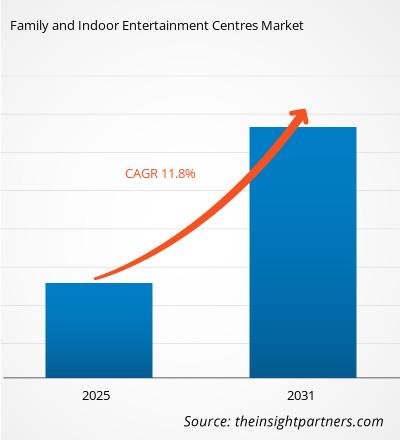
Segmentation Analysis
Facility Size
Facility Size remains strategically important because venue economics depend on available floor area, attraction density, rental costs, and the breadth of complementary services. The category is led by flexible mid-sized formats, while larger facilities support diversified entertainment portfolios and destination positioning. The main segment is expected to expand at a 5.0–5.6% CAGR during 2026–2034, with operators increasingly optimizing layouts for multiple visitor occasions.
- Below 5,000 Sq. ft.: Compact facilities suit neighborhood centers and urban retail environments where accessibility and lower occupancy costs matter. Demand is concentrated around focused play, arcade, and small-format entertainment concepts.
- 5,001 to 10,000 Sq. ft.: This format provides greater attraction diversity while retaining manageable investment requirements. Operators can combine arcade gaming, children's activities, food service, and small party areas.
- 10,001 to 20,000 Sq. ft.: Mid-sized venues offer a balanced operating model, supporting multiple attractions and broader demographics while maintaining flexibility across shopping centers and standalone urban locations.
- 20,001 to 40,000 Sq. ft.: Larger venues enable stronger attraction diversification, dedicated event areas, sports activities, and expanded dining. They are strategically relevant where destination visitation can justify greater capital intensity.
- Above 40,000 Sq. ft.: Large-format facilities can operate as destination entertainment anchors, combining numerous attractions, dining, events, and branded experiences. Their strategic importance rises in major mixed-use and tourism developments.
Application
Application segment in the Family and Indoor Entertainment Centres Market influences the experience mix, equipment investment, customer dwell time, and revenue model. Arcade Studios remain foundational, while VR Gaming Zones are gaining strategic importance through immersive multiplayer experiences. The application segment is projected to grow at a 5.4–6.0% CAGR during 2026–2034, supported by increasing diversification.
- Arcade Studios: Arcade studios retain broad appeal because redemption gaming, competitive play, and repeatable short-duration experiences fit diverse visitor groups. They remain important for dependable attraction utilization.
- VR gaming Zones: VR gaming Zones are gaining momentum as operators seek immersive experiences with stronger social and technology differentiation. Multiplayer content can increase group participation and refresh venue appeal.
- Sports Arcades: Sports Arcades combine physical activity, simulation, and competition, supporting repeat visits from teenagers and adults. Their strategic role increases as operators broaden beyond conventional arcade formats.
Visitor Demographics
Visitor Demographics shape attraction design, pricing, programming, and marketing strategy. Children remain central to family-oriented concepts, but teenagers and young adults increasingly influence demand for competitive and immersive experiences. The segment is expected to grow at a 5.2–5.8% CAGR during 2026–2034, supported by broader age appeal.
- Children 0-9: This group drives demand for safe, supervised, age-appropriate experiences, including soft play, interactive activities, themed environments, and educational entertainment. Family decision-making strongly influences visitation.
- Children 9-12: Older children increasingly seek competitive and technology-enabled activities. Venues targeting this group can combine arcade gaming, sports, immersive attractions, and structured group experiences.
- Teenagers 12-18: Teenagers favor social competition, VR, arcade gaming, sports activities, and shareable experiences. This demographic is strategically valuable for repeat visits and group occasions.
- Young Adult 18-24: Young adults support competitive socializing and technology-led formats, particularly when gaming is integrated with food, beverages, music, and group entertainment.
- Adult 24 and Above: Adults increasingly participate in family visits and social entertainment. Their presence strengthens demand for dining, premium activities, private events, and mixed-age entertainment environments.
Revenue source
Revenue source determines venue resilience and customer monetization. Entry Fees and Ticket Sales remain the largest component, with the main segment projected to grow at a 4.6–5.2% CAGR during 2026–2034. Operators are simultaneously expanding ancillary monetization to increase spending per visit and reduce dependence on admission income.
- Entry Fees and Ticket: Admission remains the primary monetization mechanism for many concepts. Flexible ticketing, bundled access, and timed-entry structures help operators balance utilization and customer value.
- Food and Beverages: Food and beverage services extend dwell time and create additional spending opportunities. Integrated dining is particularly important for family groups, celebrations, and competitive-socializing concepts.
- Merchandising: Merchandise supports brand extension and incremental spending, especially at themed or intellectual-property-led venues. Branded products can reinforce visitor engagement beyond the physical attraction.
- Advertisement: Advertising provides an ancillary monetization channel through branded experiences, digital screens, sponsorships, and activity partnerships. It is most relevant where venues attract concentrated and repeat visitor traffic.
Opportunity Snapshot
| Application | Revenue Contribution (High/Medium/Low) | Trend Tag | Adoption Stage |
| Arcade Studios | High | Redemption Play | Mature |
| VR gaming Zones | Medium | Immersive VR | Scaling |
| Sports Arcades | Medium | Social Competition | Scaling |
Family and Indoor Entertainment Centres Market Growth Drivers and Impact Analysis
Expansion of Experiential Retail Destinations
The merging of entertainment and shopping complexes and mixed-use developments creates better location opportunities for indoor entertainment businesses. Property owners demand that their facilities offer experiences that are hard to duplicate online, thus family entertainment becomes an additional source of traffic. It changes the approach to the design of venues because the business operators invest into social spaces, food services, branding, and events, not just arcade machines. It is beneficial for the whole value chain because developers, equipment providers, food providers and entertainers have an opportunity to become a part of the visitor economy. From the point of view of investors, it means that there should be increased focus on location, tenants, access and benefits from being close by. Venues which can cater to both families and adults are likely to enjoy wider usage at all times.
Technology-Enabled Immersive Entertainment
Advances in VR, interactive displays, connected gaming, motion simulation, and digital scoring are changing the competitive basis of indoor entertainment. Technology allows operators to refresh experiences more frequently while collecting operational information about attraction utilization and customer preferences. Immersive technologies may increase the value of the visit by providing unique experiences which cannot be easily replicated in one’s home environment. The effect on the market is particularly powerful when the operators apply the technology selectively without replacing the entire attraction experience. Capital investments now consider not only the costs of installing new technology but also the cost of upgrading or updating existing technologies in terms of hardware, software, content, connectivity, and technical assistance. This makes the suppliers with their modular technology and flexible content offerings increasingly relevant.
Broader Monetization Beyond Admission Revenue
The design of these entertainment centers is becoming increasingly customer-oriented in terms of total value rather than just tickets to enter the place. Such services like food and beverage, merchandise, private celebrations, sponsorships, loyalty programs, and even attraction bundles may be used to generate additional income and increase guest retention times at the same time. Such a model is changing the way facilities are planned since restaurant spaces, party rooms, retail merchandising space, and engagement technology become a part of the business model. Such a model is especially useful for bigger centers that have high rents, labor costs, utility costs, and maintenance costs to cover. Additional sources of income may help cope with fluctuations in demand on certain attractions during different seasons. Moreover, such a model allows generating many more partnership opportunities with consumer companies, schools, corporations, and event organizers.
Family and Indoor Entertainment Centres Market Future Trends
Personalized Digital Visitor Journeys
According to the Family and Indoor Entertainment Centres Market forecast, personalization is expected to become a more important operating capability as venues connect ticketing, loyalty, gameplay, food ordering, and merchandise through digital platforms. Operators can use consent-based customer data to tailor promotions, recommend attractions, manage capacity, and create targeted packages for families or group visitors. Digital wallets and mobile applications can reduce friction at entry and gameplay points while supporting faster purchasing. The next stage will involve integrated customer journeys in which a visitor can plan an itinerary, reserve activities, receive real-time offers, and manage spending from one interface. Such systems may also help operators identify underused attractions and optimize staffing. Competitive differentiation will increasingly depend not simply on installing technology, but on converting operational data into convenient, privacy-conscious experiences that improve both customer satisfaction and venue efficiency.
Convergence of Entertainment and Learning
The boundary between leisure and education is likely to become less distinct as parents and institutions seek experiences that combine recreation with practical learning. Role-play, science-based activities, creative workshops, simulated workplaces, and interactive problem-solving can extend the appeal of indoor venues beyond conventional amusement. This trend favors operators capable of creating structured experiences without making them feel like formal classrooms. Partnerships with educational organizations, consumer brands, and technology providers may support new programming while reducing content-development burdens. The model also opens opportunities for weekday utilization through school visits, camps, and organized groups, complementing family traffic concentrated around weekends. Over time, learning-oriented entertainment could become an important differentiator for operators seeking stronger relationships with parents and institutions while maintaining the social and playful characteristics that define modern family entertainment destinations.
Family and Indoor Entertainment Centres Market Opportunities
Untapped Tier-Two Urban Markets
Tier-two cities represent an opportunity for operators seeking lower occupancy costs and less saturated competitive environments. Expanding retail infrastructure, improving household purchasing power, and greater consumer exposure to branded entertainment can support smaller and mid-sized concepts outside established metropolitan centers. Investors can prioritize modular formats that require less capital and can be adapted to local demand. Partnerships with shopping centers can reduce site-development complexity while providing established visitor traffic. The strongest opportunities are likely to combine familiar arcade or sports formats with locally relevant food, events, and family programming. Operators should evaluate catchment demographics, competing leisure options, accessibility, parking, and mall footfall before expansion. A disciplined city-by-city approach can reduce rollout risk while allowing successful attraction combinations to be replicated across multiple markets.
Intellectual Property-Led Indoor Experiences
Licensed intellectual property offers a pathway to differentiate venues in increasingly crowded entertainment markets. Recognizable characters, stories, sports properties, and consumer brands can improve attraction visibility and create opportunities for merchandise, themed food, interactive activities, and promotional partnerships. The opportunity extends beyond major theme-park operators because compact branded experiences can fit within shopping centers and family entertainment venues. Investors should evaluate licensing duration, geographic rights, minimum guarantees, content refresh requirements, and merchandising economics before committing capital. Strong concepts can use intellectual property as an experience layer rather than relying on branding alone. This approach can support higher customer engagement while providing additional revenue channels. Operators with strong localization capabilities may be particularly well positioned to adapt global properties to regional languages, cultural preferences, and spending patterns without diluting brand consistency.
Recent Developments
- July 2025: Neon Panda announced the opening of a new family entertainment centre in Indore, Madhya Pradesh, scheduled for July 27. The venue features laser tag, neon bowling, a high ropes course, skee-ball, trampolines, arcade games, and Hyper Grid. The operator also planned an influencer-led launch campaign to build awareness and generate digital content around the new attraction.
- 2025: Sandbox Group announced the merger of its PlayKids Learning and FamilyEducation platforms, consolidating its digital family-learning offering. The transaction brings complementary children’s education and family-content capabilities under a unified structure, supporting broader audience reach and an integrated approach to family-oriented digital experiences.
- 2025: Bahrain Marina unveiled a new integrated family entertainment destination at Marina Walk in Bahrain. The development combines family-oriented entertainment with the wider mixed-use waterfront destination, reflecting continued investment in experiential leisure infrastructure and the expansion of organized entertainment offerings within the Gulf region.
Frequently Asked Questions

- Comprehensive Market Sizing and Forecast Analysis
- Detailed Segmentation Analysis
- In-Depth Market Dynamics Assessment
- Regional and Country-Level Insights
- Competitive Landscape and Company Benchmarking
- Strategic Business Intelligence
Recent Reports
Testimonials

The Insight Partners provided valuable market intelligence that supported our global go-to-market strategy. Their team was professional, responsive, and attentive to our feedback, providing thoughtful analysis and helpful methodological clarifications throughout the project.
Junmo Kim Chief Financial Officer (CFO), Enertech Co., Ltd.
The Insight Partners' SCADA System Market report is comprehensive, with valuable insights on current trends and future forecasts. The team was highly professional, responsive, and supportive throughout. We are very satisfied and highly recommend their services.
RAN KEDEM Partner, Reali Technologies LTDs
I requested a report on a very specific software market and the team produced the report in a few days. The information was very relevant and well presented. I then requested some changes and additions to the report. The team was again very responsive and I got the final report in less than a week.
JEAN-HERVE JENN Chairman, Future Analytica
We worked with The Insight Partners for an important market study and forecast. They gave us clear insights into opportunities and risks, which helped shape our plans. Their research was easy to use and based on solid data. It helped us make smart, confident decisions. We highly recommend them.
PIYUSH NAGPAL Sr. Vice President, High Beam Global
The Insight Partners delivered insightful, well-structured market research with strong domain expertise. Their team was professional and responsive throughout. The user-friendly website made accessing industry reports seamless. We highly recommend them for reliable, high-quality research services
YUKIHIKO ADACHI CEO, Deep Blue, LLC.
This is the first time I have purchased a market report from The Insight Partners.While I was unsure at first, I visited their web site and felt more comfortable to take the risk and purchase a market report.I am completely satisfied with the quality of the report and customer service. I had several questions and comments with the initial report, but after a couple of dialogs over email with their analyst I believe I have a report that I can use as input to our strategic planning process.Thank you so much for taking the extra time and making this a positive experience.I will definitely recommend your service to others and you will be my first call when we need further market data.
JOHN SUZUKI President and Chief Executive Officer, Board Director, BK Technologies
I wish to appreciate your support and the professionalism you displayed in the course of attending to my request for information regarding to infectious disease IVD market in Nigeria. I appreciate your patience, your guidance, and the fact that you were willing to offer a discount, which eventually made it possible for us to close a deal. I look forward to engaging The Insight Partners in the future, all thanks to the impression you have created in me as a result of this first encounter.
DR CHIJIOKE ONYIA MANAGING DIRECTOR, PineCrest Healthcare Ltd.Reason to Buy
- Informed Decision-Making
- Understanding Market Dynamics
- Competitive Analysis
- Identifying Emerging Markets
- Customer Insights
- Market Forecasts
- Risk Mitigation
- Boosting Operational Efficiency
- Strategic Planning
- Investment Justification
- Tracking Industry Innovations
- Aligning with Regulatory Trends





 Get Free Sample for