
Food Robotics Market Growth, Size & Forecast by 2034
Coverage: By Type (Articulated, Cartesian, Scara, Parallel, Cylindrical, Collaborative, Others); Payload (Medium, Low, Heavy); Application (Palletizing, Packaging, Repackaging, Pick and Place, Processing, Other Applications); End-Use Industry (Beverage, Meat, Poultry, and Seafood, Dairy, Bakery, Fruits and Vegetables, Confectionery, Other End-Use Industries) , and Geography (North America, Europe, Asia Pacific, and South and Central America)
- Status : Data Released
- Report Code : TIPRE00019451
- Category : Electronics and Semiconductor
- No. of Pages : 150
- Available Report Formats :


- Last update date : September 17, 2026


2025 Market Size
US$ 3.04 Bn
Base year value
2034 Forecast
US$ 11.64 Bn
Projected by 2034
CAGR 2026-2034
16.09 %
Growth rate
Addressable Market
US$ 62.06 Bn
(2026-2034)
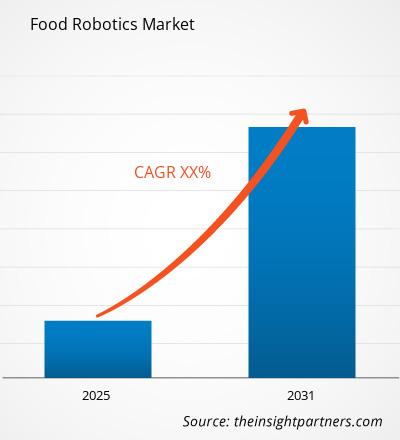
The Food Robotics market was valued at US$ 3.04 Billion in 2025 and is projected to reach US$ 11.64 Billion by 2034, registering a CAGR of 16.09% from 2026 to 2034. This growth trajectory underscores the increasing integration of automated solutions across food processing, packaging, and distribution operations. The market is driven by persistent labor shortages in the food industry, rising demand for processed and packaged foods, and the need for consistent hygiene and quality standards in food production.
Across North America, the Food Robotics Market size is supported by strong industrial infrastructure, high adoption rates of automation technologies, and the presence of major food processing conglomerates. Regional demand is expected to advance at a 14.0–16.0% CAGR range as food manufacturers invest in robotic systems to address workforce challenges, enhance production efficiency, and comply with stringent food safety regulations while protecting margins through operational optimization.
Food Robotics Market Assessment and Insights
- North America: Estimated to hold approximately 34–38% share in 2025, growing at a CAGR of 14.0–16.0% from 2026 to 2034. Growth is driven by high automation adoption, labor cost pressures, and strong presence of food processing infrastructure.
- United States: Representing nearly 85–90% of the North American market in 2025, expanding at a CAGR of 13.5–15.5%. The market is supported by substantial investments in smart factories and modernization of food processing facilities.
- Europe: Accounting for approximately 26–30% of the global market in 2025, with a CAGR of 14.5–16.5%. Leading countries include Germany, the United Kingdom, and France, driven by stringent food safety regulations and automation-focused industrial policies.
- Asia Pacific: Representing roughly 28–32% of the global market in 2025, growing at the highest CAGR of 17.0–19.0%. Key contributors include China, Japan, India, and South Korea, fueled by rapid industrialization, expanding food processing capacity, and rising demand for packaged foods.
- Largest Segment: Type segment, specifically Articulated robots, dominates with a market share of approximately 40–44% in 2025, growing at a CAGR of 15.0–17.0%. This is driven by their flexibility, multi-directional movement, and compatibility with AI and vision systems.
- High Growth Segment: Application segment, specifically Processing, projected to expand at a CAGR of 17.0–19.0%, driven by the rising adoption of AI-based robotics for repetitive and hazardous tasks, enhancing productivity and hygiene compliance.
- Key companies analyzed in detail: ABB Group, Fanuc Corporation, Kawasaki Heavy Industries Ltd., Kuka AG, Mitsubishi Electric Corporation, Rockwell Automation Incorporated, Seiko Epson Corporation, Staubli International AG, Yaskawa Electric Corporation, Universal Robots A/S.
Source: The Insight Partners' analysis based on proprietary research, government publications, company annual reports, investor presentations, industry databases, and expert interviews.
The adoption of automation systems has evolved from simple robotic arms to fully-integrated solutions that incorporate AI-based vision, collaboration, and comprehensive automation solutions in processing, packaging, and logistics operations. Food Robotics Market growth is being driven by increased sensitivity of equipment in processing fragile food items, increased demands for customized foods, and increased adoption of robotic systems in food service operations. Changes in production dynamics include investments in sensors, modular and easy to reconfigure systems, and software platforms that help to easily integrate them into the existing production line.
Factors that will drive the demand during the forecast period include the shortage of labor, need for food safety regulations, increase in consumers' expectations on food quality and variety, as well as the spread of fast-food restaurant chains through the adoption of automation. Developing countries are setting up food processing capacities and are revamping their food chains, and there is room for cost-effective solutions. Investments will favor suppliers with advanced gripping technology, AI-based vision systems, collaborative systems, and lifecycle services.
Food Robotics Market Report Scope
| Report Attribute | Details |
|---|---|
| Market size in 2025 | US$ 3.04 Billion |
| Market Size by 2034 | US$ 11.64 Billion |
| Global CAGR (2026 - 2034) | 16.09% |
| Historical Data | 2021-2024 |
| Forecast period | 2026-2034 |
Food Robotics Market Analysis
Ddemand for the product is built on the labor shortage in food processing facilities and farms, as well as the need for the consistent and reliable performance of the tasks that require precision and repetition. Value chain participants include robotic arm manufacturers, specialists on end-effectors and grippers, vision systems suppliers, software developers, systems integrators, and customers representing food processing, packaging, and distribution industries. The Food Robotics Market Report suggests that buyers tend to buy ready-made automation packages because of the influence of system integration, programming difficulty, and interoperability on production results.
Competitive rivalry is high because of the importance of technology advantage, application knowledge, and international network services instead of the availability of basic products. ABB Group, Fanuc Corporation, Kuka AG, Yaskawa Electric Corporation, and Mitsubishi Electric Corporation operate in the market based on comprehensive automation product portfolio and worldwide presence, whereas Universal Robots A/S operates in the market thanks to its collaborative robots for small food producers. Regional players include Kawasaki Heavy Industries Ltd., Seiko Epson Corporation, and Staubli International AG.
● REPORT CUSTOMIZATION
Tailor This Report To Align With Your Specific Business Requirements
This report can be customized to align precisely with your business objectives, scope, and target markets. Customization options include tailored segmentation, geography, competitive analysis, and strategic insights to support informed decision-making.
Customize This Report →WHAT YOU CAN ADJUST
- ● Segmentations
- ● Geography
- ● Competitive Analysis
- ● Language Preferences
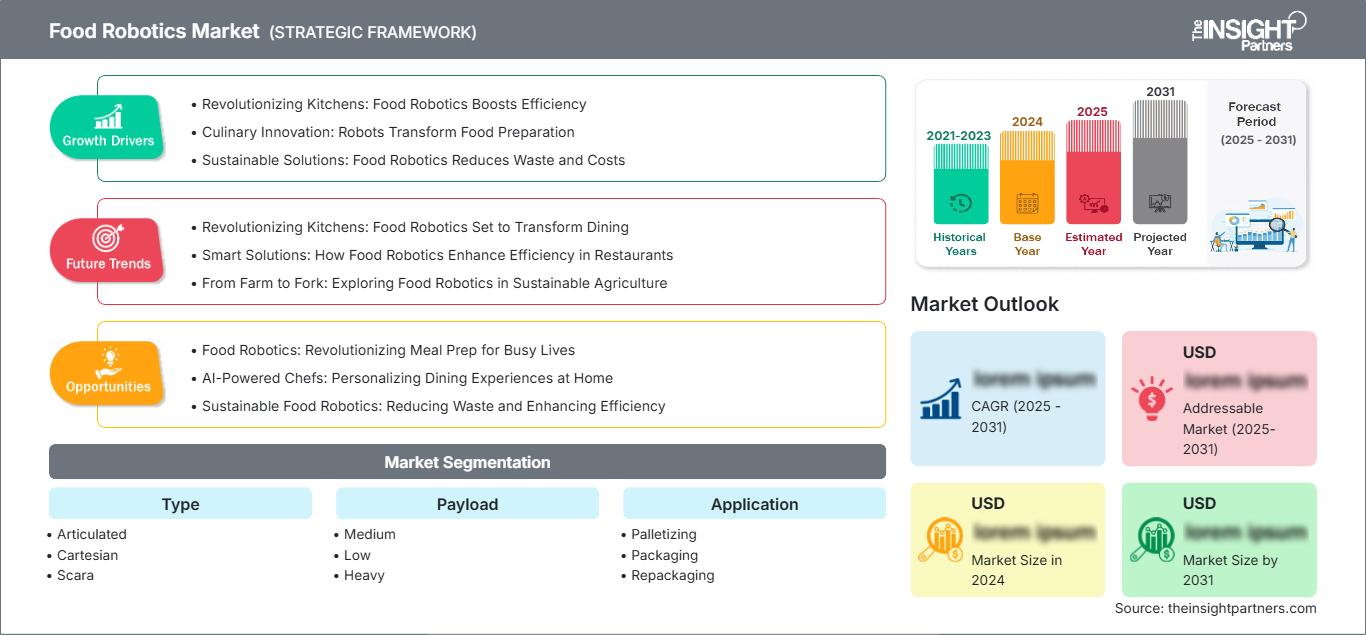
Food Robotics Market: Strategic Insights
Regional Insights
North America Food Robotics Market
North America captured 34–38% Food Robotics Market share in 2025 and will continue to grow at a CAGR of 14.0–16.0% between 2026 and 2034. Key factors favoring North America include its robust industrial base, adoption of automation technologies, and presence of food processing giants. Applications of interest include packaging, palletizing, and processing, where cost savings due to high labor costs and hygiene needs make robotization a must.
In addition to these, the Food Robotics Market share in North America is influenced by the establishment of smart factories and modernization of food processing plants. Ready-to-eat food preparation, and food service processes are increasingly using robots for improved efficiency and quality. Companies with good integration abilities, application engineering, and services have a huge potential in replacements and new builds.
U.S. Food Robotics Market
The U.S. accounted for 85–90% of North America in 2025 and is forecast to grow at a 13.5–15.5% CAGR during 2026–2034. Demand is led by packaged food manufacturers, meat and poultry processors, and dairy facilities that require high-speed, hygienic automation solutions. Construction of new food processing facilities and modernization of existing plants continues to increase specifications for flexible and collaborative robotic systems.
The presence of companies is wide, with ABB Group, Fanuc Corporation, Yaskawa Electric Corporation, and Universal Robots A/S taking care of projects which demand application engineering, integration, and support after installation. The application trend involves integration for pick and place, packaging, palletizing, and processing operations where the robot has to deal with different food items.
Europe Food Robotics Market
Europe represented a 26–30% share in 2025 and is projected to grow at a 14.5–16.5% CAGR during 2026–2034, with Germany the leading country . UK demand is supported by automation needs across food processing, packaging, and distribution sectors, with emphasis on robotics adoption to address labor shortages and rising operational costs . Germany benefits from industrial automation expertise, machinery exports, strict technical standards, and a strong food processing industry.
The demand is assured from France, Italy, and Spain in the dairy, bakery, and confectionery industries, where precision and cleanliness are of utmost importance. There exist good prospects in upgrading old production lines by equipping them with robotics. Kuka AG, ABB Group, and Staubli International AG provide strong market entry through their distribution channels.
APAC Food Robotics Market
In 2025, the Asia Pacific captured 28–32% of market share, and in the coming period 2026–2034, the region is expected to exhibit the highest regional CAGR in the range of 17.0-19.0%. The high demand in the region is driven by China owing to high food production, industrial development, and food safety . Japan brings in expertise in robotics, high standards in terms of food quality and hygiene, and high adoption of robotics technology in food processing and packaging . The region of India is witnessing food processing capacities being developed and modernized, hence the need for affordable robotic technologies.
The government backing for industrial automation, increase in domestic demand for packaged and processed foods, and smart manufacturing platforms drive the need for robotic systems.
Middle East & Africa Food Robotics Market
The demand in Middle East & Africa is expected to record a CAGR of 15.0–17.0% during 2026–2034, driven by the developments in Saudi Arabia. There is an increased need for robotic systems that can be used in applications such as packaging, palletizing, and processing in food processing infrastructure and supply chain modernization projects.
Projects in the UAE focus on automation in the field of food production and logistics, while in South Africa, there is a demand from projects that cater to the exports of food products. There are increased investments in the region in projects related to food processing and supply chain modernization projects.
Segmentation Analysis
Type
Type is projected to grow at a 15.0–17.0% CAGR during 2026–2034 as customers increasingly specify application-specific robotic configurations rather than general-purpose solutions. The Food Robotics Market scope across this segment covers articulated, Cartesian, SCARA, parallel, cylindrical, and collaborative robots used to automate handling, processing, packaging, and logistics tasks across food production environments.
- Articulated: Represents the largest segment due to flexibility, multi-directional movement, and compatibility with AI and vision systems. These robots mimic human arm movements, making them suitable for complex tasks such as processing, picking, and packaging.
- Cartesian: Offers linear movement along three axes, providing precision and repeatability for pick and place and material handling applications. Their straightforward programming and cost-effectiveness make them popular in packaging lines.
- SCARA: Combines speed and precision for assembly and inspection tasks. Their selective compliance assembly robot arm design enables fast, accurate horizontal movements, ideal for pick and place operations.
- Parallel: Designed for high-speed, lightweight packaging and handling applications. Their rigid structure and high acceleration capabilities make them suitable for rapid pick and place tasks.
- Cylindrical: Provides rotational and linear movement for material handling in confined spaces. Their compact design is advantageous in facilities with space constraints.
- Collaborative: Designed for safe human-robot interaction, enabling deployment alongside workers without safety cages. Their flexibility and ease of programming make them attractive for smaller food producers.
Payload
Payload is expected to expand at a 14.5–16.5% CAGR during 2026–2034, supported by diverse handling requirements across food processing applications. Demand varies by product weight, with medium payload robots leading due to their versatility in handling a wide range of food products.
- Medium: Holds the largest position because medium payload robots address applications such as selecting, repackaging, packing, and transferring, covering the majority of food handling tasks.
- Low: Supports lightweight handling applications including delicate produce and small packaged goods. The growing demand for handling fragile food items is driving adoption.
- Heavy: Addresses bulk handling and palletizing of heavy food products such as large packages and industrial food ingredients. These robots are strategically important for end-of-line automation.
Application
Application is projected to grow at a 16.0–18.0% CAGR during 2026–2034, supported by rising automation density across food production and logistics. Demand varies by operational stage, with palletizing representing a mature segment and processing emerging as the fastest-growing application area.
- Palletizing: Remains a key application where robots stack packaged food onto pallets for warehousing or transportation. The need for efficient end-of-line automation is driving demand in this segment.
- Packaging: Generates strong demand as food manufacturers increasingly use packaging automation to improve efficiency, consistency, and hygiene in food production.
- Repackaging: Supports secondary packaging operations where products are repackaged for retail or distribution. The growing variety of SKUs is increasing the need for flexible repackaging solutions.
- Pick and Place: Requires precise and rapid product handling for sorting, placing, and transferring operations. The rise of e-commerce and online food retail is fueling demand.
- Processing: Forms the high-growth segment as AI-based robotics are adopted for repetitive and hazardous tasks, enhancing productivity, quality, and hygiene compliance.
End-Use Industry
End-Use Industry is expected to grow at a 15.0–17.0% CAGR during 2026–2034, supported by diverse automation requirements across food product categories. Demand varies by processing complexity, hygiene standards, and product handling characteristics, with meat and poultry sectors leading adoption.
- Beverage: Utilizes robotics for high-speed filling, capping, packaging, and palletizing. The high volume and pace of beverage production make automation essential.
- Meat, Poultry, Seafood: Represents high-value applications requiring hygienic, precise handling of perishable products. Robotics adoption addresses labor shortages and improves processing efficiency.
- Dairy: Employs robotics for packaging, palletizing, and processing of dairy products where hygiene and cold chain requirements are critical.
- Bakery: Uses robotics for handling delicate baked goods, packaging, and palletizing. The need for gentle handling and consistent quality is driving adoption.
- Fruits and Vegetables: Adopts robotics for sorting, grading, and packaging where product variability and fragility require advanced vision and gentle handling capabilities.
- Confectionery: Utilizes robotics for high-speed packaging and handling of fragile, varied-shaped products in a sector where presentation and hygiene are paramount.
Opportunity Snapshot
| End-Use Industry | Revenue Contribution | Trend Tag | Adoption Stage |
|---|---|---|---|
| Beverage | High | High-Speed Fill | Mature |
| Meat, Poultry, Seafood | High | Hygienic Handling | Scaling |
| Dairy | Medium | Cold Chain Auto | Scaling |
| Bakery | Medium | Gentle Handling | Scaling |
| Fruits and Vegetables | Medium | Vision Sorting | Emerging |
| Confectionery | Medium | Precision Pack | Mature |
Food Robotics Market Growth Drivers and Impact Analysis
Labor Shortages and Workforce Challenges
Persistent labor shortages across food processing plants and agricultural operations are a primary driver for the Food Robotics market. Many food manufacturers are struggling to find workers to perform labor-intensive, repetitive, and often physically demanding tasks . Robots offer a solution by automating these processes, reducing reliance on manual labor and helping manufacturers overcome workforce shortages. The impact is most pronounced in meat processing, poultry, and packaging operations where high turnover rates and workforce availability challenges are acute. This driver is expected to significantly boost demand for robotic systems across all food processing applications.
Rising Demand for Processed and Packaged Foods
Growing consumer demand for processed, packaged, and convenience foods is fueling the adoption of food robotics. Changing dietary preferences, urbanization, and rising disposable incomes in emerging economies are increasing the volume and variety of packaged food products requiring automation . Food manufacturers require high-speed, consistent, and hygienic production lines to meet this demand. This driver is particularly influential in Asia Pacific and North America, where packaged food consumption continues to rise. The trend towards customization and product variety is also increasing the need for flexible robotic systems.
Technological Advancements in AI and Machine Vision
Advancements in robotics, AI, and machine learning are making food robotics more accessible and affordable for a wider range of food producers. Robots are becoming more adaptable, capable of performing delicate tasks such as handling fragile fruits or slicing soft cheeses without damaging them . The integration of AI and machine vision also allows robots to learn and improve over time, making them more efficient and cost-effective. This driver is expanding the addressable market by enabling automation of tasks previously considered too complex or delicate for robotic systems.
Food Robotics Market Future Trends
AI-Driven Collaborative Robotics and Vision Systems
The Food Robotics market trends indicate a significant shift towards AI-driven collaborative robots capable of real-time interaction and adaptation. Machine learning algorithms and advanced vision systems are being integrated into robotic platforms to improve object recognition, enable flexible handling of variable products, and provide quality inspection capabilities . This trend is expected to accelerate as AI becomes more accessible and as food manufacturers require robots that can handle an expanding variety of products with minimal reconfiguration. The development of end-to-end meal assembly systems is also reshaping the market.
Shift from Stationary to Modular and Flexible Systems
An emerging trend is the increasing adoption of modular, flexible robotic systems that can be rapidly reconfigured for different products and production runs. Food manufacturers are moving away from fixed automation toward systems that can handle multiple SKUs, changeovers, and product variations without lengthy downtime. The integration of modular hardware, standardized communication protocols, and software platforms is enabling this flexibility. This trend is expected to accelerate as SKU proliferation and shorter product lifecycles demand greater production agility.
Food Robotics Market Opportunities
Expansion in Emerging Asia Pacific Markets
There is a significant opportunity to penetrate rapidly growing Asia Pacific Food Robotics Market with cost-effective robotic solutions for food processing and packaging applications. As food processing capacity expands and automation awareness increases across China, India, and Southeast Asia, the demand for scalable robotic systems is growing . This opportunity is particularly relevant for manufacturers offering solutions tailored to high-volume, cost-sensitive production environments. The Food Robotics forecasts indicate significant growth potential in this region.
Developing Solutions for Food Service and Retail Automation
Developing robotic solutions for food service and retail automation presents a substantial growth opportunity. Fast-food chains, quick-service restaurants, and food retail operations are increasingly adopting automation for meal assembly, order fulfillment, and food preparation . This focused approach allows vendors to address emerging requirements in the food service sector beyond traditional food processing. Food Robotics opportunities are particularly strong in developed markets where labor costs and consumer expectations for speed and consistency are driving automation investment.
Recent Developments
- August 2026: Serve Robotics announced a partnership with Grubhub, a Wonder subsidiary, to bring autonomous sidewalk robot delivery to the Grubhub marketplace, initially covering Chicago, Los Angeles and Alexandria, with more than 100 participating merchants in Chicago and nearly 200 in Los Angeles.
- August 2026: Sagtec Global officially launched its HALO AI Food-Serving Robot and secured a purchase order valued at approximately US$3 million for 1,500 units from SMD Tech – FZCO, its exclusive Dubai-based distributor. The order marks Sagtec’s transition from AI robotics platform development and pilot deployments to large-scale commercial deployment, with the robots intended for restaurant, hospitality and high-volume food-service environments across the Middle East.
- January 2026: Chef Robotics partnered with Packline Solutions Group to offer an integrated end-to-end automation solution for flexible meal assembly and packaging. The companies developed a wireless integration connecting Chef’s AI-enabled robotic assembly systems with Packline’s packaging equipment, allowing food manufacturers to automate ingredient placement, tray handling and sealing across high-mix production lines.
Frequently Asked Questions

- Comprehensive Market Sizing and Forecast Analysis
- Detailed Segmentation Analysis
- In-Depth Market Dynamics Assessment
- Regional and Country-Level Insights
- Competitive Landscape and Company Benchmarking
- Strategic Business Intelligence
Recent Reports
Testimonials

The Insight Partners' SCADA System Market report is comprehensive, with valuable insights on current trends and future forecasts. The team was highly professional, responsive, and supportive throughout. We are very satisfied and highly recommend their services.
RAN KEDEM Partner, Reali Technologies LTDs
I requested a report on a very specific software market and the team produced the report in a few days. The information was very relevant and well presented. I then requested some changes and additions to the report. The team was again very responsive and I got the final report in less than a week.
JEAN-HERVE JENN Chairman, Future Analytica
We worked with The Insight Partners for an important market study and forecast. They gave us clear insights into opportunities and risks, which helped shape our plans. Their research was easy to use and based on solid data. It helped us make smart, confident decisions. We highly recommend them.
PIYUSH NAGPAL Sr. Vice President, High Beam Global
The Insight Partners delivered insightful, well-structured market research with strong domain expertise. Their team was professional and responsive throughout. The user-friendly website made accessing industry reports seamless. We highly recommend them for reliable, high-quality research services
YUKIHIKO ADACHI CEO, Deep Blue, LLC.
This is the first time I have purchased a market report from The Insight Partners.While I was unsure at first, I visited their web site and felt more comfortable to take the risk and purchase a market report.I am completely satisfied with the quality of the report and customer service. I had several questions and comments with the initial report, but after a couple of dialogs over email with their analyst I believe I have a report that I can use as input to our strategic planning process.Thank you so much for taking the extra time and making this a positive experience.I will definitely recommend your service to others and you will be my first call when we need further market data.
JOHN SUZUKI President and Chief Executive Officer, Board Director, BK Technologies
I wish to appreciate your support and the professionalism you displayed in the course of attending to my request for information regarding to infectious disease IVD market in Nigeria. I appreciate your patience, your guidance, and the fact that you were willing to offer a discount, which eventually made it possible for us to close a deal. I look forward to engaging The Insight Partners in the future, all thanks to the impression you have created in me as a result of this first encounter.
DR CHIJIOKE ONYIA MANAGING DIRECTOR, PineCrest Healthcare Ltd.Reason to Buy
- Informed Decision-Making
- Understanding Market Dynamics
- Competitive Analysis
- Identifying Emerging Markets
- Customer Insights
- Market Forecasts
- Risk Mitigation
- Boosting Operational Efficiency
- Strategic Planning
- Investment Justification
- Tracking Industry Innovations
- Aligning with Regulatory Trends





 Get Free Sample for