
Home Theatre Market Share, Demand & Growth by 2034
Coverage: by Technology (Wi-Fi, Bluetooth, NFC, and Others); Channel Type (5.1 Channel, 6.1 Channel, 7.1 Channel, and 9.1 Channel and above); and Sales Channels (Online/E-commerce, Organized Retail Stores, Unorganized Retail Stores, and Others), and Geography (North America, Europe, Asia Pacific, and South and Central America)
- Status : Data Released
- Report Code : TIPTE100001134
- Category : Electronics and Semiconductor
- No. of Pages : 150
- Available Report Formats :


- Last update date : August 25, 2026


2025 Market Size
US$ 13.66 Bn
Base year value
2034 Forecast
US$ 26.94 Bn
Projected by 2034
CAGR 2026-2034
7.84 %
Growth rate
Addressable Market
US$ 182.73 Bn
(2026-2034)
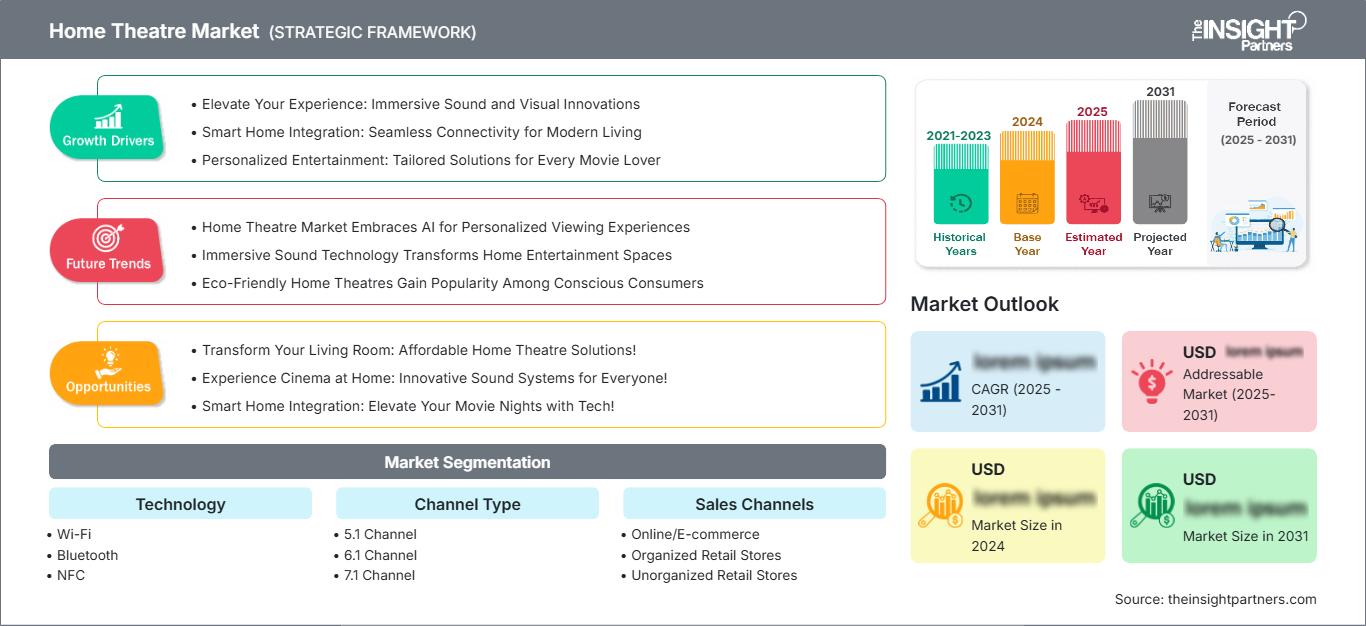
The Home Theatre Market has been witnessing significant growth driven by consumer preferences for immersive audio, connectivity in entertainment systems, and cinema-style experience inside homes. It is currently worth US$ 13.66 billion in 2025 and will further grow to be worth US$ 26.94 billion by 2034 with a CAGR of 7.84%. Some of the factors driving its growth are smart TV penetration, consumption of streaming content, wireless audio devices, and increasing preference for entertainment solutions.
Growing Home Theatre Market size in North America is attributed to well-established home entertainment systems, high disposable incomes of the residents, and usage of premium audio products. The region is expected to grow at a 6-8% CAGR till 2034 on the back of replacement needs, home renovations, gaming, and streaming content.
The competitive framework is increasingly dictated by the convergence of televisions, soundbars, speakers, streaming, gaming, and wireless technology. The trend towards simplicity of installation, spatial audio, multi-room capability, and software-controlled customization is emerging among manufacturers. This is widening the customer market from die-hard enthusiasts to average households favoring small-sized equipment providing high-performance capabilities, without the hassle normally associated with component systems.
Technology options, including streaming, large-screen displays, gaming, and high-quality audio formats, are leading to greater consumer interest in superior audio solutions, coupled with wireless technology simplifying the installation process. Options in terms of technology, such as Wi-Fi and Bluetooth, play an ever-greater role in flexibility and compatibility. Online shopping provides consumers the opportunity for specification comparison and pricing.
Home Theatre Market Assessment and Insights
- North America: North America is estimated to hold a 34–37% Home Theatre Market share in 2025 and grow at a 6–8% CAGR between 2026–2034, supported by premium audio demand, home renovation, gaming, streaming, and established consumer electronics distribution.
- US: The US represents approximately 80–84% of North America's 2025 market and is projected to grow at a 6–8% CAGR during 2026–2034, supported by premium entertainment and replacement purchases.
- Europe: Europe holds a 25–28% share in 2025 and is expected to grow at an 6–8% CAGR through 2034, led by Germany, the UK, France, Italy, and Spain through premium audio and connected entertainment adoption.
- Asia Pacific: Asia Pacific accounts for a 24–27% share in 2025 and is forecast to expand at a 9–11% CAGR, led by China, Japan, South Korea, India, and Australia as smart TVs and digital entertainment deepen.
- Largest Segment: Wi-Fi commands a 42–46% market share in 2025 and is expected to grow at a 9–11% CAGR, reflecting demand for streaming, multi-room audio, and connected entertainment.
- High Growth Segment: 7.1 Channel represents a 20–24% market share in 2025 and is projected to grow at a 8–10% CAGR as immersive surround sound gains wider acceptance.
- Key companies analyzed in detail: Audio Partnership Plc, Bose Corporation, Intex Technologies (India) Limited, JVCKENWOOD Corporation, HARMAN International Industries, Incorporated, Akai Electric Co., Ltd., Dolby Laboratories, Inc., LG Electronics Inc., Niles Audio Corporation, Panasonic Holdings Corporation
Source: The Insight Partners' analysis based on proprietary research, government publications, company annual reports, investor presentations, industry databases, and expert interviews.
The Home Theatre market has changed from complicated speaker systems to flexible ecosystems comprising soundbars, wireless speakers, AV receivers, smart TVs and digital content providers. Wi-Fi and Bluetooth have made installations less complicated, while spatial audio and object-based formats have raised the bar on immersive sound expectations. Current production needs will be more focused towards compact acoustic designs, processing capabilities, wireless connections and multi-source entertainment compatibility.
Future growth will need to capitalize on new consumer markets, especially in Asia Pacific regions, with growing middle class communities and use of connected devices opening up access to high-end entertainment services. Resources are being directed into wireless technology, intelligent audio technology, gaming capabilities and easy installation. It is also necessary to consider changes in retailing, since online retailing increases availability of products, while organized retail stores offer demonstrations of surround-sound systems.
Home Theatre Market Report Scope
| Report Attribute | Details |
|---|---|
| Market size in 2025 | US$ 13.66 Billion |
| Market Size by 2034 | US$ 26.94 Billion |
| Global CAGR (2026 - 2034) | 7.84% |
| Historical Data | 2021-2024 |
| Forecast period | 2026-2034 |
Home Theatre Market Analysis
The market growth is aided by increasing demand in consumption of streaming video, gaming, premium content on television, and digital entertainment. These include suppliers of speakers, audio processors, wireless connectivity chips, televisions, content providers, distributors, retailers, and installers. Consumer preferences are shifting towards devices that have superior acoustic performance and simplicity of configuration along with wide compatibility of devices.
Factors affecting supply are based on semiconductors availability, acoustic components cost, wireless chipsets, and improved digital signal processing. This means that suppliers are providing devices which have balance between performance and size as well as affordability. Soundbars and all-in-one devices can cater to common consumers while multiple speakers setups can serve enthusiasts and premium homes.
Analysis of the Home Theatre market reveals that competition is expanding since traditional audio experts are competing against consumer electronic brands and technology platforms. The Bose Corporation, HARMAN International Industries, Incorporated, LG Electronics Inc., Panasonic Holdings Corporation, and JVCKENWOOD Corporation have their presence in the complementary parts of the entertainment value chain. The Dolby Laboratories, Inc. is contributing to the content/audio format layer of the ecosystem, whereas the Audio Partnership Plc, Niles Audio Corporation, and Akai Electric Co., Ltd. bring audio expertise into the equation.
It becomes increasingly important for strategic positioning to consider the combination of factors like sound quality, convenience, ecosystem compatibility, and pricing. The focus is put on wireless capabilities, spatial audio, voice clarity, game performance, and configuration via apps. While the online marketing channel can offer reach and transparency in pricing, organized retail will still be necessary for premium products where demonstration is required.
● REPORT CUSTOMIZATION
Tailor This Report To Align With Your Specific Business Requirements
This report can be customized to align precisely with your business objectives, scope, and target markets. Customization options include tailored segmentation, geography, competitive analysis, and strategic insights to support informed decision-making.
Customize This Report →WHAT YOU CAN ADJUST
- ● Segmentations
- ● Geography
- ● Competitive Analysis
- ● Language Preferences
Home Theatre Market: Strategic Insights
Regional Insights
North America Home Theatre Market
The North American region represents 34-37% market share in 2025 and will see a CAGR of 6-8% till 2034. The advantages possessed by the North American region are high penetration of smart TV, advanced broadband network, luxury consumer electronics consumption, and high levels of home renovations.
Consumer spending decisions are becoming more driven by the need for gaming, streaming services, sports watching, and luxury TV screens. Wireless devices are becoming important as they can be easily installed and allow changes in room configuration. While luxury customers prefer systems with multiple speakers, ordinary consumers are increasingly going for sound bars and small systems. Leading brands and professional installers ensure access to a wide variety of products while online stores increase price comparisons.
U.S. Home Theatre Market Market
The US holds about 80% - 84% share of North American market of 2025 and is expected to grow at 6% - 8% CAGR during 2034. High expenditure by US households on entertainment technology, large screen TVs, gaming devices, and streaming services drives audio equipment upgrades. Bose Corporation, HARMAN International Industries, Incorporated, LG Electronics Inc. and other major vendors have high market visibility.
Priority applications include movie streaming, gaming, sports, and multi-room entertainment. Luxury customers prefer surround audio system installation, while middle class consumers opt for wireless soundbars and all-in-one products. High replacement business occurs as consumers upgrade their television sets and audio equipment simultaneously. E-commerce fuels sales of budget audio equipment, while specialty shops and installers play a significant role in sales of premium products.
Europe Home Theatre Market
Europe accounts for 25-28% in 2025 and is projected to expand at a 6-8% CAGR up until 2034, with Germany acting as one of the major countries. The drivers include consumer electronics of high value, entertainment streaming services, gaming and replacement of legacy sound equipment. Additional market includes the UK, France, Italy and Spain, where there are well-established channels for retail and connected devices.
The UK shows strong demand for multi-function entertainment systems as consumers tend to use streaming services, play games and watch TV simultaneously. In Germany, consumers show preference towards engineering and high-quality sound experience. France, Italy and Spain offer demand via upgrades of smart TVs, wireless audio and entertainment streaming. In Europe, apart from sound quality, design, energy consumption, connectivity and installation become more and more important.
APAC Home Theatre Market
APAC accounts for a 24%–27% share in 2025 and is expected to expand at a 9%–11% CAGR until 2034. China is the dominant regional market driven by consumer electronics production, high urban population density, and usage of connected devices. Japan and South Korea prioritize premium technology products, whereas India and Australia offer other growth prospects.
Increasing penetration of smart televisions, digital entertainment, gaming, and disposable income are driving growth. Manufacturing and technological ecosystem strength will be an advantage in China, whereas India will benefit from significant long-term potential resulting from urbanization and development of the e-commerce industry. Japan and South Korea prefer advanced audio technology and small form factors, while Australia will foster the use of premium home entertainment setups.
Middle East & Africa Home Theatre Market
The Middle East & Africa is expected to witness growth in the range of 8-10% till 2034, and among these two countries, UAE and Saudi Arabia have emerged as major opportunities. Premium residences, entertainment-linked consumer preferences, and investments in entertainment infrastructure fuel the need for audio solutions and entertainment.
South Africa offers an established consumer electronics market, whereas the Rest of MEA is offering selective opportunities via urbanization and improved retail connectivity. The consumer preference for premium homes with entertainment areas and advanced audio systems in Gulf is evident. Investments in entertainment infrastructure in Saudi Arabia and luxury residences in the UAE will further help with premium installations, whereas online distribution channels facilitate easier access to products.
Segmentation Analysis
Technology
Technology covers Wi-Fi, Bluetooth, and NFC, with the segment expected to grow at a 9–11% CAGR during 2026–2034. Home Theatre Market scope is increasingly defined by connectivity because consumers want flexible streaming, device pairing, multi-room functionality, and simplified installation. Wi-Fi has particular strategic importance for networked entertainment, while Bluetooth remains widely relevant for direct device connections.
- Wi-Fi holds a strong position because it supports streaming, multi-room synchronization, software updates, and integration with connected televisions. Its network capabilities make it strategically important for higher-functionality entertainment ecosystems.
- Bluetooth remains important for simple device pairing and direct audio streaming. Its broad compatibility and low setup complexity support mainstream adoption across speakers, televisions, mobile devices, and personal entertainment equipment.
- NFC serves primarily as a convenience technology for quick device pairing and configuration. Its strategic value is strongest where manufacturers seek frictionless setup and intuitive interaction with compatible consumer electronics.
Channel Type
Channel Type includes 5.1 Channel, 6.1 Channel, 7.1 Channel, and 9.1 Channel and above, with the segment forecast to grow at a 8–10% CAGR through 2034. Higher channel configurations remain associated with immersive entertainment and dedicated installations, while simpler configurations address mainstream consumers seeking practical surround sound.
- 5.1 Channel remains a foundational surround configuration, balancing immersive performance with manageable equipment requirements. It serves households seeking a meaningful improvement over television audio without extensive room customization.
- 6.1 Channel occupies a specialized position between conventional and more advanced surround architectures. Demand is comparatively selective, with adoption influenced by compatibility, room configuration, and enthusiast preferences.
- 7.1 Channel provides stronger spatial separation and remains relevant for dedicated entertainment rooms, gaming, and premium home cinema. It offers a practical pathway toward more immersive experiences without requiring the highest channel complexity.
- 9.1 Channel and above targets premium enthusiasts seeking greater spatial immersion and advanced room configurations. Its strategic importance is tied to high-value installations, object-based audio compatibility, and specialized home cinema environments.
Sales Channels
Sales Channels comprises Online/E-commerce, Organized Retail Stores, and Unorganized Retail Stores and is expected to grow at a 7–9% CAGR during 2026–2034. Home Theatre Market demand is increasingly shaped by omnichannel purchasing, where consumers research specifications digitally but may prefer physical demonstrations for premium systems.
- Online/E-commerce benefits from broad product availability, transparent pricing, consumer reviews, and convenient delivery. It is particularly important for standardized soundbars, speakers, and connectivity-enabled systems that require limited professional installation.
- Organized Retail Stores remain strategically important for premium products because consumers can experience sound quality, compare configurations, and receive expert assistance. Demonstration capability supports higher-value purchases and complex systems.
- Unorganized Retail Stores retain relevance in price-sensitive and geographically dispersed markets. Their local relationships and flexible purchasing arrangements can support access to entry-level and mid-range entertainment equipment.
Opportunity Snapshot
| Sales Channels | Revenue Contribution (High/Medium/Low) | Trend Tag | Adoption Stage |
| Online/E-commerce | High | Digital Discovery | Scaling |
| Organized Retail Stores | High | Audio Demonstration | Mature |
| Unorganized Retail Stores | Medium | Local Access | Mature |
Home Theatre Market Growth Drivers and Impact Analysis
Streaming and Gaming Expand Premium Audio Demand
Increased use of streaming services and gaming is resulting in higher consumption of digitally distributed entertainment, thus making the need for improved audio reproduction even more evident. The visuals of large-screen TVs have become much better than before, but their thinner bodies make it difficult to fit good-quality acoustics, thereby providing an opportunity for improving external speaker solutions. Positional and immersive audio, low latency, and many other factors make gaming require higher-quality sound output, thus making surround sound and wireless speakers options for gamers. The business opportunity lies in a broadened market of entertainment audio for households, which would use speakers only for TV sounds before. It is possible to develop solutions that would provide movie-style sound, support gaming, be capable of switching between content sources easily, and have an app-based interface.
Wireless Connectivity Simplifies Residential Installation
Wireless connectivity is decreasing the real-world difficulties of installing a home theater setup. People will be able to install the rear speakers, subwoofers, and additional audio components without laying down many wires, hence making high-quality sound systems easy to incorporate into today’s homes. Wi-Fi will facilitate networking and multi-room capabilities, while Bluetooth technology will allow connections directly from the phone and other devices. It will not only reduce installation times but also increase the number of people willing to adopt it due to reluctance in making major changes. For the manufacturer, wireless systems present the chance of adding more software, accessories, and expansion of the product line after the initial sales. This trend is affecting all kinds of products since wireless connectivity enables the television, soundbar, speakers, and even phones to work as a single entertainment system.
Spatial Audio Raises Consumer Expectations for Immersion
Spatial audio technologies are changing consumer expectations by making sound placement a visible part of the entertainment experience. Object-based formats and advanced signal processing can create a stronger perception of height, movement, and positional detail without requiring extremely complex speaker arrangements. This development encourages manufacturers to differentiate through acoustic processing, speaker placement, calibration, and compatibility with premium content. It also creates an upgrade pathway for households that already own large televisions but want a more immersive experience. The commercial effect is particularly relevant to premium segments, where consumers are more willing to pay for additional speakers, advanced processing, and specialized installation. As spatial audio becomes more familiar through streaming, gaming, and cinema content, manufacturers can use simplified configurations to introduce immersive features to mainstream consumers while retaining higher channel-count products for enthusiasts.
Home Theatre Market Future Trends
Home Theatre Market trends Shift Toward Modular Wireless Systems
The Home Theatre Market forecast indicates that future systems are likely to become increasingly modular, allowing consumers to begin with a soundbar or compact speaker and progressively add wireless surrounds, subwoofers, or additional rooms. This model can reduce the upfront commitment associated with traditional home cinema while creating a pathway toward premium configurations. Software will become more important because calibration, device management, content optimization, and updates can be delivered after purchase. Manufacturers are also likely to prioritize interoperability with televisions, gaming consoles, streaming services, and smart-home platforms. Modular designs can improve replacement economics because individual components may be upgraded without rebuilding the complete system. Over time, the distinction between soundbar, multi-room audio, and home cinema platforms is likely to become less rigid as consumers expect one ecosystem to support casual listening, gaming, movie viewing, and whole-home entertainment.
Intelligent Audio Processing Becomes a Differentiator
Artificial intelligence and advanced digital signal processing are expected to play a greater role in adapting sound to room conditions, content type, listener position, and dialogue requirements. Automated calibration can reduce the technical knowledge needed to achieve satisfactory performance, helping premium capabilities reach mainstream households. Manufacturers may increasingly use software to optimize speech clarity during movies, adjust gaming sound profiles, and balance music reproduction without requiring manual equalization. This shift changes competitive emphasis from speaker hardware alone toward the combination of acoustics, processors, microphones, algorithms, and user interfaces. It also creates opportunities for recurring software enhancements because manufacturers can improve performance through updates after installation. As intelligent processing becomes more capable, simple setup and consistent performance may become stronger purchase criteria alongside conventional measures such as power output, speaker count, and frequency response.
Home Theatre Market Opportunities
Premium Bundles Across Television and Audio Ecosystems
Manufacturers can pursue higher-value opportunities by combining televisions, soundbars, speakers, and connectivity services into coordinated entertainment packages. Bundling can simplify purchasing while ensuring that audio and visual products operate together with compatible interfaces and optimized settings. Retailers can reinforce this strategy through demonstration zones that show the difference between basic television sound and immersive configurations. Manufacturers can also create upgrade pathways that allow consumers to add rear speakers or subwoofers after the initial purchase. The opportunity is particularly attractive for premium households and new residential projects where entertainment equipment can be specified as part of the interior technology package. Strategic partnerships among display manufacturers, audio brands, content providers, and retailers can reduce compatibility concerns and increase customer lifetime value by encouraging ecosystem-based purchases rather than isolated equipment transactions.
Emerging-Market Distribution Through Digital Retail
Emerging markets offer an opportunity to expand access through e-commerce, localized product portfolios, and tiered pricing. Digital retail can overcome limitations associated with specialist audio-store coverage by providing consumers with wider product selection and detailed specifications. Manufacturers can use this channel to introduce compact wireless systems before moving customers toward higher-value configurations. Localized tuning, language support, payment options, warranty services, and installation partnerships can improve conversion and reduce after-sales friction. India and Southeast Asia are particularly relevant because expanding digital commerce and connected-device adoption can broaden the consumer base for home entertainment. In these markets, suppliers should balance premium features with affordability, focusing on simple installation and compatibility with widely used televisions and streaming devices. Effective digital distribution can therefore support market expansion without requiring a large physical retail footprint.
Recent Developments
- June 2026: Sony India — expanded its BRAVIA Theatre portfolio with the flagship BRAVIA Theatre Trio, BRAVIA Theatre Bar 7, Bar 5, Sub 9, Sub 8 and Rear 9/Rear 8, featuring technologies including 360 Spatial Sound Mapping and Dolby Atmos for immersive, cinema-like home entertainment.
- July 2026: Portronics — launched the CineArc 5.1-channel home theatre system with 200W HD sound, combining a soundbar, dual wired satellite speakers and a dedicated wired subwoofer, with Bluetooth 5.4 and multiple EQ modes for movies, gaming, music and streaming.
- April 2026: JBL — launched its new JBL Bar series in India as part of its 80th-anniversary celebrations, bringing Dolby Atmos-powered immersive audio and an expanded range of home cinema soundbars to the Indian market..
Frequently Asked Questions

- Comprehensive Market Sizing and Forecast Analysis
- Detailed Segmentation Analysis
- In-Depth Market Dynamics Assessment
- Regional and Country-Level Insights
- Competitive Landscape and Company Benchmarking
- Strategic Business Intelligence
Recent Reports
Testimonials

The Insight Partners provided valuable market intelligence that supported our global go-to-market strategy. Their team was professional, responsive, and attentive to our feedback, providing thoughtful analysis and helpful methodological clarifications throughout the project.
Junmo Kim Chief Financial Officer (CFO), Enertech Co., Ltd.
The Insight Partners' SCADA System Market report is comprehensive, with valuable insights on current trends and future forecasts. The team was highly professional, responsive, and supportive throughout. We are very satisfied and highly recommend their services.
RAN KEDEM Partner, Reali Technologies LTDs
I requested a report on a very specific software market and the team produced the report in a few days. The information was very relevant and well presented. I then requested some changes and additions to the report. The team was again very responsive and I got the final report in less than a week.
JEAN-HERVE JENN Chairman, Future Analytica
We worked with The Insight Partners for an important market study and forecast. They gave us clear insights into opportunities and risks, which helped shape our plans. Their research was easy to use and based on solid data. It helped us make smart, confident decisions. We highly recommend them.
PIYUSH NAGPAL Sr. Vice President, High Beam Global
The Insight Partners delivered insightful, well-structured market research with strong domain expertise. Their team was professional and responsive throughout. The user-friendly website made accessing industry reports seamless. We highly recommend them for reliable, high-quality research services
YUKIHIKO ADACHI CEO, Deep Blue, LLC.
This is the first time I have purchased a market report from The Insight Partners.While I was unsure at first, I visited their web site and felt more comfortable to take the risk and purchase a market report.I am completely satisfied with the quality of the report and customer service. I had several questions and comments with the initial report, but after a couple of dialogs over email with their analyst I believe I have a report that I can use as input to our strategic planning process.Thank you so much for taking the extra time and making this a positive experience.I will definitely recommend your service to others and you will be my first call when we need further market data.
JOHN SUZUKI President and Chief Executive Officer, Board Director, BK Technologies
I wish to appreciate your support and the professionalism you displayed in the course of attending to my request for information regarding to infectious disease IVD market in Nigeria. I appreciate your patience, your guidance, and the fact that you were willing to offer a discount, which eventually made it possible for us to close a deal. I look forward to engaging The Insight Partners in the future, all thanks to the impression you have created in me as a result of this first encounter.
DR CHIJIOKE ONYIA MANAGING DIRECTOR, PineCrest Healthcare Ltd.Reason to Buy
- Informed Decision-Making
- Understanding Market Dynamics
- Competitive Analysis
- Identifying Emerging Markets
- Customer Insights
- Market Forecasts
- Risk Mitigation
- Boosting Operational Efficiency
- Strategic Planning
- Investment Justification
- Tracking Industry Innovations
- Aligning with Regulatory Trends





 Get Free Sample for