
Hospitality Robots Market Growth, Trends & Demand by 2034
Hospitality Robots Market Size and Forecasts (2021 - 2034), Global and Regional Share, Trends, and Growth Opportunity Analysis Report Coverage : By Type (Reception/Front Desk Robots, Mobile Guidance Robots, Delivery Robots, Cleaning Robots), End User (Hotels, Bars & Restaurants, Travel & Tourism)
- Status : Data Released
- Report Code : TIPRE00039458
- Category : Electronics and Semiconductor
- No. of Pages : 150
- Available Report Formats :


- Last update date : September 17, 2026


2025 Market Size
US$ 597.80 Mn
Base year value
2034 Forecast
US$ 4,345.20 Mn
Projected by 2034
CAGR 2026-2034
24.66 %
Growth rate
Addressable Market
US$ 18,948.23 Mn
(2026-2034)
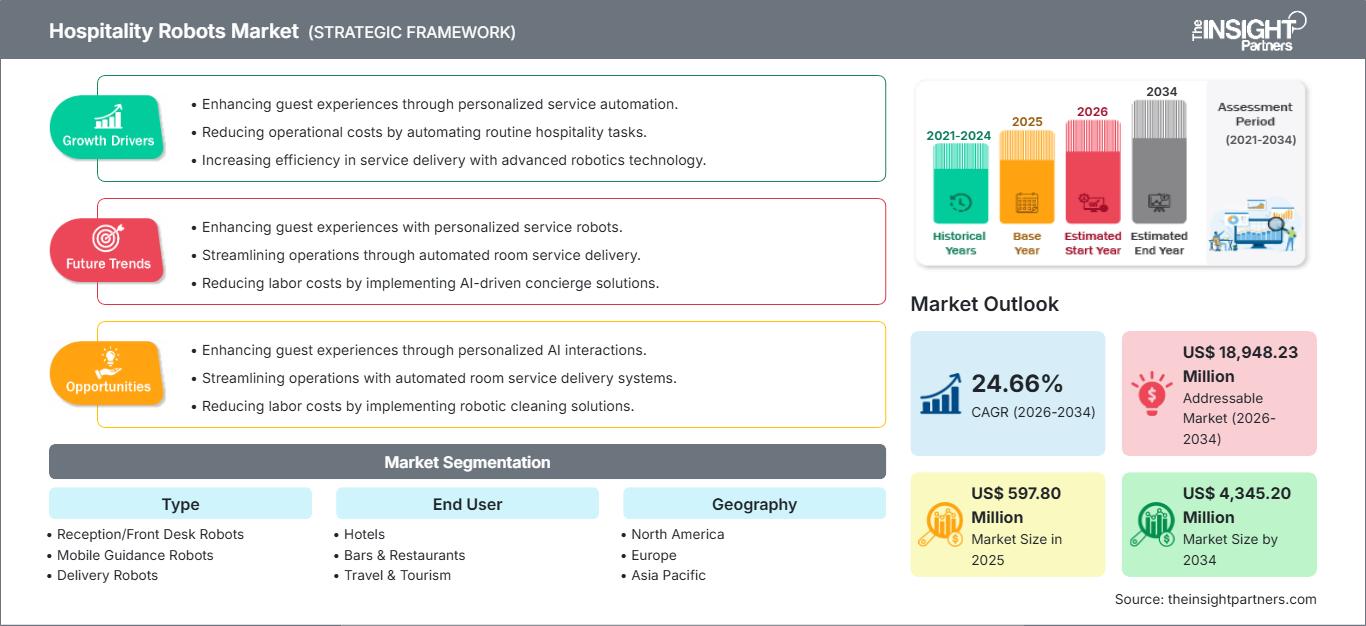
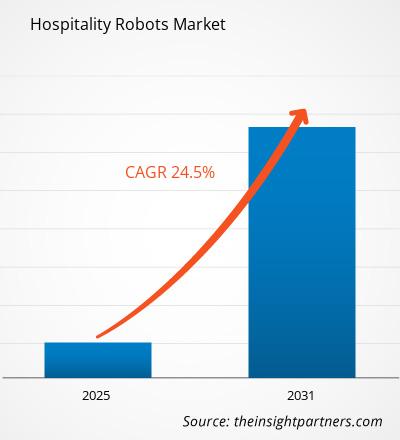
The Hospitality Robots Market was valued at US$ 597.80 Million in 2025 and is projected to reach US$ 4,345.20 Million by 2034, expanding at a CAGR of 24.66% during 2026–2034. Robotics has been backed by labor limitations, service expectations growth, automation, advancements in navigational autonomy and robotics being employed for delivery purposes, cleaning operations, guiding services and repeated tasks in hospitality operations.
The North American Hospitality Robots Market Size is considered as a pioneer region, thanks to factors such as labor cost considerations, technologically advanced hotels and existing robot service installations. The region is forecast to grow at a 23.5-24.5% CAGR for 2026-2034. Growth is expected due to the demand for robotic room services delivery, housekeeping and contactless guest services.
Hospitality Robots Market Assessment and Insights
- North America: North America held an estimated 34–38% share in 2025 and is projected to grow at a 23.5–24.5% CAGR between 2026–2034, supported by labor shortages, established robotics adoption, and technology investment by major hotel groups.
- US: The US represented approximately 81–85% of North America's 2025 market and is expected to grow at a 23.2–24.2% CAGR between 2026–2034, led by hotels and restaurants.
- Europe: Europe accounted for approximately 27–31% share in 2025 and is forecast to expand at a 22.8–23.8% CAGR between 2026–2034, with the UK, Germany, France, Italy, and Spain supporting deployments.
- Asia Pacific: Asia Pacific represented approximately 23–27% share in 2025 and is expected to record a 27.0–28.0% CAGR between 2026–2034, led by China, Japan, South Korea, India, and Australia.
- Largest Segment: Delivery Robots represented approximately 38–42% market share in 2025 and are expected to grow at a 24.8–25.8% CAGR from 2026–2034, supported by food and amenity delivery.
- High Growth Segment: Travel & Tourism represented approximately 17–21% market share in 2025 and is projected to expand at a 27.1–28.1% CAGR from 2026–2034, reflecting automated guest services.
- Key companies analyzed in detail: Relay Robotics Inc., LG Electronics Co. Ltd., Bear Robotics, Inc., Auris Robotique, Revolve Robotics, Servi Robotics, Hyundai Robotics Co., Ltd., Connected Robotics Inc., Aethon Inc., SoftBank Robotics.
Source: The Insight Partners' analysis based on proprietary research, government publications, company annual reports, investor presentations, industry databases, and expert interviews.
Market progress is moving away from stand-alone trial applications to end-to-end solutions with autonomy for delivery, cleaning, reception services, and navigation. Developments in lidar sensors, cameras, AI technology, fleet management, and indoor mapping are boosting reliability. Production practices are becoming increasingly focused on standardization of robot hardware, payloads, firmware, and remote diagnostics, thus enabling vendors to use similar hardware setups for various hospitality applications.
Expansion into the future will depend more on interoperability with property management software, elevator technology, access control systems, online ordering apps, and other infrastructure. New markets emerging in Asia-Pacific and the Middle East present opportunities for deployments by hospitality companies upgrading their infrastructure. Attention of authorities is likely to focus on machine safety, cybersecurity, guest privacy, accessibility, and human-robot interaction going forward.
Hospitality Robots Market Report Scope
| Report Attribute | Details |
|---|---|
| Market size in 2025 | US$ 597.80 Million |
| Market Size by 2034 | US$ 4,345.20 Million |
| Global CAGR (2026 - 2034) | 24.66% |
| Historical Data | 2021-2024 |
| Forecast period | 2026-2034 |
Hospitality Robots Market Analysis
Hospitality Robots Market growth factors include labor shortages, increasing cost of wages, repetitiveness in processes, and need for consistent quality. The value chain involves robot companies, navigations, sensors, software, hotels, restaurants, integrators, maintenance, and management of properties. Applications like delivery and cleaning have the most obvious use cases as processes in these applications are repetitive and measurable.
Supply chain dynamics will involve autonomous mobile robots that can carry various loads or perform multiple operations. Robot companies will be making investments in fleet management, cloud monitoring, battery management, obstacle detection, and operation with elevators. Software maintenance and Robots-as-a-Service models may decrease capital expenditure for hospitality companies. These models will help suppliers to gather more data on operation which will help them in improving navigation of their robots.
Software competence, ability to deploy the product, fleet management, adaptability of the payloads carried, and ability to integrate into hospitality procedures will determine the competitive positioning in the future. The study of Hospitality Robots Market Report reveals a competitive landscape that consists of specialists in robotics and diversified technology providers. While Relay Robotics is focused on hotel delivery applications, Bear Robotics and LG Electronics Co. Ltd. provide service robots for use in restaurants, hotels, and other commercial facilities.
The trend in investing is shifting from single-use prototypes to scalable autonomous platforms. SoftBank Robotics incorporates both cleaning and delivery functions, while Aethon Inc. and Hyundai Robotics Co., Ltd. bring autonomy and industrial robots expertise. Connected Robotics Inc., Servi Robotics, Revolve Robotics, and Auris Robotique offer specialist technologies. The differentiation will be based on economic aspects of deploying robots, integration services, and labor productivity results.
● REPORT CUSTOMIZATION
Tailor This Report To Align With Your Specific Business Requirements
This report can be customized to align precisely with your business objectives, scope, and target markets. Customization options include tailored segmentation, geography, competitive analysis, and strategic insights to support informed decision-making.
Customize This Report →WHAT YOU CAN ADJUST
- ● Segmentations
- ● Geography
- ● Competitive Analysis
- ● Language Preferences
Hospitality Robots Market: Strategic Insights
Regional Insights
North America Hospitality Robots Market
North America held around 34-38% Hospitality Robots Market share in 2025 and will register a CAGR of 23.5-24.5% during 2026-2034. The USA continues to be the leading regional market, owing to the presence of existing hotel chains, restaurant automation, higher labor costs, and significant investments made in automated services. Additional demand is provided by Canada through hotel modernization and food-service modernization initiatives, especially when looking for assistance with repetitive delivery and housekeeping tasks.
Hotels now consider robots for their economics, not novelty. Delivery robots can move room-service meals, amenities, bed sheets, and other items, whereas cleaning robots help to solve repetitive floor-maintenance tasks. Connecting the robot with elevators, access control, ordering system, and management system makes it more practical to use. The region has a developed venture capital and tech ecosystem, which allows for faster commercialization of artificial intelligence, fleet management, and autonomous navigation technologies in hotels.
U.S. Hospitality Robots Market
The US accounted for 81–85% of the market in North America in 2025 and is estimated to exhibit 23.2–24.2% CAGR during 2023-2034. There are several deployment scenarios that include big hotel chains, restaurants, casinos, airports, and entertainment. Relay Robotics Inc. has developed room service delivery robots, while LG Electronics Co. Ltd. and Bear Robotics, Inc. cater to food and other commercial robot deployments including food delivery and hospitality services.
There is a change in application trend towards improvement in productivity. There is the use of robots for delivering room service, food runners, cleaning, guiding guests, and transporting things in the back. Hotels evaluate the effectiveness of deployment on the basis of labor productivity, consistency of service, delivery time, and guest satisfaction. There is an option of subscriptions and Robots-as-a-Service business model which makes the cost of deployment relatively affordable, especially for individual hotels.
Europe Hospitality Robots Market
Europe is estimated to have a Hospitality Robots Market share of about 27-31% in 2025 and will grow at a CAGR of 22.8-23.8%. The UK is seen as the key country due to the presence of hotel automation projects, labor shortages, and existing deployments of service robots. Germany is known for good engineering skills and large hospitality sector, which drives the need for robots for cleaning, deliveries, and navigation.
In addition, France, Italy, and Spain offer opportunities in terms of tourism, hotels, restaurants, and a lot of visitors. European companies are increasingly considering the use of robots in housekeeping, food service, and logistics, but not in direct customer interactions. There could be some factors that could drive deployment such as regulations on labor, workplace safety, cybersecurity, and data protection. As a result, suppliers require good compliance management along with good navigation technologies.
APAC Hospitality Robots Market
APAC was responsible for 23-27% share in 2025 and is expected to have a CAGR of 27.0-28.0%, making it the fastest-growing major region. China is leading the regional market, followed by Japan, South Korea, India, and Australia. Factors such as advanced manufacturing ecosystem, aging workforce, technology adoption, and smart city initiatives can drive investments into autonomous service platforms.
Japan and South Korea will offer a well-developed robotics ecosystem, whereas China will leverage the manufacturing scale available locally. India will witness growing opportunities due to increased organization of the hospitality sector and digital transformation of hotels. Applications in hotels and tourism facilities are being developed in Australia. The policy support in automation, AI, and smart infrastructure can create good conditions for implementation of the technology. The demand will be driven by delivery, cleaning, guiding guests, and restaurants service applications.
Middle East & Africa Hospitality Robots Market
The Middle East and Africa segment is not as extensive but has considerable selective opportunities, especially within the realm of luxury hospitality. Saudi Arabia and UAE are the top regional markets that benefit from tourism development, luxury hotel development, large-scale destinations, and investments into the technology-powered guest experience. South Africa serves as an example of a well-developed hospitality and service-technology ecosystem.
The regional market is estimated to demonstrate the growth rate of 21.5-22.5% CAGR until 2034. The big scale of the tourism and infrastructure projects in the region can serve as a good environment for the deployment of autonomous delivery, cleaning, and assistance robots. UAE emerges as the leader among other markets due to the high degree of technology adoption and presence of luxury hospitality. Saudi Arabia benefits from destination development, while the rest of MEA offers selective opportunities.
Segmentation Analysis
Type
Type represents a central segmentation because each robotic application addresses different operational pain points. The segment is projected to grow at a 24.1–25.1% CAGR from 2026–2034. Delivery Robots currently hold the largest position because food, amenities, and internal logistics involve repetitive routes with measurable productivity outcomes. Cleaning and guidance applications are expanding as sensor accuracy and fleet-management capabilities improve.
- Reception/Front Desk Robots: These robots support check-in assistance, information delivery, wayfinding, and routine guest interactions. Their strategic role is strongest in technology-focused properties where operators want to automate repetitive information requests while preserving human involvement for complex guest needs.
- Mobile Guidance Robots: Mobile guidance systems help guests navigate hotels, resorts, convention facilities, and entertainment venues. Demand is supported by large property footprints, accessibility requirements, multilingual assistance, and the need to provide consistent wayfinding without increasing front-desk workload.
- Delivery Robots: Delivery robots represent the leading type because they address repetitive transportation of meals, amenities, linens, and supplies. Their strategic importance is reinforced by measurable route efficiency, continuous operation, elevator integration, and compatibility with hospitality workflows.
- Cleaning Robots: Cleaning robots automate repetitive floor-care activities across corridors, lobbies, restaurants, and common areas. Adoption is increasingly linked to housekeeping productivity, consistent cleaning standards, reduced repetitive workload, and improved allocation of staff toward guest-facing activities.
End User
End User is expected to expand at a 25.0–26.0% CAGR from 2026–2034, with hotels providing the largest installed base. Restaurants and bars remain important because food-running tasks are repetitive and labor intensive, while travel and tourism venues offer high-growth applications involving navigation, cleaning, delivery, and guest assistance.
- Hotels: Hotels provide the broadest deployment opportunity because robots can support room-service delivery, housekeeping, guest guidance, and internal logistics. Large properties offer multiple repetitive workflows, improving the potential utilization of autonomous systems.
- Bars & Restaurants: Restaurants use service robots for food running, table clearing, delivery, and customer engagement. High transaction volumes and staff movement requirements make these environments suitable for robots that can operate continuously during peak service periods.
- Travel & Tourism: Travel and tourism facilities offer emerging applications spanning airports, resorts, attractions, cruise-related environments, and visitor centers. Large visitor flows and complex layouts increase the potential value of automated guidance, delivery, cleaning, and information services.
Opportunity Snapshot
| End User | Revenue Contribution | Trend Tag | Adoption Stage |
| Hotels | High | Room Delivery | Scaling |
| Bars & Restaurants | High | Food Running | Scaling |
| Travel & Tourism | Medium | Guest Guidance | Emerging |
Hospitality Robots Market Growth Drivers and Impact Analysis
Persistent Hospitality Labor Constraints
Labor availability and workforce costs are becoming central considerations for hospitality operators, particularly for repetitive tasks that require continuous movement rather than complex human judgment. Robots can address selected workflows without eliminating the need for hospitality personnel, allowing employees to concentrate on guest interaction, room preparation, problem resolution, and service recovery. This changes the business case from pure labor substitution toward labor augmentation and capacity expansion. Hotels can deploy delivery robots during night shifts, while restaurants can use autonomous food-running systems during peak periods. Cleaning robots can similarly cover repetitive floor maintenance. The resulting operational impact is strongest where properties experience high task frequency and measurable travel distances. As operators evaluate automation through productivity metrics, robotic deployment becomes more closely linked to staffing strategy and service-level consistency.
Advances in Autonomous Navigation and Fleet Management
Rapid improvement in sensors, mapping, artificial intelligence, and fleet-management software is reducing the technical barriers associated with indoor robot deployment. Modern platforms can recognize obstacles, optimize routes, communicate with elevators, and coordinate multiple machines within the same facility. These capabilities are particularly valuable in hospitality environments where layouts are dynamic and interactions with guests are continuous. Better navigation reduces intervention requirements and improves utilization, strengthening the economic case for autonomous systems. Fleet management also allows operators to monitor battery levels, task completion, location, and maintenance requirements from centralized interfaces. As software becomes more capable, manufacturers can update robot functionality without replacing physical hardware. This creates an expanding role for software engineering, remote support, data analytics, and recurring digital services within hospitality automation.
Demand for Consistent Guest Service
Hospitality operators are increasingly focused on maintaining consistent service standards across properties, shifts, and operating conditions. Robots can perform defined tasks according to programmed workflows, reducing variability in repetitive delivery, cleaning, and guidance activities. This consistency is particularly relevant for hotel chains and restaurant groups seeking standardized operating procedures across geographically dispersed properties. A robot can deliver amenities along predetermined routes, perform scheduled cleaning cycles, or provide repeatable wayfinding assistance without variation caused by staffing levels. The commercial impact extends beyond labor efficiency because consistent execution can support predictable service availability. However, successful deployment depends on maintaining human oversight for exceptions, guest complaints, safety incidents, and tasks requiring empathy. Consequently, the strongest operating models combine autonomous execution with human supervision rather than pursuing fully unattended hospitality environments.
Hospitality Robots Market Future Trends
AI-Powered Guest Interaction Platforms
The Hospitality Robots Market trends are moving toward AI-enabled systems capable of interpreting guest requests, adapting responses, and coordinating physical tasks. Future reception and guidance robots may combine conversational artificial intelligence with property databases, multilingual interfaces, and real-time operational information. Instead of answering only predefined questions, robots could identify guest intent and initiate actions such as directing visitors, requesting housekeeping assistance, or coordinating deliveries. Integration with hotel loyalty platforms could enable more personalized interactions while maintaining appropriate privacy controls. Voice, vision, and language technologies are likely to become increasingly integrated into mobile platforms, improving accessibility and reducing dependence on fixed kiosks. The strategic implication is a transition from task-specific machines toward software-defined service platforms that can combine information delivery, navigation, and operational coordination within a single guest-facing interface.
Robotics-as-a-Service and Multi-Robot Operations
Robotics-as-a-Service is expected to become more prominent as hospitality operators seek automation without large upfront capital commitments. Subscription models can bundle hardware, software, maintenance, fleet management, and technical support into predictable operating expenses. This approach may accelerate adoption among independent hotels and restaurants that cannot justify substantial equipment purchases. Multi-robot management will also become increasingly important as properties deploy different machines for cleaning, delivery, guidance, and internal logistics. A centralized platform can coordinate charging, task allocation, maintenance, and performance monitoring across the fleet. Vendors that offer interoperable software can therefore create stronger long-term relationships with hospitality operators. The trend also shifts competition toward lifecycle economics, uptime, support responsiveness, and measurable operational outcomes rather than the initial purchase price of individual robots.
Hospitality Robots Market Opportunities
Integration with Hotel Technology Infrastructure
The Hospitality Robots Market Forecasts indicate an opportunity to connect autonomous systems directly with hotel property-management systems, ordering platforms, smart-room infrastructure, access controls, and elevator systems. Deeper integration can reduce manual task assignment and allow robots to respond automatically to operational events. For example, a room-service order could trigger a delivery task, while housekeeping requests could automatically assign an available machine. Integration with access controls can improve security, while elevator connectivity expands the usable operating area within multistory properties. Technology suppliers can develop application programming interfaces and middleware that allow robots from different manufacturers to communicate with existing hotel systems. This opportunity is particularly attractive because software integration can create recurring revenue while improving the practical utilization of installed robotic fleets across large hospitality portfolios.
Expansion Across Large Tourism Destinations
Large tourism developments provide attractive opportunities for autonomous systems because they combine extensive physical areas, high visitor volumes, and repetitive service requirements. Resorts, theme parks, convention centers, cruise-related facilities, airports, and integrated entertainment destinations can deploy multiple robot types across interconnected workflows. Mobile guidance robots can support navigation, delivery systems can transport food and amenities, while cleaning robots can cover common areas. Such environments can justify centralized fleet management because several robots may operate simultaneously across different zones. Vendors can also establish long-term service agreements covering deployment, maintenance, software updates, and operational analytics. This approach can produce larger contracts than individual-property sales while creating reference deployments for additional tourism projects. The opportunity is strongest where developers are already incorporating smart-building infrastructure during project design.
Recent Developments
- June 2025: SoftBank Robotics Group Corp. announced that SoftBank Robotics Australia, working with McLaren Technologies, had rolled out Gausium Phantas cleaning robots across 11 Accor-branded hotels owned by Salter Brothers. The robots were deployed for daily vacuuming, mopping, sweeping, and dusting, allowing housekeeping teams to focus on room preparation and guest-facing activities.
- April 2025: LG Electronics USA introduced a commercial-grade autonomous robotic vacuum cleaner for the hospitality industry, developed with Marriott Design Lab. The solution followed implementation pilots at Marriott International properties and was designed to automate floor cleaning in hotel corridors and meeting spaces while supporting hotel associates with routine maintenance activities.
- January 2025: LG Electronics Co. Ltd. announced that it would acquire an additional 30% stake in Bear Robotics, taking its ownership to 51%. The transaction strengthened LG's control of the AI-driven service-robot company and supported integration of Bear Robotics' software, fleet-management capabilities, and commercial robots with LG's broader robotics business.
Frequently Asked Questions

- Comprehensive Market Sizing and Forecast Analysis
- Detailed Segmentation Analysis
- In-Depth Market Dynamics Assessment
- Regional and Country-Level Insights
- Competitive Landscape and Company Benchmarking
- Strategic Business Intelligence
Recent Reports
Testimonials

The Insight Partners provided valuable market intelligence that supported our global go-to-market strategy. Their team was professional, responsive, and attentive to our feedback, providing thoughtful analysis and helpful methodological clarifications throughout the project.
Junmo Kim Chief Financial Officer (CFO), Enertech Co., Ltd.
The Insight Partners' SCADA System Market report is comprehensive, with valuable insights on current trends and future forecasts. The team was highly professional, responsive, and supportive throughout. We are very satisfied and highly recommend their services.
RAN KEDEM Partner, Reali Technologies LTDs
I requested a report on a very specific software market and the team produced the report in a few days. The information was very relevant and well presented. I then requested some changes and additions to the report. The team was again very responsive and I got the final report in less than a week.
JEAN-HERVE JENN Chairman, Future Analytica
We worked with The Insight Partners for an important market study and forecast. They gave us clear insights into opportunities and risks, which helped shape our plans. Their research was easy to use and based on solid data. It helped us make smart, confident decisions. We highly recommend them.
PIYUSH NAGPAL Sr. Vice President, High Beam Global
The Insight Partners delivered insightful, well-structured market research with strong domain expertise. Their team was professional and responsive throughout. The user-friendly website made accessing industry reports seamless. We highly recommend them for reliable, high-quality research services
YUKIHIKO ADACHI CEO, Deep Blue, LLC.
This is the first time I have purchased a market report from The Insight Partners.While I was unsure at first, I visited their web site and felt more comfortable to take the risk and purchase a market report.I am completely satisfied with the quality of the report and customer service. I had several questions and comments with the initial report, but after a couple of dialogs over email with their analyst I believe I have a report that I can use as input to our strategic planning process.Thank you so much for taking the extra time and making this a positive experience.I will definitely recommend your service to others and you will be my first call when we need further market data.
JOHN SUZUKI President and Chief Executive Officer, Board Director, BK Technologies
I wish to appreciate your support and the professionalism you displayed in the course of attending to my request for information regarding to infectious disease IVD market in Nigeria. I appreciate your patience, your guidance, and the fact that you were willing to offer a discount, which eventually made it possible for us to close a deal. I look forward to engaging The Insight Partners in the future, all thanks to the impression you have created in me as a result of this first encounter.
DR CHIJIOKE ONYIA MANAGING DIRECTOR, PineCrest Healthcare Ltd.Reason to Buy
- Informed Decision-Making
- Understanding Market Dynamics
- Competitive Analysis
- Identifying Emerging Markets
- Customer Insights
- Market Forecasts
- Risk Mitigation
- Boosting Operational Efficiency
- Strategic Planning
- Investment Justification
- Tracking Industry Innovations
- Aligning with Regulatory Trends





 Get Free Sample for