
Hydrogen Generator Market Growth, Demand & Size by 2034
Coverage: by Product Type (On-Site Generation, Portable); Process Type (Steam Reformer, Electrolysis); Capacity (1-100 W, 100-300 W, 300-700W, 700W-1 KW, 1-3KW, 3KW-Above); Application (Chemical Processing, Fuel Cells, Petroleum Recovery, Refining) , and Geography (North America, Europe, Asia Pacific, and South and Central America)
- Status : Data Released
- Report Code : TIPRE00009375
- Category : Manufacturing and Construction
- No. of Pages : 150
- Available Report Formats :


- Last update date : August 28, 2026


2025 Market Size
US$ 784.00 Mn
Base year value
2034 Forecast
US$ 1,499.40 Mn
Projected by 2034
CAGR 2026-2034
7.47 %
Growth rate
Addressable Market
US$ 10,291.57 Mn
(2026-2034)
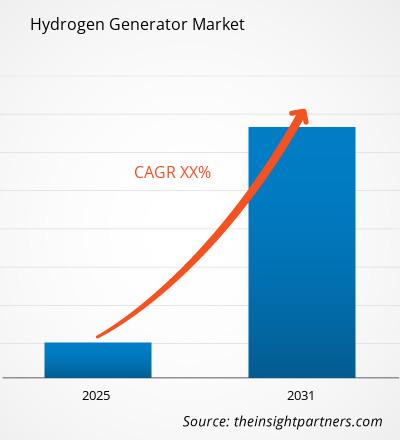
The hydrogen generator market was valued at US$ 784.00 Million in 2025 and is projected to reach US$ 1,499.40 Million by 2034. The market is expected to register a CAGR of 7.47% during 2026–2034. Expansion reflects rising demand for dependable hydrogen supply at industrial sites, greater interest in low-emissions production, and broader deployment of compact generation systems across chemical processing, refining, fuel cells, and petroleum recovery applications.
North America’s hydrogen generator market size is positioned for an estimated 6.8–7.4% CAGR through 2034. Regional momentum is supported by clustered clean-hydrogen infrastructure, established refinery demand, and public programs that reduce early project risk. The region also benefits from a deep base of electrolyzer suppliers, engineering contractors, industrial-gas operators, and fuel-cell integrators, enabling customers to procure complete on-site systems rather than standalone generation equipment.
Hydrogen Generator Market Assessment and Insights
- North America accounted for 29–33% share in 2025 and is projected to grow at 6.8–7.4% CAGR during 2026–2034, supported by refinery conversion projects, regional hydrogen hubs, and expanding electrolyzer manufacturing capacity.
- US represented 78–82% of North American demand in 2025 and is forecast to register 6.9–7.5% CAGR during 2026–2034.
- Europe held 25–29% share in 2025 and is expected to expand at 7.2–7.8% CAGR through 2034, led by Germany, the UK, France, Italy, and Spain.
- Asia Pacific captured 31–35% share in 2025 and is projected to advance at 8.1–8.7% CAGR, with China, Japan, South Korea, India, and Australia directing industrial and policy-backed investment.
- Largest Segment On-site generation held 68–72% market share in 2025 and is projected to grow at 7.1–7.7% CAGR through 2034.
- High Growth Segment Electrolysis represented 41–45% market share in 2025 and is expected to expand at 8.4–9.0% CAGR during 2026–2034.
- Key companies analyzed in detail: Air Products and Chemicals, Inc., Linde plc, Air Liquide S.A., Cummins Inc., Nel ASA, Plug Power Inc., ITM Power PLC, McPhy Energy S.A., thyssenkrupp nucera AG & Co. KGaA, and Siemens Energy AG.
Source: The Insight Partners' analysis based on proprietary research, government publications, company annual reports, investor presentations, industry databases, and expert interviews.
Technology has evolved from centralized merchant supply to modular on-site production in line with hydrogen production to meet variable demands at the plant level. Steam reforming continues to dominate wherever there is an existing gas network and consistent load conditions making economic sense, with electrolysis being increasingly considered for procurement as contracts for renewable electricity and emissions accounting get better. Suppliers have increasingly packaged their offerings to include purification, compression, control systems and maintenance, moving the competitive focus from capital cost to reliability, efficiency, footprint and lifecycle.
Until 2034, the investments are expected to diversify from traditional industrial parks to include ports, logistics centers, distributed fuel cell locations and new manufacturing clusters. Project economics and mechanisms are getting better with policy support in the US, EU, Japan, India and the Middle East. But projects continue to require credible offtake and power connectivity. Successful bankable projects would be those that use standard modules, local service capability, carbon-intensity calculations and staged capacity expansions.
Hydrogen Generator Market Report Scope
| Report Attribute | Details |
|---|---|
| Market size in 2025 | US$ 784.00 Million |
| Market Size by 2034 | US$ 1,499.40 Million |
| Global CAGR (2026 - 2034) | 7.47% |
| Historical Data | 2021-2024 |
| Forecast period | 2026-2034 |
Hydrogen Generator Market Analysis
Hydrogen generator market growth is being driven by reduction in delivery dependence, purity management, and production at the level of use. Refineries and chemical plants continue to be core buyers of hydrogen generators as the gas is critical for desulfurization, hydrocracking, ammonia, and methanol production. On-site fuel cell consumers represent an additional customer segment that cares about reliability and self-sufficiency of supply. Hydrogen generation equipment manufacturers provide stacks, catalysts, reformer units, power conversion modules, water purification systems, compressors, and controls and combine these products with engineering, installation, and maintenance services.
Supply situation varies depending on technology. Steam reformers have benefits of established production and trained technicians but suffer from carbon management restrictions. Electrolysis generators rely more on stack availability, electric power, water availability, and balance of plant design specific to each project. Pre-assembled skids save time during commissioning, while remote monitoring helps in preventive maintenance. Buyers tend to consider total cost of hydrogen, its flexibility and emissions intensity in addition to equipment size.
The hydrogen generator market assessment reveals competitive dynamics among industrial gas players, electrolysis equipment manufacturers, power generation equipment players, and fuel cell players. Air Products and Chemicals, Inc., Linde plc, and Air Liquide S.A. have project engineering capabilities, gas equipment expertise, and customers. Cummins Inc., Nel ASA, Plug Power Inc., ITM Power PLC, McPhy Energy S.A., thyssenkrupp nucera AG & Co. KGaA, and Siemens Energy AG have competitive advantage through stack technology, platform scalability, manufacturing scalability, and partnerships.
Funding is focusing on repeatable platforms, domestically manufactured products, and projects with secure electricity supply and off-take. Competitive positioning has now come to depend on reducing the installed cost of the system without impacting its efficiency and maintainability. While large players can provide funding, engineering, compression, storage, and maintenance for the life cycle of the system, specialists have competitive advantage through better stack technology and product development speed.
● REPORT CUSTOMIZATION
Tailor This Report To Align With Your Specific Business Requirements
This report can be customized to align precisely with your business objectives, scope, and target markets. Customization options include tailored segmentation, geography, competitive analysis, and strategic insights to support informed decision-making.
Customize This Report →WHAT YOU CAN ADJUST
- ● Segmentations
- ● Geography
- ● Competitive Analysis
- ● Language Preferences
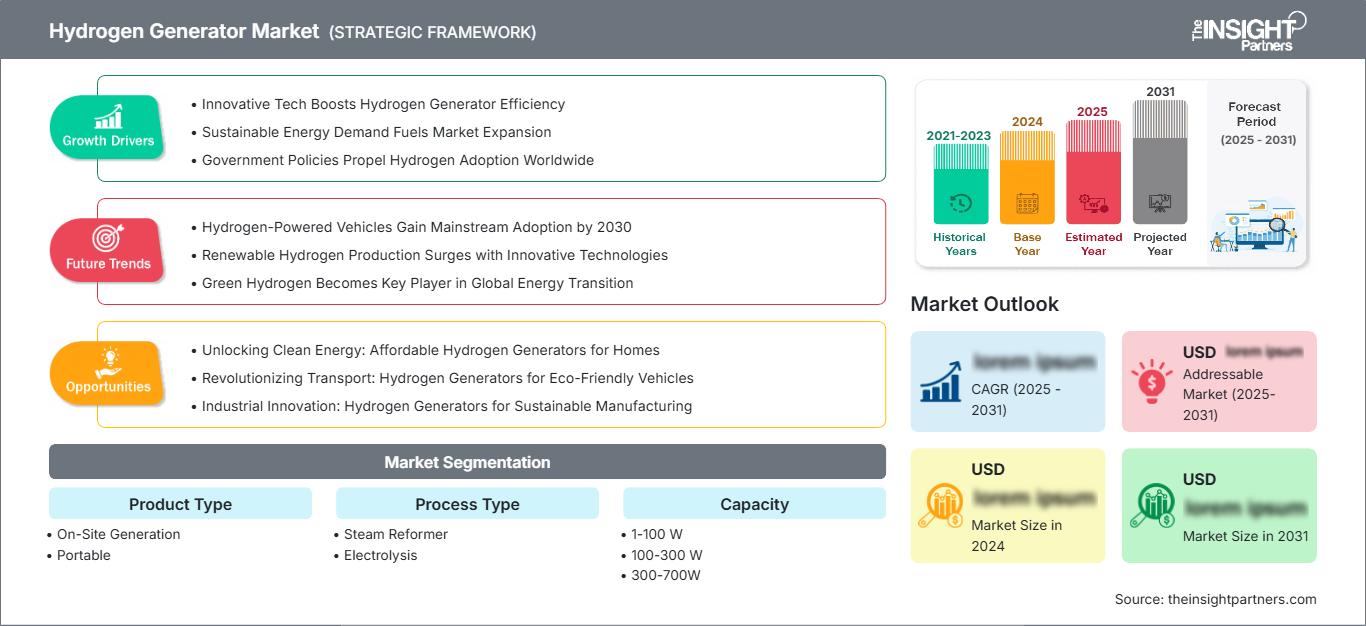
Hydrogen Generator Market: Strategic Insights
Regional Insights
North America hydrogen generator market
North America held 29–33% of the global hydrogen generator market share in 2025 and is expected to post a 6.8–7.4% CAGR through 2034. The US is backed by its refinery hydrogen utilization, chemical manufacturing, fuel cell logistics, and regional hubs development. The current infrastructure of industrial gases ensures project implementation; the rise in the domestic production and design of electrolyzers reduces delivery times for the modular system.
Canada is involved through low-carbon hydrogen projects related to hydro power, natural gas with carbon management, and processing resource. In Mexico, there is potential in the long term in relation to refining and export-oriented manufacturing. However, the availability of energy and permitting is critical in project financing. Throughout the region, the system that includes generation, purification, compression, control, and field service is preferred.
U.S. Hydrogen Generator Market
The US represented 78–82% of North American demand in 2025 and is forecast to expand at 6.9–7.5% CAGR through 2034. Refining continues to be the biggest use case in terms of market size, whereas fuel-cell-powered material handling, back-up power, sustainable fuels initiatives, and distributed industrial manufacturing widen the scope of the market.
Funding from public sources for hydrogen hubs and manufacturing is driving local sourcing and demonstration.
Air Products and Chemicals Inc., Cummins Inc., Plug Power Inc., and the U.S. subsidiaries of Linde plc, Air Liquide S.A., Nel ASA, thyssenkrupp nucera AG & Co. KGaA, and Siemens Energy AG have increased competition on all system scales. Consumers opt more often for phased deployments that can grow with contracted loads, especially when electricity integration and water treatment are involved.
Europe Hydrogen Generator Market
Europe accounted for 25–29% share in 2025 and is projected to record 7.2–7.8% CAGR through 2034. Germany is at the forefront in terms of industry decarbonization, electrolyser technology and refineries repurposing. In the UK, the capacity to harness offshore wind energy complements hydrogen clusters, while in France, the nuclear energy advantage allows for low-carbon electricity production, together with an extensive industrial gas network.
Italy and Spain are developing renewable hydrogen projects in relation to ports, chemicals, refineries and exporting routes. While Spain’s renewables profile ensures the competitiveness of its electrolysis, the Italian gas network and Mediterranean position support an integrated chain of delivery. Better regulatory frameworks for definitions, certification and auctions increase visibility, but electricity costs and offtake are key for investment decision-making.
APAC Hydrogen Generator Market
Asia Pacific held 31–35% share in 2025 and is forecast to grow at 8.1–8.7% CAGR through 2034. China leads through electrolyzer manufacturing scale and industrial deployment. Japan and South Korea emphasize imported and domestic low-carbon hydrogen supply chains, fuel cells, mobility, and power applications.
India’s national mission supports domestic equipment production and refinery, fertilizer, and steel demand, while Australia targets renewable-resource-based exports and local industrial use. Across the region, policy support is substantial, but project outcomes hinge on power cost, certification, infrastructure, and firm offtake.
Middle East & Africa Hydrogen Generator Market
The region is projected to register 7.6–8.2% CAGR through 2034. Saudi Arabia leads through large renewable projects, industrial clusters, and export ambitions, while the UAE combines ports, refining, aviation-fuel initiatives, and access to project capital.
South Africa offers demand from mining, chemicals, and heavy industry alongside strong renewable resources. Rest-of-MEA opportunities center on fertilizers, refining, and export-oriented projects, although grid quality, water availability, financing, and transport infrastructure shape equipment configuration and execution schedules.
Segmentation Analysis
Product Type
The hydrogen generator market scope across product types reflects a 6.9–7.5% CAGR during 2026–2034. On-site systems dominate continuous industrial demand by limiting delivered-gas exposure, while portable units serve laboratories, maintenance, remote power, and temporary operations. Adoption depends on required purity, duty cycle, footprint, utilities, safety design, and service access.
- On-Site Generation supports stable, high-utilization demand in refineries, chemicals, and fuel-cell hubs, making integration, uptime guarantees, and expandable capacity central buying criteria.
- Portable systems address intermittent and mobile requirements where compact design, rapid startup, simplified controls, and low maintenance outweigh the economics of larger fixed installations.
Process Type
Process type is expected to register 7.3–7.9% CAGR through 2034. Steam reforming retains relevance for continuous production where gas access is secure, while electrolysis gains strategic importance as renewable electricity, carbon accounting, and modular deployment improve. Selection increasingly weighs lifecycle emissions, utilization, feedstock volatility, dynamic operation, and carbon-management cost.
- Steam Reformer remains established in refining and chemical processing, offering mature performance and high utilization, but procurement increasingly incorporates emissions controls and carbon-capture readiness.
- Electrolysis enables low-emissions production when paired with qualifying electricity, scales modularly, and supports distributed installations requiring responsive output and verifiable carbon intensity.
Capacity
Capacity segmentation is projected to expand at 7.0–7.6% CAGR during 2026–2034. Small systems support analytical and portable uses, mid-range units serve laboratories and distributed fuel cells, and kilowatt-scale equipment addresses industrial processes. Vendors differentiate through modular stacking, turndown, output pressure, purity, footprint, and ease of maintenance.
- 1-1 W systems serve specialized micro-scale and analytical requirements where compactness, controlled output, and straightforward integration are more important than production volume.
- 1-3 W units address low-duty laboratory and instrumentation needs, emphasizing stable purity, safe operation, and low utility consumption.
- 3-7W generators fit compact technical applications requiring somewhat higher flow, predictable control, and minimal operator intervention.
- 7W-1 KW equipment supports pilot systems, laboratories, and small fuel-cell installations, balancing portability, controllability, and moderate output.
- 1-3KW systems serve distributed industrial and commercial applications where modular expansion, remote monitoring, and integrated purification improve operating economics.
- 3KW-Above units address sustained industrial demand, favoring engineered balance-of-plant, redundancy, service contracts, and integration with compression and storage.
Application
Application demand is expected to grow at 7.2–7.8% CAGR through 2034. Chemical processing and refining provide recurring baseload requirements, fuel cells reward distributed production and purity, and petroleum recovery creates project-specific demand. Supplier success depends on adapting pressure, purity, response time, and service models to each operational environment.
- Chemical Processing relies on dependable hydrogen for ammonia, methanol, specialty chemicals, and process reactions, prioritizing continuous operation, purity assurance, and integration with plant controls.
- Fuel Cells favor distributed generation near consumption, particularly where logistics, uptime, and emissions objectives justify modular electrolyzer or reformer systems.
- Petroleum Recovery uses hydrogen in selected upstream and processing contexts, with demand characterized by project-specific specifications, remote operations, and infrastructure constraints.
- Refining remains a major application for desulfurization and hydrocracking, supporting replacement, debottlenecking, and lower-carbon supply projects across existing facilities.
Opportunity Snapshot
| Application | Revenue Contribution | Trend Tag | Adoption Stage |
| Chemical Processing | High | Feedstock Security | Mature |
| Fuel Cells | Medium | Distributed Supply | Scaling |
| Petroleum Recovery | Low | Remote Operations | Emerging |
| Refining | High | Cleaner Fuels | Mature |
Hydrogen Generator Market Growth Drivers and Impact Analysis
Industrial decarbonization shifts production closer to demand
Hydrogen as feedstock in refineries, chemical facilities, fertilizer plants, and nascent low-carbon fuel plants needs to be produced locally for use as opposed to using it as an energy carrier. Local production will reduce risks posed by truck deliveries, transportation problems, and gas merchants' costs, as well as help regulate purity and pressure. The commercial value is evident where there is consistent usage, utilities, and carbon-emission targets. Purchasing now involves integration between production, purification, compression, storage, and carbon accounting. This favors manufacturers able to provide integrated solutions and availability guarantees. Retrofit solutions also benefit from the trend, as purchasers may update their old production equipment or enhance their current supply in modular form.
Fuel-cell deployment creates distributed, reliability-led demand
Hydrogen for fuel-cell vehicles, material handling, backup power plants, and selected mobility centers must be reliable with consistent quality. In cases where costs of delivery or disruptions jeopardize economic viability, small-scale on-site production can provide a sensible solution. This demand will differ from industrial baseload applications in the sense that the production can be phased, duplicated, and synchronized with fleet growth. Equipment suppliers who integrate production, dispensing, storage, control systems, and remote monitoring capabilities stand to gain an advantage and mitigate customer interface risks. Successful adoption will occur most easily when there is predictable use of equipment and access to appropriate sources of electricity, natural gas, or water.
Manufacturing scale and modular design lower execution risk
The economics of generators work well for suppliers who shift away from customization and towards standard stacks, skids, control systems, and balance-of-plant modules. Repeated manufacture cuts down on design time, facilitates easier management of spare parts, and allows for accelerated training of technicians. From the buyer's perspective, modularity makes it easier to progress from pilot-scale production to commercial-scale production, where capital risks are minimized but flexibility is maintained. Monitoring via digital technology increases availability through the detection of deterioration, water quality problems, and component problems prior to unplanned downtime. These considerations do not take away the risks associated with electricity pricing, feedstock, and offtake, but they do allow equipment performance to be more certain.
Hydrogen Generator Market Future Trends
Hybrid production portfolios become standard
The hydrogen generator market trends will increasingly favor hybrid portfolios that combine electrolysis, reforming, storage, and contracted merchant supply. Rather than selecting one pathway permanently, industrial users will optimize production against electricity prices, gas availability, carbon intensity, maintenance schedules, and demand peaks. Control platforms will dispatch the lowest-cost compliant source while preserving backup capability. This architecture can improve utilization of electrolyzers during favorable power periods and reduce oversizing. It also encourages suppliers to develop interoperable controls, standardized interfaces, and service contracts covering multiple technologies. Buyers will evaluate flexibility as a financial attribute, particularly where regulations and energy prices remain uncertain.
Carbon-intensity data becomes a procurement requirement
Customers will move beyond nameplate efficiency toward verified, time-linked carbon-intensity reporting for each kilogram produced. Generator controls will integrate electricity-source data, feedstock emissions, water use, operating load, and storage losses into auditable records. This capability will influence access to incentives, customer claims, and cross-border certification. Equipment vendors may partner with software, metering, and assurance providers to deliver traceable production data from commissioning onward. Systems lacking robust measurement could face reduced bankability even when technically competitive. The trend will also sharpen competition between reforming configurations with carbon management and electrolysis systems using qualifying low-carbon power.
Hydrogen Generator Market Opportunities
Retrofit packages for existing industrial hydrogen users
Suppliers can target refineries and chemical plants that already consume hydrogen but operate aging generation, purification, or compression assets. Retrofit packages can add modular electrolysis, improve controls, recover efficiency, or provide backup capacity without replacing the full system. The investment case is strongest where shutdown costs are high and customers can phase capital spending around maintenance cycles. The hydrogen generator market forecasts support a service-led model combining audits, engineering, installation, performance monitoring, and long-term maintenance. Vendors that quantify avoided delivery costs, reduced downtime, and emissions improvement can position retrofits as operational-risk projects rather than speculative decarbonization investments.
Localized systems for ports and logistics corridors
Ports, warehouses, and freight corridors offer concentrated demand from material handling, backup power, heavy mobility, and nearby industrial users. Developers can aggregate these loads around a shared generation, storage, and dispensing platform, improving utilization compared with isolated installations. Investment should begin with anchor customers and expandable modules, then add capacity as fleet conversion and neighboring demand become firm. Partnerships among generator suppliers, utilities, terminal operators, fuel-cell providers, and infrastructure investors can distribute risk. Successful projects will prioritize permitting, safe siting, electricity interconnection, and service access, creating replicable blueprints for other logistics clusters.
Recent Developments
- July 2026: Plug Power Inc. secured a 50 MW electrolyzer order for Orica’s Hunter Valley renewable hydrogen hub in Australia after the project reached final investment decision, extending the company’s role in large industrial systems and demonstrating bankable demand tied to chemicals and mining value chains
- May 2026: Nel ASA launched a next-generation pressurized alkaline platform designed to simplify plant architecture and improve cost efficiency for renewable hydrogen production. The announcement strengthens Nel’s offering for larger on-site projects that require standardized modules, lower balance-of-plant complexity, and scalable manufacturing
Frequently Asked Questions

- Comprehensive Market Sizing and Forecast Analysis
- Detailed Segmentation Analysis
- In-Depth Market Dynamics Assessment
- Regional and Country-Level Insights
- Competitive Landscape and Company Benchmarking
- Strategic Business Intelligence
Recent Reports
Testimonials

The Insight Partners' SCADA System Market report is comprehensive, with valuable insights on current trends and future forecasts. The team was highly professional, responsive, and supportive throughout. We are very satisfied and highly recommend their services.
RAN KEDEM Partner, Reali Technologies LTDs
I requested a report on a very specific software market and the team produced the report in a few days. The information was very relevant and well presented. I then requested some changes and additions to the report. The team was again very responsive and I got the final report in less than a week.
JEAN-HERVE JENN Chairman, Future Analytica
We worked with The Insight Partners for an important market study and forecast. They gave us clear insights into opportunities and risks, which helped shape our plans. Their research was easy to use and based on solid data. It helped us make smart, confident decisions. We highly recommend them.
PIYUSH NAGPAL Sr. Vice President, High Beam Global
The Insight Partners delivered insightful, well-structured market research with strong domain expertise. Their team was professional and responsive throughout. The user-friendly website made accessing industry reports seamless. We highly recommend them for reliable, high-quality research services
YUKIHIKO ADACHI CEO, Deep Blue, LLC.
This is the first time I have purchased a market report from The Insight Partners.While I was unsure at first, I visited their web site and felt more comfortable to take the risk and purchase a market report.I am completely satisfied with the quality of the report and customer service. I had several questions and comments with the initial report, but after a couple of dialogs over email with their analyst I believe I have a report that I can use as input to our strategic planning process.Thank you so much for taking the extra time and making this a positive experience.I will definitely recommend your service to others and you will be my first call when we need further market data.
JOHN SUZUKI President and Chief Executive Officer, Board Director, BK Technologies
I wish to appreciate your support and the professionalism you displayed in the course of attending to my request for information regarding to infectious disease IVD market in Nigeria. I appreciate your patience, your guidance, and the fact that you were willing to offer a discount, which eventually made it possible for us to close a deal. I look forward to engaging The Insight Partners in the future, all thanks to the impression you have created in me as a result of this first encounter.
DR CHIJIOKE ONYIA MANAGING DIRECTOR, PineCrest Healthcare Ltd.Reason to Buy
- Informed Decision-Making
- Understanding Market Dynamics
- Competitive Analysis
- Identifying Emerging Markets
- Customer Insights
- Market Forecasts
- Risk Mitigation
- Boosting Operational Efficiency
- Strategic Planning
- Investment Justification
- Tracking Industry Innovations
- Aligning with Regulatory Trends





 Get Free Sample for